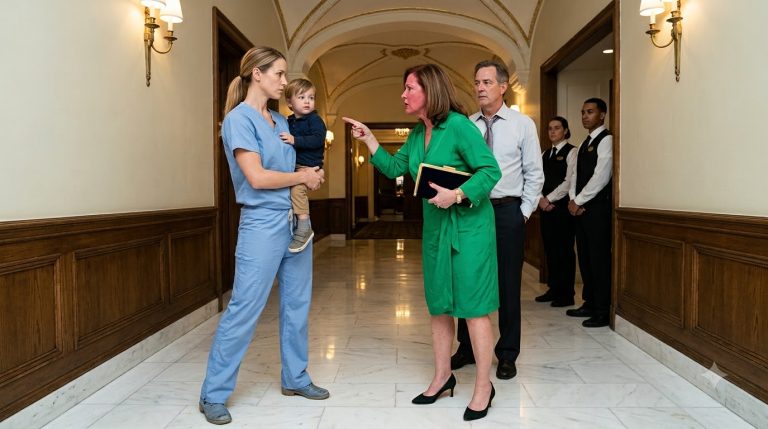
The Iron Inheritance: How a Quiet Daughter Reclaimed Her Family Home Through Cold Facts and Unyielding Patience
CHAPTER 1: THE CHILDRENS TABLE
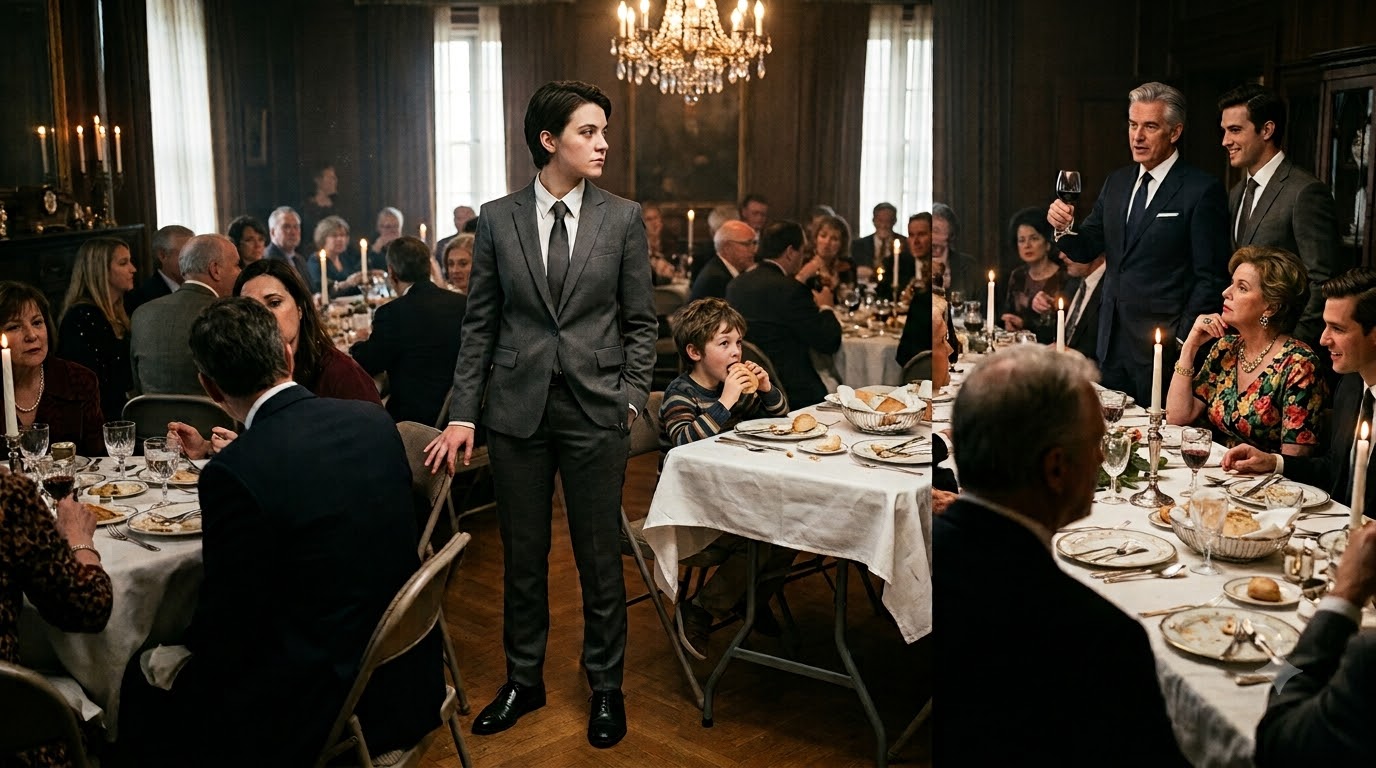
The folding table wobbled every time second-cousin Oliver kicked his sneakers against the metal leg.
Up at the main table, the crystal chandelier caught the polished surface of the sterling silver flatware my grandmother had polished by hand every autumn before her hands gave out.
My father cleared his throat, a sharp, authoritative sound he had practiced through decades of presiding over courtrooms.
“We’ve lost Mom this year,” Richard said, his voice carrying effortlessly across the crowded dining room, “but the Brennan family endures.”
He raised his glass of Pinot Noir, the dark liquid catching the candlelight.
“And I’m proudest of all of my son, Garrett, who just won the biggest case of his career.”
Applause rippled through the thirty assembled relatives.
Garrett accepted the praise with a practiced, modest nod, resting his hand casually on his wife Meredith’s shoulder.
From my seat between the folding table’s metal braces and the wall, I kept my hands flat in my lap.
My sweater was second-hand, slightly pilled at the elbows, bought for twelve dollars off a rack on Alberta Street.
Aunt Margaret leaned over from the adjacent table, her voice cutting through the clatter of silverware.
“What about Tori? Any good news, sweetheart?”
Before I could open my mouth, my father leaned back, his Cartier tank watch flashing in the light.
“Tori is still finding her way,” he said, not bothering to look down the room at me. “She’s creative. We’ll give her that.”
A ripple of polite, knowing chuckles rolled across the room.
“But every family needs someone to remind the rest of us not to take a wrong turn,” Richard added, raising his glass higher. “Right, Tori?”
Nine-year-old Oliver looked up from his bread roll, his eyes wide with confusion.
“Are you okay?” he whispered.
I smoothed the napkin across my knees, my spine straight against the wooden chair, and offered the boy a small, steady nod.
“I’m fine, Oliver,” I whispered back.
My father was already moving on, resuming his speech about legacy and tradition as if nothing had happened.
The air in the room was thick with roasted turkey and heavy perfume, but underneath it, I could feel the dry, familiar dust of an old trap closing.
They thought I was harmless because I stayed quiet.
They thought my silence meant I had nowhere else to go.
My fingers brushed against the small brass key in my coat pocket, cold and sharp against my palm.
The dinner plates were cleared away by my mother, who kept her head down and avoided my gaze entirely.
I sat quietly through the pumpkin pie and the pouring of the port wine, watching my father’s shoulders relax into the unearned certainty of a man who believed he owned the world.
He had no idea what was waiting under my mattress upstairs.
CHAPTER 2: THE EMPTY DRAWER
The twin bed sagged slightly in the middle, exactly where it had sagged since I was ten years old.
I knelt on the worn carpet and pulled the nightstand drawer all the way out, letting it rest on my knees.
The interior smelled faintly of cedar shavings and old dust, untouched by anyone since I had packed my clothes for Portland three years ago.
My fingers traced the back corner of the wooden track until they found a thin strip of tape holding a thick, cream-colored envelope against the underside.
I peeled it loose, the dry adhesive making a soft, tearing sound like parchment snapping in the cold.
The envelope bore my name written in my grandmother’s deliberate, heavy-handed cursive, the blue ink pressed deep enough to leave ridges on the reverse side.
I slipped the flap open and pulled out a two-page letter alongside a six-page partial transcript marked with a pale, translucent watermark.
The watermark caught the amber light of the bedside lamp—a faint, interlocking crest of the Oregon state seal that matched the papers Harold Caldwell kept locked in his downtown office.
“Don’t show this to your father,” Grandma Eleanor’s handwriting warned, the ink shaking slightly on the second page. “Men like Richard only understand force when it is printed on court paper.”
Downstairs, a burst of laughter echoed up through the floorboards, followed by Garrett’s sharp, confident voice discussing probate timelines.
I folded the papers back into the envelope, tucked it deep inside the canvas tote bag beside my drafting pencils, and stood up from the floor.
The closet door hung open halfway, revealing empty hangers and a single wire rack catching the shadows of the November twilight.
I walked to the window and pressed my palms against the cold glass, looking out over the overgrown peony beds in the backyard.
No one had touched the soil out there since the autumn before she died, leaving the garden to turn gray and stiff under the gray Portland sky.
My phone buzzed against my leg with a forwarded email notification from Garrett’s hidden chain, sitting quietly in my inbox like an unexploded fuse.
I didn’t open it yet; I simply watched the rain begin to trace crooked, silver lines down the windowpane.
The trap was set downstairs, but the foundation they were standing on was entirely hollow.
I zipped my coat, picked up my bag, and walked softly down the hallway toward the stairs to face whatever my father had planned for the morning.
CHAPTER 3: THE COLD OFFICE
The brass lettering read Harold Caldwell, Attorney at Law, its polished surface dulled by a thin film of downtown Portland mist.
I pushed the door open without knocking, the small brass bell overhead chiming with a dry, sharp note that cut through the silence of the room.
The solo practice smelled of aged leather, cold printer toner, and decades of legal briefs stacked high against the baseboards.
Harold Caldwell sat behind his walnut desk, wearing his wire-rimmed glasses with gold frames, methodically turning a heavy paperclip between his thumb and forefinger.
“You found it,” the old attorney said quietly, not looking up from the stack of documents spread before him.
“I found the envelope,” I replied, pulling the canvas tote from my shoulder and setting it squarely on the corner of his desk. “And I read the partial transcript.”
Caldwell stopped turning the paperclip, laying it flat against the blotter before sliding a thick, cream-colored portfolio across the polished wood.
“Your grandmother anticipated every single move your father would make,” Caldwell said, his voice dropping into a measured cadence. “She established this irrevocable instrument eight years ago specifically to protect the corpus from arbitrary modification.”
I opened the portfolio, my eyes scanning the notary’s red seal stamped firmly at the bottom of the page.
The figures were right there in black and white: six hundred and twenty thousand dollars in an educational trust managed by US Bank, alongside an asset description neither Garrett nor my father had ever bothered to verify.
“He thinks he controls the estate by default,” I said, my voice steady as I tapped a finger against the document margin.
“He has never bothered to read past the first three pages of anything because he assumes his title as trustee makes him untouchable,” Caldwell answered, leaning back in his leather chair with a faint, dry click of the springs. “But an irrevocable trust requires explicit legal consent or proven mental incapacity to alter—and Dr. Margolus’s cognitive evaluation from the exact week of signing completely shuts down his defense.”
I closed the portfolio, the heavy paper sliding together with a crisp, final slap.
“He filed a petition to swap the beneficiary to Garrett three weeks ago,” I said, reciting the metadata from the forwarded email chain I had pulled up on my phone.
Caldwell’s silver eyebrows drew together, a sharp crease forming above the bridge of his wire-rimmed glasses.
“Without your written waiver, that filing is a deliberate breach of fiduciary duty,” the lawyer said, his knuckles whitening slightly against the armrest. “If you intend to contest this, you must carry the burden of proof yourself into that house.”
The absence of a broader legal cavalry hung heavily in the small room, reminding me that I stood entirely on my own against my father’s institutional weight.
I didn’t flinch; I simply reached out and zipped the canvas bag closed over the copies of the trust.
“I’ll carry it,” I said.
Caldwell studied my face for a long, silent moment before giving a single, slow nod of absolute recognition.
“Then bring the copies back to the table when he calls you out,” the old lawyer said, sliding the master file back into his desk drawer. “Because when the mask cracks, you need to be standing right where he expects you to fold.”
CHAPTER 4: THE BROKEN PORT GLASS
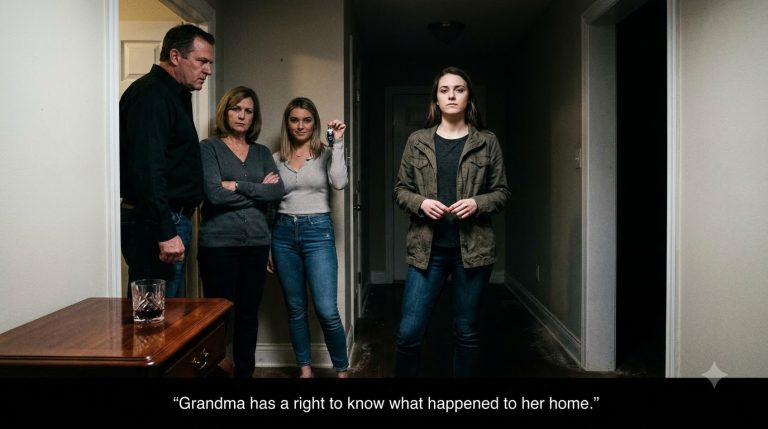
“Tomorrow morning,” Richard announced, his fingers tapping a rhythmic, impatient tattoo against the polished edge of the main dining table, “I will make the final estate distribution official.”
Around the room, thirty relatives nodded in quiet agreement, their expressions locked in comfortable deference to his authority.
My brother Garrett smiled into his wine glass, his shoulder brushing against Meredith’s silk sleeve in a silent celebration of an uncontested victory.
“Tori is still finding her way,” my father added, his voice dripping with condescending pity as he glanced down toward the metal folding table. “She can have five thousand dollars for a fresh start. It’s what she’s suited for.”
A ripple of polite, stifled laughter drifted across the room, washing over my spine like cold water.
I didn’t blink; my fingers slid quietly into the pocket of my coat hanging over the chair back, pressing hard against the cold, smooth metal of the brass key.
“Do you have anything to say to your brother for your attitude yesterday?” Richard demanded, pointing a rigid finger straight at my face. “You are grounded until you apologize.”
The laughter swelled louder this time, thirty adults amused by the spectacle of a patriarch putting his adult daughter back in her place.
I stood up slowly, the legs of the metal chair scraping against the floorboards with a sharp, metallic shriek that instantly killed the room’s amusement.
“I am not apologizing, Dad,” I said, my voice cutting through the heavy air with absolute, unyielding calm. “And you don’t own this house to distribute anything.”
Richard’s face flushed a deep, mottled crimson, his jaw locking so tight the muscle twitched beneath his skin.
“You are grounded,” he roared, slamming his palm down on the table so hard the silverware rattled against the porcelain. “Go to your room like a child!”
“I’m done going to my room,” I replied, my eyes locked onto his panic-stricken gaze. “And you’re about to find out whose name is actually on the deed.”
CHAPTER 5: THE LEDGER FALLS
Thirty pairs of eyes tracked the movement of the cream-colored pages as they stopped right beside my father’s plate.
Richard stared down at the documents, his face draining from a mottled crimson to a sharp, brittle white.
“What is this nonsense?” my father snapped, his voice cracking slightly on the edge of panic as he pushed the folder away. “You’re trespassing on a private family gathering with forged rubbish.”
“It’s not a forgery, Richard,” Aunt Margaret said, standing up from her chair with the quiet, devastating poise of someone who had watched him lie for thirty years. “Look at the notary seal. That’s the state of Oregon stamp.”
Garrett dropped his wine glass onto the table, the stem snapping against the wood and sending dark red liquid spilling across the linen.
“Dad didn’t mean it that way,” my brother stammered, his legal composure evaporating into raw desperation. “We can settle this outside the court.”
“There is nothing to settle,” I replied, my voice cold and even in the heavy silence of the room. “The trust is irrevocable, and the Hawthorne Street deed has been in my grandmother’s name since 1981.”
My father’s hands shook as he gripped the edge of the dining table, his knuckles turning absolute bone-white under the crystal chandelier.
“She was old,” Richard shouted, his judicial authority shattering completely into a child’s tantrum. “She didn’t know what she was signing! You manipulated her!”
“Dr. Margolus signed off on her cognitive evaluation the exact week she executed the trust,” I said, placing the bank confirmation letter right on top of his scattered silverware. “You filed a fraudulent petition because you thought I was too quiet to fight back.”
Great Aunt Judith nodded slowly from the corner of the room, her silver bracelets clinking softly in the quiet air.
“Eleanor told me what you’d try to do, Richard,” Judith said, her voice cutting through the space like a knife. “And she made sure you couldn’t.”
The remaining relatives shifted in their seats, their gazes sliding away from my father with visible disgust and settling on me with a quiet, terrified respect.
Richard looked around the room, desperately seeking an ally, but found only thirty closed doors and folded hands.
“Get out,” my father whispered, his voice cracking entirely as he pointed a trembling finger toward the front door. “Get out of my house.”
“It’s not your house, Dad,” I said, turning the brass key over in my pocket one last time. “It never was.”
CHAPTER 6: THE UNLOCKED DOOR
The foyer smelled of old cedar, wood polish, and the faint, sweet trace of lavender sachets my grandmother used to keep tucked behind the hallway books.
Without my father’s booming presence dominating every corner, the high-ceilinged rooms felt larger, lighter, and completely still.
I walked slowly into the study, pulling down the heavy legal volumes from the mahogany shelves to replace them with soil test kits and seed catalogs.
My phone rested silently on the desk, untouched by panicked text messages or condescending demands since Garrett sent his final, two-word acknowledgment weeks ago.
Outside the back window, the overgrown peony beds lay dark and damp under the pale morning sun, waiting for the spring thaw to break the frozen dirt.
I opened the back door and stepped out onto the wooden porch, the crisp November air biting sharply against my cheeks.
Kneeling down by the edge of the empty flower beds, I pressed my bare palms flat against the cold, rich soil of my grandmother’s garden.
The student loans were paid in full, the title was securely updated, and the unearned authority that had weighed me down for twenty-nine years had finally dissolved into thin air.
I scooped a handful of loose earth, feeling its heavy, reassuring weight before letting it filter slowly back through my fingers.
The door behind me stood wide open, and for the first time in my life, I didn’t need anyone’s permission to walk through it.