The Echo of the Steel: A Master’s Final Lesson on Beauty, Resilience, and the Weight of Time
CHAPTER 1: The Weight of Silence
The air inside the shop smelled of modern gun oil and stale air conditioning, a scent that felt hollow compared to the rich, earthy musk of the barn workshop Walter had left behind. He stood at the edge of the counter, the weight of the blanket-wrapped rifle pulling at his shoulder, his knuckles white against the rough wool.
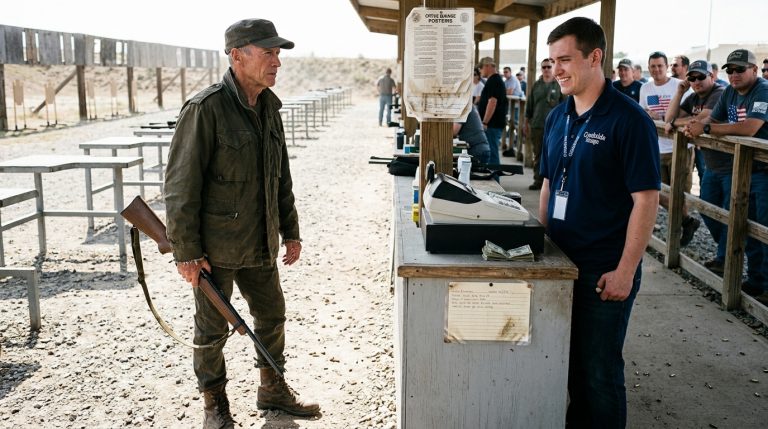
“I’m serious,” the kid—Tyler, his father’s shop namesake—said, his voice thin, barely rising above the hum of the overhead fluorescents. He didn’t even look up as he spoke. “That thing is a paperweight, old man. You’d be wasting your money and my time. Restoration like that? It’s way above your pay grade, Gramps.”
Walter didn’t blink. He felt the cold shock of the insult, but it wasn’t a flare of hot rage. It was a cold, steady clarity. He looked at the kid’s hands—clean, soft, devoid of the deep-set stains of real labor—and saw the fragility of a generation that had forgotten how to look beneath the surface. He felt the phantom ache of the 1903 Springfield resting in his arms, the metal humming against his chest like a heartbeat that refused to stop.
The shop was a landscape of tactical rifles—black plastic, synthetic stocks, modular attachments that could be swapped like children’s blocks. There was no soul here. No history. Just efficiency.
“It’s not just metal,” Walter said, his voice surprisingly steady, though it lacked the practiced, booming authority of his younger years. “It’s a 1903. It served in France. It’s held up by the grit of better men than us.”
Tyler finally looked up, his eyes skimming the blanket as if it were a bag of wet trash. His smirk was reflexive, a defensive mechanism honed by years of telling customers their dreams were too expensive to maintain. “France, huh? So, it’s a relic. Relics don’t fire, and they don’t pay the rent. Throw it in the trash, do yourself a favor, and go buy something that actually works.”
Walter stared at him, noticing the way Tyler’s gaze flickered to the clock on the wall—the impatient, twitchy motion of someone who saw time as a debt to be paid rather than a canvas to be filled. The air in the shop felt suddenly thin, suffocating.
Walter reached out and pulled the blanket back, revealing the charred, oxidized ruin of the receiver. It was a mass of orange decay, yes, but to his eyes, it was a map. He saw the potential for salvation in the way the rust had settled, the way the metal beneath hadn’t pitted as deeply as the untrained eye would assume.
“You’re missing the point,” Walter whispered, his voice barely audible over the hum of the refrigeration unit. He looked down at the rifle, and for a fleeting second, he caught the faint, lingering scent of linseed oil on his own calloused palms—a ghost of his own life’s work.
He didn’t argue. He didn’t beg for the kid’s expertise. He simply tightened his grip on the blanket, a sharp, metallic realization dawning on him: the kid wasn’t just dismissing the rifle; he was dismissing the very existence of a man who had built weapons that had shaped the century.
Walter turned to leave, his boots heavy on the polished linoleum, but as he reached the door, he caught his reflection in the glass. He looked small. Frail. Obsolete. And yet, the weight of the rifle in his arms felt like an anchor, grounding him in a truth that this sterile shop could never understand. He stepped out into the bright, biting October air, already beginning to calculate the temperature he would need for the electrolysis tank back in the barn. He didn’t need the kid. He realized, with a sudden, painful clarity, that he was the only one left who even remembered how to begin.
CHAPTER 2: The Ground Beneath
The twelve-mile drive back to the farmhouse felt longer than any journey Walter had taken in years. The heater in his truck rattled, a rhythmic, metallic clicking that mirrored the tension still coiled in his gut. Every time he glanced at the passenger seat, the sight of the blanketed rifle—a shapeless lump of potential—sent a fresh jolt of purpose through his chest. The young man’s words—throw it in the trash—echoed in the cabin, but they no longer felt like a blow. They felt like a boundary line. Beyond that line, there was only the work.
He pulled the truck into the gravel drive, the tires crunching with a sound that seemed abnormally loud in the mid-morning quiet. The farmhouse sat nestled against the edge of his property, its white paint peeling in long, curling strips that resembled dead bark. It was a structure built for endurance, much like the man who inhabited it. Walter stepped out, the crisp Virginia air hitting him with an immediate, bracing chill that he welcomed. It was a physical reality he could manage, unlike the dismissive arrogance he had just endured.
He didn’t go inside. He didn’t head for the coffee waiting on the stove. He walked straight to the vegetable garden, his gait slow but purposeful, his boots sinking slightly into the soft, rain-dampened earth.
He stood at the edge of the patch he had been expanding—the site of the find. The soil here was a deep, rich brown, scarred by the trenches he had dug just yesterday. He looked down at the hole, the place where the earth had yielded its secret.
The shovel was still where he had left it, blade-down, reflecting the weak, filtered sunlight. He picked it up, the handle cold and smooth against his palms. He hadn’t planned on continuing the expansion today, but the thought of the gun shop, the sterile, empty space of it, made him crave the dirt. He needed to be doing something that required sweat, something where the effort yielded a tangible result.
He drove the spade into the ground, but the earth was stubborn today. A thick, gnarled root from an old oak tree, hidden beneath the surface, caught the edge of his shovel, jarring his wrists and sending a ripple of dull pain up his forearms. He grunted, leaning his weight into the handle, muscles long accustomed to the finer, microscopic tolerances of a lathe now forced to deal with the raw, chaotic resistance of the land.
He dug, the rhythm steady. Therefore. The shop had rejected the history he held in his hands. But. The land, perhaps in some ancient, silent empathy, had yielded it up precisely when he was at his most adrift.
As he cleared the soil away from the root, he noticed something. The ground here wasn’t just dirt; it was packed with layers of history—bits of rusted iron, flecks of coal, the remnants of a life he had only partially occupied. He wiped his brow with the back of a calloused hand, smearing a streak of dark loam across his skin. He stood there for a moment, chest heaving, the silence of the farm settling around him like a heavy, protective blanket.
He wasn’t just a retired man gardening in the autumn of his life. He was a keeper of forgotten things. And as he looked back toward the barn, the silhouette of the converted workshop standing against the gray, overcast sky, he knew he wasn’t just fixing a rifle. He was bracing his own foundation. The work ahead would be demanding, potentially even foolish for a man of his years, but as he felt the cool, damp earth beneath his feet, the hesitation he had felt earlier that morning evaporated.
He dropped the shovel, the clang echoing against the barn doors. The rifle needed him. More importantly, he realized, he needed the rifle. It was the only thing that spoke his language—a language of steel, precision, and the stubborn refusal to surrender to the slow decay of time.
He grabbed the blanket-wrapped bundle from the truck bed. His hands, usually so prone to a slight, age-induced tremor, were remarkably still. He walked toward the barn, the wind whipping at his coat, carrying the scent of damp leaves and the faint, metallic tang of the coming winter. He pushed the heavy wooden doors open, the hinges protesting with a long, slow groan, and stepped into the dim, dusty sanctuary where everything he had ever been was waiting in the shadows.
CHAPTER 3: The Workshop Resurrection
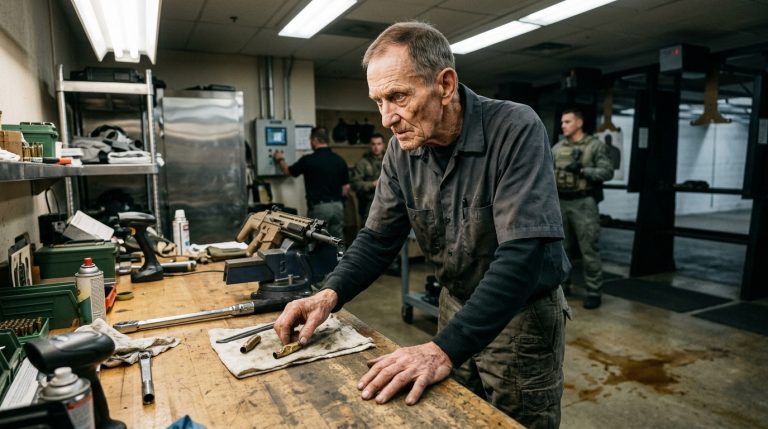
The interior of the barn felt like a lung that had been holding its breath for fifteen years. As Walter stepped inside, the air, thick with the scent of dormant dust and stale linseed oil, seemed to rush forward to greet him. He didn’t turn on the main overhead lights immediately. Instead, he let his eyes adjust to the soft, slate-gray light filtering through the high, grime-streaked windows. It was a texture he knew intimately—the quiet, muted atmosphere of a space that existed outside the frantic pace of the modern world.
He moved toward his primary workbench, his boots finding the familiar worn grooves in the floorboards. The rifle remained heavy in his arms, the rough wool blanket catching on a splinter of the workbench’s edge. He set it down with practiced care.
The silence here was not empty. It was filled with the ghosts of a thousand hours spent hunched over steel. As he began to unwrap the shroud, the first thing that hit him wasn’t the sight of the rifle, but the cold, biting reality of the rust. It was a physical corruption, a crust of iron oxide that felt, under his thumb, like the abrasive skin of some ancient, dying reptile.
He reached for the switch, and a single, focused task light hummed to life. The yellow glow illuminated the workbench, turning the rust into a landscape of jagged orange peaks and deep, dark valleys. Walter didn’t rush. He pulled a stool toward the bench and sat, his lower back popping in a way that reminded him of his age. He took a deep, steadying breath, letting the scent of the workshop—the faint, metallic sting of mineral spirits and wood shavings—fill his senses.
He began the identification process. He needed to be certain of what he was holding before the chemical bath could do its work. He took a magnifying glass, the lens cool and heavy, and held it over the receiver. The metal was pitted, yes, but as he moved the light, he saw the lines of the machining. They were clean, deliberate. This wasn’t a mass-produced, sloppy piece of work; it was a Springfield. It had been born from precision.
As he worked, a memory flared—unbidden, like a spark in the dark. He saw Dorothy, five years gone, standing in the doorway of this very workshop, holding a cup of tea, watching him with that patient, knowing smile. “You love these machines more than you love your own comfort, Walter,” she had teased. The memory was so vivid he could almost hear the rustle of her apron. He blinked, the phantom image dissolving into the reality of the cold, rusted steel. The intrusion of her memory was like a ghost passing through the room, leaving behind a profound, aching stillness.
He pushed the thought aside, not because he wanted to forget, but because he needed the focus. He started the disassembly. The screws were frozen, seized by the oxidation, but he didn’t use force. He used patience. A drop of penetrating oil, the slow, methodical application of pressure, the patience of a man who understood that if you rush, you break what you are trying to save.
One by one, the components came free. The floor plate assembly, the trigger guard, the bolt—each piece emerging from the decay like a survivor from a wreck. When he finally separated the receiver from the rotted remnants of the wood stock, the wood crumbled into gray, fibrous dust, leaving a pile of debris that seemed pathetic compared to the sturdy, stubborn metal underneath.
He stood up and walked to the corner, where his old electrolysis tank sat under a heavy, dust-covered tarp. He pulled the cover back. The plastic container was intact, though yellowed by time. He spent the next hour cleaning the copper electrodes, scrubbing away the layers of film, his movements growing more fluid, more sure. The tremor in his hands, which had bothered him earlier, had vanished entirely. It was as if, when confronted with the machinery of his life, his body remembered its job.
He mixed the water and washing soda, his motions precise, measuring the proportions by eye and memory rather than a scale. When he finally lowered the receiver into the solution, the water clouded, then began to bubble as he flipped the switch on the DC power supply. A faint, low-frequency hum emanated from the tank—a sound that, to anyone else, would have been nothing more than electrical static, but to Walter, it was the sound of the past beginning to wake up.
He leaned back against the workbench, watching the tiny, amber-colored bubbles rise to the surface. The restoration had officially begun. He was no longer just an old man in an empty farmhouse; he was a master at his bench, and for the first time since Dorothy had passed, the silence of the farm didn’t feel like an absence. It felt like an opportunity. He watched the water, his eyes tracking the slow, chemical undoing of a century’s neglect, and wondered if he, too, was undergoing a similar sort of transformation.
He didn’t know the answer. But as the hum of the tank filled the room, he knew one thing for certain: he wouldn’t be walking away from this. Not until the steel was clean, and not until the ghost of the past was finally, properly, put to rest.
CHAPTER 4: The Shaping of the Ghost
The American black walnut blank lay on the workbench, catching the morning light in a way that made the grain seem to ripple like water. It was a beautiful piece of timber, dark and heavy, aged for over two decades in the rafters of this very barn. Walter had been saving it for his own funeral piece—a stock for a rifle he’d planned to build for himself, a final, perfect testament to a career of quiet excellence.
Now, he placed the rusted receiver, stripped clean by the electrolysis, atop the wood. The disparity between the two was painful. The metal was a skeleton, a survivor of a century of neglect, while the wood was a vessel waiting to be carved.
He picked up a chisel, the edge honed to a terrifying, razor-like sharpness. This was the moment where the “decoy” of his task began to reveal its deeper truth. He wasn’t just building a stock for a piece of historical ordnance. He was carving away the parts of himself that were tired, the parts that had accepted the label of ‘obsolete’ that the boy in town had slapped on him. Each shaving of walnut that curled onto the floor was a shedding of that doubt.
But as he began the inletting—the process of carving the interior channel to seat the metal—he hit a snag. The 1903’s receiver had been stressed, perhaps from the decades buried in the acidic clay, or perhaps from some unseen violent force in its distant, forgotten history. The bedding was uneven. If he forced the steel to seat, the wood would split under the tension of a live cartridge.
He paused, the chisel held motionless in his hand. The weight of the decision pressed down on him. If he followed the standard manual, he would have to shim the fit with modern synthetic fillers. It would be easy. It would be ‘correct’ by modern gunsmithing standards. But it would be a lie. It would turn a piece of history into a hybrid, a mongrel of old and new.
His heart hammered against his ribs. The struggle wasn’t just with the wood anymore. It was a confrontation with the very philosophy the gunsmith in Lexington stood for. Why bother? the boy’s voice mocked from the back of his mind. It’s just a piece of scrap.
“No,” Walter whispered, the word sharp in the silent barn. “It’s a record.”
He put the power tools away. He reached for the rasps and the scrapers, the traditional implements that required a steady, rhythmic pressure that his hands had not been forced to maintain in years. He began to work by feel. He scraped, then tested. Scraped, then tested. He was losing the daylight, the shadows in the barn stretching long and thin, but he couldn’t stop. His eyes burned, and his back ached with a deep, grinding fatigue that seemed to settle into his very marrow, but he stayed at the bench.
He saw the discrepancy then—a microscopic misalignment in the trigger guard mortise that most would have missed. It was a subtle, almost invisible error in the metal’s geometry, a ghost of its past life. To fix it, he would have to sacrifice even more of the wood, pushing the stock’s dimensions to their absolute limit. He was risking the integrity of the entire blank. One slip, one twitch of his aging hands, and the grain would shear, and the stock—and his final, quiet project—would be ruined.
He thought of the boy, Tyler. He thought of the way the boy had looked at his phone, the way he looked at the world: a series of transactions, a series of quick fixes.
Walter set the rasp down and closed his eyes. He stopped trying to force the wood to comply with his measurements and instead listened to the way the metal sat against the walnut. He felt the vibration of the fit. It was a dialogue between the iron of 1918 and the timber of his own sanctuary. He opened his eyes and took the chisel back up.
He didn’t work like a man trying to finish a job. He worked like a man trying to remember his name. When the final layer of wood peeled away, the receiver dropped into the mortise with a sound that wasn’t a click, but a deep, resonant thud—the sound of two long-lost things finally finding their home. He sat back, his breathing ragged, the workshop suddenly very cold. He had saved the stock, but he had also, in that act of precision, crossed a threshold. There was no going back to the quiet, dusty obscurity he had cultivated for five years. He was committed now. He was back in the fray, even if the only witness to his struggle was the peeling paint of his own barn walls.
CHAPTER 5: The Alignment of Truth
The barn was silent, save for the rhythmic, metallic ticking of the cooling electrolysis tank in the corner. Walter stood over the workbench, his breath coming in shallow, measured hitches. The rifle lay before him, assembled. It was no longer a corroded, forgotten relic; it was a weapon again. The deep, rich blue of the metal contrasted against the oil-rubbed walnut with a stark, brutal elegance. He ran a fingertip along the barrel, feeling the cold, smooth reality of the bluing. It was perfect.
But as he looked closer, he saw it—the mark.
In the process of mating the receiver to the stock, he had noticed a slight, jagged scratch on the underside of the receiver, nearly invisible, buried right where the steel met the wood. It wasn’t rust. It was a gouge, deep and deliberate. Someone, a long time ago, had used a tool to pry this rifle apart, perhaps in the frantic, desperate moments of a battlefield repair. It was a fingerprint of history.
His heart skipped a beat. For days, he had viewed this project as his own redemption, a way to prove his own hands still possessed the necessary grace. But now, seeing that mark, he felt a strange, chilling shift in the dynamic. He wasn’t just restoring a machine. He was uncovering a life. That scratch was the soldier’s struggle, a moment of fear or frustration caught in the steel.
He didn’t have time to dwell on it. He needed to get to town. He needed to show the boy.
He carefully wrapped the rifle in the wool blanket, his movements tight, controlled. He felt a strange, cold clarity—the same feeling he’d had in the classified workshops of his youth. He didn’t care about the money, or even the validation anymore. He just needed to see the look on Tyler’s face. He needed to witness the moment the arrogance of the present collided with the unyielding standard of the past.
The drive to town was a blur of gray asphalt and muted, autumnal landscapes. The truck’s suspension groaned over every pothole, each jolt rattling through his bones, but he didn’t care. He pulled into the parking lot of Precision Arms, the gravel kicking up under his tires. The shop looked even smaller, more insignificant than he remembered.
He stepped out, the rifle cradled in his arms like a child. The bell chimed as he pushed the door open, the sound once again feeling jarring, intrusive.
Tyler was there, behind the counter, hunched over his phone. He didn’t look up immediately. “Look, old man, I’m busy, I told you I don’t—”
Walter didn’t speak. He simply reached the counter, cleared a space among the stacks of tactical magazines, and laid the blanket down. He peeled it back with a single, practiced motion.
The silence that followed was absolute. It wasn’t the silence of the barn; it was the heavy, suffocating silence of a space being hollowed out.
Tyler’s phone slipped from his hand, hitting the floor with a hollow clack that sounded like a gunshot. He stared at the rifle, his mouth slightly agape, the smirk he had worn a week ago utterly obliterated. He leaned in, his hands hovering over the receiver, but he didn’t touch it. He looked like he was afraid the metal might burn him.
“This isn’t…” Tyler stammered, his voice cracking. “This isn’t possible. The level of… the bluing, the inletting… how?”
Walter stood there, his back straight, his eyes fixed on the young man. He didn’t gloat. He didn’t say a word. He just waited, watching as the veneer of the boy’s expertise cracked. Tyler wasn’t looking at a repair. He was looking at a superior reality.
“I’ve seen photos of these,” Tyler whispered, looking up at Walter with a raw, terrifying confusion. “In the manuals. In the books. But to see one in person… you didn’t just fix this. You brought it back.”
The shift in the room was palpable. The air felt thinner, cleaner. Walter watched Tyler, seeing the exact moment the boy realized the distance between what he had been taught and what he was seeing. It was a painful, necessary evolution. Walter felt a strange, cold pride—not for the rifle, but for the lesson.
He had forced the world to look, for just one moment, at something that didn’t conform to the logic of the disposable.
“It’s not just a rifle, son,” Walter said, his voice quiet, steady, carrying the weight of a half-century’s experience. “It’s a standard. And it’s not about how new your tools are. It’s about how much of yourself you’re willing to put into the steel.”
He reached out and closed the bolt. The sound—a clean, sharp, definitive click—snapped the tension in the room. It was the sound of a century of history locking into place, and in that moment, Walter knew his work here was done. The truth wasn’t in the rifle. It was in the fact that it still existed, still functioned, still demanded the same level of care that its maker had poured into it in 1918.
Tyler looked at him, his expression finally settling into something that wasn’t arrogance, but genuine, agonizing hunger. “Teach me,” he said, the words barely a breath. “Please. Teach me how to see it like that.”
Walter didn’t answer right away. He looked around the shop, at the tactical rifles and the plastic components, and then back at the Springfield. The bridge had been built. The transition was complete.
CHAPTER 6: The Legacy of the Hands
The weeks that followed the restoration were a quiet blurring of seasons. The air in Lexington had turned sharp and brittle, the leaves falling in burnt-orange heaps against the foundation of the farmhouse. Walter returned to his rhythm, but the rhythm had changed. It was no longer the slow, fading tempo of a man waiting for the end; it was the steady, measured beat of a master passing the torch.
Every Tuesday and Thursday, he drove the twelve miles to Precision Arms. The shop was no longer the sterile, hollow space it had been. Tyler had cleared the back area, creating a dedicated workspace for the “old-school” methods. Dust motes danced in the shafts of afternoon light, illuminating the smell of walnut, oil, and iron. It was a sensory echo of Walter’s own barn, yet infused with the restless energy of the young men and women Tyler had started to hire.
Walter sat on his stool, his hands folded in his lap, watching. He didn’t intervene often. He waited for the moments where the friction of the work became too much—where a student’s frustration began to outweigh their patience—and then he would step in, his voice a low, gravelly anchor in the storm.
“You’re fighting the wood,” he told one young apprentice, a girl named Sarah, who was struggling with a checkering tool. “The wood knows what it wants to be. You’re just helping it get there.” He reached out, his calloused, steady fingers guiding hers, showing her the angle, the pressure, the subtle shift in weight. He watched the way her eyes widened, the way her grip loosened, the tension in her shoulders melting away as she felt the tool bite into the grain with an effortless, clean grace.
He looked over at Tyler. The boy—no, the man—was working on the trigger group of a hunting rifle, his movements precise, almost reverent. He caught Walter’s gaze and offered a small, knowing nod. There was no arrogance in his eyes anymore, only a deep, abiding curiosity. The humiliation he had felt that first day had been replaced by a quiet, driving need to understand the ‘why’ behind the ‘how.’
The truth, Walter realized as he watched them, was never about the rifles. It had never been about the metal, or the wood, or the history embedded in a serial number. It was about the continuity of the human spirit. He saw his own life’s work reflected in their focus. The classified workshops, the Smithsonian consultations, the endless nights bent over benches—it hadn’t been to create objects that would survive; it had been to create a lineage of understanding.
His own life was reaching its inevitable conclusion, a fact he felt in the persistent ache of his joints and the growing desire for the quiet of his porch at dusk. But the knowledge? The knowledge was alive. It was moving through the shop, traveling from his weathered hands into the strong, capable hands of the generation he had once assumed were lost to the screens and the plastic.
He reached into his pocket and pulled out a small, brass micrometer—his grandfather’s. He held it for a moment, the metal warm from his palm, the texture worn smooth by nearly a century of use. He walked over to Tyler’s bench and set it down.
“It’s time,” Walter said, his voice quiet.
Tyler stopped, the piece in his hand forgotten. He looked at the tool, then at Walter, understanding blooming in his expression. “I can’t take this, Walter. This is…”
“It’s not a trophy, son,” Walter interrupted, his smile gentle. “It’s a responsibility. You don’t keep a craft by holding onto it. You keep it by giving it away.”
As he walked out of the shop that evening, the sun was dipping below the horizon, bathing the street in a soft, golden light that made everything look as if it were carved from antique amber. He walked slowly, his gait unhurried. The pain in his back felt distant, almost unimportant.
Back at the farmhouse, he sat in his worn leather chair by the window. The classical music on the radio played a soft, complex piece he’d heard a thousand times. He looked at his hands—spotted with age, calloused, scarred by the work of a lifetime—and he felt a profound sense of peace. He had done his part. He had restored the piece of history, yes, but he had restored something much more fragile and much more vital.
The house was quiet, the only sound the steady, comforting ticking of a grandfather clock in the hall. He closed his eyes, his breathing slowing, drifting into the deep, easy sleep that follows a day of honest labor. The rifle he had restored now stood in the museum, a silent witness to a century of service, but here in the quiet of his home, he knew the real work continued. It was in the shop. It was in the hands of the apprentices. It was in the air, the smell of oil and wood, the endless, beautiful struggle of the human hand to shape the world into something worthy of the time we are given.
The sun finally slipped away, leaving the room in a gentle, velvet darkness, and Walter stayed there, anchored in the truth that nothing is ever truly lost, so long as there is someone left willing to pick up the tools and learn how to see beneath the surface.