The Dusty Ledger of Elm Street: How a Common-Sense Nurse Collapsed Her Father’s House of Cards
CHAPTER 1: THE CHURCH STAGE
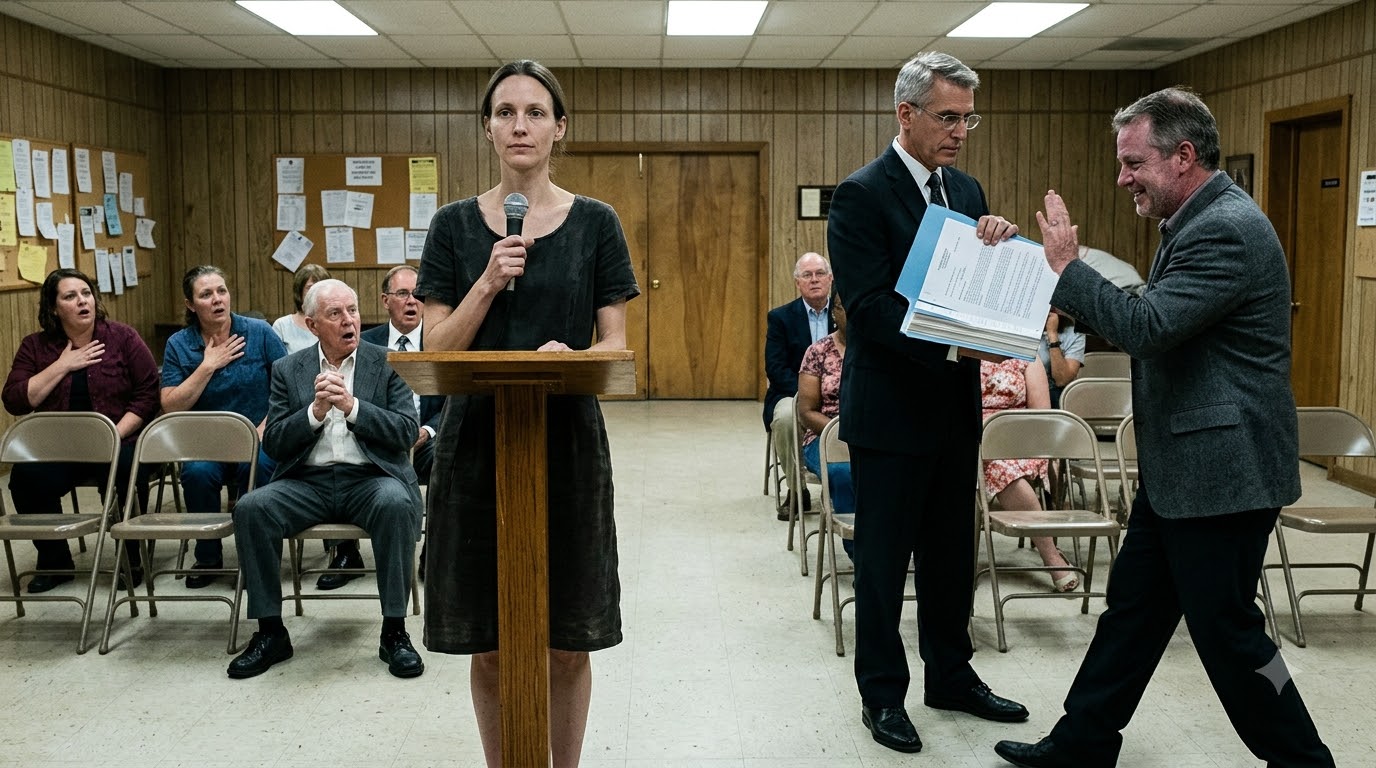
The fluorescent hum of the fellowship hall pressed against my eardrums like a dull weight.
One hundred and twenty folding chairs scraped softly against the linoleum as the congregation settled back down after the applause. My father stood beside the small podium with his hands neatly clasped, his face arranged into the practiced, gentle smile of a man who believed he owned the room.
“Wendy,” he said, handing over the microphone without a trace of hesitation.
His fingers brushed mine. They were dry and completely steady. He thought he was playing the final act of a tragedy he had scripted himself, secure in the belief that the audience would swallow his performance whole.
I wrapped my fingers around the warm black plastic.
“Thank you for your prayers,” I said, my voice cutting cleanly through the hum of the small PA speaker. “I’m truly grateful to be standing here. But I need to correct something my father just said.”
Gerald’s smile tightened by a fraction of an inch, the corners of his mouth twitching downward before he caught himself.
“My father didn’t pray by my bedside,” I continued, keeping my eyes fixed on the front row where Susan Merritt sat with her hands folded in her lap. “He was at St. Catherine’s once. The night of the accident. He didn’t come to check on my condition or ask if I was in pain. He went straight to the billing department.”
A sharp intake of breath rippled through the middle rows.
“He asked how much my second surgery would cost,” I said, letting the words drop flat and heavy into the quiet room. “And when the doctor gave him the number, he gave his exact instructions, documented in a formal hospital incident report: Let her go. We won’t pay for the surgery. She’s been a financial drain her whole life.”
Silence pressed down on the hall, dense and suffocating.
Gerald took a sharp step forward, his hand coming up to intercept the air between us. “Wendy, stop this right now. You’re confused, the medication—”
“I’m not confused, Dad,” I said, turning my head to look him squarely in the eye. “You signed a do not resuscitate order at 11:18 on a Tuesday night because you didn’t want the bill. And then you walked out and left me there to die.”
CHAPTER 2: THE GRAY SUIT
Donald Kessler did not blink.
He didn’t look at Gerald, nor did he acknowledge the collective shudder that rippled through the second row. He simply unlatched the brass clasps of his case with two dry, deliberate clicks.
“Mr. Thomas,” Kessler said, his voice level and entirely devoid of theatrical anger. “I have the original probate records from the county court dated five months ago.”
He lifted a thick sheaf of blue-backed paper, the metal staples gleaming under the harsh fluorescent tubes.
“The property at Elm Street was transferred to Wendy Marie Thomas under the direct, unconditioned will of Lillian Price. No secondary executors. No contingencies.”
Gerald’s face drained of its practiced color, the ruddy warmth fading into something gray and mottled.
“She wasn’t of sound mind,” Gerald snapped, his voice cracking upward before he could rein it in. “The medication—she didn’t know what she was signing.”
“Lillian Price was examined by three separate physicians in her final year,” Kessler replied, sliding a certified medical affidavit onto the table without missing a beat. “All of them confirmed absolute cognitive clarity. Furthermore, the deed transfer you filed three weeks ago relies entirely on a power of attorney bearing Wendy’s signature.”
Kessler looked up, his silver-rimmed glasses catching the light.
“A signature, I might add, that was executed while my client was unconscious on a ventilator following a traumatic vehicular collision.”
A heavy murmur broke out near the coffee station.
Robert Dill, the senior deacon who had stood beside my father for a decade, shifted his weight from one foot to the other. He didn’t look at Gerald. He looked down at his own shoes, his jaw working slowly.
“That’s a fabrication,” Gerald rasped, his left hand twitching sharply against his thigh as he tried to jam it into his trouser pocket. “We’re a family. We handle our own affairs.”
“You handled an estate that didn’t belong to you,” Kessler said quietly, closing the briefcase with a dull thud. “And you secured a two-hundred-and-eighty-thousand-dollar mortgage against a title you did not legally hold.”
CHAPTER 3: THE COLD KITCHEN
The notification banner was plain, block-lettered text against a dark background. Mortgage lien verification pending: account frozen by institutional compliance.
I set the phone face down on the laminate surface.
Across the small room, Deborah stood by the sink, rinsing a ceramic coffee mug with slow, deliberate rotations of her thumb. She hadn’t asked about the church confrontation, and she hadn’t asked about Kessler’s files spread across the kitchen table.
“You’re shaking,” she said, her voice barely louder than the running tap.
“It’s just the ribs,” I replied, keeping my hands flat on either side of the device. “The cold gets into the seams.”
It wasn’t the ribs. It was the absolute, quiet weight of a machine finally grinding to a halt after twenty-nine years of constant friction.
Gerald’s voice from the phone calls of the past week echoed faintly in my memory, not with anger, but with the hollow panic of a man realizing his ledger had run out of blank pages. He had spent a lifetime treating me like a line item on an unwanted balance sheet, only to discover that the math had finally turned against him.
Deborah turned off the faucet, the sudden silence ringing in the small apartment.
“The lender’s fraud investigator called my desk while you were out,” she said, drying her hands on a linen towel. “They want the hospital’s incident report on file by noon tomorrow.”
“Send it,” I said.
CHAPTER 4: THE CLOSING CIRCLE
Donald Kessler stood by the public directory pillar, holding a certified copy of the county judge’s emergency injunction.
“The title is officially restored to your name,” Kessler said, handing over the crisp paper without fanfare. “The mortgage lender has formally suspended disbursement, and Carl the notary is cooperating with the prosecutor’s office.”
I folded the document twice and slid it into my canvas bag.
Across the county seat, the local plumbing supply yard was already fielding cancellations from church members who had seen Gerald’s deacon status revoked by unanimous vote. Jim Callahan didn’t even wait for a phone call; he simply texted a photo of a disconnected pipe wrench with a short, blunt sentence.
“Don’t show up here again, Gerald,” was printed beneath the image.
My father was no longer a pillar of the community or a trusted deacon. He was a man locked outside his own perimeter, staring down a mounting pile of unpayable debt and a criminal investigation he couldn’t charm his way out of.
My phone vibrated in my pocket against my thigh, a persistent hum that had no intention of stopping.
It was Meredith.
“Let it ring,” Kessler advised quietly, adjusting his briefcase strap over his shoulder. “Some conversations don’t improve with speed.”
CHAPTER 5: THE UNLOCKED DOOR
I pressed the accept button and laid the device flat on the surface without lifting it to my ear.
“I know you’re there,” Meredith’s voice came through the small speaker, thin and cracked with exhaustion. “Dad is packing his bags. He’s moving into Uncle Ray’s spare room in Allentown.”
“That’s a private matter,” I said, keeping my tone completely neutral.
“He tried to blame the bank. He tried to blame the notary,” she continued, her breathing hitching in the quiet room. “He still doesn’t think he did anything wrong. He told me the mortgage was just business.”
“He signed a paper to let me die in a hospital bed over a billing estimate,” I replied, the words dropping like cold lead onto the wood. “Business doesn’t cover that.”
A heavy sob broke through her side of the line, messy and uncontrolled.
“I was in the waiting room when he went to talk to Dr. Hale,” she whispered, the confession finally tearing loose after weeks of silence. “He told me what he was going to do. And I stayed quiet because he promised me eighty-five thousand dollars from the estate.”
“I know,” I said.
“I’m not asking for forgiveness,” she choked out. “I just wanted you to know I finally opened the letter Grandma Lillian left me.”
“What did it say?”
“She wrote that I was too much like him, and that I needed to choose differently.” A pause stretched between us, filled only by the hum of the refrigerator. “I didn’t choose differently when it mattered. And now there’s nothing left to save.”
CHAPTER 6: THE PORCH SWING
The scent hit me before I even pushed the wooden threshold wide.
Lavender.
It drifted softly from the small silk sachets my grandmother had tucked into the seams of the hallway drawers, smelling exactly as it had every Saturday I spent sitting beside her on the worn porch swing.
There were no hospital monitors beeping in the corner, and there were no stack of fraudulent medical bills waiting on the kitchen counter.
The title deed was resting safely in a filing cabinet upstairs, cleared of every lien, every forged signature, and every shadow my father had cast over my life.
I walked into the living room and set my canvas bag down on the edge of the coffee table.
My photograph with Lillian still sat on the mantelpiece, two figures squinting into the bright sun, caught forever in a moment that required no performance and no justification.
I lowered myself into her old rocking chair, letting the wood creak once under my weight as I stretched my sore ribs and breathed out a long, slow sigh.
For the first time in twenty-nine years, the space around me belonged entirely to me.
Not because I had begged for approval, but because I had refused to carry a debt that was never mine to pay.