The Geometry of Patience: A Master Armorer’s Legacy in a World of Digital Noise
CHAPTER 1: The Weight of the Bench
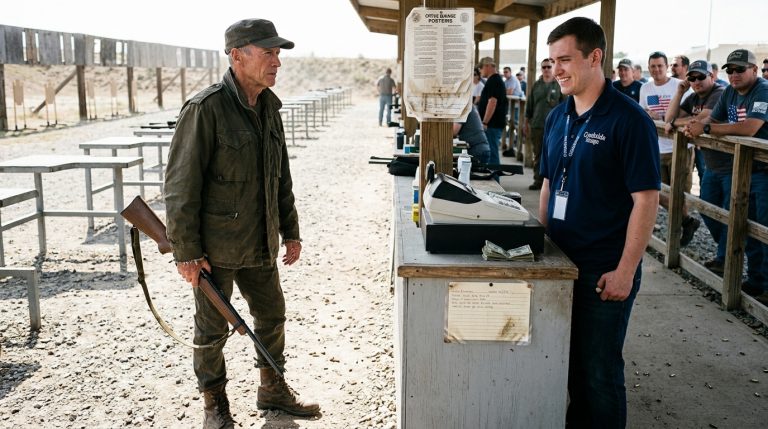
The morning air at the Greenwood Sportsman’s Club didn’t smell like pine needles or damp earth today. It smelled like wet pavement and impending erasure. Herschel sat in his usual spot, the folding chair’s canvas groaning under the shift of his weight as he eased his hip into position. His fingers, scarred and stiff, moved across the walnut stock of the Remington with the tactile intimacy of someone reading braille. He wasn’t looking at the target. He was looking at the surveyor’s stake hammered into the ground fifty yards behind the backer, a bright, jagged orange scar in the soft green of the berm.
It hadn’t been there yesterday.
He didn’t rush. He didn’t pull the bolt. He simply watched the way the morning light caught the edges of the orange plastic, turning it into a beacon of bureaucratic finality. He had spent his life teaching that if you focus on the wrong point, you miss the target entirely. The developers, he realized, were counting on the shooters focusing on their scopes and their triggers, never looking past the berm to see the ground being carved out from beneath them.
A shadow fell over his bench. It was Craig Pelletier, his face pale, his usual confidence replaced by a twitchy, rhythmic tapping of his fingers against his thigh. He wasn’t carrying a rifle. He was carrying a file folder, its edges fraying, the paper inside already damp from the humidity.
“They aren’t just selling the land, Herschel,” Craig said, his voice barely rising above the distant, melancholy groan of a truck engine on the highway. “They’re clearing the title. Everything. The clubhouse, the benches, the berm. They want it gone by the end of the quarter.”
Herschel didn’t look up from the surveyor’s stake. He kept his eyes fixed on that orange point, calculating the drift, the distance, the absolute cost of what was about to happen. “A line,” Herschel said, his voice as dry as the dust on his boots. “They’re drawing a line through a place they’ve never looked at.”
“What do we do?” Craig asked, his hand trembling as he reached for the folder.
Herschel finally turned, his pale blue eyes pinning Craig to the spot with a sharpness that had nothing to do with age. He reached into his pocket and pulled out the quarter, letting it settle into the center of his palm. The weight of it was grounding, a small, silver anchor in a world that was suddenly, violently drifting.
“We don’t need a lawyer, and we don’t need a protest,” Herschel said, his voice steadying. “We just need to show them that we can see what they’re trying to hide.” He pointed with the cane toward the backer, where the surveyors had left their marks. “They think we’re just shooting at paper. They don’t know we’re looking at the architecture of the whole valley.”
He felt the familiar thrum in his chest, the old, restless urge to repair, to calibrate, to fix the misalignment. He had spent decades trying to fix the broken world by teaching men how to see, but as he looked at Craig’s terrified face, he realized the mission had shifted. The target wasn’t a bullseye anymore. The target was the ground he was sitting on. And for the first time in his life, Herschel felt the distinct, cold prickle of an adjustment that might not be possible to make with a quarter.
CHAPTER 2: The Geometry of Intrusion
The wind picked up, a dry, autumnal gust that rattled the loose corrugated tin of the clubhouse roof. Herschel did not move. He kept his gaze fixed on the orange stake fifty yards out. In the language of a man who had spent twenty-two years as an armorer, that stake was an obstruction. It wasn’t just wood and plastic; it was a physical misalignment. It indicated that the ground beneath the range had been measured, calculated, and found to be something other than a firing line. To the developers, it was progress. To Herschel, it was a fundamental error in the math of the landscape.
Craig stood frozen beside him, the folder in his hands looking impossibly heavy. The young man’s breathing was shallow, the rhythmic, uneven cadence of someone who had just been told their sanctuary was being liquidated. Herschel reached out, his scarred hand steadying the edge of the folder, and gently took it. The paper felt brittle, the ink of the notice smudged by the humidity. It was a formal eviction of purpose.
“They think this is empty space,” Herschel said, his voice quiet, almost meditative. He began to leaf through the document. The language was sterile—zoning variances, commercial re-classification, environmental impact assessments. It was a blizzard of technical jargon designed to obscure the simple fact that they were erasing a community for a strip mall or a set of luxury condos. “They see the dirt. They don’t see the years. They don’t see the way the light hits the bench at eight in the morning or the sound of a father teaching his son how to settle a trigger.”
“The town council meeting is on Tuesday,” Craig whispered, his eyes still locked on the range. “If they approve the rezoning, the club is done. The leaseholder gave up without a fight. He’s taking the buyout and running.”
Herschel’s jaw tightened. The involuntary memory hit him—a flash of a jungle floor in 1968, the sound of a mortar tube being adjusted, the cold, clinical reality of losing a position that you had sworn to hold. It wasn’t the same, but the geometry of the loss felt identical. In both cases, the world had shifted, and the only response was to re-establish the baseline. He felt the familiar, dull ache in his hip, but he ignored it, the way he had ignored the shrapnel in his hands for nearly fifty years. He couldn’t fix the war. He couldn’t go back to Fort Jackson and change the way he had taught those first soldiers. But he could fix this.
“Tuesday,” Herschel repeated. He stood up, his cane tapping once, firmly, against the concrete. “We aren’t going to protest, Craig. Protests are just noise. They expect us to yell. They expect us to be angry, messy, and disorganized.” He looked at the firing line. The other shooters were beginning to drift in, their vehicles pulling into the gravel lot, their rifles tucked safely in cases. They were moving with the quiet, respectful grace of men who cherished their morning ritual. They were his students. They were his ledger.
“I need you to do something,” Herschel said. He leaned in, his voice dropping to a low, instructional hum. “Don’t tell them about the eviction yet. Let them shoot. Let them find their zero. When they’re done, tell them I’m holding a session in the clubhouse. A special one. Tell them it’s not about scopes today.”
“What’s it about?” Craig asked, his brow furrowing.
Herschel looked back at the orange stake. “It’s about seeing. It’s about recognizing when the environment has been compromised. If they want to save this range, they have to understand that this isn’t a hobby. It’s a point of reference. And you don’t let anyone move your reference point without a fight.”
He began the walk to the clubhouse. It was a long twenty yards. His gait was uneven, a testament to decades of walking on uneven ground, carrying the weight of heavy tool kits and heavier responsibilities. As he walked, he noticed the micro-details of the facility—the way the paint on the shooting benches was peeling in thin, curled layers like dead skin, the way the weeds were encroaching on the drainage ditch, the subtle decay that came with a place that had stopped believing in its own future.
He reached the door and pulled it open. The air inside was stale, smelling of cold coffee and old gun oil. He went to the small, grease-stained table where he usually kept his cleaning kit. He didn’t pull out the silicone cloth today. Instead, he pulled out his notebook—the one where he kept his log of every student he’d taught, every rifle he’d zeroed, every correction he’d made. He opened it to the very back, to the clean, empty pages.
He needed to map the opposition. He needed to identify the pressure points in the council’s argument. If the developers wanted to use the language of law and zoning, he would use the language of precision. He would break their argument down into its component parts, identify the friction, and then, slowly, deliberately, he would work the turrets of the situation until everything lined up exactly where it was supposed to be.
He took a seat, his cane leaning against the table. He felt the phantom weight of a rifle in his hands, the familiar comfort of a stock against his shoulder. He closed his eyes for a second, not to sleep, but to visualize the firing line as it was, and then as it would be when the bulldozers arrived. The image was sharp, a high-contrast negative. He wouldn’t let the lines blur. He wouldn’t let the image drift. He was an armorer. He fixed what was broken, and he never, ever lost his zero.
CHAPTER 3: The Ledger of Friction
The clubhouse was a tomb of forgotten hobbies. Behind Herschel, the smell of bad coffee was a permanent resident, a stale, acidic ghost of a thousand mornings. He kept his pen moving across the ledger paper, the nib scratching a rhythmic, metallic sound that seemed amplified in the quiet. He wasn’t writing a manifesto. He was listing names, caliber preferences, and, more importantly, the specific vulnerabilities he had observed in each of the regulars. Danny Wertz was precise but needed external validation; Marcus Hensley was a builder who thrived on shared labor; Craig Pelletier was an analytical mind currently paralyzed by the sheer scale of the bureaucratic threat.
He stopped writing. His hand hovered over the page. The scratching had stopped, leaving a sudden, ringing silence that made his ears ache. He looked up at the window. Outside, the light was shifting, the pale sun of the afternoon beginning to stretch shadows across the gravel lot. He saw a truck pull in—not one of the regulars. It was a white sedan, clean, unmarred by road dust or the grit of a range, the kind of car that belonged to people who viewed land as a line item rather than a place.
Herschel watched as a man in a crisp, charcoal-gray coat stepped out. He didn’t look at the firing line. He looked at his watch, then toward the range master’s tower. Herschel felt a familiar, cold prickle at the base of his neck—the same sensation he had felt in 1965 when a supply officer had arrived at Fort Jackson to audit the armory, bringing with him a clipboard and a complete lack of understanding for the weapons themselves.
He stood up, his knee popping with a dry, audible crack. He didn’t rush. He knew that if he moved too quickly, the pain in his hip would bloom, and he couldn’t afford to look compromised. He walked toward the door, his cane marking a steady, deliberate beat on the linoleum. When he opened the door, the cool air hit him, carrying the scent of dry earth and impending change.
The man in the gray coat was walking toward the range tower, but he stopped when he saw Herschel. “Mr. Caldwell?” the man asked. His voice was smooth, polished, devoid of the rough edges that usually characterized the people who frequented Greenwood.
“Who’s asking?” Herschel replied. He didn’t offer his hand. He kept it wrapped around the handle of his cane, his fingers curled in that protective, possessive grip he had perfected over decades of handling delicate, dangerous things.
“My name is Elias Thorne. I’m with the development group coordinating the Greenwood expansion.” Thorne smiled, but the expression didn’t reach his eyes. They were focused, scanning the range with a clinical, detached interest. “We’ve been reviewing the lease agreements and the land usage permits. It’s an impressive site, certainly. A bit… weathered, I suppose.”
“Weathered means it’s been used,” Herschel said, his tone flat. “Something you wouldn’t understand, I’m guessing.”
Thorne’s smile flickered, a momentary lapse in his professional armor. “There’s no need for hostility, Mr. Caldwell. Progress is simply the movement toward higher efficiency. This land is underutilized. We’re prepared to offer a significant buyout for the facility infrastructure, provided the transition is… orderly.”
Herschel looked past Thorne, toward the firing line. Marcus and Tyler were there, working on their rifle, their shoulders touching. They were in their own world, a bubble of focus and shared understanding. They didn’t know yet that the ground they stood on was being measured for erasure. Herschel felt a sudden, sharp clarity. It wasn’t about the money. It wasn’t about the zoning. It was about the fact that Thorne and his group didn’t see the lines connecting these people to this place. They only saw the space between the stakes.
“You’re measuring the land, Mr. Thorne,” Herschel said, his voice dropping into the steady, calm tone he used when explaining the mechanics of a misaligned scope to a frustrated student. “But you aren’t measuring the cost. You think this is empty space. It’s not. Every square foot of this range has been calibrated by thousands of hours of effort. You try to tear this up, and you’re going to find out that the ground here doesn’t move the way you want it to.”
Thorne checked his watch again, the gesture signaling that his patience for this conversation was finite. “It’s just dirt, Mr. Caldwell. Don’t make it into a moral crusade. The leaseholder has already indicated he’s willing to sign. The rest of you are just… temporary.”
He turned and started walking toward the tower. Herschel watched him go, the gray coat a stark, unnatural smudge against the backdrop of the brown, dying grass. He didn’t call out. He didn’t argue. He reached into his pocket and touched the quarter. It was cool, solid, and incredibly real. He realized then that Thorne was the ultimate example of the “laser bore sighter” mindset. He believed in the tool, the plan, the projection—but he had absolutely no idea how the rifle actually fired.
Herschel turned back to the clubhouse. He had work to do. He needed to get the regulars into that meeting. He needed to show them how to look past the surface. He needed to teach them that the most important part of a battle wasn’t the firepower—it was the discipline to hold the position until you were absolutely, unequivocally sure of your target. He walked back to his table, sat down, and picked up his pen. The ledger was waiting. He had names to write, and for the first time in a long time, he felt the sharp, focused heat of a purpose that didn’t just look at the past—it stared down the future.
CHAPTER 4: The Pressure of the Storm
The sky had been bruised purple for an hour, but the release came all at once—a deluge of cold, needle-sharp rain that hammered the clubhouse roof with the ferocity of small arms fire. Inside, the air grew thick and heavy, laden with the damp scent of wool jackets and the nervous, shifting energy of two dozen men and women who had come expecting a clinic on precision and were now finding themselves in the middle of a siege.
Herschel sat in his folding chair, his cane braced against the floor. He watched them—the retired firefighters, the software engineers, the father-son teams. They were huddled together on benches and stools, the space feeling smaller by the minute. The rain made it impossible to continue the session outside, and the sudden confinement had a way of cutting through the polite, detached comfort they usually enjoyed.
“Mr. Caldwell?” It was Danny Wertz, his voice sounding deeper in the cramped space. He was sitting on a stack of wooden crates near the front. “You said we needed to talk about something other than scopes. The weather’s keeping us in. Might as well hear it.”
A murmur of agreement rippled through the room. They were looking at him—not as a teacher of marksmanship, but as an authority in a room where the walls felt like they were closing in. Herschel took a slow, rattling breath. He reached into his pocket, his fingers finding the quarter. He didn’t pull it out yet. He let the metal press against his skin, a reminder of the solid, simple reality he was trying to preserve.
“You all know why you’re here,” Herschel began. His voice wasn’t loud, but it had the gravelly, resonant quality of a man who had spent years speaking over the roar of firing lines and the chaos of training grounds. “You’re here because you value the work. You value the effort it takes to understand how a system really functions. But there are people who want to tear this system down.”
He moved his gaze across the room, catching each man’s eye. When he reached Marcus Hensley, he saw the tension in the man’s jaw. Marcus knew. He had seen the surveyor stakes. He had seen the clean, gray car.
“There is a development group,” Herschel said, his tone devoid of theatrics, just plain, hard fact. “They’ve marked this land for liquidation. They’ve got their permits, their timelines, and their buyouts. To them, we’re a friction point in their math. They think they can erase this place without anyone noticing.”
The room went silent, save for the frantic percussion of the rain. The disbelief on their faces was palpable—a mixture of anger, confusion, and the instinctual, jagged urge to protect something they loved.
“They’re holding a council meeting on Tuesday,” Craig Pelletier added, standing up near the door, his posture no longer slumped. He looked as if he had been forged in the last twenty-four hours. “I did some checking. They’re banking on the fact that no one here understands the zoning bylaws. They’re planning to present it as an ‘orderly transition’ that benefits the town’s growth. They’re going to bury us under a mountain of paper.”
“Paper doesn’t mean much if you know how to read the terrain,” Herschel said. He finally pulled the quarter from his pocket. He held it up, the light from the overhead fluorescent bulb catching the edge of the silver. “You want to keep this range? You don’t do it by shouting at them. You do it by forcing them to account for every detail they ignored. They’ve missed the environmental impact of the drainage on the north berm. They’ve miscalculated the acoustic footprint for the new residential development. They’ve made mistakes, and they made them because they were rushing. They were lazy.”
“They’re a corporation, Herschel,” Danny Wertz said, crossing his arms. “They’ve got lawyers.”
“Lawyers are just people who want the path of least resistance,” Herschel replied. He stood up, the pain in his hip searing, but he didn’t wince. He used the cane to push himself into the center of the room. “We aren’t going to present a protest. We’re going to present an audit. Danny, you know the infrastructure of this place better than anyone—every pipe, every valve, every drainage point. Marcus, you’re a contractor; you know the code. Craig, you’ve got a mind for systems. We’re going to map their errors, and we’re going to present them at that meeting with the same precision we use to zero a rifle.”
He looked at them, and for a fleeting moment, he saw the reflection of his own history. He saw the soldiers he’d taught at Benning, the ones who had arrived with all the arrogance of youth and left with the quiet, devastating capability of masters. He wasn’t just teaching them to save a range. He was teaching them how to stand their ground.
“If we’re going to do this,” Herschel said, his voice dropping, “we do it right. No shortcuts. No guessing. We find every inaccuracy in their plan, and we lay it out until they have no choice but to stop and look at what they’ve actually proposed.”
Marcus stood up, his hand falling on his son Tyler’s shoulder. “I’m in,” he said.
“Me too,” Danny added.
One by one, the others nodded. The air in the room shifted. It was no longer a group of isolated shooters waiting for the rain to stop. It was a unit, and as they began to pull tables together and spread out the maps and the zoning documents, Herschel felt a strange, quiet warmth in his chest. He wasn’t just fixing a misaligned scope. He was aligning a group of men to a truth that was bigger than all of them. He sat back down in his chair, the weight of the moment pressing on him, and he allowed himself a small, fragile sense of hope. The storm was loud, but it was just weather. And he knew how to hold his position through the wind.
CHAPTER 5: The Architect of Shadows
The rain had tapered to a steady, rhythmic drip from the eaves, but the atmosphere inside the clubhouse had only grown more pressurized. Herschel sat at the table, his fingers tracing the edge of the ledger where he had meticulously mapped out the municipal code violations he’d uncovered. Then, the door creaked—not the rhythmic swell of the regulars coming in, but a hesitant, deliberate push.
A young man in a branded polo shirt stepped inside, clutching a tablet. He looked startled to find the room packed with men whose expressions were, collectively, the sound of a closing bolt. It was a site surveyor, the kind of person who dealt in topography, not people. He blinked at the assembly, his gaze snagging on Herschel’s cane, then moving to the wall of maps they had pinned up.
“I… the gate was unlocked,” the surveyor stammered, backing toward the threshold.
“The gate is meant to be unlocked,” Herschel said, his voice quiet, carrying the weight of a gavel. “But the floor you’re standing on isn’t for you.”
He didn’t wait for the boy to speak. Herschel stood, the familiar protest of his hip joint igniting a sharp, clean focus in his mind. He walked over to the surveyor, stopping just inches away. He didn’t look threatening—he looked like a man who knew exactly how much pressure was needed to make a spring snap. He reached out and tapped the surveyor’s tablet with his index finger.
“Tell your people that if they want to inspect the structural integrity of this club, they need to do it with a permit, in the light of day, and with a representative of this club present,” Herschel said. “Anything else is trespassing. And on this property, we don’t take kindly to people measuring our foundation while we aren’t looking.”
The surveyor fled, the heavy door slamming behind him. The silence that followed was total. Craig Pelletier stepped forward, his face flushed. “He was looking at the clubhouse foundation, Herschel. Why the foundation?”
Herschel moved to the wall, his cane tapping rhythmically. He looked at the layout he had sketched out. The clubhouse was the heart of the range, but it was old, built on a concrete slab that had shifted over the decades. If they could declare the structure unstable—a public hazard—they wouldn’t need a zoning board. They could order a demolition on safety grounds within forty-eight hours.
“They’re trying to bypass the council,” Herschel said, the realization settling over him like a cold shroud. “They know we’ve got the technical data to beat them on the zoning, so they’re attacking the infrastructure itself. They’re looking for a reason to tear the roof down before we can even get to the meeting.”
The realization hit him with a physical force. This wasn’t about the land; it was about erasing the history of the land. He looked around at the men in the room—Marcus, Danny, Craig—and he saw the doubt creeping in. They were ready to fight a legal battle, but the threat of a safety condemnation was a different kind of war. It was intimate, immediate.
“We need to stabilize the foundation,” Marcus said, his voice practical, his contractor’s mind already shifting to solutions. “If we can show that the structure is sound, we take that leverage away from them.”
“We work through the night,” Herschel said, his decision firm. “We’re going to reinforce the slab, patch the settling cracks, and document every inch of it. If they want to inspect, they’ll find a building that’s sturdier than the day it was poured.”
The shift was instantaneous. The tension in the room morphed into the singular, focused energy of a task force. Men who had been shooting for sport were now moving crates, grabbing tools, and organizing lighting rigs. Herschel watched them, his heart swelling with a strange, aching pride. He had spent his life trying to fix the mistakes of his past, trying to bring precision to a world that thrived on chaos. He had thought his purpose was to teach them how to shoot, but as he watched them move in unison, he realized he had been teaching them something much more vital: how to build something that could survive the pressure.
He leaned against the wall, his own physical exertion catching up with him. He was tired—a deep, marrow-level fatigue—but for the first time in twenty-two years, he didn’t feel the need to hide his hands or compensate for the tremor he’d fought so long to suppress. He was where he was meant to be, holding the line with people who finally, truly understood the stakes. He watched the light of their work-lamps reflect off the glass of his glasses, and he knew they would be ready for Tuesday. The foundation would hold.
CHAPTER 6: The Final Zero
The municipal building smelled of floor wax and recycled air, a sterile environment that stood in stark contrast to the grit and grease of the range. Herschel sat in the third row, his cane held firmly between his knees. Beside him, Marcus, Craig, and Danny sat like a defensive line, their postures rigid. They had spent the last forty-eight hours reinforcing more than just a clubhouse foundation; they had reinforced their collective resolve.
When Elias Thorne stood to present the development firm’s case, he walked with the confidence of a man who assumed the outcome was already written in the spreadsheets. He pointed to glossy renders of luxury townhomes, his voice smooth as he spoke of “community revitalization” and “structural modernization.”
Herschel waited. He didn’t interrupt. He watched Thorne, analyzing the man’s cadence, the way his hands gestured, the slight hitch in his breathing when he looked toward the back of the room where the Greenwood regulars were seated. Thorne wasn’t just presenting a plan; he was performing an execution.
When the time came for public comment, Herschel didn’t scramble to a podium. He stood slowly, the movement methodical, a veteran taking his post. He walked to the center of the room, his cane tapping against the carpeted floor—a steady, rhythmic sound that silenced the murmuring in the chamber. He didn’t look at the council members. He looked directly at Thorne.
“You talked about structural integrity,” Herschel said. His voice was quiet, yet it carried to the back of the room, anchored by a lifetime of command. He reached into his pocket and pulled out the quarter. “You said the clubhouse was unstable, that it was a hazard. But you didn’t check the foundation. You didn’t look at the work we’ve put into this place over the last two days.”
He turned to the council, opening his ledger. It was a thick, worn book, filled with the handwritten names of every soldier and student he had mentored since 1965. “This isn’t just a shooting range. It is a school. It is where people go to learn that if you don’t look at what’s in front of you—if you don’t understand the physics of your own position—you will always miss the target. You see a strip of land. I see a line that connects people to the truth of their own capabilities.”
He laid the ledger on the podium, opened to the pages where Marcus, Danny, and Craig had cataloged the development firm’s errors. “We’ve done the math. You didn’t just ignore the drainage codes or the acoustic mapping. You ignored the people who live here, the people who maintain the ground you’re trying to sell. You treated this project like an equation you could solve with a checkbook, but you didn’t do the work.”
The silence that followed was suffocating. Herschel wasn’t just talking about zoning; he was talking about accountability. For the first time, he felt the weight of his own history—not as a burden, but as an instrument. He had spent his life trying to fix the misalignment of his own soul, trying to prove to himself that the man who had seen the chaos of the armory and the heat of the jungle could still leave something behind that was worth keeping.
Thorne looked at the documents on the table, then back at Herschel. The confidence was gone. He looked smaller, suddenly exposed in the bright lights of the chamber. The council members were whispering, turning the pages of the report Marcus had provided, their eyes widening as they saw the discrepancies, the sloppy work, the blatant disregard for the town’s own ordinances.
The vote was unanimous. The project was rejected, pending a full environmental and structural review that would take years to clear.
When they walked out of the municipal building, the sun was beginning to dip below the horizon, casting a long, golden light over the parking lot. Marcus stepped forward, his hand gripping Herschel’s shoulder. “We did it, Herschel. We actually did it.”
“You did it,” Herschel said, his voice softer now, stripped of the combativeness of the room. He felt an immense, quiet peace, the kind that only comes when a long, arduous process has finally settled into place. He reached into his pocket and pulled out the quarter. He looked at it for a moment—the familiar silver, the worn edges.
He handed it to Tyler Hensley, who had been waiting by the truck. “Keep that,” Herschel said.
“What for?” Tyler asked.
“To remember that the tool doesn’t matter,” Herschel said, his eyes scanning the horizon, looking toward the range. “It’s how you use your eyes. It’s whether you’re willing to look.”
He walked toward his truck, his gait still heavy but steady. He climbed in, the scent of gun oil and mints greeting him like an old friend. He sat for a long moment, watching the others—the group of men who had become a community through the simple act of leaning in, looking through the bore, and finding the truth together. He didn’t need to be the instructor anymore. He didn’t need to fix anything. He had repaired the link, he had zeroed the target, and for the first time in fifty years, the line was straight. He turned the key, the engine coming to life with a low, resonant rumble, and drove off toward the long, golden sunset, the work finally, completely done.