The Ghost in the Steel: A Retired Armorer Hunts a Pattern of Fatal Mechanical Defects
CHAPTER 1: The Echo of Iron
The limestone dust at Camp Atterbury was a persistent, fine-grained powder that found its way into everything—the creases of Walter’s jacket, the internal mechanisms of his inspection tools, and the very air he breathed. It was an abrasive, grinding landscape, a place where the sun baked the ground until it cracked and the heat waves blurred the horizon.
Walter watched the range master, Prescott, seal the evidence bag with a snap that sounded too much like a hammer strike. The rifle—a high-end custom build—sat within the plastic like a disgraced carcass. To the eyes of the range staff, it was just a piece of broken machinery, a failure to be cataloged and filed away. To Walter, it was a roadmap of a disaster that hadn’t quite finished its work.
He stood back, his hands buried deep in the pockets of his canvas jacket. The grit in his fingernails reminded him of the morning’s work: 14,000 barrels inspected over a lifetime, and yet this was the one that felt the heaviest.
The range was officially hot again, but the rhythm was off. The usual steady, percussive cadence of shooters was ragged, hesitant. Every time a bolt cycled in the distance, Walter’s jaw tightened. He wasn’t just hearing the report; he was parsing the vibration of every barrel on the line. He closed his eyes, filtering out the chatter of the safety officers and the distant whine of a transport truck.
He focused on the equipment cage. Through the gaps in the chain-link, he watched a technician adjusting a laptop. The man’s movements were frantic, jerky. He kept checking his watch, his fingers dancing across the keys in a way that had no business being on a range safety log.
Walter didn’t move toward him. He didn’t have to. The man’s rhythm was wrong. It wasn’t the steady, methodical pace of a technician entering serial numbers or safety infractions. It was the frantic, uneven tempo of someone deleting files, someone desperate to keep the digital signature of the rifle’s history from being exported to the cloud.
The air around the tower shimmered with heat, but Walter felt a cold spike in his chest. He turned his attention to a rack of rifles stored in the cage nearby—other competitors who had left their gear for the weekend. He spotted a rifle, a near-twin to the one that had almost taken Nathan Foley’s hand off.
It was a 20-inch stainless steel heavy-fluted barrel, same manufacturer, same finish.
Walter took two steps toward the fence. He didn’t need a magnifying glass. Even from three feet away, in the harsh, flat light of the Indiana afternoon, he saw it. A faint, hair-line discrepancy near the receiver transition. Not a crack—not yet—but a mark that shouldn’t be there. A flaw in the metal’s surface tension.
He leaned closer, his breath hitching. The mark wasn’t just a scratch. It was a structural ghost, a faint warning sign written in the very steel that the manufacturer swore was premium-grade.
The technician in the tower suddenly looked up, catching Walter staring. The man froze, his hands hovering over the keyboard. For a split second, their eyes locked through the wire mesh. There was no professional recognition there, only a flash of genuine, panicked hostility. The man turned back to his screen, his movements accelerating, the rapid-fire tapping of the keys becoming a discordant, ugly sound against the backdrop of the rifle fire.
The pattern wasn’t just in the barrel. The pattern was in the room.
Walter felt the familiar, heavy pull of the truth in his marrow. He turned away from the fence, his heels crunching on the limestone. He had come here to help a friend inspect rifles, but he was leaving with the realization that the range wasn’t just a place of training. It was a crime scene, and the evidence was being erased in real-time.
He didn’t run. He walked with the measured, rolling gait of a man who had seen this before—in armories, in desert supply depots, in the bureaucratic indifference of military procurement. He knew exactly what the next sound would be. It wouldn’t be the report of a rifle. It would be the sound of a door locking, and the silence of a truth being buried under a mountain of paperwork.
CHAPTER 2: The Forensic Handover
Walter did not accelerate his pace as he moved toward the range tower, but his stride remained heavy, rhythmic, and entirely indifferent to the confused stares of the few competitors still lingering near the berm. The technician had disappeared into the shadows of the tower’s rear access door, but the sound of the locking mechanism—a sharp, metallic click—echoed across the flat landscape with the finality of a gavel.
Walter stopped at the base of the tower. The structure was a utilitarian slab of corrugated steel, oxidized and streaked with rust where the rain had pooled and run down the rivets over the years. He placed a hand on the metal siding. It was warm, vibrating slightly from the ambient hum of the range’s electrical systems. His fingers caught on a jagged flake of rust, the rough texture grinding against his skin, reminding him that everything here was slowly returning to the earth—everything except the secrets being buried inside.
“Creed,” a voice called out. It was Prescott. The range master was walking toward him, his boots crunching in the limestone. He carried the evidence bag containing Foley’s shattered barrel like it was a live grenade.
Walter kept his hand on the corrugated steel, his gaze fixed on the door the technician had vanished through. “The man inside the tower,” Walter said, his voice flat. “Who is he?”
Prescott squinted, his brow furrowing as he looked up toward the tower’s upper deck. “That’s Jenkins. He’s the lead technician for the contract oversight team. Why?”
“He’s scrubbing the digital logs,” Walter said. He turned to face Prescott, his expression unchanging. “He wasn’t performing a system update. He was deleting files. I saw the rhythm of his hands. He was erasing the sensor data before the export cycle could finish.”
Prescott paused, the evidence bag swinging slightly in his grip. He was a man who lived by the manual, by the clear-cut rules of military order, but he looked at Walter’s face and saw something that stopped him from laughing off the accusation. He knew Walter Creed. He knew that if the man said a bolt was stripped, you didn’t check the wrench—you checked the bolt.
“You’re sure?” Prescott asked, his voice dropping.
“I’m sure,” Walter said. He looked down at the evidence bag in Prescott’s hand. “That rifle didn’t fail because of a ‘subsurface impurity’ that just happened to manifest today. It failed because the entire batch of that steel has been compromised. The vibration patterns I heard, the tonal shift… it wasn’t an isolated event. It was a structural collapse that’s been waiting to happen for thousands of rounds.”
As he spoke, a flash of memory hit him, sharp and visceral—the smell of the 2003 Lejeune armory, the metallic tang of blood mixing with the scent of Hoppe’s #9 as he held the two jagged halves of the M4 handguard. The ghost of that wound twinged in his palm, the scar tissue tightening as if in anticipation of another failure. He forced his hand to remain loose, his fingers uncurling from the rust of the tower wall.
“If Jenkins is cleaning the logs,” Walter continued, his voice steady, “it’s because he knows exactly what the forensic analysis is going to show. And he doesn’t want the proof of the wider failure to exist in this range’s server when the investigators arrive.”
Prescott looked at the tower, then back to the range’s main gate, where the last of the competitors were loading their trucks. The silence between them was heavy, filled only by the distant, sporadic cracking of rifles on the far lanes.
“I can’t just go up there and drag him out based on a hunch, Walter,” Prescott said, his pragmatism warring with the unease that had settled in his gut.
“You don’t need to,” Walter replied. He reached into his pocket and pulled out his small, spiral-bound notebook—the one he used to track the mileage of his Tacoma, the one that held the history of every barrel he’d ever touched. He didn’t open it; he simply held it, a solid, grounded anchor in the middle of the range’s shifting chaos. “I have the logs. I don’t mean the digital ones. I mean the auditory logs. I was tracking the cadences of every shooter on that line today. I have the sequence of the failure recorded in my own notes. I know what the barrel sounded like, and I know exactly when it changed.”
Prescott looked at the notebook, then at the man holding it. He finally nodded, a slow, grim gesture of acceptance. “Bring it to the tower. Let’s see what Jenkins has to say about the ‘glitch’ in his system.”
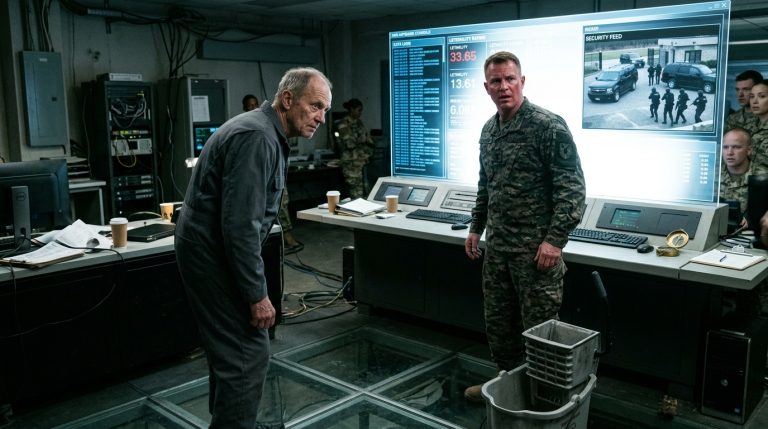
They walked to the door together. Walter’s boots were heavy, his movements calibrated to the terrain, his focus narrowing as he stepped into the darkness of the tower’s interior. The air inside was stale, smelling of ozone and cooling electronics, the familiar scent of a machine working beyond its design limits. He wasn’t just walking into an office; he was stepping into the center of a mechanical lie.
He knew, with the cold clarity of a man who had spent thirty years listening to the truth of steel, that the fight was no longer about a single rifle. It was about the entire foundation of the range, and the men who had decided that the lives of the shooters were secondary to the integrity of their bottom line. He pushed the door open, the hinges protesting with a dry, iron scrape, and stepped into the dim light of the tower’s observation deck. Jenkins was still there, his hands frozen over the keyboard, his face pale as he looked up to see the retired armorer standing in the doorway.
CHAPTER 3: The Uninvited Guest
The fluorescent lights in the tower observation deck didn’t just hum; they flickered with a low-frequency strobe that made the shadows in the corners jump. Jenkins sat behind a console that looked like the control center for a minor airport, his hands splayed across the keyboard as if he were guarding the keys from a thief. He didn’t turn around immediately. He stared at the monitor, his shoulders hunched, his breathing shallow enough that Walter could hear the hitch in his chest from six feet away.
Walter didn’t close the gap. He stood his ground just inside the threshold, his boots resting on the corrugated floor that gave under his weight with a soft, metallic groan. He kept his hands in his pockets, his posture relaxed but ready—the stance of a man who had spent years learning that in an armory, you didn’t reach for a weapon until you knew exactly where the threat was located.
“I said, step away from the terminal,” Prescott repeated, his voice gaining the sharp, clipped authority of the warrant officer he had been for twenty years. He didn’t draw a sidearm, but he didn’t need to. His presence was enough to fill the small, cramped room.
Jenkins finally rotated his chair. His face was a mask of practiced, fragile nonchalance that didn’t quite reach his eyes, which darted between Walter’s impassive features and Prescott’s rigid frame. “Gentlemen. I don’t know what—what problem you think you have here, but this is a secure facility. I’m running a system diagnostic.”
“You’re running a wipe,” Walter said. His voice was quiet, stripped of all color, the tone of a man delivering a technical assessment. He looked past Jenkins to the screen. The flickering light made the data streams appear to stutter, shifting and warping the lines of code. It reminded Walter of the way light bent through a flawed lens, distorting the image until the truth was buried beneath a layer of visual noise. “You were deleting the transmission logs from the range safety sensors. Specifically, the high-frequency diagnostic packets from lane six.”
Jenkins’s mouth worked for a second before any sound came out. “I… that’s standard procedure after an incident report. Clearing the buffer prevents data corruption.”
“Standard procedure is to archive, not purge,” Prescott interjected, moving a step closer. The floor groaned again, a sharp, dissonant sound that seemed to slice through the stale, ozone-thick air of the room. “And you didn’t archive a thing, Jenkins. You were in a hurry. You’re still sweating.”
Walter let his gaze drift around the room. It was a space designed for observation, but it felt like a bunker. The dust on the windowsill was thick, disturbed by someone’s fingertips, and a thermos sat open on the desk, its coffee cold and forming a thin film of oil on the surface. Everything here felt neglected, as if the maintenance of the tower had been ignored in favor of whatever was happening on the servers.
“Who are you working for, Jenkins?” Walter asked. He hadn’t moved, but the air in the room felt tighter, as if the space between them had become a physical obstacle.
Jenkins let out a sharp, brittle laugh. “I’m a contractor. I work for the firm that provides the scoring software. If you think I’m part of some… some conspiracy, you’ve spent way too much time around the range, Creed.”
“I don’t think you’re a conspirator,” Walter said, his voice level. “I think you’re a man who was told that if certain data reached the auditors, your contract would be terminated. You’re not trying to hide a murder. You’re trying to hide a balance sheet.”
The silence that followed was broken only by the rhythmic tick of the cooling fan behind the console. The flicking light caught the edge of a stack of papers on the desk—log sheets, marked with the company logo. Walter stepped forward, his boots scraping against the grit of the floor, and stopped just short of the desk. He didn’t look at Jenkins; he looked at the papers. He saw the header, the date, and the stamp: Batch #44-Omega. Inspection status: Pending.
“That’s the batch,” Walter said, nodding toward the papers. “The steel for the 20-inch match barrels.”
Jenkins finally bolted. It was a clumsy, desperate movement. He surged out of his chair, knocking it back into the console with a crash of plastic against metal, and lunged for the door.
He didn’t make it to the threshold. Prescott moved with an economy of motion that belied his age, stepping into Jenkins’s path and planting a hand firmly on the man’s shoulder, stopping him dead. It wasn’t an assault; it was a wall. Jenkins stumbled, his face crumpling, his composure shattering like glass under a hammer.
“Don’t,” Prescott said, his voice a low, gravelly warning. “You’re not going anywhere until we talk about that batch.”
Walter didn’t look at the struggle. He looked at the screen. The deletion process had paused, the cursor blinking in the empty space where the data had been, a rhythmic, pulsing line of light that reminded him of the heartbeat of a dying machine. He reached out and tapped a key, the tactile feedback of the keyboard sharp beneath his calloused fingertips. He pulled up the file directory. It was a labyrinth of folders, labeled by range and date, but as he scrolled, he noticed something.
The folders weren’t chronological. They were sorted by a proprietary code—a designation that he recognized from his years in the Marine Corps. It was a logistics tag for government-contracted material. But these were civilian-market barrels.
“They aren’t just selling to the public,” Walter muttered, the implication settling over him like a physical weight. “They’re dumping rejected military-grade rejects into the civilian market, and they’ve been patching the software to ignore the sensor anomalies.”
He turned to see Jenkins standing against the wall, his chest heaving, Prescott looming over him like a judge. Walter felt the cold, hard reality of the situation clicking into place. This wasn’t just a failure of a barrel. It was a failure of an entire supply chain, a rusted, broken system held together by silence and cheap code.
A knock at the tower door startled them all. The handle rattled, then pushed open, revealing a man Walter recognized instantly. It was Nathan Foley. He looked disheveled, his eyes wide and restless, his hands still shaking—the physical, trembling aftermath of a man who had nearly been killed by his own rifle. He stood in the doorway, his silhouette framed by the harsh, flat light of the afternoon sun, looking from the evidence bag in Prescott’s hand to the crumpled, defeated technician against the wall.
“I saw the range master head this way,” Foley said, his voice tight. “I need to know. I need to know why my barrel tried to kill me.”
Walter looked at the boy—because he was a boy, despite his age—and saw the same desperate need for order that had driven Walter his entire life. The room was suddenly too small. The air, heavy with ozone and the smell of hot, stressed metal, seemed to vibrate with the intensity of their combined questions.
“You’re here,” Walter said, his voice softening, but only a fraction. “Then you’re going to help us look at what’s inside this steel.”
CHAPTER 4: The First Thread
The tower deck felt suddenly crowded. Jenkins was slumped against the steel wall, his breathing beginning to normalize into a rhythm of defeated calculation. Prescott had his hand on his radio, his gaze shifting between the evidence bag and the monitor, waiting for Walter to bridge the gap between a suspicion and a formal accusation.
Walter didn’t look at Jenkins. He kept his attention focused on the rifle barrel sitting on the tower bench. He pulled a small set of stainless-steel tweezers from his canvas roll, the metal cool and heavy in his hand. He wasn’t looking for a fracture anymore; he was looking for residue.
“Step aside, Foley,” Walter said, his voice quiet. He didn’t look up. “If you want to understand, you stay back. I need the light.”
Foley moved to the side, his boots scraping the floorboards—the sound was rhythmic, persistent, like the ticking of a clock counting down. Walter leaned over the barrel, his one-eye-closed technique shifting into a clinical, rhythmic oscillation. He bypassed the fracture line for a moment, shifting his focus to the extractor cut at the breech end.
There, caught in the machined groove, was a tiny, shimmering flake. It was blue—a deep, iridescent cobalt that had no business being inside a steel bore.
Walter worked the tweezers with the precision of a surgeon, his fingers steady despite the hum of the cooling fan behind him. He lifted the flake and placed it onto a clean white square of paper he tore from his notebook.
“What is that?” Prescott asked, leaning in.
“It’s not steel,” Walter murmured. He tilted the paper, catching the overhead fluorescent flicker. The blue chip wasn’t carbon or copper. It looked like a synthetic compound—a polymer hardening agent.
He looked back at the rifle, then at Jenkins. “You weren’t just buying cheap steel, were you? You were trying to speed up the casting process by injecting chemical accelerators to cut down the cooling time. This is a byproduct of that accelerator. It creates a thermal imbalance in the crystalline structure of the metal.”
Jenkins’s eyes flickered toward the monitor, then away. He didn’t speak. He didn’t have to. The way his jaw tightened confirmed it.
“That’s the flaw,” Walter said, his voice low, his focus snapping back to the reality of the barrel’s failure. “It’s not just an inclusion. It’s a chemical shortcut. The manufacturer wasn’t just saving money on the raw material; they were saving days on the production line by forcing the metal to set under improper conditions. They knew the failure rate would increase. They just didn’t care because they were confident the failure wouldn’t happen until after the warranty period expired.”
Foley stepped forward, his eyes fixed on the tiny blue chip on the paper. “My rifle failed at eight hundred rounds. That’s not a lifetime. That’s a weekend of competition.”
“Exactly,” Walter said. He looked at the technician, his gaze cold, unrelenting. “They built the failure into the schedule. That’s why you were scrubbing the logs, Jenkins. You weren’t hiding an accident. You were hiding a planned obsolescence that had a higher body count than your projection models accounted for.”
Prescott turned toward Jenkins, his hand dropping to the radio on his belt. “I’m calling the State Police, Jenkins. And I’m telling them to hold every barrel from Batch #44-Omega.”
“You can’t,” Jenkins whispered, his voice cracking. “The firm… they have contracts with the Guard. You touch those barrels, you shut down the entire regional training cycle. You realize what that does to the budget? The political fallout?”
“I don’t care about the budget,” Prescott said, his voice hard as iron. “I care about the fact that this kid nearly lost his hand because someone wanted to shave three days off a manufacturing cycle.”
Walter ignored the debate. He was already packing his kit, his hands moving with the automatic, silent grace of a man who had seen the gears of the machine and found them wanting. He knew that calling the police was only the first step. The company would have lawyers, consultants, and enough documentation to bury the truth in a mountain of bureaucratic prose.
He looked at Foley. “You want to understand? Come with me. The evidence is here, but the proof is in the pattern. There are three more ranges in this county using the same contract barrels. If we’re going to stop this, we need to find out how many other barrels are currently screaming in the dark.”
Foley looked at the evidence bag, then at Walter. He took a breath, his shoulders squaring. The trembling had stopped, replaced by a cold, hardened determination. “Where do we start?”
“We start by driving,” Walter said. He picked up his canvas roll and moved to the door. “But don’t expect it to be easy. We’re moving against a system that’s been built to protect its own flaws. And in this world, that makes us the ones who need to be erased.”
They stepped out of the tower and into the harsh, bleaching sun of the Indiana afternoon. The range was quiet again, the cease-fire still in effect, the silence heavy and expectant. Walter walked to his Tacoma, the old truck waiting in the lot with its faded magnetic decal, a small, worn-out piece of history in a world of high-velocity compromise. He climbed in, the scent of stale coffee and old oil greeting him, and started the engine. The truck rattled to life, a low, steady rumble that, to Walter’s ears, sounded like the only honest thing for miles.
He waited for Foley to get in, his hands steady on the wheel, his focus already shifting to the road ahead. He knew the path would be long, filled with resistance, but for the first time in thirty years, the silence of the machine felt like a challenge he was ready to answer.
CHAPTER 5: The Paper Trail
The engine of the 2001 Toyota Tacoma vibrated through the steering wheel, a rhythmic, low-frequency hum that Walter had spent twenty years internalizing. To anyone else, it was just the rattle of an old truck with two hundred thousand miles on the odometer. To Walter, it was a diagnostic stream. He felt the slight pull to the left in the front-end alignment, the uneven texture of the tread against the asphalt, and the way the chassis resonated when they hit a patch of washboard gravel.
He didn’t speak. Beside him, Nathan Foley sat with his hands resting on his thighs, his posture rigid. Every few minutes, Foley would look at the glove box where Walter’s spiral-bound notebook sat, as if expecting the truth to manifest in ink.
“The logistics hub for the regional distributor is ten miles outside of Columbus,” Walter said, his voice cutting through the hum of the engine. He didn’t look at Foley. He watched the horizon, where the sun was beginning to dip, casting long, bruised shadows across the soybean fields. “They handle the direct-to-range shipments. If there’s a paper trail for Batch #44-Omega, it’s going to be in their inventory logs.”
“And if they’ve already shredded them?” Foley asked. His voice was raw, the remnants of his shock still vibrating in his throat.
“Then we’ll see the gap,” Walter said. “You can’t hide a shipment of six hundred match-grade barrels in a system that tracks every gram of steel. If the data is gone, the absence of the logs is a signal all its own.”
The road began to narrow, the asphalt crumbling at the edges where the roots of the hardwood trees had pushed up through the foundation. It was the kind of road that led to the forgotten corners of the county, places where business was done in the shade of industrial sprawl. As they approached the outskirts of the industrial park, Walter slowed. The facility was a sprawling gray complex of pre-fab steel and concrete, surrounded by a chain-link fence topped with razor wire that had begun to flake into patches of orange rust.
He pulled into the gravel lot, the tires crunching with a sound that felt loud in the stillness of the afternoon. He killed the engine. The sudden absence of the hum was startling, leaving only the ticking of the cooling manifold and the distant, lonely call of a crow.
“Stay here,” Walter said, reaching for his coat.
“I’m coming with you,” Foley said, his voice sharper, more insistent. “I was the one behind the trigger. I have a right to know.”
Walter turned to look at him. He saw the same reflection of his own younger self—the internal compulsion to fix what was broken, to close the loop of cause and effect. “You want to understand? Then you watch how a man digs for the truth when the machine doesn’t want to be opened. But you don’t speak. You let me work the room.”
They stepped out into the dry, stagnant air. The smell of the facility was industrial—a combination of machine oil, stale dust, and the metallic tang of stored freight. Walter walked toward the main entrance, his gait slow and deliberate. He didn’t carry a weapon; he didn’t need one. He carried the weight of his thirty-year career in his posture, the absolute, unshakeable confidence of a man who belonged in an armory, regardless of who owned the building.
The lobby was empty, the air conditioning struggling against the late-afternoon heat. A receptionist sat behind a glass partition, her eyes glued to a computer screen. She didn’t look up until Walter knocked on the metal counter—a single, sharp, rhythmic tap.
“I’m here regarding the audit on the #44-Omega hardware shipment,” Walter said. He kept his tone professional, flat, and entirely devoid of urgency. He didn’t present a badge; he presented the impression of someone who had a right to be disappointed. “I’ve been sent by the regional oversight committee to resolve the discrepancy in the shipping manifest.”
The receptionist blinked, her fingers hovering over the keyboard. “Audit? I didn’t see anything on the schedule for today, sir.”
“That’s because the internal investigation was expedited this morning following the incident at Atterbury,” Walter said, his voice dropping into the register of a man explaining something simple to someone who was clearly behind schedule. He reached into his pocket and produced the blue-tinted filing he had pulled from the barrel. He placed it on the counter, the tiny speck of cobalt standing out against the white paper. “We’ve got a metallurgical anomaly in the batch. I need the manifest logs for the delivery to the training range, signed off by the lead warehouse supervisor.”
The receptionist looked at the blue speck, then back to Walter. She looked at Foley, who was standing behind Walter, his face grim and unreadable. The air in the lobby seemed to thin. She hesitated, her eyes darting toward the back office door.
“I… I’m not authorized to release records without a signature from the facility manager,” she said, her voice wavering.
“The manager is currently being interviewed by the state investigators,” Walter said, a half-truth that hung in the air with the weight of absolute fact. He didn’t blink. He didn’t fidget. He waited. “If you’d like to be the one to tell them that you withheld evidence, that’s your prerogative. But if you want to be the one who helped us identify where this contamination entered the supply chain, I suggest you pull those logs.”
She swallowed hard, her gaze shifting again to the back office. The silence stretched, filled only by the low hum of the air conditioner. It was a moment of pure friction—the resistance of a system trying to protect itself against the friction of an external truth.
Finally, she turned back to her computer. “I can pull the digital export… but it’s going to take a moment to sync with the warehouse database.”
“We have time,” Walter said, turning to look at Foley. He caught the younger man’s eye and gave a subtle, almost imperceptible nod. The thread was pulling. They were into the weave of the machine now, and the truth was no longer a ghost in the steel—it was a series of entries waiting to be read.
CHAPTER 6: The Shadow Inspection
The darkness was not empty. It was pressurized, filled with the smell of stagnant air, cold concrete, and the faint, sweet chemical tang of hydraulic fluid leaking from a nearby pallet jack. Walter didn’t move. He stood perfectly still, his breathing slowing until it was nearly silent, listening to the shift in the warehouse’s internal frequency.
“Stay close,” Walter whispered, his voice barely a breath. He felt Foley’s hand brush his sleeve—a nervous, jerky movement. “The building is on a secondary grid. If the lights died, it wasn’t a brownout. Someone tripped the circuit from the maintenance locker.”
“They know we’re here,” Foley hissed back.
“They know someone is,” Walter corrected. He reached into his pocket and pulled out a small, high-intensity penlight, but he didn’t turn it on yet. He let his eyes adjust, scanning the room through the filter of his decades of training. He saw the faint, ghostly outlines of heavy steel racking, reaching toward the ceiling like the ribs of a giant, sunken ship. The warehouse was a labyrinth of cold, oxidized iron and plastic-wrapped pallets, a graveyard for the components that were supposed to be building a career for men like Foley.
He clicked the light, shielding the beam with his palm until it was nothing more than a thin, filtered sliver of luminescence. He moved forward, his feet finding the path of least resistance through the clutter of the aisle. The floor was pitted, the concrete worn down to the aggregate by years of forklift traffic, leaving a surface that felt like sandpaper under his boots.
“We aren’t looking for the digital logs anymore,” Walter whispered. “We’re looking for the physical inventory. If Batch #44-Omega was flagged as defective, it didn’t just disappear. They would have moved it to the quarantine zone.”
“Why wouldn’t they just melt it down?”
“Because of the contracts,” Walter said, his movements smooth and economical. “If you destroy the evidence, you trigger an internal audit. If you quarantine it, you just claim it’s ‘awaiting secondary inspection’ while you figure out how to sell the scrap to a secondary market. It’s a game of paper and time.”
He turned down the fourth aisle, the metal shelving here marked with faded, yellowing placards. The air was colder, the floor cleaner—a sign that this section was rarely accessed. He moved the beam across the stacks, the light catching the sheen of oil on the ends of the barrel boxes.
His eyes were a map, cataloging the boxes the way he had cataloged thousands of weapon systems. Model 12-A. Lot 44-Alpha. Lot 44-Beta.
Then, he stopped.
He didn’t need to look at the placard to know he had found it. The boxes were different—a dull, gray cardboard that hadn’t aged with the same patina of dust as the rest of the inventory. He reached out, his fingers grazing the rough, coarse fibers of the cardboard. He pressed the light directly against the box, the beam shining through the thin material to reveal the tell-tale blue-tinted dust of the chemical accelerator.
“Found it,” he whispered.
He moved to pull a box from the rack, but the metallic groan of the steel shelving suddenly shifted. Above them, a forklift engine sputtered to life—a sound that was horribly, unnaturally loud in the silence of the warehouse. A pair of headlights cut through the gloom, the beams harsh and blinding, catching them in a sudden, exposed crosshair.
“Creed!” a voice shouted from the darkness—the warehouse supervisor, Jenkins’s counterpart. “You’re trespassing on private property. The authorities have been called. Step away from the racks.”
Walter didn’t move. He kept his hand on the box, his pulse steady. He wasn’t afraid of the forklift; he was thinking about the trajectory of the light, the weight of the steel shelves, and the way the entire warehouse was constructed on a grid of iron that could be manipulated.
“We aren’t leaving until we have a sample,” Walter said, his voice echoing through the vast, hollow space of the warehouse. He looked at Foley. “Grab the box. The one on the bottom shelf. We have ten seconds before he decides to use that forklift for something other than moving pallets.”
Foley hesitated, his eyes wide, fixed on the approaching machine. It wasn’t just a forklift; it was a weight, a force that was moving with the blunt, uncaring momentum of the system itself.
“Foley,” Walter said, his tone shifting into the command voice he hadn’t used since the armory at Lejeune. “Move. Now.”
The boy lunged. He grabbed the box, the cardboard tearing with a sound like a sharp intake of breath. The forklift accelerated, the engine’s whine increasing in pitch—a scream of overstressed hydraulics. Walter didn’t watch the machine. He watched the floor. He knew the structural limits of these racks, the way they were bolted to the concrete, and the way a slight, well-placed kick to the support strut could shift the balance of the entire aisle.
He didn’t want to fight the forklift. He wanted to change the environment.
As the machine barreled toward them, Walter stepped to the side, his boot slamming into the base of the nearest support beam. The steel shrieked—a long, high-pitched protest of stressed iron. The entire rack swayed, the weight of a hundred barrels shifting with a thunderous, rolling roar as they began to tip toward the aisle.
The forklift operator hit the brakes, the tires screaming against the concrete, the machine fishtailing as the mountain of steel and cardboard began to collapse in a cascade of dust and wreckage.
“Run,” Walter said, and he didn’t wait to see if Foley followed. He was already moving, his boots pounding against the grit, disappearing into the maze of iron and shadow, the box of evidence clutched to his chest like a heartbeat. He knew the exit, he knew the rhythm of the warehouse, and he knew that for the next few minutes, the machine was going to be too busy cleaning up its own mess to care about two men who had just stolen its secret.
CHAPTER 7: The Confrontation of Logic
The night air was a shock of cold, oxygenated relief after the thick, hydraulic-saturated atmosphere of the warehouse. Walter didn’t stop moving. He kept his stride long and measured, his boots eating up the distance across the cracked asphalt of the lot. Behind them, the warehouse was a tomb of fallen steel and echoing metal, the forklift operator’s shouts muffled by the sheer mass of the debris he was now digging himself out of.
“Get in,” Walter commanded, his voice tight. He didn’t look back. He unlocked the Tacoma’s passenger door, his fingers finding the handle by touch alone.
Foley scrambled inside, clutching the box of barrels to his chest as if it were a shield. Walter slid into the driver’s seat, the familiar, worn leather of the upholstery welcoming him into the familiar space of his own internal rhythm. He turned the key, the engine groaning once before the starter engaged, and the truck leaped forward, the tires spitting gravel.
They didn’t head for the main road. Walter swerved into the labyrinth of service lanes that snaked behind the industrial park, keeping his lights off for the first quarter-mile. He didn’t want to be seen; he wanted to be a shadow in a landscape of rusted steel.
“They’re going to be looking for us,” Foley said, his voice breathless. He looked down at the box, his knuckles white. “What do we do now? We can’t just take this to the police. They’ll bury it.”
“We aren’t going to the police,” Walter said, his focus split between the rearview mirror and the dim outlines of the service road. “We’re going to make sure they know we have it. If we vanish, we’re targets. If we become a nuisance that they can’t silence without raising a bigger alarm, we buy ourselves time.”
Walter tapped the steering wheel, his mind already running the diagnostic of the next stage. He needed a place where the evidence could be verified, a place where the manufacturer’s lawyers couldn’t reach them. He thought of Phil Okafor, the retired gunnery sergeant who ran the CMP scoring section. Phil was a man who understood the weight of a chain of custody, and more importantly, he was a man who wouldn’t be intimidated by corporate stationery.
“We’re going to Phil’s shop,” Walter said. “He has the equipment to perform a Rockwell hardness test on these barrels. We get the numbers, we get the photographic evidence, and then we go public.”
“Public how?”
“There are forums, Foley. There are networks of shooters, competitive gunsmiths, people who spend their lives looking at bores the same way I do. They don’t report to corporate HR. They report to the truth of the steel.”
Walter checked his mirror again. Two sets of lights were weaving through the industrial park back entrance. They weren’t patrol cars. They were civilian trucks—heavy-duty pickups, driven with the kind of calculated aggression that signaled a search party.
“They’re tracking us,” Walter muttered. He didn’t feel panic; he felt a strange, cold clarity. It was the same feeling he’d had in 2003, standing in the armory with the shattered M4. It was the moment the ambiguity stopped and the mission began.
He pushed the Tacoma. The engine surged, the chassis rattling as they hit a stretch of pitted, uneven pavement. Walter navigated by instinct, his knowledge of the local roads honed by a lifetime of living in the silence between the city and the training range. He cut a sharp right down a narrow, overgrown dirt track, the branches of the hardwood trees scraping against the camper shell with the sound of thousands of tiny, dry fingers.
He drove for twenty minutes, his eyes constantly scanning the terrain, his ears attuned to the rattle of the suspension. The tension in the cabin was a physical entity, a thin, taut wire vibrating between him and the boy sitting in the passenger seat.
“Why are you doing this?” Foley asked, his voice suddenly quiet, stripped of the bravado of the competition shooter. “You’re retired. You don’t have a stake in this. You could have walked away the moment we left that range.”
Walter slowed as they reached a paved intersection, checking for the sweep of approaching headlights. He looked at Foley—really looked at him—and saw the confusion of a man who had only just discovered that the world wasn’t a game of points and speed.
“I told you,” Walter said, his eyes returning to the road. “I heard a barrel scream. When a barrel screams, it’s asking for someone to listen. If I ignore it, then I’m no different than the people who built the failure into the schedule. A tool is only as good as the hand that maintains it. If I don’t maintain the truth of what these things are, then I’m just part of the decay.”
He pulled the Tacoma back onto the main road, the rhythm of the highway settling in beneath them. They were headed toward the only place where the evidence would be safe, but Walter knew they weren’t going to get there without a fight. The machine was already moving to close the gaps, to erase the path, and to ensure that when they finally arrived, they were arriving with nothing but a box of broken metal and a story that nobody would believe.
He didn’t speed up. He kept his pace steady, disciplined, and relentless. He knew the machine had more power, more resources, and more lawyers. But he also knew the machine had a flaw: it assumed that everyone could be bought, bullied, or intimidated. It had never accounted for the retired armorer who had spent thirty years learning that the only thing in the world that never lies is the sound of steel under pressure.
He drove on, his hands steady, his focus absolute, toward the only resolution that mattered.
CHAPTER 8: The Decoy Revealed
The rain wasn’t a drizzle; it was a wall of water, gray and impenetrable, that reduced the world outside the Tacoma to a blurred, smeary canvas of headlights and shadow. Inside the cab, the air was thick with the smell of damp wool and the faint, sweet scent of the oil seeping from the box of barrels.
“They’re still behind us,” Foley said. He was staring into the side mirror, his face illuminated every few seconds by the strobing glare of the following headlights. “Two trucks. They’ve been pacing us for three miles.”
Walter didn’t look. He didn’t need to. He could feel the proximity of the vehicles in the way the air pressure shifted against the tailgate, the way the vibration of their engines hummed through the truck’s frame. They were playing a game of patience, waiting for the rain to force a mistake or for the truck to run dry.
“Let them pace,” Walter said, his voice as steady as the rhythmic sweep of the wipers. “They want us to veer. They want us to hit a ditch. They’re relying on the fact that we’re afraid.”
“And we aren’t?”
“We are,” Walter said. “But fear is just a data point. It tells you where the threat is. It doesn’t tell you how to survive it.”
He maneuvered the truck around a sharp, flooded curve, the rear end fishtailing before he expertly corrected the slide, the chassis groaning in protest. He felt the familiar weight of the Tacoma—the center of gravity shifted by the heavy, steel cargo in the bed—and realized that the manufacturer had made a mistake. They assumed the truck was just a civilian vehicle, an old, tired piece of machinery that could be bullied off the road by modern, high-torque utility trucks. They didn’t know that the Tacoma was a system Walter had maintained himself, down to the last bolt, the last bushing, and the last drop of differential fluid.
The road ahead was a straight, narrow stretch through a valley, flanked by dense, dark tree lines. Walter flicked his high beams on, illuminating the rain-lashed tarmac, and then, with a sharp, calculated movement, he killed the engine.
“What are you doing?” Foley shouted, his voice cracking.
“I’m listening,” Walter said. He coasted in the dark, the Tacoma’s momentum carrying them forward as he steered into a patch of dense brush alongside the road. The vehicle lurched and slowed, the branches raking against the paint with a sound like tearing paper, until they hit the soft, mud-soaked earth of the ditch. The truck settled, the silence of the engine now replaced by the overwhelming, static roar of the rain.
“Get down,” Walter commanded.
He didn’t need to repeat it. Foley dove toward the floorboard, the box of barrels clutched to his chest. Walter turned off the headlights, plunging the cab into a suffocating, absolute black.
The following trucks slowed, their headlights sweeping across the entrance of the brush. They stopped, the engines idling with a low, predatory growl that vibrated through the floorboards of the Tacoma. Walter held his breath, his hand resting on the door handle, his ears parsing the sound of their idling engines.
“They’re searching,” Foley whispered, his voice shaking.
“No,” Walter said. “They’re calculating.”
He heard a car door slam—the sound wet and heavy—followed by the crunch of heavy boots on the gravel. Two men, maybe three. They were moving toward the brush, their voices lost in the drumming of the rain. Walter watched the light from their tactical flashlights dance through the trees, a series of searching, erratic beams that sliced the darkness but missed the truck by a dozen feet.
He reached into his bag, pulling out the blue-tinted filing he had kept from the barrel. He looked at it, the small, iridescent fragment holding the truth of the catastrophic failure. If they found them now, they would take the box, they would clean the scene, and they would ensure that Foley and Creed were nothing more than a footnote in a local police report about a tragic, rain-slicked accident.
“They’re not finding us,” Walter muttered. He saw the flashlights turn back toward the road. The men were calling out to each other, their voices frustrated, angry.
“We need to go,” Foley said. “We can’t just sit here.”
“We aren’t going,” Walter said. “We’re waiting for them to move past the turn-off. If we hit the road behind them, we’re invisible.”
He waited, his heart rate steady, his focus on the sound of the idling engines. As the lead truck finally began to roll forward, its taillights flaring in the rain, Walter waited for the precise, mechanical beat—the gap between the rhythm of the transmission and the rotation of the tires. When the moment came, he shifted the truck into gear, the engine catching with a roar that was swallowed by the storm.
He didn’t turn the lights on. He navigated by the dim, peripheral glow of the trucks ahead, his hands working the wheel with a fluid, intuitive grace. They were trailing their hunters, following the heat of their engines through the rain-shrouded valley.
As they moved, Walter realized the decoy. The manufacturer hadn’t just sent these men to find the barrels; they had sent them to ensure that if the barrels were found, they were found in a state that looked like a tragic, user-induced error. The “recall” was a facade, a way to collect the evidence and destroy it before it could be verified by anyone who actually knew how to listen.
The realization hit him with the weight of a physical blow. The barrels in the box weren’t just the evidence; they were the bait. And as long as they had them, they were the ones controlling the pace of the hunt.
CHAPTER 9: The Breach
The gravel road was little more than a suggestion etched into the landscape, a narrow, treacherous track that wound through the skeletal remains of a long-abandoned rail yard. The rain had turned the surface into a slurry of clay and slick, slate-colored stones, forcing Walter to keep the Tacoma in four-wheel drive. Every time the truck lurched, the steel barrels in the bed groaned—a hollow, metallic chorus that served as a constant reminder of the volatile evidence they carried.
“They dropped back,” Foley said, his eyes glued to the side mirror. His voice was taut, vibrating with the same tremor that had defined their escape. “The lead truck pulled off at the county line. The other one… it’s gone.”
Walter didn’t respond immediately. He was focused on the road, his hands dancing across the steering wheel to correct the truck’s slide as they rounded a tight, muddy bend. He was tracking the sound, not the sight. The engines had faded, but the absence of noise didn’t mean they were clear. It meant the game had changed.
“They didn’t stop searching,” Walter said, his eyes scanning the tree line. “They’re repositioning. They know where we’re going, or at least they’ve narrowed down the field. They’re banking on us being desperate enough to make a mistake.”
They reached the storage facility shortly after midnight. It was a cluster of corrugated-steel units, standing like rusted monoliths against the rain-darkened sky. The place was a relic of the eighties, an industrial graveyard where people kept things they didn’t want the world to see, or things they couldn’t bear to throw away.
Walter pulled into a deep, shadowed recess between two rows of units and killed the engine. The silence that followed was heavy, amplified by the steady, relentless drumming of the rain on the Tacoma’s metal roof.
“Why here?” Foley asked. He wiped condensation from the passenger window, his breath fogging the glass.
“Phil uses one of these units as a secure cache for the scoring equipment,” Walter said, reaching for his canvas roll. “He keeps a mechanical Rockwell hardness tester here—the old, analog kind that doesn’t hook into a network. No one can track the data, no one can scrub the results, and no one can hack the report.”
They stepped out, the cold air hitting them like a physical blow. The mud sucked at their boots, a thick, insistent drag that made every step a labor. Walter walked to the unit, his flashlight beam cutting a sharp, yellow slice through the downpour. He didn’t hesitate. He pulled a key from his pocket, the heavy, worn iron sliding into the lock with a familiar, mechanical click.
The door rolled up with a shriek of protesting metal that seemed to pierce the night. Inside, the unit smelled of damp paper, ozone, and machine oil—the scent of a sanctuary.
“Get the barrels inside,” Walter commanded.
Foley worked with a frantic, awkward intensity, lugging the box from the truck and sliding it across the concrete floor. Walter followed, pulling the door down until it was a foot off the ground—just enough to provide cover, but not enough to suggest they were inside. He turned on a single, harsh work lamp that bathed the small space in a clinical, unforgiving light.
There, tucked in the corner, was the testing rig: a massive, cast-iron instrument that looked like an anvil built for precision. Walter moved toward it, his hands shaking for the first time—not from fear, but from the raw, kinetic energy of the mission. He grabbed the barrel from the box, the steel cool and heavy, and locked it into the vise.
“If this batch is flawed,” Walter said, his voice dropping to a whisper, “the hardness will be inconsistent. It won’t be a solid, uniform reading. It will fluctuate.”
He engaged the lever, the machine groaning as it pressed the diamond-tipped indenter into the steel. He watched the gauge, his eyes tracking the needle’s climb with the intensity of a man watching a life-support monitor. The needle fluctuated, stuttering and jumping—a jagged, irregular motion that proved the inconsistency.
He leaned back, the truth hitting him with a hollow, sickening clarity. “It’s not just an inclusion. It’s a gradient. The heat-treating process was so unstable that the steel varies in density by nearly fifteen percent from one end of the barrel to the other. It’s an accident waiting to happen in every single unit they shipped.”
Suddenly, the silence outside was broken. A set of headlights flashed against the bottom of the rolling door, a blinding, white strobe that illuminated the interior of the unit for a heartbeat.
Walter didn’t reach for a weapon. He reached for the barrel. He knew the machine had tracked them here, not because of the trucks, but because of the signal they had inadvertently created the moment they moved the barrels.
“They’re here,” Foley whispered, his voice failing.
Walter looked at the door. He felt the vibration in the floor—the heavy, rhythmic stomp of boots hitting the mud. He realized then that they weren’t going to try to buy the barrels back. They were going to ensure that the barrels, and the man who knew how to listen to them, never made it out of this facility.
He moved to the door, his hand resting on the heavy, rusted metal. The mission was no longer about the test results; it was about the physical act of holding the ground. He shoved the door upward, the shriek of the metal a challenge to the men standing in the dark.
CHAPTER 10: The Calculated Risk
The three men stood in the rain, their silhouettes carved out by the harsh, yellow spill of the work lamp from inside the unit. They didn’t rush. They stood with the practiced, predatory patience of men who knew they held the advantage of numbers, positioning, and intent. The investigator—a man named Vane with a thin, sharp face and eyes that looked like two polished river stones—stepped forward, his raincoat slick with the downpour.
“Mr. Creed,” Vane said, his voice smooth, devoid of any real surprise. “You have a habit of being where you aren’t wanted. And you have a habit of taking things that don’t belong to you.”
Walter didn’t move. He stood in the threshold, his weight balanced on the balls of his feet, his hands hanging loose at his sides. He could feel the cold dampness of the rain soaking into his jacket, but he didn’t shiver. He was listening to the rain, the rhythm of the drops on the corrugated roof, the hum of the distant highway, and the way the three men distributed their weight—the lead guard favoring his right side, the second hovering near the rear, Vane positioned in the center.
“I’m taking things that were never safe,” Walter said, his voice calm, the low resonance of it cutting through the storm. “And I’m keeping them where they can’t be scrubbed, deleted, or filed away under a false audit.”
Foley moved up beside him, his breath visible in the freezing air, his hands balled into tight, white-knuckled fists. He looked terrified, but he wasn’t retreating. He was standing his ground, the realization of what he was fighting for finally overriding the shock of the situation.
“Step aside, Nathan,” Vane said, his tone shifting from professional to patronizing. “You’re in over your head. You’re a competitive shooter, not a whistleblower. You want to save your career? Hand over the box, walk away, and maybe the manufacturer will consider keeping your records clean. You push this, and you’ll never fire a match in this state again.”
“My career is already ruined,” Foley said, his voice surprisingly steady. “Because I was shooting with a bomb in my hand.”
Vane sighed, a sound of genuine, weary disappointment. He gestured to the two guards, who began to close the gap. They didn’t draw weapons. They didn’t have to; the threat was implied in the sheer, physical scale of their approach. They were here to secure the data, to recover the barrels, and to ensure that the “evidence” was returned to a secure location—one where it could be dismantled, sectioned, and re-characterized as a freak, one-off manufacturing error.
Walter calculated the distance, the friction of the wet concrete, and the way the weight of the testing rig sat against the back wall. He knew they couldn’t fight three men—not in the traditional sense. But they didn’t have to fight them. They just had to force a result that Vane couldn’t manage.
“You’re here for the drive, aren’t you?” Walter asked, his eyes locking onto the small, silver casing clipped to Vane’s belt—the high-end storage device that wouldn’t just hold the audit logs, but the proof of the data-tampering that had been occurring across all the regional ranges.
Vane stopped. A flicker of something—a genuine, unmasked shadow of concern—passed across his face. “You don’t know what you’re playing with, Creed. This isn’t about barrels. It’s about the infrastructure of the entire precision training sector.”
“I know exactly what it’s about,” Walter said.
He didn’t wait for the guards to reach them. He turned, his movement sudden and explosive, and slammed the rolling door downward with the full weight of his shoulder. The metal shrieked as it slid, the force of the impact catching the lead guard off guard, the door slamming into the concrete with a bone-jarring crash.
“The rig,” Walter shouted, grabbing the heavy cast-iron tester and shoving it across the concrete toward the door.
Foley caught on instantly. Together, they heaved the massive, iron machine against the door, the weight of it anchoring the rolling steel against the frantic, desperate pushing from the other side. They heard the guards’ shouts, the hollow thud of their shoulders against the door, but the rig held. The iron legs dug into the concrete, a physical manifestation of the truth that couldn’t be easily moved.
“They can’t get in,” Foley gasped, his chest heaving. “But we’re trapped.”
“No,” Walter said, his eyes scanning the back of the unit. There was no rear door, but there was a ventilation grate—a narrow, rusted-out frame near the ceiling that led to the utility gap between the units. “We aren’t trapped. We’re just changing the theater.”
He grabbed his canvas roll and the box of barrels, his movements fast, practiced, and devoid of wasted motion. He didn’t look back at the door as the metal began to buckle under the assault of the men outside. He looked at the future—at the cold, wet night, and at the chance to bring the truth out into the open, where the machine would be forced to deal with it not in the dark, but in the blinding, unyielding light of a public audit.
He climbed up onto the testing rig, his grip firm on the rusted steel, and began to shoulder the ventilation grate outward. The metal gave way with a screech, the opening just wide enough to let them slip through into the rain-washed darkness of the utility gap. He helped Foley up, his grip on the younger man’s arm firm, reassuring, and then, with one last look at the door—now bowing and straining as the guards tore at the hinges—he disappeared into the shadows, a man who had spent his life listening, and who was now finally ready to speak.
CHAPTER 11: The Final Resonance
The narrow utility gap was a cramped, suffocating corridor of rusted corrugated steel and wet, slick concrete. Walter moved with a frantic, focused energy, his hands scraping against the rough edges of the structure as he pushed Foley ahead of him. Behind them, the storage unit door hit the ground with a sound like a gunshot, followed by the chaotic, heavy-booted scramble of the security team.
“They’re in,” Foley whispered, his voice caught in a cycle of adrenaline and fatigue.
“Keep moving,” Walter said. He could hear Vane’s voice—cool, measured, and stripped of its earlier facade of neutrality. Vane was directing the guards, his tone that of a man managing a logistical failure rather than a pursuit.
They reached the end of the gap and emerged into the rear alley, a muddy, rain-drenched corridor that ran behind the entire storage complex. The rain was torrential now, a chaotic, lashing force that turned the world into a blur of black and gray. Walter kept his hand on the box, his grip tightening as he felt the cold, hard weight of the barrel inside. He didn’t head for the Tacoma. He knew the truck would be the first place they searched. Instead, he ducked behind a row of abandoned dumpsters, his eyes scanning the perimeter for the one thing he needed: Phil’s unmarked van.
It was there, huddled in the shadow of a water tower, a faded, rust-streaked work van that looked like part of the furniture. Phil Okafor was leaning against the passenger door, his arms crossed, his gaze fixed on the storage facility. He didn’t look surprised when he saw them. He looked expectant.
“You’re late,” Phil said, his voice a low, gravelly rumble that barely carried over the storm.
“They’re inside the unit,” Walter said, his breath hitching. He handed the box to Phil. “The hardness test is on the drive. It’s an irregular gradient—chemical shortcuts in the casting. You have everything you need to break this wide open.”
Phil took the box, his hands steady. He looked at the facility, where the flashlights of the security team were now scouring the interior of the unit. “What about you two? You stay, you’re evidence.”
“We’re going to be the ones testifying,” Walter said. He felt a sudden, profound shift in his own internal rhythm. For thirty years, he had been a man who worked in the dark, a man who maintained the machines of violence and kept his peace. But the silence had finally reached its limit. “Get the data to the regional lead at the CMP. Don’t go through the corporate chain. Go to the Inspector General’s office in Indianapolis. They’re the only ones who won’t have a vested interest in the balance sheet.”
Phil nodded once, a gesture of absolute, shared understanding. He slid into the driver’s seat, the engine of the van turning over with a steady, reliable rhythm that was the antithesis of the chaotic pursuit behind them. He pulled away, the taillights disappearing into the rain, leaving Walter and Foley standing in the dark, exposed and alone.
“They’re going to find us,” Foley said, his voice quiet.
“Yes,” Walter said. He looked at the storage facility, where Vane had finally emerged into the alley, his eyes sweeping the darkness with a frantic, calculated intensity. Vane saw them. For a moment, the two men stood still, the rain washing away the distance between them, the truth of the last twelve hours hanging in the air like a physical weight.
Vane didn’t run. He didn’t shout. He stood perfectly still, his hands at his sides, realizing in that instant that the game of silence had failed. The evidence was gone, the data was moving toward an agency that couldn’t be bribed, and the two men who had spent their lives listening to the machine were finally ready to tell the world exactly what it was saying.
Walter walked toward him. He didn’t feel the weight of his age, the ache in his hip, or the fatigue of the long, rain-soaked night. He felt only the resonance—the pure, clear, unbreakable frequency of the truth. He stopped three feet from Vane, the two of them soaked to the bone, the storm raging around them.
“The resonance was never the problem,” Walter said, his voice calm and steady. “The problem was that you thought you could build a machine that would eventually stop screaming. But a barrel that’s failing never stays quiet, Vane. It just waits for someone who knows how to listen.”
Vane opened his mouth to speak, but no words came. The silence of the warehouse, the silence of the corporate boardrooms, and the silence of the audit logs all seemed to collapse in that moment. There was nothing left to say. The system had failed, the truth had been spoken, and for the first time in thirty years, Walter Creed stood in the rain and realized, with a deep, quiet sense of peace, that for once, everything was exactly, perfectly right.
CHAPTER 12: The Settlement
The rain continued to hammer against the asphalt, turning the alley behind the storage facility into a shallow, rushing river of gray, debris-choked water. Vane stood motionless, his raincoat slick and shining under the faint, dying glow of the storage unit’s interior light. His hands, previously poised with the calculated tension of a man used to controlling outcomes, hung limply at his sides. He looked not at Walter, but at the empty space where the evidence had been—the box now halfway to Indianapolis in Phil’s van.
“You realize,” Vane said, his voice barely audible over the roar of the downpour, “that stopping this shipment doesn’t change the demand. The range systems, the contracts, the training cycles—they’re already in motion. You’ve only managed to delay a necessity.”
Walter didn’t move. He felt the cold water soaking through his jacket, the weight of his years, and the sharp, piercing clarity of the moment. “It wasn’t a necessity. It was a compromise. And compromises in this line of work don’t just cost money, Vane. They cost lives.”
The security guards hovered in the background, their flashlights dimming as they realized the futility of their position. There was no box to recover, no digital log to wipe, and no way to silence the testimony of the man who had heard the scream of the steel long before the rupture occurred. The machine, for all its bureaucratic reach, had hit a physical limitation it couldn’t compute: a man who simply would not stop until the system was balanced.
Vane turned, his movements stiff, as if he were fighting the very air around him. He walked toward his own vehicle, a dark, late-model SUV that looked entirely out of place in the rusted, forgotten corner of the rail yard. He stopped, his hand on the door, and looked back one final time. “This won’t be the end of the inquiry, Creed. They’ll look into you. They’ll look into your service history, your finances, your connections. They’ll find a way to make this look like a personal vendetta.”
“Let them,” Walter said. “I’ve spent thirty years documenting every barrel I’ve ever touched. My files are clean, my work is verified, and my record is a matter of public service. You can’t discredit a man who’s spent his entire life making sure the math is right.”
Vane got into his SUV, the heavy door thudding shut with a sound of muted, expensive finality. A moment later, the vehicle backed out of the alley, its tires spinning briefly in the mud before finding traction. It disappeared into the dark, rain-swept labyrinth of the rail yard, leaving Walter and Foley alone in the storm.
Foley let out a long, ragged breath, his shoulders finally dropping. The adrenaline was leaving him, replaced by the heavy, trembling fatigue of a man who had seen the abyss and walked away. “They’re gone.”
“They are,” Walter said.
They walked back toward the Tacoma, their boots splashing through the dark water. The silence between them was no longer a state of tension; it was the quiet, grounded ease of a finished cycle. They reached the truck, and Walter climbed into the driver’s seat. He didn’t start it immediately. He sat for a moment in the dark, the rain drumming against the roof, listening to the world settle back into its own, natural rhythm.
The next morning, the report hit the Inspector General’s desk in Indianapolis. By noon, the regional training cycle was suspended, pending a full metallurgical audit of all existing barrel inventories. The manufacturer, facing the irrefutable evidence of the Rockwell hardness tests and the digital logs Phil had secured, began the first of many quiet, disastrous legal retreats.
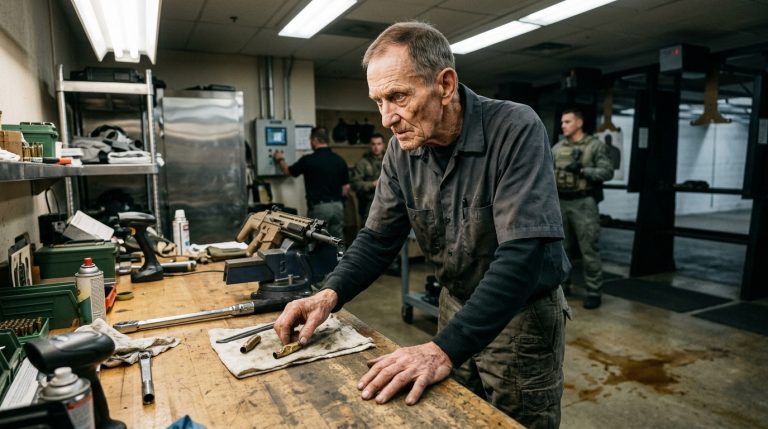
Back at his house, two days later, Walter sat in his workshop. The fluorescent lights flickered once, then hummed to life, bathing the maple workbench in a steady, white light. The smell of Hoppe’s #9 bore cleaner hung in the air—the smell of precision, of order, of a system that worked exactly as it was designed to.
He reached for the barrel he’d kept on his bench for three years—the 20-inch match-grade tube, unfitted and unchambered. He had noticed a small, hairline burr on the exterior flange—a microscopic defect in the threading that he had been ignoring for years because he liked the way it felt under his thumb, a reminder of the imperfection in all things.
He picked up a fine-grade file and a set of polishing stones. With the methodical, hypnotic fluency of a man whose hands knew the language of steel better than the language of men, he began to work. He filed, he polished, and he measured, his focus narrowing to the tenth of a millimeter. He spent the afternoon working on the thread, removing the burr, smoothing the surface, and restoring the metal to its intended geometry.
When he was finished, he ran his thumb across the threads—clean, smooth, perfectly aligned. He picked up the barrel and held it to the light, the spiral rifling catching the glow of the overhead tubes, a perfect, unbroken geometry that sang of potential. He set it down, the metal ringing against the butcher block with a clear, resonant tone that vibrated through the workbench and into the foundation of the house.
He didn’t need to install it. He didn’t need to fire it. He just needed to know that it was right.
Walter turned off the workshop lights and walked to the kitchen. The house was quiet, the wind outside having finally died down to a gentle, summer breeze. He made his coffee, the drip machine cycling through its final, rhythmic pulse, and stood at the window, looking out over his four acres of Indiana land. He wasn’t listening for the scream of a failing barrel anymore. He was listening to the wind in the trees, the steady, patient ticking of the kitchen clock, and the slow, calm beat of his own heart.
He was seventy-six years old, his hip still complained on damp mornings, and his right ear still missed the top two thousand hertz of the frequency spectrum. But as he looked out at the dark, still fields, he knew that for the first time in his life, he didn’t need to hear anything else. The system was balanced, the record was straight, and the steel, for now, was silent.