A Silent Ledger of Sacrifice: The Unspoken Code of the Veterans Who Reclaimed a Fallen Legacy
CHAPTER 1: THE CALIBRATION OF WEIGHT
The garage light hummed with a sickly, yellow flicker, casting long, distorted shadows that danced across the concrete floor like ghosts in a formation. Chris stood at the workbench, his breath hitching as he adjusted the strap on his leg. It wasn’t about the pain anymore; he had made his peace with the constant, dull ache of his hip. It was about the weight.
He reached into the green ammo box and pulled out the list of call signs, his fingers tracing the waterproof parchment. It was cold—bitterly so. He thought of Maya, of the way she had looked at the floor yesterday, her shoulders hunched as if she were trying to make herself small enough to disappear. That was the real injury. Not the skin he’d lost in the Humvee, but the way his daughter was learning to apologize for his existence.
He heard the crunch of gravel outside—a slow, rhythmic sound. He didn’t look up. He knew the cadence of those boots.
The door creaked open, admitting a sliver of gray morning light. A man stepped in, his silhouette tall and rigid, the unmistakable frame of a soldier who had spent a lifetime holding a line. He didn’t speak. He simply stood there, checking the tension in his own hands, his movements sharp and efficient.
“They’re ready,” the man said. His voice was like grinding stone.
Chris finally looked up, his face a landscape of scars that didn’t move as he spoke. “We don’t break the rules, Tom. We change the context.”
“The teacher is expecting a confrontation,” Tom replied, leaning against the cold metal of the doorframe. “He wants a villain. If we give him one, we lose.”
Chris nodded, closing the ammo box with a metallic snap that echoed in the small space. He wasn’t looking for a villain. He was looking for a mirror. He stood up, testing the balance of his prosthetic, and felt the familiar, heavy gravity of the situation. He had walked through fire once; this was just a different kind of heat.
He glanced at his reflection in the dark window of the garage. He looked like a relic, a broken piece of hardware, just as Whitman had said. But as he turned to face the door, he didn’t feel like a relic. He felt like a blade that had been sharpened in the dark, waiting for the one moment where it was finally needed to cut through the lie.
“Let’s move,” Chris said.
As they walked toward the truck, Chris noticed something that stopped him cold. The logbook—the one detailing every member of his old unit—was missing from the workbench. He turned back, his eyes narrowing. He had placed it there not ten minutes ago. Now, only a faint, rectangular outline in the dust remained. A micro-mystery that felt too deliberate to be an accident. But there was no time to search. The clock on the dashboard flickered: 07:45.
He didn’t need the book. He knew the names by heart. Every one of them was already moving toward the school.
CHAPTER 2: THE NETWORK OF SHADOWS
The silence in the garage was not empty; it was pressurized. Chris stood by the workbench, his fingers hovering over the empty rectangle in the dust where the logbook had rested only moments before. The chill of the morning air seemed to seep through the concrete, biting into his scars. His pulse was a steady, rhythmic thrum—the only sound in the room—but his mind was already calculating the variables.
He didn’t panic. Panic was a luxury for people who hadn’t learned how to measure the cost of an error. Instead, he forced his breathing to slow, feeling the familiar, grinding friction of his prosthetic leg against the floor. Whoever had taken the book knew exactly what it was. It wasn’t a theft; it was a signal. It meant the perimeter was compromised, or perhaps, the network was tighter than even he had realized.
He stepped out of the garage, the transition from the dim, oily interior to the crisp, unforgiving light of the driveway acting like a slap. His truck, a rusted Dodge, sat idling with a low, throaty rumble that vibrated through the soles of his boots. Tom was already behind the wheel, his jaw set in a line of granite.
“The book is gone,” Chris said, his voice clipped as he climbed into the passenger seat.
Tom didn’t look at him. His eyes were fixed on the rearview mirror, tracking the quiet, suburban street. “If it was taken, it’s already being used. That’s what a network does, Chris. It absorbs information.”
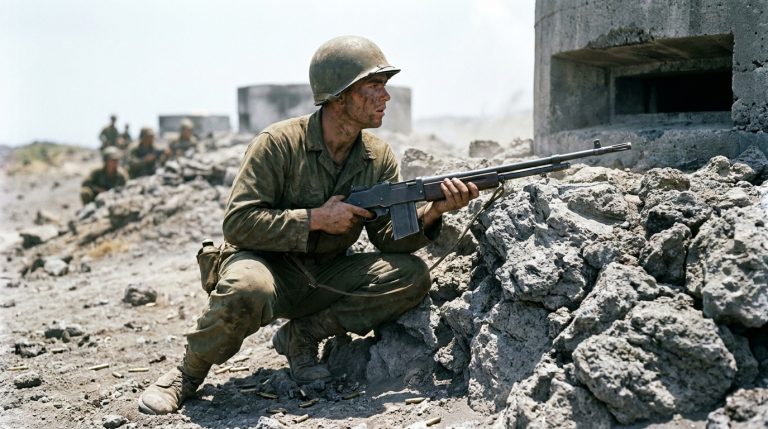
Chris leaned back, his hand instinctively gravitating toward the door handle, feeling the cold metal beneath his palm. The psychological phantom of the Humvee explosion—that sudden, blinding white flash and the deafening, hollow roar of tearing steel—threatened to claw its way into his vision. He shook it off. He wasn’t back in Fallujah; he was here, in a town that pretended to be safe, preparing to walk into a classroom that had turned into a frontline of mockery.
“We aren’t going in to fight,” Chris reminded him, his eyes scanning the horizon.
“We are going in to provide backup,” Tom corrected, his voice a low, gravelly rasp. “Whitman thinks he’s teaching a lesson. We’re going to show him what happens when the subject matter is blood and bone.”
As they pulled onto the main road, the world felt hyper-saturated. Chris noted the sharp edges of the suburban fences, the cold, geometric lines of the school buildings in the distance, and the way the morning light caught the dew on the manicured lawns. Everything was too clean. It felt like a stage set. He thought of Maya, currently sitting in that classroom, likely staring at her desk, her internal resolve eroding under the weight of the snickers.
He had to get to her. Not to rescue her—the lesson they had learned years ago was that the only rescue that mattered was the one you managed for yourself—but to ensure she saw the support that had materialized around her. The veterans were scattered, moving independently, converging on the school like a silent, slow-moving tide. They wouldn’t announce themselves with sirens or shouting. They would arrive like the turning of a season—inevitable and cold.
“Do you think she knows?” Tom asked suddenly, his gaze shifting to the side.
“She knows the letter,” Chris replied, his hand tightening on the armrest. “But she doesn’t know the cost. She thinks heroism is a story you read in a book. She doesn’t understand that it’s a debt you pay every day for the rest of your life.”
The car turned a corner, and the school came into view. It was a sprawling brick structure, its windows reflecting the gray, overcast sky like a series of darkened eyes. Chris watched as a few students walked toward the main entrance, their movements sluggish and careless. They had no idea what was about to descend on them. They were children of a peaceful, sheltered world, protected by the very silence that Chris and his platoon had carried home in their own broken bodies.
He felt the familiar itch in his scars, a phantom sensation that always preceded a major shift. The logbook might have been taken, but the call signs were already vibrating across the encrypted channels of the past. The platoon was on the move. They weren’t a unit anymore; they were a collective memory, a living ledger of everyone who had been pulled from the fire, everyone who had refused to die, and everyone who had chosen to stand when they could have crawled away.
“We park in the back,” Chris commanded.
“Understood.”
As they pulled into the lot, Chris watched the rows of parked cars. He was searching for the tell-tale signs—a specific bumper sticker, a certain way of parking, the stillness of a driver who had learned that motion without purpose was a waste of energy. He saw a gray sedan three rows over. The driver wasn’t moving. He was just watching, his hands resting on the steering wheel, his eyes tracking the school’s front doors.
It was Sarah, one of the few who had been there at the end, the one who had helped him stitch his own tactical vest after the secondary blast. She didn’t look at him, but he saw her head tilt just a fraction—an acknowledgment. The network was in place. The decoy—the appearance of an impending raid—was perfectly balanced. Whitman would expect a protest, a confrontation, a public spectacle. He wouldn’t expect the quiet, surgical precision of people who had nothing left to prove and nowhere left to go.
Chris took a breath, the cold air filling his lungs like glass shards. He was ready. He looked at the school, at the brick and the glass, and felt the weight of the rusted dog tag sitting in his pocket. It was time to show the world that when you mock a warrior, you don’t just insult a man; you insult the entire history of the sacrifices that allowed your own shallow, comfortable life to exist.
“Let’s go,” Chris said, his voice barely above a whisper.
He opened the door, his prosthetic foot hitting the asphalt with a solid, definitive thud. The sound echoed in the morning air, a sharp, metallic rhythm that marked the beginning of the end. He didn’t look back at the truck, and he didn’t check for Tom. He simply began to walk, his stride uneven, his posture locked into the rhythm of a man who had walked through hell and found the exit.
CHAPTER 3: THE THRESHOLD OF RESILIENCE
The lobby of the school was a cavern of hard surfaces. Polished linoleum stretched out like a frozen lake, reflecting the flickering overhead lights in long, jagged streaks. Chris paused at the threshold. His prosthetic leg felt heavy, the metal plate pressing against the floor with a grounding weight that seemed to vibrate through his entire skeletal frame. He had spent years standing outside, an observer of the world he had once fought to preserve, but today, the space between the exterior and the interior felt less like a door and more like a membrane.
He walked forward, his gait rhythmic and deliberate. Every step was a conscious calibration of balance and force. He didn’t look at the reception desk, where a secretary sat staring at her screen, her hands pausing mid-type as if she sensed the sudden atmospheric pressure shift. He didn’t look at the students huddled by the lockers, their laughter dying out as they registered the singular, unwavering focus in his stride.
He was looking for the geometry of the space. Tactical awareness was a muscle; even after years of civilian life, it remained atrophied but present. The hallways were too narrow, the sightlines cluttered with lockers, and the fluorescent lighting created harsh, unforgiving shadows that masked corners. It was a poor environment for a confrontation, but excellent for a display of intent.
Tom followed a few paces behind, his eyes flicking from the ceiling cameras to the emergency exits. He was counting, Chris knew. Calculating the number of people in the hallway, the distance to the stairwells, the sheer logistics of holding the line if the school administration panicked.
“Stay focused on the narrative,” Chris whispered, his voice low enough to be lost in the building’s hum. “If we escalate, we fail.”
“The narrative is already shifting,” Tom replied, his head barely moving. “Look at the students. They aren’t looking at us. They’re looking at Maya’s locker.”
Chris slowed his pace. Maya’s locker was halfway down the main corridor, a dull, navy-blue metal box covered in the small, chaotic stickers of a fourteen-year-old’s life. A group of boys stood near it, their voices low, but as Chris approached, they drifted away, their eyes skittering toward him and then to the floor. It was the avoidance behavior of people who had been touched by something they couldn’t name.
He reached the locker and stopped. He didn’t open it. He didn’t need to. He just stood there, his presence acting as a silent, immovable anchor in the middle of the hallway’s morning rush.
He felt a familiar distortion, a V-4 shift in his perception. For a split second, the school hallway wasn’t a school hallway. It was a debris-strewn alleyway in the desert. The flickering of the lights became the erratic pulse of a damaged electrical grid. The smell of floor wax morphed into the sharp, metallic tang of ozone and scorched earth. His hands tightened into fists, the knuckles turning white. He saw a shadow move at the end of the hall—a flicker of movement that reminded him of a spotter on a ridgeline.
“Chris,” Tom said, his hand landing firmly on Chris’s shoulder. The weight of it snapped him back.
The hallway returned to its sterile reality. The lockers were just lockers. The shadow was just a student running for class. The ozone was just the smell of cleaning chemicals.
“Stay in the now,” Tom reminded him, his expression unreadable.
Chris exhaled, a slow, controlled release of air. “I’m in the now. I just miscalculated the distance.”
“We all did,” Tom said, his gaze drifting to the classroom doors that lined the corridor like slots in a massive, clockwork mechanism. “But we’re here. And the platoon is in position. Every exit is being monitored, not by us, but by the people who remember why we walked through that fire in the first place.”
They continued walking. The hallway seemed to stretch, the linoleum echoing with the sound of Chris’s unequal stride—a steady thump-tap, thump-tap that felt louder than it should have. It was a heartbeat. It was a cadence. It was the rhythm of a man who had walked through the fire and was now bringing the heat back to the place where it had been forgotten.
He felt the presence of others before he saw them. A woman in a charcoal suit stood near the gymnasium entrance, her arms folded. She was Sarah. She caught his eye, gave a microscopic nod, and then turned her attention to a teacher who was pacing nervously by the office. She was a wall. A human barrier that held the line between the school’s bureaucracy and the truth of the platoon.
They reached the civics department. The door to Whitman’s classroom was closed. Through the narrow glass pane, Chris could see the blurred shape of Maya, sitting at the front, her head bent low, her hand gripping the edge of her desk. She looked so small, so exposed, and for a terrifying moment, the logic of his mission fractured. Was this the right place? Was this the way to give her the strength she needed?
The decoy secret—the idea that he was leading a squad to “raid” the classroom—felt thin, a fragile glass bulb he was holding in his hand. If he pushed, it would shatter. And underneath it was the real truth: that he wasn’t here to save her from Whitman. He was here to show her that she was never alone, that her own voice, however quiet, was backed by a chorus of people who had lived through the unthinkable.
He reached for the door handle. It was cool, smooth, and utterly ordinary. He looked at Tom, who had assumed a position of perfect, silent guard to the left of the door, his eyes scanning the hallway for any interference.
“Ready?” Tom asked.
“I’ve been ready since the day I realized I wasn’t coming home as the same man who left,” Chris said.
He turned the handle. The latch clicked, a sound that seemed to shatter the silence of the hallway like a gunshot. He pushed the door open, not with violence, but with the measured, terrifying confidence of a man who knew exactly where he stood.
CHAPTER 4: THE DECOY OF DEFIANCE
The door swung open, and the transition from the hallway’s chaos to the classroom’s forced order was instantaneous. Inside, the air was stagnant, heavy with the scent of dry-erase markers and the faint, chemical musk of teenage anxiety. Mr. Whitman stood at his desk, his posture a curated image of professional control, but the moment he saw Chris, his smirk flickered. It was a fractional movement of a lip muscle, but it told Chris everything he needed to know. Whitman expected a scene. He expected shouting, perhaps a tantrum, something he could dismiss as the erratic behavior of a damaged man.
Chris stepped over the threshold, his prosthetic heel striking the linoleum with a heavy, deliberate sound. He did not rush. He did not speak. He moved toward the center of the room, his eyes locked not on the teacher, but on the daughter he had come to protect. Maya sat at her desk, her knuckles white as she gripped her notebook. When she caught her father’s gaze, her eyes widened—not with shame, but with a sudden, sharp recognition of the weight he carried.
“Mr. Caldwell,” Whitman said, his voice dripping with a practiced, condescending calm. “This is a closed session. You’re disrupting the academic environment.”
Chris stopped. He stood in the narrow aisle between two rows of desks. The silence in the room was absolute, a vacuum that sucked the breath out of the students. Every head was turned toward him. He felt the cold, hard edges of the desks against his coat as he moved, the geometry of the room closing in.
“I’m not here for an academic session,” Chris said. His voice was steady, void of the anger Whitman was clearly hoping to provoke. “I’m here to correct the record.”
Whitman took a step forward, his shadow stretching across the front of the room. “The record is quite clear, Sergeant. We value objective success here. We value reality, not…” He gestured vaguely toward Chris’s leg, his eyes narrowing. “…sentimental crutches.”
A ripple of nervous laughter moved through the back of the room, but it died quickly. It was choked off by the presence of Tom, who had moved to the side of the door and now stood, his arms crossed over his chest, his gaze scanning the room with the clinical detachment of a man counting targets.
Chris saw the shift in the students. They weren’t laughing anymore. They were watching. And then, he saw it—the V-1 discrepancy. In the third row, a student was holding a phone under the desk, the screen glowing, but she wasn’t recording a video of a tantrum. She was typing rapidly, her eyes darting between Chris and the door. She wasn’t capturing the “raid”—she was observing the silence. She was looking for a narrative that Whitman couldn’t provide.
“You think you’re teaching them to be sharp,” Chris said, turning his head just enough to keep Whitman in his peripheral vision. “But you’re only teaching them to be small. You’re teaching them that if something is broken, it’s useless. That if someone pays a price, it’s a failure.”
“That is a gross misinterpretation of the curriculum,” Whitman countered, his voice rising, a sharp, ragged edge entering his tone. He was losing control of the room, and he knew it. He turned to the class. “Students, ignore this. We have an assignment to finish.”
But no one moved. No one opened a book.
Chris felt the heat in the room rising, a physical pressure against his skin. This was the moment where the decoy held. Whitman was framing this as a confrontation, a battle between a man of authority and a man of ‘psychological baggage.’ He was playing the role of the rational educator, and he desperately wanted Chris to break the character, to shout, to lunge, to prove him right.
“My daughter wrote an essay,” Chris said, his voice carrying clearly to the back of the room. “She wrote about the weight of a life. You told her it was manipulation. You told her that wounds are a weakness.”
“Because they are!” Whitman snapped. The mask slipped. His face flushed a deep, mottled red, his composure finally dissolving into the bitter reality of his own insecurity. “Look at you! You’re a liability! You represent nothing but a broken system!”
The words hit the air like physical blows. The class gasped. It was the moment of total escalation. Whitman had finally revealed his own petty malice, and the room had seen it, naked and ugly.
Chris felt a strange sense of clarity. The mission wasn’t to fight Whitman. The mission was to let Whitman defeat himself. He took a single step toward the desk, the prosthetic leg clicking rhythmically.
“I didn’t come here to argue about what I am,” Chris said, his voice dropping into a register that made the students in the front row flinch. “I came here because my daughter has a right to define her own reality. And she doesn’t need your permission to believe in the truth.”
He reached into his pocket and pulled out the rusted dog tag, the metal dull and pitted from fire. He placed it on the desk between them. It landed with a soft, heavy thud that seemed to vibrate through the wood.
“That was found in the wreckage of a convoy in Fallujah,” Chris said, his eyes locking onto Whitman’s. “It belonged to a man who didn’t come home. His family doesn’t see a ‘broken system.’ They see a life that stood for something.”
Whitman stared at the tag, his mouth working silently. He looked around the room, searching for an ally—a student, a colleague, anyone—but he found only a sea of eyes that were reflecting back his own shame. The silence was no longer a vacuum; it was a verdict.
Chris turned away from him and looked at Maya. She was standing now, her notebook still gripped in her hands, her eyes bright and unwavering. The classroom was a trap for Whitman, but it was a sanctuary for her. The decoys had served their purpose; the facade was burning down, and the foundation of the truth was finally starting to show.
CHAPTER 5: THE WEIGHT OF THE WITNESS
The air in the classroom had thickened, turned into a pressurized medium that made every breath feel like a conscious effort. Mr. Whitman stood frozen, his eyes fixed on the rusted dog tag as if it were a live grenade. He had tried to frame the narrative—to paint Chris as a relic, a broken man—but the room had rejected the script. The students weren’t looking at him with the amusement he had cultivated; they were looking at him with a cold, analytical appraisal. He was no longer the teacher; he was the subject, and the subject was found wanting.
“The lesson,” a voice cut through the stillness.
It was Colonel Jacob Marks. He hadn’t moved since entering, his stature a stark contrast to the slumped, defeated posture of the teacher. He didn’t speak with aggression. He spoke with the quiet, terrifying finality of a man who had seen the end of empires and knew how they fell.
“The lesson isn’t about the past, Whitman,” Marks continued, his gaze drifting over the sea of students. “It’s about who you choose to be when the fire starts. You chose to mock. These men and women chose to hold the line.”
Whitman opened his mouth to speak, to offer a defense or a retort, but the words died in his throat. He looked at the platoon members lining the walls—twenty-three silent witnesses whose very existence negated everything he had preached about strength and success. They were, by any standard metric, “broken.” They were scarred, they walked with limps, they carried the physical and psychological toll of a decade of chaos. And yet, their presence was the only thing making the room feel stable.
Then, the butterfly detour occurred. The classroom door groaned as it was pushed wider, and the school’s resource officer—a former Army MP named Henderson—stepped in. He had been lurking in the hallway, likely trying to decide if he should call for backup, but when he caught sight of the group, his face didn’t go into ‘alert’ mode. It went into ‘recognition’ mode.
His eyes scanned the room, landing on the men and women standing against the walls. He went pale. He stopped, his hand falling away from his belt, and he gave a slow, stiff, involuntary nod—a sign of respect that transcended school protocol. He looked at Chris, then at the dog tag, and he finally understood. This wasn’t a raid. It was a pilgrimage.
“I’ll… I’ll keep the hallway clear,” Henderson muttered, stepping back out and closing the door with a gentle, deliberate click.
The room erupted in a silent, collective shift. The final authority figure had effectively surrendered the space to the platoon. Whitman was now truly alone.
“My daughter,” Chris said, the sound of his voice drawing every pair of eyes back to him. He didn’t look at Whitman; he looked at Maya. “She thought she had to be quiet to be right. She thought that if she wasn’t loud, if she wasn’t ‘successful’ by your narrow definitions, then her story didn’t matter.”
He walked over to Maya’s desk. He placed a hand on her shoulder—not as a protector, but as an equal.
“She wasn’t wrong,” Chris said, his eyes now sweeping the room. “She was just waiting for the right audience.”
“We’re the audience,” the girl in the third row said. She was the one who had been typing on her phone. She stood up, her face flushed, her eyes wet but determined. “We’re listening now.”
One by one, the other students began to move. They didn’t shout; they didn’t cheer. They simply stood, a quiet, growing tide of defiance against the atmosphere Whitman had created. The tension in the room, previously a jagged, sharp edge of hostility, transformed into a heavy, solemn resonance.
Whitman was retreating, his back hitting the whiteboard, his hands gripping the edge of his desk so hard his knuckles were white. He was watching his reality shatter. The students were no longer his. They were witnesses to a different, harder, and much more permanent truth.
Chris saw the moment the teacher broke. It wasn’t a sudden explosion; it was a quiet, internal collapse. The arrogance that had fueled his daily existence leaked out of him, leaving him looking smaller, older, and profoundly isolated. He looked at the dog tag, then at the platoon, and he finally saw them for what they were: not victims, but keepers of a legacy that he could never even begin to comprehend.
“The lesson,” Chris said, his voice low, “is yours to take home.”
He didn’t wait for Whitman to respond. He didn’t need to. The man was already a ghost in his own classroom. Chris turned and walked toward the door, his prosthetic leg striking the floor with a rhythmic, steady cadence that felt like a march. The platoon followed—not as a squad on a mission, but as a group of people who had finished their task and were ready to return to their own lives.
As Chris reached the door, he paused and glanced back. Maya was still standing, her notebook open, her back straight. She wasn’t looking at him. She was looking at the class, at the door, at the future. She had the letter, she had the tag, and she had the memory of a room full of people who had stood up for her.
The silence remained, but it was no longer heavy. It was clean. It was the silence of a truth that had finally been spoken, and in that, Chris found his own catharsis. He had opened the door, and now, for the first time in years, he could walk through it without looking back at the shadows.
CHAPTER 6: THE FINAL LEDGER
The parking lot was a sea of gray asphalt, still damp from the morning’s mist. The rain had fully tapered off, leaving behind a sky the color of a bruised plum. Chris stepped out of the school’s main entrance, the heavy, double-paned glass doors swinging shut behind him with a dull, muffled thud that felt like the closing of a book.
He didn’t stop. He walked straight toward his truck, the rhythm of his movement—the thump-tap, thump-tap—unbroken and steady. He was exhausted. It wasn’t the physical fatigue of a long march, but the deeper, more corrosive exhaustion of a man who had finally put down a burden he hadn’t realized he was carrying.
The platoon was already dispersing. A woman in a charcoal suit stood near her car, her posture relaxed, her eyes scanning the periphery with a habit that would never truly fade. Tom stood by the passenger door of the Dodge, his arms crossed, watching the school windows. As Chris approached, Tom didn’t offer a congratulatory nod or a smile. He simply stepped aside and opened the door.
“It’s done,” Tom said.
“No,” Chris replied, sliding into the seat, the worn fabric of the upholstery feeling like a memory against his back. “It’s just beginning. The ledger is open now. That’s all we needed.”
He watched the front doors of the school. Maya appeared a moment later, walking slowly, her head held high. She was surrounded by three other students—the girl from the third row among them. They were talking, their gestures animated, their voices lost in the distance, but the change in her posture was a physical revelation. She was no longer shrinking. She was claiming the space she occupied.
This was the payoff. He watched as she paused near the entrance, looking toward the parking lot. She caught his eye, and she didn’t look away. She raised a hand—a simple, quiet gesture—and for a second, the years of pain, the nights of silence, and the burning memory of the Humvee blast felt like they had finally reached a state of equilibrium. The antagonist—Whitman—had been defeated not by the platoon’s presence, but by his own exposed, pathetic smallness. The students had witnessed it, and that was the poetic justice. It was a failure he would have to carry, alone, into a classroom that would never look at him the same way again.
“She’s going to be fine,” Tom said, sliding into the driver’s seat and starting the engine. The truck’s roar cut through the quiet, a mechanical growl that felt like the earth settling.
“I know,” Chris said.
As they pulled out of the lot, Chris reached into his pocket and pulled out the rusted dog tag. He held it in his palm, feeling the jagged edges, the fused metal, the history embedded in its cold surface. It was a piece of wreckage, yes, but it was also an anchor. He looked down at the floorboard of the truck, where he had kept a small, worn leather pouch—the place he kept his small tools, the things he used to repair his gear when the world wore it down.
He slipped the dog tag into the pouch. He didn’t lock it away in the ammo box; he kept it where he could reach it. It was no longer a secret to be kept under a shadow box; it was a testament.
The drive home was quiet. The town, which had seemed like a stage set only an hour ago, now looked like a landscape of ordinary, flawed people. He saw the shops, the crosswalks, the faces of people rushing to work. They were oblivious to the fact that a quiet, seismic shift had just occurred two blocks away. He felt a profound sense of peace.
When they pulled into the garage, the overhead light flickered once and then hummed to a steady, constant glow. Chris climbed out of the truck, his legs feeling heavy but sure. He walked over to the workbench. He picked up his cane, the wood worn smooth by years of use, and he leaned it against the wall. He wouldn’t need it today.
He reached for a wrench, his movements deliberate. He had been meaning to adjust the hinge on the garage door for weeks—a small, physical repair that required focus and patience. It was a mundane task, one that seemed almost trivial after the morning’s events, but that was the point. The “cool down” had begun. The world had settled into a new, quiet configuration, and he was a part of it.
He worked the metal, the friction of the wrench against the bolt a grounding, tactile reminder of his own existence. Click. Turn. Tighten. Every motion was earned.
Maya would be home soon. He imagined her coming through the door, the sound of her backpack hitting the floor, the smell of the house, the quiet rhythm of a life that was finally, truly, her own. He wouldn’t need to ask her about her day. He would see it in the way she moved, in the way she spoke, and in the way she looked at the world.
The garage was warm now, the smell of oil and dust replaced by the crisp, clean scent of the afternoon air drifting in through the open door. Chris set the wrench down and wiped his hands on a rag. He looked at the empty space on the workbench where the logbook had been. It didn’t matter anymore who had taken it. The network had acted, the witness had been given, and the truth had been established.
He walked to the doorway and looked out at the backyard. The sun was beginning to dip, casting long, golden shadows across the grass. He felt a deep, resonant connection to the space, to the silence, and to the girl who was currently walking toward it. The arc of his journey had concluded, and in the aftermath, there was nothing but the quiet, enduring grace of a life that had finally been allowed to breathe.