The Weight of Silence: A Veteran’s Quiet Path Through the Echoes of a Shattered Past
CHAPTER 1: The Lingering Echo
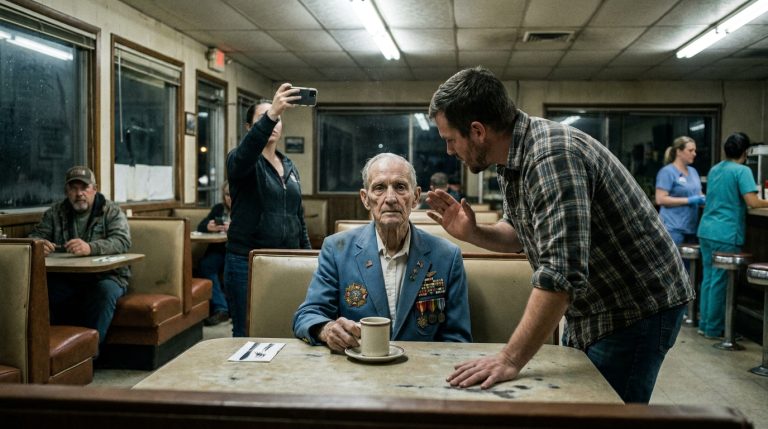
The sunlight hit the floorboards at a slant, highlighting the dust motes dancing in the stagnant air of the bar. It was a slow, golden morning, the kind that usually offered Eli the only peace he had managed to cultivate in the last decade. He traced the familiar, jagged chip in his coffee cup with his thumb, a small, rhythmic motion that kept the ghosts at bay.
The door groaned. It was a heavy, metallic protest that sliced through the low hum of the ceiling fan.
Eli didn’t look up. He didn’t have to. The cadence of the footsteps was distinct—measured, heavy, and purposeful. It was the gait of someone trained to occupy space, not just exist within it. The smell followed a second later: gun oil, ozone, and a faint, sharp scent of sterile antiseptic that felt entirely wrong in a room that smelled of stale beer and floor cleaner.
“You’re early, Elias.”
The voice was rough, like gravel ground between tectonic plates. It was the man from the night before, the one who had stood in the center of the SEAL team. He wasn’t in uniform today, but the civilian clothes hung off his frame as if they were a disguise he hadn’t yet learned to wear. He pulled out the stool next to Eli, the wood screeching against the floor, but didn’t sit. He just hovered, a shadow that blocked the gentle warmth of the morning sun.
Eli took a slow, deliberate sip of his coffee. The liquid was tepid, bitter, and grounding. “I didn’t invite you back, Marcus.”
“We aren’t here for an invitation.” Marcus leaned forward, his hands flat against the worn wood of the bar. His skin was mapped with fine, white scars, the legacy of a life spent in the dirt. “The guys from last night? They weren’t just random thugs, Eli. They were part of a salvage crew. They weren’t looking for a fight. They were looking for something they thought you had.”
Eli’s heart didn’t race; he had trained his body to ignore that particular alarm. He simply focused on the chip in the ceramic. “Then they found the wrong man.”
“Did they?” Marcus reached into his pocket and slid something across the counter. It wasn’t money. It was a heavy, silver-plated coin, worn smooth at the edges, stamped with a seal that hadn’t been officially recognized in twenty years. “One of the bikers dropped this when they ran. It was tied to a set of coordinates, Eli. Coordinates that lead right to your old command post in the hills.”
Eli’s eyes finally shifted. They landed on the coin, his pale blue gaze as calm as a frozen lake. His lungs felt tight, a familiar constriction that had nothing to do with age and everything to do with the heavy, buried weight of his own history. The decoy was starting to fall away, but the true threat—the reason he had spent twenty years in this wheelchair—was suddenly, violently, in the room with him.
“You shouldn’t have brought that here,” Eli whispered.
“I didn’t have a choice,” Marcus said, his voice dropping into a dangerous, intimate register. “They’re coming back, Eli. And this time, they won’t be acting alone. They think you’re the keeper of the gate, and they’re ready to break the lock.”
Eli looked past Marcus, out the window to the street. A black sedan had just pulled to the curb, its engine idling with a low, predatory hum.
CHAPTER 2: The Uninvited Guest
The engine of the black sedan outside pulsed with a low, rhythmic vibration that Eli could feel through the soles of his feet, even though they no longer felt the floor. It was a mechanical heartbeat, steady and insistent. Marcus stood motionless, his silhouette framed against the morning light bleeding through the door. He was waiting. He was always waiting.
Eli didn’t look at the coin on the counter. He kept his focus on the coffee cup, tracing the rough, jagged edge of the chip with his index finger. The scent of Marcus—a mix of high-grade gun oil and the sharp, metallic tang of an antiseptic he hadn’t smelled since the terminal room in Khost—triggered a sudden, violent flicker in his mind. He wasn’t in the bar anymore. He was back in a room filled with the acrid smell of melting plastic and the sound of servers screaming as they dissolved under the chemical wash he’d poured over them.
The memory hit him like a physical blow to the sternum. He blinked, the vision dissipating as quickly as it had formed, leaving behind only the taste of cold, bitter coffee and the sight of Marcus’s boots, caked with the red dust of the high desert.
“You’re a long way from home, Marcus,” Eli said, his voice a low, gravelly rasp that barely cut through the silence of the bar. He finally looked up. His pale blue eyes were steady, stripped of the weariness he usually wore like a second skin. “And you’re carrying ghosts that aren’t yours to bear.”
“The ghosts are getting restless, Eli,” Marcus replied, pulling a stool out and sitting down. He didn’t look at the bar, or the bartender, or the street outside. He looked only at Eli. “That cache you ‘lost’ in the hills? The one that was supposed to have been scrubbed from the ledgers? It turned up on a black-market satellite ping three days ago. Someone found the frequency. Someone found the pulse.”
Eli’s fingers stopped tracing the cup. The silence in the bar was absolute, save for the hum of the refrigerator. He had engineered that cache to be a ghost, a phantom frequency that would look like nothing more than atmospheric static to anyone who didn’t know how to listen. If the bikers had found it, they hadn’t found it by accident. They had been guided.
“And you think I have the key to opening it,” Eli said. It wasn’t a question.
“I think you’re the only one who knows what’s inside,” Marcus corrected. “The brass thinks it’s an armory. They think it’s leverage. If they find out you didn’t destroy it—”
“I did destroy it,” Eli interrupted, his voice sharpening, a blade of cold steel hidden in velvet. “I broke the core, Marcus. I didn’t hide it. I erased it.”
Marcus leaned in, his voice dropping to a whisper that vibrated with suppressed tension. “Then why did the ping come from your old terminal ID? Why does the signal only respond to the retinal pattern of someone who was in that room twenty years ago?”
The question hung in the air, heavy and suffocating. Eli felt the familiar ache in his legs, a phantom pain that had haunted him since the day he left that mountain. He hadn’t just sabotaged the equipment; he had shackled his own identity to the destruction of the data. To move the cache was to admit he was still tethered to the crime.
“If they think I have it, they’ll come here,” Eli said, his eyes scanning the periphery of the bar. He noticed, for the first time, a small, black device adhered to the underside of the counter—a transmitter, no bigger than a thumbprint. He didn’t react, didn’t let his gaze linger. He simply registered it. They were already being watched.
“They aren’t just coming, Eli,” Marcus said, glancing toward the door. “They’re watching. And they aren’t going to let an old man in a chair walk away with the keys to a kingdom he claimed to have burned down.”
Eli shifted his weight in the chair, the familiar squeak of the metal frame a comfort against the mounting pressure. He realized then that the bikers weren’t the threat—they were the bait. They were the ones used to smoke him out. The true hunters, the ones Marcus served, were the ones he had to worry about.
“You aren’t here to save me, are you?” Eli asked, his tone almost conversational.
Marcus paused, his hand moving to his side, hidden by the curve of the counter. “I’m here to make sure that if the truth comes out, it doesn’t take the rest of us with it.”
Eli felt the weight of the moment—the fragility of the life he had built, the precariousness of his silence. He turned his head slightly, his eyes catching the reflection of the street in the window. The sedan was still there, but another car had pulled up behind it—a nondescript grey SUV, windows tinted to a deep, impenetrable black.
“Then we have a problem,” Eli said, reaching for his cane, his movements slow, deliberate, and entirely calm. “Because I don’t intend to let you, or them, break what I’ve spent twenty years trying to heal.”
He stood, his legs locking into place with a practiced, painful efficiency. The bar was no longer a place of quiet reflection. It was a battlefield, and the lines were being drawn in the dust of the floorboards.
CHAPTER 3: The Memory Trigger
The transmitter beneath the bar counter emitted a sound that only Eli seemed to hear—a high-frequency whine that vibrated against his teeth, a digital ghost mocking his attempt at a quiet retirement. He moved with a grace that surprised even him, his hand sliding off the bar not in retreat, but in a calculated adjustment of his position. He needed to be closer to the door, closer to the truth, even if the truth was currently rotting in a mountain pass three hundred miles away.
“You’re shaking, Marcus,” Eli said, his voice level despite the rising hum of the electronic interference. He kept his eyes locked on the bartender, who was busy scrubbing a glass with a fervor that bordered on the manic.
Marcus didn’t deny it. He gripped his own coffee cup, the ceramic groaning under the pressure of his calloused hand. “It’s not just the cache, Eli. It’s what’s wrapped around it. The signal is piggybacking on a defunct weather array, one that shouldn’t even be powered. If I’m feeling the static, it means the whole sector is going dark. They’re isolating us.”
Eli felt a momentary dip in his perception, the world tilting slightly to the left. The faded yellow paint of the bar wall seemed to pulse like a heartbeat, and for a fleeting second, the floor beneath his wheelchair felt like it was shifting, as if he were back on the deck of a transport ship in a storm. He clenched his hands on the armrests, forcing his focus to settle on the texture of the worn leather. He was there. He was present. He was in control.
“They aren’t isolating us,” Eli corrected, his gaze sharpening. “They’re forcing an interaction.”
He looked toward the window again. The grey SUV remained, a silent sentinel, but the street was now devoid of pedestrians. The silence of the neighborhood had become predatory. He realized that his memory of the terminal room wasn’t just a mental phantom; it was a sensory footprint left by the same technology currently being deployed to find him.
“You were there,” Eli murmured, more to himself than to Marcus. “In the valley. When the order came to purge the data.”
Marcus went still. The bravado he had worn as a civilian suit cracked, revealing the hollowed-out eyes of a man who had seen the same fire Eli had. “I was on the perimeter. I saw the flash. We were told it was a gas leak, a containment failure. But I saw the logs, Eli. I saw the signatures you left behind. You didn’t just break the servers; you injected a recursive loop. You gave the system a conscience.”
The admission hung in the stale, beer-scented air. Eli didn’t flinch. He reached into his jacket pocket and pulled out a small, frayed notebook—an object he had carried for two decades. He opened it to the back page, where a series of faded, hand-drawn schematics were scribbled in graphite that had almost turned to dust.
“I didn’t give it a conscience,” Eli said, tracing a line on the paper. “I gave it an expiration date. And it wasn’t supposed to expire until someone forced it to acknowledge its own failure.”
He slid the notebook toward Marcus. It wasn’t the map the bikers were looking for. It was the logic flow of the sabotage. If the cache was active, it wasn’t because it had been found; it was because someone had triggered the bypass, and the system was now desperately trying to purge itself.
The whine in Eli’s teeth intensified, accompanied by a sharp smell of burning copper. The transmitter beneath the counter turned from a silent observer into a beacon. The grey SUV outside shifted, its driver-side door creaking open just an inch.
“They know,” Marcus breathed, his hand darting to his side. “They’ve intercepted the bypass signal.”
Eli felt the weight of the moment—the convergence of past and present. He realized the decoy wasn’t the cache itself; the decoy was the idea that there was anything left to steal. The cache was a trap, a lure meant to bring out the people who were still holding the strings, and he had just inadvertently tripped the wire.
“Then let them come,” Eli said, his voice devoid of fear, filled only with the cold, hard logic of survival. He spun his wheelchair, the wheels squeaking in the quiet room, and moved toward the back exit. “But they aren’t going to find what they’re looking for. They’re going to find what I left for them.”
The air in the room seemed to compress, the pressure building until the glass behind the bar rattled in its rack. Eli’s pulse was steady, a rhythm of survival that had carried him through the fire and would carry him through the storm currently gathering on his doorstep. The decoy was dead. The real game had just begun.
CHAPTER 4: The Friction of Truth
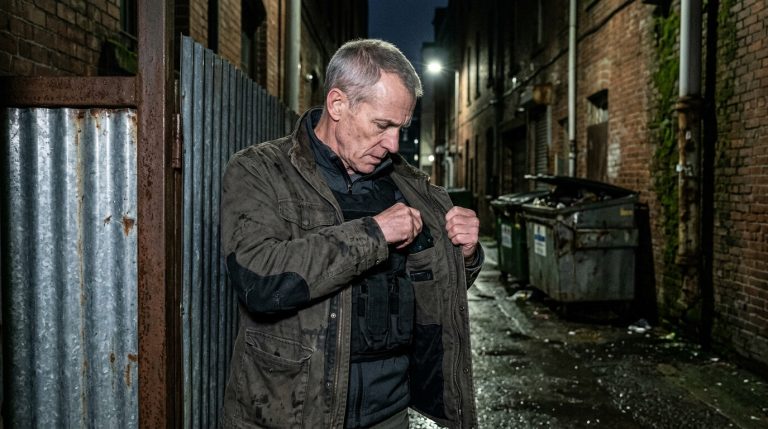
The back exit was a heavy steel door that groaned in protest as Eli shoved it open. The transition from the stale, dim atmosphere of the bar into the sharp, aggressive glare of the alleyway was jarring. The air outside was colder, thick with the smell of damp brick and the acrid, biting scent of burnt rubber.
A large delivery truck was wedged sideways against the far wall of the alley, its rear tire shredded and flapping like a wounded animal. The alley was blocked. Eli’s wheels crunched over pulverized glass as he pushed forward, his hands gripping the rims with enough force to turn his knuckles white. The plan had been simple: move to the secondary transport point in the next street over. The truck made that impossible.
“Stay low,” Marcus hissed, emerging from the doorway behind him, his hand hovering near his holster. He wasn’t looking at the truck; he was looking at the rooflines above the alley. “They’re flanking us. The grey SUV is repositioning.”
Eli didn’t waste breath on a reply. He was already assessing the geometry of the space. The truck was a tactical obstacle, but it also provided cover. He maneuvered his chair into the narrow gap between the truck’s bumper and the brick wall, the metal frame of his chair screaming in protest as it scraped against the rusted iron. It was a tight, unforgiving squeeze, the kind of friction that demanded total precision.
As he moved, he felt the vibration in his teeth again—the electronic signature of the tracker. It was louder now, a jagged, pulsing rhythm that matched the frantic beating of his own heart. He realized then that the tracking signal wasn’t just locating him; it was broadcasting a localized disruption that was likely frying the electronics in Marcus’s handheld comms.
“They aren’t just following us,” Eli whispered, his eyes fixed on a drainpipe that climbed the wall of the building to his right. “They’re trying to force a surge. If they hit the local power grid, they can create a vacuum of static that will effectively blind anyone within a block.”
“Why?” Marcus asked, stepping into the narrow gap beside him. “Why waste the resources on a blackout?”
“Because they want to make sure no one sees what they’re about to do,” Eli replied. He reached out, grabbing the rough, cold metal of the drainpipe. It was bolted to the brick, a relic of a different era, but it was sturdy. “They aren’t here to capture me, Marcus. They’re here to erase the evidence of what I did twenty years ago. And you are the only witness left who knows I didn’t fail.”
Marcus froze. The realization hit him, washing the color from his face. “You didn’t purge the servers. You offloaded the data to a dead-drop server—one that’s only accessible through a proximity handshake.”
Eli didn’t answer. He was busy working the latch on his chair’s folding mechanism. It was a delicate, precise motion, one he had performed a thousand times in his mind, but never in such a constrained space. The metal clicked, and the frame collapsed enough for him to move it manually. He shoved the chair toward the drainpipe, using it as a stepping block.
“Get on the roof,” Eli commanded, his voice devoid of emotion. “You have the security clearance. If I can get to the junction box at the top of this wall, I can spoof the signal back at them. We turn their blackout into a feedback loop.”
“Eli, if you do that, you’ll be the epicenter of the surge,” Marcus warned, his voice thick with concern. “The feedback will destroy the equipment, but the shock—”
“I know what the shock will do,” Eli said, his eyes meeting Marcus’s with a fierce, unwavering clarity. “It’s a price I’ve been paying for twenty years.”
A shadow crossed the mouth of the alley. The men from the grey SUV had arrived. They didn’t run; they moved with the practiced, predatory ease of people who knew the path was blocked and that their prey had nowhere left to hide. They weren’t looking for a fight; they were looking for an endpoint.
Eli grabbed the drainpipe, his upper body strength—honed by decades of forced reliance—pulling him upward, away from the chair. His legs hung limp, a dead weight that swung against the brick wall. Below him, the men in the alley drew weapons that hummed with a low-frequency pulse, the same sound that had been vibrating in Eli’s teeth since the morning began.
“Move, Marcus!” Eli roared, his voice echoing off the narrow walls.
Marcus vaulted onto the back of the delivery truck, his hand grabbing the edge of the fire escape above. Eli followed, his fingers digging into the mortar of the bricks, pulling himself inch by inch toward the roof. The air above them began to hum, a static charge building as the nearby power transformer started to moan under the pressure of the impending surge. The game had moved from the shadows to the skyline, and the real truth—the secret Eli had hidden in the heart of the machine—was finally beginning to surface, not as a memory, but as a weapon.
CHAPTER 5: The Breaking of the Seal
The roof was a flat expanse of tar-paper and gravel, baked by the morning sun into a brittle, unforgiving surface. Eli hauled himself over the parapet, his breath coming in sharp, ragged gasps. The physical exertion was a tax on his already frayed body, but he didn’t stop. He dragged his limp legs behind him, the sound of his palms scraping against the grit masked by the rising, keening whine of the atmosphere.
Marcus clambered up a second later, his face smeared with grease and sweat. He didn’t look at Eli; he looked at the electrical junction box humming against the ventilation housing. The air around it shimmered with the heat of the impending surge.
“The grid is already overloaded,” Marcus shouted over the growing roar of the power transformer. “If you spoof it now, the discharge will be absolute. It’ll blow the junction, the roof, and everything within twenty feet. We’re going to be vapor, Eli!”
Eli ignored him, his focus entirely on the junction box. He reached into his pocket for his multi-tool, his fingers brushing against something hard and metallic that shouldn’t have been there. He pulled it out: a small, circular tracker, its casing pulsating with a faint, rhythmic blue light. It wasn’t one of theirs. It was high-grade, corporate-tier hardware.
His stomach dropped. The decoy secret—the cache—wasn’t just a lure for the government hunters. It was a digital “canary” for the corporation that had commissioned the original work twenty years ago. They hadn’t just followed the bikers; they had been tracking Eli since the moment he stepped out of his house.
“They aren’t here for the government’s files,” Eli muttered, the realization carving a hollow space in his chest. “They’re here to scrub the witness.”
He looked at the tracker, then at the junction box. The logic clicked into place. The feedback loop he intended to create wouldn’t just blind the hunters; it would act as a localized EMP, frying every piece of corporate hardware in range—including the tracker. He had one shot to clear the board.
“Get back,” Eli commanded, his voice tight with the finality of a man who had already accounted for the cost. He pried the cover off the junction box, exposing a mess of copper and fiber optics that glowed with a dangerous, arcing intensity.
Below, the alley door shattered. The hunters didn’t waste time on stealth anymore. Boots thundered against the stairwell, a rhythmic percussion of impending violence.
“Eli, if you bridge those lines, there’s no coming back from the backlash,” Marcus warned, backing toward the edge of the roof. “Think about what you’re doing. You wanted peace. This isn’t peace; this is an ending.”
Eli didn’t look up. His hands moved with the mechanical precision of a clockmaker, bridging the copper leads with a piece of wire he’d stripped from his own chair’s internal harness. “Peace isn’t the absence of conflict, Marcus. It’s the absence of secrets. I’m done living in the gaps.”
He felt the sudden, violent jolt of the power grid shifting. The voltage wasn’t just humming anymore; it was screaming, a high-pitched metallic shriek that vibrated in the marrow of his bones. He saw the arc jump—a blinding, violet snake of electricity that leapt from the box to the wire in his hand.
The world turned white. The sensation of pain was eclipsed by the sheer, overwhelming rush of energy. He saw the roof beneath him, the sky above, and for a fleeting, crystalline second, he saw the entire architecture of his life—the wars, the losses, the long, slow erosion of his spirit—and the singular point where it all shattered.
He didn’t let go. He held the connection, feeling his own heart stutter in time with the surge, as the junction box exploded in a fountain of sparks and molten plastic.
The sound was a thunderclap that shook the very foundation of the building. Then, silence. Total, absolute, and profoundly heavy. The hum vanished. The lights in the alley below blinked once and died. The city skyline flickered, a sprawling tapestry of neon that suddenly went dark, leaving the world bathed in the cold, uncaring light of the morning sun.
Eli lay on the gravel, his skin tingling with the ghost of the charge, his breathing shallow. The tracker in his pocket was cold. The air, once thick with the threat of invisible technology, was suddenly, startlingly clean. He had broken the seal, but as he stared up at the vast, empty expanse of the sky, he knew the price of his silence had only just begun to be paid.
CHAPTER 6: The Quiet Resolution
The darkness that draped over the city was total, a velvet shroud that muffled the usual nocturnal hum of the streets. Eli remained on the gravel, his chest rising and falling in shallow, measured bursts. Above him, the sky was a deep, bruising purple, untouched by the artificial glare of the power grid he had just dismantled. He turned his head, his neck muscles stiff, and saw Marcus kneeling a few feet away, his face etched with a strange, weary awe.
The hunters—the men who had come to scrub the history of that mountain pass—were still below, but they were no longer a threat. The surge had not just killed the power; it had fried the delicate, high-frequency internal hardware they relied on to coordinate. They were blind, trapped in the stairwell of a building that had become a darkened tomb of their own making.
“You did it,” Marcus whispered, his voice cracking. He reached into his jacket and pulled out his standard-issue sidearm, then, with a slow, deliberate motion, placed it on the roof’s surface and kicked it toward the parapet. “You really did it. You destroyed the connection.”
Eli dragged himself up, propping his back against the cooling metal of the ventilation housing. He felt the cold radiation of the night air against his skin, a sharp contrast to the heat of the discharge. He reached into his pocket and pulled out the shattered remnants of the corporate tracker. It was no longer pulsing. It was just plastic and silicon, a worthless artifact of a war that had been fought in shadows.
“It wasn’t a connection, Marcus,” Eli said, his voice a low rasp that sounded like dry leaves skittering over pavement. “It was a leash. And I’ve been holding the end of it for twenty years, thinking I was the one in control.”
He looked at Marcus, really looked at him. The man he had known as a comrade was now just a person, stripped of the rank and the mission. “I didn’t sabotage the cache to keep it from the government,” Eli admitted, the words spilling out with the slow, heavy finality of water filling a basin. “I sabotaged it because the ‘data’ inside wasn’t tactical intelligence. It was a list. A list of every asset, every sleeper, and every compromised official who had been marked for termination to protect the bottom line of the people who funded the program.”
He paused, a flicker of something long-buried—guilt? No, regret—crossing his eyes. “I didn’t destroy the list, Marcus. I moved it. I encrypted it within the architecture of my own identity. My retina, my heartbeat, my biometrics—that was the key. If I died, the encryption would have triggered a broadcast pulse. Every name on that list would have been leaked to the press, the intelligence agencies, and the public.”
Marcus sat back on his heels, the silence between them stretching long and thin, like a wire under tension. “You were the fail-safe. All this time, you were the vault.”
“And the vault was getting tired,” Eli replied. He looked down at his hands, scarred and trembling slightly from the shock. “I didn’t want to live this way. I didn’t want to be a weapon anymore. But I realized that as long as I existed, they couldn’t risk taking me out without exposing themselves. And they couldn’t risk leaving me alive without fearing I’d finally hit the button.”
The aftermath of the surge was beginning to settle. A distant siren wailed, a thin, lonely sound in the dark. Eli realized that his life as a relic of the Cold War was finally over. The corporate hunters were broken, the government’s interest was neutralized by the sheer scale of the power failure, and the secret he had carried was effectively buried under a pile of fried circuitry.
He reached into his other pocket and pulled out a small, jagged piece of white ceramic—a remnant of the coffee cup he had been holding in the bar before the world tipped over. He placed it on the gravel, a tiny, imperfect monument to the morning he had finally let go.
“What happens now?” Marcus asked, his gaze fixed on the dark horizon.
“Now?” Eli looked at the sky, where the first stars were beginning to pierce the gloom. “Now, for the first time in twenty years, I don’t have a mission. I don’t have a secret to keep. I’m just a man who survived.”
He closed his eyes, and for the first time since the fire in Khost, he didn’t see the burning servers. He felt the cool, uncaring wind on his face, the slow, steady rhythm of his own heart, and the quiet. The beautiful, deep, infinite quiet of a world that no longer demanded anything from him.
Eli reached out and placed a hand on the gravel, feeling the rough texture of the ground, the solid, grounding reality of the earth beneath him. He was tired, but for the first time, it was a good kind of tired. It was the exhaustion of a long journey, ended. He didn’t need to be a soldier, a martyr, or a legend. He was home.