A Fallen Phantom Rises from the Chesapeake Fog to Dismantle a Global Web of Shadows
CHAPTER 1: THE GATE BREACH
The Chesapeake wind carried the metallic tang of diesel and the crushing weight of a decade spent in the gutter. Marcus stood before the main gate of Naval Station Norfolk, his boots rooted in the frost-slicked concrete. He was a tremor in a machine that thrived on rigid, unyielding order.
He watched the sergeant—Vasquez, the nameplate read—scan the horizon with eyes that had never seen a war zone, only the sanitized simulations of a training facility. His own skin felt thin, a fragile barrier between the man he had been and the hollowed-out survivor who drank to kill the silence.
The weight of the bronze badge in his palm was absolute. It was a physical anchor. He didn’t want to cross the line; he wanted to dissolve into the shadows of the MacArthur Bridge and let the world forget he ever existed. But Danny’s letter burned in his jacket pocket, a jagged truth that demanded he break his silence.
“Sir,” Vasquez said, her voice cutting through the wind with the practiced edge of authority. “I need you to state your business clearly. Homeless veterans are a common occurrence, but they don’t usually walk up to the main gate with military-grade tactical gear.”
Marcus kept his hands visible, his breath hitching as the scent of the base—the faint smell of jet fuel and floor wax—triggered a cascading memory of the Kandahar bunker. The darkness, the suffocating lack of air, the six of them moving as one, a singular organism of violence and precision.
“I’m not here for a handout,” Marcus said, his voice a gravel-heavy rasp.
He didn’t make the mistake of reaching for the badge. Instead, he watched the way Vasquez’s hand drifted toward her sidearm, a nervous, habitual twitch. She was afraid, not of him, but of the disruption he represented.
“I need to speak to Danny Mercer,” Marcus continued, calculating the distance between them. Twelve feet. A tactical nightmare if things turned sour. “He’s in the base hospital. He sent for me.”
Vasquez tapped her comms. “Command, this is Gate One. I have an individual on-site. Claims to be a friend of patient Mercer. No credentials. Negative hit on the visitor registry.”
Marcus felt the shift in the air before he heard it—the low, resonant hum of a black SUV rounding the corner of the security perimeter. It wasn’t just a patrol vehicle. The tinted glass and the precise, aggressive alignment of the tires suggested a command-level arrival.
A realization cold as the bay water settled into his stomach: he hadn’t just arrived at a checkpoint. He had stepped onto a trigger plate. And as the rear door of the SUV began to open, the familiar, suffocating pressure of a trap closing began to tighten around his throat. Something was wrong with the timing. Someone had been waiting for him to break his four-year vow of silence.
CHAPTER 2: THE INFIRMARY PROTOCOL
The door of the black SUV stood open like an invitation to a grave. Marcus didn’t move. His boots felt fused to the concrete, his muscles coiled, ready to recoil or strike, but his mind was already parsing the variables. The vehicle’s arrival wasn’t a coincidence; it was a calibrated response. In the world of the Teams, timing was everything, and the timing of this appearance was perfect—too perfect.
General Robert Harding emerged, his uniform pressed to a razor’s edge, his face a mask of calculated professional concern. He didn’t look like a man who had been summoned; he looked like a man who had been expecting a ghost to walk through the gates.
“Sergeant Vasquez,” Harding said, his voice clipped and projecting with the practiced authority of a man who owned the airspace. “Stand down. I’ll handle this.”
Vasquez blinked, her hand dropping from her holster as if the weapon had suddenly turned to ice. She backed away, her eyes darting between the General and the man in the threadbare jacket. Marcus felt the air thin out. He watched Harding approach, noting the lack of surprise in the man’s eyes—only a cold, analytical recognition.
“Marcus,” Harding said, extending a hand that was steady, too steady. “You look like hell. But I suppose that’s expected, given where you’ve been.”
Marcus didn’t take the hand. He kept his own jammed deep into his jacket pockets, his fingers tracing the outline of the bronze badge. “I’m not here for a reunion, General. I’m here for Danny.”
“Danny Mercer is on the top floor of the surgical wing,” Harding replied, unfazed by the rejection. He gestured toward the SUV. “And he is currently surrounded by security detail that would make it impossible for an unauthorized civilian to reach him. Get in. We have things to discuss—things that supersede hospital visitation protocols.”
The smell of the hospital, drifting from the open door of the infirmary nearby, hit Marcus with the force of a physical blow. It wasn’t the scent of medicine; it was the scent of the briefing room in Kandahar—the smell of antiseptic, recycled air, and the underlying, metallic tang of fear. The psychological phantom of the mission surfaced, a sudden, intrusive flash of the bunker’s damp, dark interior.
“I walk,” Marcus said, his voice low. “Or I don’t go at all.”
Harding’s eyes narrowed, a momentary flicker of irritation crossing his face before he smoothed it over with a practiced, paternal smile. “Fine. You walk. But remember, Marcus, the base is a sensitive environment. You’re a ghost, and ghosts have a habit of being exorcised if they linger too long.”
They moved through the corridors in silence, a strange procession. Harding maintained a pace that suggested he was leading a prisoner rather than guiding a veteran. Marcus focused on the sharp edges of the environment: the brutal, fluorescent glare of the hallway lights, the cold precision of the floor tiles, the way the base’s internal geometry seemed designed to funnel individuals toward specific, controlled outcomes.
Every step felt like a compromise. He was back in the belly of the machine, a place he had spent four years trying to forget. He felt like a weapon that had been left in the rain, rusted and malfunctioning, yet still capable of doing the damage he was designed for. He watched Harding’s reflection in the glass of the double doors, analyzing the man’s posture. Harding was tense—a man who had something to hide, even if he didn’t know yet that Marcus had the key.
They reached the private ward. A sergeant stood guard, but a single, sharp nod from Harding was enough to force the man to step aside.
The room was a sanitized cage. Danny Mercer lay in the center of it, his frame so thin it seemed to be sinking into the mattress. The rhythmic, mechanical beep of the heart monitor was the only sound in the room, a steady, pulsing reminder of the fragility of the human form. Danny’s eyes, once bright and predatory, were clouded with the haze of heavy sedation, but they focused the moment Marcus entered.
“Phantom,” Danny breathed, the word a rattling, broken sound.
Marcus crossed the room in two strides, his presence alone seemingly changing the atmospheric pressure. Harding stayed by the door, a silent sentinel, but Marcus knew better. The General was listening, cataloging every nuance, every word.
“I’m here, Danny,” Marcus said, keeping his voice a low, gravel-edged murmur.
Danny gripped his wrist—a gesture that possessed an surprising, desperate strength. His gaze flickered toward Harding, then back to Marcus, a silent warning etched into the weary lines of his face. He leaned in, his breath hitching, his fingers tightening like iron bands.
“They’re watching,” Danny whispered, his voice barely audible over the mechanical pulse of the machines. “The drive… they think they lost it in the extraction. But I know you, Marcus. I know where you bury things.”
Marcus felt his heart hammer against his ribs. The decoy. Danny was talking about the drive, but the intensity in his eyes was focused elsewhere, on something deeper, something that hadn’t been on any mission report. The air in the room grew heavy, saturated with the weight of an unspoken secret that was beginning to push its way toward the surface, threatening to shatter the carefully maintained facade of the room.
“Danny,” Marcus started, but the younger man shook his head violently.
“Don’t speak,” Danny choked out, his eyes darting to the General’s silhouette in the doorway. “Listen. The coordinates… they weren’t for a rescue. They were for a tomb.”
The realization hit Marcus with the force of a bullet. The mission in Kandahar hadn’t been about diplomats. It had been about something else entirely—a buried truth that had been festering for years, and now, it was finally starting to breathe.
CHAPTER 3: THE LOCKER ROOM GHOST
Marcus didn’t react. He didn’t tighten his grip on Danny’s wrist, and he didn’t look back at Harding, who remained a looming, silent statue in the doorway. He allowed his face to remain a mask of carefully calibrated neutrality, the kind of stillness that had once made him a nightmare for enemy spotters in the Hindu Kush. Inside, however, the gears were grinding. Tomb. The mission hadn’t been about rescue; it had been about burial.
He leaned back, his chair scraping against the linoleum with a harsh, abrasive sound that seemed far too loud in the quiet ward. He needed to leave. Every second he stayed in this room, under the gaze of the General and the surveillance of the staff, he was inviting the walls to close in.
“Rest, Danny,” Marcus said, his voice flat, stripped of the emotional tremor that threatened to betray him. He stood up slowly, ensuring his movements were fluid, non-threatening. “You’ve done enough.”
Danny’s eyes searched his, a frantic, unspoken plea for a response that Marcus couldn’t give—not with an audience. Marcus tapped the edge of the mattress once, a subtle, rhythmic double-beat. I hear you.
He turned toward the door. Harding was waiting, his hands clasped behind his back, his expression as unreadable as a slab of polished granite. “Satisfied, Marcus? He’s in a precarious state. Delirium often follows high-stress neurological issues.”
“Delirium,” Marcus repeated, the word tasting like copper. He walked past the General, his shoulders brushing the doorframe as he stepped out into the hallway. “If you say so, sir.”
Harding fell into step beside him. “You’re a man of few words, as always. It served you well in the Teams. But you’re not in the Teams anymore. You’re a liability to the current command structure, and you’re walking around with a reputation that’s essentially a ticking bomb.”
Marcus ignored the bait. He focused on the geometry of the hallway. The exit was to the left, but he needed a diversion—or at least a moment of autonomy. He knew where the supply locker was; the old operational protocols for Norfolk, even four years later, were etched into his muscle memory. If the equipment he had been promised was actually waiting for him, it was his only chance to shed this civilian vulnerability and reclaim the tactical advantage.
“I need to collect my things from the supply wing,” Marcus stated, stopping at the intersection of the main corridor.
Harding checked his watch—a tactical timepiece that looked identical to the ones used by Devgru. “I have a car waiting to take you off-base. Your belongings will be transferred to your accommodation.”
“I need to verify them myself,” Marcus countered, his tone hardening. “If I’m going to be a liability, I’d prefer to be a fully equipped one.”
Harding held his gaze for a long moment, the silence between them thick enough to choke on. The General’s eyes were searching, looking for a sign of instability, a crack in the armor that he could exploit. Marcus gave him nothing. He stood in the harsh, fluorescent glow, his posture balanced, his hands loose at his sides—a predator in a suit of worn-out civilian clothes.
Finally, Harding sighed. “The supply building, level B. I’ll give you twenty minutes. After that, my security detail will escort you to the gate, and we will not have this conversation again.”
Marcus didn’t acknowledge the order with a salute. He simply nodded and turned toward the stairwell.
As he descended, the smell of disinfectant faded, replaced by the scent of ozone and machine oil—the smell of the armory. His pulse, which had remained lethargically steady since the gate, began to climb. He pushed through the heavy steel door into the basement level. It was empty, a tomb of concrete and shadow, echoing with the hum of the base’s ventilation system.
He navigated the rows of lockers, his feet finding the path without conscious thought. He reached the one labeled with a nondescript, alphanumeric code. The lock had been replaced, but the keypad was an older model. He entered a sequence that hadn’t existed in any public manual: his old call sign, followed by the date of the Kandahar extraction.
The lock beeped, a sharp, digital chirp, and the door swung open.
Inside, sitting on the shelf, was the duffel bag. It looked like it had been packed by someone who knew his preferences—tight, efficient, and lethal. He reached in, his fingers brushing the cool steel of a Glock 19 and the familiar, textured grip of his old K-Bar knife. He didn’t pull them out yet. He waited, letting his eyes adjust to the dim light, scanning the locker for any sign of tampering.
There was none. But there was something else—a small, silver keycard tucked into the side pocket of the bag. It wasn’t standard-issue. It was an access key for the lower-level sub-basement, an area that shouldn’t have been accessible to a retired veteran.
He lifted the bag, the weight of it a familiar, comforting gravity. As he stood, he noticed a flickering shadow against the far wall—the silhouette of someone moving through the rows of lockers. It was too fluid for a janitor, too precise for a lost sailor.
Marcus didn’t move toward it. He stood perfectly still, his hand hovering over the Glock inside the bag. He was no longer the homeless veteran huddled under a bridge. He was Phantom 6, and he was back in the game. He realized then that Danny wasn’t just warning him about a tomb; he was warning him that the tomb was still being built, and he was the one being marked for the interior.
He checked the hallway behind him. Harding had given him twenty minutes, but time was a flexible variable in a cage. He grabbed the bag, slung it over his shoulder, and moved into the shadows of the lockers, the silver keycard gripped tightly in his palm. He was going to find out exactly what this locker contained, and he was going to do it before the General’s security detail realized their guest had stopped playing by the rules.
CHAPTER 4: THE MONTANA COLD
Marcus didn’t exit through the main corridor. Instead, he took the service maintenance tunnel, a narrow, concrete artery choked with conduits and the low-frequency hum of high-voltage cabling. He moved with a predator’s economy of motion, his footsteps silent on the damp floor. The shadow he had seen earlier—a dark shape that had detached itself from the locker rows—hadn’t followed him into the tunnel. Either he had successfully shaken the tail, or he was being allowed to lead them somewhere.
He didn’t trust the air of convenience. He reached the end of the tunnel, pushed open a heavy fire door, and stepped out into the biting, late-night chill of the Virginia air. The flight line was bathed in the sickly yellow hue of sodium lights, the tarmac stretching out like a vast, frozen sea. Harding’s SUV was waiting by the perimeter gate, the driver—a man in a standard-issue windbreaker—sitting motionless at the wheel.
Marcus approached the vehicle, his hand still resting on the gear in his bag. As he opened the door, the driver looked up. The man’s eyes were too steady, his posture too rigid.
“The General is waiting at the private hangar, Mr. Reeves,” the driver said, his voice flat, devoid of the usual deference shown to a veteran.
“I’m going to Montana,” Marcus replied, his voice leaving no room for negotiation. He climbed into the passenger seat, his eyes locking onto the driver’s reflection in the rearview mirror. “And I don’t need a detour.”
The driver stiffened but started the engine. They drove in silence, leaving the base through a secondary gate, the tires crunching over loose gravel. Marcus watched the perimeter fade, his mind mapping the route, calculating the probability of a follow-car, the likelihood of a mid-transit intercept. He was drifting back into the old rhythms: the constant, subconscious assessment of threats, the evaluation of exits, the preparation for an impact that was always one mile away.
The flight to Montana was a blur of high-altitude turbulence and bitter, sleepless reflection. The private jet Harding had provided felt less like a gift and more like a leash. Marcus spent the hours in the back, his fingers tracing the edge of the keycard he’d pulled from the locker. He hadn’t yet risked using a secondary reader to see what the card unlocked; he couldn’t afford to trigger a remote alarm while he was still in transit.
When he finally stepped onto the tarmac in Missoula, the air hit him like a physical blow—cold, thin, and smelling of pine and ancient ice. He took a cab to the edge of the Bitterroot range, then hiked the final three miles, his boots sinking into snow that had been accumulating for days.
The cabin was a structural scar on the landscape, a small, dark box of timber weathered to a silver-gray by years of relentless winters. A single flicker of orange light glowed from the chimney.
Marcus approached from the flank, avoiding the main path. He knew Reaper wouldn’t just be waiting with the door unlocked. He reached the porch, his breath hitching in the sub-zero temperature, and tapped out a code on the heavy oak door—a rhythmic sequence of strikes they had used during their final training exercises.
CHAPTER 4: THE MONTANA COLD
Marcus didn’t run. Running was for those who still had something to lose, and he had spent the last four years shedding his attachments like dry skin. He navigated the locker rows with the methodical precision of a predator, his senses tuned to the subtle shifts in airflow and the distant, rhythmic hum of the facility’s internal systems. The shadow had moved toward the maintenance hatch, a route he knew led to the lower levels, but he didn’t pursue. If someone was watching him, let them think he was playing by the rules.
He didn’t head for the stairs. Instead, he took the service elevator—a slow, clanking behemoth that groaned under the weight of his duffel. As the lift descended into the sub-basement, he pulled the silver keycard from his pocket. It felt cold against his skin, a stark contrast to the heat radiating from his own frustration. Harding had given him twenty minutes, but twenty minutes in a high-security facility was an eternity if you knew where to look.
When the lift doors ground open, he stepped into a space that shouldn’t have existed. This wasn’t storage. It was a secondary communication hub, shielded by reinforced concrete and lined with cabling that hummed with a low-frequency static. It was here that the Kandahar mission had been authorized. He could smell it—the ozone of overtaxed servers, the faint trace of cigarette smoke that hung in the air like a ghost from a different era.
He didn’t need to be told what this place was. He felt it in the way the air pressure changed, a subtle, crushing weight that he remembered from the debriefing rooms of his youth. He walked to the central console, his boots clicking sharply on the grated flooring. He didn’t plug in the keycard yet. He surveyed the room. The cameras were positioned differently here, angled not for security, but for surveillance of the personnel working at the stations.
He moved to the corner of the room, near a rusted support beam. He saw the marks—faint, etched scratches in the iron. He traced them with a gloved finger. They were coordinates. Not for Kandahar, but for a remote valley in Montana.
The pieces began to align. Danny hadn’t been raving; he had been transmitting. The tomb wasn’t in Kandahar. It was here, in the records of the men who had been sent to vanish.
Marcus tapped a command into the console, bypassing the primary interface with a sequence he had learned from a now-deceased signals officer. The screens flickered, the green text scrolling with the lazy, uncaring pace of outdated hardware. Then, it happened. A file opened. It was a casualty log, dated two weeks after the Kandahar extraction. Three names were highlighted in red. Beneath them, there was no mention of accidents. The logs were empty, scrubbed clean of all data.
He reached into his duffel, pulled out the phone Harding had provided, and checked the signal. Dead. He had known it would be. He wasn’t being monitored by external networks; he was being monitored by the facility itself.
He turned back to the stairs, but the sound of heavy boots echoing against the concrete stopped him. Security. More than one. He didn’t wait to identify them. He turned, tossed his duffel over his shoulder, and sprinted toward the maintenance hatch. He had the coordinate. He had the proof that the mission had been a lie.
The transit out of Norfolk was a blur of calculated risks. He moved through the base’s periphery like a shadow, slipping through a gap in the fence near the motor pool, the same route he had used as a younger, less jaded man. He didn’t look back at the base. He didn’t look back at the life he was finally beginning to understand he had never really left.
He made the flight to Missoula under a false identity, a ghost traveling through a world that was too busy to notice the dead.
Montana was a landscape of jagged edges and brutal, unyielding white. The wind didn’t whistle here; it screamed. He found the cabin in the shadow of the Bitterroot Range, a structure of timber and neglect that looked as though it had been forgotten by time.
He didn’t knock. He pushed the door open, the wood groaning under the pressure. The interior smelled of woodsmoke and old whiskey. Reaper was sitting by the fire, his hands occupied with a disassembled bolt-action rifle. He didn’t look up, but his voice was steady, resonant with the skepticism of a man who had been expecting a ghost for years.
“You’re late, Phantom,” Reaper said, his eyes finally shifting to meet Marcus’s gaze. “The storm’s coming in. If you have the drive, bring it into the light. If you have a lie, leave it at the threshold.”
Marcus walked to the table, the weight of the duffel bag suddenly unbearable. He pulled the silver keycard and the coordinates he had memorized from the sub-basement. “It wasn’t a mission, Reaper. It was a cleanup. We weren’t there to save them. We were there to witness them being removed.”
Reaper set the rifle bolt down on the table, the sound of metal on wood ringing out like a judge’s gavel. He looked at the coordinates, then at Marcus. The skepticism in his eyes shifted, darkening into something far more dangerous.
“They’re coming for the rest of us, aren’t they?”
“They’ve already started,” Marcus replied, his voice a low, steady promise. “And this time, we don’t bury the truth. We dig it up.”
Outside, the first wave of the Montana squall slammed against the cabin, a wall of white that cut them off from the rest of the world. They were isolated, cornered, and armed with the only things that mattered: a shared history of violence and a collective, burning need for vengeance.
CHAPTER 5: BERLIN INFILTRATION
Marcus didn’t wait for the wind to dictate the terms of his existence. He lunged forward, grabbing the heavy oak door and kicking it shut with a force that rattled the entire frame. The sound was a sharp, percussive crack in the silence of the room. Reaper remained seated, his gaze fixed on the map of Berlin they had salvaged from the sub-basement files, the glow of the dying fire casting long, dancing shadows across his scarred features.
“They won’t stop at the mountain line,” Reaper said, his voice dropping to a low, gravel-heavy murmur. “If they have the coordinates, they know exactly where we are. The storm gives us cover, but it also gives them a kill zone.”
Marcus moved to the table, his movements heavy with the exhaustion of a man who had not slept since the gates of Norfolk. He reached out and placed his hand over the map, his fingers pressing into the paper until his knuckles turned white.
“We don’t wait for them to find us,” Marcus replied, his voice a blade. “Sarah is in Berlin. She was the only one who actually accessed the drive. If Hakeim is hunting the ghosts of Kandahar, she’s his primary objective. If we get to her, we control the narrative. If we wait, we’re just waiting for the burial.”
Reaper looked up, his eyes reflecting the firelight. He didn’t ask how Marcus was so sure, or why they couldn’t just bury the drive and disappear again. They were both past the point of strategic retreat. They were ghosts, and for the first time in four years, the ghosts were hungry.
The transition from the Bitterroot mountains to the gray, rain-slicked sprawl of Berlin was a blur of high-altitude lethargy and focused, tactical preparation. They moved through Teagel Airport not as soldiers, but as transients—men who had learned to blend into the cracks of the global infrastructure. Marcus felt the weight of the fake passport in his jacket pocket, a flimsy piece of cardstock that was the only thing standing between him and a black site.
Berlin was a city of ghosts itself, its history layered like geological strata. Marcus and Reaper moved through the district of Kreuzberg, their senses tuned to the subtle vibrations of the urban landscape. It was here, in the shadow of a decaying industrial complex, that Sarah had maintained her final safe house.
The approach was silent. They used the service alleys, avoiding the high-traffic zones where surveillance would be saturated. Marcus led the way, his eyes scanning the windows above for the tell-tale sign of a disturbed blind or an irregular light pattern. The safe house was a fourth-floor walk-up in a building that groaned under the weight of its own obsolescence.
As they ascended the stairs, the air grew thick with the smell of wet concrete and something else—the faint, acrid scent of ozone. Marcus stopped on the third landing, his hand rising in a silent signal. Reaper halted instantly, his body pressed into the shadows of the stairwell.
Marcus sniffed the air. Ozone. The signature of a high-end surveillance sweep.
“They’ve been here,” Marcus whispered, the realization settling into his chest like cold lead.
He didn’t need to ask who. The signs were all there—the slight distortion of a floorboard, the way the silence felt too deliberate. He reached into his coat and drew the Glock 19, the weight of it a grounding, familiar anchor.
They reached the fourth floor. The door to Sarah’s apartment was closed, but the frame was slightly splintered—a sign of forced entry that had been clumsily repaired. Marcus signaled for Reaper to take the flank. He moved to the door, his heart hammering against his ribs, not with fear, but with the cold, focused intensity of the hunt.
He tried the handle. Locked. He pulled the lockpick set from his kit, his movements effortless, born of a decade of breaching doors in worlds that didn’t appear on any map. The lock turned with a soft, metallic click.
He kicked the door inward, his weapon leveled, his eyes sweeping the room in a three-second arc.
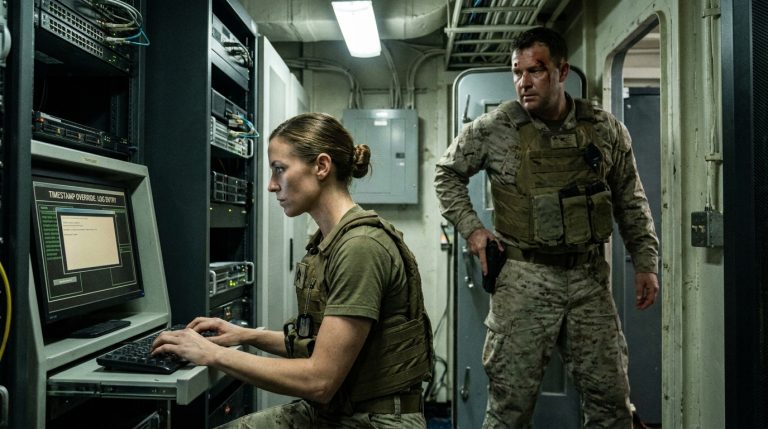
The apartment was empty, but it wasn’t silent. The laptop on the table was still powered on, its screen glowing with the blue, sterile light of an active terminal. Marcus stepped inside, his boots crunching on broken glass. He moved to the laptop. The screen displayed a list of encrypted file paths, each one corresponding to a member of the Six.
He looked toward the window. The curtain was billowing in the wind, a scrap of fabric torn from a larger whole. Beyond it, the city lights of Berlin flickered, a sprawling maze of potential threats.
“She’s gone,” Reaper said, his voice tight. He was standing by the closet, the floorboards pried up, the space beneath empty. “And they took the box.”
Marcus stared at the terminal. He didn’t look at the files. He looked at the window, at the way the rain was streaking the glass. He realized then that they weren’t just being hunted—they were being guided. Sarah hadn’t been captured; she had been used as a lure to draw them into the heart of the city, into a space where they could be cornered, documented, and eventually, silenced.
He turned back to Reaper, his expression as cold as the Montana ice.
“They don’t want us dead, Reaper,” Marcus said. “Not yet. They want us to see what they’re doing. They want us to watch the network dismantle itself.”
He pulled the USB drive from his pocket, the physical weight of it small, but the implications massive. They were no longer the hunters; they were the bait. And for the first time in a long time, Marcus Reeves felt the terrifying, exhilarating thrill of being a target.
“We leave,” Marcus commanded, holstering his weapon. “We go to the old meeting place. If Sarah is playing the game, she’s waiting. And if she’s not, then we’ve got a lot more than just a list of names to burn.”
They left the apartment, descending into the dark, rain-drenched streets of Wedding. The city seemed to close around them, the shadows lengthening as they walked. They were moving toward the center of the trap, their eyes fixed on the horizon, ready to engage a reality that was far more dangerous than any mission they had ever survived.
CHAPTER 6: THE APARTMENT TRAWL
Marcus didn’t touch the floor. He crouched, his boots balanced on the threshold of the closet, and scanned the disturbed dust with the detached focus of an examiner. The pattern was deliberate. Someone had not just taken the box; they had cleared the floorboards with a sweep that was far too clean for a panicked exit. This was a sanitization.
“Reaper,” Marcus said, his voice a low, disciplined rasp. “Don’t move. Look at the floorboards near the corner. Three inches from where the box was.”
Reaper stepped forward, his eyes narrowing as he crouched beside Marcus. He didn’t speak. He just pointed a calloused finger at the faint, oily residue—a smear of lubricant, the kind used for high-precision door hinges, not for household repairs.
“They didn’t just take the box,” Reaper whispered, his voice vibrating with a suppressed, cold rage. “They were looking for something else. Something connected to the sub-floor.”
Marcus shifted his gaze back to the laptop. The terminal was still active, a cascade of green text scrolling across the screen. He moved to the keyboard, his fingers hovering over the keys. He didn’t try to crack the encryption; that was Sarah’s domain. Instead, he pulled the USB drive from his pocket and slotted it into the port. If Sarah had been lured out, she would have left a breadcrumb—not in the files, but in the metadata of the trap itself.
He accessed the recent system logs. The last ping hadn’t been from the apartment. It had been from a mobile node, an encrypted handheld that was currently broadcasting from a distance of less than two kilometers.
“She’s moving,” Marcus said. “Or they’re moving her.”
He stood, the sudden movement causing his jacket to brush against the desk, sending a discarded coffee cup clattering to the floor. The sound was like a gunshot in the stagnant air of the apartment.
“We don’t go to the meeting place,” Marcus decided, the tactical landscape of Berlin shifting in his mind. “If they have her, the meeting place is the kill zone. We intercept the transport.”
“How?” Reaper asked. “The city is a grid. We move, they see us.”
“We don’t move like soldiers,” Marcus replied. “We move like the city.”
He checked his watch. It was 02:00. The streets below were slick with rain, the neon glow of the Wedding district reflecting off the puddles like blood on a wet canvas. He knew the layout of this neighborhood; he had spent months here during an exchange program years ago, memorizing the blind spots, the delivery routes, the forgotten access points that the tourist guides never mentioned.
They left the apartment, descending the stairs with the silence of ghosts. As they hit the alleyway, Marcus felt the familiar, biting cold of the Berlin night. He led Reaper toward a transit hub, an old U-Bahn tunnel that had been decommissioned after the wall fell. It was a cavern of rusted metal and forgotten concrete, a place where the shadows weren’t just absences of light, but solid, protective layers.
As they moved through the tunnel, Marcus noticed a discrepancy. A piece of graffiti—a red mark he hadn’t seen before—was sprayed onto the rusted support column. It was a symbol, a call sign he hadn’t seen since Kandahar. It was the mark of the Six.
He stopped. The air in the tunnel felt wrong. The hum of the city above was absent here, replaced by the rhythmic, dripping sound of condensation hitting the tracks. He placed a hand on the wall, feeling the vibration. Not from a train. From something heavier.
“Reaper,” Marcus murmured, his hand dropping to his holster.
Reaper didn’t need to be told. He was already in a low, defensive stance, his eyes scanning the pitch-black length of the tunnel.
A flashlight flickered on at the far end, the beam slicing through the darkness. It didn’t waver. It centered on them, a cold, clinical spotlight that revealed their position with absolute, terrifying clarity.
“Mr. Reeves,” a voice echoed through the tunnel—an accent that was sharp, polished, and unmistakably professional. “The General sends his regards. He thought you might find the trail interesting. But you’ve reached the end of it.”
Marcus didn’t move. He stood in the center of the beam, the light blinding, his silhouette a dark, immovable shape. He recognized that voice. It was the driver from Norfolk. The man who had been the General’s proxy.
“Where is she?” Marcus demanded, his voice a flat, dead calm that cut through the silence.
The light dimmed, but didn’t go out. A group of men emerged from the shadows, their movements coordinated, their weapons leveled. There were six of them. One for each badge, perhaps. The symmetry was too precise to be accidental.
“She’s exactly where she needs to be,” the driver replied, his voice devoid of malice, which made it all the more chilling. “She’s the bait that finally pulled you out of the shadows. And now that we have you, the rest of the list becomes… irrelevant.”
Marcus felt the shift in the tunnel—the tightening of the perimeter, the sound of safeties being clicked off. He wasn’t just a target; he was the final piece of a narrative that was about to be closed. He felt a sudden, sharp, and entirely unexpected surge of clarity.
They thought they knew who he was. They thought he was a ghost, a relic of a mission that had been scrubbed clean. They didn’t know that for four years, he hadn’t been hiding. He had been waiting. And the thing about shadows was that they were always connected to something solid.
He didn’t draw his gun. He looked at Reaper. A silent, instinctive communication passed between them—a language of shared survival that had been honed in fire.
“Now,” Marcus whispered.
He lunged for the support column, the rusted metal vibrating under his touch. As he pushed, the column—compromised by years of neglect and the deliberate tension of his own previous observation—shuddered. He didn’t aim for the men. He aimed for the architecture of the trap itself.
The tunnel began to groan, the ceiling above the men buckling as Marcus triggered the structural weakness. It wasn’t a choice; it was an inevitability. As the tunnel started to collapse, filling the void with tons of earth and rusted steel, Marcus and Reaper turned, disappearing into the labyrinth of the secondary service ducts, leaving their captors to deal with a reality they had never been trained to face.
CHAPTER 7: THE BARROOM CONFRONTATION
Marcus scrambled into the maintenance duct, his breath coming in ragged, shallow hitches. Beside him, Reaper was already moving, his rifle tucked close to his chest. The duct was cramped, a claustrophobic tube of corrugated steel that smelled of stagnant water and deep, ancient rot.
“The collapse won’t hold them,” Reaper grunted, his voice tight. “They’ll be through in ten minutes. Maybe less if they have heavy extraction gear.”
“We don’t need to be here for their exit,” Marcus replied. He crawled forward, his elbows scraping against the rusted edges of the steel. His mind was playing back the driver’s voice—the General sends his regards. It was a tactical admission. Harding wasn’t just directing the cleanup; he was watching the play. If the driver had been sent to bait them, then the meeting place was no longer just a potential trap—it was the designated site for the General’s final move.
They emerged from the duct into a damp basement underneath an abandoned warehouse three blocks away. Marcus didn’t pause. He moved toward the street-level exit, his tactical instincts overriding the physical ache in his joints.
“The bar,” Marcus said. “Zum Schwarzen Adler. If Sarah left that text, she knew we’d head there. But we have to assume the location is compromised. Hakeim’s people aren’t just hunting us; they’re herding us.”
“And if she’s already been moved?” Reaper asked.
“Then we find out who she was moved for.”
The city of Berlin at night was a tapestry of cold, rain-streaked neon. They moved through the back alleys of Kreuzberg, avoiding the main thoroughfares. Every shadow seemed to hold the potential for an intercept, but the streets were strangely empty, the city’s pulse dampened by the late hour and the persistent, biting drizzle.
Zum Schwarzen Adler was a relic, a hole-in-the-wall establishment that survived on the patronage of ghosts and the occasional, misguided tourist. As they approached, Marcus signaled for Reaper to hold back. He scouted the front, his eyes darting to the windows. The interior was lit by the dim, flickering amber of Edison-style bulbs. Three figures were inside: two men playing chess in the corner—their posture too rigid for casual players—and a woman sitting alone at a booth in the back, her face veiled by the low-hanging shadow of a hood.
Sarah.
Marcus didn’t approach through the front door. He moved to the side entrance, a heavy steel door that looked like it hadn’t been opened in a decade. He tapped it—a slow, rhythmic pulse. The door creaked, just enough to reveal a sliver of the interior.
Sarah was sitting with her back to the wall, her hands resting on the table. She wasn’t bound, but the way her gaze flickered toward the chess players told him everything. She was under surveillance.
Marcus pushed the door. It swung open with a screech of protesting hinges that cut through the low murmur of the bar. The chess players went rigid, their hands dropping to the small of their backs.
Sarah looked up. Her eyes, usually as sharp as a razor, were clouded with a fatigue that she couldn’t quite mask.
“You’re late,” she whispered, her voice a fragile reed.
Marcus stepped into the room, his presence shifting the air. He didn’t look at the chess players. He looked at Sarah, at the subtle, involuntary twitch of her shoulder—a injury, likely recent, and poorly treated.
“They know, Sarah,” Marcus said, keeping his voice a low, steady drone. “They know about the drive. They know about the Six.”
“They know everything, Marcus,” she replied, her gaze drifting toward the men in the corner. “They aren’t hunting us anymore. They’re managing us. The drive… it wasn’t insurance for us. It was a digital map of the General’s entire operational history.”
The chess players stood up. Their movements were coordinated, clinical. Marcus didn’t wait. He felt the cold iron of his Glock slide into his hand, the weight of it a familiar comfort. He didn’t fire at the men. He fired at the light fixture above them, plunging the corner of the room into instant, jarring darkness.
“Reaper!” Marcus shouted.
Reaper crashed through the front door, his weapon leveled. The bar erupted into controlled, tactical chaos. Marcus vaulted the table, reaching Sarah before the first man could recover his line of sight. He hauled her to her feet, his arm locked around her waist as he pulled her toward the service exit.
“Why is he doing it?” Marcus demanded, his voice barely audible over the sound of breaking glass.
“Because he’s not the architect,” Sarah hissed, her breath ragged. “He’s the janitor. He’s been cleaning up the mess since Kandahar, and he’s terrified of what happens when the floor finally gets too slippery.”
They burst out into the rain. The alleyway was dark, save for the rhythmic pulse of a distant siren. Marcus stopped, looking back at the bar, where the sound of shouting was being quickly drowned out by the metallic clatter of heavy-duty security doors being sealed.
They weren’t just running from an enemy; they were running from the entire command structure. Marcus looked at Sarah, then at Reaper. The hunt had moved from the physical to the structural, and the only way to survive was to stop being the targets and start being the architects of their own, final, and lethal move.
CHAPTER 8: THE WAREHOUSE AMBUSH
Marcus didn’t waste breath on survival. He hit the ground, the impact rattling his teeth as the warehouse’s internal skeleton groaned and surrendered to gravity. The demolition wasn’t just a distraction; it was a total environmental override. He rolled, his hand finding the grip of his Glock, his eyes tracking the red laser sights cutting through the settling dust like predatory fireflies.
“Reaper! Sarah!” Marcus barked, his voice straining against the ambient roar of settling brick and twisted rebar.
“Moving,” Reaper grunted from somewhere to the left, the sound punctuated by the dry, percussive crack of his rifle.
Marcus didn’t check for confirmation. He rose to a crouch, his peripheral vision catching the movement of Hakeim’s enforcement unit—men in tactical black, their movements too fluid for standard mercs. They were clearing the ruin with a cold, terrifying lack of hesitation. They weren’t looking for prisoners; they were looking for a body count.
He pulled the USB drive from his pocket. The light on the casing, once a steady, reassuring blue, was blinking with a frantic, low-power pulse. The decoy drive was dying. If the encryption failed before he could transmit the data to the hardline he’d seeded in the warehouse’s basement, the entire trap would be for nothing. He had minutes, maybe seconds, before the internal fail-safe triggered a complete wipe of the drive’s contents.
He sprinted toward the basement access, his boots slipping on the slick, oil-stained concrete. A bullet tore through the air beside his head, the snap so close it singed his ear. He didn’t blink. He dove behind a fallen girder, the impact bruising his shoulder, but he reached the hatch.
“Covering fire!” he shouted, his hand jamming the keycard into the reader.
Reaper and Sarah erupted in a synchronized, lethal response. The warehouse floor became a kaleidoscope of muzzle flashes and ricocheting lead. Marcus watched the reader—it remained red. The power grid had been cut during the collapse.
Think, he commanded himself, the pressure of the moment stripping away everything but the raw geometry of the problem. There’s an auxiliary line.
He scrambled beneath the hatch, his fingers finding the junction box he had wired two days prior. The wiring was frayed, hanging by a thread, but the connection was live. He bypassed the digital lock, hot-wiring the terminal with the rhythmic, steady precision of a man who had built his life on the edge of a blade.
The screen blinked to life. 15 percent.
He didn’t look back at the warehouse floor. He didn’t watch the men closing in. He stared at the progress bar, his mind cycling through the potential consequences of the data being exposed. If he transmitted, he didn’t just expose Hakeim; he exposed the vulnerability in the command structure that allowed Hakeim to exist. He exposed Harding.
The realization sat in his chest, a cold, hard knot. He had spent his life believing that the system was the shield. He was finding out, in the cold, dusty air of a dying warehouse, that the system was the source of the rot.
“They’re coming through the roof!” Sarah shouted, her voice laced with the sharp, acidic bite of impending failure.
Marcus didn’t look up. The drive reached 40 percent.
“Hold them,” Marcus ordered, his voice steadying. “Thirty seconds.”
He was back in Kandahar. The bunker. The smell of blood and burning plastic. The memory wasn’t a choice; it was a sensory intrusion, a psychological phantom that threatened to paralyze him. He could hear the screaming of the men he hadn’t saved, feel the weight of the bronze badge hanging around his neck.
Therefore. He did this, because the alternative was the erasure of everything he stood for.
The drive hit 80 percent.
A figure dropped from the ceiling, landing with a heavy, localized thud ten feet from the terminal. Marcus didn’t hesitate. He pivoted, his movement fluid and violent, and triggered two shots into the man’s center mass. The figure collapsed, but the distraction cost him—a grazing shot tore through the sleeve of his jacket, and the force of the impact threw him against the wall.
95 percent.
“Get out of there, Marcus!” Reaper’s voice was a roar, buried under the sound of a fragmentation grenade exploding near the entrance.
100 percent. Transmission complete.
Marcus ripped the drive from the slot and scrambled to his feet. The warehouse was becoming a furnace. The fire from the upper floors was dropping, a raining, liquid death that turned the floor into a mirror of flame. He didn’t look for the exit—he made one. He fired at a structural support near the western wall, the weakened metal finally giving way, punching a hole through the exterior.
He lunged through the gap, the cool air of the Berlin night hitting him like a resurrection. He landed on the wet asphalt, the cold rain extinguishing the smoldering fabric of his jacket.
Reaper and Sarah were already regrouping near the edge of the alley, their faces smeared with dust and dried blood. They didn’t ask if he had succeeded. They looked at the empty drive in his hand and then back at the inferno they had left behind.
“It’s out there,” Marcus said, his voice a ghost of its former self. “The entire network. Harding, Hakeim, the lot of them.”
“Now what?” Sarah asked, her hand pressing against her shoulder, the bandage soaking through with dark, crimson stains.
“Now,” Marcus said, looking back at the flickering lights of the city in the distance, “we see who comes to claim the debris.”
The war wasn’t over. They had just escalated it to a level where the shadows couldn’t hide the rot anymore. The hunt was no longer in the dark—it was going to happen in the open, and for the first time, the system had no choice but to face the ghosts it had created.
CHAPTER 9: THE DOUBLECROSS
Marcus stood in the center of the alley, the cold rain washing the soot of the warehouse from his skin. Beside him, Sarah was clutching her shoulder, her breathing rhythmic and shallow, each inhale a jagged reminder of the cost of their escape. Reaper was crouched at the mouth of the alley, his eyes scanning the horizon for the distinctive, low-profile signature of the General’s tactical response teams.
“The drive,” Sarah whispered, her voice barely audible over the relentless drumming of the downpour. “It wasn’t just a map. It was a beacon.”
Marcus looked down at the plastic casing. He felt a sudden, cold clarity. The transmission hadn’t just gone to Harding. It had been broadcasted across the entire tactical network—a wide-band signal that tagged their current position with the precision of a surgical strike. They hadn’t exposed the system; they had triggered a purge protocol.
“They’re not coming to capture us,” Marcus said, the realization hitting him with the force of a physical impact. “They’re coming to erase the data source.”
Reaper turned, his rifle raised. “We need a move. Now.”
“The old signal station,” Marcus commanded. “If we can reroute the broadcast through a local high-gain array, we can scramble the signal, mask our location, and force the network to dump the data onto a public server. It’s the only way to make this truth bulletproof.”
They moved as a singular, disciplined unit. The city was a maze of narrow, shadowed arteries, and Marcus navigated them with the predatory awareness of a man who had finally stopped running and started dictating the terms of his own survival. They reached the station—a decommissioned broadcast tower disguised behind a dilapidated industrial facade.
The interior was a graveyard of analog technology, thick with the smell of dust and stagnant air. Marcus didn’t bother with the lights; he worked by the faint, flickering glow of his tactical flashlight. He connected the drive to the station’s remaining primary uplink, his fingers flying over the manual override switches.
“Harding is going to see this the moment the packet hits the main hub,” Reaper noted, guarding the door.
“Let him,” Marcus gritted out. “By then, the entire global tactical infrastructure will be looking at his history.”
The progress bar on the station’s monitor began to climb, a slow, agonizing crawl that reflected the tension of the room. 10 percent. 20. Suddenly, the station’s internal alarms flared—a shrill, ear-piercing wail that signaled an external override. Harding hadn’t just been waiting; he had been preempting every move they made.
“They’re bypassing the link!” Sarah shouted, scrambling to the terminal. “They’re attempting a hard-kill on the server!”
Marcus didn’t flinch. He reached into his duffel, pulled out the K-Bar knife, and jammed it into the primary power shunt, a desperate, analog solution that sent a cascade of sparks raining down onto the floor. The terminal hummed, a high-pitched whine that signaled a complete, system-wide blowout.
The screen went black.
“Did it take?” Reaper asked, his voice strained.
Marcus stared at the dark monitor, his chest heaving. The silence that followed was total, an absolute absence of sound. Then, a single, flickering light on the console shifted from red to green. A steady, unblinking green.
The data was gone. Not deleted, but released.
Outside, the first of the tactical vehicles skidded into the industrial park, their high-beams slicing through the rain like surgical blades. Marcus looked at Sarah and Reaper, his expression devoid of the exhaustion that had plagued him for the last four years.
“It’s out,” he said.
He didn’t wait for a reply. He reached into his pack, pulled out the last of their gear, and signaled for the exit. They hadn’t just survived the ambush; they had turned the system’s own infrastructure against its master. Harding was no longer a General directing a mission; he was a man being hunted by the very truth he had spent his life burying.
The transition to the final phase of their survival began not with a fight, but with the cold, absolute certainty of an ending.
CHAPTER 10: THE HARDING DIVERGENCE
Marcus didn’t waste time on the sirens. He turned toward the alley’s far end, toward the heavy industrial door that led into the guts of the facility. “Move,” he ordered. His voice was steady, but his heart was a drumbeat of forced acceleration.
They breached the facility’s lower levels, moving through the labyrinthine maintenance tunnels that ran beneath the city like necrotic veins. Every turn was an exercise in calculated friction. The General’s reach was vast, but it wasn’t omnipotent; Harding’s arrogance was his Achilles’ heel. He assumed Marcus would run for the perimeter. Instead, Marcus was heading toward the administrative core—the central nervous system of the General’s local command node.
As they reached the heavy blast door of the server room, Marcus stopped. He didn’t use the keycard. He used the emergency maintenance bypass he had memorized from the sub-basement files in Norfolk. The door slid open with a hiss of pressurized air, revealing a room bathed in the sterile, unblinking red of an emergency lighting array.
Inside, the servers were dead—purged, wiped, and silenced.
Sarah moved to the central console, her face pale in the emergency red, her hands trembling as she pulled a portable drive from her kit. “They’re scrubbing everything. If we don’t get a snapshot of the primary register, we have nothing but a story.”
Marcus turned to the emergency kit mounted on the wall. It was a standard, ruggedized container, but it had been tampered with. He pried it open. Inside wasn’t a first-aid kit; it was a physical ledger. He flipped through the pages—ink-stained, handwritten, and terrifyingly detailed. It was a record of payments made to an entity that, according to the military database, didn’t exist. The contractor.
He stared at the names. They were the Six. And next to their names were the dates, the locations, and the final, brutal payments made for their “disposal.”
“It wasn’t Hakeim,” Marcus whispered, the realization shattering his final, fragile hope. “Hakeim was just the subcontractor. Harding didn’t lose control of the mission. He sold it.”
Reaper stepped beside him, his eyes scanning the ledger. The silence that filled the server room was heavy, thick with the weight of four years of stolen lives. They had spent years punishing themselves for the deaths of their brothers, for the failure of a mission they thought was pure. The truth was far more visceral: they had been liquidated to protect a ledger of corruption that reached all the way to the top of the command chain.
Suddenly, the red emergency lights died, replaced by the harsh, white glare of the overheads. A voice crackled through the facility’s PA system, calm, clinical, and chillingly familiar.
“Marcus. Reaper. Sarah.” General Harding’s voice. “You have performed remarkably well. You’ve managed to expose a narrative that was never meant for the public domain. But you are standing in a room filled with evidence of your own unauthorized entry—and your own complicity in the destruction of federal property.”
“We’re not the ones who should be in this room, General!” Marcus shouted, his voice echoing off the sterile metal walls.
“The world doesn’t care about ‘should,'” Harding replied, his tone shifting into something that wasn’t just authority—it was a confession. “The world cares about order. And you three? You are the final chaotic variable that needs to be factored out.”
The doors leading into the server room sealed, the heavy hydraulic locks engaging with a definitive, mechanical finality. Outside, Marcus could hear the sound of boots on concrete, hundreds of them, closing the distance.
Marcus looked at the ledger. He looked at the server banks that were now nothing but expensive, dead plastic. They were trapped, outgunned, and stripped of their leverage. The escalation had reached its peak.
“We don’t get out of this through the door,” Marcus said, his eyes scanning the ceiling. “We go through the infrastructure.”
He gestured to the ventilation shaft, the only path that remained. It was narrow, choked with wiring, and likely booby-trapped. But it was the only direction left to go.
“Reaper, you lead. Sarah, you have the ledger?”
She nodded, clutching the book to her chest like a shield.
“Then let’s show the General how a ghost leaves a room,” Marcus said.
As they ascended into the narrow, claustrophobic darkness of the shaft, the server room behind them began to fill with the smoke of an impending tactical sweep. The hunt had been stripped of its illusions. They weren’t just fighting an enemy anymore; they were fighting the inevitable, brutal momentum of a system that would crush anyone who dared to look behind the curtain. And as the sound of the blast door being breached echoed through the shaft, Marcus realized that the only way to win was to ensure that the truth—the real, raw, and ugly truth—was already in the hands of someone the General couldn’t touch.
CHAPTER 11: THE SILENT HAMMER CLIMAX
The drop was fifteen feet, but to Marcus, it felt like a fall through time. He hit the polished concrete of the bunker’s floor with the calculated, heavy impact of a man who had left behind all pretense of stealth. Reaper and Sarah followed, the trio forming a compact, lethal shadow in the center of the General’s inner sanctum.
The room was vast, dominated by a wall of monitors displaying the global tactical network—the same infrastructure that had been used to hunt them. General Robert Harding stood at the center, his back to them, his hands clasped behind him as he watched the live feed of the empty warehouse they had just escaped.
He didn’t turn around. “You’ve made a significant error, Marcus. You think this is a struggle between truth and power. It is not. It is a struggle between stability and chaos.”
Marcus raised his Glock, the red dot of his laser sight dancing on the General’s spine. “The ledger is out, Robert. The network is bleeding. Stability is gone.”
Harding finally turned. His face was devoid of the paternal mask he’d worn in the infirmary. He looked old, tired, but terrifyingly composed. He looked at the ledger Sarah clutched against her chest, then at the empty USB drive in Marcus’s hand.
“You believe that ledger is the truth,” Harding said, walking slowly toward a desk that was cluttered with nothing but a single, heavy brass compass. “You believe that you were the ones being manipulated. But look at the logs on the screen, Marcus. Look at the date of the Kandahar mission.”
Marcus glanced at the monitors. The numbers flickered, a sequence of data points that shouldn’t have existed.
“Kandahar wasn’t the start,” Harding continued, his voice dropping to a low, intimate murmur. “It was the end of a process that started decades ago. The diplomats weren’t the targets. They were the key to an intelligence nexus that kept the world from falling into open, kinetic conflict. I didn’t sell those men to protect my career. I sold them to protect the baseline of global order. A choice you would have made yourself, had you been in my position.”
“I would have let them die in the field,” Marcus spat, his finger tightening on the trigger. “I wouldn’t have put a price tag on their names.”
“That is exactly why you were a soldier, and why I had to be the General.”
Harding reached for the brass compass, his movements slow, deliberate. “You want justice? Here it is. The network you’ve exposed will collapse within the hour. The chaos that follows will be yours to witness, the consequence of your ‘truth.’ But you will not be around to see it.”
The security detail moved, flooding the room from the side corridors. Marcus, Reaper, and Sarah didn’t scramble. They stood their ground, their weapons locked on the General. The stalemate was absolute.
“You’re going to kill us?” Sarah asked, her voice steady despite the blood staining her sleeve. “In your own bunker? That’s going to be a hard truth to bury, General.”
Harding looked at them—really looked at them—for the first time. The arrogance flickered, replaced by a momentary, haunting reflection of what they all had been: soldiers who had once believed in the mission.
“I don’t have to bury you,” Harding said. “The system will do it for me. It is designed to self-correct.”
Marcus saw the trigger. Not on a weapon, but on the console behind Harding. The General’s hand shifted, hovering over an emergency lockdown that would vent the room’s atmosphere.
Marcus didn’t wait. He didn’t shoot Harding. He shot the fire suppression system’s pipe above the console, the high-pressure release of halon gas instantly filling the room with a freezing, blinding fog. The bunker erupted into white, a suffocating, disorienting haze.
“Now!” Marcus shouted.
Reaper fired—not at the guards, but at the monitors, systematically dismantling the infrastructure of Harding’s control. Sarah surged forward, her shoulder screaming in protest, and slammed the ledger onto the desk, pinning Harding’s hand to the console before he could trigger the vent.
The struggle was brief, brutal, and entirely devoid of the honor Marcus had once attributed to the profession. It was a contest of desperate, kinetic survival. Marcus grappled with Harding, their bodies crashing into the console, the weight of their shared history bearing down on them.
“You’re a ghost, Marcus!” Harding hissed, his grip on Marcus’s throat slipping.
“Then look at me,” Marcus growled, forcing the General’s head toward the shattered monitors where the data streams were now scrolling in a public, uncensored flood. “The ghosts are home.”
Marcus shoved Harding back, the General hitting the concrete with a final, hollow thud. He didn’t move. The network screens were dead, replaced by the scrolling black of a system failure. The bunker, once the heart of a global power, was now just a room filled with the sound of three people breathing, and the long, slow, final ticking of a brass compass rolling across the floor.
CHAPTER 12: THE HORIZON CHECK
The room didn’t just feel empty; it felt erased. The once-towering monitors were now hollow frames of black glass, and the hum of the global network had been replaced by the high-pitched, insistent whine of a ventilation system struggling to reset itself. Marcus stood over Harding, his chest heaving, his hands raw from the struggle. The General was a broken line on the floor, his uniform torn, his eyes fixed on the ceiling with a vacant, shattered stare.
“It’s over,” Sarah whispered, her voice barely audible. She was leaning against the central console, her face drained of color, her wound weeping dark onto the sterile tile.
Marcus didn’t move. He looked at the brass compass lying near Harding’s hand. He reached down and picked it up. The needle wasn’t pointing north; it was spinning, locked in a erratic, aimless dance, mirroring the state of the command structure that had collapsed around them.
“The systems are dead,” Reaper said, his rifle now slung across his back, his posture loose—a soldier finally stepping off the line. “But the people who run them aren’t. They’re coming, Marcus.”
Marcus nodded. He walked to the center of the room and looked at the ledger, then at the dead servers. The five-pillar catharsis wasn’t coming in the form of a parade or a medal. It was coming in the form of the hard, cold reality of a life that had been reclaimed from the shadows.
He walked over to the console where Sarah had managed to download the final, un-scrubbed records of their own files. He took the device, looked at his own name—Marcus Daniel Reeves—and then deleted the entry. He wasn’t a ghost anymore, and he wasn’t a weapon. He was just a man.
“We leave through the loading bay,” Marcus said. “Reaper, take the ledger. Sarah, keep the record.”
They moved through the bunker, the facility’s automated security systems now flickering in a state of terminal, confused failure. The doors stood open, the sensors blinded by the crash they had initiated. As they exited into the loading bay, the dawn was beginning to break over the industrial park—a thin, gray line of light that promised nothing, but obscured nothing, either.
The Payoff arrived not in a flash of glory, but in the sight of the authorities arriving at the gates—not to arrest them, but to investigate the total, systematic implosion of their own infrastructure. The Poetic Justice was watching Harding’s command node burn from the inside out, the collapse of his reputation as absolute as the collapse of his servers.
They reached the perimeter fence, the same fence Marcus had once crossed as a man trying to disappear. He paused, looking back at the facility. He reached into his pocket, pulled out the bronze badge with the Roman numeral ‘VI’—the badge he had once thought was his only identity—and dropped it into the oil-stained mud of the loading bay. He didn’t need the artifact to remember the cost. The scars on his knuckles and the quiet in his mind were more than enough.
The Cool Down set in as they hiked toward the tree line, the adrenaline fading into a dull, manageable ache. The world was cold, the air thin, but it felt, for the first time in four years, like the world he was supposed to inhabit.
“What now?” Reaper asked, his voice low.
Marcus stopped, looking out toward the horizon where the first real light of the morning was hitting the peaks. “We live. We fix what we can. And we make sure that when someone else stands in the gap, they know the cost.”
He reached out, his hand finding the rusted, cold metal of the fence for a brief, tactile moment—a symbolic closure, the final repair of the man who had been broken by the machine. He had been a predator, then a ghost, and finally, a protector.
The three of them stood there, three survivors in a landscape that had tried to consume them. There was no grand speech, no triumphant music. There was only the shared, quiet connection of people who had been to hell and back, and who had realized that the real victory wasn’t in winning the war, but in choosing to keep their humanity when the war was finally done.
Marcus took a breath, the air clean and sharp, and started walking toward the light. He wasn’t looking back. He was, at long last, moving forward.