The Echo of the Trident: A Veteran’s Quiet Return to the Light of Common Humanity
CHAPTER 1: THE SHATTERED GLASS
The air on Pier 14 was heavy with the smell of salt and low tide, a damp, rotting scent that had been the backdrop of Marcus’s life for six years. He sat against the weathered wooden post, his spine aching, his head tilted forward, listening to the rhythmic slap of the Atlantic against the pylons. He wasn’t waiting for anything. He was simply existing, a ghost occupying a space the world had deemed empty.
Then, the laughter started. It was loud, synthetic, and sharp—the sound of men who hadn’t yet learned that the world was built on brittle foundations.
“Hey, what’s your rank, Captain Cardboard, Admiral of the Dumpster Division?”
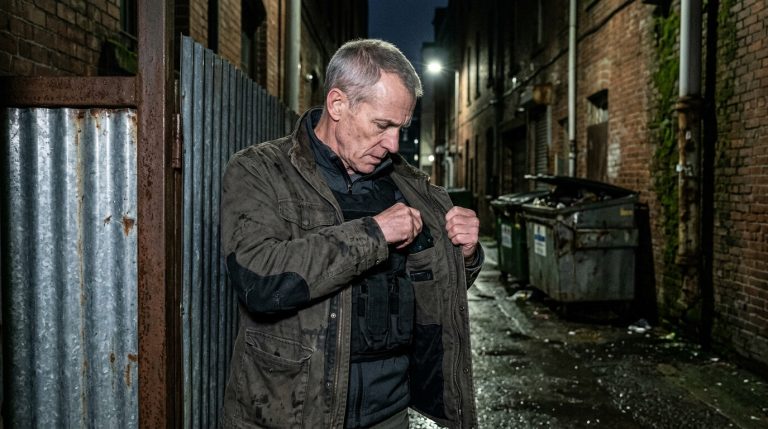
Marcus didn’t flinch. He didn’t need to. He knew the type—the clean uniforms, the polished bars, the arrogance of someone who had never seen the sky turn black with smoke. He kept his hands folded in his lap, his fingers tracing the jagged, unseen scars on his palms.
“I’m talking to you,” the voice barked, closer now. The smell of expensive bourbon drifted over him, thick and cloying.
When the Lieutenant crouched, Marcus could feel the man’s heat, a stark contrast to the biting November wind. He watched, through the curtain of his own matted hair, as the man’s boot scuffed the wood—a deliberate, provocative movement.
“You smell like failure, old man,” the Lieutenant whispered, the mockery replaced by a predatory edge. “Does it hurt? Knowing you’re invisible? That nobody cares?”
Marcus felt a familiar, cold weight settle in his chest. It wasn’t anger. It was the calculated calm of a weapon being readied. He slowly unclenched his hands.
“Captain,” Marcus said. The word was a heavy stone.
He lifted his head, his eyes meeting the Lieutenant’s. The younger man’s confidence wavered, a flicker of genuine confusion crossing his face. Marcus reached into his jacket, his movements slow and deliberate, and produced the plastic-sealed ring. The bronze trident caught the fading, bruised light of the sunset.
He didn’t scream. He didn’t boast. He simply rolled back his sleeve, exposing the dark, indelible ink on his forearm: the coordinates of a massacre and the date he had lost everything.
The dock turned deathly still. The Lieutenant’s jaw slackened, his mouth hanging open like a rusted gate. The hand holding the bourbon bottle began to tremble. When the glass hit the wood, the sound was like a thunderclap in the void. Marcus looked at the shattered fragments—sharp, dangerous, and irrevocably broken—and realized that the quiet life he had built under the pier was over.
He hadn’t just revealed his past; he had accidentally pulled the thread that held this young man’s entire reality together. And in the distance, past the breakwater, the dark silhouette of a naval destroyer let out a long, mournful blast, as if acknowledging the ghost that had finally stepped back into the light.
Marcus stood, the joints in his knees grinding in protest, and looked at the terrified face of the boy who had tried to mock a dead man. The air was suddenly thinner, charged with an unspoken realization: this wasn’t just a confrontation on a pier; it was an interrogation of a history that should have stayed buried.
CHAPTER 2: THE ANATOMY OF SILENCE
The shattered glass caught the dim light of the overhead harbor lamps, scattering into a thousand jagged, sparkling fragments. Marcus didn’t look at the mess. He didn’t look at the faces of the people who had, moments ago, been laughing at his existence. He kept his gaze locked on the horizon, where the dark water met the darker sky, feeling the weight of the air change from casual arrogance to sharp, metallic dread.
Lieutenant Brad Connelly stood frozen, his hand still suspended in the air where the bottle had been. His face had gone from a flush of drunken confidence to a sickly, pale gray. He looked at the shards on the dock, then at Marcus’s hands—calloused, scarred, and completely steady—and finally at the tattoo on Marcus’s forearm. The coordinates seemed to pulse in the low light, a graveyard etched in ink.
“I…” Brad began, his voice cracking, a high, thin sound that didn’t belong to a Naval officer. He stepped back, his polished boot catching on the edge of a damp wooden plank. The pier groaned beneath his sudden, clumsy movement, the wood slick with the mist rolling in from the Atlantic. He swayed, reaching out to steady himself against a rusted pylon, his fingernails scraping against the peeling, salt-bitten paint.
Marcus didn’t move. He stood like a statue carved from the very geography of the waterfront—worn, weathered, and indifferent to the turmoil he had caused. He watched the Petty Officer, Garcia, who had finally moved. The man’s face was a map of conflict, his eyes darting from the trembling Lieutenant to the man who was, by every measure of their trade, his superior in blood and history. Garcia’s hand was still hovering near his forehead in that rigid, reflexive salute, his own breathing coming in shallow, ragged bursts.
“Sir,” Garcia whispered, the title finally landing with the gravity it deserved. “I didn’t—we didn’t know.”
Marcus didn’t acknowledge the salute. He felt the cold dampness of the fog seeping through his layers—the torn Carhartt, the stained flannel, the threadbare shirts. He was cold, but it was an old cold, one that lived in his bones and had nothing to do with the weather. He felt the weight of the $20 bill in his pocket, a small, paper ghost of the young recruit’s empathy, and the heavy, bronze ring tucked into his jacket.
“You don’t have to know,” Marcus said. His voice was like grinding gravel, a sound meant for communication, not conversation.
He moved to step around the broken glass, but the rain, light and persistent, began to fall, slicking the already treacherous wood. He felt his heel slide on a patch of algae-covered timber, and for a fleeting second, he had to reach out and grab the pylon to balance himself. The physical exertion burned in his shoulder—an old ache, a reminder of the night in Beirut that never quite ended.
The woman, Kelly, had moved closer to the railing, her face shielded by her hands. She wasn’t looking at Marcus anymore; she was looking at the scene as if she had just witnessed a man fall from a great height.
“Brad,” she said, her voice shaking. “We need to leave.”
“I…” Brad started again, his eyes wide, reflecting the harbor lights in a frantic, unmoored way. He looked at the onlookers, the two lieutenants who were now effectively trying to blend into the shadows of the dock, their laughter vanished, replaced by the crushing weight of their own cowardice. “I was just… we were just having a drink.”
Marcus ignored him. The necessity of his own rhythm, the survival cycle he had perfected over six years, pulled at him. Wake, fold the sleeping bag, find the church, watch the water, disappear. But the center of that rhythm had just been fractured. He saw Garcia pull his phone out, his fingers fumbling with the screen. He was already calling someone. The military machine was beginning to stir, a massive, sluggish beast that only woke up when something was broken.
Marcus looked at the recruit, the kid who had been watching from the shadows, his face illuminated by a mix of shock and a strange, quiet reverence. The kid didn’t look away. He stood rooted to the spot, perhaps realizing that the “hero” his father had spoken of wasn’t a marble statue, but a man made of meat, blood, and profound, jagged exhaustion.
Marcus turned his back on them. He didn’t want the apology. He didn’t want the realization. He wanted the anonymity of the darkness.
“Sir, wait!” Garcia shouted, stepping forward, his boots clattering on the wood. “The base commander… he needs to be informed. You can’t just walk away.”
Marcus didn’t stop. He walked with a limp he usually masked, his boots finding the familiar gaps in the boards. The rain was picking up, the sound of it tapping against the hollow barrels near the entrance of the pier like a funeral march. He walked past the recruit, who stepped aside as if giving a king the right of way, and headed toward the gravel path that led to the city’s underbelly.
He was being hunted now, he realized. Not by enemies with RPGs, but by an institution that would want to wrap his story in a flag, strip away its edges, and use it to scrub the stains off men like Brad Connelly. He felt the cold iron of the dock railing under his hand for one last moment before he stepped off the wood and onto the wet, dark earth. He was no longer just a man sleeping under a pier. He was a variable in a calculation he had spent years trying to escape.
CHAPTER 3: THE COMMANDERS REACH
Marcus didn’t look back. The rhythmic crunch of his worn boots against the loose, water-logged gravel was the only sound in the world, save for the low-frequency hum of the city beyond the warehouse district. The rain had intensified, turning the night into a blurred palette of desaturated greys and deep, ink-like shadows. Each step was a calculated decision, a choice to keep moving forward despite the protests of his knee and the heavier, more persistent ache in his chest—an ache that hadn’t been there before tonight.
He was navigating by the geography of survival. He knew the alleyways that led away from the pier, the ones where the city light didn’t reach, the ones where the smell of rotting fish was replaced by the stale, metallic scent of damp concrete and refuse. He expected, with a cold, detached part of his brain, to hear the siren. He expected the flashing blue and white lights to cut through the rain, signaling that the system had recognized a disruption in its order and was moving to neutralize it.
But the night remained quiet. That, more than anything, unsettled him.
He reached the shadow of a rusted shipping container, its corrugated sides dripping with condensation. He paused, pressing his back against the cold steel, the metal biting through the layers of his jacket. His breathing was slow, practiced. He waited for the adrenaline to subside, but it clung to his system like salt residue. He looked at his hands, steady even now, and then at the faint, rhythmic movement of his chest. He was in his element, yet he felt like an intruder in his own life.
He knew what the next move would be. When he hadn’t shown up at the church on Broad Street by morning—or even if he did—the military would find him. They wouldn’t come with weapons drawn; they would come with folders, with offers, with the terrifying, suffocating politeness of an institution trying to bury its own mistakes. The fact that the base commander was already involved meant that the “ghost” was no longer being ignored; he was being audited.
He reached into his pocket, his fingers brushing against the bronze ring. It felt smaller than he remembered, or perhaps his hands were just larger, swollen by the damp and the cold. He thought of Garcia’s face on the pier, the way the man had looked at him not with pity, but with a sudden, devastating recognition of what had been lost. That wasn’t just shock. That was the look of someone who knew that Marcus’s existence was a live grenade in the base’s internal affairs.
He pushed off the shipping container and continued into the labyrinth of the industrial zone. He wasn’t heading to his usual sleeping spot; he needed a transition. He needed to be somewhere the patrol cars wouldn’t immediately look—a derelict rail yard three blocks inland where the tall, dry grass still offered a vestige of concealment.
As he walked, his perception of the city shifted. The familiar shadows felt less like hiding places and more like a stage. He saw the flicker of a distant neon sign, its light warped and fractured by the rain, and for a split second, it reminded him of the lights of Beirut, the way they had danced on the water before the world ended. He blinked, shaking the phantom image from his mind. It was a failure of focus, a dangerous lapse into the past.
He was halfway to the rail yard when he saw the headlights.
They didn’t sweep the area with the aggression of a police cruiser. They moved slowly, deliberately, a pair of black, non-descript SUVs rolling with the muted power of official vehicles. They turned onto the service road that paralleled his path. Marcus didn’t run. Running was an admission of guilt, a provocation. He simply shifted his trajectory, ducking behind a stack of weathered timber pallets, and merged into the darkest part of the path.
He watched the vehicles glide past. They were looking for something—or someone—but they were looking too high, their spotlights scanning the street-level horizon rather than the low-slung shadows where a man who knew how to be invisible would be hiding.
He realized then that they weren’t just looking for a veteran. They were looking for a piece of intel. They were looking for the story he represented.
He waited until the tail lights faded into the rain before he moved again. His muscles were tight, humming with the static of a trapped animal. He reached the rail yard, the scent of creosote and wet iron heavy in the air. He curled up beneath the skeletal frame of an abandoned cargo car, pulled his coat tight, and stared into the dark. He wasn’t sleeping tonight. He was waiting. And he knew, with the cold, cynical clarity of a man who had survived traps before, that the conversation he had avoided on the pier was merely postponed. The system had found its target, and it wasn’t going to stop until it had successfully rewritten the narrative of the last six years.
CHAPTER 4: THE APARTMENT OF MIRRORS
The sound was faint—a soft, mechanical chick-chick—but to Marcus, it was a thunderclap. He didn’t breathe. His hand, already buried in the grit of the rail yard, moved with the muscle memory of a man who had survived on instinct for half a decade. He rolled, shifting his weight onto the balls of his feet, pressing his back against the rusted iron frame of the cargo car.
“I know you’re there,” a voice called out, but it wasn’t the command of a soldier. It was thinner, nervous.
A figure stepped from the gloom, holding a camera like a shield. It was the young recruit from the pier, the one whose father had served. He looked smaller here, away from the docks, his uniform jacket replaced by a damp hoodie that clung to his frame. He wasn’t armed, but the look in his eyes was one of desperate, frantic curiosity.
Marcus surged forward, closing the distance in a low, predatory crouch. He didn’t strike; he simply crowded the kid, backing him against a stack of rotting railroad ties until the recruit’s heels hit the wood with a dull thud. Marcus gripped the boy’s collar, his own face a mask of iron.
“You’re following me,” Marcus said. The words were a flat statement of fact.
“I… I just wanted to see,” the kid stammered, his eyes darting to the camera. “My dad… he told me you were a myth. I had to know if you were real.”
Marcus let go, disgusted. He didn’t have time for hero-worship. He looked at the camera, then at the boy’s trembling hands. The kid didn’t understand the machinery he was touching. He didn’t know that by taking a picture, by following a ghost, he had marked Marcus for the very people he was trying to hide from.
Before Marcus could speak, the sound of an engine—a low, idling purr that seemed to vibrate through the gravel—reached them. It was the same pitch, the same rhythmic cadence as the vehicles that had rolled past earlier. It was a sound that belonged to the night of the ambush, a sound that triggered the phantom heat of a burning Humvee behind Marcus’s eyes. He didn’t hesitate. He grabbed the recruit by the arm and shoved him into the deep shadow behind the cargo car.
“Stay down,” Marcus hissed.
The vehicles were back. They weren’t just patrolling; they were sweeping. A spotlight cut through the rain, an aggressive, searching beam that turned the gravel into a field of white, blinding heat. It passed over the car, lingered on the rusted iron, then moved on. The system wasn’t looking for a vagrant; it was performing a surgical extraction.
Marcus stayed prone, the mud soaking through his clothes. He watched the recruit out of the corner of his eye. The kid was hyperventilating, his jaw clenched, his entire posture screaming the same terrified vulnerability Marcus had felt on the night the world ended. The sight of it sent a jolt of something sharp and painful through Marcus’s chest. It was the “Kintsugi” of their shared pain—the kid had cracked the porcelain of his own innocence, and Marcus was the jagged edge that had done it.
“They aren’t looking for you because they care,” Marcus whispered, the words barely audible over the rain. “They’re looking for you because I’m a problem they haven’t solved yet. You go home. You destroy that camera. If they find you with those images, you won’t be a hero. You’ll be a liability.”
The kid looked up, his eyes searching Marcus’s face, looking for the legend, but finding only the man. “What about you?”
“I don’t exist,” Marcus said, his voice cold, final.
He stood, ignoring the protests of his joints. The vehicles had reached the end of the service road and were beginning to circle back. He had to move. He left the recruit in the shadows and began the long, grueling trek toward the city center. He needed to get to the VA housing complex. Not because he wanted the sanctuary, but because that’s where they would eventually push him. The apartment they had given him—the “housing solution”—was a cage, designed to keep him in a predictable grid where the Base Commander could monitor the “problem.”
He walked for three miles, his boots heavy with mud, his lungs burning with the sharp, acidic bite of the rain. When he finally reached the drab, brick-faced building, he didn’t use the front entrance. He scaled the rear fire escape, his movements fluid and silent, a ghost haunting the architecture of a society that didn’t know how to look at him.
He slipped into the apartment, the air inside smelling of stale heat and antiseptic. It was a box, a space defined by white walls and a view of the ocean he never looked at. He walked to the kitchen table, where the framed photo of his team sat. He picked it up, staring at the faces of the men who had been his world. Then, he looked at his own reflection in the window glass—gray, unkempt, a relic of a war that had been officially erased from the public record.
He pulled the bronze ring from his pocket and set it on the table next to the photo. For the first time, he didn’t see a burden. He saw a key. The military had given him this apartment to hide him, to silence him, to keep the “Longshot” legend from becoming a scandal. They wanted him to play the broken veteran, a quiet, grateful recipient of their charity.
But as he sat in the dark, the sound of sirens finally approaching in the distance, he realized that by placing him in this apartment, they had given him a window. And if he was being hunted, he might as well learn who was doing the targeting. He picked up the phone that had been installed by the VA, its dial tone sounding unnaturally loud in the empty room. He had been a weapon for the Navy. He had been a ghost for the streets. It was time to see if he could still be a soldier.
He didn’t call the police. He didn’t call the base. He dialed the only number he had in his journal—the number of a reporter who had written a piece on the Beirut mission three years after the fact, a woman who had asked questions no one else had the courage to voice. The line clicked open. Marcus didn’t speak. He just waited, his hand steady, his eyes fixed on the door. He was no longer hiding; he was preparing for the audit.
CHAPTER 5: THE HIDDEN FILE
The line remained open, a soft hiss of static suggesting the reporter on the other end was waiting. Marcus didn’t hesitate. He dropped the receiver into the cradle, the plastic clattering with a sound that felt like a gavel strike in the sterile room. He didn’t have time for a conversation; he had time for a search.
He moved away from the table, his eyes scanning the apartment with the predatory focus of a man who knew exactly what he was looking for. The VA had “helped” him by providing this place, but they had also been sloppy. In their arrogance, they had assumed a man who had spent six years sleeping under piers wouldn’t know how to look for the seams in their design.
He walked to the small, veneer-covered desk in the corner. It was a cheap, government-issue piece of furniture, utilitarian and hollow. He ran his calloused fingertips along the underside, feeling for a false panel or a magnetic latch. His hands, though swollen and stiff from years of rough living, possessed a mechanical precision. He stopped at the center drawer. It didn’t sit flush with the frame. There was a fraction of a millimeter of misalignment—a physical discrepancy that shouted for attention.
He pulled. The drawer didn’t slide out; it jammed against a hidden stop. Marcus didn’t force it. He tapped the wood, listening to the hollow echo, then tilted the entire desk, feeling the weight shift inside the frame. A small, black object slid from the interior cavity—an unmarked USB drive.
He didn’t have a computer. He didn’t need one. He looked at the device, his heart rate remaining a steady, rhythmic thud against his ribs. He knew what this was. It was the “insurance” the base command kept, the leverage they held over anyone who got too close to the truth of the 2015 Beirut operation. He didn’t need to see the files to know they existed; he just needed to know where the lock was.
The electronic chirp at the apartment door cut through his concentration.
It was a badge swipe. The kind issued to VA staff, or perhaps someone with higher security clearance—someone who didn’t knock. Marcus moved to the corner of the room, his body sliding into the shadow of a heavy, floor-to-ceiling curtain. He didn’t reach for a weapon; he reached for the tactical reality of the space. He knew the windows were too high, the door was the only egress, and whoever was on the other side was likely not coming for a wellness check.
The door swung open with a hiss of compressed air. A man stepped in, silhouette framed by the harsh hallway light. He was dressed in a standard maintenance uniform, but his posture was all wrong. He didn’t check the light switch. He didn’t glance at the heater. He moved with the calculated, scanning efficiency of a professional. He was looking for Marcus.
Marcus watched him. The man moved toward the desk, his hand reaching for the small, concealed compartment Marcus had just vacated. The intruder’s focus was entirely on the furniture, his movements fluid, almost arrogant in their confidence.
Marcus could have let him find the empty space. He could have watched, waited for the man to realize the drive was gone, and then used the distraction to slip out the door. But the rage that had been simmering for six years—the rage against the silence, against the medals pinned to his chest while his brothers died, against the bureaucracy that had turned his life into a file on a government drive—boiled over.
He stepped out of the shadow.
“You’re looking for this,” Marcus said.
The intruder spun, his hand flying to his waistband, but he was a fraction of a second too slow. Marcus didn’t strike with a fist; he moved through the man’s guard, his shoulder driving into the intruder’s diaphragm with the force of a battering ram. The man gasped, the breath leaving him in a wet, ragged wheeze, and Marcus followed with a precision strike to the base of the neck, a move designed to incapacitate, not kill.
The man crumpled to the floor, his face hitting the thin, institutional carpet. Marcus stood over him, his breath coming in measured, icy hitches. He looked down at the intruder, his eyes devoid of anything resembling empathy. He wasn’t a hero anymore. He wasn’t a veteran returning to the light. He was a ghost who had finally decided to haunt the people who had tried to bury him.
He reached down and pulled a radio from the intruder’s belt. It crackled with a burst of static, a voice—cold, detached—asking for a status report.
Marcus held the radio, his thumb hovering over the transmit button. He looked at the photo of his team, then at the unconscious man at his feet. The decoy secret—the “PR salvage” operation—had just been shredded. He knew now that the truth went much deeper than a simple cover-up of a bad mission. It was a system built on the erasure of people like him.
He clicked the transmit button. “Status: compromised,” Marcus said, his voice a low, gravelly promise of what was to come.
He didn’t wait for a reply. He walked to the door, stepped over the man’s body, and headed for the stairwell. He wasn’t leaving. He was going to the base. If they wanted a ghost, he would give them a nightmare. The final truth—the Layer 2 reality—was waiting behind the gates of the command center, and Marcus was finally ready to break the seal.
CHAPTER 6: THE SILENCE OF THE SEAL
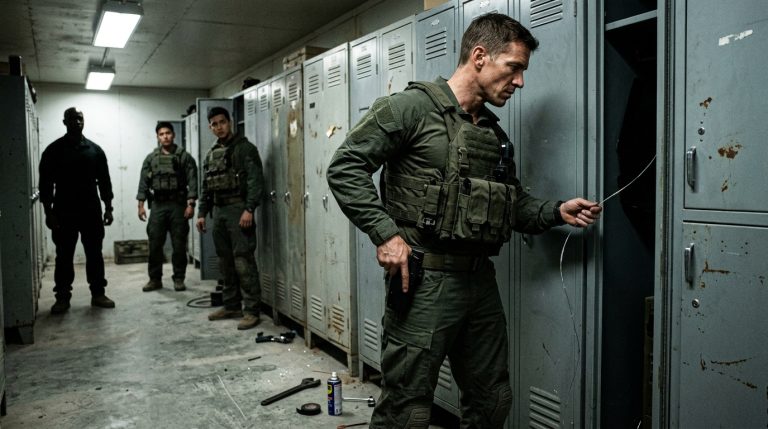
The corridor leading to the command center was lined with polished steel and cold, recessed lighting. It was a space designed for order, for the quiet machinery of authority. Marcus didn’t walk; he moved with the steady, predatory grace of a man who had already reached the conclusion of his journey. The radio he held was still warm from his grip. He stepped past a startled duty officer, whose hand hovered over a silent alarm, and entered the office of Captain Robert Tagert.
Tagert was standing by the window, watching the rain lash against the reinforced glass. He didn’t turn around when the door opened. He didn’t have to. The silence in the room told him everything.
“I expected you sooner, Captain,” Tagert said, his voice devoid of surprise. He turned slowly, his face etched with the weariness of a man who had spent years guarding secrets that were rotting from the inside.
Marcus didn’t speak. He stepped into the center of the room and placed the USB drive on the polished mahogany desk. It looked small, almost insignificant against the vast, clean surface. Beside it, he laid the bronze trident ring—the physical anchor of his identity.
“The file on the drive,” Marcus said, his voice low and steady. “It wasn’t just the Beirut mission. It was the report on the RPG fire that tore through our Humvee. The report that proved the intel we were fed was intentionally compromised to clear the compound.”
Tagert’s gaze flickered to the drive, then back to Marcus. “It was a different administration. A different time. We were trying to prevent a larger conflict.”
“You sacrificed six men to keep a geopolitical board clean,” Marcus replied. The anger that had fueled him all night had burned away, leaving only a cold, hard clarity. “You pinned medals on me, you called me a hero, all while the people who ordered that hit were being promoted to desks at the Pentagon.”
Tagert sighed, moving toward the desk. He didn’t reach for the drive. “If that goes public, it won’t just destroy this command. It will tear down the foundation of the teams. The public doesn’t want the truth, Hayes. They want the legend. They want to believe that when things go bad, it’s just the chaos of war, not the calculated cost of policy.”
“Then let the legend die,” Marcus said.
He didn’t wait for Tagert’s counter-move. He knew the protocol. He knew that if he walked out of that room, they would try to disappear him again. But he had already bypassed the decoy—the “PR salvage” of his dock incident—and reached the truth. He looked at Tagert and saw the antagonist of his story not as a villain, but as a mirror: another man broken by the weight of an institution that demanded loyalty in exchange for conscience.
Tagert’s hand drifted toward a button beneath his desk. It was the final counter-move. The “Cornered Beast” protocol. He didn’t want a confrontation; he wanted containment. But Marcus saw the movement before it was completed. He didn’t strike; he simply pulled the radio from his belt and held it up.
“The reporter is on the line, Captain,” Marcus said. “I didn’t call her just to talk. I called her to listen. Everything you’ve said—the justification, the admission of the compromise—is already in the public domain.”
Tagert froze. The silence in the room became absolute, a suffocating pressure that seemed to drain the air from the space. He looked at the radio, then at the man he had once honored as a legend. For the first time, Tagert looked truly old. The calculated poise, the command presence—it evaporated, leaving behind a man who had spent his life trading his soul for a seat at the table.
“You didn’t just break the system,” Tagert whispered. “You broke the only thing that gave you purpose.”
“No,” Marcus said, looking down at the bronze ring on the desk. “I just stopped letting other people define what that purpose was.”
Marcus turned and walked out. He didn’t look back at the desk. He didn’t look at the drive or the ring. He walked through the command center, past the officers who had once saluted him, their eyes wide with the realization that the ghost they had ignored was the one who had finally judged them.
The exit was cold, the rain still falling, but the atmosphere had shifted. As he reached the perimeter gate, he stopped. He picked up a small, weathered stone from the ground—a simple, grounding physical act—and let it drop, the sound swallowed by the heavy rhythm of the rain. He didn’t feel the need to run. The weight of the six dead men, the voices that had haunted his dreams, the absolute, crushing loneliness of the last six years—it was all still there, but it wasn’t a weight anymore. It was a witness.
He walked away from the base, away from the bureaucracy, away from the life of a legend. He found himself walking toward the church on Broad Street. It was early, the dawn just beginning to bleed through the clouds, turning the bruised sky into a soft, honest grey. He didn’t have a plan. He didn’t have a mission. For the first time in six years, he had nothing but the quiet, terrifying, and beautiful possibility of a day that was entirely his own. He looked at his hands—calloused, scarred, and steady—and for the first time, he didn’t see a weapon. He saw a man.