The Weight of the Reticle: A Marine’s Journey from the Edge of Silence to Home
CHAPTER 1: THE FIRING LINE
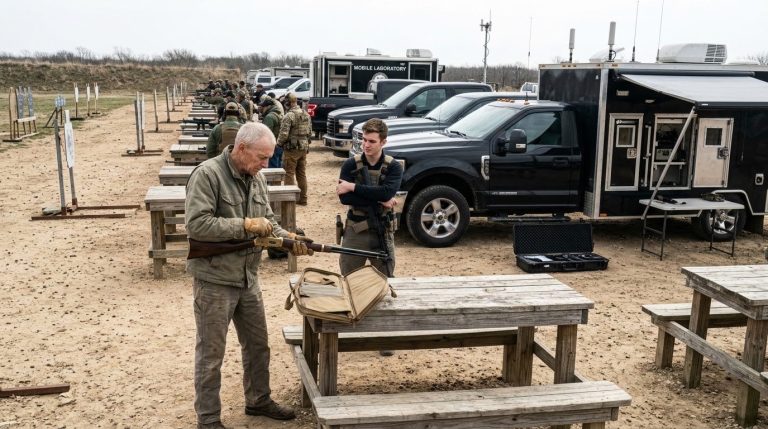
The barrel of the Remington 700 felt like a length of ice in Thomas’s grip. It was a weight he knew—a familiar geometry of steel and pressure—but here, in the clearing, it felt like an intrusion. Eight men watched him, their silence heavy with the kind of judgment that didn’t need words. Garrett Mitchell stood to the side, his posture a masterclass in calculated arrogance, his eyes tracking the tremble in Thomas’s hands.
Thomas looked down at his own fingers. They were spider-webbed with the fine, involuntary tremors of six years spent sleeping on cold concrete. The mountain air bit at his skin, thin and sharp, contrasting with the humid, heavy memories that were beginning to push against his focus. He could hear the wind moving through the pines, a low-frequency hum that he had once translated into ballistics.
“You’re shaking, Brennan,” Garrett said, his voice barely audible over the rustle of the trees. “Seems the ‘Iceman’ is nothing more than a thaw-out now.”
Thomas didn’t answer. He couldn’t. To speak would be to break the seal he had kept on his chest for years. He closed his eyes, and the scent of the dirt—damp, decaying leaves and mineral dust—suddenly grounded him. The tremor in his hands didn’t stop, but it shifted, tightening from a frantic vibration into a focused, rhythmic thrum. It was the familiar cadence of a heartbeat trying to keep time with a drum that wasn’t there.
He lay down, the grass pressing cold against his chest. As he settled into the prone position, the physical world narrowed. The mountain, the hunters, the humiliation—they all blurred into a periphery of gray static. The only thing that remained sharp was the reticle of the Leupold scope.
He didn’t think about the $10,000 or the deed to the cabin. He thought about the physical distance. Eight hundred meters. It was a number, a variable, a bridge. He adjusted his breathing, forcing it to slow, forcing his heart to stop competing with the rhythm of the wind.
When he reached for the bolt, the metal was biting cold. He cycled it, the sound a sharp, mechanical click that seemed to echo for miles across the valley. He felt the phantom weight of a spotter next to him, the ghost of a voice that used to count his breaths.
He steadied his cheek against the wood. The trembling in his hands hadn’t vanished; it had simply been absorbed into the rifle. He became the pivot point, a conduit between the earth and the projectile.
The first shot was a release.
The rifle bucked against his shoulder, a familiar, violent kick that sent a jolt of electricity through his nerves. He didn’t wait to hear the impact. He was already working the bolt, already recalculating the wind drift, already losing himself in the clean, arithmetic purity of the task. He was still the Iceman, but for the first time in six years, the ice was cracking. He didn’t know what was behind it, and that was the most terrifying thought of all.
CHAPTER 2: THE QUIET AFTERMATH
The metallic ring of the final shot didn’t just fade; it seemed to be absorbed into the very grain of the surrounding forest. Thomas remained prone for a heartbeat longer than necessary, his cheek pressed against the cool, splintering stock of the Remington. His world, which had been a tightly focused point of wind-drift and ballistics, began to expand again, rushing back in with the force of an incoming tide.
Eight hundred meters. Five shots. One hole.
He stood up, his joints complaining with the stiff protest of a man who had spent too many years folding himself into the geometry of a bridge underpass. The hunters were still there, but the air around them had curdled. Garrett Mitchell looked smaller now, his shoulders hunched as if he were trying to shrink away from the space he occupied. He didn’t look at Thomas. He couldn’t.
Thomas didn’t offer a taunt. He didn’t seek the validation that Garrett had desperately clung to. He simply turned, his movements deliberate, and began the walk back to the cabin. Every step on the leaf-strewn ground felt like a negotiation with gravity. His pulse, which he had tuned to a machine-like fifty-two beats per minute only moments ago, was beginning to climb, reacting to the sudden absence of the threat.
As he reached the porch, his hand brushed the rough, weathered wood of the railing. It was splintered and grey, bleached by decades of sun and neglect. He found himself gripping it hard, his knuckles white, as the silence of the mountainside began to press against his ears.
He stepped inside the cabin, the door clicking shut behind him with a finality that made him flinch. The interior smelled of dust and dried pine, a scent that triggered an involuntary flash—not of the mountains, but of a small, cramped apartment in 2008. The smell of floor wax and the faint, medicinal sweetness of chemotherapy.
He moved to the small table in the center of the room and placed the leather journal down. His hand hovered over the cover for a long moment. Inside, the pages were thick with the ghosts of his past—coordinates, wind speeds, the names of targets that had long since turned to dust. He hadn’t opened it in years, and yet, the simple act of laying it on the table felt like an act of surrender.
He sat, the wooden chair groaning beneath him. He was supposed to be triumphant. He had won. Garrett was humiliated, his authority shattered, and the deed to the property was his to keep. But the victory felt like a hollow vessel, fragile and dangerously empty.
A knock at the door startled him. It was a soft, tentative sound, not at all like the aggressive pounding of an intruder. Thomas stood, his hand unconsciously checking his waistband—a ghost habit from a life he thought he had left on the streets. He walked to the door and pulled it open, expecting to see Mitchell or one of his sycophants.
Instead, it was the older man from the group—the one who had recognized him. Davis. He stood on the porch, his hands deep in his pockets, his gaze fixed on the dirt near his boots.
“I didn’t come to argue,” Davis said, his voice stripped of the bluster that had defined the afternoon. He looked up, and for the first time, Thomas saw the deep, rhythmic exhaustion in the man’s eyes. It was a familiar look, one he had seen in mirrors for the last six years. “I just… I needed to see that it was actually you. That the Iceman hadn’t died in a gutter somewhere.”
Thomas felt a strange, cold prickle run down his spine. “I’m just Thomas, now,” he said, his voice raspy from disuse.
“Are you?” Davis asked, gesturing vaguely toward the valley. “You don’t shoot like a civilian, Thomas. You don’t even breathe like one. You’re still there. Back in the sand, back in the wind. And I think that’s why this cabin is going to be the hardest post you’ve ever had to hold.”
Before Thomas could respond, Davis reached into his jacket and pulled out a folded envelope. He held it out, his hand steady but his expression troubled. “I found this in the truck. One of the others, he wasn’t going to give it to you. He wanted to keep it as leverage, maybe use it if you didn’t leave. I didn’t think that was right.”
Thomas took the envelope, the paper heavy and cream-colored, feeling stark against his calloused, dirt-stained fingers. He watched as Davis turned and walked back toward the trail, the man’s stride measured and solemn.
Thomas stepped back inside and closed the door. He didn’t open the envelope immediately. He walked back to the table and sat down, his heart beginning to beat with a new, irregular rhythm. He felt the phantom pressure of a gaze—the weight of expectations he hadn’t asked for.
He opened the envelope. Inside was a crisp, typed letter on official letterhead, bearing the seal of a firm he hadn’t thought about in years. As he scanned the text, the light in the cabin seemed to dim, the dust motes dancing in the afternoon sun turning from gold to a stagnant, grey ash. The letter wasn’t a threat from Mitchell. It was an inquiry from a legal representative in South Carolina, referencing a case file he thought had been permanently sealed.
His hands began to shake again, but this time, there was no rifle to absorb the tremors. The “Iceman” persona, the armor he had just used to win the challenge, offered no protection against this. He was no longer a sniper instructor standing on a firing line; he was a man standing on the edge of a chasm, and for the first time in six years, he couldn’t calculate the distance to the bottom.
CHAPTER 3: THE THRESHOLD OF CONNECTION
Thomas did not touch the letter again. He left it lying where it was, a volatile artifact of a life he had tried to burn away. Instead, he stepped out onto the porch, the screen door whining on its rusted hinges. The evening air was cooling rapidly, settling into the valley like a heavy, damp blanket.
He moved toward the steps, his boots crunching against the gravelly earth. He needed to work. Work was the only language he understood, the only dialect of healing that didn’t require him to translate his own pain into words. The woodpile near the edge of the clearing was dwindling, and the ritual of splitting logs—the simple, binary requirement of force and aim—was the only thing that kept the tremors at bay.
He took up the maul, the weight of it familiar and grounding. He didn’t think about the legal notice inside, nor about the way the paper felt like a summons to a courtroom he had no desire to visit. He focused on the knot in the center of the oak log. He raised the iron, felt the pull of the weight, and swung. The crack of the wood splitting was clean, sharp, and final.
He had split three logs when a rhythmic crunching of tires on the trail broke the silence. He stopped, the maul resting on the ground, and watched as a familiar, weathered truck pulled into the clearing. Ashley.
She climbed out of the cab with the slow, steady grace of someone who had lived on this mountain long enough to belong to it. She carried a covered ceramic dish, the steam curling from it despite the cooling air. She didn’t approach him with questions; she simply walked to the edge of the woodpile and set the dish down on a flat, broad stump.
“Stew,” she said, nodding at the pot. “Too much for one person. It’s a burden, really, having to share it.”
Thomas wiped his hands on his trousers, the dirt leaving dark, ingrained streaks. “You don’t have to do this, Ashley.”
“I know,” she replied, her eyes scanning the cabin and the clearing with a gentle, watchful intensity. “That’s why I do it. Your uncle Jack, he was a man of patterns. Every Sunday morning, he’d be standing right where you are, breathing in the air like it was something he’d earned. I figured you might be the same.”
Thomas looked at the cabin, then back at the woman. “I’m not Jack,” he said, the words feeling brittle.
“Never said you were,” she countered. She moved to the porch and sat on the bottom step, patting the space next to her. It wasn’t an invitation to talk; it was an invitation to exist in the same space.
Thomas hesitated, then moved toward her, sinking down onto the steps. The wood was cold, damp with the evening dew. For a long time, neither of them spoke. The only sounds were the distant call of a night bird and the low, rhythmic sigh of the wind through the pines. He found his hands gripping his knees, his knuckles tight. He consciously forced them to relax, one finger at a time.
“I saw the video,” Ashley said, her voice barely a murmur.
Thomas stiffened. “It wasn’t a performance.”
“I didn’t think it was,” she said, looking out at the tree line. “I saw a man who had forgotten that his hands were made for more than just shaking. You think this is all about the shooting, Thomas. You think the precision is the point. But the woods… they don’t care about your accuracy. They care about whether you’re here, truly here, or if you’re still living in a time that’s passed.”
Thomas stared at his hands. They were steady, resting on his thighs. He tried to reconcile that fact with the panicked, irrational fear the letter had ignited in his chest. Was he truly here, or was he just waiting for the next target to appear?
“I’m finding it difficult,” he admitted, his voice low. “Every time I think I’ve built a foundation, something from the past comes to remind me that it’s all on sand.”
Ashley reached out, her hand calloused and steady, and gave his forearm a light, firm squeeze. It was a brief, human touch—the first he had truly felt in years that didn’t carry the weight of a threat or a clinical assessment. “Then build on the sand,” she said. “You’re a Marine. You know how to secure a position. Even if the ground is shifting.”
She stood up, leaving the dish of stew on the stump. “Come by tomorrow morning. Early. I have a porch light that won’t stop flickering, and my knees aren’t what they were when Jack was here to handle it.”
She walked back to her truck, the engine turning over with a low, reliable rumble. Thomas watched her go until the taillights vanished into the darkness of the trees. He walked over to the stump and picked up the dish. The warmth of it seeped into his palms, a radiating heat that felt like a quiet, persistent rebellion against the cold.
He didn’t go back to the woodpile. He walked inside, set the stew on the table next to the letter, and sat down. He didn’t pick up the envelope again. Instead, he reached for a small, plain notebook he had pulled from the back of the kitchen drawer earlier that day. He wrote the date, and then, below it, a single, tentative observation: The ground is shifting, but I am still standing. It wasn’t a victory, and it wasn’t the end of the war, but it was a beginning. He realized then that his path wasn’t about returning to who he was before the loss; it was about navigating the ruin that remained, one steady movement at a time.
CHAPTER 4: THE THERAPISTS MIRROR
The drive into town was a study in controlled tension. The rain began as a thin, silver mist, then thickened into a steady, freezing downpour that turned the gravel track to slick, dark mud. Thomas gripped the wheel, his movements rhythmic and steady, but his mind was an uncoiled spring. Every turn of the tires on the slick road felt like an exercise in managing variables—speed, friction, the encroaching darkness. He was heading to the clinic, a place he had begun to associate with a different kind of precision: the slow, painstaking dissection of a life that felt like a ruin.
He parked in the designated spot, the windshield wipers slapping back and forth in a syncopated, hypnotic rhythm. Dr. Marcus Holt was already waiting. Through the glass of the office window, Thomas could see the man sitting at his desk, his posture relaxed, his hands folded—the antithesis of the way Thomas felt, his nerves pulled taut as a bowstring.
As Thomas stepped out of the truck, the rain bit at his face, cold and sharp. He walked to the building, his boots splashing into puddles that shimmered with an iridescent sheen of oil. The smell of the clinic—that distinct, sterile blend of floor cleaner and old paper—greeted him like a physical challenge as he pushed the door open.
“You’re five minutes early,” Holt said, standing up as Thomas entered. There was no judgment in his voice, only a calm observation.
Thomas sat in the chair he had claimed as his own for the past three weeks. He didn’t take off his damp jacket; he kept it tight against his chest, as if it were a barrier. “I didn’t want to sit in the truck,” he said. The words were flat, stripped of nuance.
Holt sat back, his gaze steady. He didn’t rush to fill the silence. He let it stretch, let the sound of the rain against the office glass fill the void. “You’re holding a lot of tension, Thomas. It’s not just the drive. What’s going on?”
Thomas reached into his jacket pocket and pulled out the letter—the one he had avoided touching for three days. He placed it on the desk. “I received this. It’s from a law firm in Greenville. It involves the period before I left—the time with Karen, the incident with Emily.”
Holt didn’t reach for the letter. He looked at Thomas, his eyes reflecting the soft, muted light of the office. “The incident you’ve avoided talking about for every session we’ve had so far.”
“It’s not relevant to the present,” Thomas said, his voice sharpening. “I’ve moved on. I’m splitting wood, I’m teaching, I’m maintaining the property. The past is a variable that has already been accounted for.”
“Is it?” Holt asked. “Or is it the variable that’s making the current equation impossible to balance? You think this is about being ‘strong’ enough to handle the past, Thomas, but you’re still treating yourself like a target that needs to be hit. You think if you can just be precise enough—if you can just split the wood perfectly, if you can just keep the cabin in order—you can prove you’re still the man you were before.”
“I am that man,” Thomas insisted.
“You’re a man who survived,” Holt corrected, his voice firm. “And you’re terrified that if you drop the armor, if you admit that the ‘Iceman’ persona is just a way to keep from feeling the depth of the loss, you’ll cease to exist.”
Thomas stood up abruptly, the movement aggressive, jarring the chair against the floorboards. The rain intensified, drumming a frantic, irregular beat against the window. He paced the small room, his eyes scanning the shelves, the diplomas, the mundane objects that seemed to mock his turmoil. He felt a sudden, sharp surge of panic—the same sensation he’d had on the bridge, the same feeling of being unmoored.
“I don’t need this,” he muttered, his hand reaching for the door handle.
“If you walk out now,” Holt said, his voice remaining level, “you’re just going back to a cabin where the walls are getting thinner. You’re trying to build a life on the same ground that collapsed under you six years ago. You want to be ‘whole,’ but you’re still hiding the pieces you’re ashamed of.”
Thomas stopped. The handle was cold under his palm. He looked back at the desk, at the letter that still sat there, a silent judge of his progress. The reality of his situation crashed over him—the “Iceman” wasn’t a hero, wasn’t a legend; he was just a man who had used training as a substitute for grieving. Every shot, every mission, every hour of discipline had been a way to avoid the quiet of his own home.
He didn’t turn back to the chair immediately. He stood there, his breath ragged, the smell of the rain and the sterile office mingling in his nostrils. He realized then that he couldn’t fix this with precision. He couldn’t calculate his way out of the guilt or the memory of the terror he had seen in Emily’s eyes.
He walked back to the desk and sat down, slowly. His hands weren’t shaking, but they felt empty, purposeless. “She was nineteen,” he said, his voice barely a whisper. “She was just nineteen, and she looked at me like I was a monster.”
Holt leaned forward, the shadows in the office softening. “Now we’re getting to the truth, Thomas. Not the legend, not the Marine, but the father. Start there.”
Thomas looked at the rain, the blurred world outside the glass, and for the first time in years, he didn’t try to look for a target. He just let the weight of the moment hold him, a fragile, aching start to a long overdue conversation.
CHAPTER 5: THE LETTER
The drive back to the cabin was a blur of gray light and the rhythmic thrum of tires on wet pavement. Thomas didn’t look at the scenery; the Blue Ridge Mountains were nothing more than dark, hulking shapes against a bruising sky. His mind was a locked room, and inside, the words from his session with Holt were bouncing off the walls. Start there. It felt less like advice and more like an order to march into a minefield.
When he reached the cabin, the silence of the mountain felt different—not empty, but expectant. He parked the truck, the engine ticking as it cooled in the damp air. He didn’t rush inside. He stood by the driver-side door, letting the fine, freezing mist soak through his jacket. He reached into his pocket and pulled out the letter again.
He didn’t read the text this time. He looked at the edges of the paper, the way the ink of her signature—Emily—seemed to bleed slightly into the fiber of the page, as if she had hesitated before finishing it. He noticed a detail he had missed before: a small, faint smudge of blue ink on the back of the envelope, a recurring mark he had seen on the notes his wife used to leave for him. It was a small, piercing intimacy that he had ignored in his rush to stay “Iceman.”
He walked inside. The cabin was cooling, the fire he had lit that morning reduced to a handful of glowing, dying embers. He threw another log on, the sparks spiraling upward into the dark chimney. The warmth didn’t reach his core.
He sat at the table and finally, truly read the letter. Not as a Marine, not as a man analyzing a target, but as a father who had been absent for the most formative years of his daughter’s life.
I never stopped looking for you, the words whispered from the page. I saw the video. I saw that you’re still you.
He realized then that he had been so focused on the fear of being seen—the fear of the “broken” version of himself being exposed—that he had completely failed to consider her perspective. She didn’t want the legend. She didn’t want the precision of the Iceman. She wanted the man who used to hold her hand when she was small, the man who hadn’t yet been hollowed out by the weight of too many ghosts.
A sudden, jarring thought struck him: if she had seen the video, if she had been looking for him all those years, then the “invisible” life he had lived on the streets might not have been as solitary as he believed. The thought didn’t bring comfort; it brought a surge of raw, unvarnished shame.
He pulled out the stationery he had bought in town. His hand, which had been steady enough to put five rounds into a single hole at eight hundred meters, began to tremble. He fought it. He breathed—the same controlled, rhythmic breath he used on the range—but it didn’t work this time. The physiological armor was failing because it had no purpose here.
Sunday, 2:00 p.m. I have coffee now. I’ll be waiting.
He wrote the words, but they felt insufficient, thin. He wanted to add more—to explain the bridge, the guilt, the six years of self-imposed exile—but he stopped. The “Iceman” wanted to explain, to justify, to provide a tactical report of his own collapse. The father just wanted to be present.
He set the pen down. The cabin felt quiet, but it was no longer the silence of a tomb. It was the silence of a waiting room.
He spent the next two days in a state of suspended animation. He didn’t split wood. He didn’t go to the range. He paced the cabin, his footsteps heavy on the floorboards, measuring the distance from the kitchen table to the front door, over and over. Every sound—the wind shifting the eaves, a branch scraping against the siding—made his heart skip.
He found himself looking for her in the shadows of the trees, a phantom of the past. He realized he was trying to calculate her arrival as if she were a target to be acquired, a variable to be fixed. The habit of the sniper was deep, a part of his neurology, but as the hours ticked down toward Sunday, he forced himself to let it go.
He moved to the front porch as the clock approached 2:00 p.m. on Sunday. The sun was pale, filtering through a thin veil of high-altitude clouds. He stood by the railing, his hands resting on the wood, and for the first time, he didn’t look for the wind or the elevation. He looked for a car.
He looked for the future.
The sound of an engine reached him before the vehicle appeared—a slow, cautious hum. When the silver Honda crawled up the final, rocky bend of the trail, Thomas felt his chest tighten, a sensation so sharp it bordered on physical pain. The car stopped. The engine cut out.
The silence that followed was the longest, heaviest moment of his life. He watched the driver’s side door open, and when she stepped out—the same green eyes, the same hesitant posture—the world didn’t just stop. It realigned. He wasn’t the man who had stood on the firing line, and he wasn’t the man who had lived under the bridge. He was just Thomas, and he was finally, terrifyingly, going to have to face the person he had hurt the most.
He didn’t move to intercept her. He let her come to him, waiting on the threshold of a new, uncertain reality, knowing that the most difficult shot he would ever take wasn’t made with a rifle—it was the decision to finally let his guard down and be seen.
CHAPTER 6: THE WEDDING THRESHOLD
The small, weathered porch of the cabin had become more than just an entryway; it was the foundation of everything Thomas had built in the year since he had stood against the men in the clearing. The air today was crisp, scented with the dying leaves of October and the sharp, clean bite of mountain autumn. Thomas stood before the mirror inside the cabin, adjusting a tie that felt strange and restrictive against his throat. The suit—a deep, charcoal wool—wasn’t something he had ever imagined wearing, but as he looked at his reflection, he didn’t see the hollow-eyed man from the bridge. He saw someone who had, against all odds, managed to navigate the ruins of his own history.
He walked out onto the porch. Emily was waiting near the edge of the clearing, where a simple floral arch had been erected against the backdrop of the shifting, golden-hued trees. She turned, and the breath caught in his throat. She looked so much like Karen—the same luminous green eyes, the same tilt to her head—that for a heartbeat, the years seemed to fold inward, collapsing into a single, aching moment of grace.
“Dad,” she said, her voice soft, devoid of the fear that had once defined their interactions. She walked toward him, her dress rustling in the quiet air. She stopped just in front of him, reaching out to straighten his lapel.
“You look…” Thomas started, then stopped. The words felt too small, too clinical. He took a breath, letting it out slowly. He was no longer counting the seconds or calculating the wind. “You look like your mother.”
Emily smiled, a radiant, genuine expression that reached all the way to her eyes. “She would have loved this place, Dad. She would have loved seeing you like this.”
The ceremony was a quiet affair, a gathering of people who had become the scaffolding of his new life: Ashley, watching from the front row with a pride that warmed him; Dr. Holt, who had helped him learn how to carry his history without letting it crush him; and Derek, the man who stood at the end of the aisle, waiting with an expression of quiet, unwavering devotion.
As Thomas offered his arm, he felt Emily take it, her hand resting firmly against his sleeve. This was the payoff. This was the moment that the six years of cold and hunger had sought to steal from him. He walked her down the makeshift aisle, his pace measured, his focus not on the surroundings but on the simple, profound weight of his daughter beside him.
The exchange of vows was short, spoken in the hush of the mountain. He stood to the side, watching as they made their promises, feeling a peace so deep it felt almost alien. There was no noise in his head—no tactical variables, no phantom alerts, no lingering echoes of combat. There was only the sound of his daughter’s voice, steady and clear.
After the ceremony, as the light began to turn to the amber of late afternoon, the small group moved to the clearing for refreshments. Davis Coleman, who had once stood in the ranks of the hunters, approached Thomas. He looked different today—older, perhaps, but the hard, guarded edges had softened.
“I still watch that video sometimes,” Davis said, his voice low. “Not to see you shoot. I watch it to remind myself that we aren’t defined by the times we fall. You showed a lot of us that, Thomas.”
“I was just trying to find my way back,” Thomas replied, his hand resting on the back of a chair.
“We all were,” Davis said, nodding. “You just happened to be the one who showed us where the path was.”
The denouement of the day was slow, a gentle descent into dusk. Thomas spent the time talking to people—truly talking, listening without scanning for exits, engaging without calculating risks. He realized that the “5-Pillar Catharsis” wasn’t a destination he had reached, but a state of being he had worked to earn.
Later, he walked to the porch railing, the same place he had stood on so many nights while struggling to piece his mind back together. He pulled the leather journal from his pocket. It was frayed now, the leather darkened by his touch. He opened it to the final page and picked up the pen Ashley had given him.
October 15th, 2020. I walked her down the aisle. Karen, if you can hear me somehow, our daughter is happy. She’s strong. She’s everything we hoped she’d be. And I’m okay.
He paused, looking out at the mountains. The shadows were lengthening, swallowing the valley, but the cabin behind him was filled with the sound of laughter and the warm, golden glow of lanterns. He wasn’t the Iceman anymore. That persona had been a shell, a hard-edged defense against a world he felt he couldn’t survive. But he wasn’t a victim of his past, either. He was a father, a neighbor, a man who had chosen to step back into the light.
He touched the railing, feeling the coarse, familiar grain of the wood—the physical anchor of his repair. He was whole, not because the scars were gone, but because he had finally learned to accept them as part of the structure. He closed the journal and tucked it into his pocket. Emily walked out onto the porch, leaving the warmth of the cabin behind, and leaned her head against his shoulder.
“Thank you, Dad,” she whispered.
“I’m the one who should be saying that,” he murmured, looking at the stars that were beginning to pierce the twilight. He didn’t have any more targets. He didn’t have any more missions. He just had the rest of his life, and for the first time, he knew exactly how to move through it: one breath, one step, and one act of grace at a time. The silence of the mountain was no longer a threat; it was a home.