The Weight of the Soil: A Generational Saga of Steel, Steam, and the Ties That Bind
CHAPTER 1: THE SINKING
The horizon was a flat, bruised purple, typical of a September morning in Clayton County. Frank Donnelly didn’t see the beauty of it. He saw only the muddy, swirling water where, twenty minutes ago, there had been a state-of-the-art Caterpillar 375. Now, only the top of the cab remained, a yellow island in a sea of black, primordial sludge.
The silence that followed the initial descent was worse than the sound of the metal groaning. It was a heavy, expectant silence that seemed to press against his eardrums. Beside him, his lead foreman, Miller, had his hands shoved deep into his pockets, his gaze fixed on a patch of reeds that seemed to be vibrating.
“Ground was supposed to be packed, Frank,” Miller said, his voice unusually thin. “The surveyors swore on their certifications.”
Frank didn’t answer. He was busy listening. There, beneath the suck and gurgle of the swamp, there was another sound—a sharp, rhythmic clink-thud. It wasn’t the sound of the excavator’s cooling engine. It was distinct, metallic, and deep. It sounded like something hitting stone far below the muck.
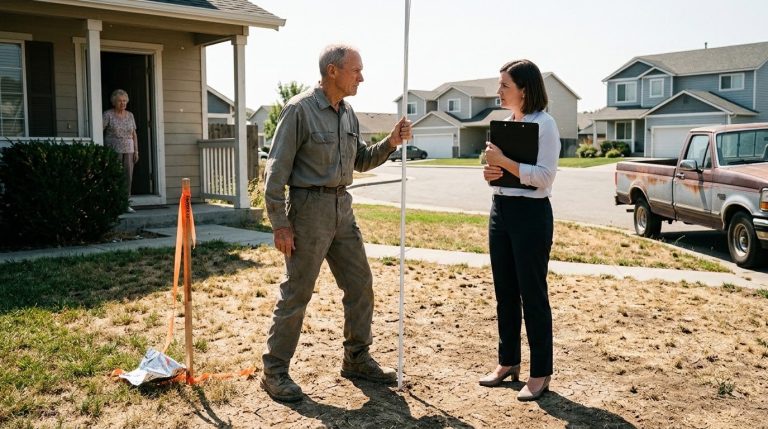
“Get a survey rod,” Frank commanded, his voice tight. “I want to know what’s under that chassis.”
“It’s fifty feet of muck, Frank. You’re not hitting anything.”
“Get the rod,” Frank snapped, turning to face him. His eyes were hard, the color of flint. “I heard something. A hollow sound. This shouldn’t be hollow.”
As Miller hurried toward the supply trailer, Frank walked to the very edge of the bank. The ground beneath his heavy work boots felt spongy, treacherous, and alive. He stared down at the half-submerged machine. The weight of the equipment was dragging it down at a pace that defied logic. He wasn’t just losing a machine; he was losing his foothold in this county.
He leaned forward, his balance precarious, and looked into the murky water near the cab. Something glinted—not yellow steel, but something darker, jagged, and older. He reached out, his hand hovering over the water, when a sudden, sickening shift in the earth beneath him sent a jolt of alarm through his spine. The ground tilted.
From the corner of his eye, he saw a solitary figure standing by the tree line, a silhouette against the rising sun. An old man, leaning on a shovel, watching him with an expression that wasn’t sympathy, but recognition.
Frank froze. The clink-thud sounded again, louder this time, echoing up from the bowels of the swamp, and suddenly, the water around the excavator began to froth, as if something deep below had finally been disturbed.
CHAPTER 2: THE FIRST FAILURE
The ground tilted again, a slow, sickening lurch that threw Frank off balance. He scrambled backward, his boots sliding in the slick, iron-rich muck. Beside him, Miller had returned, holding the survey rod like a spear, but he stopped dead when he saw the expression on Frank’s face.
“Frank? What is it?”
“Get back,” Frank whispered, not taking his eyes off the water. The bubbling had ceased as quickly as it had begun, but the surface of the swamp remained disturbed, a dark, oily sheen spreading outward from the cab of the Caterpillar.
The clanking sound had faded into a deep, hollow hum that resonated through the soles of Frank’s boots. It wasn’t the sound of an engine; it was the sound of the earth settling—a long, agonizing groan of shifting stone and displaced water. He felt a sudden, irrational urge to reach out and pull the machine back, as if his own muscles could override the physics of the suction.
“The rod, Miller. Now.”
Miller handed it over, his hands trembling slightly. Frank didn’t hesitate. He waded into the edge of the swamp, the cold slime instantly soaking through his jeans, biting into his skin. He plunged the steel rod down into the muck near the excavator’s tracks. It went down three feet, then four, and then—clink.
It wasn’t the soft, yielding strike of rock or the squelch of mud. It was the sharp, distinctive ping of iron striking metal. A beam? A pipe? Frank pushed harder, trying to get a sense of the dimensions. The rod didn’t slide to the side; it caught on something solid, something large. He twisted the rod, feeling the vibrations travel up the shaft and into his teeth.
“It’s not just mud under there,” Frank muttered, his voice barely audible over the wind picking up across the field. “There’s a structure. A foundation.”
“A foundation? In the middle of a state-surveyed swamp?” Miller wiped sweat from his forehead, despite the chill in the air. “Frank, we’ve been working this site for months. The environmental impact reports were clear. There’s nothing here but silt and springs.”
“Then the reports were wrong,” Frank said, pulling the rod back. The tip was coated in a dark, rust-colored residue that smelled of sulfur and age. “Or someone wanted them to be wrong.”
He looked back toward the tree line. The old man, the one from the edge of the site, had moved. He was closer now, standing near the boundary fence that Frank had forced him to move just last week. The man’s face was unreadable, a map of deep-set lines and shadows, but his posture was that of a sentry. He was waiting.
“Miller, get the D8s,” Frank ordered, turning away from the swamp. His heart was hammering against his ribs, a frantic, syncopated rhythm. “We’re not going to pull it out the way we planned. We’re going to need to clear the perimeter of the sinkhole. If there’s a foundation under there, we need to know exactly how far it extends.”
“Frank, if we start digging up the perimeter, we’re going to violate the easement. The inspectors—”
“Forget the inspectors!” Frank’s shout cracked like a whip across the site, silencing the few workers who had been leaning against the equipment, watching the drama unfold. “That machine is my life, Miller. I don’t care about the easement. If that foundation is what’s holding the swamp floor in place, and the weight of the Cat is pushing it down, we’re going to create a crater that’ll swallow this whole highway project by Monday.”
He strode toward the bulldozers, his mind calculating variables that hadn’t existed an hour ago. Torque versus structural integrity. He was a builder, a man who believed in the primacy of stone and steel, but he felt a cold, encroaching dread. He had always viewed the land as a blank canvas—something to be molded, corrected, and improved. But as he looked back at the excavator, now sinking deeper, he realized the land wasn’t blank. It was hiding something, and it was fighting back.
He climbed into the cab of the lead D8, the scent of diesel and stale coffee grounding him. He started the engine, the roar a familiar, comforting sound that usually signaled the start of a productive day. Today, it signaled a war of attrition.
He moved the D8 toward the edge of the swamp, the tracks biting into the gravel. He had to clear the sediment, to expose the structure beneath. He had to see what was buried in the black heart of the Iowa earth. But as he nudged the dozer blade toward the bank, he felt the ground beneath him quiver.
It was a soft, rhythmic vibration, mirroring the beat of his own pulse. The old man at the tree line hadn’t moved a muscle, but for one terrifying second, Frank felt as if the man was the one operating the earth, waiting for Frank to make the wrong move. Frank pushed the lever forward, the hydraulics hissing. He wouldn’t be outmaneuvered by a swamp and an old man in overalls. He pushed, the dozer groaned, and the land began to yield—not with a whimper, but with a sudden, violent crack that tore through the silence of the morning.
CHAPTER 3: THE OBSERVER
The crack was not the sound of breaking stone; it was the sharp, jagged report of metal shearing under impossible tension. The Caterpillar bulldozer lurched, the front blade nose-diving into a pocket of soft, gray silt that had opened up like a wound. Frank was thrown forward against the control levers, the breath knocked out of him as the machine tilted forty-five degrees to the left.
For a heartbeat, the world stopped. There was only the smell of overheated hydraulics and the panicked shouting of Miller, whose voice sounded tiny against the vast, oppressive dampness of the swamp.
Frank didn’t shout back. He shoved the gear selector into reverse, but the tracks only hummed—a high-pitched, metallic whine of spinning steel fighting against a void. The machine was pinned, its weight contributing to its own entrapment. He hit the kill switch, plunging the cab into a sudden, jarring stillness.
He climbed out, his boots sinking deep into the slurry that now lapped at the tracks. He felt the cold seep through his heavy denim, a persistent, biting dampness that spoke of the deep, subterranean springs Walter Brennan had hinted at. He jumped to the bank, his lungs burning.
“Frank, get away from there!” Miller ran over, his face flushed, eyes wide with the realization that they were no longer just losing a machine; they were losing the site. “The whole embankment is buckling. If we try to winch this one out, we’re going to lose the bank entirely.”
Frank ignored him. He crouched by the churned-up earth where the dozer blade had bitten deep. He reached into the mud, ignoring the filth that coated his arms, and cleared away a layer of black silt. Something caught his eye—a glint of oxidized iron.
He pulled. It was a pin, heavy, forged in a square shape, with the faint, embossed marking of a manufacturer long since buried by time. It was part of a hinge. He rubbed the mud from it, his fingers tracing the jagged edge where it had been sheared off.
“What is that?” Miller asked, leaning over.
“It’s a anchor point,” Frank said, his voice flat. He looked up, his gaze sweeping the tree line. The old man, Walter, hadn’t moved. He was leaning on the fence post now, a quiet, stationary figure in a landscape that was currently coming apart.
Frank stood up, his knees aching. He had spent his life building over things—old barns, rusted fences, forgotten foundations—but this was different. The swamp wasn’t swallowing his machine; it was rejecting it. He walked toward the tree line, his steps heavy. Every yard he gained on the solid ground felt like a retreat.
“You,” Frank called out, his voice raspy.
Walter straightened slowly. He didn’t look like a man who had just watched a hundred thousand dollars of heavy machinery get swallowed by the earth. He looked like a man who had seen this exact scene play out in his dreams for decades.
“Told you the ground wouldn’t hold,” Walter said. His voice was calm, a stark contrast to the chaotic tension vibrating through the construction site.
“You knew,” Frank said, reaching the fence line. He gripped the wire, the metal biting into his palms. “You knew there was something buried here. A foundation. A structural anchor.”
Walter looked at the pin in Frank’s hand. He didn’t seem surprised. “My grandfather called it the ‘Sunken Floor.’ Used to be a sawmill here, back in the 1890s. Then the spring shifted, the whole thing dropped into the mud, and they just covered it over with dirt and started again elsewhere.”
Frank felt a cold prickle of realization at the base of his neck. “And the surveys? The environmental reports? They said this was solid ground.”
“Surveys measure the top six feet, Mr. Donnelly. They don’t look for what’s beneath the silt,” Walter said. He stepped forward, his eyes scanning the site with the clinical detachment of a surgeon. “You didn’t just break the crust. You shifted the load. When your excavator hit that hidden foundation, it broke the seal on the spring underneath. That’s why the ground is buckling. You’ve turned the whole sector into a sieve.”
Frank looked back at his site. The bulldozer was sinking lower, the mud creeping up the yellow metal of the tracks like a rising tide. “Can it be stopped?”
“Stopped?” Walter let out a dry, mirthless laugh. “You’re fighting the geology of the county, son. You can’t stop it with more machines. The more weight you put on that bank, the faster the whole thing drops.”
Frank looked at his hands, the grease and mud staining his skin, the sharp iron pin pressing into his palm. He had wanted progress. He had wanted the highway, the contracts, the legacy. Now, he was standing at the edge of a catastrophe that he had engineered with his own hubris.
“You came here to watch me fail,” Frank said, his voice stripped of its usual bravado.
“I came here to see if you were smart enough to stop digging before you lost more than just a machine,” Walter replied. He turned away, toward his own property. “But you’re a builder, Frank. Builders don’t stop. They just build faster, until the ground catches up to them.”
Frank watched him go, the old man’s walk slow and deliberate, the gait of a man who owned the land because he understood it. Frank turned back to the swamp. He needed to get that bulldozer out, but as he looked at the water—oily, dark, and bubbling with new, urgent life—he realized that the ground beneath his feet was already starting to tilt.
CHAPTER 4: THE CONFRONTATION
Frank didn’t move for several seconds. The silence that followed the shift was heavy, punctuated only by the distant, rhythmic creak of the dozer’s frame settling deeper into the mud. The mud didn’t just hold the machine; it seemed to be actively embracing it, pulling it down with a slow, deliberate suction that mocked his earlier confidence.
“Frank, we have to pull the men out,” Miller said, his voice unusually high. He was standing on the firmest patch of ground he could find, his eyes darting from the sinking excavator to the buckling embankment. “That crack is widening. If the bank lets go, we’re going to lose the D8, too.”
Frank looked at the bulldozer, his mind caught in a sudden, sharp memory of his father—the way he would stand by the window of their first office, watching the rain hit the construction sites. Pride is a heavy load in soft soil, Frank, his father had once said, watching a crew struggle with a flooded trench. If you fight the ground instead of working with it, it’ll eat you alive.
He pushed the memory away, though the sting of it remained. “We don’t pull out,” Frank said, his voice flat. “We reinforce the perimeter.”
“With what? The whole bank is liquefying!”
Frank pointed toward the construction trailer. “Get the steel plates. We need to bridge the soft spots before we can even think about hooking a cable to the Cat. We’re going to build a platform, right here, over the sinkhole.”
Miller stared at him as if he had lost his mind. “A platform? Frank, that’s madness. It’ll just sink under the weight.”
“Not if we anchor it to the foundation I found,” Frank countered. His brain was working with a cold, desperate clarity. He walked back toward the edge of the swamp, his boots making squelching, sucking sounds that sounded far too much like the earth laughing. He felt the cold dampness of the mud creeping up his legs, but he didn’t care. The pin he had retrieved—that square-headed anchor—was still heavy in his pocket. It was a fragment of the past, but it was also, he realized, the only thing he had to fight with.
He climbed back onto the D8. The engine sputtered, the cold morning air struggling to ignite the fuel. He felt the machine tilt another inch, a slow, greasy slide. He gripped the controls, forcing himself to be steady. If he lost this, the company wouldn’t just be delayed; it would be bankrupted by the insurance claims and the cost of the lost equipment.
As he worked, he caught a glimpse of movement near the road. A heavy truck, an older model, was crawling toward the construction site. It wasn’t one of his. It was a weathered, flatbed Ford, piled high with thick, treated timber and coils of heavy chain.
It pulled to a stop at the edge of the fence line. Walter Brennan climbed out. He didn’t say a word. He began unchaining the timber, his movements slow, deliberate, and entirely lacking the frantic energy that was currently defining Frank’s life.
Frank left the dozer and walked over, his chest heaving with exertion. “I didn’t ask for help, Walter.”
Walter looked up, his face devoid of judgment. He leaned against the side of the truck, his hands calloused and stained with the same black sludge that currently coated Frank’s life. “You didn’t ask for help with the excavator, either, but that didn’t stop it from sinking. You’re trying to fight the swamp with steel and force, Frank. That’s what machines are for. But the ground? You fight the ground, you lose every time.”
“So what’s the wood for?” Frank asked, his voice guarded.
“Distributing the load,” Walter said. “If you try to bridge that gap with just steel plates, they’ll buckle under the weight of the Cat. You need timber—redwood, oak, something that has a bit of give. You lay it down, you distribute the pressure, and you give the ground a chance to set.”
“Why are you doing this?” Frank demanded, gesturing to the expensive timber. “You’ve spent all morning watching me struggle. You could have told me this hours ago.”
“I could have,” Walter agreed. “But then you would have thought you were just following a set of instructions. You needed to see that your way wouldn’t work. You needed to hit the wall before you realized you were building in the wrong direction.”
Walter grabbed a heavy timber, his arms surprisingly strong for a man of his years. “My grandfather built that foundation under the mud because he knew something about this land that you haven’t bothered to learn. It’s not just a swamp, Frank. It’s a pressure valve. You keep digging, you keep forcing, and you’re going to blow it.”
Frank looked at the wood, then back at his sinking machine. The tension in the air felt like a wire stretched to its breaking point. He realized then that the decoy mystery he had been chasing—the machine and the mud—wasn’t the truth at all. The truth was the land itself, and his own ignorance of it.
“Help me set the plates,” Frank said, a silent admission of defeat and, perhaps, the beginning of something else.
“I’ll help you set the timber,” Walter corrected. “You’re still the one who has to do the work.”
They worked in a silence that was punctuated only by the wind and the occasional, sharp groan of the excavator shifting in the muck. As they moved, the textures of the site changed; the abrasive, sharp grit of the construction zone gave way to the earthy, damp, and ancient smell of the timber. Frank felt the weight of his own frustration beginning to fray at the edges, replaced by a grim, pragmatic focus. He wasn’t just saving a machine anymore; he was learning how to stand on ground that he had once thought was beneath him.
CHAPTER 5: THE STEAM RISES
The weight of the timber felt different than the steel he was used to. It had a strange, organic resistance, a give that pulsed under Frank’s hands as they worked to lash the beams together. Beside him, Walter was methodical, his movements stripped of any wasted energy. They were lashing a secondary brace to the D8’s chassis, trying to create a rigid platform that could distribute the load of the excavator back onto the firmer shelf of the swamp’s edge.
“Easy, Frank,” Walter murmured, his voice steady. “The wood needs to seat itself. If you drive those chains too tight, the timber will snap under the tension of the pull.”
Frank wiped his forehead with a sleeve already caked in a thick, gray paste of mud and oil. “It feels like we’re trying to build a bridge out of toothpicks.”
“We’re building a lever,” Walter corrected. “We’re not trying to span the whole swamp. We’re just trying to give the excavator a firm foot to push off from when the torque hits.”
Frank paused, looking at the older man. The air was getting colder, the afternoon light thinning into a pale, watery yellow. “You talk about torque like it’s a living thing.”
“It is,” Walter said, tightening a bolt on the chain assembly with a wrench that looked as old as the hills. “It’s the difference between a man who fights the world and a man who moves it. You’ve been fighting the world all day, Frank. You’re exhausted. That’s why you’re starting to see ghosts.”
Frank didn’t respond. He looked back at his Caterpillar, now nearly level with the mud. He realized with a jolt that he hadn’t thought about his schedule, his deadline, or the progress reports that were sitting on his desk back at the office. He was entirely consumed by the immediate, tactile struggle of saving this one machine. It was a strange, grounding feeling—to be doing work that was simple, brutal, and necessary.
They finished the bracing just as the sun touched the horizon. The platform looked flimsy—a chaotic web of pine timbers, rusted chains, and steel cables—but when Frank walked across it, he felt the underlying structure shift with a solid, reassuring resistance.
“She’s braced,” Frank said, stepping back. He breathed in the smell of pine sap and sulfur. The swamp was quiet now, the earlier bubbles and groans muted by the encroaching twilight.
“Now,” Walter said, his voice dropping an octave. “We need power. Real power. Not the high-RPM spin of a bulldozer.”
Frank looked at the flatbed truck. “You’re still planning to bring that steam engine?”
“I’m planning to bring it back,” Walter said, gesturing toward the horizon. “I’ve been keeping her fired. She’s been sitting on the trailer, ready for when the pressure reached the right point. I needed to see if you were going to try the right thing or just bury yourself deeper.”
Frank felt a surge of something that might have been gratitude, or perhaps just the sheer, overwhelming relief of letting go of his pride. “If we do this—if we hook your engine to this platform—it’s going to be a hell of a noise.”
“It’s going to be a scream,” Walter said. “And the ground won’t like it. But it’s the only way to pull that weight out without shearing the frame of the excavator.”
They climbed into the truck, the engine turning over with a low, guttural rumble that felt like a heartbeat against the silence of the swamp. As they drove back toward the farm, Frank watched the construction site recede in the side mirror. The yellow lights of the D8 looked lonely, a monument to his failure, but the platform they had built around it looked, in the dying light, like an anchor.
Back at the Brennan farm, the steam engine sat in the barn, a silent, black giant that seemed to absorb the light. It was enormous, a complex assembly of boiler, wheels, and brass that looked like it belonged in a different century, one where men built things to last forever.
“I’ve spent my life looking at the bottom line,” Frank said, standing in the shadow of the massive iron wheels. “Every machine I buy, I look at the cost-per-hour, the depreciation, the maintenance. This… this isn’t an investment.”
“No,” Walter agreed, beginning the process of checking the valves. “It’s a responsibility. My grandfather kept this, my father kept this, and I’ve kept it. Not because it made money, but because sometimes, when the world gets too fast, you need something that knows how to pull slow and steady.”
Frank watched him, the way he touched the brass fittings, the way he listened to the faint, distant hiss of the pressure building in the boiler. He realized that the decoy mystery—the secret foundation, the environmental collapse—was only the surface. The deeper reality, the one that made his chest ache, was the recognition of a standard he had failed to set for himself. He had built a company; Walter had built a legacy.
“We start at dawn,” Frank said.
“Dawn,” Walter agreed, his eyes glowing with the reflection of the firebox. “When the earth is still asleep. That’s when the swamp is at its weakest.”
CHAPTER 6: THE PULL
The rain began as a whisper, a fine mist that clung to the brass fittings of the steam engine, then transformed within minutes into a rhythmic, punishing deluge. Frank stood on the iron platform, his coat already saturated, the cold soaking through his layers and numbing his fingers against the polished steel of the throttle. Beside him, Walter Brennan was a shadow, his eyes fixed not on the excavator, but on the water line.
“The spring is waking up,” Walter shouted over the drumming of rain on the boiler. “The rain is feeding the underground system. If we don’t move now, the whole bank will liquify.”
Frank gripped the lever. His knuckles were raw, the skin cracked from the previous day’s work. “I’m ready. Give me the signal.”
Walter raised his hand, then let it drop. “Now.”
Frank pushed the throttle. The steam engine didn’t roar like a modern diesel; it inhaled. A sharp, high-pitched whistle of escaping steam gave way to a deep, resonant thrum that vibrated through the floorboards. The drive wheels, six feet of iron and steel, began to rotate. At first, they slipped—a screech of metal against the slick, wet timber of the platform. Then, the cleats bit.
The chain, thick as a man’s wrist, went taut. It hummed, a high, musical note of tension that threatened to snap.
In the swamp, the excavator groaned. It was a sound of mechanical despair, the metal frame of the machine straining against the suction of the black, gluttonous earth. Frank watched as the mud began to froth and bubble, a dark, viscous mixture of water and decayed matter churning around the tracks.
“She’s moving!” Miller yelled from the bank, his voice barely audible over the gale. “She’s coming up!”
Frank kept his eyes on the pressure gauge. The needle was climbing, trembling in the red zone. The steam was hissing from the valves, a white plume that spiraled away into the gray, weeping sky. He felt the weight—not the weight of the machine, but the weight of the years of ego, the failed contracts, and the relentless, driving need to be the smartest man on the site. All of it was channeled through the iron arm of the engine.
Then, a sickening crack echoed from beneath the swamp—the sound of the foundation ruins, the “Sunken Floor,” finally giving way under the pressure of the extraction.
“Hold it!” Walter bellowed. “Don’t back off!”
The excavator surged upward, a spray of black water showering the platform. It rose, tilting, its tracks caked in the thickest, most putrid mud Frank had ever seen. But as it cleared the primary suction point, the entire bank beneath the steam engine began to tilt. The timber platform, their improvised anchor, was sliding.
Frank slammed the throttle further. He didn’t think about the machine’s safety; he thought about the cost of stopping. If the excavator slipped back now, it would be gone forever, and with it, the truth of what he had destroyed.
The steam engine bucked. It was a terrifying, violent motion, the twenty-two tons of iron shifting on the saturated earth. Frank was thrown against the boiler, the heat of the iron scorching his arm through his wet coat. He didn’t let go of the lever. He braced his boots against the iron floor, his vision blurring with rain and sweat.
The excavator moved another foot. Then another. It was a slow, agonizing crawl, a battle between the desperate pull of the steam and the greedy, sucking void of the swamp. Frank could see the face of the foreman, Miller, white with terror on the bank. He could see the way the mud was beginning to surge around the wheels of the steam engine itself, as if the swamp were trying to claim the rescuer along with the victim.
“She’s almost at the ledge!” Walter shouted. He was leaning into the rain, his hand on the pressure release valve, watching the boiler with the intensity of a prayer.
Frank shoved the throttle to the stop. The engine shrieked—a sound of raw, unadulterated power that seemed to tear through the storm. The excavator surged forward, sliding over the final edge of the bank and onto the solid, gravel-packed ground they had reinforced.
It hit the ground with a heavy, final thud that shook the entire site. The chain went slack. The steam engine, deprived of its resistance, began to spin its wheels in a frantic, terrifying rhythm.
Frank hauled the throttle back, the engine gasping, a sudden, deathly silence falling over the swamp, broken only by the relentless drumming of the rain. The excavator sat on the edge of the site, mud-slicked and battered, but whole.
Frank dropped from the platform, his legs buckling as he hit the wet earth. He didn’t look at the machine. He looked at the bank. Where the platform had been, a new, wider fissure had opened. The ground was gone. A dark, bubbling pool had replaced the earth where they had stood just seconds ago.
He had the machine, but he had opened the earth to get it. And as he looked at the water—deep, dark, and utterly indifferent—he realized that the struggle had only just begun. The swamp wasn’t just a place; it was a memory that had been waiting for someone to disturb it. And he had done exactly that.
CHAPTER 7: THE AFTERMATH
The rain had tapered to a dismal, rhythmic drizzle, but the damage to the construction site was absolute. Where there had once been solid earth, there was now a ragged, churning amphitheater of gray mud and splintered timber. The Caterpillar excavator sat on the gravel shelf like a bruised trophy, its yellow paint streaked with deep, black scars.
Frank didn’t move from his position by the bank. His hands, caked in a drying crust of sediment, were still shaking with the residual vibration of the steam engine’s throttle. He stared at the new, widening fissure in the earth, his mind trying to reconcile the physical reality of the swamp with the frantic, irrational fear that the ground beneath him was not just soil, but a skin that he had permanently punctured.
“Frank.” Miller’s voice sounded muffled, coming from somewhere far away. “We need to get the equipment out of here. If the inspector sees the extent of the bank collapse, we’re going to be shut down for weeks. Maybe months.”
Frank turned, his movements stiff. He looked at Miller, seeing the fear in the foreman’s eyes. It was a reflection of his own. “Weeks?” Frank’s voice was a rough rasp. “If this ground keeps shifting, there won’t be a site left to inspect. The foundation—the ‘Sunken Floor’ Walter talked about—it’s not just a set of ruins. It’s an archway. I’ve broken the keystone, Miller.”
“You’re talking crazy, Frank. It’s a swamp. It’s just wet dirt and bad luck.”
Frank walked over to the excavator. He reached out and touched the steel track, the metal cold and biting against his overheated skin. He felt a vibration in the frame—a low-frequency thrum that he was starting to associate with the very air of the site. He glanced toward the tree line, but Walter Brennan was gone. The old man hadn’t waited for a thank-you or a celebration. He had simply retreated into the gray, misty silence of his farm, leaving Frank to deal with the hollow space he had opened up.
“It’s not just luck,” Frank muttered, more to himself than to Miller.
He climbed into the cab of the excavator. He needed to move it further back, to clear the edge of the collapse. He turned the key, the modern ignition system firing to life with a clean, antiseptic precision that felt jarringly out of place in the ruined, organic chaos of the swamp. He engaged the controls, but the machine shuddered—a violent, jarring protest.
The excavator didn’t move. The tracks were bogged down in a new, softer layer of silt that had surged over the bank within the last ten minutes.
Frank slammed the control forward, his frustration boiling over. He wasn’t going to be beaten by a machine, not when he had already sacrificed the steam engine’s rescue to get it out. He pushed the throttle, the engine revving, the hydraulic pumps screaming in protest.
Clunk.
The sound was resonant, hollow, and horrifyingly close. It wasn’t the sound of a rock. It was the sound of something large, metallic, and structural deep beneath the machine’s belly. He froze, his foot hovering over the pedal.
“Frank! Stop!” Miller shouted from the bank. “The ground under the tracks is liquefying!”
Frank looked down through the glass of the cab. The mud around the tracks wasn’t just sitting there; it was draining. He could see the surface of the soil visibly sinking, a whirlpool of black slurry spiraling downward into a cavernous, unseen void. The machine was teetering. He had pulled it out of the grave only to park it on the edge of an abyss.
He realized then the extent of his error. The “Sunken Floor” was not a ruin; it was a pressurized chamber, a hollow heart of the swamp that he had spent six months compressing with his heavy equipment. By pulling the machine out, he had effectively removed the plug from a drain.
He didn’t wait for Miller’s further warnings. He didn’t try to salvage the machine. He slammed the gear selector into neutral, kicked the door open, and leaped.
The landing was hard, his shoulder hitting the gravel with a force that sent sparks of pain down his arm. He scrambled to his feet, ignoring the agony, and ran—not toward the bank, but away from the entire sector.
Behind him, the earth gave a long, final sigh. The ground where the excavator had been sitting simply vanished, a smooth, terrifying descent into a black, watery mouth. The excavator didn’t fall; it was swallowed, disappearing in a slow, silent motion that was more efficient than any act of nature Frank had ever witnessed.
He stopped at the fence line, panting, his lungs burning with the sharp, cold intake of air. He stood in the rain, watching the surface of the swamp smooth itself over, leaving nothing but a few ripples and a sudden, unnatural silence.
The excavator was gone. The investment, the legacy, the pride—all gone into the dark. And as the rain intensified, Frank realized with a chilling certainty that the swamp wasn’t finished. It had taken what it wanted, but it hadn’t stopped moving. The ground beneath the entire highway project was beginning to sag, a slow, inevitable bowing toward the center of the sinkhole.
He had saved the machine for an hour, only to lose it to the land. And now, he was standing on the edge of a disaster that would not end with a single piece of equipment. It would end when the entire project—and everything he had built—finally slipped into the hole he had spent his life digging.