A Fragile Peace In The Desert: The Final Reckoning Of Marcus Steel Donovan’s Last Promise
CHAPTER 1: THE DANGER IN THE DRIP
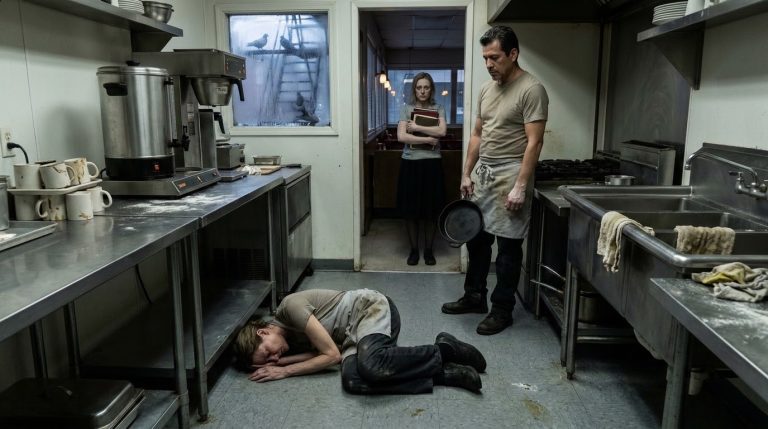
The diner felt smaller today. The air was thick, heavy with the smell of burnt toast and the sour metallic tang of fear—a scent I knew better than my own reflection. Every muscle in my shoulder blades was knotted, a wire pulling taut. Collins was standing at the edge of the counter, his thumb hooked into his gun belt, his eyes darting toward the back of the kitchen where Rosie had retreated.
I didn’t look at him. I looked at my coffee. Black. No sugar. It was cooling, forming a thin, oily film on the surface.
“You’re new,” Collins said. It wasn’t a question; it was a territorial marking.
I didn’t turn. I just kept my eyes on the reflection of the street through the diner’s front glass. The heat shimmer off the asphalt was distorting the horizon, making the town look like it was melting. My hand relaxed, a fraction of an inch. I didn’t need to be a hero; I needed to be a ghost.
“I’m just passing through, Sheriff,” I said, my voice sounding like gravel grinding in a mixer.
“People don’t just pass through Dustville,” he countered, stepping closer. I could feel the heat radiating off his uniform, a stifling, humid pressure. “They stay, or they leave. Which is it?”
I finally turned my head, slow, measured. I didn’t look at his badge; I looked at his hands. They were steady. Too steady. He wasn’t nervous; he was expectant. He was waiting for me to do something that would justify the weight on his hip.
“I fix things,” I said, my gaze dropping to the floor where a floorboard was warped—a tiny, structural flaw in a dying building. “Right now, I’m just trying to finish my coffee.”
Collins laughed, a sound that started in his throat and ended in a grunt. He reached out, his hand hovering over my shoulder, but then the kitchen door swung open. Rosie stepped out. She was holding a plate of eggs, her knuckles white against the ceramic.
“Sheriff,” she said, her voice a fragile reed in a storm. “Your order.”
She placed the plate down with a clatter that sounded like a gunshot in the vacuum of the room. As she pulled her hand away, I caught it. A bruise, dark and blooming like a midnight flower, traced the line of her wrist.
My breath hitched. Not from shock, but from the sudden, sharp, and terrifying clarity of the situation.
I looked at the window again. A black Dodge Charger was idling at the curb, engine humming, a predator waiting for a signal. Beside the car, a deputy was staring directly into the diner, his hand resting on the radio.
The information gap I’d been hunting for just arrived. It wasn’t about what Collins was doing; it was about who he was waiting for. And as I watched the deputy pull a small, silver keycard from his pocket and toy with it—a card that didn’t belong to any government vehicle I’d ever seen—I realized that the “accidental” death of Clayton Hartwell wasn’t just a cover-up. It was a heist.
The diner was silent, save for the hum of the old jukebox playing a low, distorted melody. I took a sip of the cold coffee. It tasted like ash.
“Is there a problem, Sheriff?” I asked, my voice dangerously calm.
Collins smiled. It was the smile of a man who owned the air we were breathing. “No problem at all, Donovan. Just keeping the peace.”
He turned to leave, but he stopped at the door, his silhouette blocking out the desert sun. He looked back at Rosie, then at me. “Make sure you’re gone by sunset. The heat out here does funny things to strangers.”
The door swung shut. The bell chimed. And as the sound died, I looked down at the counter. Rosie had left a napkin there, and under it, hidden from view, was a scrap of paper with a handwritten address—the address of the storage facility next to the station.
The bridge was burned. I was in.
CHAPTER 2: THE ANATOMY OF A GHOST
The silence in my garage was a physical presence. It smelled of motor oil, oxidized steel, and the faint, lingering sweetness of the coffee I’d just left behind at the diner. I stood there, motionless, the scrap of paper with the storage facility’s address feeling like a lead weight in my palm. The dust motes dancing in the singular shaft of light piercing the roof felt like static, a distraction from the reality that the world had just tilted on its axis.
I didn’t reach for the bike. I didn’t reach for the wrench. I reached for the past.
My hands moved with an autonomy that terrified me. I stepped over to the workbench, clearing away the scattered rags and the discarded bolts from the Harley’s transmission. I needed space. I needed to see the geography of the next twelve hours laid out in front of me like a circuit board. My thoughts were no longer a jumble of regret; they had crystallized into the cold, sharp focus of a man who had already died once and was simply waiting for the rest of his body to catch up.
I pulled the silver-framed photo of Linda from the edge of the table. I didn’t look at her face. I looked at the background—the blurry, nondescript architecture of the hospital parking lot from fifteen years ago. My eyes traced the lines, the way the light hit the pavement, the shadow of a security booth that had been there that night. That booth had been run by a company called ‘Sentry North.’
I shifted my focus to the scrap of paper Rosie had given me. Sentry North.
The name clicked into place like a gear seating into a housing. It wasn’t just a security company; it was the same entity that had been contracted to manage the electronics at the Dustville Sheriff’s station six years ago. The same contract Clayton Hartwell had been working on when he died.
The coincidence was a lie. I’d spent forty years around men who dealt in lies, and I knew how to spot the seams where they were stitched together.
I turned back to the Harley. It was a beautiful machine, polished to a mirror finish, but it wasn’t a tool for this. It was a loud, attention-drawing beast. I needed something quieter. Something that didn’t scream “renegade” to every patrol cruiser on the road. I moved to the back corner of the garage, pushing aside a stack of discarded tires to reveal a hidden compartment beneath the floorboards.
Inside lay my old toolkit—not the one I used for the bikes, but the one I’d carried in the desert. It was heavy, packed with specialized gear: lock picks, a thermal scanner, and a multi-tool that could bypass most analog security systems if you knew the right frequency to vibrate the tumblers. I felt the weight of it, the cold bite of the steel, and for a fleeting second, I was twenty-eight again, crouching in the sand, waiting for the signal to move.
But I wasn’t in the desert. I was in a town that was eating itself alive, and I was holding a napkin that felt like a suicide note.
I shoved the kit into a plain, nondescript canvas bag. I didn’t rush. Rushing was for people who didn’t understand the physics of an ambush. If I moved now, I’d be walking into a shadow of Collins’s choosing. If I waited, I’d be walking into the light of my own.
I stepped outside, the desert heat hitting me like a physical blow. The air was dry enough to crack the skin, and the sun was a white-hot coin suspended in a cloudless sky. I checked the perimeter of my house. No cruisers. No parked vans. No observers. The silence was too perfect, the kind of stillness that usually precedes a collapse.
I walked to my truck, a beat-up F-150 that looked like it belonged to every other broken-down resident in Dustville. I didn’t start the engine immediately. I sat there, listening to the ticking of the cooling metal, watching the house. I thought about Cat. I thought about the way the phone had rung, that ghost of a sound, and how I’d been ready to hang up, ready to accept the distance as a permanent state of affairs.
That silence was a choice. And so was this.
I put the truck in gear and pulled out of the driveway, taking the long way around to Baker Street. I needed to see the diner again, not because I expected Rosie to be there, but because I needed to know if the trap had already closed.
The diner was dark. The sign said “Open,” but the interior was bathed in shadow, the chairs turned upside down on the tables like skeletons of a forgotten feast. I didn’t stop. I kept driving, my eyes glued to the rearview mirror. Three blocks back, a dust cloud was kicking up, lazy and slow, following the route of a vehicle that wasn’t trying to hide.
A cruiser.
My pulse didn’t jump. It slowed. My breathing deepened, drawing in the dry, heated air. I knew those roads. I knew every crack in the asphalt, every drainage ditch that could swallow a chassis, every blind corner where you could vanish if you knew exactly when to kill your lights.
I wasn’t the prey. I was the person who knew how the house was wired.
I accelerated, not toward the station, but toward the abandoned industrial district at the edge of town. If Collins wanted to play, I would give him a game that would take him exactly where I needed him to be—into the belly of the beast, where the architecture of his corruption was most vulnerable.
My hand rested on the canvas bag beside me. The metal tools inside were cold, a sharp contrast to the scorching heat of the cabin. I was going to strip this town down to its skeleton, starting with the wires behind the wall. I wasn’t looking for a fight; I was looking for the truth, and I was ready to pull the entire foundation down to find it.
CHAPTER 3: THE FRICTION OF TRUTH
I didn’t move immediately. I sat with my hands at ten and two, the leather of the steering wheel feeling coarse against my palms. The truck was parked in a dead zone, wedged between a rusted corrugated warehouse and a stack of discarded shipping containers. From here, I had a view of the Dusty Boot’s rear delivery entrance.
The cruiser I’d spotted earlier had looped back, its headlights cutting through the twilight like twin scalpels. It didn’t pull into the lot. Instead, it crawled past the front entrance, slowing just enough for the spotlight to sweep across the gravel. I held my breath, my lungs tight. If the deputy saw the tire tracks leading into this dead zone, the game would change from observation to pursuit.
The cruiser continued on, disappearing into the maze of abandoned warehouses. I exhaled, the sound loud in the enclosed cabin, and grabbed the canvas bag.
The Dusty Boot wasn’t just a bar; it was a relic. Hank Morrison had owned the place for decades, but the foundation was older than that—part of the original mining infrastructure. If Collins was running a black-site operation, he wouldn’t use the station. He’d use somewhere where the utility bills were already bloated and the foot traffic was heavy enough to provide cover.
I stepped out of the truck, the desert air cooling rapidly as the sun kissed the horizon. I moved with a predator’s economy, staying within the narrow strips of shadow cast by the stacks of containers. My boots crunched softly on the grit, a sound I muffled by placing my weight on the balls of my feet.
The back door to the bar was a slab of reinforced steel that hadn’t seen a coat of paint since the nineties. I reached for the handle, expecting it to be locked, but it gave under the slightest pressure. A mistake. A bar that had survived forty years in this town didn’t leave its rear entrance unlatched.
I pushed the door open just a crack, letting my eyes adjust to the interior. The air inside smelled of stale beer, pine cleaner, and something else—a sharp, ozone scent of overheated electronics. That shouldn’t have been there.
I slipped inside, closing the door behind me with a silent, controlled movement. I was in a narrow service corridor. Ahead, the low, rhythmic thumping of the jukebox in the main bar was muffled by a heavy curtain. But beneath that, there was a different sound: the high-pitched, insistent whine of a cooling fan.
I moved toward the noise, my hand sliding into the bag to grip the handle of the multi-tool. I rounded a corner and found myself in the basement access area. Hank was nowhere to be seen. The basement door, usually chained and padlocked, stood slightly ajar.
I leaned in, peering through the gap. Down the wooden stairs, a single bank of monitors was glowing in the dark, the screens casting a sickly blue light across the walls. I didn’t rush. I took a step back and scanned the stairs. There, embedded into the wall, was a junction box that looked completely out of place. It was an old-school analog relay, the kind used in broadcast radio before the digital shift.
It was vibrating.
I opened the box with a gentle click. Inside, tucked behind the copper wiring, was a small, high-gain transmitter—a bug. It wasn’t just recording the bar; it was broadcasting the audio directly to a receiver somewhere else.
My stomach churned. Hank Morrison had been my source, my anchor in this town. But if this transmitter was here, installed with professional-grade precision, then everything Hank had told me—everything I’d relied on—was potentially compromised data.
I pulled the transmitter out. The wire snapped with a clean, satisfying ping.
The silence that followed was heavy. My mind raced. If Collins had been listening to me through Hank’s bar, then he knew I was interested in Clayton. He knew about the promises. And if he knew that, then the “accidental” deaths weren’t just about liquidation—they were about containment.
I stood in the dark, the cold metal of the transmitter digging into my thumb. I was being watched, and the person watching wasn’t just the sheriff. It was whoever had set up this relay, someone who understood the architecture of this town better than I did.
I turned away from the stairs, abandoning the server room for now. I needed to rethink the board. I moved toward the service corridor, but stopped.
Footsteps.
Heavy, uneven footsteps coming from the main bar. Not the smooth, polished walk of a deputy, and not the slow, shuffling gait of a bar patron. It was the walk of someone who was trying to be quiet and failing.
I pressed myself into the shadows behind a stack of beer crates. The door to the corridor creaked open, and a sliver of light from the main bar spilled onto the floor.
“I know you’re in here, Steel,” a voice rasped. It was Hank. But the tone wasn’t the warm, salt-of-the-earth greeting I was used to. It was thin, brittle, and jagged with terror. “They’re listening, Marcus. They’re listening to everything.”
I didn’t answer. I watched the shadows. Hank was holding a flashlight, but he wasn’t pointing it at me. He was pointing it at the transmitter box I’d just sabotaged.
“You cut the feed,” he whispered, his eyes wide and vacant. “You don’t understand. If the feed stops, they know.”
Before I could step out, a light erupted in the parking lot behind the bar. It wasn’t a cruiser’s light. It was a high-intensity floodlight, turning the entire warehouse district into a stage. Through the cracks in the corrugated steel of the warehouse, I saw them: three men, dressed in tactical darks, moving with the cold, practiced precision of a kill team.
They weren’t police. They were cleaners.
The game had shifted from a hunt to an extermination. I looked at Hank, who was staring at the door with the expression of a man who’d seen his own obituary written in stone. I had to move, and I had to move now. I reached out, grabbed Hank by the collar, and pulled him into the deeper shadows of the stairwell, my heart rate steadying into the familiar, lethal calm of the desert nights.
CHAPTER 4: THE ARCHITECTURE OF BETRAYAL
I didn’t let go of Hank. Not yet. I pressed him deeper into the cramped crawlspace beneath the stairwell, my eyes fixed on the sliver of light filtering through the steel door. The men outside—the cleaners—weren’t speaking. They didn’t need to. Their movement was a synchronized dance of tactical precision; I heard the soft, rhythmic scrape of rifle slings against tactical vests and the faint, unmistakable click of a weapon’s safety being disengaged.
These weren’t Sheriff Collins’s deputies. They were something far more disciplined, and far more lethal.
Hank’s body was shaking against my arm, a rhythmic vibration that threatened to give us away. I leaned closer, my mouth inches from his ear, my voice a barely audible rasp. “If you make a sound, we both die,” I whispered. “And if we die, nobody finds out what happened to Clayton. Do you understand?”
He blinked, his eyes wide and frantic, reflecting the erratic blue strobe of the servers in the basement. He nodded once, a sharp, jerky movement. I slowly eased my hand away from his face.
“They’re not just listening, Marcus,” he hissed, the words tumbling out in a rush of panicked breath. “They’ve been here since the nineties. The mining company, the sheriff, the road routes… it’s all one machine. We’re just the grease.”
I didn’t have time for the philosophy of his despair. I focused on the environment. The ozone smell—that sharp, biting tang of overheated electricity—triggered something primal. Suddenly, I wasn’t in a basement in Dustville. I was in a foxhole in Kuwait, the air thick with the smell of burning circuit boards after a mortar strike. The phantom sensation of a radio handset clutched in my hand, heavy and dying, washed over me. I blinked, forcing the memory into the dark recesses of my mind. This wasn’t the war. This was an investigation, and I had work to do.
I moved to the edge of the stairwell, peering through the gap in the riser. The three men had entered the main bar. Their boots crunched over the shattered glass of a spilled beer bottle. One of them—a tall, lean man with a scar running through his left eyebrow—stopped near the jukebox.
“The signal stopped,” the scarred man said. His voice was flat, devoid of regional cadence. Professional. “Donovan’s local. He’s cutting the lines.”
“Find him,” the second man replied.
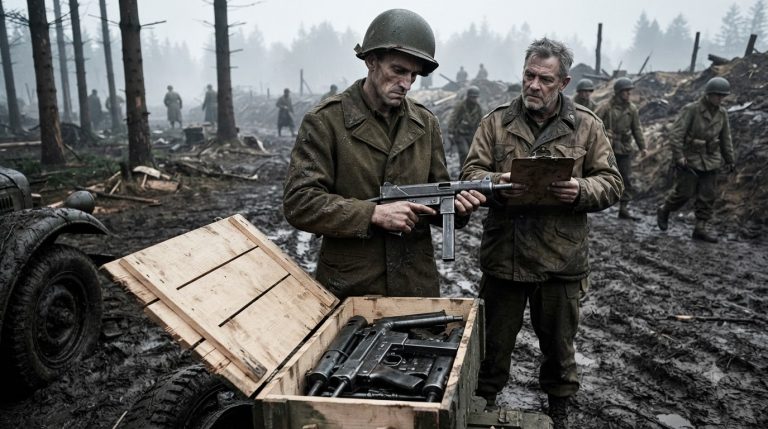
I pulled back, my muscles coiled. I had the canvas bag, but I didn’t have a firearm. I had a multi-tool, a length of copper wire I’d stripped from the relay, and a tactical knife. Against three men armed with silenced carbines, those weren’t weapons; they were suicide notes.
I looked at Hank. He was staring at the wall, his gaze tracking something I couldn’t see. He reached out a trembling hand and pointed to a loose panel behind the stairs.
“The old ventilation shaft,” he whispered. “It leads to the generator room. It’s the only way out, but it’s rigged. Everything in this building is rigged.”
I checked the panel. It was an intake vent, caked in decades of dust and grease. I used the multi-tool to pry the screws loose, the metal groaning with a high-pitched protest. I ignored the sound, my focus narrowing to the task at hand. I pulled the cover back, revealing a narrow, pitch-black space that smelled of stagnant air and forgotten history.
“Get in,” I commanded.
Hank scrambled inside, his movements awkward and desperate. I followed, sliding into the suffocating darkness just as the bar door above us kicked open.
The sound of gunfire ripped through the basement, not directed at us, but at the servers. They weren’t looking for us anymore; they were destroying the evidence. The whine of the cooling fans died, replaced by the crackle of flame as the man with the scarred eyebrow ignited a thermite charge on the primary unit.
The heat bloomed instantly, turning the air in the vent into a furnace. I shoved Hank forward, our bodies scraping against the jagged metal of the shaft. We were crawling through the circulatory system of a lie, and with every inch we gained, the pressure in the room intensified.
We emerged in the generator room, a cavernous space filled with heavy, oil-stained machinery. My tactical training kicked in. I didn’t head for the exit. I knew how these people thought. If the bar was the bait, the exit was the snare. I stopped, listening to the hum of the massive industrial generator in the center of the room.
“They’re going to burn the building,” I said, my voice grim. “They want the server gone, and they want us buried in the rubble.”
“Why?” Hank asked, his voice a hollow echo. “It’s just money.”
“No,” I replied, checking the fuel lines on the generator. “It’s about what the money bought. Collins wasn’t just a sheriff. He was a caretaker for an archive. And if that archive is burning, then the people he was protecting are finally safe.”
I grabbed a handful of rags from a nearby workbench, soaked them in a spilled puddle of high-grade diesel, and wrapped them around the main fuel coupling. It wasn’t elegant, and it wasn’t safe, but it would provide the distraction I needed.
I wasn’t just going to escape this building; I was going to ensure that whatever was left of the server wouldn’t be the only thing the fire consumed. I stood up, the heat of the approaching flames licking at the back of my neck, and looked at the door. I had the decoy evidence in my pocket, but I was beginning to realize that the decoy was the only thing standing between me and a very deep grave.
I looked at Hank. “When I trigger the line, you run for the truck. Don’t look back. Don’t stop for anything.”
He looked at the exit, then at me. “And you?”
“I’m going to make sure they know exactly who pushed them off the ledge.”
I struck a match, the small flame illuminating the desperate lines of his face, and dropped it onto the diesel-soaked rags. The fire jumped, hungry and fast, as I pushed the door open into the chaos of the burning bar.
CHAPTER 5: THE MAINTENANCE OF SECRETS
I shoved the heavy steel access panel closed, locking it into place with a kick of my heel just as the main floor of the Dusty Boot groaned. Above us, the structure was failing. The cleaners were thorough; they weren’t just burning the evidence, they were leveling the site. I didn’t wait to see if they’d reached the basement. I grabbed Hank by the back of his canvas jacket and hauled him forward into the dark.
The maintenance tunnel, which I had previously studied on Clayton’s blueprints, was already reacting to the thermal shift. A pipe overhead, weakened by the heat from the floor above, burst with a spray of scalding steam. It hissed against the concrete, the sound filling the cramped, narrow passage like a thousand angry wasps.
“Keep moving,” I commanded, my voice barely audible over the roaring fire above. “The station access is another thirty feet.”
But the blueprints hadn’t accounted for the structural rot of a building that had been neglected for twenty years. As we reached the midway point, the ceiling above us buckled. A massive slab of concrete sheared away from the rebar, crashing into the tunnel floor and completely blocking the path forward.
We were cut off.
I checked the thermal scanner. The heat signature coming from the floor above was rising rapidly; the cleaners were using accelerants that were melting through the foundation. We were in a pressurized pipe, and the pressure was increasing by the second.
“It’s a dead end,” Hank whimpered, his face pale in the dim light of my flashlight.
“Nothing is a dead end,” I said, though my gut told me otherwise. I scanned the walls, looking for the tell-tale rust patterns of an old drainage bypass. I found it three feet to the left—a circular, iron-grated port that hadn’t been touched in decades. It was fused with orange, calcified scale.
I hauled my multi-tool from the bag, the metal biting into my palms. I didn’t pick the lock; I dismantled the bolts, one by one, the iron crumbling like dried cake under the pressure of the tool. My arms were screaming—the cumulative fatigue of the last twelve hours of constant tension, the slap-echo in the diner, the crawl through the vents—but I didn’t let the rhythm falter. If I stopped, the heat would catch us.
The grate fell away with a muffled clunk.
I slid through first, the space beyond tight and claustrophobic. It was a secondary drainage line, likely abandoned when the mine closed in the seventies. It smelled of wet earth and iron, a sharp, metallic rot that tasted like old blood. Hank followed, his breathing labored.
As we crawled, I saw the discrepancy.
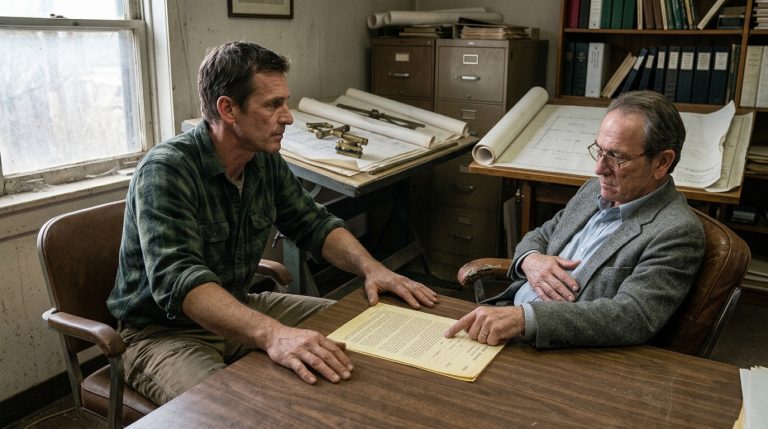
Embedded in the wall of this bypass was a cable—a modern, fiber-optic line. It shouldn’t have been here. It didn’t exist on any of the blueprints I’d stolen from Rosie’s house. I traced the line with my fingers. It ran perpendicular to the tunnel, disappearing into a high-security junction box bolted directly into the rock.
This was it. This was how they were bypassing the local grid. This wasn’t just embezzlement; it was a ghost network.
I didn’t stop to trace it. The tunnel beneath us began to vibrate. The cleaners were using heavy equipment now, likely trying to excavate the basement to ensure the server was shredded beyond recovery. The vibration was shaking loose the ceiling, and dust poured down on us like a desert storm.
“Marcus!” Hank yelled, pointing ahead.
The tunnel curved upward, leading to a heavy, industrial-grade egress door. I scrambled to my feet, the adrenaline surging, and slammed my shoulder into the door. It didn’t budge. I pulled the scanner out, checking the other side.
Empty.
I took a deep breath, centered my focus, and went to work on the bypass. I didn’t have the luxury of time. I pulled the fiber-optic line I’d found and shorted it against the lock’s solenoid. It was a desperate move—an improvisation that relied entirely on the voltage of the ghost network being compatible with the door’s mag-lock.
The lock buzzed, a high-pitched whine that set my teeth on edge, and then clicked open.
I pushed the door wide. We stepped out into the cool, dank air of the station’s basement maintenance level—the exact heart of the facility I’d originally intended to hit. But we weren’t alone.
Standing in the center of the room, illuminated by the flicker of the emergency lights, was Deputy Carson Hayes. He had his sidearm drawn, held in a low, trembling ready position. He looked at me, then at the soot-covered wreck of Hank Morrison.
“I told you,” Hayes said, his voice strained. “I told you to get the evidence to the state. Why the hell are you back here?”
“The bar is gone, Hayes,” I said, keeping my hands visible, the multi-tool tucked into my palm. “The cleaners are purging everything. If you want to save yourself, you need to tell me who owns that line.”
Hayes’s gaze flickered to the cable running along the wall. “You found it? You weren’t supposed to.”
“Who owns it, Hayes?”
“It doesn’t matter who owns it,” he said, and the tone of his voice changed. It wasn’t the voice of a nervous deputy anymore; it was the flat, dead sound of someone who had already decided the outcome. “What matters is that you brought it to me.”
He stepped aside, revealing another man standing in the shadows behind the cooling racks—a man wearing an expensive suit that looked entirely too clean for a basement in Dustville. He held a suppressed pistol, and his eyes were as cold as the desert at midnight.
“Thank you for the shortcut, Mr. Donovan,” the suit said. “We’ve been looking for that specific bypass for years. It’s so hard to find good engineers these days.”
I realized then that the decoy wasn’t just the server; the decoy was the entire investigation. I hadn’t been following a trail; I had been providing a delivery service for the very people I was trying to expose.
CHAPTER 6: THE ARCHITECT OF COLLAPSE
The man in the suit—the architect of this trap—smiled. It wasn’t a smile of triumph, but of weary professional satisfaction, the way a contractor might look at a finished job. He kept the barrel of his pistol steady, a locked, immovable weight.
“You were always the sentimental one, Marcus,” the man said. His voice was smooth, a polished stone in a rough landscape. “Clayton Hartwell, the memory of your brother, the daughter in Seattle. You built this entire investigation on the foundation of your own guilt. It made you so easy to predict.”
I didn’t blink. I couldn’t afford to. My peripheral vision caught the slight tremor in Hayes’s hands. The kid was breaking, his internal morality clashing with the cold, hard logic of his handlers.
“Who are you?” I asked, my voice holding steady despite the steel against my throat.
“A name wouldn’t change the trajectory of the next ten seconds,” the man replied. He glanced at Hayes. “Clear them out. Burn the room. I don’t want a trace of this, or of our friend from the Hells Angels.”
“Wait,” Hayes blurted, his voice cracking. He looked at me, then at the suit, his eyes swimming with a desperate, frantic energy. “You said he was just a delivery vector. You said he was the only one who could open the relay without triggering the failsafe. You didn’t say anything about killing a local.”
The man in the suit didn’t even look at the deputy. He pulled a second pistol from his shoulder holster with fluid, efficient grace and shot Hayes in the chest before the boy could even blink. The sound was a dull, muffled thwip. Hayes folded like a discarded rag, sliding into the darkness behind the server racks.
The silence that followed was heavy with the smell of cordite and the realization of how deeply I had underestimated the opposition. I had expected a struggle; I was getting an execution.
My hearing, already ringing from the chaos of the bar, began to fracture. The world tilted. The sharp, mechanical hum of the server fans sounded like distant, rhythmic screaming. Was it real? Was it a psychological phantom, a lingering ghost from the war? I gripped the multi-tool in my palm, the sharp points digging into my skin. Focus.
The man in the suit stepped back, adjusting his tie. “You have such a dramatic history, Marcus. It’s a shame it has to end in such a mundane basement.”
He moved his aim from my throat to my forehead. I had one shot. Not at the man—too far, and the suppressor was too efficient—but at the environment. I shifted my weight, feeling the tension in my calves, and drove my heel backward, not into the floor, but into the thick, exposed bundle of cables running to the server’s primary power intake.
I didn’t try to pull them; I slammed my entire weight against them, forcing the short-circuit I’d been planning for since I entered the station.
The room erupted.
A massive, blue-white arc of electricity jumped from the server housing, shattering the cooling racks and sending a shower of sparks cascading across the concrete floor. The man in the suit flinched, his aim wavering for a fraction of a second as the light blinded him.
I dove.
I hit the floor, rolling beneath the arc of the electricity, my hand grabbing the heavy iron fire extinguisher mounted to the wall. I didn’t think; I swung. The metal canister connected with the man’s knee, the sickening crunch of bone echoing against the roar of the short-circuiting servers.
He went down, but he didn’t stop. He fired a blind shot, the bullet tearing through the wall just inches from my ear, showering me in concrete dust. I was on him instantly, my hands locking onto his wrist, forcing the muzzle toward the ground.
He was strong—lean, fast, and wired to kill. He twisted, his thumb digging into my pressure point, but I used the momentum, rolling him into the electrical arc. The suit caught fire, the synthetic material sizzling in the high-voltage current. He screamed, a sound that wasn’t professional or polished, but raw and animalistic.
I pulled back, gasping for air, the room around me a blur of smoke and crackling power. The man in the suit was no longer a threat, but the basement was filling with toxic fumes from the burning server housing.
I looked over at where Hayes had fallen. The deputy was alive, his chest rising in shallow, painful heaves. He was staring at me, his eyes filled with a terrifying, hollow light.
“You… you were supposed to be the variable,” Hayes whispered, blood bubbling at his lips. “The ghost of the club… you were supposed to keep the past… buried…”
The past.
It hit me with the force of a physical blow. The way he said it—the weight he placed on the word ‘club’. This wasn’t about embezzlement. It wasn’t about the Vipers.
I leaned down, grabbing Hayes by the collar. “Who?” I demanded, my voice raw. “Who is the architect? Who is at the top of the chain?”
Hayes’s eyes fixed on something above my shoulder. A ghost? A phantom? I turned, but there was nothing there but the flickering, dying light of a broken server. When I turned back, his eyes were glassy, his head slumped to the side.
He was dead.
I was standing in the dark, surrounded by the ruin of the investigation, the truth sitting just beyond my reach, obscured by the smoke of a fire I’d started myself. I pulled the USB drive from my pocket. It was scorched, the casing warped by the heat, but the connection port looked intact.
I hadn’t solved the mystery. I had only succeeded in burning down the cover.
I turned and bolted for the maintenance tunnel, the exit I’d used to enter. I had to get out. The station was collapsing, and if I stayed, I would be the only body they found, the convenient scapegoat for the entire operation. I crawled through the debris, my lungs burning, the taste of metallic dust thick in my throat. I was alone, I was out of ammunition, and for the first time in my life, I was genuinely, profoundly afraid.
CHAPTER 7: THE GHOST IN THE CIRCUITRY
I hauled myself through the final jagged gap of the maintenance tunnel, my boots finding purchase on the slick, oil-stained concrete of the alleyway behind the station. The night air was freezing, a sharp, violent contrast to the furnace I had just left. Above, the sky was a bruised purple, and the sounds of the fire—the structural groans of a dying building—were beginning to settle into the crackle of localized ruin.
I didn’t stop. I couldn’t. I sprinted toward my truck, my legs heavy, my breath hitching in my chest. Every shadow felt like an extension of the cleaners; every gust of wind sounded like the cycling of a bolt-action rifle.
I reached the truck and ripped open the door, sliding behind the wheel with a desperate urgency. My hands were shaking so hard I nearly dropped the keys. I turned the ignition, and the engine roared to life, a sound that felt entirely too loud in the stillness of the alley. I backed out, the tires spinning on the loose gravel before finding traction, and I tore out onto the main road.
That was when I saw it.
Lying on the passenger seat, in the precise center of the upholstery, was a silver-plated Zippo lighter. It was familiar—the scratched casing, the slight dent on the bottom hinge. It belonged to James “Wrench” Torres. I hadn’t seen this lighter in six years. I hadn’t seen Wrench since I left the club.
A coldness, deeper and more absolute than anything the desert night could offer, settled into my marrow. My fingers hovered over the lighter, but I didn’t touch it. It was a message. A signal.
If Wrench’s lighter was here, in the middle of a desert town three hundred miles from the nearest chapter, then Wrench was here. And if Wrench was here, then the ghost network I’d uncovered wasn’t just some vague, high-level conspiracy. It was a family reunion.
The realization hit me with the force of a head-on collision. The “architect”—the man in the suit who hadn’t bothered to give me his name—hadn’t just been using the corruption of the town; he was orchestrating it using the same logistical chains that the Hells Angels had perfected decades ago.
I gripped the steering wheel, my knuckles turning bone-white. I had been fighting a war I thought was about a corrupt sheriff and a dead wife’s memory. I was actually fighting a war against the very brotherhood I’d spent forty years serving.
I looked at the USB drive. It was my only leverage, my only defense. But how do you use evidence against a ghost?
I drove, but my mind was fractured. The auditory hallucinations returned—the faint, rhythmic sound of a motorcycle engine idling in the distance. Was it real? I looked at the side mirror. Nothing but the long, empty stretch of Route 47. But I knew better. They wouldn’t come at me with cruisers or tactical teams anymore. They would come with the one thing they knew I couldn’t resist: the obligation of the patch.
I pulled the truck onto the shoulder, the gravel crunching beneath the tires. I had to know. I had to look at what was on the drive.
I reached into the glove box, pulled out a portable laptop I’d kept hidden for emergencies, and plugged in the drive. The screen flickered, the OS booting with a sluggish, reluctant hum. I accessed the files, my fingers dancing over the keys, skipping the financial spreadsheets, skipping the drug routes. I went straight for the communications logs.
There it was.
The weekly call Collins made. I pulled up the timestamp from three days ago. I hit play.
The voice that came out of the speakers wasn’t the polished, flat tone of the suit in the basement. It was gravelly, familiar, and stained with the weight of a thousand miles of road.
“The job in Dustville is nearing completion,” Wrench’s voice said, sounding bored, as if he were discussing a motorcycle repair rather than a liquidation. “Collins is a liability. Clean him up. And Marcus… if he shows his face, don’t make him suffer. He was the best president we ever had.”
The sound died away. The screen glared back at me with the cold, impartial light of a confession.
I sat in the dark, the engine ticking as it cooled. The silence outside was no longer empty. It was filled with the sound of the road—the distant, approaching rumble of a dozen heavy-duty engines heading my way.
I wasn’t the hunter. I was the target.
I looked at the lighter on the passenger seat, then at the USB drive. I had the evidence, the keys to the kingdom, the proof of a betrayal that reached back forty years. But I realized then that the evidence was irrelevant. They didn’t care about the law. They didn’t care about the sheriff. They only cared about the cycle, and the cycle demanded that I be excised.
I didn’t try to hide. I didn’t try to drive away. I sat in the truck, waiting for the headlights to crest the horizon, my hand resting on the Colt 1911 I’d retrieved from the hidden compartment earlier. If I was going to die, I was going to die in a way that left a mark on the history of the club, a mark that even Wrench wouldn’t be able to ignore.
The rumble grew into a roar. Headlights appeared, a phalanx of them, cutting through the darkness like the eyes of some ancient, hungry beast. I turned the laptop off and tossed the USB drive onto the seat. Then, I stepped out of the truck, the wind whipping my jacket around my shoulders, and stood in the middle of the road, the only thing standing between the past and the future.
CHAPTER 8: THE LAST RIDE HOME
I stood in the center of the road, the heavy weight of the Colt 1911 in my hand feeling less like a weapon and more like a gavel. The phalanx of bikes halted in a spray of gravel, the engines cut in unison, leaving a silence so profound it felt like a vacuum. Wrench stepped forward, his leather cut weathered by years of sun and violence, his face a map of choices that had led us both to this desolate stretch of Arizona blacktop.
“You’re a long way from the clubhouse, Marcus,” Wrench said. His voice wasn’t a threat; it was a mournful acknowledgment. He didn’t look at the gun. He looked at my eyes. “We didn’t come to kill you. We came to collect the drive.”
“You came to protect the rot,” I replied. My voice sounded steady, a surprise even to myself. “You’ve been laundering dirty money through a dead-end town for five years, Wrench. You used Collins to kill the only man who actually tried to do his job, and then you had the audacity to use me to finish the job.”
Wrench stopped ten feet away. The other men—brothers, people I’d ridden with, bled with—waited for the order. “The club needed stability, Marcus. You left. You chose a quiet life, a dead wife, and a ghost. We stayed. We kept the order.”
“You kept a sickness,” I said. I pulled the USB drive from my pocket and held it out, letting it catch the glare of the headlights. “This drive contains the log files, the financial transfers, and the recordings of every transaction you and Collins made. It’s the truth, Wrench. And truth is the only thing the club can’t survive.”
Wrench’s expression hardened. “The club is bigger than the truth. It’s bigger than you. Give me the drive, and you walk away. Go back to your garage, back to your bikes, back to your daughter. Forget you ever saw us.”
“I can’t,” I said. “Because every time I look at this lighter, I don’t see the brotherhood. I see the price of my own silence.”
I took a step toward him, and in that split second, the tension broke. Wrench reached for his sidearm—a tactical, professional motion—but he was a heartbeat too slow. I didn’t fire at him. I fired at the fuel tank of the bike directly behind him. The bullet hit the steel, a spark erupting in the dark, and the tank bloomed into a fireball that forced the brothers to scatter.
Chaos erupted.
The brothers weren’t trained for a fight against one of their own who knew every trick in the manual. I didn’t engage in a firefight; I used the environment. I rolled behind the ditch, the mud soaking my jacket, and pulled the pin on the flare I’d kept in my pocket. I threw it into the center of the formation. The blinding magnesium light filled the road, turning the night into a distorted, white-hot void.
They couldn’t see. They fired blindly, but I was already moving, flanking them through the scrub brush. I didn’t need to defeat them all; I only needed to break the center. I reached Wrench, who was still trying to navigate the blinding flare, and I didn’t use the gun. I used the momentum of my own life, tackling him into the dirt with the force of forty years of suppressed rage.
We rolled in the dust, the man who had been my brother, the man who had facilitated the death of Clayton Hartwell. I pinned him, the barrel of the Colt pressed into the soft earth near his head.
“Look at me,” I shouted, forcing him to meet my eyes. “The FBI is already decrypting the backup files I sent them before I got here. Even if you kill me, the club is over. The investigation is already at the doorstep of the state capitol.”
Wrench stopped struggling. The fight left him, leaving behind only the weary, shattered shell of a man who realized the road had finally ended. “You burned it all down,” he whispered. “For what? For a town that doesn’t even know your name?”
“For the man I was supposed to be,” I said.
I left him there in the dirt. I walked back to my truck, the USB drive gone, the evidence secured by the state police who were already visible as a distant string of sirens on the horizon. The brothers didn’t follow. They didn’t shoot. They watched as I climbed into the truck, a man who had finally shed the weight of a ghost.
The drive back to Dustville was quiet. The sirens grew louder, their red and blue lights washing over the desert landscape like a cleansing tide. I pulled the truck to the side of the road, switched off the ignition, and stepped out.
The air smelled of sagebrush and rain—a clean, sharp scent that promised a beginning.
I walked to the edge of the cemetery, where the white roses lay by Linda’s grave. I didn’t say anything. I didn’t need to. I reached into my pocket and pulled out a small, steel tool—a wrench I’d carried for as long as I could remember. I walked to the grave marker, and with steady, methodical movements, I tightened the loose bolt on the flower frame that had been bothering me for months.
It was a small thing. A quiet thing.
Cat was waiting by the gate, her silhouette a dark curve against the rising sun. She didn’t say a word. She just walked to me, took my hand, and held it. Her skin was warm, a living, breathing connection to a future I hadn’t realized I was allowed to have.
“Is it done?” she asked.
“It’s done,” I said.
The sun broke the horizon, painting the desert in colors of gold and ochre. I took a deep breath, the taste of metallic dust finally gone from my mouth, replaced by the crisp, cool air of a new day. We turned and walked away from the graves, away from the past, and toward a home that was finally, truly ours.