The Weight of Silence: A Ghost Finds Home Among the Living in the Dust of Memory
CHAPTER 1: The Impossible Horizon
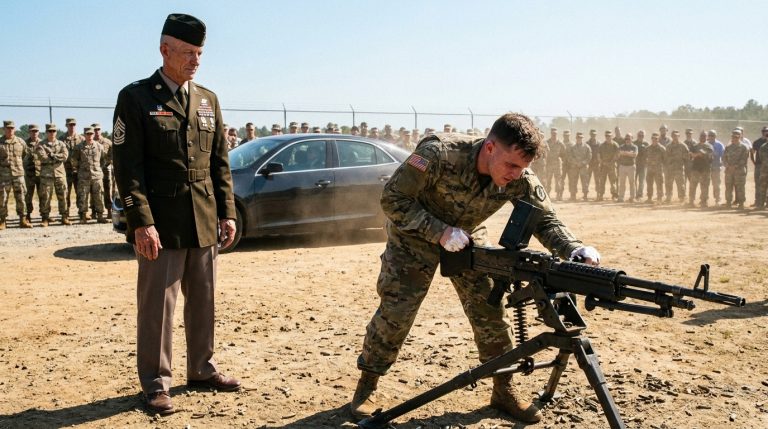
The desert sun was not a light; it was a weight. It pressed against the backs of the elite sniper division, turning the red dust of the range into a suffocating, golden haze. Captain Miller stood at the edge of the firing line, his knuckles white as he gripped his binoculars. Three hundred yards away, the steel silhouette stood mocking them—a black, jagged tooth against the shimmering backdrop of the canyon.
Twenty rounds had been sent into the air. Twenty rounds had been swallowed by the silence of the valley.
“Physics, Miller,” General Sterling’s voice cut through the dry air like a dull blade. The General didn’t look at the shooters. He looked at the horizon, his arms crossed over his chest, his eyes unblinking. “It doesn’t care about your excuses.”
Miller swiped a hand across his sweating forehead, leaving a smudge of dirt on his brow. “Sir, with respect, the thermal draft in that canyon is erratic. It’s a localized micro-climate. No platform, no optic, can compensate for a swirl that changes every three seconds.”
“Impossible is a word for men who miss,” Sterling growled.
Behind them, the rusted wheels of a cart groaned—a rhythmic, metallic protest against the gravel. It was the sound of lunch. Saul, the mess hall cook, had arrived. He looked less like a soldier and more like a relic, his white apron bearing the faint, brownish stains of a dozen meatloaf dinners. He stopped the cart, the squeal of the wheels dying into the oppressive heat.
Saul began pouring water, his hands gnarled and steady, seemingly oblivious to the tension that threatened to snap the air itself.
“Not now, Saul,” Miller barked, not bothering to turn around. “Get that cart away from the firing line. You’re blocking the line of sight.”
Saul didn’t move. He tilted his head slightly, squinting against the glare. The light caught his eyes, washing them into a pale, startling blue. He looked out at the target, then down at the dust, his lips barely moving.
“Wind ain’t ten knots, Captain,” Saul said. His voice was a thin, dry rasp, like leaves dragging over concrete. “It’s swirling in the draw. Fourteen knots at the apex. You’re aiming for the wind at the barrel, but the bullet has to travel through the canyon.”
Miller spun around, his boots kicking up a cloud of red grit. He walked until he was inches from the old man, invading the small, private space Saul occupied. The smell of cold grease and onions clung to the cook’s apron.
“Did the heat finally boil your brain, Saul?” Miller asked, his voice dripping with condescension. “You’re a cook. You manage the stove. Don’t presume to manage the math.”
Saul didn’t flinch. He didn’t even blink. He reached out with a hand that seemed too stiff to hold a ladle, let alone a rifle, and pointed at the distant silhouette. His finger didn’t shake. “Two mils left. One up for the humidity. And you wait for the lull. You’re firing too fast, Captain. You’re fighting the wind instead of reading it.”
The silence that followed was heavy, a vacuum that seemed to draw the breath out of the men on the line. Miller’s face went from flushed to a dangerous, mottled purple. But before he could unleash the fury building in his chest, a heavy hand rested on his shoulder.
General Sterling stepped forward. He looked at Saul, really looked at him, for the first time in a month. He saw the grease, yes, but he also saw the feet—planted with a strange, deliberate balance. He saw the breathing—rhythmic, measured, barely perceptible.
“You think you can make that call, cook?” the General asked, his voice low.
“Physics is physics, General,” Saul replied. “Bullet don’t care who pulls the trigger. It only cares about the math.”
Saul’s gaze didn’t drop. It held the General’s with an unsettling, clear intelligence that felt like an intrusion. Miller let out a sharp, mocking laugh, but it died in his throat when the General gestured toward the empty shooting mat.
“Prove it,” Sterling commanded.
As Saul began to lower himself to the ground, his movements stiff and agonizingly slow, Miller felt a cold prickle of intuition at the base of his neck. Something was off. It wasn’t just the cook’s audacity. It was the way the air seemed to settle around him, as if the desert itself were holding its breath, waiting for a ghost to wake up.
CHAPTER 2: The Weight of Steel
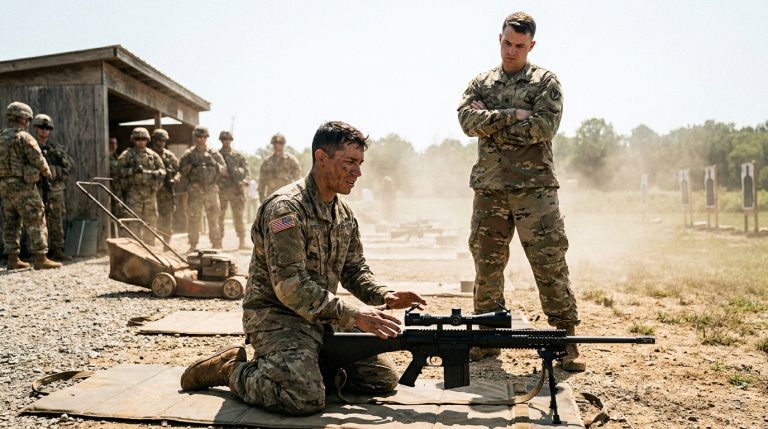
The gravel shifted under Saul’s knees with a dry, grinding sound that seemed amplified in the stagnant desert heat. He did not move with the sharp, explosive speed of the younger men standing behind him; instead, he moved with the agonizing, deliberate economy of someone who understood that every calorie burned was a calorie taken away from the mission.
Miller watched him, his jaw tight enough to ache. He wanted to offer a hand, to correct the old man’s posture, to stop this absurdity before the General lost his patience—but the words died in his throat. Saul was not just kneeling. He was settling. It was as if he were trying to become part of the very crust of the earth, his body sinking into the firing mat until the space between his chest and the ground effectively ceased to exist.
“Need a pillow for your knees, Grandpa?” one of the younger snipers whispered, his voice a nervous, mocking tremor.
Saul did not respond. He didn’t even turn his head. He reached out and grasped the chassis of the rifle—a prototype that felt like a cold, alien artifact in his gnarled hands. He didn’t lift it so much as he pulled it into his shoulder, a fluid, ancient movement that suggested he and the weapon had been acquainted in another lifetime.
As the rifle stock met his cheek, the air on the range seemed to thicken. The arrogance that had permeated the unit moments ago—the scoffing, the defensive posturing, the restless energy of men who were used to being the smartest in the room—evaporated. Saul’s posture changed. The slight, almost imperceptible hunch in his shoulders vanished, replaced by a rigid, linear alignment. His breathing slowed until it wasn’t a sound, but a rhythmic ebb and flow that matched the very pulse of the desert heat.
Click.
The sound of the scope turret turning was faint, but in the silence of the line, it sounded like a hammer striking stone. Saul didn’t look through the glass immediately. He watched the mirage. He watched the way the heat waves danced off the desert floor, distorting the world between the firing line and the target. He was reading the air. He was waiting for the hidden language of the wind to reveal its next syllable.
“Chamber is hot,” Saul whispered.
The voice was not the thin, raspy plea of the man who served sandwiches. It was a low, resonant command. It carried the weight of a man who had stood on ridgelines when the world was ending and decided it was his job to make sure it didn’t.
Miller took an involuntary half-step forward. He looked at the General, whose face remained a mask of stone, though his eyes were narrowed, tracking Saul’s trigger finger. Saul’s index finger hovered over the pad of the trigger, not pulling, but sensing. He was waiting. He wasn’t just aiming; he was hunting.
The wind shifted. A sudden, violent gust kicked up a swirl of red dust just a few yards from the firing line, forcing the younger snipers to squint, but Saul didn’t react. He was already somewhere else, his mind fully committed to the invisible geometry of the valley. He was measuring the drop, the drag, the cross-breeze that had defeated twenty rounds of high-tech ammunition.
Five seconds.
Miller’s heart hammered against his ribs. He felt a sudden, sharp pang of shame, a realization that he had been looking for a technological solution to a human problem. He had been blaming the rifle, the wind, the optics—everything except the one thing that actually mattered: the connection between the shooter and the shot.
Ten seconds.
Saul’s finger closed the gap. The trigger moved, absorbing the slack, finding the wall of resistance. His entire body—every muscle, every joint, every weary fiber of his being—turned to steel. He was the fulcrum. He was the point where physics became reality.
Boom.
The rifle roared. It was a massive, concussive sound that seemed to shatter the heat shimmer. The muzzle brake kicked up a blinding cloud of fine, red dust, enveloping the old man in a miniature storm of his own making. The force of the shot made the firing mat ripple, but Saul didn’t move. He held his position, his eye glued to the scope, the rifle still tucked firmly into his shoulder.
For five seconds, no one breathed. The spotter, who had been calling misses all morning, leaned into his scope, his face draining of color.
“Flight time…” the spotter murmured, his voice cracking. “Impact.”
The word hung in the air, fragile and heavy.
“Target,” the spotter whispered, louder now, his eyes wide with a terror that looked remarkably like awe. “Target destroyed. Center mass. Dead center.”
The silence that reclaimed the range was different than the one that had preceded the shot. It wasn’t the silence of arrogance or anticipation. It was the silence of men who had just seen a mountain move. Miller looked at the monitor. The steel silhouette, sitting two miles away, bore a fresh, dark mark right in the kill zone—a mark that shouldn’t have been possible.
Saul opened the bolt, the brass casing clattering onto the gravel with a sound that felt like the final note of a symphony. He stood up, the stiffness returning to his joints as if the mantle of the ghost he had just resurrected was already becoming too heavy for his aging body to bear. He reached down and brushed the dust from his knees, his movements once again slow and agonizing.
“It was fourteen knots,” Saul said, his voice returning to that thin, raspy scrape. He didn’t look at the monitors. He didn’t look at the snipers. He looked at the General. “Wind picks up speed in the draw. You keep fighting it, you’ll never find your mark.”
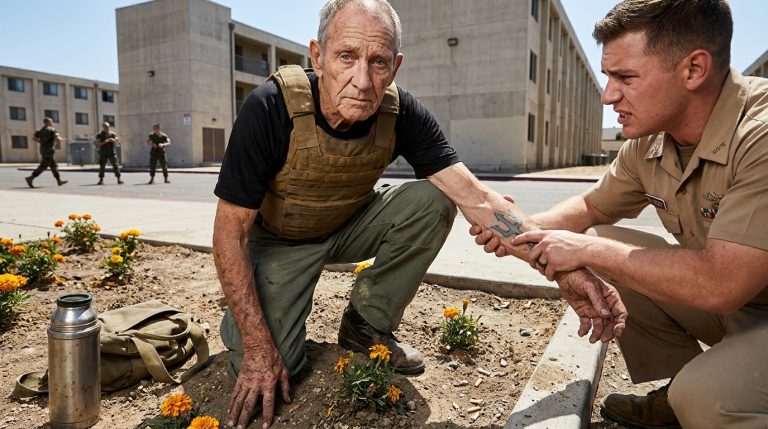
He turned, reaching for the handle of his rusted cart, ready to return to the kitchen, to the peace of the onions and the soup. But as he turned, the sleeve of his shirt rode up just enough to reveal the jagged, star-shaped burn on his right forearm.
General Sterling’s hand shot out, catching Saul’s arm with a grip that was less of a grab and more of an anchor. The General’s face, usually so composed, had gone pale, his eyes fixed on the scar as if it were a map leading to a place he had been told didn’t exist.
“Where did you get that?” Sterling asked, his voice shaking.
Saul looked down at his arm, his expression unreadable, a flicker of something deeply old and deeply weary passing behind his pale blue eyes. He pulled his arm back, the cloth of his shirt falling back into place to hide the ghost of his past.
“Kitchen accident, sir,” Saul said, his voice flat. “Hot grease.”
CHAPTER 3: The Unmasking
The General’s fingers did not slip. They held onto Saul’s forearm with the desperate, white-knuckled intensity of a man who had finally found the anchor to a story he had lived his entire life hearing. Around them, the range had ceased to exist. The wind, the heat, the distant target—everything blurred into a dull periphery. For Miller and the other snipers, the world had shrunk to the space between two men: a high-ranking officer and a man covered in the grease of a life lived in service to the mundane.
Saul’s gaze didn’t flicker, but the rhythm of his breathing changed. It shifted from the slow, wide-open cadence of the marksman back into the constricted, defensive pace of the cook. He pulled his arm back, not with a sudden jerk, but with a firm, steady application of force that forced the General to release his grip.
“Kitchen accident, sir,” Saul repeated. His voice was steady, perfectly modulated, as if he were simply informing the General that the meatloaf had been burnt. He wiped his hands on his apron again, the fabric bunching up to obscure the star-shaped burn. “Oil splashes are a hazard when you’re working a double shift on the fry station. Nothing to get worked up about.”
General Sterling took a step back, his face a complex mosaic of shock, confusion, and a burgeoning, terrifying certainty. He looked at Saul’s eyes—not the eyes of a man who flipped burgers, but the eyes of a man who had seen the world through the narrow aperture of a high-power scope for seventy-two hours of hell.
“Valley of Tears,” the General murmured, the words barely escaping his throat. “1972. Operation Silent Thunder.”
The air around them seemed to shiver. Miller, standing only a few feet away, felt a jolt of genuine fear—not for his life, but for the fundamental understanding he had of the man standing in front of him. If this was true, then every morning he had spent complaining about the coffee, every afternoon he had spent treating Saul as a background element in the base’s ecosystem, had been a grotesque error of judgment.
Saul didn’t acknowledge the date. He didn’t acknowledge the operation. He merely turned and grabbed the handle of his cart. The wheels let out a familiar, high-pitched squeak as he began to push it across the gravel, heading back toward the mess hall, his back slightly hunched, his posture once again the broken, tired shuffle of an old man.
“Wait,” Sterling commanded. His voice didn’t carry the authority of a three-star general; it carried the pleading tone of a son who had finally found the hero of his father’s bedtime stories. “You were MIA. Presumed dead. The reports said you held the line until the last chopper cleared the ridge. They said you destroyed your weapon and vanished into the mountains.”
Saul stopped. He didn’t turn around. He stood there, a small, solitary figure against the expanse of the desert, his apron flapping slightly in a sudden, hot updraft.
“Reports are written by people who want closure, General,” Saul said, his voice coming from over his shoulder, flat and devoid of melody. “I didn’t want closure. I wanted a life that didn’t involve counting casualties.”
He took another step, but the General was already moving, his pace rapid, his boots crunching loudly on the dry earth. He rounded the cart, blocking Saul’s path. The snipers stayed back, frozen, watching the tableau.
“My father was one of those men,” Sterling said, his voice dropping to a whisper. “He was on the final bird. He told me he was alive because a ghost was watching over them. He told me the story every night until he died. He believed you were a legend.”
“Legends are things you keep in books, General,” Saul replied. He finally turned to face the man. For a second, the fatigue in his face seemed to drop away, leaving behind a hard, crystalline resolve that Miller found difficult to look at directly. “I’m a cook. I make food. I make sure men have the energy to do their jobs. That is the only reality I recognize.”
“I saw the shot,” Sterling countered, pointing toward the distant target. “I saw the wind call. You didn’t just ‘make a shot.’ You navigated a micro-climate that baffled the best equipment in the military. You’re not just a cook.”
Saul looked at the General’s hand, then up at his face. The subtext in the silence was deafening—the struggle between a man who had earned his right to be forgotten and a man who needed to remember. Saul’s jaw tightened. He looked past the General, toward the firing line where the elite snipers stood, their mouths agape, their entire world-view currently undergoing a violent, involuntary reconstruction.
“You want to know what I am?” Saul asked, his voice low, sharp enough to cut through the heat. “I’m a man who learned that the only way to save a life is to be willing to take a thousand. I chose to stop. And if you force me to be something else, General, you’re just inviting the ghosts back into the room. And trust me, you don’t want them here.”
Saul didn’t wait for a response. He pushed past the General, the weight of the cart creaking in protest. He walked away with that same, steady, rhythmic step that Miller now realized was not the gait of an old man, but the deliberate, muscle-memory pace of a hunter who never stops scanning the horizon.
Sterling didn’t move to stop him again. He watched him go, his own hand still slightly raised in the air, a salute that never quite formed. Miller looked at his own hands, then at the rifle on the mat. The metal, once a symbol of his superiority, now felt like a heavy, crude tool in the presence of a master.
The heat shimmer rose, distorting the path where Saul was walking, making it look as if he were dissolving into the shimmering air, fading into the dust and the light until he was nothing more than a ghost, walking back toward the only place where he felt the world could remain still.
CHAPTER 4: The Ripple of Silence
The wind had died down, leaving the firing range in a state of unnatural stillness. General Sterling remained anchored to the spot where Saul had brushed past him, his arm still held in the mid-air curve of a half-salute. The squeak of the cart’s rusted wheels grew fainter, a rhythmic, grating sound that seemed to measure the distance between the myth he had chased for years and the man who had just walked away from it.
Captain Miller stood a few paces away, his hands shoved deep into his pockets, though his fingers still twitched with the phantom sensation of the rifle stock. The other snipers had clustered together near the shooting mats, their earlier bravado replaced by a shell-shocked hesitation. They looked at the target—the steel silhouette with its fresh, mocking hole in the kill zone—and then at their own equipment, which suddenly looked like toys in a child’s playroom.
“Sir?” Miller ventured, his voice barely rising above a whisper.
Sterling didn’t turn. He watched the corner of the mess hall building where the cart had finally disappeared. The General’s shoulders were slumped, the sharp, rigid posture of command having bled out of him in the wake of Saul’s departure. He looked, for the first time, like an old man—much like the cook he had been chasing.
“He told me not to bring the ghosts back,” Sterling said, his voice reflecting a profound, hollow exhaustion. He finally lowered his hand, his fingers flexing against his side as if he were trying to recall the feeling of a rifle grip. “I thought… I thought if I found him, I could give him back his life. I could fix the history that was stolen from him.”
Miller took a step forward, the gravel crunching loudly under his boots. “Sir, with all due respect, he didn’t look like he wanted it fixed. He looked like he was protecting it.”
Sterling turned then. His eyes were red-rimmed, the clarity he had seen in Saul’s gaze earlier now replaced by the murky confusion of someone who had collided with a truth they weren’t prepared to handle. “Do you have any idea what he did, Miller? My father told me he held that ridge for seventy-two hours. He didn’t just fight; he orchestrated a retreat that saved forty-seven men. He was a force of nature. And now? Now he’s flipping burgers for men who don’t know the difference between a headwind and a gust.”
“Maybe that’s the point, sir,” Miller said. The words surprised him, pulled from a place in his subconscious he hadn’t realized was thinking about this. “Maybe he decided that being a hero was the most exhausting thing you could be. Maybe he just wanted to be a person again.”
Sterling looked at the Captain, a flicker of irritation crossing his face, but it didn’t take hold. He looked back at the target. “He was a legend. Legends don’t just stop. They don’t just melt into the scenery.”
“I think he did,” Miller said, glancing toward the mess hall. “I think he spent his entire life being watched, and the moment he realized he could stop being watched—he chose it. He chose to disappear.”
The General sighed, a long, ragged sound that seemed to empty his lungs of air. He pulled a small, silver lighter from his pocket, flicked it once, but didn’t light a cigarette. He just watched the flame dance, a tiny, golden tongue of fire in the harsh desert light.
“We were supposed to run the final qualification today,” Sterling said, his tone shifting back to the pragmatic, detached language of the base. “The black ops mission is scheduled for next week. If we don’t have these men ready, if we don’t have that caliber of skill, we aren’t just failing a test. We’re putting lives at risk.”
He looked at Miller. The expectation was clear, a silent command hanging in the heavy, ozone-scented air.
“He’s still here, sir,” Miller said, his resolve hardening. “He didn’t leave the base. He just left the range. If we want that level of skill… we go to him. Not as a General and a Captain, but as students. If he’s really the ghost he says he is, he’ll know we aren’t there to drag him back into the light. We’re there because we’re out of options.”
Sterling nodded slowly, snapping the lighter shut with a sharp click. “Do not harass him, Miller. If he wants to flip burgers, you let him flip burgers. But if he has more to teach… you make sure you’re the one listening.”
Miller nodded, his jaw set. He turned toward the mess hall, his stride purposeful. As he walked away from the firing line, he passed the cart—now sitting abandoned near the supply shed, a few paper cups still rattling in the bottom. He didn’t look back at the snipers, or the target, or the General. He felt the weight of the day pressing into his shoulders, a strange, new burden. It wasn’t the burden of a weapon. It was the burden of having seen something he could never unsee: a man who had mastered the ultimate art of destruction, only to realize that the highest form of discipline was the act of putting it down forever.
He reached the heavy metal door of the mess hall and paused, his hand hovering over the handle. The smell of frying onions and stale grease wafted out, a mundane, human scent that felt like a sanctuary. He took a breath, pushed the door open, and stepped into the dim, cool light of the kitchen.
CHAPTER 5: The Geography of Scars
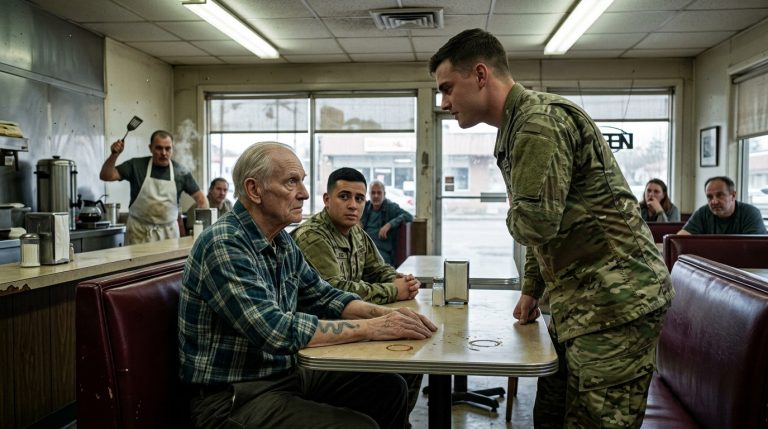
The transition from the kitchen to the classroom was not merely a walk; it was a shift in reality. Miller moved from the humid, metallic scent of the fryers to the dry, chalk-dusted air of the lecture room. Twenty elite snipers sat before him, their posture unnatural—they were leaning forward, their eyes locked on the front of the room where the old man sat. Saul had not changed his apron, but the way he sat in the wooden chair, with his hands folded loosely on a set of yellowed tactical diagrams, commanded a silence more profound than any drill sergeant’s shout.
He did not stand to greet them. He simply waited, his pale blue eyes tracking the room with an unsettling, predatory calm.
“Open your books,” Saul said. His voice was no longer the raspy, broken instrument of the cook. It was resonant, steady, and dangerously clear. “But put your pens down. I don’t want you writing down what I say. I want you to remember why you’re here.”
Miller found a seat in the front row, his hands resting on his own notebook. He felt the gaze of his men on his back. They were looking to him to see how to react to this—to the mess hall cook, to the “Ghost,” to the man who had humbled them all with a single, impossible shot. Miller didn’t look back. He kept his eyes on Saul.
“You have all passed the certification,” Saul said, sliding a weathered photograph across the desk. It was an aerial shot of a ridgeline, the geography jagged and unforgiving. “You know how to calculate for wind. You know how to factor for elevation. You know the specs of your equipment until you can dream the part numbers. But you don’t know the first thing about the terrain of a decision.”
Saul leaned back, and for a moment, the room seemed to flicker. Miller saw not an old man in a stained apron, but a shadow on a ridge, a figure that moved with the terrifying speed of an animal. The memory of the Valley of Tears was not a story in this room; it was an atmosphere.
“When you are in the scope,” Saul continued, “you are not looking at a target. You are looking at a consequence. Every time you squeeze that trigger, you are changing the shape of the world. And if you are not prepared for that change, you shouldn’t be holding the rifle.”
He picked up a piece of chalk, but he didn’t draw a diagram. He drew a line. A long, uneven, jagged line that cut across the blackboard.
“This is the line between life and everything else,” Saul said. “In 1972, I spent seventy-two hours on the other side of that line. I didn’t have high-tech optics. I didn’t have spotters. I didn’t have a kitchen to go back to.”
A sniper in the back row shifted, the movement sounding like a gunshot in the heavy silence. Saul didn’t react. He kept his eyes on Miller, pinning him with a stare that felt like it was reading the subtext of his own soul.
“Captain,” Saul said, his voice dropping into a quiet, conversational tone that was somehow more intimidating than his shout. “If you had a target in your crosshairs, and you knew that firing meant the end of your own peace, would you take it?”
Miller felt the air leave his lungs. He was an officer. He was trained to respond to this—to the ethics of the battlefield, the rules of engagement, the mission parameters. But sitting here, in front of the man who had actually lived the reality of those ethics, the textbook answers felt like sand in his mouth.
“I… I would follow my orders, sir,” Miller said, his voice sounding thin even to his own ears.
Saul smiled. It was a small, sad, crooked expression that reached his eyes but failed to touch the weariness settled there. “That’s a good answer for a textbook, Captain. But you aren’t in a classroom when you’re on the ridge. You’re alone. The orders don’t reach that high. The only thing that reaches that high is the sound of your own heartbeat.”
Saul stood up. The movement was stiff, and he clutched the edge of the desk for a second, his knuckles white—a brief, startling reminder of his age. He walked to the blackboard and tapped the jagged line he had drawn.
“Physics is physics,” he repeated, the mantra he had used on the range. “But the math of survival is based on loss. You think you’re training to be heroes? You’re training to be the ones who stay behind when everyone else leaves. And the cost of that, the real cost, is that you never truly come home.”
He looked around the room, meeting the gaze of every sniper there. His eyes were hard, unsentimental, and profoundly sad. “Tonight, I want you to go to the range. I want you to take your rifles, I want you to set up on the mats, and I want you to stare at that target until the sun goes down. And I don’t want you to fire a single round. I want you to feel the weight of the rifle. I want you to feel the distance. And I want you to ask yourself if you’re ready to disappear.”
He turned his back on them, picking up his eraser and wiping the blackboard clean, leaving nothing but a faint, white ghost of the line he had drawn.
“Class dismissed.”
Miller stood, but he didn’t move toward the door. He watched Saul shuffle toward the corner of the room, toward the small, wooden cart he’d left by the door. The transition was complete. The mentor was gone, replaced by the man who served soup. But as Miller walked out into the corridor, he could still feel the weight of the chalk line, a jagged memory etched into the air of the room, marking a distance he hadn’t yet learned how to cross. He looked back once, but the room was empty, the shadows stretching long and thin across the floor, and he felt a cold, sharp realization: the training hadn’t ended. It had only just begun.
CHAPTER 6: The Shadow on the Range
The sun had long since surrendered, leaving the firing range as a hollow, ink-black void beneath a sky studded with uncaring stars. Miller walked the perimeter of the gravel, his boots crunching with a regularity that served as a heartbeat to the silence. He was alone, as he had been for the last three hours, standing behind the rifle on the mat. He hadn’t fired a shot. He hadn’t even chambered a round. He was simply staring, his eyes burning from the strain of trying to pierce the darkness where the target silhouette waited, invisible and absolute.
Saul’s voice echoed in his mind, not as a memory, but as a persistent, gnawing interrogation. Are you ready to disappear?
Miller felt a drop of sweat roll down his temple, cool and sharp against his skin. He reached up, wiping it away, his hand shaking with a tremor he couldn’t suppress. This was the discipline Saul spoke of—the act of holding a tool of destruction and choosing to let it stay silent. It was a test of willpower, but more than that, it was a test of identity. If he didn’t fire, who was he? If he didn’t hit the target, did he still belong to the elite?
A sudden, sharp sound snapped through the dark—the distinct clack-clack of a metal cart’s wheels on loose stone.
Miller spun around, his hand moving by instinct toward the holstered sidearm he wasn’t carrying. He squinted into the gloom, watching the dim outline of the mess hall cart emerge from the shadows of the supply shed. It moved with that same, slow, rhythmic squeak he had come to dread and respect in equal measure.
Saul was pushing it. The old man looked smaller in the moonlight, a hunched silhouette, his white apron a ghostly patch of pale fabric in the dark. He wasn’t heading toward the mess hall. He was walking straight toward the firing line.
“Captain,” Saul said, his voice dropping through the night like a plumb line.
Miller stepped away from the rifle, his posture instinctively straightening. “Saul. It’s midnight. The training ended hours ago.”
“Training doesn’t end just because the sun goes down,” Saul said. He stopped the cart a few yards away, the metal frame groaning as he locked the wheels. He moved with a stiff, labored grace, reaching into the cart and pulling out two metal cups of coffee. He held one out.
Miller took it, the warmth of the ceramic seeping through his gloves. “I’m just… I’m thinking about what you said. About disappearing.”
Saul walked to the edge of the firing mat and stood there, looking out into the total, featureless dark. He didn’t seem to be looking at the target. He seemed to be looking through it, into a distance Miller couldn’t fathom.
“You’re not thinking about disappearing, Captain,” Saul said, his voice devoid of judgment, flat and clinical. “You’re thinking about replacing. You want to take the space I left behind. You want to be the one on the ridge, the one who holds the line, the one who carries the weight. But you don’t want the cost. You want the glory of the ghost, but you want to keep the life of the man.”
Miller felt a flare of defensive pride. “I’ve given my life to this unit. I’ve sacrificed everything.”
“You’ve given your hours,” Saul corrected, turning to look at him. In the moonlight, the star-shaped scar on his forearm seemed to catch the pale light, a jagged, silver map of a place Miller had only heard about in rumors. “Sacrifice isn’t about what you do when you’re standing in the sun, Captain. It’s about who you are when you’re standing in the dark, and you have to decide whether to save a man or to be a hero.”
Saul gestured to the rifle on the mat. “Pick it up.”
Miller didn’t hesitate. He dropped to his knees, his movements feeling clunky and amateurish compared to the fluid, ancient ease Saul displayed. He felt the cold, hard contact of the stock against his cheek.
“Don’t look at the target,” Saul said, standing directly behind him. “Close your eyes. Listen to the wind. Not the wind on the range, but the wind in the canyon. The one that swirls. The one that changes.”
Miller closed his eyes. He felt the darkness press against his eyelids, heavy and suffocating. He listened. At first, there was nothing but the sound of his own breathing, loud and ragged. But then, he caught it—a low, rhythmic whistle of air moving through the crags of the distant ridge, a subtle, shifting sound that he had never bothered to listen for before.
“That’s not the wind,” Saul whispered, his voice so close it felt like it was coming from inside Miller’s own head. “That’s the distance. That’s the space between you and what you’re trying to protect.”
Miller’s fingers brushed the trigger. His heart rate slowed. He wasn’t thinking about the mission, or the General, or his career. For the first time, he was thinking only about the weight of the steel, the cold, unforgiving reality of the tool he was holding. He realized, with a sudden, sinking dread, that he didn’t know what he was aiming at. The target was gone. The mission was a fiction.
“If you pull that trigger right now,” Saul said, his voice hardening into the cold, predatory command Miller had heard on the range, “you won’t be hitting a target. You’ll be firing into the dark, hoping to find yourself.”
Miller pulled his finger back, his hand shaking. He opened his eyes, but he couldn’t see the range. He could only see the dark, and for a moment, it felt as if the entire world had fallen away, leaving him standing on the edge of a ridge that was three thousand miles and fifty years away.
“I don’t know who I am without the rifle,” Miller confessed, the admission ripped from his throat.
“That,” Saul said, his voice softening just a fraction, “is the first lesson you’ve actually learned.”
He reached down, his gnarled hand covering Miller’s on the stock, and gently guided the rifle down, away from the night, toward the cooling earth of the desert.
CHAPTER 7: The Ridge and the Rain
The sky above the firing range had bruised into a deep, sickly purple, the air thickening with the ozone-heavy scent of an incoming desert storm. The dry heat, which had been the constant, suffocating backdrop to their training, was being rapidly replaced by a sharp, damp chill that made the metal components of the rifles feel like ice against Miller’s skin.
Saul didn’t move away after he guided the rifle down. He remained standing behind Miller, his presence a steady, heavy weight in the gathering gloom. He didn’t say anything, but the way he held his posture suggested he was listening to more than just the wind. He was listening to the pressure.
“The storm,” Saul said finally, his voice barely audible over the rising whistle of the gale through the canyons. “It brings the variables you can’t calculate. Humidity changes. Barometric pressure drops. The mirage disappears, and suddenly, you’re just a man with a piece of metal.”
Miller sat up, the gravel biting into his knees. He looked at the rifle—the prototype that was supposed to be his ticket to a successful black ops mission—and felt a strange, detached indifference toward it. “Is that what it was like?” he asked. “On the ridge?”
Saul looked out toward the distant silhouette, now barely visible against the darkened hills. “It wasn’t a choice, Captain. It was a subtraction. Every time I pulled the trigger, I wasn’t just hitting a target. I was removing a future. By the end of the first day, the mission didn’t matter. The enemy didn’t matter. The only thing that mattered was the math of survival—the balance of how much one life was worth against the lives of the forty-seven men huddled in the rocks below.”
Miller stood up, the movement slow and deliberate. He could see the flash of lightning in the distance, a silent, flickering pulse that illuminated the jagged, broken geography of the canyon. “You didn’t just stay because of orders,” Miller realized, the words feeling heavy on his tongue. “You stayed because you knew if you left, they would be the ones paying the price.”
“That’s the secret,” Saul said, turning to look at Miller. His eyes were no longer weary. They were sharp, clear, and terrifyingly present. “You think you’re here to learn how to kill. But you’re here to learn how to endure the cost of having done it. You want to be a ghost? Then you have to accept that you can never truly be anything else. You have to be willing to lose yourself so that others don’t have to.”
The first fat drops of rain hit the dry earth, kicking up the sharp, pungent scent of dust and damp stone. It was a transformative smell, washing away the heat of the day and replacing it with the cold, hard reality of the approaching night. Miller felt the rain on his face, cooling the feverish heat of his own obsession. He looked at Saul—the man in the greasy apron, the ghost of the valley, the cook who had somehow become the only thing tethering Miller to reality.
“I’m not a hero,” Miller said, looking back at the rifle. “And I don’t think I have the strength to be a ghost.”
“Good,” Saul said. He reached out, his hand—rough, gnarled, and stained—resting for a brief, human moment on Miller’s shoulder. “Heroes are the first ones to break when the math stops adding up. The ones who survive are the ones who stay human, even when the job forces them to be something else.”
Saul turned and walked toward the cart. He didn’t look back as he grabbed the handle and began to push it across the gravel, the wheels skidding slightly in the gathering mud. Miller watched him go, the white apron appearing as a singular, stubborn point of light against the encroaching dark.
He didn’t follow. He stood on the firing line, his feet planted wide, and watched the desert storm swallow the man who had taught him that the only way to win a war was to refuse to let it define the soul. Miller turned back to the rifle. He reached out, his fingers tracing the cold, oily length of the barrel, and then, with a quiet, decisive motion, he opened the bolt and cleared the chamber. He left the weapon on the mat, its potential silent and spent, and walked away into the rain, leaving the range behind. He wasn’t going to the mess hall. He wasn’t going to the barracks. He was going to walk, just as he was, into the dark, and for the first time in his life, he didn’t care where the wind was blowing.
CHAPTER 8: The Kitchens Quiet Peace
The rain had softened into a steady, rhythmic drumming against the corrugated tin roof of the mess hall. Inside, the air was warm, smelling of flour, yeast, and the sharp, clean scent of scrubbed stainless steel. Saul stood at the center of the kitchen, his movements slow and methodical as he prepared for the morning’s first meal. The grease stains on his apron were gone, washed away by a frantic session at the laundry sink, and his hands, usually so stiff, moved with an easy, practiced grace as he kneaded a mound of dough.
The heavy door creaked open, admitting a gust of damp, cold air. Captain Miller stepped in, his uniform darkened by the rain, his boots leaving muddy tracks on the polished floor. He stopped just inside the threshold, watching the old man. There was no confrontation in his posture, only a quiet, searching stillness.
Saul didn’t look up from his work. “The range is quiet tonight, Captain.”
“It is,” Miller replied. He walked forward, not to the counter, but to the small wooden table in the corner where the officers usually ate. He sat down, the wood groaning slightly under his weight. “I left the rifle. I didn’t think I had the right to keep it.”
Saul paused, his hands buried deep in the dough. He turned his head, his pale blue eyes clear and unflinching in the harsh, sterile light of the kitchen. “Right isn’t something you’re given, son. It’s something you earn by deciding what you’re willing to lose.”
Miller watched him, realizing for the first time the true scale of the sacrifice. It wasn’t just the killing; it was the isolation. Saul had spent decades in the shadow of the base, intentionally shrinking his world until it consisted of only what he could touch, what he could nourish, and what he could keep simple. He hadn’t been hiding from his past; he had been building a cage around it, a cage made of meatloaf and iced water, so that the violence wouldn’t ever touch another soul.
“My father’s story,” Miller began, his voice softening. “He told me you survived because you didn’t leave until the last chopper cleared. He said you were the only reason he got to go home to his family.”
Saul went back to his work, his hands rhythmically folding the dough. “I stayed because I knew how to count the math of the ridge better than anyone else. I knew how long the enemy would take to advance, how many rounds I had left, and exactly how many seconds it would take for that final bird to clear the canyon wall. I didn’t save them because I was a hero, Captain. I saved them because I knew exactly how many of them had to die for the others to live.”
The admission hung in the kitchen, a cold, hard truth that stripped away the myth of the legend. Saul wasn’t a hero of mythic proportions; he was a man who had lived with the exact, calculated tally of his own survival.
“That’s why you stopped,” Miller realized, the weight of the confession landing on his chest. “You didn’t just stop because you were tired. You stopped because you couldn’t stand the tally anymore.”
Saul set the dough aside, wiping his hands on a clean, white towel. He walked over to the coffee pot, poured two cups, and brought one over to the table. He set it down in front of Miller and sat opposite him, his posture for once not broken, but merely tired.
“The ghost of the valley was a man who mastered the art of ending things,” Saul said, his voice steady. “But I learned that the art of ending things is the easiest skill to acquire. The hard part is the art of starting something else. Cooking, cleaning, teaching—these are the things that require you to give something of yourself, not take something from someone else.”
Miller looked down at his coffee. The steam curled up, swirling in the cool air, a delicate, fragile thing. “The black ops mission is moving forward, Saul. The men, they’re different now. They aren’t training for glory anymore. They’re training because they understand the responsibility of the rifle.”
“Then they’ll survive,” Saul said. He reached out and pushed a small, metal object across the table. It was a spent casing, polished until it shone, a star-shaped indentation etched into the brass. “Keep that. Not as a badge of honor, but as a reminder that every piece of lead has a cost, and every shot you don’t take is a victory you’ve earned for yourself.”
Miller picked up the casing, the brass warm against his skin. He looked at Saul—the cook, the ghost, the man who had traded a legacy of blood for a life of bread—and finally understood the depth of the peace he had been chasing.
“I won’t be coming back to the range,” Miller said, his voice quiet.
“I know,” Saul replied. He picked up his own cup, his expression soft, almost content. “You don’t need to. You’ve already found your own ridge, Captain. Just make sure you know what you’re defending.”
They sat in the quiet of the kitchen, the rain drumming a steady, comforting rhythm against the tin, the smell of rising bread filling the air. For the first time in his life, Miller didn’t feel the need to stand at attention. He just sat, letting the heat of the coffee sink into his bones, while the old man who had once been a legend went back to his work, the simple, honest labor of a man who had finally, truly, come home.