The Weight of Iron: A Master Sergeant’s Final Stand to Protect the Dying Craft of Precision
CHAPTER 1: THE HEAT OF THE RANGE
The air at Fort Campbell did not just sit; it shimmered, a viscous, heat-soaked haze that turned the three-hundred-yard targets into dancing ghosts of ink and paper. Sergeant First Class Rodriguez squeezed his eyes shut for a heartbeat, clearing the phantom flicker of the mirage, then opened them to the unforgiving clarity of the new Schmidt and Bender scope.
It was a piece of art—four thousand dollars of German engineering, sleek and matte black, mounted with the kind of clinical precision that should have made his shot a mathematical certainty. Instead, it was a liability.
Eighteen inches left. Fourteen inches low.
Rodriguez adjusted his windage, his thumb moving with a mechanical rhythm he’d practiced for a decade. He settled the crosshairs back into the center mass of the target, felt the familiar, heavy tension of the trigger against his index finger, and breathed. The air was dead, the wind flags limp as dead skin. He let half his breath out. He squeezed.
The rifle bucked, the sound sharp and violent in the stillness of the range, but the impact—when the spotter called it—wasn’t just a miss. It was a joke.
“Six inches low,” the spotter muttered, his voice devoid of the usual crisp professionalism. “Same point of impact, Sergeant. It’s… it’s not tracking.”
Rodriguez pulled his face from the stock, the rubber eye-cup leaving a pale, damp ring around his socket. His jaw clicked, a sharp, metallic sound of repressed frustration. He looked toward the firing line, where Captain Meyer stood with his arms folded, a silhouette carved from cold judgment.
“That’s three, Rodriguez!” Meyer’s voice didn’t need amplification to slice through the humidity. It carried the weight of a whip. “Three days of this. We are burning through match-grade ammunition like it’s cheap charcoal, and you’re shooting like a recruit who just learned how to close his left eye. What is the status?”
Rodriguez didn’t answer immediately. He looked down at the rifle, his hands hovering over the mounting screws as if they were live wires. He felt the phantom pressure of the scope tube against the rings—a sensation of binding, a subtle, microscopic resistance that shouldn’t have been there. It was as if the rifle itself were fighting the optic, a violent, mechanical rejection.
“The scope’s not holding zero, sir,” Rodriguez finally said, his voice flat. “It’s not me. Every time I dial it in, the erector assembly binds. It’s like the internal springs are bottoming out against a wall that shouldn’t be there.”
“Negative,” Meyer stepped forward, the dust on his boots kicking up in small, angry clouds. “The manufacturer has certified these units for extreme-stress environments. Your excuse is noted, Sergeant, but it’s irrelevant. The problem isn’t the glass. It’s the user.”
Rodriguez looked up, his eyes meeting Meyer’s. There was no argument left to make. The bureaucracy was a loop, a closed circuit of logic where the gear was perfect by definition, and any failure was a moral or skill-based defect of the operator.
As Meyer turned to walk toward the next shooter, a faint, rhythmic sound cut through the tension—the low, steady chug of a lawnmower’s engine. A few yards away, a man in faded, grass-stained overalls pushed a rusted mower across the berm. He didn’t look at the soldiers. He didn’t look at the targets. He was just part of the landscape, as silent and permanent as the dirt itself.
Rodriguez watched the old man pass, noticing for the first time that his hands, though gnarled with the tell-tale swelling of age, gripped the mower’s handle with a surgical, fixed stillness. The man didn’t flinch when a rifle fired nearby. He didn’t even turn his head. He just kept moving, his eyes tracking the edge of the grass with a precision that made Rodriguez’s own grip on his rifle feel clumsy and loud.
The man turned the mower, his gaze drifting for a fraction of a second toward Rodriguez’s rifle. It was a fleeting, almost imperceptible glance, but it carried a weight of judgment that made the air feel suddenly, terrifyingly thin. For the first time in his career, Rodriguez felt the crushing suspicion that the answer to his failure wasn’t in the manual, and it certainly wasn’t in the captain’s clipboard. It was somewhere he wasn’t allowed to look.
CHAPTER 2: THE BUREAUCRATIC WALL
Captain Meyer did not move for a long moment. The silence on the range had thickened, becoming something tangible, like the heavy, stagnant air before a summer storm. His eyes remained fixed on the spot where the groundskeeper had been, but the old man was already moving again, the rhythmic clack of the mower’s wheels against the concrete berm echoing like a slow, steady heartbeat.
“Sergeant,” Meyer said, his voice dropping from its usual bark to a low, serrated edge. He didn’t look at Rodriguez. He was staring at the line of rifles, the pristine optics glinting with a cold, unearned light. “Dismiss the shooters. Five-minute break. I want the armorers at the cleaning tables. Now.”
Rodriguez felt the shift in the atmosphere, a subtle tightening of the unit’s morale. He signaled the line down, the familiar sound of safeties being engaged and bolts locking home creating a mechanical rattle that seemed to underline the captain’s discomfort. As the snipers moved toward the shade of the cleaning hut, their conversations were hushed, their postures slouched under the weight of three days of failure.
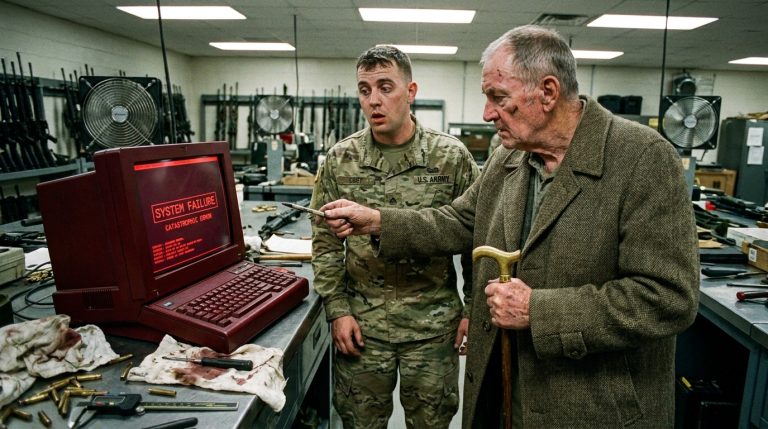
Meyer strode toward the cleaning tables, his stride deliberate and hard. Sergeant Willis, the unit’s lead armorer, was already there, his face pale, frantically scrubbing the barrel of a rifle with a solvent-soaked patch as if he could scour the failure away with enough effort.
“Willis,” Meyer said, stopping behind him. The captain’s hands were clasped firmly behind his back, a posture of rigid control. “Tell me again. The torque specs. The alignment. Everything.”
Willis looked up, his movements hesitant. “Sir, I used the digital wrench. 25-inch pounds. It’s the standard, sir. It’s what the manual for the M110 system dictates. I checked the alignment with the laser collimator twice. The civilian techs signed off on the mounting procedure. We followed the directive exactly.”
Meyer turned, scanning the range. His gaze landed again on the old man pushing the mower. The groundskeeper was currently maneuvering around a patch of tough weeds near the fence line, his movements methodical and unhurried.
“The civilian technicians,” Meyer muttered, more to himself than to Willis. He pulled his phone from his tactical vest, his thumb hovering over the screen. He needed someone to confirm what his eyes were seeing but his mind refused to process: that the system he was defending was systematically breaking the very tools it relied upon.
“Sir?” Willis ventured, his voice barely audible over the heat-induced hum of the range. “If the equipment isn’t the problem, and the shooters aren’t the problem… maybe it’s the environment. The temperature, the humidity. Maybe we should pause qualification until the atmospheric pressure stabilizes.”
Meyer felt a flash of irritation—the institutional instinct to shift blame to the uncontrollable rather than the human. He looked at Willis, really looked at him. The man was young, intelligent, and entirely a product of the modern era’s reliance on automated checks. He knew the software, the hardware, and the manuals, but he didn’t know the feel of the steel. He didn’t know the language of the tool.
“We aren’t pausing,” Meyer said, his voice clipped. “We’re going to verify the verification. Take every rifle off the rack. Strip the scopes. I want a complete teardown of the mounting hardware. Not with the digital wrenches—use the manual gauges. Check the ring spacing. Check the tube integrity for any deformation, even a micron. I want to know if these scopes are binding.”
He walked away before Willis could respond, moving toward the observation tower to gather his thoughts. He needed to be alone. The frustration was no longer just about the qualification scores; it was about the creeping, corrosive realization that he was losing control of his section. He was an officer who prided himself on the efficiency of his unit, yet he was currently commanding a group of men who couldn’t hit a target, equipped with gear that was supposedly perfect.
As he reached the tower, he caught a glimpse of his own reflection in the tinted glass: a man in uniform, precise, controlled, and utterly baffled. Below him, the range continued its slow, mechanical rhythm. The sound of the mower had stopped, replaced by the faint, metallic scrape of tools hitting the workbenches.
He didn’t want to admit it—to himself, to the battalion commander, or to the men—but the thought kept circling back to that brief, silent assessment from the groundskeeper. The way the old man had looked at the rifle hadn’t been a critique of the shooter. It had been the look of a man watching a car crash in slow motion, knowing exactly where the fault lines were and choosing to remain silent.
Meyer gripped the railing of the tower, his knuckles white. The bureaucracy demanded he trust the manual, the experts, and the certified technicians. But the air on the range felt different now, charged with the weight of an error that was hiding in plain sight. He was staring at the very definition of a paradox: the equipment was too precise to be wrong, yet it was failing so consistently that the truth had to be something entirely impossible.
He took a breath, the air hot and dry in his lungs, and looked at his watch. He had two weeks before the Pentagon brass arrived. In two weeks, he either had to fix the machine, or he had to find a way to justify the silence of the man who knew how to turn it.
CHAPTER 3: THE CALL TO HISTORY
The humidity had begun to curdle, thickening the air with the scent of ozone and baked dry grass. Captain Meyer remained in the observation tower, his eyes tracking the battalion commander, Lieutenant Colonel Foster, who was currently standing by his vehicle at the edge of the range. Foster was a man of few words, a relic of a combat era that didn’t tolerate the kind of bureaucratic rot Meyer was currently presiding over.
Meyer moved. He descended the steel stairs of the tower, the metal groaning under his weight, the rhythmic clang-clang-clang echoing in the near-silent firing line. He reached the bottom and walked toward the command vehicle. The gravel crunched with a brittle, dry sound under his boots.
“Colonel,” Meyer said, stopping a respectful distance away. His salute was sharp, precise, and devoid of its usual arrogant crispness. It felt heavier today.
Foster didn’t return the salute immediately. He was looking across the range at the maintenance tables, where Sergeant Willis was still laboring under the direction of the civilian techs. Foster’s face was a map of past wars—lined, weary, and utterly unimpressed by the frantic activity of the modern armory.
“My snipers are still failing, Colonel,” Meyer said, cutting through the pleasantries. “The civilians are blaming atmospheric shifts and barrel harmonics. They’re running every diagnostic the manuals allow.”
“And you, Captain?” Foster asked, his voice low, lacking the performative volume of the command hierarchy. “What do you think is happening?”
Meyer felt the weight of his own earlier dismissal. He remembered his own words—the problem is between the stock and the scope. He had blamed the men, and yet, the men were proving themselves the only stable variable in a crumbling equation. “I think the manual is wrong, sir. Or at least, the application of it is.”
Foster gestured toward the distant figure of the groundskeeper, who was currently clearing a jam in the mower’s blade with a pair of pliers. “That man out there is Robert Kaine. Bobby to those who knew him before the bureaucracy decided he was finished.”
“I don’t know him, sir,” Meyer admitted, his jaw tightening.
“You don’t need to,” Foster replied. “You need to know what he represents. Twenty-three years as the lead armorer for the Army Marksmanship Unit. He has forgotten more about the physics of a rifle than those civilian technicians have ever learned from their two-week certification courses. He was the one who set the tolerances for the M110 when the platform was in its infancy.”
Meyer looked back at the maintenance tables. Willis was currently staring at a torque wrench, his brow furrowed, his movements jerky. “He’s been watching us, sir. For three days.”
“He watches everything,” Foster said. “He was the one who taught us that the difference between a master and a technician is the ability to listen to the machine. You’ve been listening to the manuals, Captain. You’ve been listening to the contracts. But the machines? They’ve been screaming at you since the first round went wide.”
Foster pulled his phone from his holster. It was an older model, scratched and scuffed, nothing like the sleek, high-tech devices that filled the officers’ hands. He looked at it for a moment, then dialed. “I need you to look at something, Bobby.”
The conversation was brief—four words that shifted the entire tectonic plate of Meyer’s command. As Foster hung up, he looked at Meyer with a gaze that felt like a surgical probe. “He’s coming over. And Captain, if you value your section’s integrity—and your own career—you will stop the civilians from touching another screw until he has finished his inspection.”
Meyer felt a chill that the Tennessee sun couldn’t touch. He looked toward the equipment shed. The groundskeeper was climbing off the mower. He wasn’t hurrying; he moved with the slow, deliberate pace of a man who knew exactly how much weight the world could hold. As he approached, Meyer noticed the tools peeking out of his pockets—a collection of worn, mismatched steel, nothing like the polished, calibrated digital kits that were currently failing to explain why a rifle shouldn’t hit its target.
The groundskeeper didn’t salute. He didn’t offer a greeting. He stopped in front of Foster, his weathered hands tucked into his overalls, his eyes the color of a winter sky that had seen too much.
“Tom,” the man said.
“Bobby,” Foster replied.
Meyer stood there, a captain in the middle of a command structure that was supposed to be bulletproof, feeling like a child who had been playing with toys he didn’t understand. The silence that followed wasn’t just the absence of noise; it was the presence of a truth that was about to be laid bare.
CHAPTER 4: THE RETURN OF THE GHOST
The transition was not marked by a shift in personnel, but by a sudden, cooling gravity. Captain Meyer stood to the side, his hands still clasped behind his back, feeling the unfamiliar sensation of being a spectator in his own domain. Beside him, Lieutenant Colonel Foster remained motionless, a sentinel watching the old man, Bobby, approach the firing line.
Bobby didn’t walk like a soldier anymore; he moved with the caution of a man whose joints remembered every heavy pack and every long trek across rugged terrain. Yet, when his eyes tracked the row of rifles, the tremor in his hands vanished. It was as if the metal reached out to him, offering a history he had spent a lifetime refining.
“Captain,” Bobby said, his voice a gravelly monotone that didn’t demand attention but commanded it nonetheless. He didn’t wait for a response. He walked toward the first rifle on the bench—the one Rodriguez had been struggling with for three days.
The civilian technicians were huddled near the back of the cleaning hut, whispering, their clipboards held like shields. One of them, a man in his forties with a polo shirt embroidered with the manufacturer’s logo, stepped forward. “Sir,” he said, directing his comment to Meyer, though his eyes were on Bobby. “We have the torque data. The digital sensors are consistent. If there is a mechanical failure, it is within the scope’s internal erector housing. This man… he doesn’t have the diagnostic equipment.”
Meyer looked at the technician, then at Foster. The battalion commander didn’t even turn his head. He was watching Bobby’s fingers.
“The manual says 25 inch-pounds,” Bobby said, his voice quiet, almost to himself. He reached into the deep, frayed pocket of his overalls and pulled out a small, L-shaped Allen wrench. It was dark, the steel polished to a dull sheen by years of friction. “The manual was written by someone who had never felt the crush of aluminum under that much pressure.”
Bobby leaned in. He didn’t pick up the rifle. He simply touched the scope ring with his thumb, pressing against the side of the mount. It was a subtle, almost intimate motion, the kind of tactile check that no laser collimator could replicate. He felt the resistance—the subtle, microscopic binding of the tube against the ring.
“When you tighten these past 15,” Bobby continued, his eyes drifting away from the rifle, as if he were looking at something far off, perhaps a range at a different time, under a different sky, “you aren’t securing the scope. You’re choking it.”
Meyer felt a sharp, intrusive flash of memory: a night at the range years ago, when he had been a young lieutenant, trusting the equipment because he hadn’t yet realized that gear was merely a mirror of the man who prepared it. The thought, a psychological phantom of his own inadequacy, rattled through him. He had spent his career polishing the surface of his unit, ensuring every report was compliant, every box checked. He had forgotten that precision was not a compliance issue. It was a craft.
Bobby turned a screw, not with a digital click, but with a slight, measured rotation. The sound was distinct—a dry, metallic tick.
“You’re all focused on the numbers,” Bobby said, looking toward Willis, the unit’s master armorer. “Numbers are honest, but they are cold. A rifle is a living thing in the hands of a shooter. If you build it with fear—fear of recoil, fear of deviation—you build a trap. That’s what this is. A trap.”
Willis looked at the rifle, his face flushing. “I followed the specs, Master Sergeant.”
“I know you did, son,” Bobby said, his tone softening, losing its edge. “And that’s the tragedy. You were trained to follow, not to feel. You were trained to be a technician, not a guardian of the craft.”
Meyer stepped forward, his boots feeling heavy on the concrete. “Master Sergeant, what do we do?”
Bobby finally looked at him. The winter-sky eyes were devoid of malice, but they held the weight of an era that had been systematically stripped away. “You stop trusting the manual and start trusting the steel. We aren’t here to pass a qualification. We’re here to make these rifles shoot true.”
He began to move down the line. Each rifle was treated not as a component of an inventory list, but as an individual patient. He checked the eye relief with the same care a doctor might check a pulse. He loosened, adjusted, tightened, and leveled, his gnarled fingers finding the ‘sweet spot’ that the digital tools had missed by a margin that felt like a mile.
Meyer watched the civilian technicians in the background. They were motionless now, their clipboards discarded on the table, their faces drained of the smug certainty they had worn that morning. They were witnessing the breakdown of their own reality.
The air felt thinner, the ozone smell sharper. For the first time, Meyer understood that this wasn’t just about scopes. It was about the slow, silent erosion of skill in favor of convenience. He looked at Rodriguez, who was standing nearby, his eyes glued to Bobby’s hands. The sergeant wasn’t looking at the manuals or the captain anymore. He was watching the master.
“We’re going to be here a while,” Bobby said, not looking up. “And I’m going to need you to move those crates of brass out of the way. They’re interfering with the sight-line of the bench.”
Meyer nodded, finding himself for the first time in his command acting on a direct, non-bureaucratic order. He turned to his men. “You heard him. Clear the deck. Let the man work.”
As the soldiers began to move, Meyer felt a strange, jarring shift in the atmosphere. The tension hadn’t dissipated; it had merely changed. It was no longer the cold, brittle tension of failure. It was the sharp, focused energy of a lesson about to be learned. And as he watched Bobby work, Meyer felt the first, faint cracks in his own armor. The institutional rot he had been presiding over—the reliance on the system to do the thinking for him—was finally being exposed by a man who didn’t even have a rank left to his name.
CHAPTER 5: THE ANATOMY OF ERROR
The range had fallen into a profound, suffocating quiet. Even the wind had died down, leaving the flags hanging limp against their poles like wet rags. Bobby stood over the first rifle—Rodriguez’s weapon—his movements measured, deliberate, and entirely immune to the impatience of the men watching him. But then, as he reached for the final locking screw on the scope ring, the tool in his hand—that venerable, L-shaped piece of hardened steel—caught on a burr of deformed aluminum.
His hand hitched. A tremor, barely visible to the untrained eye, rippled through his thumb. It was a fleeting, ugly moment of frailty.
“Master Sergeant?” Willis took a half-step forward, his voice tight with an anxiety that was becoming infectious.
Bobby didn’t answer. He carefully withdrew the wrench, turning it over in the dim light of the cleaning hut. The tip was worn, blunted by decades of service, and the edge of the aluminum ring he was working on was already showing the deep, jagged indentations caused by the initial 25-inch-pound torquing. It wasn’t just that the rings were the wrong material for that torque; it was that they had been permanently warped. The metal was exhausted, its molecular structure stressed to the point of structural failure.
“This,” Bobby said, his voice unusually thin, “isn’t a matter of adjustment. It’s a matter of damage.”
He gestured for Rodriguez to come closer. “Look at this, son. See how the metal has flowed around the screw head? It’s not holding the scope tube anymore. It’s biting into it. Every time you fire, the recoil drives the scope back, but the ring doesn’t hold it—it grinds against it. That’s why your zero wanders. The scope is literally swimming in a bed of its own destroyed hardware.”
Rodriguez leaned in, his face inches from the bench. He could see it now—the hairline fractures spider-webbing out from the contact point. He looked at the civilian technician, who was watching from the periphery with a face like a shuttered window.
“You told us these were certified,” Rodriguez said, his voice dropping into a dangerous, low register. “You told the captain they were within spec.”
“They are within spec for steel,” the technician stammered, his earlier confidence replaced by a hollow, defensive posture. “The manufacturer’s documentation—”
“The manufacturer’s documentation assumes the technician has the sense to differentiate between the strength of steel and the malleability of aluminum,” Bobby interrupted, his voice cutting through the excuse like a hot wire. He didn’t look at the technician; he was focused entirely on the mangled ring. “You didn’t build a precision system. You built a ticking clock of mechanical failure.”
The realization hit Meyer like a physical blow. The “incompetence” of his unit wasn’t a failure of training; it was a failure of the entire supply chain and the doctrine that demanded he follow it without question. He looked at his men—hard-working, dedicated, and now, visibly shaken by the fact that they had been set up for humiliation by the very bureaucracy they served.
“We need new rings,” Willis said, his voice cracking. “I can pull them from supply—”
“Supply has the same ones,” Bobby said, not looking up. “They’re all from the same batch, aren’t they?”
The technician didn’t answer. He didn’t have to. The silence was an admission of guilt.
Bobby began to systematically strip the scope from the rifle. His hands were working with a desperate, frantic precision now, driven by a need to reveal the full scope of the disaster before the afternoon session began. As he pulled the optic from the cradle, he exposed the tube underneath. It was scarred, the finish rubbed away, the metal scored by the sharp edges of the over-torqued rings.
“It’s not just the rings,” Bobby muttered, his gaze tracking the length of the tube. “The tube itself is compromised. Look at the light refraction. See that distortion?”
He tilted the scope toward the light. A subtle, wavy shadow rippled across the glass—a sign that the tube was bent, however slightly, by the pressure. It was no longer a precision instrument. It was a paperweight disguised as a four-thousand-dollar piece of state-of-the-art technology.
Meyer stepped forward, his heart hammering against his ribs. The decoy secret—the idea that the gear was merely “improperly mounted”—had just been shattered. This wasn’t a setup error. This was a fundamental, systemic failure of the equipment itself. The rifles weren’t just misconfigured; they were systematically ruined.
“We have seven more rifles,” Meyer said, his voice uncharacteristically steady despite the surge of dread.
“They’re all the same,” Bobby said, finally standing up and rubbing his lower back. His face was etched with a deep, weary cynicism. “You followed the manual. You trusted the system. And the system gave you high-end garbage that couldn’t handle the physics of its own installation.”
He looked at Foster, who was standing by the range gate, his face like stone. The battalion commander didn’t need to be told. He was already calculating the fallout. This wasn’t just a range failure; it was a procurement scandal, a doctrinal collapse that reached far higher than the captain of a sniper section.
“What do we do, Bobby?” Meyer asked, knowing the answer was already beyond his control.
“You have two choices, Captain,” Bobby said, looking him dead in the eye. “You can hide this, scrap the rifles, and hope the brass doesn’t notice the discrepancy in your inventory before the audit. Or, you can tell the truth, and watch the entire architecture of this unit’s logistics come crashing down around your ears.”
The choice hung in the air—the survival of the unit’s image, or the brutal, honest, and utterly destructive path of accountability. Meyer looked at his men, then at the mangled rings on the bench, the rusted tools that were more reliable than the digital ones, and he knew that there was only one choice left to make.
CHAPTER 6: THE RIPPLE EFFECT
Captain Meyer held the mangled aluminum ring in his palm, the serrated edges biting into his skin. The heat of the afternoon sun seemed to intensify, baking the range into an oven of dust and iron. He looked toward his men, who were now standing in a loose, uneasy circle around the cleaning tables. They had been watching the dissection of their rifles with a dawning realization that the failure wasn’t in their hands, but in the chain of command itself.
“Sir?” Rodriguez’s voice cut through the shimmering air. He stood a few paces back, his rifle cradled in his arms like a wounded animal. “What do we do with the rest of them? If they’re all like this, we’re not just unqualified. We’re unfitted.”
Meyer didn’t answer immediately. He looked at Bobby, who was methodically wiping his tools clean with a rag that looked as ancient as his skills. The old man didn’t seem concerned with the political fallout; he was focused on the next rifle in the rack, his movements fluid, steady, and entirely detached from the chaos he had just unleashed.
“We keep working,” Bobby said, his eyes not leaving the rifle he was currently dismantling. “We check every ring. We torque every screw to 15 inch-pounds, not 25. And we shim what we have to, for now. It’s a field fix for a command-level problem.”
“And if the battalion asks why we deviated from the manual?” Willis asked, his hands still trembling slightly. “If they ask why we’re using rubber shims on a four-thousand-dollar system?”
“Then tell them you were making them shoot true,” Bobby replied, his tone sharp. “Or better yet, invite the Colonel to look at the metal himself.”
Meyer felt a surge of cold, pragmatic resolve. The decoy secret—that this was just an installation error—was dissolving in his hands. It was becoming clear that the institutional rot wasn’t just in the equipment, but in the entire mindset that favored the illusion of precision over the reality of it. He had spent his career as a captain ensuring that his unit appeared flawless on paper, and now, he was faced with the reality that his obsession with that appearance had blinded him to the structural collapse occurring in plain sight.
He looked at the civilian technicians. They were packing their equipment, their faces a mixture of confusion and defensiveness. They had spent years selling a ‘standard’ that was inherently incompatible with the material, and they were finally beginning to realize that the person they were dealing with wasn’t just a groundskeeper; he was the person who had defined the standards they had spent years mangling.
“Wait,” Meyer called out, his voice ringing with a new, authoritative clarity. The technicians froze. “You aren’t leaving until the inventory is fully accounted for. And you aren’t leaving until you’ve seen what happens when these rings are torqued to the correct specification.”
The technician stopped, his hand hovering over his gear bag. “Captain, the liability—”
“The liability is on your company,” Meyer said, stepping toward him, the mangled ring still in his palm. “If these rifles fail during the evaluation in two weeks, I’m not just going to report an installation error. I’m going to report a systemic failure of your product to meet the physical requirements of the platform. And I’m going to have the man who wrote the original military standard for this rifle testify to exactly why your hardware is failing.”
The technician went pale. The threat was real, and it carried the weight of a man who had finally stopped caring about his career-safe compliance and started caring about his mission.
Meyer turned back to the firing line. The soldiers were watching him now, their eyes no longer filled with the uncertainty of failure, but with a sudden, sharp interest. They saw their captain finally standing for the truth of the job, rather than the optics of it.
“Rodriguez,” Meyer said, his voice calm. “Get back on the line. We’re going to test the first one. Let’s see if we can get those groups to tighten up, even with the makeshift fix.”
As Rodriguez moved to the bench, the entire unit shifted. There was a change in the way they handled the rifles, a new, deliberate care that hadn’t been there when they were just following a checklist. Bobby watched from the side, a ghost of a smile playing on his lips. He began to instruct the next shooter, his voice low, passing down the ‘old ways’—the feel of the trigger, the consistency of the cheek weld, the way to listen to the rifle’s own harmonics.
The first shot cracked—a clean, sharp sound. A moment later, the spotter called out: “Center mass. Ten ring.”
Meyer exhaled, a long, ragged breath that felt like the first clean air he’d taken in days. He watched the group of men and the old master, and he realized that the fight to save his unit had only just begun. The systemic rot was deep, and this was only a temporary reprieval, but for the first time, they were shooting true.
CHAPTER 7: THE MIRROR HELD UP
The range was no longer a place of aimless frustration; it had become a crucible. Captain Meyer stood at the edge of the firing line, his gaze locked on the target boards where the groups were now clustered with a tight, disciplined lethality. It was the physical proof of everything he had tried to ignore, and looking at it felt like staring into a mirror that showed the ugly, neglected reality of his own command.
The civilian technicians were gathering their equipment, their movements hurried and clumsy. The man in the embroidered polo shirt stopped a few feet from Meyer, his face a mask of calculated indifference, but his eyes were darting toward the exit.
“Captain,” the man said, his voice clipped. “We have the data from the latest strings. We’ll be submitting a report to the regional office regarding the… unconventional adjustments made today. My company takes procurement compliance very seriously.”
Meyer stepped into his path, his presence blocking the route to the parking area. He didn’t raise his voice, but the sharpness of his tone stopped the technician dead in his tracks. “You’ll submit whatever report you like. But you’ll include the physical condition of the rings your team installed. You’ll include the fact that those rings were torqued to specs that are physically incompatible with the material, and that this entire unit was led to believe the failure was theirs.”
The technician’s jaw tightened. “We were following the established protocols for M110 optics setups. If the military standard has changed, that’s not our liability.”
“The standard didn’t change,” Meyer said, his voice cold. “The standard was forgotten. And your team was all too happy to sell us the equipment that would make sure we kept forgetting it.”
He didn’t wait for a reply. He turned away, leaving the man sputtering in the dust. The confrontation had been a necessity, but it felt hollow. He was still a captain in a system that prioritized paperwork over performance, and he knew that the report this man would write would be designed to insulate the manufacturer from any blowback. The institutional machine was a closed, self-protecting loop, and Meyer had only just begun to understand how tightly its gears were meshed.
He walked over to where Bobby was sitting on the tailgate of his old mower, his tools neatly arranged on a piece of grease-stained canvas. The old man looked smaller now, his shoulders hunched, his eyes fixed on the distant hills.
“You’ve started a fire, Captain,” Bobby said, without looking up.
“It needed to burn,” Meyer replied, leaning against the side of the mower. “My unit is shooting true. That’s what matters.”
“For today, maybe,” Bobby said, his voice dry. “But the brass doesn’t like it when the groundskeeper knows more than the armorer. They don’t like it when the ‘incompetence’ turns out to be a product of their own flawed logic. You’ve exposed more than just a bad mounting job. You’ve exposed the fact that they’ve stopped training soldiers to be masters. They’ve turned them into operators who don’t know how the machine functions.”
Meyer looked at his soldiers. They were gathered around the rifles, their heads bent together, talking. They weren’t just discussing the shots; they were discussing the why. They were sharing the knowledge Bobby had been passing down—the feeling of the ring, the way to check the level, the patience required to make a system work when the manuals failed.
“I can’t change the whole army,” Meyer said.
“No,” Bobby agreed. “But you can change this section. You can teach them that the manual is just a starting point. That’s the only way you survive the next inspection. When the brass comes, they’ll see the targets, but they’ll also see that your men aren’t just following orders—they’re thinking. They’re feeling the metal.”
Meyer looked at the horizon, where the sun was beginning to dip, casting long, jagged shadows across the range. The air felt heavy with the scent of spent brass and the lingering smell of ozone—the smell of a storm that hadn’t yet broken. He had two weeks. Two weeks to turn his unit into a group of masters who couldn’t be broken by a bad batch of equipment or a flawed protocol.
He walked back toward his men. He didn’t walk with the stiff, performative posture he had used three days ago. He walked with a different weight, a groundedness he hadn’t possessed until he realized that the authority of his office was nothing compared to the authority of the truth.
“Gather round,” Meyer said, his voice low and steady.
The soldiers stopped their work and converged on him. There was no hesitation now, no cynicism. They were looking at him, waiting to see what the next move would be.
“We aren’t going to scrap these rifles,” Meyer said. “We’re going to master them. Every one of you will learn the setup, the maintenance, and the feel of the system. We’re going to be the most proficient section in the battalion, not because of the glass, but because of what we know about the metal.”
He looked at Rodriguez, who nodded once, a look of profound, quiet determination on his face. The cycle of failure was broken. The institutional rot was still there, lurking in the shadows of the procurement contracts and the command staff offices, but here, on this range, in the heat and the dust, the truth was holding firm.
CHAPTER 8: THE FINAL ZERO
The two weeks that followed were not marked by the expected panic of the impending Pentagon evaluation, but by a strange, focused intensity that transformed the sniper section into something the battalion hadn’t seen in years. The air on the range no longer carried the scent of frustration; it smelled of gun oil, solvent, and the metallic tang of brass. Bobby was a constant, shadow-like presence in the workshop, his gnarled hands guiding the soldiers through the process of ‘trueing’ the rifles—the meticulous, slow work of fitting the metal to the shooter rather than forcing the shooter to adapt to a flawed standard.
Captain Meyer stood at the edge of the firing line on the morning of the evaluation, his uniform crisp, his posture relaxed. He watched as Rodriguez finished the final cycle of calibration. The sergeant didn’t use a laser collimator or a digital torque wrench. He used the feel of the screw, the tension of the mount, and the way the scope sat on the rail—an instinctive, tactile knowledge that had become the new standard of the unit.
The brass arrived in a convoy of sleek, black SUVs, led by a Colonel from the Pentagon who looked as if he hadn’t spent a day in the field in a decade. Behind him trailed the civilian representatives from the optics manufacturer, their faces tightened into expressions of professional concern. They were expecting a repeat of the failures from two weeks ago—a chance to document the “unprofessionalism” of the unit and justify a massive, lucrative procurement of even more complex, more automated, and more expensive equipment.
“Captain,” the Pentagon Colonel said, his voice clipped as he stepped out of his vehicle. He didn’t offer a greeting, only a sharp, questioning gaze. “We’re here to evaluate the operational readiness of your section. I’ve seen the reports from two weeks ago. My technicians tell me you had a… significant issue with your primary equipment.”
“We did, sir,” Meyer said, his voice steady. “We discovered that the equipment was being improperly integrated into the platform. We’ve corrected the procedure.”
The civilian tech sneered, glancing at his partners. “Corrected, Captain? Without factory oversight? That’s a bold claim, considering the precision tolerances required for this system.”
“The precision is there,” Meyer said, nodding toward the firing line. “The oversight was the problem.”
The evaluation began. It was not the chaotic, failing disaster the civilians had predicted. One by one, the soldiers moved to the line. They didn’t rely on the digital tools the manufacturers had brought to ‘fix’ the previous issues. They moved with a calm, deliberate rhythm, their adjustments quick, manual, and deadly accurate. The sound of the rifles was a rhythmic, punishing cadence that shattered the silence of the range.
The spotter reports were unanimous: ten-ring, center mass, repeated impact.
As the final shooter finished, the Pentagon Colonel walked to the target boards. He stood there for a long time, looking at the patterns—the tight, baseball-sized clusters that were physically impossible given the reports he had read only days prior. He looked at the manufacturer’s lead tech, whose face was rapidly losing all color.
“These are the same rifles?” the Colonel asked, his voice low.
“Yes, sir,” Meyer said. “The same rifles. The same scopes. We just stopped trusting the system and started trusting the fundamentals.”
The manufacturer’s representative scrambled to find a reason, a fault, an excuse, but the evidence was etched into the paper. The ‘incompetence’ was gone. What remained was the undeniable reality of a unit that had reclaimed its own agency.
When the evaluation was over and the brass had finally departed—having signed off on the readiness report with a begrudging, confused respect—the range fell into a quiet, golden-hour stillness. Bobby was sitting on his mower, the engine silent, watching the men pack their gear.
Meyer walked over, the weight of the last two weeks lifting from his shoulders. He reached into his pocket and pulled out the mangled aluminum ring he had kept as a reminder—a small, jagged piece of metal that had nearly cost him his command and his honor. He tossed it into a bucket of scrap brass.
“They didn’t like the answer, Bobby,” Meyer said, looking toward the old man.
“Truth is rarely popular,” Bobby replied, pulling his battered cap down over his eyes. “But it lasts.”
Meyer walked back to the firing line. He picked up his own rifle—the one Bobby had helped him calibrate that morning. He felt the weight of it, the balance of the scope, the way the metal felt solid and true in his hands. It was the symbolic closure he needed. He tightened a single screw, feeling the final, satisfying click, and then looked at his soldiers.
They were talking, laughing, their posture no longer burdened by the weight of systemic doubt. They were masters of their own craft, and for the first time, he felt the peace that came with knowing the work would hold.
He stood there as the sun began to dip below the horizon, painting the Tennessee hills in shades of rust and gold. The range was at rest, the equipment was true, and for the first time in his career, he understood that the greatest strength of his command wasn’t the technology they used, but the resilience of the men who knew how to make it work. He closed his eyes and listened to the sound of the wind, a long, deep, and steady breath that echoed the quiet confidence of a unit that had finally found its zero.