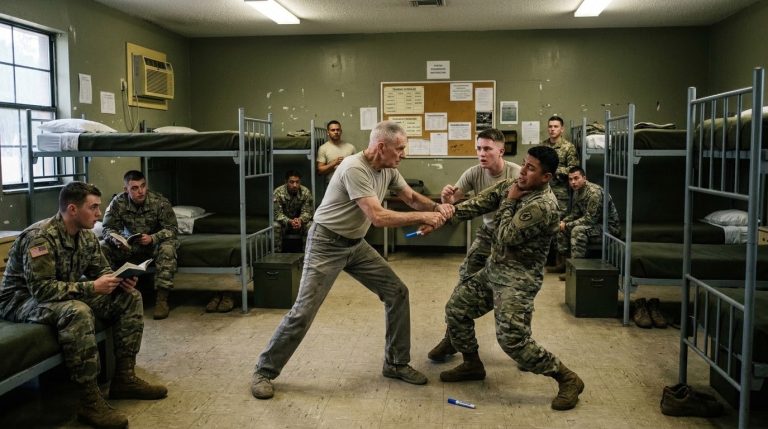
The Phantom’s Resonance: A Journey from the Shadows of Silence back into the Light of Service
CHAPTER 1: The Threshold
The frost on Marcus’s beard felt like powdered glass. He didn’t look up when the young woman dropped the dollar into his cup—the metallic clink was a sound he’d learned to filter out, just like the roar of the city traffic and the endless, aching thrum in his right knee. He was the architecture of an afterthought, a pile of worn canvas and duct-taped memories huddled against the brickwork.
Then, the scream. It wasn’t the jagged, frantic noise of a city scuffle. It was the specific, hollow resonance of a mother realizing her world was ending. Marcus’s head snapped up. Across the asphalt, a boy lay twisted on the concrete, his limbs vibrating with the rhythmic, brutal stutter of a seizure.
Marcus was on his feet. The transition was liquid, automatic. His backpack, a mildew-scented relic of a life he’d buried four years ago, swung onto his shoulder. His hands reached inside, fingers dancing over the familiar, expired gauze and the small bottle of rubbing alcohol. He didn’t think about the cold. He didn’t think about the filth beneath his fingernails. He thought about the airway. He thought about the pressure.
The mother was a blur of weeping terror. “Please,” she whispered, her eyes meeting his. She didn’t see the man who had saved forty-seven lives under the canopy of a war-torn sky; she saw a miracle in rags. Marcus dropped to his knees. The concrete was unforgiving, biting through his trousers, but his hands were steady—a calm, surgical anchor in a world tilting toward panic.
“Protect his head,” Marcus murmured, his voice a low, gravelly vibration. He turned the boy, clear, consistent, timed. Ninety seconds of pure precision. When the seizure finally broke, and the boy’s chest rose in a jagged, hesitant breath, Marcus was already retreating. He didn’t wait for the gratitude. He didn’t want the warmth of it; it burned too much.
He was just turning toward the railroad bridge, the weight of the moment pressing on his lungs, when he heard it. The commotion at Walter Reed. It wasn’t a cry of a single child; it was the sharp, jagged pitch of institutional panic—overlaid shouts, the frantic rhythmic tread of heavy boots on tile.
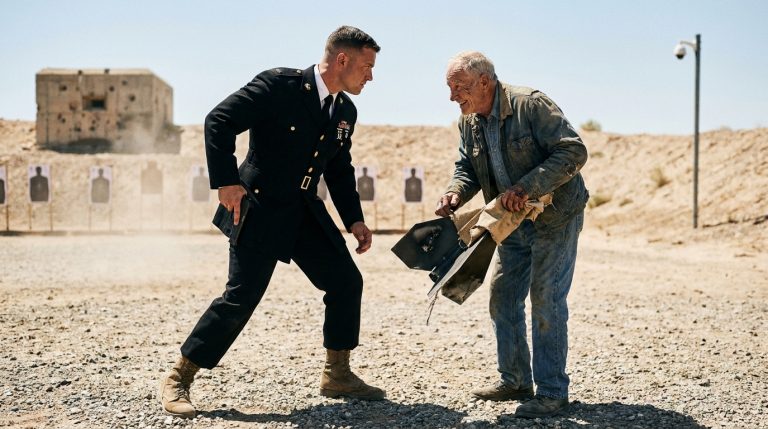
He moved toward the hospital entrance. The automatic doors reflected the dying December light, turning the world into a fractured, golden mosaic. Lieutenant Jason Hartwick stood there, a wall of spit-shined leather and cold, dismissive authority. He looked at Marcus—really looked at him—with a gaze that stripped away the person and left only the statistic.
“This is a military medical facility,” Hartwick said, his voice a blade of ice. “Not a homeless shelter.”
Marcus stared past him, through the glass, toward the chaos that echoed the ghost-riddled fields of Helmand. Inside, a nurse was screaming for a corpsman.
“I can help,” Marcus said, the words feeling like dry leaves in his throat.
Hartwick laughed, a cruel, hollow bark. “You help? You smell like failure. You’re nothing.”
Marcus felt the ghost of a tremor in his hand, not from the cold, but from the realization that the man standing before him was blocking the only path back to the light. And then, the doors behind Hartwick exploded outward, and the nurse’s voice cut through the air: “We’re losing him. It’s Admiral Forner.”
Marcus didn’t check if the door was locked. He didn’t check for consequences. He shoved, the force of his own momentum carrying him forward into the sterile, unforgiving glare of the interior. Hartwick spun, his face a mask of shock, but Marcus was already a ghost finding its way back home. He reached the corridor, the smell of sanitizer suddenly, violently sharp, and for the first time in four years, the darkness ahead felt like it might be waiting for him to speak its name.
The room door was slightly ajar. Through the sliver of space, he saw the gurney, the monitors dancing with erratic, desperate lines, and a young resident who looked like he had never held a life in his hands before. Marcus didn’t hesitate. He crossed the threshold, leaving the cold, the street, and the judgment of the lieutenant behind. He was a corpsman again. And he knew, with a sudden, sickening clarity, that the boy he had saved outside was only the beginning of a much deeper, much colder truth he had yet to uncover.
CHAPTER 2: The Breach
The sterile white of the hospital hallway seemed to tilt. Marcus didn’t run, but he moved with a terrifying, economy-of-motion efficiency that forced the medical staff to part around him. His boots, stained with the gray slush of the city, tracked a faint, uneven line across the polished linoleum, but his eyes were locked on the open door of Room 14.
He could feel the weight of Lieutenant Hartwick’s gaze—a mixture of outrage and bewilderment—trailing him like a physical anchor. Behind him, the shouts of the security guards were rising in pitch, but Marcus’s world had already shrunk to the diameter of the doorway. He reached it, his hand grazing the doorframe. The sensory overload of the room hit him at once: the sharp, acrid scent of ozone and antiseptic, the frantic, jagged beeps of a monitor, and the terrifying, hollow stillness of a man who was slipping away.
Admiral Forner lay on the gurney, his face a bruised, mottled purple that spoke of a throat closing off against the world. He was a vessel of authority now rendered fragile and mute. The young resident, Dr. Kevin Park, was a statue of paralyzed potential, his knuckles white as he gripped an EpiPen, his eyes wide and vacant. The nurses were hovering, their movements circular and frantic, lacking the kinetic focus that saves lives in the dark.
Marcus crossed the room in two strides. He didn’t ask for room; he simply occupied the space.
“Airway,” Marcus said. The command wasn’t shouted, yet it possessed a gravity that pulled the chaos into orbit. He didn’t wait for a reply. He reached the side of the gurney, his hands moving with an independent, instinctual intelligence. He felt the admiral’s pulse beneath his own skin—faint, thready, a bird’s heart trying to beat through a wall of water.
Dr. Park blinked, the shock of Marcus’s sudden appearance breaking his paralysis. “Who… who are you? You can’t be in here!”
Marcus didn’t turn. His focus was a locked circuit. “The EpiPen. .3 milligrams. Intramuscular. Lateral thigh. Now.”
The authority in his voice was a relic, a ghost-command that bypasses the logic of bureaucracy and speaks directly to the urgency of survival. Dr. Park obeyed because the alternative was unthinkable. He pressed the device into the admiral’s leg. The sharp click sounded like a gavel in the quiet.
Marcus, meanwhile, had the admiral’s head tilted, his thumb and forefinger manipulating the jaw with a precision that bordered on the reverent. The obstruction was absolute, a structural failure of the body. He signaled to Nurse Castellano. She had been screaming for help only seconds ago, but now she was moving toward him, her eyes searching his face, a glimmer of recognition sparking in her pupils—a memory of a training drill, a story whispered in the halls of better times.
“Laryngoscope,” Marcus ordered. His voice was lower now, grounded. “Size 8 ET tube.”
Castellano moved with a fluidity that caught the rest of the room off guard. She handed him the scope. Marcus inserted it. The physical reality of the situation was absolute: the vocal cords, swollen and angry, stood against him like a closed door. He didn’t force it. He waited for the rhythm of the patient, for the tiny window of opportunity, and then, with a single, practiced motion, he slid the tube into place.
The monitor’s rhythm shifted. The sound of the bag valve mask being squeezed by the respiratory therapist became the new heartbeat of the room.
“Good,” Marcus murmured, the word barely audible. He watched the chest rise, the artificial lung doing the work the admiral’s own body refused to perform. He began checking the monitors, adjusting the IV flow with the same casual, confident hand that he had once used to adjust a morphine drip in the back of a bouncing Humvee.
He was the ghost that had become real. He didn’t look at the lieutenant standing in the doorway, his face pale and his authority shattered. Marcus looked only at the charts, the numbers, the vital signs. He was fixing the break, trying to ignore the way the familiar metallic taste of blood—from a war that ended years ago—lingered on the back of his tongue, a reminder that every time he breathed for someone else, he was stealing a little more air from his own internal silence.
He wasn’t a savior; he was just a machine that had been turned back on. And as he checked the pulse again, feeling the strengthening thrum under his fingertips, he realized with a cold, sinking dread that by entering this room, he had ensured there would be no turning back. The ghost was visible now, and the world would demand to know where it had been hiding.
CHAPTER 3: The Recognition
The heart monitor continued its steady, metronomic assertion of life, but for Marcus, the sound had become a drumbeat of unwanted exposure. Admiral Forner’s gaze, once clouded with the haze of anaphylactic shock, was sharpening into a terrifying clarity. It was the look of a commander who had seen too much to be easily fooled, yet was currently struggling to reconcile the legend of the “Phantom Needle” with the man of dirt and duct tape shivering in the corner of his observation suite.
Marcus’s first instinct was to pull away, to tuck his hands—the source of his betrayal, his shame, and his hidden expertise—deep into the pockets of his stained canvas jacket. He backed toward the door, his boots making a soft, rhythmic thud against the tiled floor. He had done the task. He had moved the needle back toward life. Now, the logic of the street dictated that he dissolve, that he become the shadow that no one questioned.
“Wait.”
The word was raspy, stripped of the Admiral’s usual booming authority, but it carried the residual static of a command that couldn’t be ignored. The Admiral’s hand, resting weakly on the crisp, white sheet, twitched. His fingers clawed at the air for a second before finding purchase on the bedrail.
Marcus stopped, his shoulders hunching almost involuntarily. He didn’t turn around. He focused his vision on the reflection in the observation window: his own haggard face, the matted hair, and the way Lieutenant Hartwick stood behind him, trembling with a mixture of professional fear and burgeoning, ugly realization.
“Please,” the Admiral said again. It was a plea, not an order.
Slowly, Marcus turned. The room felt smaller than it had seconds ago. The nurses had retreated into the periphery, their professional masks slipping to reveal expressions of stunned curiosity. They weren’t looking at a patient anymore; they were looking at a ghost.
The Admiral’s eyes didn’t just scan Marcus; they dissected him. They traced the grime on his neck, the way his knuckles were scarred from years of manual, often brutal labor, and finally, they landed on the wrist. Marcus tried to hide it, but the sudden movement caused his sleeve to hike up, revealing a sliver of skin that had remained stubbornly un-soiled by the life he had chosen. There, the trident—the mark of a life devoted to the shadows, the mark of the team that had been the only family he had ever understood.
The Admiral’s breath hitched. A sound, ragged and raw, escaped his throat—half-laugh, half-sob. “Phantom… Phantom Needle?”
The name hung in the recycled, chilled air of the room like a ghost. Marcus felt a phantom pain in his own chest, an ache where his pride used to reside. He didn’t want the title. Titles belonged to men who had futures, men who hadn’t stood in the mud in Helmand with the blood of nineteen-year-old Marines staining their forearms until the skin felt like it was weeping.
“I’m just a man, sir,” Marcus said. His voice was a rasp, a rusted gate swinging on neglected hinges.
“You’re not ‘just’ a man,” Forner retorted, his voice gaining a fraction of its former iron strength. He gestured weakly toward the bedside tray. “That flashlight. That red Maglite on your pack.”
Marcus looked down. The flashlight was there, an ancient, battered thing, its red lens faded to a dull, translucent pink. It was a piece of junk to anyone else, but to the men who had served with him, it was a compass. It was the tool he had used to check the pupils of the dying in the pitch-black of a desert night, under the constant, rhythm-breaking whistle of sniper fire.
The Admiral’s gaze drifted back up to Marcus’s eyes, and in that moment, the power dynamic in the room shifted. The professional mask of the medical setting peeled away. Forner wasn’t the Admiral of the Sixth Fleet, and Marcus wasn’t a homeless vagrant. They were two men tethered by the brutal, undeniable history of a war that neither of them had ever truly finished.
“I remember the ceremony,” Forner whispered, his eyes glassing over. “I remember the silence after your team came back. You weren’t supposed to be here, Sullivan. You were supposed to be…”
“I wasn’t supposed to be anywhere,” Marcus cut in, the sudden sharpness of his own tone surprising him. The discomfort was a physical weight now, pressing down on his ribcage. He couldn’t sustain this. The scrutiny, the weight of the Admiral’s recognition—it was stripping him bare, exposing the raw, unhealed trauma he had spent four years burying under layers of poverty and silence.
Lieutenant Hartwick stepped forward, his face a disaster of conflicting emotions. “Sir, I… I had no idea. The security protocols were explicit about—”
“Quiet, Lieutenant!” Forner snapped, the command slicing through the room with surgical precision. He didn’t look away from Marcus. “You’ve spent four years in the shadows, haven’t you? While the rest of us moved on, you decided to anchor yourself to the dirt.”
Marcus looked at the floor, the polished white tiles swirling beneath his gaze. He felt the weight of his backpack, the familiar, comforting mildew-scent of his miserable existence. He wanted to run. He wanted to go back to the bridge where the only judge was the cold, indifferent wind.
“I’m done, sir,” Marcus said, his voice flat. “I’ve done what you needed. I’m leaving.”
He turned, but the Admiral’s hand shot out, grasping Marcus’s sleeve with a strength that belied his physical condition. The fabric tore, a small, sad sound that felt like the snapping of a tether. Marcus looked down at the hand, then up at the Admiral, and for the first time in years, he saw not pity, but the reflection of his own exhausted, haunted soul.
CHAPTER 4: The Crucible
The fabric gave way with a soft, pathetic pop. Marcus stepped back, the torn remnant of his sleeve fluttering in the stale air of the observation suite. He felt exposed, his arm oddly cold where the duct tape and grime had been interrupted.
Lieutenant Hartwick was still hovering near the doorway, his posture rigid, though the confidence had leaked out of him like air from a punctured tire. He looked less like a security officer now and more like a man watching his life’s work dissolve in real-time. The two security guards who had accompanied him into the room were glancing at each other, hands hovering nervously near their radio holsters, unsure whether to arrest the hero or salute him.
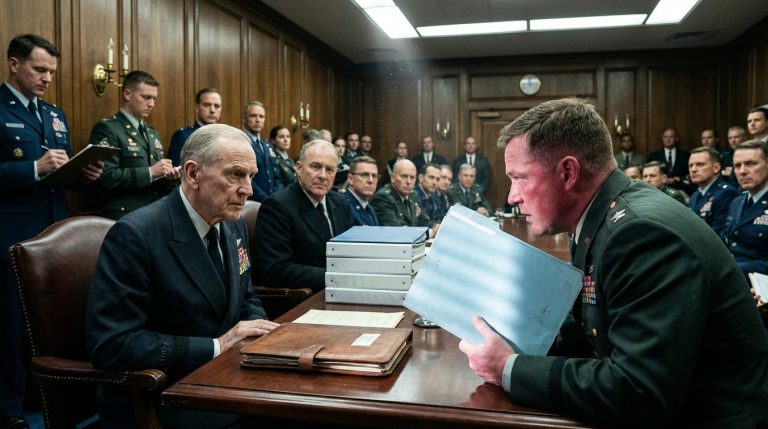
“Lieutenant,” Forner said. His voice was gaining ground, the authority returning as the epinephrine finally leveled his system. He didn’t look away from Marcus, but his tone was directed at the younger man like a heat-seeking missile. “You will step out of this room. You will secure the area, and you will wait for the base commander to contact you. Do you understand?”
Hartwick’s throat bobbed. “Sir, I—”
“Now, Lieutenant.”
The silence that followed was heavy, textured with the hum of the ventilator and the distant, muffled sounds of a hospital that had no idea its hierarchy had just been dismantled. Hartwick turned, his heels clicking with a hollow, rhythmic finality against the floor, and retreated into the corridor. The two guards followed, their departure creating a vacuum in the room.
Marcus was alone with the Admiral, the nurses, and Dr. Park, who was still standing by the monitor as if glued to the display.
“You look tired, Marcus,” Forner said. It wasn’t an observation; it was an indictment of the system that had allowed the man standing before him to wither into a shell of his former self.
“I’ve been… busy, sir,” Marcus lied. His hands were shaking now, a fine, high-frequency tremor he couldn’t suppress. He shoved them into his pockets, but the motion only made the contrast between his filth-stained hands and the sterile environment more jarring.
He glanced toward the window. Outside, the December light had fully surrendered to the night, leaving the hospital grounds a silhouette of sharp angles against an ink-black sky. The sight triggered a sudden, intrusive phantom: the smell of burning rubber and diesel. He was back in Helmand, kneeling in the dirt, the rhythmic thud-thud-thud of a medevac rotor vibrating through his very marrow. The scream of Lance Corporal Ramirez, the way the arterial spray felt like warm, wet velvet against his skin—the memory surged, a sensory tidal wave that threatened to drown out the beep of the monitor.
Marcus gasped, his knees buckling slightly. He reached out to stabilize himself, his hand landing on the cool, metallic edge of the crash cart.
“Easy,” the Admiral said. Forner’s eyes were keen, tracking the shift in Marcus’s breathing. “I know that look. I’ve seen it on the bridge of a ship during a storm. It’s the look of a man who hasn’t forgiven himself for surviving.”
“You don’t know what it’s like,” Marcus whispered, the honesty of the words catching him off guard. “You’re an Admiral. You sit in a room and you make calls. I… I had to hold them while they left. I had to watch the light go out of their eyes when there was nothing left to do.”
“And you think that makes you a monster?” Forner asked, his voice unexpectedly gentle. “You think that makes you someone who belongs under a bridge?”
“I think it makes me a failure,” Marcus said. He looked at his hands again. They were clean of blood now, but the stains of the last four years—the mildew, the engine grease, the street grime—were etched into his skin, a permanent ledger of his penance. “I saved forty-seven, sir. But that doesn’t fix the ones I didn’t. It doesn’t fix the way Hayes looked at me when he realized the tourniquet wasn’t enough.”
The room seemed to shrink. Dr. Park, who had been listening intently, finally broke his silence. “I froze today,” he said, his voice quiet, almost ashamed. “When the Admiral collapsed, I thought, this is it. He’s going to die and I’m going to be the one who killed him. I was paralyzed. I looked at you, and you… you didn’t think. You just acted.”
“I was a machine,” Marcus replied, his jaw tight. “That’s all a corpsman is in the field. A machine that stops the bleeding.”
“No,” the Admiral interjected, his gaze piercing. “A machine doesn’t care. A machine doesn’t carry the weight of those nineteen-year-old boys for four years. What you did today… that wasn’t a machine, Marcus. That was a choice. Every single day you’ve spent on the street, you’ve been making a choice to stay broken because you think it’s the only way to pay for the ones you couldn’t save. But by staying broken, you’re just creating another list of people who couldn’t be saved. Look at me. I’m one of them now. You chose to save me today. Why?”
Marcus looked at the gurney, at the man who had been the face of the institution that had discarded him. “Because it was the right thing to do,” Marcus said, the words feeling alien, like a language he hadn’t spoken in years.
“Exactly,” Forner said. “And it’s the right thing to do to let us help you. Not as a charity. Not as a favor. But because we need you, Marcus. The system is bloated, it’s cold, and it’s lost its way. It needs people who know the difference between protocol and reality.”
Marcus shook his head, but the argument was losing its force. The friction of the sterile, starched linens nearby, the steady, rhythmic assurance of the heart monitor—it was beginning to overwrite the ghost-sounds of the desert. He felt a sudden, sharp exhaustion, the kind that only comes after the adrenaline of a crisis finally burns off. He was standing in the center of the room, a man caught between the ghost he had been and the shadow he had become, and for the first time, he realized that the choice wasn’t about the dead anymore. It was about whether he was willing to inhabit the living.
CHAPTER 5: The Threshold of Healing
Marcus stepped out of the observation suite, the transition from the pressurized, climate-controlled silence of the room to the bustling, erratic energy of the hallway hitting him like a sudden drop in altitude. The corridor was a sensory gauntlet. The linoleum reflected the overhead fluorescent lights in long, clinical strips that seemed to sharpen the ache in his knee, and the air was thick with the scent of floor wax and the underlying, metallic tang of an institution that never truly slept.
He was still wearing the jacket, though the torn sleeve hung limply, a ragged flag of his recent collapse. He felt like a loose thread in a garment that was otherwise perfectly tailored. As he navigated the turn toward the exit, he almost collided with a transport gurney. The orderly behind it didn’t even glance at him, his focus entirely on the patient, but Marcus flinched, his body instinctively coiled into a defensive posture—the “corpsman’s crouch”—that he hadn’t fully shed in four years.
“Mr. Sullivan?”
The voice was crisp, professional, and entirely devoid of the awe he’d been receiving from the others. He turned to find a woman standing by a heavy, fire-rated door. She wore a dark gray blazer, and her expression was guarded, analytical. This was Commander Lisa Bradshaw. He’d seen her briefly during the post-crisis chaos, but here, in the semi-shadows of a secondary corridor, she seemed far more formidable.
“I’m Marcus,” he said, his voice feeling like a trespasser in the refined air of this section of the hospital.
“I’m Commander Bradshaw,” she replied, gesturing toward the door behind her. “We need to talk about your intake. The Admiral has authorized a direct transfer, but the paperwork is… let’s call it complicated.”
She held the door open, revealing a small, stark office that felt like the antithesis of the crowded, chaotic streets he had called home. Marcus hesitated. The threshold was barely an inch high, but it looked like a mountain. He was supposed to walk out the main doors, head back to the bridge, and fade back into the background radiation of the city. But the Admiral’s hand, the heavy weight of the duty he had felt in that room, was still anchoring him to this place.
He stepped inside. The office smelled of old paper and stale coffee, a texture of bureaucratic stagnation that he found, strangely, more comforting than the sterile, high-end suites he’d just left.
“Take a seat,” she said, indicating a chair that looked remarkably uncomfortable.
As he sat, his hand brushed against the corner of a file folder sitting on her desk. It was open, and the top page was a summary of the hospital’s security logs from the last three months. His eyes caught a line of text: Incident Report: Recurring unauthorized presence near Entrance B. Subject: Unidentified.
He felt a chill that had nothing to do with the air conditioning. He reached out, his curiosity overriding his desire to remain invisible, and shifted the paper slightly. It wasn’t just a log. It was a pattern. The dates aligned perfectly with the days he had sat by the pharmacy, the days he had watched the hospital lights from the bridge. The report wasn’t just tracking him—it was tracking a failure. The facility had been aware of the homeless veterans congregating near the perimeter, but instead of offering aid, they had been logging the complaints of visitors to ensure the ‘aesthetic integrity’ of the campus.
“Something wrong?” Bradshaw asked, her eyes narrowing.
Marcus looked up. He didn’t tell her what he saw. Instead, he pulled his hand back, the paper feeling unnaturally abrasive against his fingertips. “Just wondering why you’re doing this, Commander. Why bring me inside? Why risk the protocol?”
Bradshaw sighed, a sound that carried the weight of someone who had spent her career trying to steer a ship through shallow, jagged waters. “Because for the last decade, I’ve watched good people walk through those front doors and come out on the other side as statistics. We have the best medicine in the world, Marcus, but we’re losing the war on the soul of our people. The Admiral sees you as a savior. I see you as the proof of our neglect.”
She pushed a pen and a packet of forms toward him. “If you sign these, you’re not just a patient. You’re a liability. You’re someone who knows what it looks like from the outside, and you’re going to be in a position to tell us exactly where we’re failing. It’s not going to be easy. People like Hartwick will fight you every step of the way because you represent the truth they’re trying to ignore.”
Marcus looked at the pen. It was sleek, expensive, and heavy—nothing like the ballpoint pen casing he’d once used to perform a tracheotomy in the heat of a firefight. He took it, the weight of the tool feeling like a new kind of weapon. He was being asked to step into the machine, to use his experience not to save lives in the dark, but to dismantle the cold, mechanical apathy that allowed men like him to fall through the cracks in the first place.
He signed his name, the letters jagged and slow, as if he were carving them into stone. The moment the pen lifted, the air in the room seemed to shift, the walls tightening in on him. He had signed away his invisibility. He had signed away the bridge. He had entered the crucible, and he knew, with a sudden, sharp clarity, that there was no way to leave without being completely, irrevocably forged into something new.
CHAPTER 6: The Unraveling
The transition from the office back into the hospital proper felt like stepping from a pressurized cockpit into a storm. Marcus followed Bradshaw through the corridors, his pulse spiking at every sudden noise. The administrative file he’d glimpsed—that pattern of negligence—lay heavy in his mind, a ticking clock of information. He wasn’t just a corpsman anymore; he was a potential whistleblower inside the very machine he’d once served.
“You’ll have a room in the transitional wing for now,” Bradshaw said, not looking back. Her pace was brisk, her heels clicking against the linoleum with a rhythm that demanded he keep up. “It’s not luxury, but it’s clean, and it’s secure. We have a team of therapists starting you on a light-duty schedule tomorrow. I expect you to be present.”
“Light duty,” Marcus repeated, the words tasting like ash. He was a veteran of field hospitals, a man who had functioned on three hours of sleep and pure muscle memory in the middle of a war zone. The idea of ‘light duty’ felt like a diminishment, a slow suffocation of the only identity he had left.
“You need to stabilize, Sullivan,” she said, finally stopping and turning to face him. Her expression softened, just a fraction. “You’ve spent four years living in the dirt. Your cortisol levels are probably through the roof. If we put you in a classroom tomorrow, you’ll burn out before the first lecture ends.”
She led him to a heavy, reinforced door near the back of the medical complex. It opened into a small, sparsely furnished room. It was clean—frighteningly so. The walls were a shade of beige that felt like sensory deprivation, and the bed, neatly made, looked like an invitation to a dream he didn’t want to have. Marcus walked to the window. Outside, the view looked down toward the parking lot, the exact spot where he had spent hundreds of hours in the cold, invisible and ignored.
“I saw the files,” Marcus said, his voice flat. He turned to face her, the shadow of the security logs still playing out in his mind. “I saw the patterns, Commander. You know it’s there, don’t you? The neglect. The way the complaints were handled.”
Bradshaw’s posture didn’t change, but her eyes darkened. She leaned against the doorframe, her arms crossed tightly. “I know that things have been run poorly. I know the administration has prioritized appearances over the welfare of those who served. But pointing that out is a very quick way to ensure you never get the chance to teach anyone anything.”
“I’m not looking to burn the place down,” Marcus said, though he felt a flicker of the old, cold resolve—the ‘Phantom’ logic—surging in his gut. “But I won’t pretend it’s not broken.”
“Good,” she said, her voice dropping to a low, intense whisper. “Because the Admiral didn’t bring you here to be a mascot. He brought you here to be a surgeon, Marcus. And sometimes, to save the life of a system, you have to be willing to cut out the rot.”
She left him alone then, the door clicking shut with a sound of absolute finality.
Marcus paced the room. It was tiny, claustrophobic. He felt the phantom weight of his backpack on his shoulder, but it wasn’t there. He reached into his pocket and pulled out the small, red Maglite. He clicked it on. The beam was weak, the red plastic cover dull and scratched. He shined it on his own hand, watching the way the red light turned his skin into something alien, something raw.
He sat on the bed. The mattress was firm, the sheets crisp and cold. He closed his eyes, and immediately, the room dissolved. He was back in the mud of Helmand. The rain was falling—cold, miserable, turning the earth into a sucking, greedy mess. He was hunched over a marine, his hands buried deep in an open wound, the sound of mortar fire tearing the sky apart. Don’t let me die, the voice pleaded. Don’t let me die.
Marcus gripped the Maglite so hard his knuckles turned white. He wasn’t back there. He was here. He was at Walter Reed. He was an instructor. He was safe.
He opened his eyes, gasping. His heart was hammering against his ribs like a trapped bird. The room was dark, save for the weak red glow of the light. He looked at the walls, the sterile, perfect corners, and realized the truth of Bradshaw’s words: he wasn’t just here to recover. He was here because the ghosts he was running from had finally caught up to him, and the only way to silence them wasn’t to run further—it was to stand his ground, right here in the center of the rot, and fight for the next person who walked through the door.
He set the flashlight on the nightstand. His hands were shaking again, but this time, he didn’t hide them. He watched them, studying the tremors, acknowledging them as part of the cost. He lay back on the bed, staring at the ceiling, waiting for the sleep that he knew would be filled with faces, but this time, he wasn’t going to wake up and run. He was going to wake up and start the work.
CHAPTER 7: The Bridge
The sound was agonizing—a screech of metal teeth grinding against metal that tore through the quiet of the recovery wing. Marcus was off the bed before his mind could process the noise, his instincts overriding the exhaustion that had been seeping into his bones all night. He moved with the predatory grace of someone who had spent their life listening for the warning signs of a failing structure.
Outside his room, the hallway was bathed in the harsh, red-tinted glow of the emergency lights. The shift had clearly been caught off guard. The air was turning thin, the vents in the ceiling rattling with a metallic, frantic cadence.
He stepped into the hall. A nurse he recognized—Amy Castellano, the one who had been at the Admiral’s side when he’d first entered the hospital—was struggling with a maintenance panel near the ceiling. She was using a heavy metal tray to try and jam a loose, vibrating plate that was causing the deafening shriek.
“It’s the pneumatic relay,” Marcus said, his voice cutting through the din. He reached her in four long, measured strides, his hands already moving to take the tray from her. “The pressure is overloading. If you don’t vent the secondary valve, the whole system is going to lock out.”
Castellano looked at him, her eyes wide with a mix of relief and surprise. “I can’t reach the manual override. It’s too high.”
Marcus didn’t hesitate. He shifted his weight, his knee—the one that usually burned with the ghost of a Kandahar explosion—holding firm. He leaped, his hand catching the edge of the maintenance bay. He pulled himself up, his muscles straining against the sudden, unnatural tension of the building’s failure. It felt like he was back in the Humvee, fighting the pressure of the desert, fighting the failure of the gear that was supposed to keep him alive.
He felt for the override lever. His fingers brushed against a tangle of wires—exposed, frayed, and vibrating with the current. He realized with a jolt of alarm that the system wasn’t just failing; it was rotting. The insulation was gone, the copper wire bare and sparking against the metal frame.
He clicked the override. A sharp thwack echoed through the ceiling, followed by a hissing sound as the pressure equalized. The shrieking metal fell silent, replaced by the sudden, heavy thrum of the emergency backup compressors.
Marcus dropped back to the floor, his breathing ragged. Castellano was looking at him, her face pale. “How did you know that? We’ve been having problems with the climate control for weeks. Engineering keeps saying it’s just old piping.”
Marcus stood, the adrenaline beginning to curdle into something colder, something more calculated. He wiped his hands on his jacket, noticing the smear of grease and dust he’d just collected. “It’s not the pipes,” he said, his gaze drifting toward the ceiling panels, which looked like they hadn’t been opened for years. “It’s the infrastructure. It’s failing because it’s being ignored.”
He walked away from her, his mind racing. The incident with the Admiral wasn’t an isolated anomaly; the entire system was collapsing under the weight of its own neglect. He realized now that the ‘rot’ Bradshaw had warned him about wasn’t just metaphorical—it was physical, woven into the very bones of the hospital.
He didn’t go back to his room. Instead, he made his way toward the administrative wing. The hallway was empty, the late-night silence returning, but now it felt like a predator’s calm. He remembered the file on Bradshaw’s desk. The report of the homeless population, the complaints, the logs of people who had been ‘removed’ instead of helped.
He reached the administrative office, but as he passed, he saw the light beneath the door was still on. He leaned in, his ear catching the low, urgent murmur of a voice.
“—if the Admiral recovers fully, he’ll start asking questions about the maintenance budget,” the voice said. It was Hartwick. “We need to ensure the records are ‘adjusted’ before the inquiry team arrives.”
Marcus froze. His hand curled into a fist, the memory of the night he’d been shoved—the arrogance, the cold dismissiveness—surging back with a vengeance. They weren’t just incompetent; they were actively covering their tracks. They were sacrificing the safety of the entire hospital to protect their careers.
He stood in the darkness, the cold tile beneath his feet, feeling the shift in his own internal landscape. He wasn’t a corpsman anymore. He was a witness. And if the Admiral was the symbol of the institution’s authority, Marcus was the phantom who was going to make sure the truth finally had a voice. The bridge he had been building toward his recovery had just been crossed; there was no going back to the shadows now. He had to decide: would he act now and risk everything, or wait for the Admiral to regain his strength?
The answer, he realized, was already in his hands. He tapped his pocket, feeling the cold, hard weight of the small, red flashlight. It wasn’t just for checking pupils anymore. It was for finding things in the dark.
CHAPTER 8: The Return
The sun was bleeding over the horizon, painting the hospital grounds in hues of bruised orange and gold. Marcus stood in the center of the administrative office, the air thick with the smell of scorched paper. Hartwick, caught red-handed with a lighter and a stack of redacted logs, stood frozen, his face a mask of primal terror. He wasn’t a lieutenant anymore; he was a small man facing the gravity of a lifetime of cowardice.
The door burst open. Commander Bradshaw, followed by two base security officers, stepped in. She didn’t need to ask what was happening. The evidence lay scattered across the linoleum—the redacted names of homeless veterans who had been turned away, the falsified maintenance budgets, the paper trail of a system that had traded lives for “aesthetic integrity.”
“It’s over, Jason,” Bradshaw said. Her voice wasn’t triumphant. It was tired.
Hartwick didn’t fight. He slumped, the lighter falling from his fingers, his shoulders collapsing as if the very air had been sucked out of the room. He was defeated not by force, but by the weight of his own calculated indifference. As the security officers moved to escort him out, he looked at Marcus. There was no defiance left, only a hollow, pathetic realization.
Marcus didn’t offer him a word. He didn’t need to. He watched the lieutenant be led away, the man who had called him “nothing” now finally reduced to exactly that. It was poetic justice, cold and absolute.
Later, in the quiet aftermath of the investigation, the hospital felt different. The tension that had defined the halls for weeks had dissipated, replaced by a strange, fragile peace. Marcus sat in his office—a real office now, with a desk, a lamp, and a window that looked out over the city he had once lived beneath.
Admiral Forner walked in, his gait a little stiff but purposeful. He didn’t wait for Marcus to stand. He took the chair opposite the desk.
“The investigation is ongoing,” Forner said. “But the rot is being carved out. You did more than save my life, Marcus. You saved the soul of this place.”
Marcus looked down at his desk. He reached into his drawer and pulled out the small, red Maglite. He placed it on the polished wood—a stark, battered contrast to the professional space.
“I didn’t do it alone,” Marcus said. He thought of Sergeant Chen, who had stood by him when no one else would; he thought of Castellano, whose professionalism had never faltered; and he thought of the young corporal, Davies, whom he had helped the day before.
He reached into his bag and pulled out a roll of heavy, industrial medical tape—the kind he’d once used to hold his life together under fire. He took the tape and, with deliberate, slow motions, began to repair the hinge of the flashlight, the tape binding the metal to the plastic, creating a sturdy, permanent bond.
“I’m ready to start the class, sir,” Marcus said, looking up.
Forner smiled, a genuine, tired, yet hopeful expression. “I know you are.”
The Admiral left, leaving Marcus in the quiet of his room. He stood and walked to the window. The city looked different today—not like a sprawling, indifferent monolith, but like a place where people lived, struggled, and occasionally, found their way back to one another.
He heard a knock at the door. Petty Officer Simmons, one of his new students, stood there, holding a stack of training manuals.
“Ready to start, Instructor?” she asked, her eyes bright with a mixture of curiosity and genuine respect.
Marcus looked at the manuals, then back at the red flashlight—repaired, steady, and bright. He felt a deep, resonant calm settle into his chest, a sense of belonging that he hadn’t touched in nearly two decades. The nightmares of Helmand were still there, tucked away in the corners of his mind, but they no longer defined him. They were part of the story, not the end of it.
He picked up the flashlight, tucked it into his pocket, and stood up. He walked toward the door, his stride even, his posture upright, leaving behind the ghost he had been and stepping into the man he was meant to become.
“I’m ready,” Marcus said.
He stepped into the hallway, moving toward the classroom, toward the students, and toward the life he had finally, earned the right to live. The darkness of the past remained, but he carried his own light now. And for the first time in his life, he knew exactly where he was going.