The Price of Twenty-Eight Years: A Daughter’s Calculated Reclamation of Truth and Blood
CHAPTER 1: THE SUNDAY ULTIMATUM
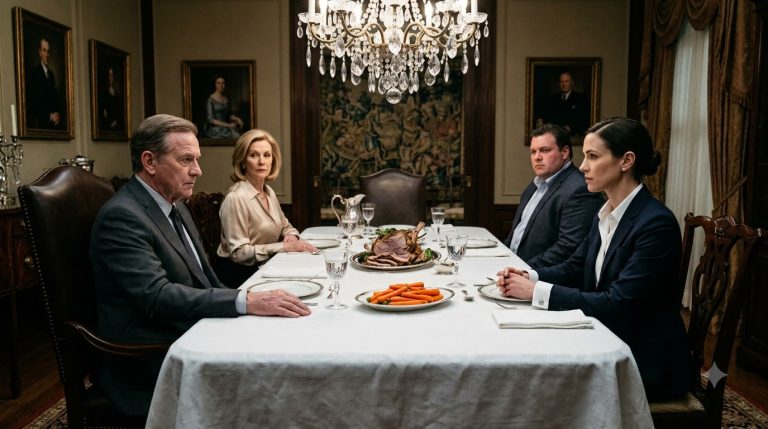
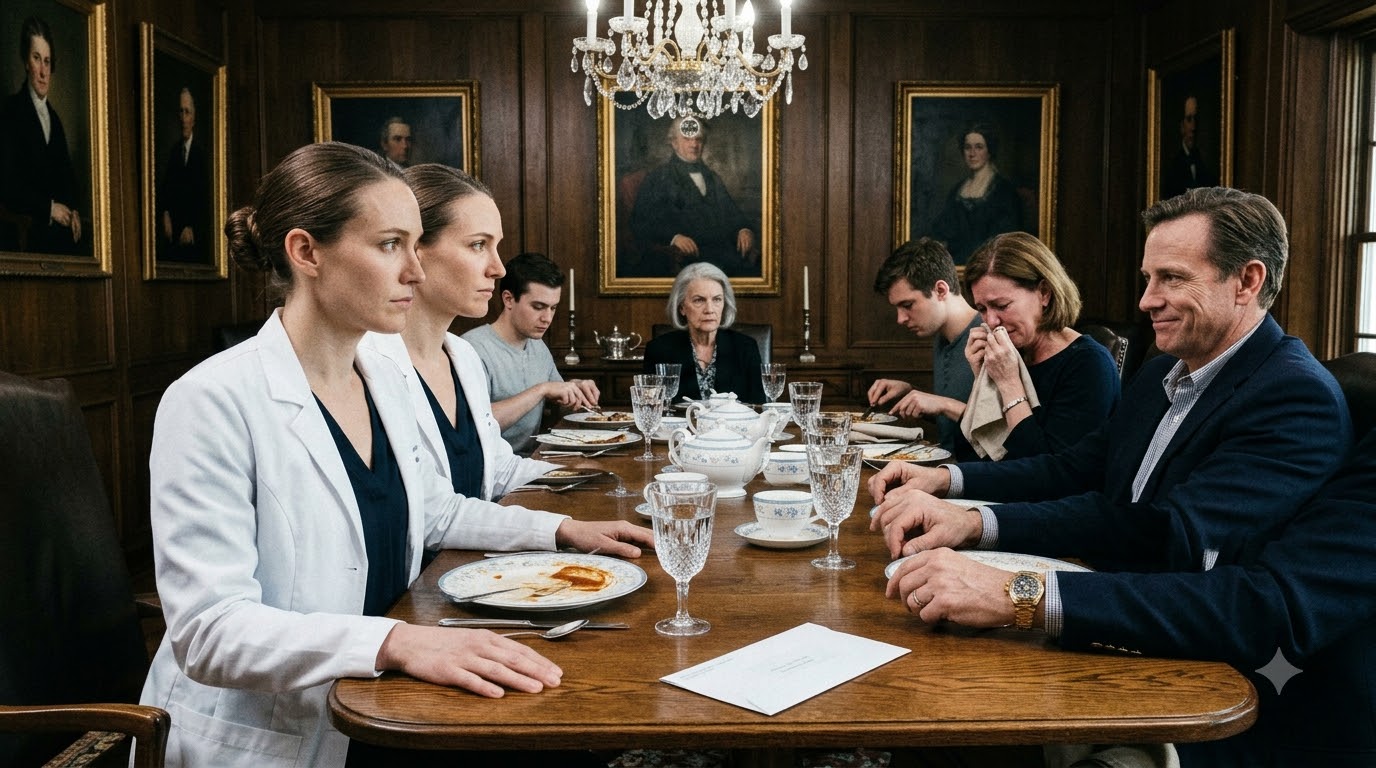
The oak table at the center of the Fairfield dining room had been polished to a mirror shine, reflecting the low hum of the chandelier above.
I picked up my silver fork, feeling the cold weight of the metal against my thumb, and set it down without making a sound.
Gerald Townsen cleared his throat, the sharp raspy sound cutting straight through the clatter of Wedgwood china.
“I won’t be attending your wedding, Tori.”
My mother’s fork clattered against her plate, leaving a dark smudge of sauce on the pristine white linen.
“Gerald,” she whispered, her fingers tightening around her napkin until her knuckles turned yellow. “Please. Not in front of your mother.”
Gerald didn’t look at her; he reached inside his navy blazer, pulled out a folded white envelope, and slid it across the grain of the table.
It stopped six inches from my glass of water.
“I’ve thought about this for a long time,” Gerald said, his voice level, completely devoid of heat. “I’m not walking another man’s daughter down the aisle, and I’m not writing a check for a party until we settle this once and for all.”
I didn’t reach for the envelope.
I stared at the heavy gold band of his Submariner watch where it rested against the table edge, catching the light as his fingers tapped a steady, impatient rhythm.
“That’s a consent form for a certified paternity lab in Hartford,” he continued, leaning back in his leather chair. “You have six weeks. Take the test, publish the results to the family, and if you’re mine, I’ll be in the front row. But we both know what that paper will say.”
Across the table, my brother Marcus kept his eyes fixed on his roasted potatoes, his jaw working in slow, silent chews.
My grandmother Eleanor sat at the far end, her silver hair pinned tight, watching Gerald with a look that could have stripped paint off an old barn.
“Twenty-eight years, Gerald,” I said, my voice flat, keeping my hands resting flat on the table. “You waited twenty-eight years to pull a contract over roast beef.”
“I waited until you were about to tie yourself to another family under my name,” Gerald replied, a thin, tight smile touching his lips. “Your mother spent twenty-eight years dodging the truth. I’m just closing the ledger.”
Diane began to weep—not a loud sob, but a quiet, rhythmic shaking of her shoulders that had been part of our Sunday dinners for as long as I could remember.
I looked at the white envelope, then at my father’s cold, calculating eyes, feeling the familiar burn of an old friction settling deep in my chest.
“I won’t sign your paper tonight, Gerald,” I said, standing up smoothly and pulling my cardigan over my shoulders. “And I won’t touch your lab.”
“Then you don’t get a father at the altar,” he spat back, his composure cracking just enough to show the ugly, jagged edge underneath.
“I never had one,” I said, turning my back on the gleam of the chandelier. “I’ll remember this.”
CHAPTER 2: PAPER TRAILS AND COLD CALLS
The driveway gravel crunched under my heels as I pulled the portfolio against my ribs.
Behind me, the tutor mansion’s front windows cast long, yellow rectangles across the dark lawn, but I didn’t turn back.
I got into my car, tossed the bag onto the passenger seat, and sat there in the dark until my breathing leveled out.
Gerald wanted a war over bloodlines, but he’d built his whole fortress on the assumption that I would scramble to prove I belonged to him.
He didn’t realize that twenty-eight years of cold shoulders had already cut the wire.
I unzipped the main compartment of the portfolio, the dry leather creaking in the damp air.
Inside lay the manila folder my grandmother Eleanor had handed me years ago—a thin stack of hospital discharge papers, yellowed at the edges and smelling faintly of attic dust.
I flipped to the birth summary sheet, tilting it toward the dim dashboard lights.
St. Mary’s Hospital, Bridgeport. March 15, 1997. Time of Delivery: 11:47 PM.
I knew that time by heart, but I also knew my mother’s voice every time she recalled that night—how she had watched the wall clock while the contractions tore through her, counting down the last eleven minutes to midnight.
11:58 PM.
An eleven-minute gap didn’t mean much on a rushed ward, but in a paper trail, eleven minutes was an eternity.
The driver-side window clicked as Nathan tapped on the glass, his jacket pulled tight against the wind.
I unlocked the door, and he slid into the seat, bringing the chill of the evening with him.
“How bad?” he asked, his voice steady.
“He wants a certified test in six weeks,” I said, tracing the stamped signature at the bottom of the record. “He thinks he’s backing me into a corner.”
“Are you going to take it?”
“On my terms,” I said, pulling my phone from my pocket. “Not through his hand-picked clinic, and not with samples pulled behind anyone’s back. I’m filing a formal, voluntary submission with GenTrust in Hartford.”
“And your mother?”
“She’ll give hers voluntarily,” I said. “She has nothing to hide. But look at this.”
I held the paper under the dome light, pointing my fingernail at the crisp cursive signature beneath the attending physician’s line.
Head Nurse: Margaret Sullivan.
“My grandmother told me this woman ran out of the room like the walls were on fire,” I murmured. “An eleven-minute discrepancy on the chart, a head nurse who panicked, and a father who’s been using my hair color as a weapon for three decades.”
“You think the hospital made an error?” Nathan asked, his brows knitting together.
“I think mistakes happen when people are tired,” I said, setting the paper back in the leather pouch and snapping the brass latch shut. “And I think people cover them up when they’re scared.”
By nine the next morning, I was sitting in my small Hartford apartment with the landline receiver pressed to my ear.
The public directory had listed three Margaret Sullivans in Fairfield County; two were disconnected, but the third rang six times before a creaky, hesitant voice picked up.
“Hello?”
“Mrs. Margaret Sullivan?” I asked, keeping my tone plain, professional, the same voice I used when admitting a patient at the clinic. “My name is Tori Townsend. I was delivered at St. Mary’s on March 15, 1997.”
Silence stretched over the line—a heavy, static-filled quiet that lasted three long seconds.
“I don’t know that name,” she said, her voice dropping an octave, tightening up instantly.
“You signed my birth record at 11:47 PM,” I said smoothly, opening my notebook on the table. “My mother remembers the delivery at 11:58 PM. I’m not calling about a lawsuit, Mrs. Sullivan. I’m calling because my family is tearing itself apart over who I belong to.”
“I can’t help you,” she blurted out, her breath catching audibly through the receiver.
“Mrs. Sullivan, please—”
“I don’t remember thirty years ago,” she interrupted, her words tumbling over each other in a frantic rush. “Don’t call this number again. Please.”
The line went dead with a sharp, metallic click.
I slowly lowered the phone to the cradle, watching the steady blink of the answering machine light.
An innocent woman would have told me I had the wrong number or called me a nuisance.
Margaret Sullivan had been terrified.
CHAPTER 3: THE ZERO PERCENT REALITY
My palm felt dry against the trackpad as I clicked the file open and typed in my verification code.
Nathan walked in from the hallway, setting two mugs of tea on the table, but he didn’t sit down.
He stood right behind my shoulder, his breathing steady against the quiet hum of the refrigerator.
The document header came up crisp and official—black borders, state seal, certified lab technician numbers running down the left margin.
I scrolled past the procedural fine print straight to the summary box at the bottom of page two.
Subject A (Tori Townsend) vs. Subject B (Gerald Townsend): 0.00% Probability of Paternity.
“There it is,” Nathan muttered, his hand resting lightly on my shoulder. “He got his answer.”
I expected to feel something sharp—a wave of anger, or maybe just the heavy sting of an old wound finally closing up.
Instead, my eyes kept moving down to the second line of the table, where my mother’s voluntary sample had been processed against mine under the exact same protocol.
Subject A (Tori Townsend) vs. Subject C (Diane Townsend): 0.00% Probability of Maternity.
The room seemed to shrink down to the width of the monitor.
“Nathan,” I said, my voice barely making a dent in the quiet. “Read that line.”
He leaned in closer, his thumb pressing into the corner of the wooden table until the knuckle turned bone-white.
“That’s a typo,” he said quickly, his voice dropping into a harsh whisper. “They messed up the control label.”
“It’s a certified lab,” I said, reaching for the phone sitting beside my tea mug. “They don’t mix up control labels on an expedited filing.”
I dialed the GenTrust emergency client support line printed on the bottom of the letterhead.
A night shift supervisor answered on the third ring, her voice crisp, practiced, and entirely indifferent to the hour.
I gave her my case number, my security passphrase, and sat there listening to the faint tap of her keyboard over the speakerphone.
“Ms. Townsend,” she said after a long half-minute. “I’m looking at the double-run verification right now. Both samples were run through separate extractions to verify the initial zero-match result.”
“My mother gave birth to me at St. Mary’s,” I said, keeping my tone strictly level, grounded in plain facts. “I need you to tell me if there is any biological possibility—”
“There isn’t,” she interrupted smoothly. “You share zero maternal markers with Subject C. The science is absolute. You are not biologically related to either individual.”
I hung up, setting the phone down on the wooden table right beside my mother’s signed consent form.
For twenty-eight years, Gerald had turned every family dinner into a courtroom, accusing my mother of stepping out on him because I didn’t have his dark hair or his brown eyes.
He had convinced himself, my brother, and half our extended family that she was a liar.
He was right that I wasn’t his daughter.
But he was catastrophically wrong about why.
My mother hadn’t cheated on him.
She had walked out of St. Mary’s Hospital twenty-eight years ago carrying a baby that belonged to someone else entirely.
And somewhere out there, living under another family’s roof, was a woman who carried my mother’s blood while I carried a stranger’s.
I stood up, picked up my phone, and grabbed the keys off the counter.
“Where are you going?” Nathan asked, taking a step toward the door.
“Fairfield,” I said, slipping my arm through my cardigan. “Before Gerald sends another mass email claiming victory.”
CHAPTER 4: FINDING RACHEL MORRISON
The photo showed an elementary school teacher with chestnut hair, warm brown eyes, and a square jawline that looked so much like my brother Marcus it felt like staring at a family photograph taken in an alternate life.
My mother sat at the wrought-iron patio table, her hands wrapped so tightly around a cold teacup that her knuckles were dead white.
“Is that her?” Diane asked, her voice raspy, barely carrying across the small glass table.
“Rachel Morrison,” I said, leaning over so she could see the screen. “Born at St. Mary’s in Bridgeport. March 15, 1997.”
My mother touched the screen with one trembling tip of her index finger, tracing the line of Rachel’s jaw.
“She has Gerald’s chin,” my mother whispered, a single tear slipping past her lower eyelid without her making a sound. “She has his exact chin.”
“Mom,” I said, setting my phone face-down on the glass table. “I’m going to text her. But we have to do this right. No accusations, no melodrama—just plain facts and official paper.”
“Gerald’s already drafting another email,” she said, her head dropping into her hands. “Marcus told me. Gerald thinks he’s won. He told Marcus he’s changing the locks on the Fairfield house by Friday.”
“Let him draft his email,” I said, pulling my notebook out of my portfolio. “A man who builds his house out of arrogance usually forgets to check the foundation.”
I spent twenty minutes drafting a plain, clear message on my phone, laying out the dates, the lab accreditation numbers for GenTrust, and my contact information.
I didn’t ask for money, and I didn’t ask for a sudden emotional reunion.
I simply stated the timeline and offered to share the official documentation if she was willing to look at it.
I hit send at 2:14 PM.
The silence that followed stretched through the rest of the afternoon and into the evening, heavy and agonizing.
It wasn’t until 9:38 PM, while Nathan and I were sitting in the quiet of our kitchen, that my phone vibrated twice on the wood counter.
An unknown area code from Springfield, Massachusetts.
I slid the green button and pressed the speakerphone icon.
“Is this Tori?” a voice asked—shaky, cautious, but carrying a distinct, dry cadence that felt unnervingly familiar.
“It is,” I said smoothly. “Thanks for calling back, Rachel.”
A long breath whistled through the phone line.
“I read your message three times,” Rachel said slowly. “My first instinct was to call the police and report a scam. But then I went into my closet and pulled down my baby book.”
“What does it say?” I asked.
“St. Mary’s Hospital. March 15, 1997. My mother always told me I was born right around midnight.”
“11:58 PM,” I said, pulling the photo of Margaret Sullivan’s handwritten shift log toward me. “The hospital log shows two baby girls delivered eleven minutes apart. A head nurse named Margaret Sullivan made a record of an infant mix-up after a bath, but the administration signed off on sealing the files to avoid liability.”
There was a long pause on the other end, followed by the faint rustle of paper.
“My legal father died three years ago,” Rachel said, her voice dropping into a soft, uneven rasp. “He used to tease me because I was the only brown-eyed kid in a house full of blondes. We all laughed about it. We thought it was just a strange quirk of genetics.”
“Genetics aren’t always a quirk,” I said plainly. “Sometimes they’re just cold math.”
“What do you want to do?” she asked.
“I want to send you a voluntary test kit from GenTrust,” I said, looking over at Nathan, who nodded silently. “No coercion. If you process your sample against Gerald and Diane Townsend’s profiles already on file, we will have legally certified proof of what happened in that nursery.”
“And if it comes back positive?” Rachel asked, her breath catching slightly.
“Then we stand in front of the sixty people Gerald invited to his victory lap,” I said, “and we hand them the truth.”
CHAPTER 5: THE PUBLIC RECKONING
The paper felt heavy and crisp in my hands, fresh off the laser printer, carrying the weight of two lives rewritten by cold genetic markers.
Through the heavy oak door, the low roar of sixty dinner guests echoed down the hallway, punctuated by the clinking of wine glasses and polite laughter.
Nathan leaned against the doorframe, checking his wristwatch before looking up at me.
“Gerald just called for the microphone,” Nathan said quietly. “He’s standing on the raised platform by the head table.”
I folded the paper carefully and slid it into my brass-latched portfolio along with Margaret Sullivan’s notarized affidavit and the hospital’s yellowed shift log.
“Is Margaret in her seat?” I asked.
“Corner table by the terrace doors,” Nathan replied. “She’s nervous, but she’s not leaving. And Rachel is ready in the conservatory.”
I picked up the portfolio, snapped the brass latch shut with a loud, metallic click, and turned the brass doorknob.
As we stepped into the main hall, Gerald’s voice carried clearly over the public address system, smooth, practiced, and dripping with unearned superiority.
“—so while we celebrate upcoming milestones,” Gerald was saying, tapping his micro-pen against his water glass for emphasis, “I think everyone in this room knows why there has been a shadow over this family for the last six weeks.”
My mother sat at the front table near my grandmother Eleanor, her fingers locked together so tightly her gold wedding band cut into her skin.
Marcus stood two feet behind Gerald’s right shoulder, staring down at his polished dress shoes with a rigid, uncomfortable posture.
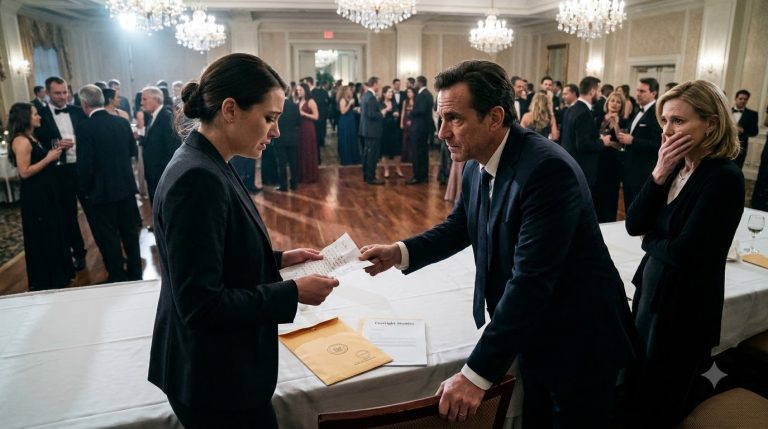
“I asked Tori for simple transparency,” Gerald continued, waving a single white sheet of paper toward the crowd of aunts, uncles, and cousins. “And thanks to my son, who had the courage to pull the file, I have the certified lab document right here.”
A collective murmur rippled through the dining room.
An aunt near the back leaned in to whisper behind her cloth napkin, her eyes darting toward my mother.
“Zero percent match,” Gerald declared, his voice rising, carrying a razor-sharp edge of theatrical triumph. “Twenty-eight years I carried the burden of being mocked by silence. Twenty-eight years of knowing that something wasn’t right in my own home. And now, the science proves that Diane Townsend lied to every single person in this room.”
My mother didn’t look up, but her shoulders dropped an inch as if an invisible blow had landed across her spine.
Gerald leaned into the microphone, a thin, triumphant smile stretching his cheeks.
“She brought another man’s child into my house and asked me to pay for the upbringing,” Gerald spat, his face flushing dark red under the chandelier light. “I won’t be silent anymore.”
I walked straight down the center aisle between the round dinner tables, my heels clicking sharply against the polished hardwood floor.
“You’re right about the zero percent, Gerald,” I said, my voice carrying cleanly across the room without needing a microphone.
The dining hall went instantly dead silent.
Gerald’s smile flickered, his eyebrows drawing together as I reached the edge of the low platform and extended my hand.
“Give me the microphone,” I said plainly.
He hesitated, his fingers tightening around the metal casing, but sixty pairs of eyes were locked onto us, and his precious image forced his hand.
He handed it over with a short, condescending sneer. “Going to apologize now, Tori? A little late for damage control.”
I stepped onto the platform, rested my brass-latched portfolio on the podium, and unclasped the lock.
“The GenTrust report shows a zero percent genetic match between me and Gerald Townsend,” I told the room, looking straight at my aunts and uncles. “It also shows a zero percent genetic match between me and my mother, Diane Townsend.”
Gerald let out a sharp, barking laugh. “What kind of ridiculous spin is that? You think a lab error wipes out—”
“It wasn’t a lab error,” I interrupted, pulling the second sheet of parchment from my portfolio and laying it flat on the wood. “It’s a double-negative result because I am not my mother’s biological daughter either.”
Gerald’s voice cut off mid-sentence.
His mouth stayed slightly open, his brow knotting in sudden, visible confusion as he looked from me to the paper on the podium.
“My mother never cheated on you, Gerald,” I said, my voice steady, cold, and entirely unyielding. “She was completely faithful to you for thirty-five years. You spent twenty-eight years torturing her over an affair that never happened.”
“That’s impossible!” Gerald snapped, taking an aggressive step forward, his fists clenching at his sides. “She gave birth to a child in Bridgeport! I was in the waiting room!”
“She gave birth to a baby girl at 11:58 PM on March 15, 1997,” I replied, turning to point toward the terrace doors. “And eleven minutes earlier, another woman gave birth to a baby girl in the exact same ward.”
I raised my hand, signaling toward the conservatory door.
Rachel Morrison stepped into the hall—wearing a plain beige dress, her chestnut hair pulled back, her sharp, square jawline catching the light in a way that made my brother Marcus visibly gasp.
“This is Rachel Morrison,” I said into the microphone, the sound bouncing off the high timber beams of the ceiling. “She was born at St. Mary’s eleven minutes before me. A trainee nurse mixed up the newborn wristbands after a bath, and the hospital administration ordered a total cover-up to protect their corporate liability.”
“Lies,” Gerald hissed, though his voice lacked its previous booming authority, a slight tremble breaking through his lower lip. “You fabricated this! You hired an actor to save your mother’s reputation!”
“Margaret,” I called out, looking toward the corner table.
Margaret Sullivan stood up slowly, her hands trembling as she held her worn leather shift log against her chest.
“I was the head nurse that night, Mr. Townsend,” Margaret said, her voice shaking but loud enough for the front three tables to hear clearly. “I signed the altered intake sheet under threat of losing my license. Your wife never touched another man. The hospital swapped those infants in the nursery.”
Gerald stared at Margaret, then at Rachel’s face, his eyes darting frantically between Rachel’s jawline and my mother’s quiet, tear-streaked face.
The room erupted into a wave of shocked whispers, chairs scraping back as relatives stood up to get a better look at the lab sheets displayed on the podium.
Gerald’s face turned from red to an ashen, sickly white, his chest heaving as the entire foundation of his twenty-eight-year crusade collapsed into dust right under his feet.
“No,” Gerald whispered, grabbing the edge of the podium to steady his shaking hands, his eyes wide with desperate, unyielding rage. “No, this isn’t over! I don’t accept this paper!”
CHAPTER 6: THE AFTERMATH AND NEW FOUNDATIONS
“This is a coordinated hit!” Gerald roared, his knuckles turning chalk-white as he shoved the microphone away, his eyes wild as he swept his arm toward the room. “She paid off this nurse! They forged state medical stamps to protect Diane’s reputation!”
Nobody moved.
My aunt sitting at the front table lowered her wine glass, her face frozen in flat disgust.
Marcus stepped forward, placing a hand firmly on Gerald’s shoulder, but Gerald violently jerked his arm back, nearly losing his balance against the lectern.
“Don’t touch me!” Gerald spat, his voice cracking into a high, hysterical pitch. “You’re taking her side? After everything I built for this family? I paid your tuition, Marcus! I bought the house!”
“Dad,” Marcus said, his voice flat, stripped of every drop of the hesitation he’d carried for thirty years. “Stop talking.”
Gerald looked from Marcus to my mother, who had stood up from her chair and walked slowly toward the platform.
She didn’t yell, and she didn’t throw a scene.
She stood three feet below him, looking up at the man who had turned every family holiday into an interrogation.
“Twenty-eight years, Gerald,” my mother said, her voice carrying through the silent room like a ringing bell. “I stayed because I believed you were a good man who was simply hurt. But you were never hurt. You were just arrogant.”
Gerald opened his mouth to shout, but no sound came out.
His knees buckled, his hand slipping off the wood as he sat down heavily on the edge of the low stage platform, staring blankly at the floorboards between his expensive dress shoes.
The public lawsuit against St. Mary’s Hospital took eight months of relentless, methodical paperwork.
Rachel and I filed jointly, backed by Margaret Sullivan’s sworn testimony and the original shift logs that the hospital’s legal department had spent nearly three decades hiding in closed archives.
When the hospital’s board realized the paper trail was airtight, they settled out of court—a four hundred and fifty thousand dollar resolution for each family, accompanied by a public apology printed in the local paper.
The administrator who had ordered the original cover-up had his name attached to an official state health board sanction, stripping away whatever comfortable legacy he had planned to hide behind in retirement.
I set down my coffee mug on the kitchen table in our new Hartford apartment, feeling the morning sun warm the wooden tabletop.
The brass-latched portfolio sat open beside my laptop, no longer holding evidence or legal filings, but holding two clean birth certificates—the original with its corrected 11:58 PM timestamp, and a fresh medical record.
My mother walked in from the balcony, holding a small plate of warm toast, her cardigan buttoned neatly over a floral dress.
She looked younger, the deep creases between her eyebrows smoothed out by eight months of quiet, undisturbed sleep.
“Linda called,” my mother said, setting the plate down next to my portfolio. “She’s bringing Rachel over for Sunday dinner at noon.”
“Are you making the roast?” I asked, looking up from my screen.
“No,” my mother smiled, her eyes bright and clear. “We’re ordering takeout. I’m done spending my Sundays working over a hot stove to impress people who don’t deserve the effort.”
Nathan walked through the doorway, sliding his car keys onto the wooden hook by the fridge before sitting down beside me.
Outside the window, the morning breeze moved through the maple trees lining the driveway, quiet, steady, and entirely free of old ghosts.
I reached across the table, took a slice of toast, and rested my hands flat against the cool grain of the wood.
CHAPTER 5: THE SISTER ACROSS STATE LINES
“Tori?”
Her voice carried the same slight upward inflection my mother used when she was nervous.
Rachel stepped up to the table, her hands clutching the straps of a canvas tote bag so tightly her knuckles shone white under the recessed lighting.
“You found me,” she said, sliding into the opposite chair with a sudden, breathless laugh that felt like looking into an emotional mirror.
I pushed the envelope containing Margaret’s notarized statement across the small round table, letting the documents rest between our untouched lattes.
“I didn’t just find you,” I replied, keeping my voice steady against the rising hum of the espresso machine behind us. “I found out why we both grew up in houses that never quite fit.”
Rachel pulled the papers toward her, her brown eyes scanning the handwritten lines of the 1997 shift log with the same analytical intensity Marcus used when balancing a spreadsheet.
“Zero percent match to Gerald,” she whispered, her gaze snapping back up to mine. “And zero percent to Diane. But that means…”
“It means our lives were swapped in an eleven-minute window before the hospital staff locked the records away,” I said, leaning forward to anchor her panic with my own calm. “And your biological parents are walking around Connecticut right now, entirely unaware that the man who tormented us both is about to face what he built.”
CHAPTER 6: THE FALL OF CERTAINTY
“Twenty-eight years,” Gerald’s voice boomed across the packed banquet hall, dripping with the venom of a man who believed he had finally secured his absolute triumph. “Twenty-eight years I’ve been telling everyone that something wasn’t right, and now the science proves it.”
He looked straight at my mother, his face contorted with the ugly weight of decades of manufactured resentment.
“You lied to me, Diane,” he shouted, holding the zero-match report aloft like a weapon. “And now the whole family knows exactly what kind of woman you really are.”
The absolute silence of the room was heavy enough to crush bone.
I did not wait for Marcus or anyone else to react; I stepped out from the shadows of the side door and walked straight toward the raised wooden stage.
“You’re right about one thing, Gerald,” I said, my voice cutting through the thick air as I reached up and took the microphone right out of his trembling hand. “The DNA test shows I’m not your biological daughter, and I’m not mom’s biological daughter either.”
Gerald’s smug smirk flickered for a fraction of a second before total confusion took over.
I turned my back on him and nodded toward the side entrance, where Rachel stepped forward into the warm light, her brown eyes mirroring the exact jawline of the man standing beside me.
“This is Rachel Morrison,” I told the sixty stunned relatives in the room, holding up Margaret Sullivan’s notarized shift log and the hospital documents for everyone to see. “She was born eleven minutes before me at St. Mary’s Hospital on March fifteenth, nineteen ninety-seven, because a trainee nurse mixed up the infants and the administration buried it under a forced non-disclosure agreement.”
Gerald staggered backward against the heavy oak podium, his face draining of every last trace of color as he looked from Rachel to my mother and back again.
“She is your biological daughter, Gerald,” I said, my voice cold, steady, and unyielding. “The daughter you’ve been searching for was hidden away in Massachusetts because your precious hospital chose a cover-up over the truth.”
Margaret Sullivan stepped out from the corner of the room, her small frame trembling as she delivered her final, damning confirmation to the crowd.
“He never betrayed you, Mr. Townsen,” Margaret said, pointing directly at my mother. “I was there. I watched it happen.”
Gerald stared at the documents, at the faces of the relatives who had believed his lies, and at the daughter he had never known.
His knees buckled under the crushing weight of his own unearned certainty, and he crashed hard onto the hardwood floor, catching himself on one hand as ragged, broken breaths tore through his chest.
“I didn’t know,” he whispered, his arrogant facade shattering into a million pieces against the unyielding floorboards. “How could I have known?”
“You could have trusted her,” my mother said, stepping forward with her head held higher than it had ever been in twenty-eight years. “Instead, you chose cruelty.”
From the edge of the platform, Marcus stood up in absolute silence, walked past his kneeling father without a single glance, and crossed the floor to stand firmly by our mother’s side.
Gerald reached out a shaking hand, grabbing the microphone off the floor to choke out three words he should have spoken three decades ago.
“I was wrong.”