The Echo of the Echo: An Octogenarian’s Silent Legacy and the Weight of a Lifetime’s Peace
CHAPTER 1: THE CABIN DOOR OPENS
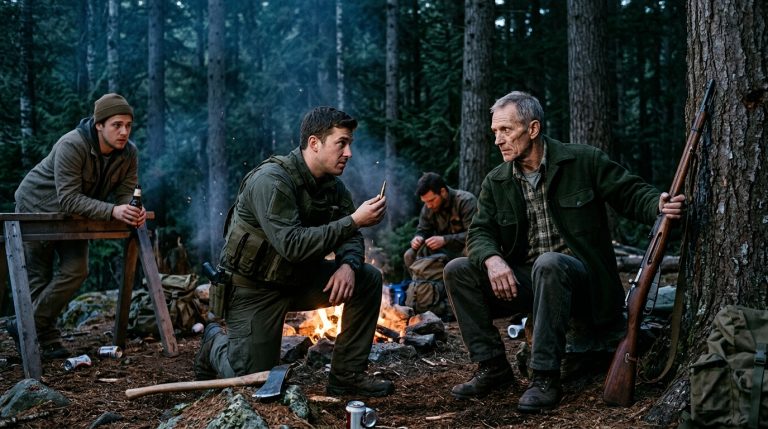
The mountain air didn’t just bite; it felt like a physical presence, pressing against the cabin walls and seeking out every crack in the timber. Inside, the heat was cloying, thick with the scent of cheap beer and rendered animal fat. Tyler leaned back in his folding chair, his $500 camouflage jacket rustling loudly. He was in the middle of a joke, something about the absurdity of a local guide’s pricing, when the door to the mudroom creaked open.
Raymond stepped through. He moved with a hitch in his right leg—a rhythmic, deliberate hesitation—and the silence that followed him was heavier than the cold outside. He carried a bundle of green wool, draped across his forearms like a holy relic.
“Grandpa,” Tyler said, his voice dripping with an ironic, performative edge. He didn’t stand up. “Did you find that at a yard sale, or did you just pull it out of a trench?”
Raymond didn’t look at him. He didn’t look at the poker game, the pile of crumpled dollar bills, or the mountain of high-end equipment that littered the floor. He walked to the wooden chair by the stove—the one that always smelled of pine sap—and laid the bundle down. He unwrapped the wool with a slowness that felt offensive to the frantic energy of the room.
When the stock of the rifle emerged, it was raw, scarred wood, darkened by decades of sweat and oil. The steel was dull, honest, and utterly devoid of the shimmering, high-tech optics the younger men favored.
“It’s a Mosin,” Bird whispered, though he sounded less like he was identifying a tool and more like he was witnessing a ghost.
Tyler stood up then, the chair scraping sharply against the wood floor. He looked at the rifle, then at Raymond’s thin, wind-worn hands. “Sir, you’re not planning on taking that out tomorrow, right? The elk around here are smart. You need reach. You need glass.”
Raymond reached into a small tobacco tin and pulled out a clean, fraying rag. He began to wipe the bolt. He did it with a precision that bordered on surgical. He didn’t look up, but his silence grew teeth.
“I’ve been coming here for fifty-one years,” Raymond said. His voice was quiet, a low rasp that forced everyone to lean forward just to catch the syllables. “I’ve never needed to see the world through a lens to know when it’s time to move.”
Tyler opened his mouth to retort, perhaps to offer the Bergara again, but the words withered. There was a detail in the way Raymond’s thumb traced a cluster of shallow grooves near the receiver—grooves that looked less like design and more like a name carved in haste—that caught Tyler’s eye. It was a physical discrepancy, something out of place among the factory-perfect gear of the modern hunters. It was a shadow that didn’t belong in the light of the wood stove.
Tyler felt a sudden, sharp prick of something he couldn’t name. It wasn’t fear, exactly. It was the sudden, dizzying realization that he was looking at an artifact, and the man holding it was no longer just an old man in a flannel shirt. The air in the room felt thin, stretched tight, and as Raymond finally lifted his slate-gray eyes, Tyler saw something that made him step back: a cold, absolute focus that suggested this cabin wasn’t just a hunting destination, but a place where a very long, very painful history was about to breathe again.
Then, outside, a twig snapped in the darkness—a sound too deliberate for a deer—and Raymond’s hand stilled on the bolt, his eyes snapping to the door as if he’d been expecting the visitor all along.
CHAPTER 2: THE WEIGHT OF STEEL
Raymond did not stand. He did not reach for a weapon, nor did he look toward the windows that framed the encroaching blackness of the Montana ridge. He simply remained where he was, his large, arthritic hand resting perfectly still against the cold blued steel of the Mosin-Nagant. The cabin was unnaturally silent. The fire in the stove hissed, a damp log popping and releasing a plume of sharp, pitch-heavy smoke that drifted into the room.
Tyler had moved a half-step back, his hand instinctively dropping toward the empty space where he wished a sidearm hung. Marcus, sitting at the table, had frozen with a bottle of beer halfway to his lips, the condensation beaded cold and slick on his palm. Even Doug, who had been focused on the stove, had gone rigid, his head tilted toward the darkness beyond the mudroom door.
“Ray?” Doug’s voice was barely a whisper. “Did you hear that?”
Raymond’s eyes moved, not to the door, but to the rifle across his lap. He slid the bolt forward with a soft, metallic click—a sound that, despite its familiarity in a hunting cabin, felt jarringly intentional. It was the sound of a gate locking.
“The mountain has a way of shifting,” Raymond said. His voice was steady, lacking the tremor of old age. “When the temperature drops this fast, the trees settle. The ice expands in the cracks of the shale.”
He looked at Tyler then, and the weight of that look was far heavier than the rifle itself. It was the look of a man who knew the difference between the settling of shale and the calculated movement of a bipedal predator. Tyler felt the skin on the back of his neck prickle. He had mocked the old man, had treated him as a piece of history best kept in a display case, but the raw, unpolished reality of Raymond’s focus made the camouflage jacket feel like a costume.
Raymond stood up. He didn’t rush, but the hitch in his right leg seemed to vanish, replaced by the economy of motion that only comes from years of moving through terrain where mistakes meant death. He picked up the Mosin-Nagant with one hand, the rifle balanced perfectly, the wool blanket falling away to reveal the scarred, dark wood of the stock. He walked toward the mudroom.
“Ray, wait,” Tyler stammered, stepping into the old man’s path before he could stop himself. “If there’s someone out there, we have the gear. We have the rangefinders. Let us—”
Raymond stopped. He didn’t push past Tyler, but he didn’t need to; he simply held his ground, his eyes scanning the space between them. It was a space filled with the smell of the pine shavings Doug used in the mudroom and the iron-scent of gun oil that seemed to cling to Raymond’s skin like a second coat.
“You have gear,” Raymond said, his tone devoid of condescension, yet sharper than any rebuke. “You have glass that magnifies, and electronics that calculate. But you do not have the quiet.”
He brushed past Tyler, his shoulder barely grazing the younger man’s arm. The contact was brief, but it felt to Tyler like walking into a cold front. Raymond opened the mudroom door. He didn’t step outside into the freezing dark. Instead, he simply stood in the threshold, letting the freezing air bleed into the warm, beer-scented cabin, and looked out into the void.
For a long minute, no one spoke. The younger men at the table—Marcus, Bird, and Tyler—were motionless, their faces caught in the dim, yellow glow of the lanterns. They were waiting for a command, or perhaps for a confirmation that their own bravado had been misplaced.
Outside, the wind whipped up, a low, keening sound that seemed to mock the structure of the cabin. But Raymond didn’t turn back. He reached down and touched the wooden frame of the door, his fingers tracing the grain of the rough-hewn timber, his mind clearly somewhere else entirely—perhaps in a place where snow didn’t just feel like winter, but like a shroud.
“They’re gone,” Raymond said finally, turning back to the room. He didn’t explain who ‘they’ were, or why he was so certain. He simply hung the rifle on the nail by the wall, the dull metal catching the firelight and throwing a long, thin shadow across the poker table.
He moved back to his chair and sat, his breathing slow and rhythmic. “Pour the coffee, Doug. We have a long morning tomorrow. The elk will be moving before the sun even touches the ridge, and we need to be ready.”
He didn’t ask if anyone believed him. He didn’t seek reassurance. He acted as if the interruption was nothing more than the background noise of a life he had been living for a very, very long time. Tyler sat back down, his legs feeling heavy, his earlier arrogance replaced by an uneasy, churning curiosity. He looked at the Mosin-Nagant hanging on the wall, the scarred wood looking older and more significant than it had ten minutes ago, and for the first time that night, he didn’t see a museum piece. He saw a tool that had been tempered in a fire he couldn’t begin to imagine, held by a man who was, in every meaningful way, still standing on that frozen hillside in 1950.
The silence returned, but it had changed. It was no longer the silence of three arrogant men and one ignored elder. It was a heavy, expectant silence, the kind that settles over a room when the inhabitants realize they are no longer in control of the narrative, and that the quietest man in the room is the only one who truly knows the way forward.
CHAPTER 3: THE COLD CANYON
The transition from the warmth of the cabin to the pre-dawn exterior was a violent shift. The air at this altitude didn’t just chill; it scoured, carrying the taste of ancient snow and frozen pine needles. Raymond stepped out onto the porch, his boots making a soft, crunching sound on the light dusting of frost that had gathered overnight. He moved with a deliberate, measured gait, his shoulders hunched slightly against the wind, his hands tucked into the deep pockets of his worn wool coat.
Tyler, Marcus, and Bird followed, their movements clumsy by comparison. They were bundled in high-performance synthetic layers, their packs bristling with external frames, carbon-fiber bipods, and the long, protruding ends of modern, high-magnification rifles. They clattered as they walked, the metallic slap of rifle slings against their gear sounding offensively loud in the pristine mountain silence.
Doug Brennan brought up the rear, his face set in a grim, tight line. He glanced at Raymond’s back, noting the way the older man carried the Mosin-Nagant—not in a fancy, foam-lined case, but strapped across his shoulders with that same improvised leather harness that looked like it belonged in a museum of agricultural history.
“You’re sure about the route, Ray?” Doug asked, his voice coming out as a puff of white vapor. “The logging road is frozen solid. We could take the quad bikes to the base of the ridge.”
Raymond didn’t stop. He didn’t even turn his head. “The machines are loud, Doug. They carry your intent into the canyon before you even arrive. We walk.”
Tyler exchanged a glance with Marcus. It was the same glance they’d shared over the poker table—one of skeptical amusement, tempered now by the lingering memory of Raymond’s cold, absolute stare in the mudroom. Tyler shifted his pack, the weight of his expensive rifle digging into his shoulders. He reached down to adjust the strap, his fingers brushing the digital rangefinder clipped to his chest, and he felt a sudden, strange sense of inadequacy. It was a phantom weight, the realization that while he was equipped to measure the distance to a target with sub-meter precision, he had no idea how to read the canyon itself.
They hiked for twenty minutes in a darkness that felt thick enough to touch. The forest here was dense, the pines leaning in like silent observers. Raymond never once checked a compass or referenced a GPS device. He moved by an internal map, his steps landing with a confidence that felt unearned to the younger men. Every time they passed a landmark—a jagged rock outcropping or a twisted, lightning-scarred cedar—Raymond’s pace didn’t falter. He knew the terrain not as a grid, but as a series of physical relationships between wind, elevation, and shelter.
As they reached the edge of the first major rise, the sky began to turn a bruised, gunmetal purple. The horizon was still jagged and indistinct, but the light was finally beginning to reveal the scale of the landscape. Below them, the canyon dropped away into a deep, misty abyss, the bottom hidden beneath a thick blanket of frost-fog that swirled like slow-moving water.
“We stop here,” Raymond said, stopping abruptly at a flat, wind-swept plateau.
The younger men gathered around, panting slightly, their breath forming frantic clouds in the freezing air. Bird immediately started pulling his gear out, his fingers fumbling with the clips of his rangefinder. He tried to get a reading, the laser flickering across the mist-filled basin, but the fog turned the return signal into a chaotic mess of data.
“I can’t get a lock,” Bird muttered, frustration rising in his voice. “The rangefinder is just bouncing back off the mist.”
Raymond didn’t look at him. He was busy unfolding the green wool blanket, laying it across a fallen log that had been bleached white by decades of exposure. He knelt on his “bad” knee—the one that had exhibited that strange, rhythmic hitch—and it didn’t hitch at all. It moved with the fluid grace of a man who had spent years kneeling in mud, in snow, and on rock.
He unwrapped the Mosin-Nagant. The rifle emerged, dull and matte in the morning light. There was no scope to mount, no turret to dial. Raymond simply sat behind the weapon, his cheek coming to rest against the worn, polished wood of the stock. He looked out into the canyon, his eyes narrowing as he scanned the far ridgeline.
Tyler moved to his own spot, unfolding his bipod and seating his Bergara. He watched Raymond out of the corner of his eye. It was a physical discrepancy that bothered him: the total absence of a technical interface. How did the old man know the windage? How did he account for the drop at long range?
“Ray,” Tyler said, his voice quiet, stripped of its earlier arrogance. “If you don’t mind me asking… how do you plan to adjust for the drift? Even at four hundred yards, that crosswind is going to push a bullet six inches to the left.”
Raymond didn’t take his eye off the far ridge. He was watching the way the tops of the lodgepole pines were swaying, not in unison, but in a staggered, rolling wave. He was watching the behavior of a solitary crow circling near the treeline, its flight path dipping and correcting against unseen currents.
“The wind is not a constant, Tyler,” Raymond said, his voice a low vibration in the still air. “It’s a story the mountain tells. You don’t read it on a screen. You feel it on the skin of your neck. You watch the grass flatten. You wait for the pause between the gusts.”
He turned his head slightly, and for a fleeting second, his gaze locked onto Tyler’s. In that moment, Tyler saw a reflection of the war—not the glory of it, but the crushing, monotonous reality of waiting for a target in the freezing dark. It was a texture of exhaustion and calculated violence that made the hunting trip feel small, almost trivial.
“The rifle tells you the rest,” Raymond finished, turning his attention back to the canyon.
He placed his index finger outside the trigger guard, his breathing perfectly synchronized with the rhythm of the wind. Beside him, the four younger men grew silent, their own high-end optics suddenly feeling like distractions. They were no longer hunting elk; they were waiting, with a growing, nervous intensity, for the moment when this old man would decide that the story of the mountain had reached its conclusion. And as the first light hit the canyon floor, turning the mist into shimmering, ethereal silk, they all knew that if he fired, he would not miss.
CHAPTER 4: THE SOUND OF THE WIND
The minutes stretched, turning the early dawn into a bright, biting clarity that revealed every contour of the far ridge. Raymond remained motionless. His cheek was pressed against the stock of the Mosin-Nagant with such intimacy it seemed as though the wood and the bone were fused. His breathing was so slow it was almost imperceptible, a shallow, steady inhale that matched the light, swirling currents of air rising from the canyon floor.
Tyler shifted his weight, the movement causing his Gore-Tex layers to crinkle with a sound that felt like a gunshot in the absolute stillness of the plateau. He peered through his scope, his crosshairs dancing over the distant, brushy meadow where the big 6×6 bull was still bedded, oblivious to the scrutiny of five men. Tyler’s internal ballistic computer, displayed on a small screen inside his high-end scope, recalculated the trajectory for the tenth time. It was a sterile, mathematical process that felt increasingly hollow.
“Six hundred and eighty-eight yards,” Tyler whispered, more to himself than to the others. He began to dial the elevation turret, his fingers numb despite his expensive, insulated gloves.
Raymond did not look up, but he shifted his focus. He wasn’t watching the bull. He was watching a patch of tall, dry bunchgrass halfway across the canyon. It leaned west, then north, then south in a chaotic, hypnotic rhythm. His eyes, slate-gray and squinting against the rising glare, were tracking the invisible currents of the air, mapping the turbulence as if he were feeling the wind move across his own skin.
Suddenly, a memory bloomed in the back of his mind—a phantom image, sharp and unbidden. It was 1951, the biting cold of the Korean winter, the smell of cordite mixing with the metallic scent of blood on fresh snow. He remembered another canyon, narrower and darker, where he had learned that the wind didn’t just move objects—it communicated intent. He felt a phantom tightening in his chest, a momentary, crushing weight of all the lives he had cataloged in the crosshairs of this very rifle. He suppressed it, pinning the memory down with a lifetime of practiced discipline.
“The air is thickening,” Raymond said, his voice barely audible over the low moan of the wind against the rocks. “The bull knows. He feels the pressure shift.”
Doug, watching through the spotting scope, nodded, his jaw tight. “He’s restless, Ray. He’s standing.”
The bull rose. It was a massive, fluid movement, the animal’s antlers sweeping the air like a crown. For a heartbeat, the beast stood broadside, a statue of wild power against the backdrop of dark timber.
Tyler’s finger tightened on his trigger. He took the shot. The report of the Bergara was a high-frequency crack, a modern, violent tearing of the air. The echo bounced back immediately, a flat, artificial sound.
“Low and right,” Doug murmured, his voice heavy with disappointment. “Two feet. He’s moving.”
The bull trotted, panicked by the impact of the bullet into the dirt near its hooves. It began an erratic, plunging run, angling up the slope toward the treeline. Marcus grabbed his rifle, frantic, his eyes wide and unfocused. “I’ve got him! I’ve got him!” he shouted, but he hadn’t even found the bull in his glass.
Raymond didn’t move. He didn’t panic. He followed the bull’s path with the barrel of the Mosin, his movements so smooth they seemed almost liquid. He wasn’t tracking the animal; he was waiting for the moment when the rhythm of the mountain and the rhythm of the bull converged. The wind crested, a final, sharp gust that rattled the pines, and Raymond exhaled.
The shot from the Mosin-Nagant was not a crack. It was a deep, resonant boom—an ancient, rolling sound that seemed to pull the very atmosphere into the barrel and exhale it back out as a single, terminal point of impact. It didn’t bounce off the canyon walls; it seemed to consume them.
The silence that followed was absolute. It was the kind of silence that happens when the world stops rotating for a split second.
“Down,” Doug whispered. His voice was trembling, a raw, jagged sound that cracked in the cold air.
Marcus lowered his binoculars, his mouth hanging slightly open. “He… he didn’t take a step.”
Raymond was already working the bolt. The metallic shick-clack was the only sound in the canyon. He pulled the empty casing—the brass gleaming dully in the morning light—and set it on the log. He didn’t look at the bull, and he didn’t look at the men surrounding him. He was already reaching into his pocket for a clean cloth, his focus returning to the maintenance of his tool, the internal, professional silence of a man who had completed a task that was entirely mundane to him, but world-shattering to everyone else.
Tyler sat back on his heels, his rifle resting forgotten across his lap. He looked at his rangefinder, then at the rifle in Raymond’s hands, and he felt a cold, humbling realization wash over him. He hadn’t been watching a hunter; he had been watching a system. Raymond wasn’t just a man with a gun—he was a component of the landscape, a part of the mountain that had finally decided to act.
“Seven hundred and fourteen yards,” Doug added, his voice hollow. “Iron sights. With the wind.”
Raymond didn’t respond. He just kept wiping the bolt, his fingers moving with the rhythmic, hypnotic repetition of a man who was trying to scrub the memory of the shot from his own skin. The wind continued to moan, but it sounded different now. To the younger men, it was no longer just the weather; it was a testament to a skill they had deemed impossible, a phantom of the past that had just reached out and touched the present with the brutal, efficient precision of a ghost.
CHAPTER 5: THE DRESSING OF THE BULL
The journey down into the canyon was not the triumphant procession the younger men had envisioned. It was a brutal, physical negotiation with gravity and loose shale. Every step down the slope felt like a test of structural integrity; the ground, hardened by the overnight frost, gave way in long, sliding sheets of gravel. Tyler led the way, his breath coming in ragged, shallow bursts, his eyes fixed on the distant, silent bulk of the bull lying at the meadow’s edge.
Raymond followed, his descent remarkably fluid. He didn’t slip, and he didn’t reach for balance. He moved with a heavy, deliberate grace, his boots finding purchase where the younger men saw only slick rock. The rifle, slung across his back, remained a silent, constant presence, the leather harness digging deep grooves into his heavy wool coat.
They reached the meadow in silence. The bull was lying on its side, a massive, muscular architecture of bone and hide that looked significantly larger in death than it had from the plateau. The frost was already beginning to melt from its coarse, brown hair, leaving dark, damp patches that shimmered like oil.
“I’ll start the field dressing,” Doug said, though his voice lacked its usual professional crispness. He pulled his knife, the blade sharp enough to shave with, and knelt by the bull’s flank.
“Wait,” Raymond said. He didn’t bark the command; he simply held up a hand, and the others stopped as if they had hit a wall. He walked to the bull and placed a calloused hand on the animal’s neck, his head bowed. He remained there for a long time, the only sound the distant, mournful caw of a raven circling high above the canyon rim. When he stood, his face was set in lines of deep, weary gravity. “He gave his life. We don’t take that for granted. We work clean, and we work quickly.”
The younger men fell into a rhythm of necessity. Tyler found himself holding the bull’s heavy, rigid leg as Doug began the incision. The physical reality of the task was a shock—the steam rising from the cavity, the pungent, iron-rich scent of warm viscera that filled the cold morning air, and the sheer, dead weight of the animal. It was no longer a target; it was a physical burden, a massive, unyielding puzzle of sinew and bone.
Tyler’s hands were stained with blood within minutes, the dark crimson seeping into the pores of his skin. He looked over at Raymond, who was methodically sectioning the carcass, his movements precise and entirely devoid of wasted energy. There was no struggle, no hesitation. The old man handled the knife like a surgeon, his large, arthritic knuckles showing no sign of fatigue as he navigated the complex anatomy of the beast.
“You’ve done this before,” Tyler said, his voice quiet. It wasn’t a question, but a concession.
Raymond paused, his hand deep inside the cavity, and looked at Tyler. His eyes were clear, reflecting the pale, washed-out blue of the morning sky. “In a place where meat didn’t come wrapped in plastic, you learned to be grateful for every ounce. You learned to waste nothing.”
The atmosphere in the meadow shifted. The earlier, competitive tension between the hunters had been replaced by a communal, exhausted focus. They were all covered in blood, their expensive synthetic gear stained and torn, their physical limits being tested by the sheer labor of the task. They were no longer the hunters from Billings with the fancy optics; they were simply men, working in the cold, trying to move a mountain of meat back to the safety of the cabin.
Bird, who had spent the morning laughing at the others, was now silent, his face flushed, his breath rattling in his chest as he struggled to shift the weight of the animal’s torso. He looked up at Raymond, seeking a sign of approval, but Raymond only nodded once, a gesture that was entirely devoid of praise, acknowledging only the completion of the work.
As the sun climbed higher, the canyon began to heat up. The mist burned off, leaving the meadow in a harsh, unforgiving light. Every action became a struggle against gravity. They hauled the heavy quarters, the weight of the meat pressing into their shoulders until their muscles burned with a dull, throbbing heat. Tyler felt the strain in his lower back, the ache migrating into his knees. He looked back at the slope they would have to climb to reach the ridge, and for the first time, he felt a genuine, gnawing fear.
“We have to get this up the ridge,” Tyler said, his voice strained. “Doug, how the hell are we going to move all this?”
Raymond stepped back, wiping his hands on a clump of dry grass. He looked at the slope—a steep, treacherous path of scree and loose brush—and then back at the four young men. “You don’t move it all at once,” he said, his voice calm, pragmatic. “You take what you can carry. You leave what you can’t. You make the return trip because you have to.”
The realization hit Tyler with the force of a physical blow: there were no shortcuts. There was no technology that could lighten the weight of this harvest, no ballistic calculator that could ease the strain on their muscles. The canyon demanded the same tax from every man, regardless of the price of his gear.
They worked until their limbs felt like lead, their movements becoming slower, more mechanical. As they neared the edge of the meadow, Raymond stopped and leaned against a boulder, his chest heaving, his face pale. It was the first sign of age he had shown all morning, a sudden, sharp reminder that the man who had shot the bull with such clinical efficiency was nearly eighty years old.
Doug rushed to his side. “Ray, you okay? Take a break, let us finish.”
Raymond shook his head, his hand gripping the edge of the boulder so hard his knuckles turned white. “I’m fine,” he rasped. “Just… give it a second.”
He stood there for a long moment, staring out into the center of the canyon, his breathing stabilizing. Tyler, watching him, noticed something that hadn’t been there before: a faint tremor in the old man’s left hand. It was slight, a rhythmic vibration that Raymond seemed to be fighting to suppress. It was a subtle, human detail—a fracture in the facade of the untouchable marksman—that made Tyler look away, feeling like he was witnessing something intensely private, a momentary breakdown of the walls that Raymond had spent a lifetime building.
CHAPTER 6: THE UNINVITED GUEST
The trek back to the cabin was a slow, agonizing grind. The sun had long since dipped behind the peaks, leaving the canyon in a bruised, violet twilight that bled into a cold, absolute black. Every step was a calculation of remaining energy, the heavy packs biting into their shoulders. Doug and Tyler supported Raymond for the final quarter-mile, their arms linked with his as if he were a brittle, precious thing that might shatter if left to his own gravity.
When they finally broke through the tree line into the clearing, the cabin stood against the dark sky like a tombstone—quiet, still, and smelling of wood smoke. Raymond broke free of their support as they reached the porch, his stride regaining a semblance of that rhythmic, phantom-free certainty. He pushed open the mudroom door, the smell of pine shavings and stale grease hitting them like a welcome wave.
They collapsed inside, the equipment falling from their backs with a series of heavy, metallic thuds. Marcus, Bird, and Tyler stripped off their heavy gear, their bodies slick with sweat that immediately began to freeze on their skin. They didn’t speak. The exhaustion was too deep, a physical weight that drained the desire for bravado.
Doug moved to the wood stove, his movements sluggish and mechanical. He knelt to stir the embers, the dry wood catching with a sudden, sharp hiss. The cabin filled with a weak, flickering orange glow, casting long, dancing shadows that seemed to distort the room.
“Chili’s still warm,” Doug muttered, though he made no move to ladle it out. He sat on the floor, his back against the iron stove, his eyes fixed on the ceiling.
Raymond moved to his chair in the corner. He moved without the hitch, his body seemingly fueled by the final, necessary momentum of the day. He unwrapped the Mosin-Nagant from the wool blanket, the familiar, comforting motion of his fingers tracing the stock. He looked, for a second, like the man who had sat there the night before, but the tremor—the slight, rhythmic vibration in his left hand—was back. He curled his fingers into a fist, forcing his hand to stay steady, and began the work of cleaning the action.
The cabin was quiet, but it was a different kind of silence than the one they had known before. It was dense, thick with the weight of the day’s labor and the unspoken questions that hung between the younger men and the old veteran. They watched him, their gazes stealing toward the rifle as if they were trying to decipher the history carved into its wood.
Then, the silence was shattered.
The deep, guttural thrum of an engine cut through the woods—not the mechanical whine of a quad bike, but the heavy, authoritative pulse of a high-displacement SUV. Tires crunched against the gravel, the sound slowing, stopping directly in front of the cabin door.
Doug stiffened. He stood up, his face pale in the firelight. “Who the hell is out here at this hour? The logging road is impassable for anything but a truck.”
He moved toward the window, pulling the heavy wool curtain back just an inch. “It’s a black SUV. Dust-covered. Looks like it’s been driven hard.”
Raymond stopped cleaning the rifle. The bolt, halfway out of the receiver, hung suspended in his hand. He didn’t look at the window; he didn’t even turn his head. He was staring at the door with an expression that was entirely unreadable—a mix of recognition and something that looked like a long-dormant pain.
“Ray?” Tyler asked, stepping away from the wall. “You expecting someone?”
Raymond didn’t answer. He carefully slid the bolt back into the rifle, the click of the metal frame sounding like a gavel in the small, cramped room. He stood up, his posture shifting—the hunch of age gone, replaced by a straight, rigid line that looked like it had been tempered in a different century.
A heavy, measured tread sounded on the porch boards outside. It was the stride of a man who owned the space he walked through, a rhythm that was confident, disciplined, and undeniably military. There was no hesitation, no uncertainty in the knock that followed—three sharp, heavy raps on the wood.
Doug opened the door, his hand still damp with chili grease.
A tall man stepped in. He wore a long, dark coat that seemed to absorb the light of the flickering stove. He didn’t look at Doug, or at the younger men standing in the shadows, or at the cooling bowls of food on the table. His eyes went directly to the corner of the room, to the chair by the fire, and to the thin, weather-worn man standing there with a Mosin-Nagant across his lap.
The man’s face, etched with the deep, permanent lines of a life spent in service, fractured. The iron-hard composure that had carried him through the door disintegrated, his features twisting with an intensity that made the younger men in the room want to look away.
He didn’t speak. He stepped into the room, his stride eating the distance between him and the chair, and as he reached the center of the cabin, he came to a sudden, rigid halt. He squared his shoulders, his boots clicking together with the snap of a parade ground, and he lifted his right hand in a salute so precise, so devoid of hesitation, that it cut through the room like a blade.
“Gunnery Sergeant Holloway,” the man said, his voice a low, gravelly rasp that seemed to vibrate in the floorboards. “I’ve been looking for you for forty-one years, sir.”
The air in the room felt as if it had been sucked out. Tyler, who had been struggling to keep his composure, felt the back of his throat tighten. Raymond didn’t move. He stood, the rifle heavy in his hands, his slate-colored eyes fixed on the newcomer. And then, for the first time, Raymond Holloway began to cry. Not the soft, shallow tears of an old man, but a slow, rhythmic weeping that he made no attempt to hide, the tears carving clean, bright channels through the dust and grime of the canyon floor on his face.
“Frankie,” Raymond whispered.
The name sounded like a secret, or a prayer, or the closing of a long-abandoned door. The younger men, standing in the shadows of the firelight, realized in that singular, agonizing moment that they were no longer guests in a hunting cabin. They were witnesses to a history that had finally, after four decades of searching, caught up to the present.
CHAPTER 7: THE SIX WORDS
The cabin was no longer a hunting shelter; it had become a sanctuary for the remnants of a war that had never truly ended for either of them. Frank DellaRosa, the two-star general who had spent decades commanding legions and navigating the cold, high-stakes corridors of power, remained on his knees in the dust of the cabin floor. His hands, though aged and spotted with the inevitable marks of time, gripped Raymond’s weathered, arthritic fingers with the desperation of a child.
Raymond sat in his wooden chair, the Mosin-Nagant still across his lap, its presence a silent, metallic anchor. His own hands were shaking, not from fear, but from the overwhelming flood of buried memory. He looked down at Frank—at the graying hair, the eyes that still held the haunting, distant blue of the boy he had pulled from the rice jar in 1952—and saw the totality of what he had done. He had saved a life, and in doing so, he had changed the trajectory of a human soul.
“Frankie,” Raymond whispered again, the name feeling like a prayer. “I didn’t think… I didn’t know if you’d made it out.”
Frank lifted his head, his face wet with tears that he made no effort to wipe away. “I made it out, Ray. I made it out because you refused to let me go. Because you stood against the brass and the cold and the darkness. You gave me a future I had no right to have.”
The younger men—Tyler, Marcus, Bird, and Doug—were huddled in the corner, their presence almost erased by the weight of the moment. They were no longer observers of a hunt; they were accidental witnesses to a profound, human reckoning. Tyler leaned against the wall, his eyes fixed on the two men. He felt a sharp, sudden pang of shame for his earlier mockery. The rifle that he had deemed a “museum piece” was not just a weapon; it was the instrument that had allowed this man to exist.
“Do you remember?” Frank asked, his voice cracking. He reached into his coat and pulled out a worn, leather wallet, his movements slow and deliberate. He opened it, revealing a small, cracked photograph that had clearly been held, folded, and wept over for decades. He passed it to Raymond.
Raymond took the photo, his hands trembling as he stared at the image of a younger, harder version of himself, standing in the shadow of a bunker, cradling a skinny, hollow-eyed boy. The texture of the paper was frayed, the edges softened by years of friction. It was a tangible piece of history, a physical proof of a connection that had endured through the erosion of time.
“I remember,” Raymond said, his voice gaining strength. He closed his eyes, and the cabin seemed to recede. He was back in the Taegu village, the smell of smoke and death clinging to his uniform. He remembered the weight of the boy—the fragility of him, the way he had gone silent, a state of shock so absolute it felt like he had already left the world. Raymond had made a decision, a quiet, mutinous act of defiance against the orders to turn the boy over to the local authorities, and in that moment of choice, he had forged the rest of his life.
Frank watched him, his own gaze searching Raymond’s face. “The chaplain, Ray. He raised me. He gave me everything. But he always told me that he was just a steward. That the real work was done by a Marine from Montana who knew the wind.”
Raymond looked up, his eyes meeting Frank’s. The silence in the room deepened. “It wasn’t about the work, Frankie. It was about the life.”
“Then say it,” Frank whispered. “Say the words.”
Raymond’s throat worked. The silence stretched, a taut, vibrating wire that connected every man in the room. He leaned forward, his voice a soft, rhythmic cadence in the flickering light of the wood stove. He spoke in a broken, heavily accented Korean, the sounds harsh yet deeply melodic in the cold, mountain air.
Neoneun salgeoya. Neoneun gieoghalgeoya. Neoneun joeun saram-i doelgeoya.
The translation hung in the air: You will live. You will remember. You will be a good man.
Frank DellaRosa, a man who had led men into battle and briefed presidents, buried his face in his hands and wept. The raw, guttural sound of his sorrow was the most honest thing the four younger men had ever heard. It was the sound of a life fully accounted for, a debt that could never be repaid but had finally, in this cabin, been acknowledged.
Raymond reached out and placed a hand on Frank’s shoulder, his touch light, steadying. The tremors in his own hand had stopped. He was no longer the old man in the corner; he was the man who had stood on that frozen ridge, the protector who had refused to surrender the smallest of his charges.
Tyler watched them, his own eyes burning. He realized then that the “mystery” he had spent the weekend trying to uncover—the secret of the rifle, the legend of the sniper—had never been about the kills. It had been about the preservation. It was about the capacity of one man to carry the weight of another’s survival across the decades. The cabin, with its smell of pine and coal, felt like a bridge between the carnage of the past and the quiet, hard-won peace of the present. And for the first time, Tyler understood that his own future was something to be earned, not just built with the expensive, shallow tools of his generation.
CHAPTER 8: THE STARTING LINE
The drive to Colorado Springs had been a pilgrimage of sorts, a long, winding transit that felt less like a cross-country trip and more like a slow unraveling of the past. When Raymond finally turned his rusted F-150 into the manicured driveway of the DellaRosa estate, the contrast was jarring. The house was a sprawling, stone-fronted sanctuary of comfort, surrounded by blooming gardens that were the antithesis of the harsh, frozen canyons he had left behind.
A color guard, a handful of Marines in pristine dress blues, stood at attention, their presence a shock of discipline against the soft, suburban green of the lawn. As Raymond stepped out of the truck, the sharp, rhythmic sound of a bugle playing taps drifted through the air, vibrating in the stillness of the afternoon. Raymond stood in the driveway, his worn wool cap clutched in his large, arthritic hands, the flannel shirt he wore feeling threadbare and small in the face of such formal honor. He felt the tears coming again, not as a storm, but as a slow, quiet river.
Frank’s youngest granddaughter, a little girl named Eleanor with bright, curious eyes, emerged from the house, her small hand reaching out to find Raymond’s. “Grandpa Frankie says you’re the reason we all exist,” she said, her voice clear and earnest. “Is that true?”
Raymond knelt down, his bad knee protesting with a sharp, familiar ache, but he welcomed the pain; it was a physical reminder of the life he had lived. He looked the little girl in the eye, seeing in her the reflection of the peace he had helped facilitate. “Sweetheart,” he said, his voice steadying, “your grandpa is the reason you all exist. I just helped him get to the starting line.”
The months that followed were a soft, muted denouement. Raymond returned to his home in eastern Montana, but the house no longer felt like a place of isolation. It was filled with the echoes of his conversation with Frank, the weight of the years finally having found a place to rest. He spent his days in the quiet rhythm of his chores, but he was no longer carrying the rifle as a shield. It sat in his closet, wrapped in that same green wool blanket—a relic, yes, but a holy one, its duty long since discharged.
When the news of his passing came, it was not a shock; it was the inevitable conclusion of a life that had been lived to its absolute, final measure. He was found in his bed, a photograph of Eleanor on his nightstand and the small, faded picture of a nine-year-old Korean boy in his wallet. The Mosin-Nagant was precisely where it belonged, its history intact.
The funeral service in Miles City was a gathering of ghosts and legacies. The church was overflowing, a sea of faces—some familiar, some strangers brought there by the sheer gravity of a life well-lived. Frank DellaRosa stood at the pulpit, his dress blues immaculate, his posture as rigid as it had been the day he walked into the Montana cabin. He paused for a long, heavy minute before he could speak, his gaze scanning the crowd and landing on the younger faces of the men who had been with Raymond at the end—Doug, Tyler, Marcus, and Bird.
“I stand before you today,” Frank began, his voice echoing in the rafters, “because of a man who refused to treat a child as a casualty. He was a Marine, a sniper, and a protector, but those labels feel small. He was the architect of a peace he could never quite claim for himself.”
Tyler Matthews, sitting near the back, felt the tears running freely down his cheeks. He wasn’t crying for the loss of a legend; he was crying for the man who had stopped him in time, who had taught him that the value of a man’s life wasn’t measured by the caliber of his rifle or the price of his gear, but by the weight of the history he was willing to carry for others.
The final resolution came weeks later, at Camp Pendleton. The Mosin-Nagant was installed in a glass case at the visitor center, a brass plaque detailing the story of Victor Pashkov, the frozen ridge, and the boy in the rice jar. Visitors came every day—Marines, families, hunters, curious strangers. They stood before the case in a silence that felt like an extension of the church in Miles City. They saw the rifle, they read the words, and they understood.
The lesson of Raymond Holloway’s life had finally become the architecture of his legacy. It was not a grand monument or a history book entry. It was the simple, quiet truth that the loudest man in the room is often the most hollow, and that the man who serves in silence—who protects, who endures, who carries the burden of the past so that the future might have a chance to bloom—is the only one who truly matters. As the sun set over the Pacific, casting long, golden shadows across the camp, the rifle rested in its case, its work finished, its story finally, completely, told.