The Weight of Iron: A Sniper’s Reckoning in a World of Compromised Hardware and Hidden Sins
CHAPTER 1: The Sound of Iron
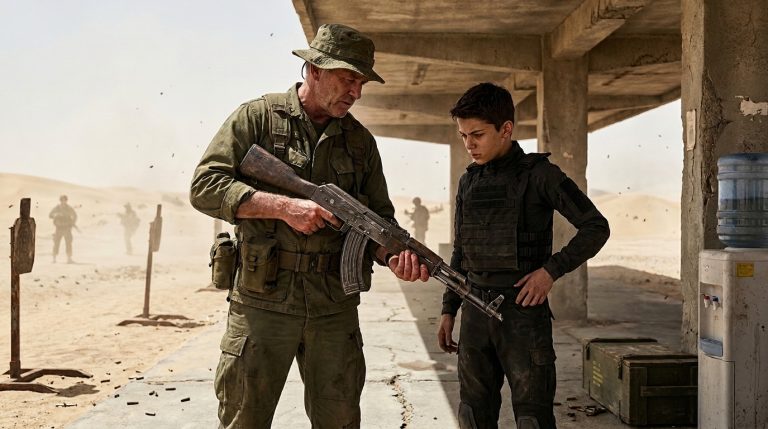
The air in the range tasted of ozone and burnt propellant, a thick, metallic tang that coated the back of Rasque’s throat. He stared at the target, the black circle a taunting void. Six inches to the left. Again.
“I told you,” Rasque said, his voice grating like gravel under a boot. “The rifle is a paperweight.”
His squad leader, Miller, stood behind him. He wasn’t looking at the target. He was looking at the exit, his posture rigid, his hands buried deep in the pockets of his fatigue jacket. “It’s a tool, Rasque. Tools don’t lie. You do.”
Rasque felt the familiar hum of adrenaline, the cold, sharp focus that came when the world narrowed down to a single objective. He didn’t want to argue. He wanted to be right. He wanted the physics of his life to make sense again. He slammed the rifle onto the shooting bench, the synthetic stock making a dull, hollow thud against the wood.
In the corner, the janitor continued his work. The straw broom hissed across the concrete, a rhythmic, abrasive sound that seemed to mock the tension in the room. Scritch. Scritch. Scritch. The man was a ghost in grey coveralls, his skin like crumpled parchment, eyes milky and unfocused. But he was watching. Rasque could feel it, a prickle on the back of his neck that had nothing to do with the range lights.
“It’s not the optics, Rasque,” Miller repeated, his voice dropping to a dangerous, low register. “It’s the rifle. Or maybe it’s the shooter. Drop it. We’re moving to the heavy munitions bay.”
“I’m not leaving until I see the bore,” Rasque spat, turning his back on Miller.
He didn’t wait for a reply. He reached out and grabbed the janitor by the shoulder, spinning him around. The old man didn’t flinch, but the broom dropped, clattering against the concrete with the finality of a gavel.
The janitor’s face was unreadable, a map of deep-set lines and forgotten geography. He looked at the rifle on the bench, then at Rasque’s hands.
“You’re holding it wrong,” the old man whispered. The voice was like dry leaves skittering over pavement. “But that isn’t the problem, boy. The problem is that the iron doesn’t want to point straight.”
Rasque froze. The silence that followed was absolute, heavy with the weight of something unspoken. He looked down at the rifle’s receiver. Etched into the steel, almost invisible under a layer of industrial grease, was a serial number. It was stamped in an odd, uneven font—a jagged, antique script that felt entirely out of place on a modern-day weapon.
His heart hammered against his ribs. He looked up, expecting the janitor to explain, but the old man had already bent down, his fingers—calloused and stained with dark, permanent oil—closing around the handle of the broom. He wasn’t looking at Rasque anymore. He was looking at the wall, at a shadow that looked suspiciously like a door that shouldn’t have been there.
CHAPTER 2: The Geometry of Failure
The silence in the range bay was no longer empty; it was pressurized. Rasque’s fingers traced the serial number on the rifle’s receiver, his thumb catching on the uneven, jagged stamp of the digit ‘4’. It wasn’t just an ugly font—it was hand-struck, inconsistent with the precision manufacturing expected of modern armory standards.
“Point of impact is a question of geometry,” the old man said, his voice barely audible over the distant hum of the ventilation fans. He didn’t look at Rasque. He returned to his sweeping, his movements slow, deliberate, and entirely too practiced. The straw broom continued its rhythmic, abrasive song against the concrete. “But you’re looking at the wrong lines, son. You’re looking for an error. You should be looking for a signature.”
Rasque felt a cold knot tighten in his gut. He looked toward the entrance, where Miller stood near the blast doors, watching them with the steady, unblinking gaze of a man who had already decided on the outcome of the day. Miller’s hand rested on the tactical radio clipped to his shoulder, a subtle, constant reminder of who held the authority in this concrete tomb.
“What signature?” Rasque whispered, keeping his back to Miller.
“The one that says this piece of steel was never meant to hit a target,” the janitor murmured, his broom pausing for a heartbeat near Rasque’s boot. “It’s built from the scraps of a broken promise. You’d do well to stop asking why it shoots left and start asking why it was allowed to reach this range at all.”
Before Rasque could press further, the heavy steel door at the far end of the range groaned open. A range safety officer stepped through, his boots clattering with sharp, authoritative cracks that shattered the fragile intimacy of the moment.
“Range clear!” the officer barked, his voice echoing off the corrugated metal walls. “We’ve got a recalibration check on the main firing line. Miller, get your team prepped. We’re running the integrity drill in ten minutes.”
The spell was broken. Rasque quickly wiped the grease from the receiver with his thumb, hiding the tell-tale serial number beneath a layer of carbon and dirt. He stood up, his joints aching from the tension. The janitor had vanished—or rather, retreated into the shadows of the supply alcove, his broom already working a patch of dust that hadn’t moved in years.
Rasque walked toward Miller, his mind spinning. The rifle felt heavier now, its weight shifting in his hands as if it possessed a malign consciousness. He caught Miller’s eye. The squad leader’s expression remained a mask of professional neutrality, but his eyes were hard, calculating.
“Optics cleaned?” Miller asked.
“Something like that,” Rasque replied, his voice flat.
“Good. Don’t let your personal frustrations interfere with the drill, Rasque. We’re here to prove the system works, not to find excuses for why it might fail. You understand me?”
It was a command masked as a question. Rasque felt the burn of it—a familiar, irritating heat that demanded a reaction, but he forced it down, burying the anger beneath a layer of calculated indifference. He had to know what the janitor meant. He had to see that serial number again, under better light, away from the watchful eyes of the chain of command.
As they walked toward the firing line, the scent of rusted iron and stagnant grease clung to the air, thicker than before. Every step toward the range floor felt like a tactical maneuver. Rasque noticed a small, metal-cased flashlight clipped to his own gear—an item he’d ignored until now. It was a simple tool, but in the dim light of the back bay, it was his only leverage against the dark. He didn’t have time to look at the rifle now, but the opportunity was closing in. He would need a diversion, a moment where the eyes of the range were fixed on the targets rather than the shooter.
The range safety officer was already shouting instructions, and the other team members were moving into position. Rasque felt the cold, hard reality of the situation: he was currently a prisoner of his own gear, holding a weapon that was designed to lie. The janitor’s words repeated in his mind, a rhythmic, maddening loop. The iron doesn’t want to point straight.
He reached the bench and laid the rifle down. It settled into the rack with a sound that felt less like a click and more like a warning.
CHAPTER 3: The Ghost in the Receiver
The firing line was a gauntlet of harsh fluorescent hum and the biting scent of burnt powder. Rasque settled into the prone position, the concrete floor cold and unyielding against his chest. Miller stood three paces behind him, a silent sentinel whose presence felt like a physical weight pressing down on Rasque’s spine. To the left and right, the rest of the squad went through the motions—chambering rounds, snapping off controlled bursts, the rhythmic thwack-thwack of impacts echoing down the range.
Rasque didn’t fire. He kept the safety engaged, his fingers tracing the cold, oily metal of the rifle’s furniture.
Ozone.
The smell hit him suddenly, sharp and electric, and for a fleeting second, he wasn’t in the range bay at all. He was five years younger, standing in the ruins of a training facility in the high desert, watching a comrade’s weapon disintegrate in their hands during a live-fire exercise. The memory was violent and invasive, an unbidden phantom that made his heart stutter. That rifle, too, had been a newer issue. It had been, he remembered now, stamped with the same erratic, hand-struck fonts. The phantom smell of scorched resin was so potent that he could almost see the smoke rising from the desert floor.
He blinked, shaking the image away. The reality of the current range reasserted itself, but the connection was made. It wasn’t just a defect; it was a lineage of failure.
“Rasque,” Miller’s voice cut through the air, cool and demanding. “You’re off the rhythm. Range protocol mandates three bursts per target set. You’re sitting on your magazine.”
“Feeding issue,” Rasque muttered, not looking back. He kept his head down, his focus entirely on the receiver.
He didn’t need the flashlight now. He needed his nails. He scraped at the carbon buildup around the serial number he’d seen earlier. The grime was stubborn, layered on thick as if intentionally applied to obscure the mark. He worked with a frantic, quiet precision, his breath shallow. As the last of the hardened grease flaked away, the number revealed itself more clearly: 0-4-0-9-R-E-C.
Rec. Reclaimed.
His stomach flipped. He wasn’t holding a modern tactical rifle. He was holding a piece of hardware that had been dragged out of a scrapyard and force-fitted into a chassis that didn’t belong to it. The realization sent a shockwave of adrenaline through him that was harder to control than the recoil of a weapon.
“Step away from the firing line,” Miller ordered. The squad leader’s boots were close now, stopping just inches from Rasque’s own. “If the weapon is malfunctioning, you report it to the armory. You don’t perform unauthorized field stripping in the middle of a live-fire session.”
Rasque rolled over, sitting up slowly. He kept the rifle positioned across his thighs, blocking Miller’s view of the receiver. The older man’s face was unreadable, cast in the harsh, downward-facing shadow of the overhead lights.
“It’s not malfunctioning in the way you think, Miller,” Rasque said, his voice steadying. “The feed ramp is clean. The buffer spring is fine. But the receiver? It’s not standard issue.”
Miller didn’t blink. “You’re reaching, Rasque. You’re looking for a conspiracy because you can’t handle the fact that you’re missing your target.”
“I’m missing because the tool is pulling me,” Rasque countered, standing up. He felt the tension in the air shift. “I’m taking this to the supply cellar. I need to verify the batch numbers.”
“You’re going to stay here and finish your drills,” Miller stepped into his space, his posture subtly radiating a threat. “That is a direct order. If you walk away, you’re looking at a disciplinary hearing that’ll end your career before the afternoon is out.”
Rasque held Miller’s gaze. Behind the squad leader, he saw the janitor emerging from the gloom of the supply alcove. The old man wasn’t sweeping. He was watching the interaction with an intensity that bordered on hunger. He tipped his head, just a fraction, toward the service elevator tucked into the rear corner of the building—a route that didn’t lead to the barracks.
It was a pivot point. If Rasque stayed, the truth of the weapon remained buried under bureaucratic threats. If he moved, he was breaking the chain of command to chase a shadow.
“My career,” Rasque said, the words tasting like copper in his mouth, “is already over if I don’t know what I’m shooting.”
He didn’t wait for Miller’s next reprimand. He stood, slung the rifle over his shoulder, and took a deliberate step toward the side aisle, leaving the firing line and his squad leader behind. Every muscle in his body was coiled, expecting the heavy hand of authority to slam into his back, but he kept moving. He moved toward the dark, toward the janitor, and toward the truth that the iron had been trying to whisper all along.
CHAPTER 4: The Ledger of Scraps
The service corridor was a narrow, artery-like passage of unpainted concrete and exposed conduit. Behind him, the range bay was a muffled roar of activity; ahead, the path spiraled downward into the bowels of the facility, lit only by flickering, yellowed lights that struggled against decades of dust. Rasque didn’t look back. He kept his rifle held across his chest, the weight of it suddenly familiar—a burden he had carried without knowing it for too long.
His boots hit the floor with a dull, echoing slap. He was walking into the restricted zone, a place that existed outside the standard logistics of the base. The smell here was different—less ozone, more stagnation. It was the scent of forgotten things: oxidized copper, damp paper, and the dry, rasping breath of an old building that had seen its best years in a different century.
The janitor, who had moved with an unnerving, silent fluidity, was twenty paces ahead. He didn’t turn around, but he slowed his gait, keeping Rasque within the reach of his steady, rhythmic shuffle.
“You’re leaving the line,” the old man said, not as a question, but as a statement of fact. His voice was sandpaper on wood. “A dangerous choice, boy. Miller won’t just let the record show you walked out. He’ll look for a reason to close the book on your file.”
“He’s hiding something,” Rasque said, his voice bouncing against the low, sweating ceiling. “The rifle isn’t just bad optics. It’s not just a bad batch. You said it yourself—it’s a signature.”
The janitor stopped at a heavy, rusted door labeled Maintenance Records – Sublevel 4. He produced a brass key, one that looked like it belonged to a museum rather than a modern military complex. The lock groaned as the key turned, a sound of metal grinding against metal that set Rasque’s teeth on edge.
“I said many things,” the janitor replied, pushing the door open into a room thick with the smell of old oil and stagnant heat. “I didn’t say I was a savior. I’m a sweeper. I clean up the messes that men like Miller create.”
Rasque entered the room, his eyes scanning the space. It was a chaotic archive, rows of steel cabinets lined with bulging files and stacks of disassembled hardware. It looked like a graveyard for technology. In the center of the room sat a workstation, covered in heavy rubber mats and illuminated by a single, high-intensity lamp.
“Put it there,” the janitor commanded, gesturing to the mat.
Rasque stepped forward and laid the rifle down. The old man reached out, not for the weapon, but for a set of calipers and a jeweler’s loupe. He didn’t check the action. He didn’t check the trigger. He went straight to the receiver, where Rasque had scrubbed the serial number clean.
“You have the eyes of a marksman,” the janitor whispered, pressing the loupe to his milky eye. “But you’re looking at the surface. Look at the edges of the stampings.”
Rasque leaned in. Under the magnified light, the numbers didn’t look like they had been machined. The edges were uneven, pushed up in tiny, microscopic ridges of displaced steel. It looked like the metal had been soft when the numbers were struck—or, more accurately, like it had been re-forged from something else.
“This steel,” the janitor murmured, his finger tracing the edge of the R in REC. “It has a higher carbon content than the rest of the chassis. It’s brittle. It was never meant for a high-velocity bolt. It was taken from an experimental housing, one that was decommissioned five years ago after a failure in the desert.”
The phantom smell of scorched resin returned, sharper this time. The desert training incident. The comrade whose rifle had burst. Rasque’s hand hovered over the receiver, his skin crawling. “If this was decommissioned, why is it in a standard-issue box?”
“Because,” the old man said, finally looking up. His eyes, though clouded with age, held a sharp, terrifying clarity. “Miller isn’t just running a unit. He’s running a test. He’s using you, and every other recruit in his squad, to see if these re-forged hulls can withstand sustained fire without killing the operator. It’s not a range drill, Rasque. It’s a stress-test.”
The room seemed to shrink. The silence was deafening, broken only by the rhythmic dripping of water somewhere deep within the building’s foundations. Rasque looked at his own hands—the same hands that had trusted that rifle to hold a zero for months. The rage he felt wasn’t a sudden, hot flash; it was a cold, hardening realization. He hadn’t just been training; he had been a lab rat in a game where the cost of failure was measured in anatomy.
“Who authorized it?” Rasque asked, his voice a low, dangerous vibration.
“The same people who signed your paycheck,” the janitor said, turning back to the shadows of the shelves. “Don’t look for a villain in a fancy office, boy. Look for the man who is standing between you and the truth. Miller has a ledger. Every failure, every ‘drift,’ every misfire—he logs it all in a black book. He’s building a case for a new, cheaper procurement contract based on the ‘durability’ of these reclaimed parts.”
Rasque looked at the rifle, then at the door he had just walked through. The path forward was clear, and it didn’t lead back to the range. It led to the office where Miller kept his records. The janitor was already moving, his silhouette blending into the gloom of the back shelves. He was a man who knew exactly where the bodies—and the blueprints—were buried.
“If you want to end this,” the janitor said from the dark, “you don’t shoot for the target. You shoot for the architect.”
Rasque picked up his rifle, the cold, heavy metal feeling like an anchor. He wasn’t just a soldier anymore. He was a man who had seen the gears of the machine, and he knew exactly where to jam them.
CHAPTER 5: The Ledger of Silence
The stairwell leading up from the maintenance sublevels was a claustrophobic throat of bare concrete and weeping pipes. Rasque climbed it with a slow, deliberate cadence. Every landing, every turn of the railing, felt like a deliberate choice to move further away from the safety of his rank and closer to the precipice of mutiny.
He didn’t trust the rifle, and for the first time in his career, he didn’t trust his own recollection. The memory of the desert failure—the heat, the scream of twisting metal, the smell of ozone—it felt too sharp, too cinematic, as if it had been burnished into his mind by constant replaying. Was it a genuine memory, or was it a narrative Miller had planted, a psychological anchor designed to make Rasque doubt his own senses? He gripped the rifle tighter, the cold steel biting into his palm. Pragmatism was his only compass now. Believe nothing you aren’t holding.
He reached the administrative level. The office doors here were heavy, veneered wood—a jarring contrast to the industrial rot below. Miller’s office was at the end of the hall, the glass panel in the door dark, suggesting the squad leader was still down at the range or perhaps occupied with his own version of ‘maintenance.’
Rasque reached the door, his heart rate steady, forced into a rhythm of artificial calm. He didn’t have a key, but the lock was a simple, outdated tumbler mechanism. He knelt, pulled a flat-head screwdriver from his gear—the same tool he’d used to adjust the optics earlier—and began the work of picking it. It took three minutes of agonizingly slow tension, listening for the soft click of the internal pins. When the latch finally gave way with a subtle, mechanical exhale, he pushed the door open.
The office was exactly what he expected: surgically clean.
Files were organized by date. Equipment manifests were tallied in neat, red-inked columns. But it was the desk that commanded his attention. A small, black leather-bound ledger sat in the center, untouched.
He moved to the desk, his boots making no sound on the heavy carpet. He opened the book. The pages were dense with names—the names of the men in his squad, and those who had rotated through the unit in the last two years. Each name had a corresponding serial number for their assigned equipment. Beside his own name, the entry read: 0-4-0-9-R-E-C (Stress-Test Cycle 14: Failed Calibration, Adjusted parameters for kinetic load).
His hands shook, not from fear, but from the sudden, jarring impact of seeing his own life reduced to a variable in a spreadsheet. He flipped to the back of the ledger. There, stapled to the final page, was a series of technical diagrams that shouldn’t have been in a simple supply book. They were blueprints for a weapon system he recognized—the same one that had blown apart in the desert five years ago.
He turned the page, and a loose photograph slipped out, fluttering onto the dark wood of the desk.
It was a picture of him. A younger version of himself, training in that same desert facility. Standing behind him, obscured by the blur of a long-range lens, was a man in civilian clothing. Miller.
The room seemed to tilt. The logic he had been building—that Miller was just a corrupt officer looking for a contract—felt insufficient. This wasn’t a supply chain fraud. This was personal. This was a long-term, calculated grooming of a test subject.
A sound from the hallway froze him. The rhythmic, distinct click-clack of tactical boots on hard floor, approaching the office. It wasn’t the heavy, lumbering walk of the janitor. It was the sharp, efficient gait of someone who owned this space.
Rasque shoved the ledger into his cargo pocket and grabbed the rifle, backing into the shadow of a floor-to-ceiling bookshelf. His mind whirred, calculating his exits. The window behind the desk was barred. The door was the only way out, and it was being approached.
The shadow in the hallway grew, a thin sliver of light expanding under the door as someone reached for the handle. Rasque held his breath, his finger hovering near the rifle’s safety, the metal cold and biting against his skin. If he was caught, the game of subversion was over. He would be the one written up as a failure, a case study in the ledger of his own destruction.
The handle turned. The door swung inward.
Miller stepped inside, his posture relaxed, his eyes scanning the room with the casual confidence of a predator entering his den. He stopped. His eyes drifted to the desk, then to the slightly askew chair, and finally to the shadow where Rasque was hidden.
“You know,” Miller said, his voice terrifyingly calm, “the problem with trying to learn the truth, Rasque, is that you never stop to ask why the information was left where you could find it.”
He didn’t draw his weapon. He didn’t even tense. He just stood there, waiting for Rasque to reveal himself, as if this were a conversation they had been rehearsing for years.
CHAPTER 6: The Clandestine Chamber
The sound of the door sealing was a finality that made the air in the office feel instantly thinner. Miller remained in the doorway, his silhouette framed by the harsh, sterile light of the hallway. He didn’t move toward his desk. He didn’t draw a weapon. He simply watched, his hands still relaxed at his sides, as if the locking mechanism were a mundane consequence of Rasque’s intrusion rather than a tactical trap.
“You like the ledger?” Miller asked, his voice low, lacking any trace of alarm. “It’s a comprehensive history, Rasque. Every cycle, every failure, every data point that confirms why this program is so vital.”
Rasque didn’t holster his rifle. He kept the muzzle pointed at the floor, but his finger remained indexed near the trigger guard. He felt the familiar, coarse texture of the stock—a reminder of the deception he’d been holding. “Vital for what? Breaking things? Breaking people?”
Miller stepped fully into the room, and the door clicked shut behind him, sealing the seams with a heavy, magnetic thud. “Vital for survival. You think the world operates on clean manufacturing and perfect QA/QC protocols? You think the hardware that keeps this base standing is new? This base is built on salvage, Rasque. It’s built on the things that were too broken for the public eye, too discarded for the mainstream budgets, and too necessary to be left in the dirt.”
Miller moved to the bookshelf, his hand tracing the edge of a volume as if he were scanning a shelf in a library. “You were always the best shot in the unit. Not because you were faster, but because you were obsessed. You needed to know why things worked, or why they didn’t. I just gave you the opportunity to pursue that obsession to its logical end.”
“You used me,” Rasque said, his voice flat. “The desert failure. That wasn’t an accident, was it?”
Miller stopped. He turned slowly, his face etched with a look of mock disappointment. “An accident? No. It was a litmus test. I needed to see if you could survive a catastrophic hardware failure and still possess the cognitive capacity to analyze it. You didn’t just survive it; you became defined by it. It made you the perfect candidate for this phase.”
Rasque felt a surge of cold, hard anger—the kind that didn’t burn, but instead focused his vision until the room was nothing but edges and points of friction. He shifted his weight, his boots testing the carpet. He knew the exits were barred, but he also knew the room’s layout. Beneath the desk, there was a heavy-duty power junction for the office’s main terminal. If he could create a surge, he could force the electronic locks to cycle.
“And now?” Rasque asked, taking a subtle step to the left, toward the desk. “What happens in Phase 15?”
“Phase 15 is the field deployment,” Miller said, his eyes tracking Rasque’s movement with predatory ease. “We’re shipping these rifles out on Tuesday. They aren’t going to a testing range, Rasque. They’re going to a hot zone. And you’re going to be the one leading the squad.”
The floor beneath Rasque’s feet felt like it was shifting. The implications hit him with the force of a physical blow. Miller wasn’t just building a case for a contract; he was deploying flawed hardware into a real-world combat scenario, treating the lives of his men as disposable metrics in a corporate and political game of survival.
“I’m not doing it,” Rasque said.
Miller laughed, a dry, humorless sound. “You don’t have the luxury of choice. You’re deep in the ledger, Rasque. Your DNA, your service record, your ‘unauthorized’ entry into this office—the documentation is already written. If you don’t go, you won’t be a hero who exposed a scandal. You’ll be a malcontent who tried to sabotage operational equipment. You know how that ends.”
Rasque reached the corner of the desk. His hand dropped down, his fingers finding the heavy gauge wire of the terminal’s power supply. It was warm to the touch. “There’s one thing your ledger forgot to account for, Miller.”
“And what’s that?”
“The person who knows how to break the gear.”
Rasque jerked the wire upward with a violent, controlled snap, ripping the junction box clean from the base of the desk. Sparks showered the floor, a jagged, electric spray of light that hissed as it hit the carpet. The office lights flickered and died, plunging the room into a deep, claustrophobic gray. The magnetic seals on the door groaned as the power cut, and for a split second, the air pressure in the room shifted.
Miller didn’t hesitate. He lunged forward, his movement a blurred, fluid shadow in the darkness. Rasque didn’t wait for him to arrive. He spun, driving the butt of the rifle into the space where he knew Miller would be, the weight of the steel connecting with something soft and resistant. Miller grunted, the sound sharp and ragged, but he kept coming, a relentless, physical force.
They collided in the dark, a mass of limbs and heavy gear, the smell of dust and ozone thick enough to choke on. The office was no longer a room of paper and secrets; it was a confined, kinetic arena. Rasque wasn’t fighting for his career anymore. He was fighting for the reality that the janitor had teased—the truth buried in the rusted, reclaimed marrow of the iron he had been issued.
He managed to shove Miller back, the squad leader’s heavy jacket tearing under his grip. Rasque lunged for the door, his hand slamming into the manual release lever he’d spotted when he’d first entered. It gave with a sharp, pneumatic hiss.
The door swung open, and Rasque spilled out into the hallway, gasping for breath. He didn’t look back to see if Miller was following. He scrambled to his feet and ran, his boots clattering against the concrete, the ledger heavy and sharp against his thigh. He was out, but the facility was coming alive—the sound of alarms, low and mournful, began to bleed through the walls. The hunt wasn’t just on; it had expanded.
CHAPTER 7: The Blueprint of Betrayal
Rasque didn’t run; he moved with the predatory economy of a man who knew he was being hunted in his own backyard. The hallway ahead was a blur of yellowed emergency lighting, the air thick with the smell of scorched insulation and the metallic tang of old, dormant systems waking up. Behind him, the sound of heavy boots echoed—a staccato rhythm that was gaining ground.
He ducked into a narrow service crawlspace, a relic of the building’s original design. It was tight, the walls pressing in with a cold, damp weight, the air smelling of stagnant oil and dust. His heart pounded against his ribs, a frantic, irregular rhythm that matched the pulsing of the alarm lights. He pressed his back against a rusted pipe, trying to regulate his breathing, the ledger in his pocket pressing sharp against his thigh.
He had to get to the fabrication wing. If the janitor—the old man who seemed to know the skeleton of this place as intimately as his own palms—had been right, then the fabrication wing held the master records. He needed to compare the serial numbers in Miller’s ledger with the original procurement logs of the failed desert program.
The alarm shifted, its pitch rising to a shrill, piercing frequency that triggered an involuntary spasm in Rasque’s hands. For a sickening second, the sound morphed into the roar of the desert blast, the heat washing over him, the smell of burning composite. He closed his eyes, forcing the phantom memory down. It was a projection. A psychological trick. Stay grounded. He reached out, his hand finding the rusted, rough surface of a pipe, its gritty, peeling paint a stark, physical reality that anchored him to the present.
He scrambled forward, the crawlspace opening into a narrow ventilation shaft that overlooked the primary fabrication floor. He peered down through the slats.
The floor below was bathed in the harsh, sterile glow of maintenance lights. He saw Miller’s security team—not his regular squad, but men in black tactical gear, moving with an eerie, coordinated silence. They were searching every rack, every cabinet, their flashlights cutting through the gloom like scalpels.
Rasque focused on the central workbench. It was littered with components, the same reclaimed chassis parts he had seen in the maintenance bay. A technician stood there, methodically assembling a bolt group. He wasn’t working with care; he was working with the detached, mechanical indifference of a man performing a repetitive, low-value task.
He had to get down there. He had to prove the link.
He spotted a service ladder tucked into the shadows, leading directly to the center of the fabrication floor. It was a risky maneuver, but he didn’t have the luxury of strategy. He pulled the rifle from his shoulder. He checked the chamber; it was ready, but his hand hesitated. The weapon was a lie, a tool of destruction that might fail him at the most critical moment. He needed to neutralize the threat, not just with steel, but with information.
He began the descent, his movements slow, deliberate, each step a calculated risk. As his boots hit the grating of the fabrication floor, he froze.
A figure emerged from the far end of the wing. It wasn’t one of Miller’s security men. It was the janitor. The old man was walking directly toward the technician, his broom in hand, his pace unhurried, almost defiant. The security team stopped, their rifles raised, but they didn’t fire. They hesitated, as if the old man’s presence was a glitch in their tactical programming.
“You’re working with the wrong tolerance,” the janitor said, his voice carrying clearly across the sterile, metallic space.
The technician looked up, startled. “Who the hell are you?”
“I’m the one who designed the receiver you’re currently butchering,” the old man said, his tone as casual as a conversation about the weather. “The alloy is too brittle for that pressure rating. You’re not building a rifle. You’re building a grenade.”
The security team didn’t move, but their attention was fixed on the old man, their perimeter fracturing. Rasque saw his window. He lunged forward, moving behind a row of heavy storage racks, closing the distance to the central workbench. The ledger felt heavy, a physical weight of proof he was moments away from presenting.
He didn’t need to fight his way out. He needed to broadcast the truth. He reached the master console at the edge of the workbench, his fingers dancing over the interface. He needed a bypass, a way to connect the ledger’s encrypted data to the facility’s internal communications array. It was a technical impossibility, but the janitor had left a bypass port on the side of the console—a legacy feature that shouldn’t have been there, but was.
He slammed the cable into the port, the interface glowing blue as it acknowledged the connection. The ledger’s data began to upload, a progress bar flickering on the screen.
10%… 20%…
“Rasque!”
The shout came from the balcony above. Miller.
Rasque looked up. Miller was standing on the observation deck, a sidearm leveled directly at him. The squad leader’s face was a mask of cold, controlled fury. “Shut it down, Rasque! You have no idea what you’re unleashing!”
“I think I do,” Rasque said, his finger resting on the enter key.
50%… 60%…
The security team turned, their rifles swinging toward Rasque. He didn’t look at them. He kept his eyes on the progress bar, his breath steady, his mind a crystalline point of focus. The rusted truth of the facility was about to be laid bare, and for the first time, the weight of the rifle in his hands didn’t feel like a lie. It felt like a gavel.
CHAPTER 8: The Friction of Truth
The progress bar on the console reached 99%. Rasque watched the blue light pulse with a rhythmic, hypnotic frequency. He didn’t turn to face Miller. He didn’t look at the security team, who were now fanning out, their tactical lights playing over the rows of rusted steel racks like inquisitive, predatory eyes. He kept his focus on the interface, his hand resting on the console’s edge, his muscles coiled for the sudden, violent surge of adrenaline that would follow the final percent.
“You’re wasting your life for a footnote, Rasque,” Miller called out, his voice echoing through the vast, industrial cavern of the fabrication wing. He was twenty feet away, moving with a calm, predatory grace. “Once that data hits the network, it’s just noise. You think anyone cares about the integrity of a bolt group? They care about the budget. They care about the procurement cycle. You’re fighting a bureaucracy that’s already decided you don’t exist.”
The bar hit 100%. The screen flickered, a small, green indicator light blinking to life: Transfer Complete.
Rasque didn’t wait for the confirmation message. He jerked the cable free, the port sparking with a final, dying hiss. He spun, his rifle leveled not at Miller, but at the main electrical coupling for the fabrication floor’s entire lighting grid. He fired a single, calculated shot.
The bullet struck the coupling with a shower of white-hot sparks and a report that sounded like a tectonic plate shifting. The facility plunged into total darkness, the only light the residual glow of the emergency systems.
In the void, Rasque moved. He didn’t go for the exit. He went for the shadows—the familiar, labyrinthine geography of the machinery he had spent the last hours navigating. He knew the sounds of this room better than Miller knew the ledger. He knew the hum of the cooling fans, the rhythmic drip of the coolant line, the hollow resonance of the steel grating underfoot.
He felt a sudden shift in the air—the displacement caused by someone moving toward him. He dropped low, his boots finding purchase on the floor, and swept his rifle in a wide, defensive arc. He heard Miller’s grunt of effort, the sliding of leather on steel.
“You think you’re a ghost?” Miller hissed, the sound coming from just a few feet to his right. “I built this place, Rasque. I know every shadow, every blind spot. You’re not hiding; you’re just delaying the inevitable.”
A tactical light flickered to life, a blinding, narrow beam that cut through the gloom. It didn’t hit Rasque, but it illuminated the rack of disassembled rifles next to him—the reclaimed scrap that Miller had been forcing them to test.
Rasque saw his opportunity. He didn’t aim at Miller. He aimed at the rack’s primary support, the rusted, over-stressed iron holding up half a ton of heavy steel. He fired two more rounds.
The rack groaned, the metal screeching in protest as it buckled. It tipped, a massive, cascading avalanche of steel that slammed into the floor, creating a chaotic wall of wreckage between him and Miller. The noise was deafening, a physical wall of sound that vibrated through the floorboards and rattled the very bones of the building.
In the ensuing silence, Rasque moved. He didn’t head for the door. He headed for the supply alcove, the place where the janitor had first appeared. He felt the cold touch of the concrete against his palm, the familiar, rough texture of the wall. He needed to find the old man. The janitor had the key to the sub-levels, the only place where the true story of the desert incident—the real Layer 2—was documented beyond the digital reach of Miller’s ledger.
He reached the alcove, but it was empty. The broom was gone. The shadows were vacant.
A heavy hand landed on his shoulder. Rasque spun, his rifle coming up, but he stopped. It was the janitor, standing in the absolute blackness of the alcove, his face a landscape of deep, inscrutable lines.
“You did well, boy,” the old man whispered. The voice was soft, almost a lullaby. “You broke the cycle. But you haven’t destroyed the machine. To do that, you need to see what I saw five years ago. You need to see the graveyard.”
The janitor held out a hand, a small, worn metallic key resting in his palm. It was cold, heavier than it looked, smelling of iron and dry, desert earth.
“Miller is coming,” the old man said. “He won’t stop for a ledger. He’ll stop when there’s nothing left to hide. Follow me. It’s time you saw the truth about what happened in the sand.”
Rasque took the key. The metal bit into his skin. He didn’t look back at the wreckage on the fabrication floor. He followed the janitor into the wall itself, into a hidden, narrow passage that shouldn’t have been there—a forgotten artery of the facility, leading down into the quiet, dark foundation of the entire, rotting project.
CHAPTER 9: The Graveyard of Intent
The air in the sub-basement was thick, smelling of wet earth and oxidized iron. It was a place where time didn’t flow so much as settle in layers of dust. Rasque followed the janitor’s lantern, his own heartbeat the only sound in the oppressive silence. They walked past crates marked with dates from half a decade ago, crates filled with the shattered remains of rifles, receivers, and high-velocity bolts—the very equipment that had been the subject of the desert failure.
The janitor stopped before a heavy blast door that had been partially pried open. “This was the staging ground,” the old man said, his voice stripped of its usual cryptic cadence. He walked inside, and the light of his lantern revealed the truth.
Rows upon rows of salvaged weapons stood on racks, each tagged with a name. Rasque walked toward the nearest rack, his fingers hovering over a rifle that looked identical to the one he had been issued. He lifted it, turning it over to see the serial number: 0-4-0-9-R-E-C. It was the same batch. The same lineage.
“They didn’t just test us,” the janitor said, standing in the center of the room. “They harvested us. Miller needed a way to prove that these salvaged parts could be integrated into active combat loadouts to save millions on the procurement budget. He used you as a baseline. He needed a marksman who would push the weapon to its failure point, and then report the results as ‘operational variables’ so he could fine-tune the salvage process.”
Rasque felt the cold reality solidify. The desert explosion hadn’t been an accident; it had been a controlled detonation of a faulty component, observed and logged by Miller himself. The “truth” of his own trauma was just a metric in a corporate ledger.
The sound of footsteps echoed from the top of the stairs. Miller had arrived.
He stepped into the room, his tactical gear dusted with the grime of the fabrication floor. He didn’t look like a commander anymore; he looked like a man standing over a grave he had spent years digging. He stopped, looking at the rows of salvaged weapons, then at Rasque.
“You found the archive,” Miller said. His voice was devoid of malice now, replaced by a terrifying, pragmatic calm. “You see the logic now, don’t you, Rasque? This wasn’t about malice. It was about necessity. The military budget is a finite resource. By re-engineering these platforms, I’ve saved the department four hundred million in five years. You think I’m the villain? I’m the only one here who actually understands the cost of doing business.”
“You traded our lives for a budget line,” Rasque said, his voice steady. He reached into his pocket and pulled out the ledger he’d taken from the office. He tossed it onto a stack of crates between them. “The network is already processing the upload, Miller. Every log, every name, every ‘failed’ calibration. It’s all out there now.”
Miller looked at the ledger, then back at Rasque. A slow, thin smile touched his lips. “You think that matters? The people who approved this know exactly what I’m doing. They’re the ones who signed the checks. You haven’t exposed a crime, Rasque. You’ve just cataloged a policy.”
Miller raised his weapon, but he didn’t aim at Rasque. He aimed at the primary coolant line running along the ceiling of the chamber—a massive, pressurized pipe filled with chemical fire-suppressant.
“If I go down, this whole wing—this entire archive—goes with me,” Miller said. “And you along with it. No evidence. No scandal. Just a tragic fire in an abandoned sub-level.”
He took a step forward, his thumb resting on his sidearm’s trigger. But then, the janitor moved. He didn’t use a weapon. He simply stepped between them, his broom—sturdy, iron-bound, and ancient—striking the floor with a force that made the room vibrate.
“The alloy is brittle, Miller,” the janitor said. He reached down and picked up a piece of the salvaged receiver Rasque had been holding. He threw it—not at Miller, but at the cooling pipe. The steel fragment, tempered and forged with the exact same defect Miller had been trying to hide, struck the pipe with perfect, kinetic precision.
The pipe didn’t just leak. It shattered. The pressurized chemical blast erupted, hitting Miller with the force of a battering ram, throwing him backward into a rack of steel. The impact, fueled by the brittle, over-stressed metal of the salvage he himself had championed, resulted in a localized collapse. The heavy rack fell, pinning Miller beneath the very weight of his own “necessary” salvage.
The room fell into a sudden, eerie quiet. Miller lay trapped, his face a mask of shock and pain, the weight of the steel pinning him to the floor. The fire-suppressant gas began to fill the room, a white, suffocating fog that erased the edges of the chamber.
Rasque stood over him. He felt no triumph, only a deep, settling exhaustion. He looked at his rifle—the one he’d held for months—and then at the pile of wreckage that had finally claimed its architect. He picked up his wrench—the tool he’d used to pick the lock—and stepped toward a nearby workbench. He didn’t fix the rifle. He dismantled it, piece by piece, dropping the components into a crate of scrap, letting the pieces return to the dust of the facility.
The janitor stood by the door, his lantern casting long, flickering shadows on the wall. “The machine is still running, boy,” the old man said. “But for today, at least, it’s stopped moving.”
Rasque walked out of the room, leaving the ledger, the wreckage, and the man who had turned his life into a variable behind. He climbed the stairs toward the surface, toward the light, his legs heavy but his mind finally, painfully, clear. He reached the top of the stairs and stepped into the cool, dark air of the night, the weight of his own identity finally his own to carry.