The Silent Phantom of the Kabul Alleys Proves Her Worth to an Unyielding General
CHAPTER 1: THE COLD BRIEFING
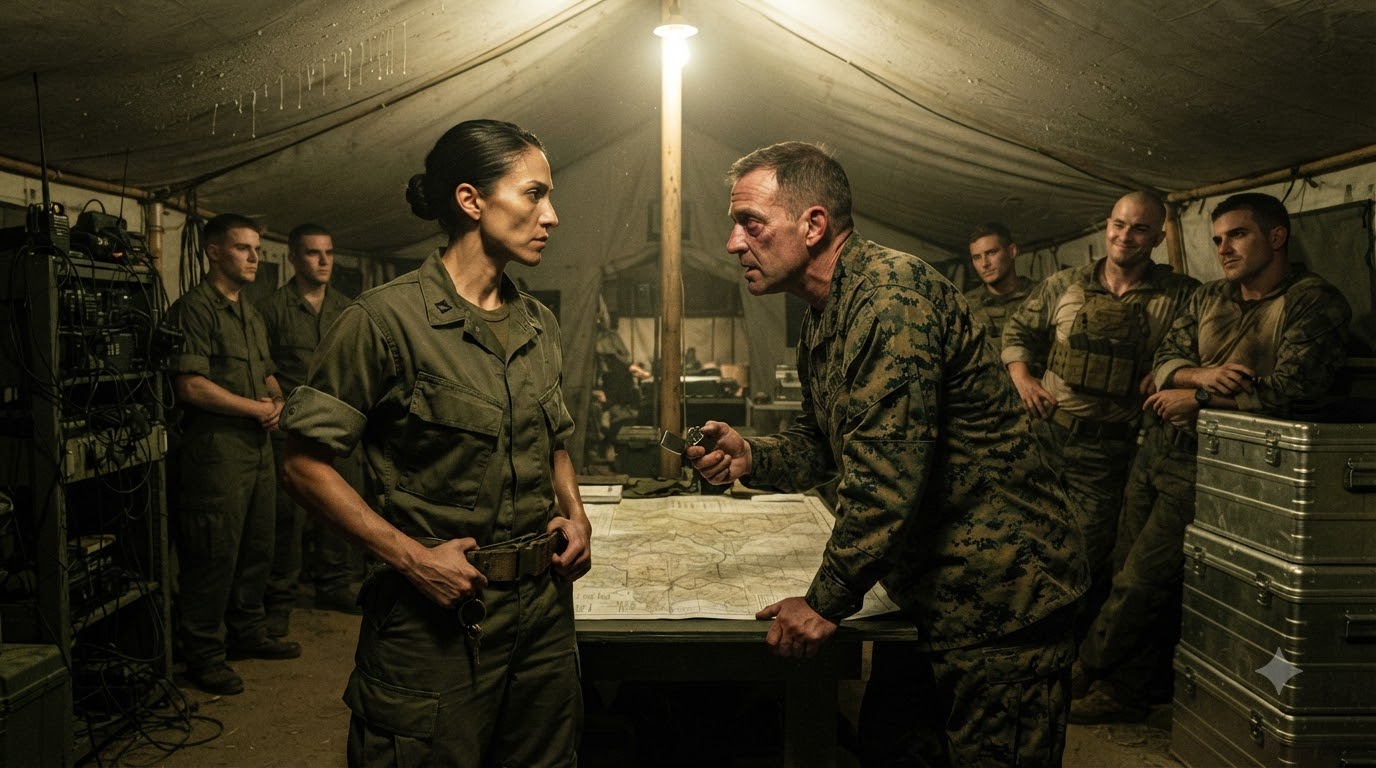
The plywood under General Marcus Steel’s combat boots didn’t flex.
It creaked once, a sharp sound that cut through the low hum of the tactical generator outside the operations tent. Dust hung suspended in the harsh yellow light above the map table, thick enough to taste like powdered chalk.
Elena Torres stood four feet from the edge of that table. Her right hand rested naturally at her side, inches from the worn fabric of her utility belt, her thumb lightly resting against the notched edge of a rusted brass key ring she’d carried since Second Recon. She didn’t adjust her stance. She didn’t shift her weight.
Across the map, three Navy SEALs leaned against a stack of aluminum transit cases. One of them, a lieutenant with a shaved head and a grease stain across his chest rig, let out a dry, quiet exhale.
“That’s her?” the lieutenant muttered, not bothering to lower his chin. “That’s the one from the alley reports?”
Steel didn’t look at the lieutenant. His eyes, heavy-lidded and bloodshot from seventy-two hours of tracking dark patrols, stayed locked on Torres’s collar insignia.
“Name and unit,” Steel said. The tone wasn’t a question. It was a iron bar laid across the room.
“Gunnery Sergeant Elena Torres,” she said. Her voice remained flat, lacking the sharp, barking cadence young officers used when trying to sound firm. “First Reconnaissance Battalion.”
Steel flipped a brass Zippo lighter open with his thumb. Clack. He didn’t strike the wheel. He just held the cold metal in his palm, feeling the weight before snapping the lid shut again. Snap.
“I don’t care about the battalion,” Steel said softly. He took half a step forward, his shadow swallowing the lower corner of the tactical grid mapped out across the butcher paper. “I care about the chatter. I’ve got captains writing poetic after-action logs about ghosts slipping through brickwork. I’ve got junior enlisted carving initials into their body armor like they’re praying to a saint.”
The SEAL with the shaved head smirked, crossing his arms over his chest plate. “Spectre,” he whispered under his breath. “Right.”
Torres didn’t turn her head. Her eyes stayed fixed on the frayed edge of General Steel’s left collar tab.
“Call sign,” Steel barked, the Zippo snapping open again with a sharp metal ring.
“Spectre 6, sir,” Torres said.
The silence that followed was heavy, filled only by the dry scrape of boots on grit as one of the junior watch officers near the radio rack stiffened. The smirks on the transit cases didn’t disappear, but the silence stretched long enough for the generator’s rhythmic thrum to fill the corners of the canvas.
Steel closed the lighter. Snap. He leaned down until his face was six inches from hers, the smell of stale black coffee and field tobacco rolling off his uniform.
“A legend in a combat zone is a liability, Sergeant,” Steel said, his voice dropping into a raspy whisper that carried to every corner of the tent. “It makes scared men brave when they ought to be smart. And smart men die trying to follow a ghost into a breach. You think you’re unbreakable?”
Torres looked straight into the cracked red veins in the General’s right eye. Her thumb moved one millimeter against the brass key ring at her hip, feeling the notch in the metal.
“I don’t break, General,” Torres said evenly. “Because if I break, my Marines stay in the dirt.”
Steel stared at her for five long seconds. The air in the tent felt thin, stretched tight enough to snap. He opened his mouth to speak, but the canvas flap at the rear of the tent was yanked aside, letting in a cold draft of mountain air and the sharp stench of diesel.
A young lieutenant stumbled over the wooden threshold, a blue-topped casualty folder clutched in his right hand.
“General,” the lieutenant said, his voice cracking slightly on the first syllable. “Recon Bravo just missed their third check-in. Sector Four outskirts. The whole grid just went dark.”
CHAPTER 2: INTO THE STATIC
“Read the grid back,” Steel said, his eyes never leaving the map’s faded blue crosshairs. He didn’t look at the lieutenant with the folder, nor did he look at the three Navy SEALs who had suddenly stopped leaning against their equipment cases.
“Sector Four, sir,” the lieutenant said, his throat clicking as he swallowed. ” The western drainage shelf below the old brick kilns. Recon Bravo went quiet after two brief bursts of automatic fire. No voice traffic. No distress signal.”
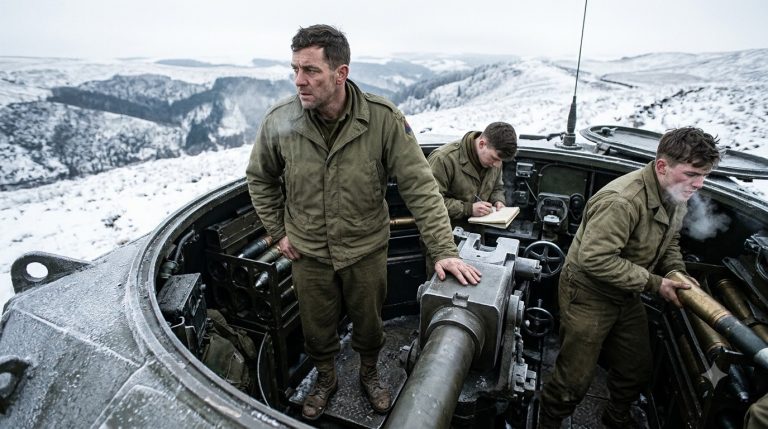
Torres didn’t ask about air support. She already knew the answer. The cloud deck hanging over the Hindu Kush was dropping low enough to scrape the radio towers on the ridge, and the local relay on Hill 204 had been dead since Tuesday. If Recon Bravo was in the dirt, nobody was going to fly a bird into that dark pocket to pull them out.
“They didn’t get ambushed,” Torres said quietly.
The SEAL lieutenant turned his head, his brow furrowing over his grease-stained face. “You were in the tent three minutes ago, Gunnery Sergeant. You got eyes on the kilns from here?”
“They went silent without a distress call,” Torres replied, her voice dropping into that flat, rhythmic cadence that came from years of listening to bad news over broken headsets. “That means whoever hit them didn’t start with small arms. They cut the line of sight first, pressed them into the low ground, and locked them down before the point man could even touch his chest rig.”
Steel picked up a wax pencil from the corner of the table, the red lead worn down flat on one side. He pressed the tip against Sector Four, leaving a thick, bloody mark across the grid lines.
“Take the light truck element,” Steel said, his jaw tightening until the muscle near his ear twitched. “Get to the edge of the kilns. If they’re breathing, bring them back. If they aren’t, I want to know who turned off the lights.”
“No air, no relay,” the SEAL lieutenant said, stepping toward the table and laying his palm flat on the paper. “General, with respect, sending four men into the kilns blind without a overhead feed is just giving them more targets.”
“Then don’t send four men,” Torres said, stepping past the SEAL until her shoulder brushed his chest rig. “Send three. And leave the engine noise two ridges back.”
She didn’t wait for Steel to sign the movement order. She turned on her heel, her boots catching the edge of the plywood floor with a low, deliberate scrape, and walked out into the mountain air.
The night outside FOB Kabul smelled of wet gravel, burning trash, and diesel exhaust. The overcast sky had swallowed the stars, leaving the valley in a greasy, pitch-black silence. She walked straight to the back of the second utility truck, where Corporal Dennis was already sitting on the dropped tailgate, scraping dried mud off his combat boots with the dull edge of a bayonet.
“Bravo’s dark?” Dennis asked without looking up.
“Bravo’s dark,” Torres said. She unlatched her rifle’s upper receiver, checked the bolt face by touch in the shadow of the canvas canopy, and snapped it back into place with a dull click. “We’re walking the last mile.”
Dennis stopped scraping his boot. He looked out past the wire toward the dark, jagged shape of the mountain ridge three miles west. “Acoustics are going to be terrible down in those dry washes, Gunny. The wind is coming off the river.”
“Good,” Torres said, slinging the weapon across her chest plate and feeling the notched brass key ring in her pocket press against her hipbone. “That means they won’t hear us coming either.”
Ten minutes later, the light utility vehicle rattled out through the eastern gate, its blackout lights cutting thin, faint slivers into the mud ahead. They didn’t use the main supply road. They cut south, hugging the low terrace where the old irrigation ditches ran parallel to the mountain wall.
When the truck engine finally killed two miles out, the silence didn’t just return—it slammed down over the wash like a wet wool blanket.
Torres dropped off the side of the truck bed, her knees taking the shock without a sound. She didn’t pull out a radio. She didn’t check a handheld GPS. She raised her left hand, fingers spread wide, and pointed toward the narrow gap where the dry wash squeezed between two crumbling mud-brick walls.
The air was freezing, carrying the sharp, iron scent of damp clay and old woodsmoke.
A mile ahead, deep inside the shadow of the kilns, a single metallic thud echoed through the stone—not a rifle shot, but the heavy, deliberate drop of an iron latch falling into place.
CHAPTER 3: THE VERTICAL CRAWL
Dennis shifted his weight behind her, his breath coming in tight, shallow bursts that condensed into white mist. “Gunny,” he murmured, his fingers twitching against the plastic furniture of his handguard. “That came from above the wash.”
Torres didn’t answer. She pointed two fingers toward the base of the western kiln structure—a towering, crumbling spire of sun-dried mud brick and exposed iron rebar.
A single muzzle flash split the blackness seventy feet up, followed instantly by the flat thump-crack of a high-velocity round punching into the earth two inches from her left boot. Dust whipped into her eyes.
The kill zone was built like a funnel. Three distinct firing points on the upper parapets held the low ground in an overlapping grid, pinning anything that moved through the dry wash. There was no radio to call in a mortar strike, no overhead optic to pinpoint the shooter, and zero room to maneuver horizontally.
“Stay flat, Dennis,” Torres said, her voice barely carrying over the sudden chatter of automatic fire rattling off the kiln walls. “Keep their eyes in the ditch.”
“You can’t cross that flat ground, Gunny—”
—”I’m not crossing it,” she interrupted, unbuckling her chest rig’s heavy center latch and letting the extra magazine pouches drop onto the dirt to strip away dead weight.
She moved before the next burst tore through the wash. Slid flat on her stomach across ten feet of broken slate, the sharp edges digging through her uniform sleeve, until her shoulder slammed against the raw brick face of the main stack.
The wall didn’t have steps. It had century-old mortar erosion and jagged nicks where iron reinforcement bars had rusted through and snapped off.
Torres jammed her right boot tip into a two-inch gap in the masonry. Her fingers hooked into a cold, grit-covered ledge above her head. Friction and gravity. She pulled, her arm muscles burning under the sudden strain as her body lifted off the ground.
Ten feet up, a stray round slammed into the brick work right next to her knee, spraying blinding clay dust into her face. She held her breath, refusing to cough, her fingers locking tighter onto the rough stone until the skin on her knuckles stretched white.
She didn’t look down at Dennis. She didn’t look up at the shooter. She tracked the rhythm of the weapon above—three-round bursts, a two-second pause to clear smoke, then three more.
At forty feet, her hand slipped. The old mortar crumbled under her fingertips like dried flour. Her left foot swung out into empty air, her entire weight suddenly hanging from four fingers jammed into a crack in the brickwork. Her ribs scraped against an exposed iron bar, the dull metal tearing through her blouse and bruising the skin beneath.
She didn’t gasp. She dragged her left knee up, dug the side of her boot against an exposed header brick, and forced her torso upward by sheer, grueling momentum.
Seventy feet. The top edge of the kiln parapet appeared through the haze.
A man in a dark wool vest was crouched behind a low stack of masonry, his rifle rested on the ledge as he fired down into the wash where Dennis was drawing his attention.
Torres reached over the coping, hooked her elbow over the lip of the wall, and hauled herself over the edge without a sound.
Her boots hit the gravel roof with a dull, heavy crunch. The shooter started to turn, his face twisting in sudden confusion, but Torres closed the four feet between them before he could clear his barrel from the wall. She drove her shoulder into his side, pinning him against the brickwork, her right hand clamping down on his rifle receiver to jam the bolt.
The struggle was brief, messy, and silent—a desperate contest of leverage and weight high above the dark valley floor. The man lost his grip, the weapon clattering onto the gravel, and slumped back against the parapet, gasping for air.
Torres didn’t raise her weapon. She stood over him in the freezing wind, her lungs burning, blood dripping slowly from the scrape on her left forearm down into her palm.
From the high perch, the entire kiln complex opened up below her. And down in the central courtyard, bathed in the dim light of a single kerosene lamp, sat a commercial transport crate marked with the blue crest of FOB Kabul’s internal quartermaster.
CHAPTER 4: THE CELLAR DISCREPANCY
She didn’t use the exterior wall to descend. She dropped through a collapsed brick flue on the interior side, her boots sliding through years of accumulated soot until her heels hit the packed clay floor of the cellar courtyard.
Corporal Dennis met her at the wooden doorway, his rifle low and angled toward the dark corridor leading deeper into the kiln’s subterranean storage vaults.
“Rooftop’s clear, Gunny,” Dennis said, his eyes flicking to the dark smudge of blood running down her sleeve. “Bravo’s four guys are alive inside the cellar alcove. Tied up, banged around, but breathing.”
Torres didn’t answer right away. She walked past him, her boots making no sound on the damp earth, and stopped two feet from the blue wooden transport crate.
The crate was solid pine, stamped with the military seal of FOB Kabul’s logistics branch. But it wasn’t the blue stenciling that drew her eye. It was the latch.
Securing the heavy iron clasp was a brand-new, untarnished commercial brass padlock. The steel shackle showed zero rust, zero wear, and zero field dust. It looked like it had been taken out of a factory box ten minutes ago inside a climate-controlled office.
“Dennis,” Torres said flatly. “Look at this lock.”
Dennis leaned down, squinting under the dim yellow glow of the hanging kerosene lamp. He reached out a gloved finger, touching the polished face of the brass.
“That’s not issue,” Dennis said, his brow creasing as he looked up at her. “Supply doesn’t distribute brass commercial padlocks to field units in Sector Four. Everything out here gets heavy steel security bolts.”
“Supply doesn’t drop crates off in abandoned brick kilns three miles outside the wire, either,” Torres said.
She pulled the brass key ring from her pocket—the worn ring she’d carried for six years—and held it against the padlock’s keyway. The brand was Master Lock. Standard commercial grade, available in bulk at the base civilian exchange contract store inside the main terminal.
“Bravo wasn’t ambushed by insurgents hunting patrols,” Torres murmured, her thumb feeling the sharp notch in her own key ring. “They walked right into a pick-up point. Somebody inside the base was using Recon Bravo’s patrol schedule to clear this sector so a supply load could be moved off grid.”
Dennis straightened up slowly, his fingers tightening against his rifle stock. “Gunny… if Recon Bravo showed up thirty minutes early because of a schedule adjustment—”
—”They caught the crew in the middle of moving the crate,” Torres finished. “So the local spotters locked them down, tied them up, and waited for the night to clear.”
She didn’t try to force the lock. She took out her grease pencil, marked the serial number etched onto the bottom of the brass padlock, and turned toward the back alcove where the four bruised Marines of Recon Bravo were sitting against the mud wall.
The lead sergeant of Bravo looked up through a swollen right eye, his uniform torn at the shoulder. “Gunny,” he rasped, coughing on the dry dust. “Who hit us?”
“Nobody hit you, Sergeant,” Torres said, reaching down to slice his wrist restraints with her pocket knife. “You just stumbled onto somebody’s inventory list.”
CHAPTER 5: THE STANDOFF IN THE DUST
General Marcus Steel didn’t wait inside the ops tent this time. He stood under the harsh halogen floodlights near the motor pool ramp, his arms crossed over his chest plate, his boots dusted gray from the morning wind.
Beside him stood Major Vance—the base logistics liaison—a crisp, spotless uniform clinging to his thick frame, a clipboard resting securely under his left arm. Vance’s face was unreadable, but his right thumb incessantly smoothed down the corner of his laminated manifest sheets.
“You brought them back, Gunnery Sergeant,” Steel said, his voice cutting clean through the low rumble of the truck’s diesel exhaust. “All four?”
“All four, General,” Torres said, stopping three paces back. She didn’t salute. She didn’t offer a dramatic report. She simply let her right hand rest against her utility belt, her fingers hovering near her notched brass key ring.
Major Vance took a step forward, his polished boots making a sharp click on the concrete staging pad. “Recon Bravo was off-route, Sergeant. Their movement log clearly states Sector Three. If they took fire in Sector Four, it was due to their own navigation failure—”
—”They didn’t fail their navigation, Major,” Torres interrupted flatly, her eyes locking onto the slight, twitching muscle at the corner of Vance’s mouth. “They were rerouted on the master board at 2100 hours. Before we left the gate.”
Vance’s posture stiffened, his fingers pressing harder into the clipboard. “The master board is restricted to logistics command. Are you accusing my staff of a clerical error during an active patrol window?”
“It wasn’t an error,” Torres said. She pulled the folded butcher paper from her pocket and tossed it onto Vance’s clipboard. It landed right across the manifest columns. “That’s the serial number off a commercial Master Lock securing a blue quartermaster crate inside the kiln cellar.”
Steel didn’t move a muscle, but his eyes dropped to the paper. His right hand reached slowly into his jacket, pulling out his brass Zippo. Clack.
“That serial number matches a bulk requisition order signed three days ago,” Torres continued, her voice low, steady, and utterly devoid of pity. “Signed by the logistics liaison office to secure ‘surplus equipment’ pending transport. Except the transport wasn’t headed to Bagram. It was sitting in a cellar waiting for a local truck.”
Major Vance let out a sharp, dismissive scoff, though a thin bead of sweat broke along his hairline despite the mountain frost. “This is absurd. You’re a Recon sergeant making wild accusations based on a hardware store lock found in a public wash—”
—”The lock isn’t public, Vance,” Steel rasped, the Zippo snapping shut in his palm with a sound like a pistol cocking. Snap.
Steel stepped up until his shoulder brushed Vance’s arm, his stare fixed entirely on the major’s trembling hand. “She didn’t find a legend out in those kilns, Vance. She found my missing supply manifest.”
Vance’s face flushed dark red, his jaw tightening as he realized the trap had swung closed. He clutched his clipboard against his ribs like a shield, his eyes darting toward the guard post at the main gate.
“General, you cannot take the word of an enlisted Marine over a department officer based on a scribble—”
“I don’t take words, Major,” Steel cut him off, his voice dropping into a cold, terrifying calm. “I take results. And Sergeant Torres just handed me yours.”
CHAPTER 6: THE UNSPOKEN PACT
Major Vance didn’t try to pick up the manifest sheets blowing across the gravel. His face went gray under the harsh halogen floodlights as two shore patrol guards stepped off the gate platform, their boots striking the concrete with heavy, synchronized thuds to flank him.
“You’re out of your mind, Steel,” Vance spat, his voice pitching high and thin as his hand yanked at his collar tab. “You’re taking the word of a Recon sergeant who spent three hours in a ditch over a commissioned supply officer! This won’t hold up at division!”
“It doesn’t need to hold up at division, Vance,” Steel said, his raspy voice flat enough to freeze water. “It holds up in my motor pool.”
Steel turned his back on the major without another word, letting the guards escort Vance toward the holding office near the main gate. The heavy iron door slammed shut thirty seconds later, the metallic thud echoing across the yard before being swallowed by the steady hum of the base generator.
Torres didn’t cheer. She didn’t smirk at Vance’s departure. She stood motionless beside the idling utility truck, her boots resting flat on the concrete, her right thumb lightly tracing the notched edge of the brass key ring in her pocket.
The SEAL lieutenant who had mocked her in the ops tent two hours earlier walked past the truck, holding a fresh roll of field dressing. He stopped four feet away, looked at the blood drying on her sleeve, and nodded once—a sharp, silent gesture stripped of all arrogance—before heading toward the medical tent to help Recon Bravo.
General Steel walked back toward the edge of the staging pad. He stopped in front of Torres, his heavy frame blocking the glare of the floodlights.
He reached into his jacket pocket, pulled out the brass Zippo, and held it out in his open palm. The casing was scratched, worn bare down to the dull yellow metal at the corners.
“You knew what was in that cellar before you ever climbed the kiln wall,” Steel said.
“I knew somebody gave Recon Bravo a bad grid, General,” Torres replied evenly. “The lock just had a name on it.”
Steel flipped the lighter open with his thumb. He didn’t light a flame. He just looked at the small steel wheel, then snapped the lid closed again. Snap.
“My officers thought you were a myth,” Steel said quietly, looking past her shoulder toward the dark mountains rising against the overcast night sky. “Mythical soldiers get men killed because everybody expects them to do the impossible.”
“I don’t do the impossible, sir,” Torres said. “I just pay attention to the locks.”
Steel let out a long, slow breath through his nose, the tension in his shoulders dropping two inches as he slipped the Zippo back into his pocket. He didn’t give her a ribbon, a speech, or a formal commendation.
“Get your arm cleaned up, Gunnery Sergeant,” Steel said, turning back toward the operations tent. “We’ve got a supply audit at zero six hundred.”
Torres watched him walk away until the canvas flap dropped behind him.
She pulled her cleaning rag from her cargo pocket, sat down on the dropped tailgate of the utility truck beside Corporal Dennis, and began wiping the mountain dust off her rifle receiver in steady, quiet strokes.