The Frozen Gate: A Weary Veteran Forces Entitled Internet Bullying to Spectacularly Collapse Under Its Own Weight
CHAPTER 1: COLD AIR AND COLD LAUGHTER
The departure board at Gate B12 flickered, flipping another three flights to delayed, and a collective groan rippled through the packed terminal. Snow slammed sideways against the reinforced glass, painting the Christmas Eve sky in thick strokes of white. People shifted their weight on the polished tile, clutching lukewarm coffee cups and pulling heavy coats tighter against the draft creeping through the jet bridge doors.
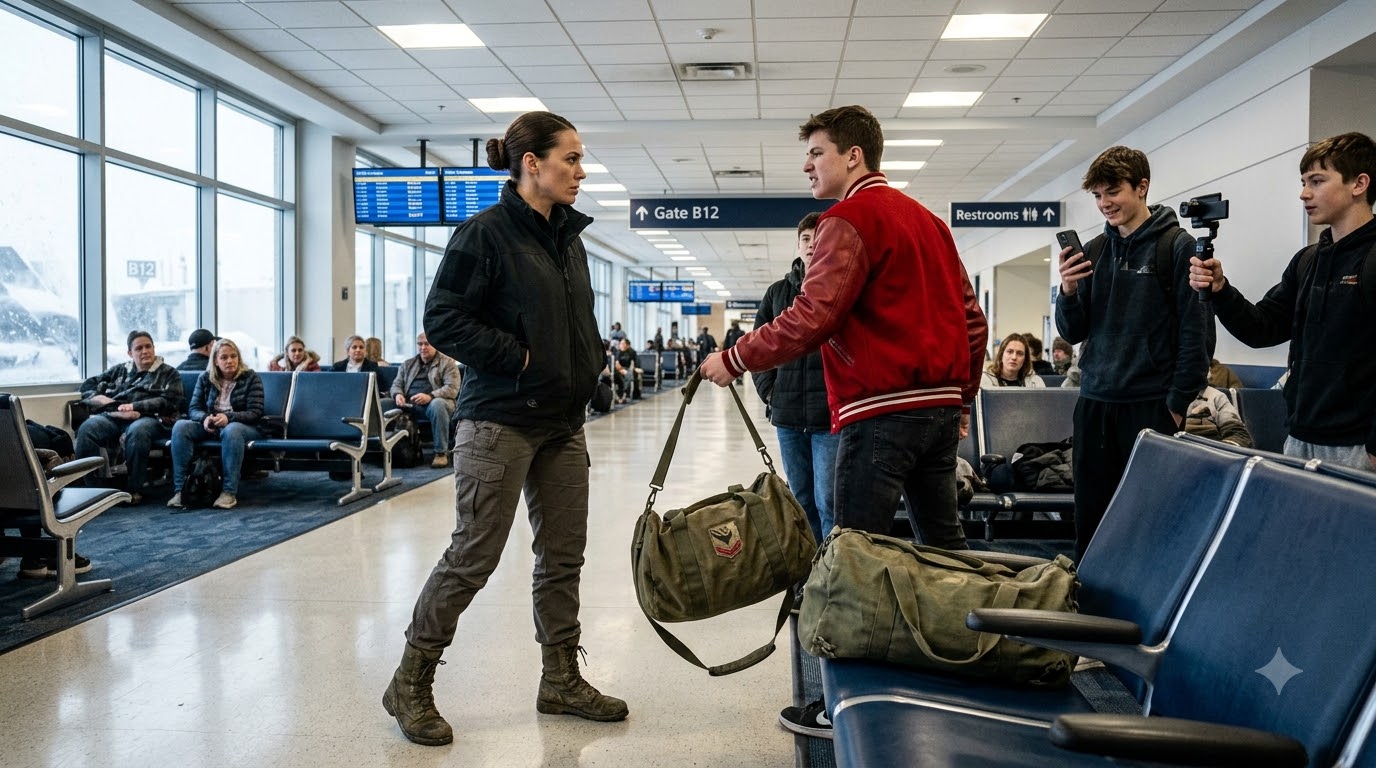
I kept my back against the support pillar, heels set shoulder-width apart, feeling the hard metal frame of my worn canvas duffel resting against my right calf. In my left coat pocket, my thumb slid mechanically across the cold, cross-hatched body of a silver Zippo lighter. Click-slide. Click-slide. Never striking the flint, just rolling the brass wheel under the pad of my thumb to keep my rhythm steady against the low hum of airport anxiety.
“Look at that thing,” a voice cut through the background static of holiday carols. It came from three feet to my right—a kid in a glossy crimson varsity jacket, his leather-sleeved arm nudging the girl beside him. “Looks like she pulled that bag straight out of a landfill. Ed smells like a damp basement from here.”
The girl tilted her phone up, her ringed fingers tapping rhythmically against the plastic case. She looked me up and down, letting her gaze linger on my scuffed work boots and the faded gray hoodie draped over my shoulders. “I swear she looks like someone who flunked out of basic training on day two,” she said, her voice rising just enough to capture the attention of the family waiting nearby. “Did she even try, or does she just wear the trash for aesthetic?”
The third kid, holding a small camera mounted on a folding handle, chuckled into his screen. “Total thrift-store operator. She probably practices saluting in her bathroom mirror for free coffee.”
I didn’t turn my head. I kept my eyes fixed on the gate counter, tracking the rhythm of the agent’s fingers as she hammered on her keyboard. Two seconds per entry. Frustrated posture. Her shoulders were jacked up toward her ears—she was three minutes away from locking the podium and calling security for crowd control.
“Hey, thrift store,” the varsity jacket kid said, stepping directly into my line of sight. He smelled like expensive cologne and sour energy drink. He pointed a finger toward the faded patch stitched near the zipper of my bag—a simple, subdued emblem worn down to gray threads. “What’s the discount on fake military gear these days? You buying that by the pound?”
My thumb stopped on the lighter wheel. I took a slow, measured breath through my nose, letting the cold air clear the stale scent of his cologne.
“The line moves forward when the agent calls the group,” I said softly, keeping my voice level, flat, and entirely devoid of heat. “You’re blocking the walkway.”
He grinned, looking back at his buddy with the camera as if he’d just won a prize. “Oh, look, it talks. And it thinks it’s in charge.”
CHAPTER 2: THE PHYSICAL BOUNDARY
“I asked you a question, thrift store,” the kid said, taking half a step closer. His breath smelled of artificial wintergreen and stale coffee. “That patch on your bag—my uncle was in the Army. He says people who wear those little subdued tags without a uniform are usually lying. So, which surplus bin did you dig it out of?”
I kept my chin level, letting my gaze rest on the small silver button on his collar rather than meeting his eyes. Engaging an angry dog only gives it something to bark at. “The bag stays where it is,” I said, my tone as flat as the concrete runway outside. “And you need to step back.”
“Or what?” The girl with the phone stepped up beside him, her screen glowing as she angled the lens down toward my feet. “What are you gonna do, call the fake military police? Look at her, Tyler—she’s practically shaking.”
I wasn’t shaking. My hands were perfectly still inside my pockets, the brass body of the Zippo absorbing the warmth of my palm. But my right calf could feel the stiff canvas of the duffel pressing back. Inside the front zippered compartment, tucked beneath a spare pair of wool socks, sat the thick manila envelope from the Department of Veterans Affairs, stamped with my medical discharge parameters and the casualty notification summary from a December night in the Hindu Kush that I spent ten years trying to forget. They saw an old bag. I held the weight of four men who didn’t make it to the chopper.
“She’s not gonna do anything,” the kid named Tyler said. He smirked, looking directly into his buddy’s camera. “Watch this. Real veterans carry themselves with pride. Frauds just freeze up when you call them out.”
He reached down. His fingers pinched the frayed nylon strap of my duffel, giving it a sharp, mocking tug that dragged the base an inch across the floor tile.
The sound of canvas scraping against dust was louder to me than the snow slamming into the terminal glass.
I didn’t yell. I didn’t reach for his hand. I simply took one step sideways, dropping my center of gravity two inches, and placed the heavy welt of my scuffed boot directly onto the tail end of the strap he was holding. The sudden resistance snapped his wrist downward, his grip slipping off the nylon with a loud thwack.
Tyler stumbled forward half a pace, his smirk instantly evaporating into a flash of shock.
“Do not touch my gear again,” I said, my voice dropping an octave into the low, quiet register I used when leading patrols through dark alleys in Ramadi. It wasn’t loud, but it cut straight through the chatter of the crowded gate.
A businessman sitting three seats away stopped typing on his laptop. An older couple across the aisle turned their heads, their eyes wide as they picked up on the abrupt shift in the air.
“Hey!” the camera kid yelled, shifting his footing. “You can’t do that! She just aggressive-assaulted him!”
“She stepped on a strap,” a weary voice called out from the seating area—a retired Air Force guy wearing a faded flight jacket. “Kid, leave the woman alone and sit down.”
Tyler’s face flushed a deep, angry crimson. His jaw worked silently as he looked from his camera buddy to the growing circle of watching eyes, his sense of unearned entitlement suddenly cornered by his own bad performance.
“You think you’re tough?” Tyler spat, his voice cracking slightly as he pointed a trembling finger at my chest. “You’re a fake! A pathetic, lying fraud trying to look like something you’re not for attention on Christmas Eve!”
I didn’t answer him. I just kept my boot firm on the strap, my hands resting inside my coat, watching his composure crack wide open.
CHAPTER 3: THE BROKEN MASK
“Is there anyone with medical training?”
The gate agent’s voice cut through the terminal speaker system, high-pitched and laced with panic. “We have a medical emergency in the Gate B12 seating area. Is there a medical professional present?”
A quiet ripple ran through the line as people turned away from Tyler’s red-faced tirade. Near the carpeted divide by the window, an elderly man in a dark woolen coat had slumped sideways against his wife’s shoulder, his eyes half-closed, his breathing coming in thin, rattling gasps. The woman held his hand between both of hers, her lips moving without making a sound as she looked around at the sea of blank faces.
Tyler blinked, his arm dropping an inch as the audience he’d worked so hard to cultivate suddenly dissolved. “Hey,” he muttered, trying to pull his camera friend back into frame. “We’re still filming here.”
I shifted my boot off the strap and stepped past him. I didn’t run. Running makes panicked crowds scatter; steady movement gives them an anchor.
“Hey, where do you think you’re going?” the girl called out, her phone trailing behind me. “You can’t just walk away after—”
I dropped my duffel to the floor tile next to the row of chairs, dropped to one knee, and placed two fingers firmly against the older man’s carotid artery. His skin was clammy, cold sweat sheen reflecting the overhead lights.
“Ma’am,” I said, keeping my voice steady, eyes scanning his chest rise. “Has he had any heart issues, or is he on blood thinners?”
“He—his heart, yes,” the wife stammered, her fingers trembling against mine. “He took his pill, but the flight delays… he hasn’t eaten since noon.”
“He’s in shock, his blood sugar crashed,” I said quietly, reaching out with one hand to tilt his chin up two degrees, clearing the soft passage of his throat. “Sir, can you hear me? Focus on my voice.”
The man gave a faint, raspy exhale, his eyelids fluttering open just enough to catch the light. I turned to the gate counter without standing up. “Agent. Get two orange juices from the lounge cart and call the terminal medics to confirm hypoglycemia. Tell them he’s conscious and airway is clear.”
The agent blinked, then sprinted toward the service cart behind the counter.
Behind me, the sound of rubber shoe soles stopped on the tile. Tyler and his camera friend stood three feet back, the lens pointed directly at my back.
“Look at her pretending,” the camera kid whispered, though the quiet of the terminal carried every word. “She’s just touching him to look like a hero for the camera.”
“She probably saw a video online once,” Tyler scoffed, trying to regain his footing, though his voice sounded thin against the heavy silence of the watching passengers. “She doesn’t know what she’s doing.”
I reached into my coat pocket, pulled out a small packet of glucose gel—something I’ve carried in my kit since a bad patrol in Helmand—and carefully tore the tab with my teeth. The old man swallowed it slowly as I supported the back of his neck, his breathing deepening within thirty seconds, the gray hue in his cheeks beginning to recede.
The retired Air Force veteran stepped over, standing like an iron wall between Tyler’s camera lens and the kneeling man. “Shut your mouth, kid,” he said in a low, gravelly tone, staring Tyler straight in the eyes. “She just saved that man from hitting the floor.”
Tyler opened his mouth to snap back, but the phone girl lowered her device by two inches, her eyes wide as she watched the old man sit up slowly with his wife’s help. The narrative they had built—the easy story of a fake veteran hiding behind an old bag—was fracturing right in front of twenty witnesses.
I wiped my thumb on my jeans, picked up my duffel, and stood back up, my frame blocking Tyler’s path back to the line.
CHAPTER 4: THE PRESSURE TRAP
“You think that makes you special?” Tyler took a step around the veteran, his jaw clenched so tight the tendons in his neck stood out like cords. “You hit a guy with some medical trick to make us look bad on camera. But you still haven’t proved where you got that patch.”
I turned my head slowly, looking past him to the kid holding the camera rig. The little red tally light on the side of his casing was blinking steady and bright.
“Federal Aviation Administration regulations,” I said, my voice low and dry as gravel, “prohibit recording passengers or airline personnel inside a secure gate area without explicit consent once a security directive is active.”
The camera kid’s thumb twitched over the handle control. He looked over at Tyler, his confidence flickering. “Wait, is that real?”
“She’s lying!” Tyler snapped, waving his arm dismissively. “She’s just making up rules because she knows we’re gonna put her face all over the internet. Show us what’s in the bag, thrift store. Show everyone the paperwork or admit you bought that tag off eBay.”
I unzipped the side pocket of my coat, pulled out my silver Zippo, and rested it flat across my knuckles. I didn’t open the cap. I just held it there—cold, solid steel sitting in the open palm of my hand.
“I don’t owe you my life story, kid,” I said quietly, watching his eyes drop to the lighter. “And I certainly don’t owe your audience a show. But if that lens stays hot for five more seconds, I won’t ask the gate agent to call airport security. I’ll ask the airline supervisor to review your boarding passes under the harassment and gate disturbance policy.”
The girl with the phone swallowed hard, her thumb instinctively tapping her screen to kill her recording app. “Tyler, come on… the agent is looking right at us.”
“Shut up!” Tyler shouted, turning on her with a sudden, desperate surge of volume that made three people in the nearest row jump out of their seats. “She’s bluffing! Look at her! She’s a nobody in a trashy hoodie trying to act tough!”
“Sir!” The gate agent slammed her palm down on the podium counter, the crack echoing off the frosted glass windows like a pistol shot. “That is enough! Stand back from that passenger right now!”
Tyler froze, his face turning from hot red to a pale, blotchy white as the entire terminal’s attention locked squarely on his shoulders. He didn’t back down. He squared his stance, his chest heaving, his fingers balling into fists at his sides as he prepared to push his stunt past the point of no return.
CHAPTER 5: THE PUBLIC COLLAPSE
“I want her removed!” Tyler pointed a shaky finger at my face, his voice rising in an unsteady pitch that cracked across the gate area. “She threatened us, she stepped on my hand, and she’s wearing military patches she didn’t earn! She’s a fraud!”
The gate agent stopped two feet away, her arms crossed tight across her navy blazer. “Sir, I have been watching this entire exchange on the terminal monitors since the delay started. You and your friends have been harassing this woman for forty-five minutes.”
“We were filming a public reaction!” Tyler shot back, his face blotchy with sweat as he grabbed his camera friend by the shoulder, dragging him forward. “Show her the footage, Mark! Show her how she acted!”
“Mark, don’t you dare,” the girl muttered, backing away into the row of empty seats, her phone already stashed deep in her pocket.
I didn’t move an inch. I slowly turned the Zippo over in my palm, slipped it back into my coat pocket, and unzipped the top main pocket of my duffel. Reaching inside, past the worn wool socks, my fingers closed around the edge of the stiff manila envelope.
“You wanted to see what’s in the bag, Tyler?” I asked quietly.
I pulled the envelope halfway out—just enough for the red Department of Veterans Affairs seal to catch the harsh halogen lighting, alongside the black-stenciled serial numbers and the bold red lettering across the top: OFFICIAL CASUALTY SUMMARY / MEDICAL SEPARATION RECORD.
The discolored seam along the duffel’s side, where dark iron stains had been scrubbed into faded gray threads, rested right beside the paper.
“This bag was sitting in the snow on a ridge outside Ghazni on December twenty-fourth,” I said, my voice cutting through the terminal noise without ever rising above a conversational tone. “The man who owned the patch gave it to me right before we loaded his litter onto the MEDEVAC bird. His name was Sergeant Miller. You want me to read his service record to your camera?”
Tyler stared at the red stamp on the envelope. His mouth opened, but no sound came out.
“Delete the video,” the camera kid whispered, his fingers scrambling desperately over the digital interface of his rig until the red recording light went dead. “Dude… delete it right now.”
“I… I didn’t…” Tyler stammered, stepping back a full pace as three surrounding passengers stood up from their seats, their faces set in hard, cold disgust. “We were just… it was just a joke for the channel…”
“Your boarding passes are canceled,” the gate agent said flatly, pulling her scanner from her belt. “Security is on their way to escort you back to the main terminal entrance. Step away from the gate.”
CHAPTER 6: THE QUIET DEPARTURE
“You can’t do this!” Tyler yelled, his voice cracking as the lead officer grabbed him by the elbow. “She manipulated the whole thing! I have rights! I’m gonna sue this airline!”
“Save it for the ground transportation curb, kid,” the officer said, turning Tyler around with a firm, practiced twist of his wrist and guiding him down the concourse toward the main security exit. His two friends followed in utter silence, their heads hanging low, completely stripped of their earlier swagger.
The gate area settled into a deep, peaceful quiet. The gate agent printed a fresh slip of paper, stepped around her counter, and handed it to me with both hands.
“Seat 2B,” she said, her voice soft and full of quiet respect. “First class, Staff Sergeant. It’s already taken care of. Have a safe flight home.”
“Thank you,” I said, sliding the paper into my coat pocket next to my Zippo.
I pushed the manila envelope back into the main compartment of my duffel, pulled the zipper shut, and lifted the bag onto my shoulder. The weight rested against my hip—neither light nor heavy, just familiar.
The jet bridge hummed under my boots as I walked down the carpeted ramp, leaving the noise of the terminal behind.
Inside the aircraft cabin, I sat down by the window, resting my head against the cool glass. Outside, snow drifted through the amber glare of the runway lights, soft and slow. I unzipped the side pocket of my duffel one last time, my fingers brushing the frayed thread of the unit patch before letting my hands rest quietly in my lap.
When the plane touched down two hours later, the snow had stopped.
I stepped off the jet bridge into the small, three-gate regional airport, the cold air smelling clean and sharp like pine needles. Through the glass doors leading to the baggage pickup area, an older man stood in a worn flannel jacket, leaning slightly against the metal railing. His hair was completely white now, but his eyes were sharp, scanning every face coming through the doors.
“Dad,” I said, stepping across the threshold.
He didn’t make a speech. He didn’t ask about the delays, the bag, or the years between us. He just stepped forward, wrapped his arms around my shoulders, and pulled me in close, his hands patting my back with steady, rhythmic strength.
“Porch light’s on, Em,” he murmured against my shoulder. “Let’s go home.”
I picked up my duffel, set my shoulder into the strap, and walked out into the cold night beside him.