The Professor’s Secret: How a Quiet Woman Broken by War Taught Untouchable Warriors the Ultimate Lesson
CHAPTER 1: THE CHALK AND THE MUD
The damp smell of dried sweat and Pacific saltwater hung heavy in the Coronado briefing room. Sixteen candidates shuffled through the doorway, their boots caked with black mud from the obstacle course, their faces drawn tight with exhaustion.
At the front desk stood a woman who looked like she had taken a wrong turn on her way to a university library.
Elaine Thorne adjusted her wire-rimmed glasses, her fingers light against the thin metal frame. She didn’t wear camouflage or heavy boots. She wore a tailored beige blouse, dark slacks, and a composure so still it made the room feel colder than the air conditioning justified.
In her left hand, a heavy, oxidized brass Zippo lighter clicked open and shut in a slow, rhythmic cadence. Flip. Snap. Flip. Snap.
A low chuckle rippled through the front row. Merrick Davenport, six-foot-four and broad enough to block the doorway single-handed, folded his arms over his chest. His uniform was stained with brine, his jaw set in a permanent sneer that had carried him to the top of every physical ranking on the base.
“Looks like the psych department sent a substitute,” Davenport muttered, not even troubling to lower his voice. “Wrong hall, ma’am. The library’s across the yard.”
Elaine didn’t look up from her papers. She set a piece of chalk on the wooden lip of the blackboard, the chalk clicking against the grain.
“Trainee Davenport,” she said. Her voice was flat, carrying no anger, no theatrical command—just the dry weight of an auditor reading a bad balance sheet. “Front of the room. Show me your team’s standard three-man breach.”
Davenport let out a short, nasal breath, stepping forward with deliberate, heavy strides that made the floorboards groan. He snapped his hands up, mimicking a shortened carbine, angling his hips to clear the imaginary doorway drawn on the concrete floor. His movements were swift, violent, and precise—the product of eight months of relentless physical repetition.
“Clear,” Davenport barked, stepping through the line with a smirk. “Textbook.”
Elaine picked up the white chalk. She didn’t touch Davenport. She walked past him, her soles making almost no sound, and drew three sharp Xs along the wall behind his lead shoulder.
“Textbook indeed,” she said softly. “Which means you just gave an insurgent in a third-floor window seven full seconds to place a three-round burst directly into your rear plate.”
Davenport’s smirk hardened into a tight line. “In the field, speed fixes geometry, ma’am. We hit hard enough that nobody’s looking out a third-floor window.”
“Speed doesn’t bend lead,” Elaine replied. She rolled the brass lighter across the knuckles of her left hand, the metal scraping softly against a pale, jagged scar that ran from her wrist up under her rolled sleeve. “In Fallujah, a team with your exact entry speed lost four men in eleven seconds because the team leader assumed strength was a substitute for angle management.”
Davenport stepped closer, his shadow completely swallowing the small desk where her notes lay. “With respect, lady, you get your numbers from books written by people who sleep in air-conditioned offices. Out there, bullets don’t care about your chalk.”
Elaine stopped the lighter cold under her thumb. She looked up, her gray eyes locking onto his with a stillness that didn’t shift an inch under his weight.
“Sit down, Trainee,” she said quietly. “Before you prove how easy you are to kill.”
CHAPTER 2: FRICTION IN THE DARK
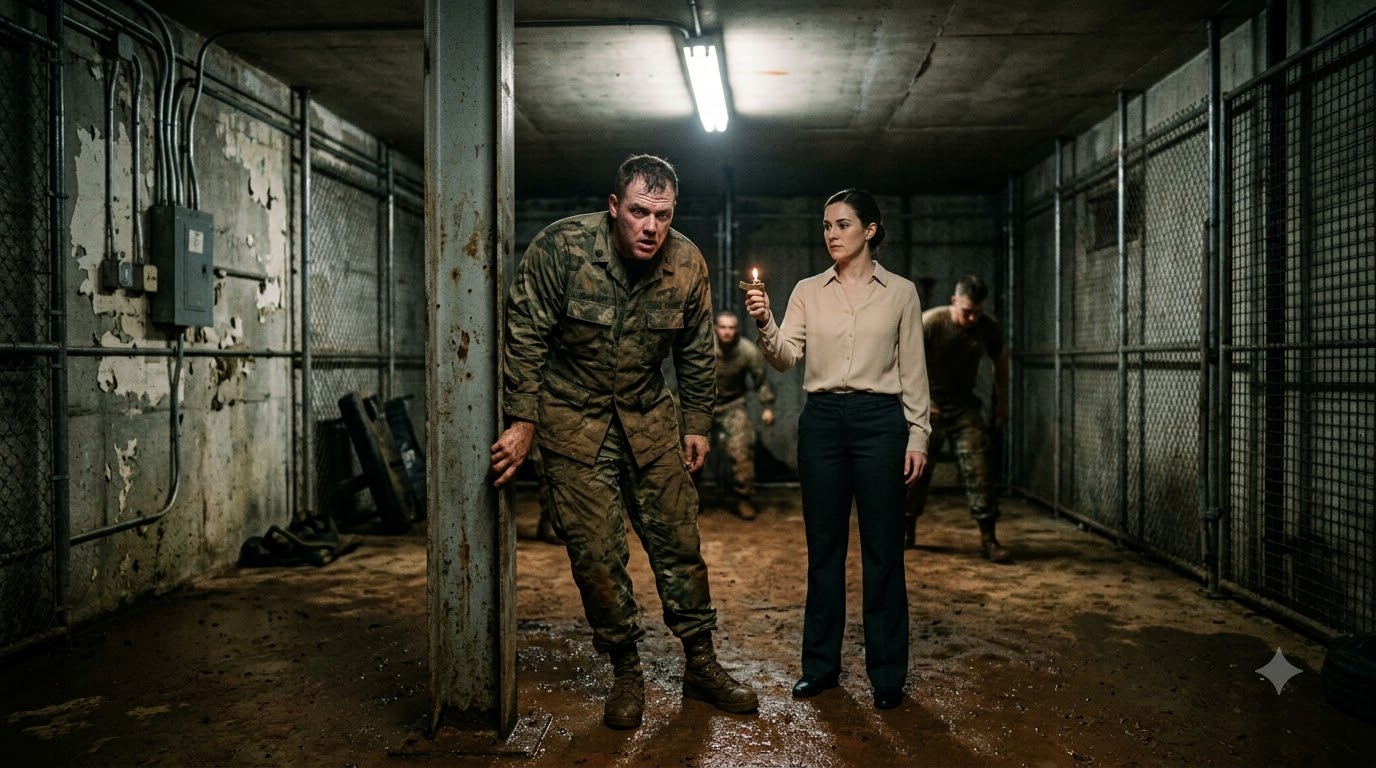
The basement training grid of Building 32 smelled of ozone, damp concrete, and the stale copper tang of men pushed past their limits.
There were no windows. The only light came from a single overhead strip that flickered with a faint, high-pitched hum that buzzed right behind the teeth.
Elaine stood near the control breaker at the back of the room. Her beige blouse was clean, her hair still pinned tightly in its low bun. She didn’t have a clipboard or a stopwatch. She just held the heavy brass Zippo in her left hand, her thumb moving over the worn metal casing with a dry, scraping sound.
In the center of the grid, Davenport and three of his team members stood in full loadout, minus their primary weapons. Their boots were slick with wet red clay from the morning’s four-mile sprint.
“This is a waste of a training block,” Davenport said. His voice echoed off the concrete, thick with a week’s worth of built-up frustration. “We’ve got dive qualifications in forty-eight hours. Sitting in a dark room playing mind games doesn’t build lung capacity.”
“Your lungs won’t matter if your brain shuts down the first time the room turns inside out,” Elaine said flatly.
She reached out and flipped the main breaker handle down.
The light died instantly. Darkness hit the room like a heavy wet blanket, thick and absolute.
Before Davenport could take a breath to speak, a high-decibel strobe pulse tore through the blackness—a blinding, white-hot flash that lasted less than a microsecond, immediately followed by the deafening, screeching feedback of a directional acoustic disrupter. The sound didn’t hit the ears; it rattled the jawbone, turning the inner ear into a swirling pool of nausea.
“Clear the threshold!” Davenport barked, his voice rising over the audio static.
A sharp thump echoed through the dark as one of the candidates slammed hard into a steel pillar, his heavy boots skidding across the wet floor.
“Hold the wall—hold the line!” Davenport yelled again, but his command was chopped apart by another blinding strobe flash.
In that microsecond of light, Elaine saw him. Davenport was leaning heavily against a vertical support beam, his hand clawing at the concrete, his eyes wide and unblinking as his equilibrium failed him. The sheer physical size that made him a force in the mud was now just extra weight dragging him toward the floor.
“You’re relying on your legs,” Elaine’s voice cut through the noise, coming from a corner of the room Davenport hadn’t expected. She wasn’t shouting. She moved through the pitch-black space without a flashlight, her soles whispering against the smooth concrete as if she had the layout burned into her retinas. “Your muscles are trying to fight a threat they can’t touch.”
“Turn the damn lights on,” Davenport growled, his breathing ragged. He took a blind step forward, his boot catching the edge of a rubber barrier, and hit the deck hard on his hands and knees. The impact cracked against the quiet.
“In Ramati, 2012, three men died in an alley because they tried to push through a visual disrupter instead of changing their axis,” Elaine said softly, her voice moving behind him now. “They were six-foot-two. They could bench three hundred pounds. The insurgents didn’t bother shooting them until they were already crawling.”
The strobe killed itself. The audio feed cut to dead silence.
The dark remained, heavy and suffocating. The only sound left in the room was the harsh, rattling gasp of four elite candidates struggling to find their balance on a flat floor.
Elaine flipped the brass lighter. The tiny yellow flame sparked to life, throwing soft, amber shadows across the concrete.
She stood three feet in front of Davenport. He was still on his knees, his massive hands planted in the dirt on the floor, sweat dripping off the tip of his nose and splashing onto his boot.
He stared up at her through the flickering yellow light, his jaw tight, his pride raw and bleeding in the dark.
“Physical strength is just a shell, Trainee,” Elaine said, clicking the lighter shut and plunging the room back into pitch black. “And yours just cracked.”
CHAPTER 3: THE BROKEN JOINT
The empty lecture hall was dead silent by six in the evening. Shadows stretched across the empty wooden desks, turned long and dark by the setting Pacific sun filtering through the high narrow windows.
Elaine sat at her desk, organizing three neat stacks of student evaluation forms. Her fingers worked methodically, aligning the edges until the paper lined up like cut timber.
The heavy oak door swung open with a harsh scrape.
Davenport blocked the doorway. He hadn’t washed the mud off his arms. His collar was torn, exposing the thick tendon in his neck vibrating with raw adrenaline. He didn’t step into the room like a student; he stalked inward like a man trying to claim back stolen ground.
“You’re done here, lady,” Davenport said. His voice was raspy, stripped raw from the afternoon’s dust. “I talked to the boys. Nobody’s signing your course log. We’re filing a formal petition for review at zero-eight-hundred.”
Elaine didn’t pause. She placed a paperclip over the first stack with a tiny metallic click.
“Your petition won’t clear the department desk before Friday, Trainee,” she said flatly.
“I don’t care about the desk,” Davenport growled, stepping past the front row of desks. His boots slammed against the floorboards, closing the distance between them until he towered over her seated frame. “You don’t belong in this compound. You’re an academic leech taking up hours we need for live-fire training. You’re putting my men at risk with soft civilian theory.”
Elaine picked up the brass Zippo resting beside her desk pad. She didn’t open it. She just held it flat in her right palm, her fingers closed tight around the cold metal casing.
“Your men are at risk because their team leader thinks six feet of height makes him immune to crossfire,” she said.
“Say that again,” Davenport barked, his jaw clenching so hard a pale knot bulged along his cheekbone. “Say it to my face.”
“You’re a liability, Davenport.”
The reaction was immediate. Davenport didn’t argue. His right hand shot out like a piston, his thick fingers locking around the collar of her blouse. He jerked her upward, pinning her back against the chalk-dusted blackboard. The wooden frame groaned under the sudden weight.
“This isn’t a lecture hall anymore,” Davenport snarled, his breath hot against her cheek. “This is real world. Down here, nobody gives a damn about your papers.”
Elaine didn’t gasp. She didn’t pull back against his grip. Her gray eyes stayed flat, tracking the micro-adjustments of his chest as he leaned his full two hundred and thirty pounds into her sternum.
“You’re overcommitted,” she whispered.
Before Davenport could process the words, her left hand snapped up, her knuckles striking the inside of his wrist with surgical accuracy. The nerve impulse forced his grip to open for a fraction of a second.
Elaine dropped two inches, slipping underneath his center of gravity. She grabbed his extended wrist with both hands, twisted her hips sharply into his side, and leveraged his momentum directly toward the desk edge.
Davenport’s boots lost traction on the polished floor. The world tilted sideways.
A heavy, sickening pop echoed through the silent room as his right shoulder joint over-rotated past its socket. Davenport let out a choked grunt as his massive frame crashed hard onto the floorboards, his arm trapped beneath his own weight, locked flat under her knee.
Elaine held the pressure steady. Her face remained entirely calm, her breathing barely altered. In her right hand, the brass lighter was still clenched tight, cold and unyielding against her palm.
Davenport gasped, his forehead pressed flat into the floorboards, sweat instantly soaking into the dry wood. He tried to drive his left elbow backward, but Elaine shifted her weight by an inch, sending a sharp spike of white-hot agony straight down his spine.
“Your strength didn’t save your posture,” Elaine said quietly into his ear. “And your anger just broke your joint.”
CHAPTER 4: THE GHOST OF KANDAHAR
Elaine released the lock. She didn’t hurry to her feet. She stood up smoothly, smoothing the front of her beige blouse before picking up her glasses from the edge of the desk.
On the floor, Davenport rolled onto his left side with a guttural groan, cradling his right arm against his ribs. His breathing came in shallow, ragged bursts. The fight had bled out of his posture, leaving only the raw, throbbing reality of a joint forced past its limit.
“The corpsman’s bay is down the hall,” Elaine said, her voice dropping into that quiet, auditing rhythm. “Tell them you slipped on wet clay during the night drill. If you report an assault, I won’t deny it—but the review board will want to know how a two-hundred-and-thirty-pound candidate got pinned by an unranked civilian.”
Davenport pushed himself up into a slouched sit against the baseboard, his face gray with shock. “You think… you think you proved something?” he rasped, his left hand clutching his injured shoulder. “You’re still just a ghost sitting in a chair. You don’t know what it costs out there.”
Elaine reached into her skirt pocket. She pulled out the heavy brass Zippo lighter and tossed it into the space between them.
The metal landed on the hardwood with a hollow clack, sliding three inches before coming to a stop against Davenport’s boot.
In the dim light, the casing looked plain—scratched, dull, its brass finish worn down to gray nickel along the corners. But on the flat side, deeply grooved into the metal, was a scrubbed serial number and a faint, stamped anchor.
Davenport stared at it. His breathing hit a sudden, hitching wall. His left hand drifted down, his fingers hovering over the cold metal before pulling back as if the casing were white-hot.
“Where… where did you get this?” Davenport whispered. His voice lost its rasp, stripping down to a thin, disbelieving murmur.
“Kandahar. 2012,” Elaine said flatly. “A three-man recce element got pinned in a dry creek bed outside Sangin. The lead chief had two six-inch structural tears in his vest plate. He had the muscle to carry his team leader ninety yards through open dirt, but he didn’t have the patience to wait for smoke cover.”
Davenport’s eyes didn’t leave the lighter. A single drop of sweat ran down his nose and hit the floorboards between his knees.
“Chief Garrett Davenport,” Elaine continued, her tone stripping away every layer of academic detachment. “Your father didn’t die because he was weak. He was stronger than five men in this compound. He died because he believed brute force could override a bad angle. I sat in the dirt next to him for four hours waiting for a bird that couldn’t land.”
The room went completely dead. The distant hum of the Pacific surf against the concrete seawall seemed to vanish, leaving only the sound of Davenport’s chest straining against his ribs.
Layer 1 was broken. The decoy idea that she was an outsider had dissolved completely, leaving the raw, bleeding truth of his family’s wreckage laid out on the floor between them.
“He carried that lighter in his left chest pocket,” Elaine said softly. “He gave it to me so I’d remember that muscle without calculation is just a slower way to die. I brought it here to make sure his son didn’t make the same mistake.”
Davenport reached out, his trembling fingers finally closing over the cold brass. He squeezed it flat against his palm, his head dropping forward until his forehead almost touched his knees.
“He always said… strength was the only thing that kept a team alive,” Davenport choked out, his voice muffled against his trousers.
“He was wrong,” Elaine said, turning back toward her desk to gather her papers. “And if you don’t learn that before graduation, you’re going to put six more men in the ground just like him.”
CHAPTER 5: THE CRUCIBLE DRILL
The rain started at midnight, turning the tidal flats behind Range 4 into a thick, clinging soup of black mud and decaying kelp.
Sixteen candidates stood in the deluge, their faces masked in greasepaint, their lungs burning from a six-hour continuous navigation problem. There were no instructors giving orders through megaphones. There was only Elaine, standing near the edge of the access road under a plain canvas tarp, her beige raincoat buttoned up to her chin.
She held no radio. No superior officer walked the line to validate her presence. She had only her clipboard and the cold, unyielding weight of common sense.
Davenport stood at the center of his element. His right arm was bound tight against his torso with a heavy tactical sling, locking his dislocated shoulder flat against his ribs. Every breath he took dragged a spike of sharp friction across his collarbone, but his eyes were clear, pinned entirely on the terrain map strapped to his wrist.
“Primary route is flooded,” Callaway reported, his voice shaking under the physical strain of carrying both his radio pack and Davenport’s secondary gear. “The culvert’s completely blocked by wash. If we force the crossing, we’re stuck in a bottle.”
Two days ago, Davenport would have barked an order to push through by sheer physical drive, driving his men into the mud until muscle gave out.
Now, he looked down at his left hand. His thumb pressed against the cold, rectangular outline of the brass Zippo tucked securely inside his inner pocket.
“No,” Davenport said. His voice was low, carrying over the roar of the rain without shouting. “The culvert’s an obvious choke. They want us to use brute force because it fails every time.”
He turned toward the steep, rocky ridge rising to the north—a sheer wall of loose granite and thick brush that every training manual explicitly tagged as impassable for a heavily loaded squad.
“We take the high wall,” Davenport ordered.
Callaway blinked, wiping a mixture of rain and greasepaint from his eyes. “We’ve got two guys down on gear load and your arm’s in a sling. We can’t climb that ridge with weight.”
“We don’t climb it with weight,” Davenport replied flatly. “We strip the packs, haul them up on a dead-line anchor using the spare winch cable, and move single-file along the blind crest. We adapt the gear to the terrain, not the other way around.”
From beneath the canvas tarp thirty yards away, Elaine watched the element pivot.
She didn’t offer praise. She didn’t adjust her posture. But as Davenport led his men up the mud-slick rocks—using his good left arm to set handholds while calculating every blind spot along the ridge—she slowly closed her notebook.
He wasn’t fighting the terrain with muscle anymore. He was using the friction to climb.
CHAPTER 6: SILENT HORIZON
The morning air smelled of wet pine and salt. The candidates assembled in formation outside Building 32, their uniforms clean, their posture straight.
There was no formal ceremony. No high-ranking officers lined up with medals or speeches. The course had never been listed on an official training syllabus, and it carried no ribbon.
Davenport stepped out from the lead file. His right arm was no longer in a sling, though he moved his shoulder with deliberate care. He walked down the gravel path toward the small sedan parked under the oak trees.
Elaine was loading a single cardboard file box into the trunk of her car. She wore her beige blouse and wire-rimmed glasses, looking once again like an academic packing up after a temporary semester.
Davenport stopped three feet from her. He reached into his pocket and pulled out the brass Zippo lighter. He held it in his palm, the worn metal catching the morning sun.
“You left this on the desk,” Davenport said.
Elaine looked at the lighter, then met his eyes. “It belonged to a Chief who thought muscle was enough. It belongs to a leader who knows better.”
Davenport’s hand closed around the casing. He didn’t offer a dramatic speech or a stylized salute. He simply gave a firm, single nod of his head—a gesture carrying the quiet weight of a lesson bought with blood and paid for in discipline.
“We move out for deployment next month,” Davenport said.
“I know,” Elaine replied softly. “Manage your angles, Trainee.”
Davenport turned and walked back toward his team. His men didn’t whisper or smirk as he returned to the formation. They fell into line behind him, moving together as an adaptable unit that understood the difference between pride and survival.
Elaine closed the trunk of her car. The latch clicked shut with a solid, definitive sound. She got into the driver’s seat, started the engine, and turned down the access road toward the main gate, leaving the compound behind in quiet, unbroken stillness.