The Frozen Ridge Where a Twenty-Dollar Scrap of Stamped Steel Stood Between Life and Total Destruction
CHAPTER 1: THE FROZEN FOXHOLE
Sergeant Michael Molly scraped a frozen fingernail down the receiver of his $200 Thompson submachine gun, lifting a sliver of dark, greasy clay.
The bolt did not glide. It grated against the internal channel with a harsh, metallic stutter that promised a catastrophic jam the moment a target appeared.
Across the skeletal pine trunks of the Hurtgen Forest, the rhythmic, high-speed rip of German MP40s tore through the freezing rain like a shredder through cloth.
Molly pressed the polished walnut stock tighter against his chest, trying to preserve the faint warmth of his own body heat inside the canvas wrap.
It was a useless ritual repeated for three nights straight, treating a precision-machined heirloom like a fragile, dying child.
The wind cut straight through his wool coat, and the gray sleet turned the bottom of the trench into a sluggish swamp that sucked endlessly at his boots.
A heavy artillery shell impacted fifty yards down the ridge, showering the foxhole in jagged splinters of frozen pine and a blinding spray of wet earth.
Molly yanked the charging handle back; it immediately froze half-an-inch short of the sear, caught on a single microscopic grain of sand.
Out in the blinding gray mist, the distinct mechanical chatter of an enemy patrol crept closer through the brush, and the weapon in his hands hardened into an eleven-pound club.
CHAPTER 2: THE PLUMBERS CRATE
The heavy rattle of a supply truck engine groaned through the thick fog, its tires churning the muddy track into a frothing soup before stalling twenty feet from the command post.
Supply Sergeant Miller hopped down from the running board, his boots splashing into the ice-cold mire with an audible squelch.
He didn’t bother offering a cheerful greeting or asking how the men were holding up against the freezing rain and the distant, rhythmic pounding of German artillery.
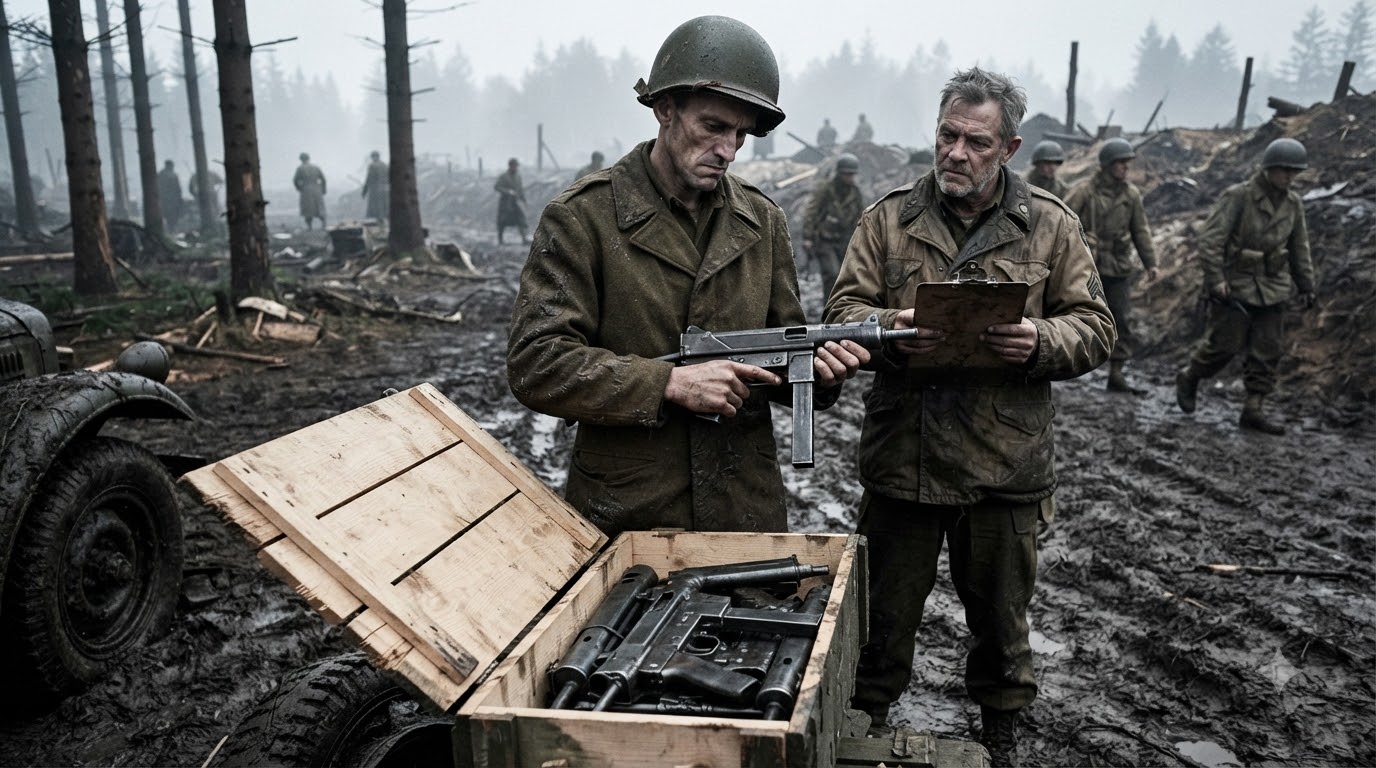
Instead, he jammed a rusted crowbar beneath the wooden lid of a long, unpainted packing crate and heaved upward with a sharp grunt of strain.
The nailed slats tore away with a dry screech, releasing the heavy, stagnant smell of machine oil and raw industrial steel into the damp air.
Sergeant Michael Molly trudged through the mud, his boots heavy with frozen clay, hoping against hope for dry wool socks or fresh ammunition clips for his struggling Thompson.
He peered over the edge of the crate and stopped dead, his breath pluming into white clouds against the gray backdrop of the Hurtgen Forest.
Rows of raw, gray metal tubes stared back at him, devoid of any woodwork, polished finishes, or refined sights.
They looked less like military hardware and more like spare sections of industrial plumbing or discarded parts from an automotive assembly line.
A crude welding seam ran jaggedly down the length of each receiver, naked and unpolished, exposing the raw, unadorned nature of mass production.
“What in the world is this junk?” Molly demanded, his voice flat with disbelief as he reached down and lifted one of the heavy steel cylinders.
It rattled violently in his grip, a loose, clanking vibration that sounded like a box of loose bolts shaking inside a tin can.
“M3 submachine gun,” the supply sergeant muttered, checking a grease-stained manifest clipped to his clipboard without looking up.
“Made by the Guide Lamp division of General Motors out in Detroit. The folks who make headlights.”
A heavy, stunned silence settled over the surrounding paratroopers as the grim reality of the delivery sank deep into their tired bones.
Down the line, a young private burst out into a harsh, bitter laugh that cut short into a cough against the freezing wind.
“Headlights?” the private scoffed, staring down at the crude metal tube with open disgust. “They’re handing us spare parts from a radiator shop while the Germans have MP40s.”
Molly turned the gray tube over in his bare, numb hands, searching for a charging handle or a safety lever that wasn’t just a stamped piece of sheet metal.
Instead of a traditional bolt handle, he found only a small, jagged hole cut directly into the side of the cylindrical bolt casing.
“You stick your finger right in that hole and pull it back,” the supply sergeant said indifferently, turning back toward his truck to pry open another crate.
Molly stared at the hole, a cold knot tightening in his stomach as he realized the entire weapon was built with deliberate, visible gaps between every moving part.
The men crowded closer, casting mournful glances at their carefully wiped, jammed-up Thompsons leaning uselessly against the frozen dirt of the trench walls.
“They call it a grease gun,” someone muttered down the line, a bitter edge of betrayal sharpening every syllable of the nickname.
Molly didn’t laugh, but his jaw tightened into a rigid, aching line as he weighed the heavy, rattling iron against the freezing mud around his boots.
The army hadn’t sent them an upgrade; they had sent them a disposable tool, and the realization tasted like cold iron and dry dust.
Out in the gray distance, an enemy patrol opened fire with crisp, rhythmic bursts, reminding every man in the trench that their beautiful, expensive heirlooms were already dead.
Molly dragged the crude metal tube back toward his foxhole, his fingers scraping against the rough welding seams as the first flakes of heavy winter snow began to fall.
CHAPTER 3: THE TRACTOR RHYTHM
Sergeant Michael Molly dropped a row of empty ration cans against the base of a blasted stone wall, his shoulders aching from the damp cold.
Private Miller leaned against a tree stump, cycling the heavy bolt of his newly issued gray tube with an expression of deep, unconvinced skepticism.
“Sounds like an old tractor about to throw a rod,” Miller muttered, hefting the weapon by its bent wire stock.
“Just pull the trigger and watch the targets,” Molly replied, his breath pluming white as he raised the crude steel receiver to his shoulder.
With a traditional Thompson, pulling the trigger meant an immediate, blinding wall of noise and a fierce, vertical climb that fought the shooter every inch.
When Molly squeezed the flat steel blade of the M3, nothing happened for a distinct, agonizing fraction of a second before the heavy internal bolt slammed forward.
The sound was not an angry buzz, but an industrial, deliberate thunk that echoed slowly across the desolate snow-covered field.
It cycled at four hundred and fifty rounds per minute, a heavy, measured cadence that felt almost lazy against the frantic tempo of standard infantry weapons.
The muzzle did not jump toward the gray sky; because the straight-line stock sat directly behind the barrel, the recoil pushed straight back into his shoulder.
Molly watched through the crude peephole as the empty ration cans danced and fell in a tight, concentrated cluster no larger than a dinner plate.
“Look at that grouping,” Molly said, lowering the smoking barrel and wiping a fleck of grease from the ejection port with his thumb.
“It doesn’t climb because it doesn’t rush,” Miller observed, a slow realization dawning in his eyes as he watched the bullet holes neatly centered in the tin.
The slow rate of fire wasn’t a manufacturing defect or a cheap shortcut; it was a mechanical anchor designed for cold, shaking hands.
A thirty-round magazine lasted twice as long, allowing a frightened soldier to walk fire onto a target without burning through ammunition in two frantic seconds.
Molly realized that the laziness of the machine was its greatest asset, turning an ugly piece of stamped steel into a controllable, steady stream of power.
They weren’t holding a luxury heirloom anymore; they were holding an industrial tool that rewarded patience and punished panic.
Down the line, other squad members began firing test rounds into the snowbank, listening to the slow, heavy rhythm echoing through the pine trees.
The initial mockery started to fade, replaced by a quiet, calculating focus as the men understood the physics of what they had been given.
Molly looked down at the rough welding seam along the receiver, feeling the dense weight of the heavy steel bolt shifting inside the housing.
“Pack it up,” Molly said, turning back toward the trench as a cold gust of wind swept across the ridge. “We’re done testing.”
CHAPTER 4: THE SLUDGE EXPERIMENT
The freezing rain turned into a thick, adhesive sleet that coated the Hurtgen Forest in a layer of treacherous gray armor.
Sergeant Michael Molly walked back to his position carrying a rusted tin can filled with heavy motor oil scavenged from a stalled transport truck.
He didn’t bother wiping down the mud caking the exterior of his weapon or clearing the grit packed tightly around the wire stock hinges.
“Watch this,” Molly said, gesturing for Private Miller to step closer as he unscrewed the rusted cap of the oil container.
Without hesitation, he poured the dark, viscous fluid directly into the open ejection port of the M3, flooding the internal mechanism with sludge.
Thick black grease mixed with fine forest dirt, creating a disgusting slurry that oozed sluggishly down the sides of the stamped steel bolt.
Miller winced, stepping back as if the weapon were about to explode in their faces.
“You just drowned the action in filth, Sarge,” Miller warned, his eyes wide with disbelief. “That thing’s going to seize up solid on the very first pull.”
Molly didn’t answer. He simply reached back, hooked his finger into the bolt hole, and hauled the heavy slide hard against the grinding resistance.
Metal scraped violently against grit, producing an ugly, protesting screech that sounded like a shovel dragging across gravel.
He pointed the muzzle toward a thick pine stump forty feet away and yanked the trigger straight back without a second thought.
The heavy bolt slammed forward with its characteristic industrial thud, crushing the grit and sludge out of its path with sheer mechanical mass.
The gray tube roared to life, coughing out a steady, rhythmic stream of heavy lead that chewed deep splinters out of the frozen wood.
It didn’t jam. It didn’t stutter. The loose tolerances engineered by the factory floor left nowhere for the contamination to wedge itself tight.
“The tolerances are too wide for the dirt to stop it,” Molly said over the steady chugging cadence of the weapon.
“A precision instrument dies in this mud, but a tractor just keeps on running.”
Miller stared at the smoking ejection port, watching fresh oil bubble through the grime as the heat of sustained fire melted the freezing sludge.
The last argument against the plumbing supply vanished right then and there into the damp, freezing air of the forest.
They couldn’t clean them properly, and they didn’t have the tools to save them, but they didn’t need to anymore.
Molly closed the metal ejection port flap with a sharp click, locking the weapon safe as a fresh wave of wind shook the skeletal pine branches above.
“Load your spare mags,” Molly ordered, his voice dropping into a flat, hard register. “Something’s moving out in that fog.”
CHAPTER 5: THE BULGE BREAKTHROUGH
The ground beneath the foxholes began to vibrate with a low, bone-deep rumble that tore through the quiet air before any sound reached the ears.
The eastern horizon flared into a continuous, blinding sheet of orange fire as the greatest artillery barrage of the winter front slammed across the line.
Out of the boiling wall of white smoke and flying snow, massive silhouettes of white-painted armor ground forward through the shattered pine trunks.
King Tiger tanks rolled directly over the frozen earth, their seventy-ton tracks crushing everything in their path while enemy infantry swarmed behind them.
Elite SS Panzer Grenadiers emerged from the freezing mist, advancing with absolute discipline and firing assault weapons at chest height.
Platoon leader Lieutenant Vance ran down the trench line, his face drained of all color as he screamed warnings over the deafening roar of explosions.
“They’re coming straight up the center—hold until armor can get here!” Vance yelled, his boots slipping in the wet slush of the trench.
Sergeant Michael Molly looked down at his squad, watching young Private Miller shake so violently that his steel helmet clattered against his coat collar.
Molly jammed a fresh magazine into his crude steel receiver, flipping the ejection port open with a quick swipe of his thumb.
“Listen to me!” Molly shouted, his voice cutting through the rising tide of mechanical thunder.
“They have better tanks and fancy rifles—but they don’t have this trash!”
He slammed a palm against the side of the weapon, feeling the gritty, oiled slide settle into place without a single hint of hesitation.
“When they get close, you don’t aim—you just hold that trigger down and let the tractor eat!”
A wave of gray-clad soldiers surged across the open field at a hundred yards, expecting a disorganized, terrified rabble to break instantly on contact.
Molly waited, his fingers locked onto the rough wire stock, letting the enemy close the distance until the cold condensation of their breath became visible.
He squeezed the flat steel trigger.
The heavy internal bolt slammed forward with its heavy industrial thud, sending a thick, controllable stream of heavy caliber slugs straight into the lead advance.
The first enemy soldier took the impact squarely in the chest, stopping dead and dropping backward into the snow from the sheer weight of the slug.
Molly swept the muzzle slightly to the right without releasing pressure, steering the slow cycle rate the way a gardener directs a steady stream of water.
Around him, a dozen M3 grease guns opened fire simultaneously, creating an unyielding, rhythmic chorus that sounded like an assembly line operating at full shift.
The German infantrymen paused in confusion, waiting for the traditional American firing pauses to exploit, but the pauses never arrived.
The relentless, unbroken cadence of the heavy bolts kept chewing through the snow, pinning the elite attackers behind logs and cratered earth.
“Keep feeding it!” Molly roared over the noise, slapping another magazine home as his thumbs ached against the raw spring tension.
The high-technology enemy rifles across the field began to stutter and seize as the freezing cold turned their fine lubrication into sticky paste.
Meanwhile, the simple, wide-tolerance plumbing supplies grew hotter with every burst, melting the internal ice and firing smoother the harder they were worked.
Miller fired from the hip, keeping his weapon tucked low as an enemy soldier leaped toward their trench line.
The heavy lead slug struck true, dropping the attacker before his boots could touch the frozen dirt of the parapet.
The enemy infantry screen dissolved into chaos, stripped of coordination as the supporting tanks were left blind and vulnerable to waiting anti-tank teams.
Molly kept his finger locked on the trigger, watching the gray wave break and scatter back toward the safety of the smoking tree line.
CHAPTER 6: THE IRON VINDICATION
The smoke drifted slowly across the white snowfields, hanging low above the scorched hulks of the broken armored columns.
Sergeant Michael Molly lowered his heavy gray tube, his right hand trembling slightly from the raw physical toll of sustained firing in the freezing cold.
Private Miller walked over, his boots crunching against the icy crust, holding his dented weapon loosely by the bent wire stock.
“I think I burned the barrel right out of this thing,” Miller muttered, running a soot-stained thumb across the scorched metal housing.
“I put ten magazines through it without stopping once.”
Molly took the weapon from the young private, rattling the loose bolt back and forth against the wide internal tolerances.
It moved with the same sloppy, unrefined freedom it had possessed on the day it arrived in the plumber’s crate.
“It’s fine, kid,” Molly said, handing the ugly iron tool back with a quiet, hard-earned nod.
“It’s just broken in.”
Down the line, clean jeeps rolled up through the slush carrying rear-area officers in immaculate, unblemished coats and pristine gear.
They stared in open disbelief at the massive wall of spent brass cartridge casings carpeting the snow around the shallow foxholes.
They looked at the smoldering wreckage of the elite assault forces and scratched their heads, trying to reconcile the mathematics of war with reality.
“How did a ragged line holding plumbing parts stop a panzer division?” an officer demanded, stepping carefully around a frozen ruts.
Molly did not offer a grand tactical briefing or salute their polished uniforms; he simply pointed a calloused finger down at the sandbag.
Resting quietly on the rough burlap was a twenty-dollar stamp-steel tube, its finish blistered, its metal scratched, and its receiver caked in hardened mud.
The reputation of the grease gun flipped right there in the frozen mud, transforming overnight from a despised joke into an immortal legend.
The tankers who had sneered at it two weeks earlier were now trying to trade anything they had to get their hands on a spare.
Because when the interior of a tracked vehicle is burning and every second counts, a long, elegant rifle is nothing more than a death trap.
You need a short, brutal hose you can grab with one hand, a tool that does not care about dirt, oil, or sub-zero winters.
Decades later, long after the confetti parades of victory had faded and the gray tubes had outlasted generations of high-tech replacements in Korea and the jungle, the lesson remained.
Molly sat on his front porch years afterward, his rough hands resting quietly in his lap as he watched the evening shadows stretch across the grass.
He didn’t mount a shiny medal on the wall, and he didn’t keep a clean heirloom in a glass display case to impress visitors.
His legacy was simpler, forged in the frozen misery of the forest where beauty meant nothing and survival meant everything.
You don’t judge a tool by how it looks on a showroom floor or how neatly its parts fit together in a warm room.
You judge it by whether it fires when you pull the trigger, right when the world is ending around you in the mud.
The ugly duckling of the American arsenal proved that mass production and honest engineering possess a quality all their own.
When the frost settles and the high technology fails, the simple, unyielding truth of the common-sense tool is the only friend left standing.