Cold Steel and Quiet Mathematics: How an Outgunned American Crew Rewrote the Rules of Armored Warfare
CHAPTER 1: THE FROSTCOVERED RIDGE
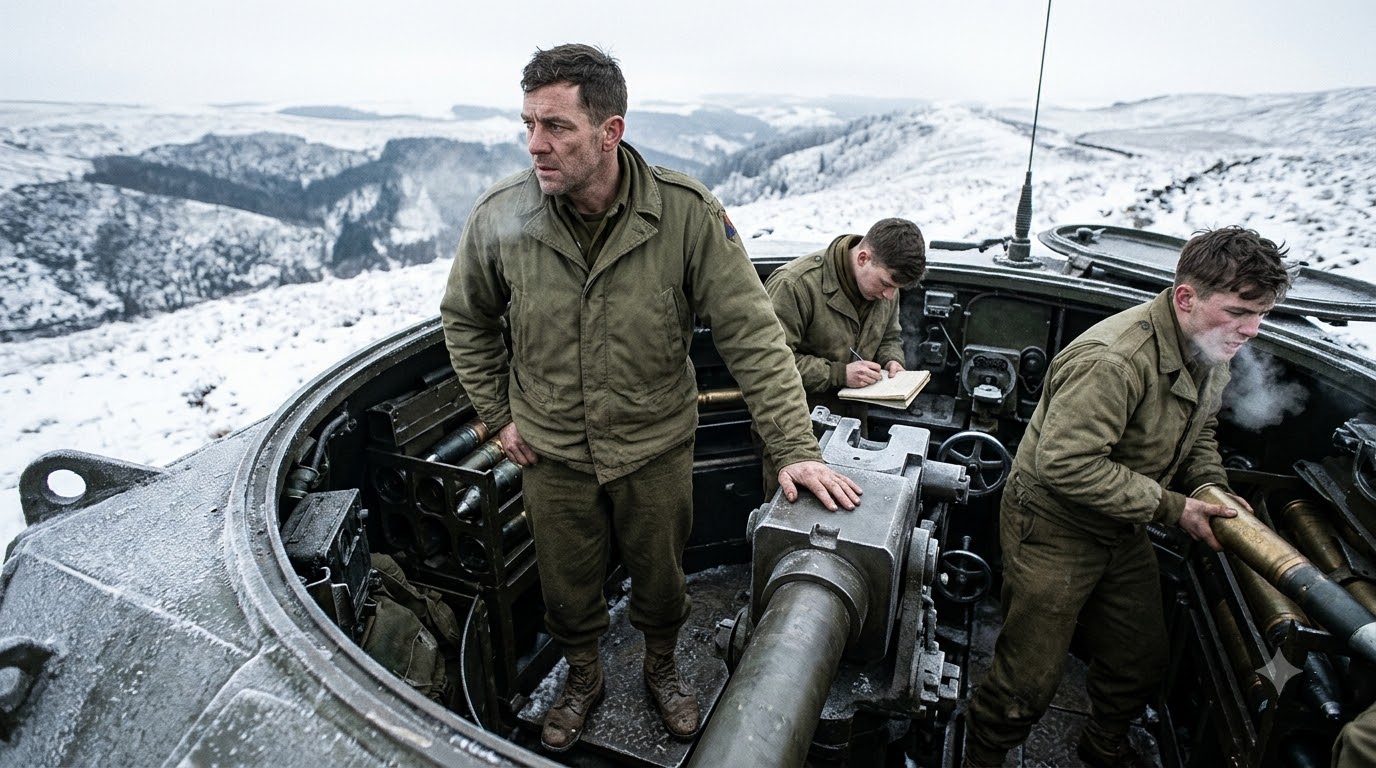
The periscope lens was crusted with overnight rime, requiring a slow, deliberate scrape of a gloved fingernail to clear the glass. Sergeant David Morrison kept his breathing shallow, watching the heavy vapor curl away into the frozen air of the Ardennes. Beneath them, nearly seventy tons of German engineering idled in the valley, its low growl vibrating right through the thin steel floor of the M36 Jackson.
Corporal James Parker sat hunched over his lap, the pages of his battered notebook fluttering slightly in the draft sweeping through the open-topped turret. His pencil moved with mechanical precision, marking windage adjustments and temperature gradients against the margin. Beside him, nineteen-year-old Tommy Walsh struggled to wedge a forty-three-pound high-velocity round into the ammunition rack, his fingers stiff from the bitter cold.
“Range is holding at twenty-eight hundred yards,” Parker murmured, his eyes locked on the crosshairs of the gunsight.
The enemy commanders believed their frontal armor rendered them completely untouchable at standard combat distances. They had no reason to suspect an adversary hidden miles away in the grey morning haze. Morrison rested his hand against the cold breach of the ninety-millimeter cannon, feeling the dead weight of their tactical disadvantage. They had no thick plates to absorb a counter-strike, only distance and the unforgiving math of survival.
The lead King Tiger’s long barrel slowly elevated, shifting its aim downward toward a small farmhouse draped with a white civilian flag. Morrison did not wait for a command that would arrive too late. He tapped Parker’s shoulder sharply.
“Make it count, Jimmy.”
Parker’s thumb rested lightly on the firing trigger, his expression entirely drained of fear, replaced by the cold focus of a mechanic solving an impossible engine failure. The ninety-millimeter gun kicked backward hard against the recoil buffers, shattering the quiet morning with a sharp, high-pitched crack that rolled across the snow-draped hills.
CHAPTER 2: THE IMPOSSIBLE DISTANCE
Morrison didn’t waste a second celebrating the hit on the distant ridge. The target below was shifting, its massive eighty-millimeter barrel desperately traversing to find an invisible vector.
“They’re scanning the valley blind, Jimmy,” Morrison muttered, wiping soot from his eyes. “Give them another before they guess our elevation.”
Parker’s hands moved over the handwheels with mechanical coldness, his eyes locked onto the optical sights. A strange anomaly flickered in the corner of his vision—a small, grease-stained corner of Bobby’s faded photograph tucked beneath the rubber eyecup, fluttering every time the wind whipped through the turret.
“Wind’s shifting right,” Parker said, his voice dropping an octave as he calculated the drift. “Eleven miles per hour. Target is reversing backward into the gully.”
Walsh heaved another heavy projectile into the breach with a sharp metallic clatter, his breath frosting instantly against the cold brass.
“Loaded!” Walsh shouted, pressing his back against the hull plates to clear the recoil path.
Parker didn’t hesitate. He pulled the lanyard, and the gun barked a sharp, angry protest that rattled their teeth. Across the frozen expanse, the second shell found its mark with brutal, unrelenting precision.
CHAPTER 3: THE SECONDARY PUSH
Dirt and frozen crust rained down over the open-topped compartment, pelting the casing of Parker’s ballistic notebook with a rhythmic clatter.
For a brief, jarring second, the sensory shock of the blast triggered an intrusive memory of a burning fuel truck back at the depot—the blinding wall of orange heat and the helpless shouting.
Parker blinked hard, shaking the phantom echo from his mind, and shoved his thumb back down against the rubber eyecup to refocus his crosshairs.
“They’re walking their fire closer to our coordinates,” Morrison barked, wiping grit from his eyelashes. “Shift position twenty yards down the trench line before they zero in.”
Walsh didn’t wait for a second prompt, his boots slipping slightly on the frosted mud as he muscled another forty-three-pound projectile out of the rack.
“Moving now—” Walsh strained, his shoulder hitting the bulkhead as the vehicle lurched forward in a sharp, grinding slide.
Across the valley floor, the German armored column was throwing up thick plumes of grey exhaust as they scrambled in frantic, uncoordinated directions.
They had expected an easy sweep against entrenched infantry, not an invisible ghost striking from miles away with absolute mathematical certainty.
CHAPTER 4: THE CHRISTMAS EVE STAND
Ice crunched beneath the heavy steel tracks, settling the tank with a solid, jarring thump that sent a shiver through the chassis.
Parker did not waste a second looking up from his range cards, his thumb tracing the worn edges of the paper where the numbers were scribbled in lead pencil.
“Crossroads traffic is bunching up down by the valley floor,” Parker stated, his voice flat and steady. “Heavy armor flanked by infantry screens. They’re moving cautious today.”
Morrison leaned over the armor rim, scanning the grey expanse through his binoculars.
“They learned our trick from the other day,” Morrison muttered, wiping a smear of frost off the lens. “They’re not giving us a straight vertical line without an escort.”
Walsh planted his boots firmly against the ribbed metal floor, sliding a fresh forty-three-pound projectile from the rack with a practiced heave.
“Let them bring their escorts,” Walsh breathed, the muscles in his forearms tightening under the strain of the heavy brass casing. “Distance doesn’t care how many infantrymen are walking beside them.”
Parker adjusted the elevation wheel by a fraction of a millimeter, his eyes locked on the crosshairs.
“Range is twenty-seven hundred yards,” Parker whispered. “Wind is quartering right at twelve miles per hour.”
CHAPTER 5: THE MARGIN OF ERROR
A thin layer of ice crusted the edge of the optical sight, blurring the distant silhouette of the enemy barricade blocking the main pass.
“They’ve doubled up the anti-tank detachments in the draw,” Morrison warned, squinting through his binoculars against the biting glare of the snowfield. “If we miss this opening, there won’t be a second pass.”
Parker adjusted his spectacles with a freezing fingertip, his eyes darting across the worn columns of his notebook.
“Range is twenty-nine hundred yards,” Parker muttered, his voice dropping into a tight, rhythmic cadence. “Wind shear off the gully is throwing twelve knots left.”
Bennett jammed the heavy brass casing home with a harsh metallic clang, stepping back instantly clear of the recoil path.
“Loaded and locked—” Bennett grunted, his breath pluming white against the breech block.
The heavy turret groaned on its mount as Parker cranked the elevation wheel upward, fighting the frozen grease in the gears.
“Hold steady, Jimmy,” Morrison murmured, his thumb resting near the electrical contact. “Make the math speak.”
CHAPTER 6: THE QUIET GARAGE
Months later, the heavy scent of motor oil and hot exhaust replaced the biting frost of the Ardennes, grounding them firmly in the quiet routine of the Cleveland workshop.
Morrison wiped his grease-stained hands on a rag, looking across the workbench where Parker carefully slid a worn photograph back into the lining of his leather wallet.
“Customer’s waiting on the sedan, Jimmy,” Morrison said softly, his voice carrying the calm cadence of an ordinary working-class life.
Parker nodded, latching his toolbox with a sharp metallic snap that echoed against the concrete floor.
“Coming right up, Sarge,” Parker replied, trading his old slide rule for a standard wrench without a moment’s hesitation.
Walsh stepped through the front doorway, carrying a fresh ledger under his arm and smiling as the afternoon sun cut through the open bay doors.
They had carried the heavy mathematical weight of survival across a brutal winter, but the ledger was finally balanced and the quiet ordinary work had returned.