The Weight of a Single Word: How a Humbled Teacher Built an Unshakable Life Beyond the Country Club
CHAPTER 1: The Quiet Kitchen Table
The old wooden tabletop bore the faint rings of spilled coffee and the deep, permanent scars of a household that actually lived.
Marcus stood by the sink, his broad shoulders squared against the fading evening light, rinsing a ceramic mug with slow, deliberate motions.
At the end of the counter, Lily muttered under her breath, her tongue tucked between her teeth as she wrestled a stubborn multiplication worksheet into submission.
My phone rested between us, face up, glowing with a message I had not asked to receive.
“Victoria called the school today,” Marcus said without turning around, the water running over porcelain with a steady, muted hiss. “Asked if the family section for next month’s ceremony was already reserved.”
I didn’t answer right away.
I picked up the cold mug, letting the rough clay ground the sudden, familiar tightening in my chest.
Four years of absolute silence—four years of building a life out of lesson plans, soil, and small hands holding mine—undone by a single newspaper headline about a superintendent promotion.
“She didn’t ask how I was,” I said, my voice flat, carrying the dry exasperation of a teacher dealing with a child who refused to read the syllabus. “She asked about seating.”
“They don’t know how to do anything else,” Marcus replied, setting the mug down with a dull thud. “To them, an achievement isn’t something you earn. It’s a prop for the mantelpiece.”
He walked over, his heavy boots muffled by the braided rug, and placed a warm, soil-roughened hand on my shoulder.
There were no grand speeches, no dramatic declarations of war.
Just the solid weight of a man who had stood beside me through every early morning and late night without ever asking me to shrink myself.
I looked down at the phone screen, at the clean white letters of Victoria’s forwarded text from the family group.
They were coming.
Not to apologize, not to mend what they had shattered, but to collect a trophy they had explicitly forbidden me from sharing.
“Let them come,” I murmured, my thumb tracing the edge of the ceramic rim. “For four years, I let their absence define the silence. It’s time they learned what a real boundary sounds like.”
Marcus gave my shoulder a firm, grounding squeeze, then turned back to help Lily with her math.
I set the phone face down on the wood, stood up from the table, and walked to the window to watch the last amber light fade behind the old oak tree in the backyard.
CHAPTER 2: The Uninvited Delegation
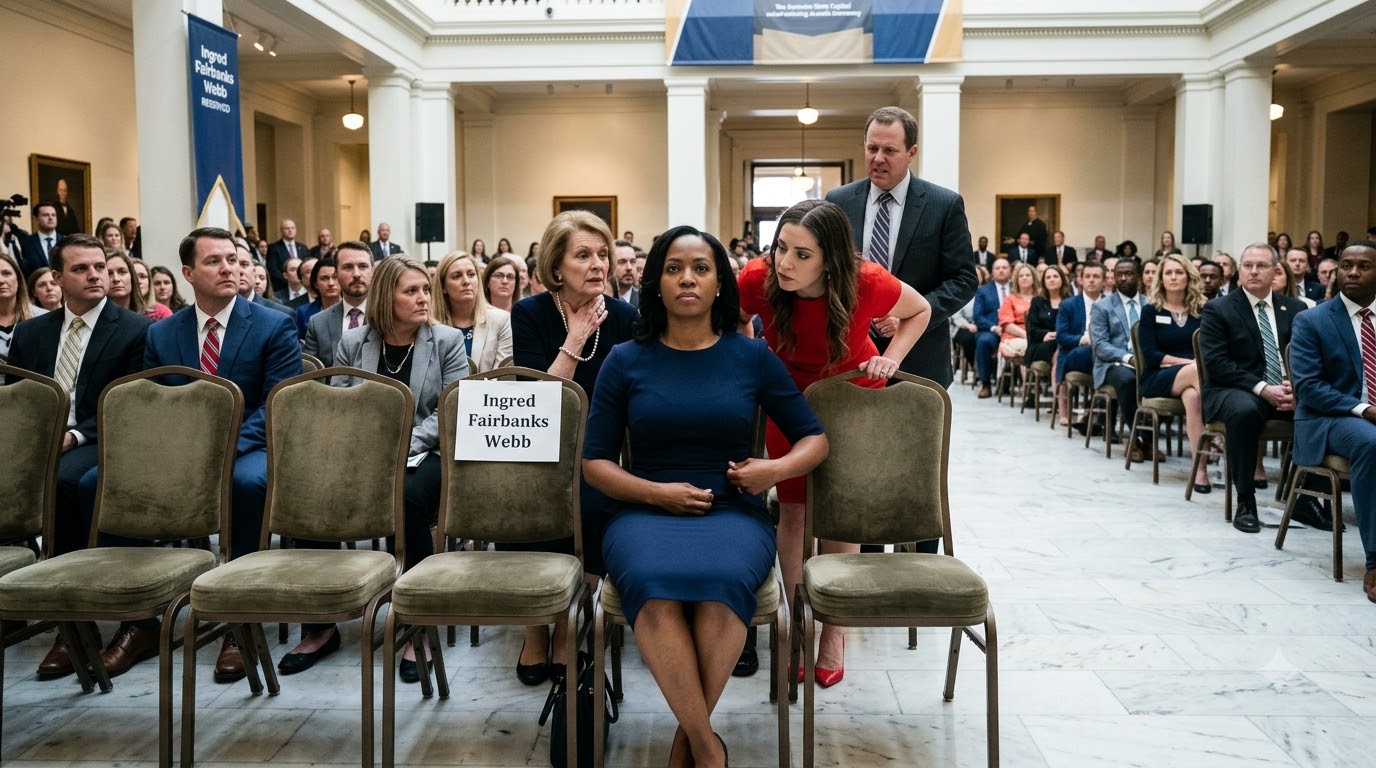
The vaulted ceilings of the state capital building amplified every heel click and whispered ambition into a dull, echoing roar.
Marcus kept his hand firmly on the small of my back, guiding me past a bronze statue of a founding father whose stern gaze felt entirely too familiar.
A volunteer in a crisp blue blazer intercepted us near the second-row seating tier, her clipboard clutched like a shield.
“Dr. Webb, your family section is right here,” she said, offering a warm, professional smile that didn’t quite reach her eyes. “We have three seats reserved for your immediate household.”
I nodded, sliding past the row of empty velvet chairs.
Marcus took the aisle seat, pulling Lily gently into the middle position so her small patent-leather shoes dangled just an inch above the carpet.
Behind us, the sharp, rhythmic tap of designer stilettos announced the arrival of an entirely different delegation.
“Excuse me,” Margaret’s voice cut through the murmur of the crowd with the practiced, effortless authority of a woman who expected parting seas. “We are the Fairbanks family. Front row, center. There must be some mistake with the seating charts.”
I didn’t turn around.
Instead, I reached down to adjust the collar of Lily’s yellow dress, letting the silence between us stretch thin and sharp.
Victoria’s red Valentino dress swished with a dry, expensive rustle as she leaned over the back of our row, her breath warm and smelling faintly of clove and high-end bourbon.
“Ingred,” Victoria murmured, her tone dripping with the condescending patience one uses on a difficult child. “We drove ninety miles. At least have the decency to look at us when we speak to you.”
The tactical weight of the room shifted instantly.
Around us, local administrators and school board members subtly adjusted their posture, their heads turning just enough to catch the friction without appearing to stare.
I kept my eyes fixed straight ahead on the massive banner stretched across the stage, reading my own name printed in bold, undeniable letters.
“My family is sitting right here,” I said, my voice entirely level.
A sharp, audible intake of breath rattled behind my left shoulder.
Margaret’s pearls clicked against one another as her hand flew to her throat, her fingers tightening around the clasp with a sudden, jerky desperation.
“We arranged our entire schedules for this,” Bradley interjected from somewhere behind Carolyn’s rustling silk, his lawyer’s cadence strained by genuine irritation. “Mom spoke to the coordinator last week. We’re supposed to be in the family block for the presentation.”
I didn’t offer an explanation, and I didn’t reach into my pocket for the digital proof I no longer needed.
The silence remained immovable, heavy as lead.
CHAPTER 3: The Stage and the Silence
Eleanor adjusted the brass microphone with a firm, practiced click, her eyes scanning the sea of five hundred seated educators before fixing gently on the front row.
“In fifteen years of working in Virginia’s education system, I’ve had the privilege of meeting thousands of extraordinary teachers,” Eleanor began, her voice carrying a steady, foundational authority that needed no amplification. “Today, I want to tell you about one who stands apart.”
Behind me, the soft rustle of silk and a sharp intake of breath marked Margaret shifting forward, her posture straightening as she prepared her public expression for the live camera feeds.
“Ingred Fairbanks Webb started her career in a rural elementary school with twenty-three students, limited resources, and unlimited determination,” Eleanor continued, letting the words settle over the quiet room. “In her first year alone, she raised reading levels by an average of two grade levels per student—not through magic, through showing up every single day.”
A subtle wave of approval rippled through the middle rows, heads nodding in silent solidarity with the grind of the classroom.
“Ingred didn’t come from a background that made her path easy,” Eleanor said, a deliberate, metallic weight dropping into her tone. “She didn’t have connections or privilege handed to her on a silver platter.”
I felt the sudden, rigid tension in the row directly behind mine, the sound of fingernails lightly scraping against a leather purse strap.
“She built everything herself—her master’s degree while teaching full-time, her mentorship program now adopted across thirty-seven counties, and her family,” Eleanor paused, her gaze locking onto the front row. “Her husband Marcus, who has served on the Clark County School Board, and her daughter Lily, who reminded us backstage what unconditional love looks like.”
The overhead cameras swiveled smoothly, panning down our row to frame Marcus and Lily, entirely bypassing the cream Chanel suit and red Valentino dress two feet behind us.
“Please welcome your 2024 Virginia State Teacher of the Year,” Eleanor announced, stepping back from the microphone. “Ingred Fairbanks Webb.”
I stood up, smoothing the fabric of my navy dress, and walked toward the stairs.
Behind me, the heavy creak of a second-row armrest snapping under sudden pressure confirmed that the curtain was only just beginning to rise.
CHAPTER 4: The Unyielding Boundary
“Ingred, sweetheart, surely you didn’t forget your own mother.”
Margaret’s voice rang through the high-ceilinged chamber, pitched precisely between wounded maternal grief and commanding social authority.
From the corner of my eye, I saw her cream Chanel suit flash against the aisle carpet as she took one deliberate step onto the lower tier of the stage.
The five hundred educators seated before me froze, a collective breath held in the heavy air.
Camera lenses clicked and swiveled in unison, locking onto the unexpected drama unfolding beneath the massive banner.
“Mrs. Fairbanks,” I said, my voice measured and calm, floating effortlessly into the room’s amplification system.
She stopped dead with one patent-leather heel resting on the first riser, her expertly maintained smile flickering with a sudden, hairline fracture.
“Thank you for attending,” I continued, meeting her wide, disbelieving eyes across the stage lights. “But the family portion of my speech has concluded.”
A low murmur rippled through the middle rows like wind over dry grass.
Margaret’s jaw tightened, the skin around her mouth pulling taut against four decades of country club poise.
“Ingred, I’m your mother,” she whispered, though the microphone picked up every sharp syllable as she leaned forward.
“You said you no longer saw me as your daughter,” I replied evenly, letting the words drop into the silence like lead weights. “Four years ago, in a group message, you announced that I chose to be a lowly teacher and that I was no longer part of your family.”
Gasps echoed sharply off the marble walls behind us.
A program slipped from someone’s trembling fingers, hitting the floor with a distinct, hollow snap.
“I’ve simply honored your decision,” I said, my hands resting lightly on the podium wood without a single tremor. “The family I thank today is the family that stood by me—the family that didn’t require me to prove my worth through a job title or a bank account balance.”
A security guard in a dark blazer stepped smoothly out from the wings, placing a polite but immovable hand near Margaret’s elbow.
She stood frozen on the step, neither advancing nor retreating, her cream pearls catching the glaring stage lights as her public facade dissolved into thin air.
CHAPTER 5: The Hallway Confrontation
“You humiliated us on live television,” Victoria hissed, her red Valentino dress catching the harsh overhead light while her jaw worked overtime to keep her voice down.
Around us, other attendees and local journalists gave wide berths, their steps slowing as they pretended to study marble cornices while soaking in every syllable.
Margaret stood slightly behind her daughter, her cream Chanel jacket looking suddenly stiff and unyielding, stripped of the effortless country club armor she had worn for decades.
Bradley hovered near the edge of a bronze planter, his charcoal suit jacket buttoned tight, his hands jammed deep into his pockets to mask the slight tremor in his fingers.
“I stated a fact, Victoria,” I said, my tone remaining entirely level as Marcus adjusted his grip on Lily’s hand beside me.
“We rearranged our entire schedules to support you,” Bradley interjected, his lawyer’s cadence strained by a desperate, rising edge of public panic. “Do you have any idea what this does to the family name in Richmond?”
“I gave up that name two years ago,” I replied, lifting my left hand just enough for the simple gold band to catch the light. “And names only mean something when the people behind them actually show up.”
Margaret stepped forward, her lower lip trembling with a sudden, biological fragility that no amount of charm school could smooth over.
“Ingred, we only wanted to be part of your success,” she whispered, her voice cracking beneath the weight of five hundred silent witnesses. “We’re your family.”
“Four years ago, in a group message, you decided I wasn’t,” I said, meeting her eyes without a shred of malice or triumph—only the cold, heavy weight of reality. “You chose your image over your child. I simply honored your choice.”
Victoria’s face flushed a deep, mottled crimson, her mouth opening to launch another defensive counter-move, but the words caught in her throat as she realized no one in the hallway was looking at her with sympathy.
They were looking at the cracks in the facade.
I turned my back on them, letting the heavy silence settle over their frantic PR spin, and walked toward the exit doors with Marcus and Lily by my side.
CHAPTER 6: The Unlocked Drawer
Marcus stood by the counter, his thumb wiping away a stray coffee ring while Lily practiced her scales on the piano in the next room, the notes rolling out with bright, imperfect grace.
I slid my finger under the gold-embossed flap, unfolding the thick stationery that carried my mother’s careful, lifelong cursive.
“ING,” the letter began, the ink slightly faded where a hand had paused over the page.
“I’ve written this letter forty-seven times, trying to explain, to justify, to make you understand why I did what I did.”
I read the words without anger, without the tight, stinging defense mechanism I would have worn like armor four years ago.
“The truth is simpler and uglier than any explanation I could give—I was afraid of being judged, afraid that your choices reflected failures in me.”
The sentences marched down the page with a quiet, hollow surrender.
“I don’t expect you to forgive me, and I haven’t forgiven myself, but I was wrong.”
Marcus looked across the wood, his eyes steady and questioning.
“She admitting it?” he asked softly.
“She is,” I said, folding the heavy paper back along its original creases.
I didn’t reach for my phone.
I didn’t open a cloud folder or search for digital receipts to prove a point to a world that had already moved on.
The Asymmetric Handicap had stripped away every crutch, leaving only the hard, clean ground of a boundary that no longer required validation.
I pulled open the kitchen drawer, placing the letter beside Lily’s crayon drawing of three stick figures beneath a yellow sun.
“What are you going to do?” Marcus asked, stepping closer to rest his hand on my shoulder.
“Nothing,” I answered, looking past the window toward the golden light catching the branches of the old oak tree. “I don’t need an apology to keep moving forward.”
I closed the drawer with a quiet, solid click, turning back toward the sound of music and the life we had built entirely with our own hands.