The Daughter They Forgotten Turned Out to Be the Only One Who Saw Everything
CHAPTER 1: THE SILVER SPOON GATE
The edge of the Waterford crystal glass bit into my palm as I polished it.
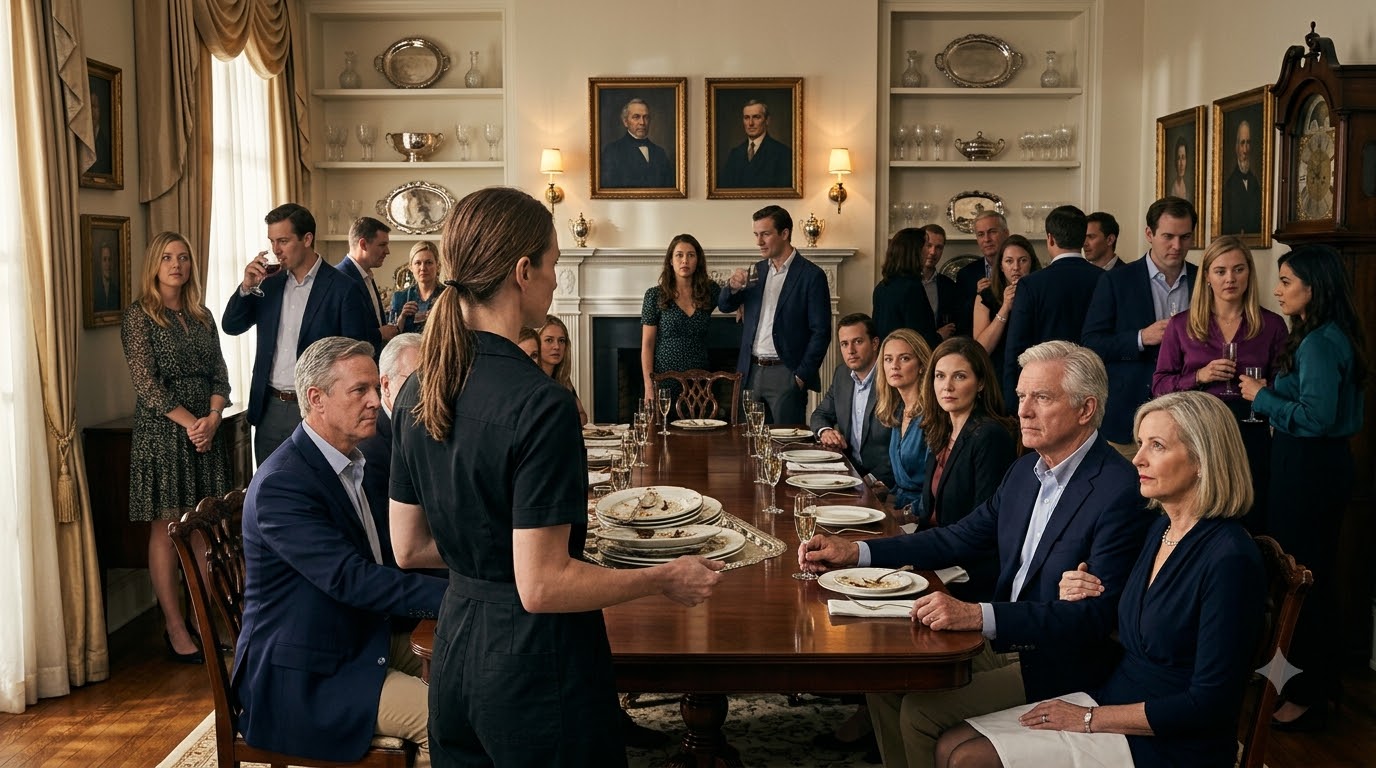
“Not that one, Wendy,” my mother said, her voice dropping into that familiar, razor-thin murmur as she passed the dining table. “The stems with the gold rims go on the right. Derek is sitting at the head next to your father.”
I didn’t answer. I aligned the glass with the linen napkin I’d ironed four hours earlier. My lower back throbbed with a dull, constant heat—a souvenir from standing over the kitchen counter since six in the morning, prepping crab cakes and slicing crostini for thirty people who didn’t know my last name.
Through the arched doorway, the living room hummed with the smooth, expensive noise of suburban Boston wealth. Sports coats, silk blouses, the sharp clink of ice against heavy crystal. My sister Megan stood near the fireplace in a bright red wrap dress, holding a glass of Pinot Noir while her husband, Derek, held court with three men from his downtown law firm.
“Aunt Wendy!”
Five-year-old Oliver slammed into my knees, his hands covered in blue icing from the appetizer table. Behind him, three-year-old Sophie was dragging a greasy napkin across the hardwood floor.
“Wendy, handle that,” Derek called out from across the room, not even turning his head fully. He tapped his cufflink, adjusting his watch. “Megan’s dress is silk. We can’t have fingerprints on it before the toasts.”
I reached into my apron pocket, pulled out a wet wipe, and knelt on the floor. The cold oak pressed into my knees through my black trousers.
“Come here, buddy,” I whispered, wiping the sugar off Oliver’s fingers. “Let’s get you cleaned up.”
“You’re so good at the messy stuff,” my mother said, stepping over my outstretched ankle to adjust a bowl of white peonies on the sideboard. “It’s a real blessing you have flexible hours with your little accounting clients. I don’t know how Megan would manage without you.”
I squeezed the used wipe into a tight ball inside my fist. “I cleared three deadlines this week, Mom. I took three days off to set up this party.”
“Yes, dear, and we appreciate it,” she said, her eyes already scanning the front hallway. “Oh, look. The Hendersons are here. Put those dirtied napkins in the laundry room before you bring out the tiramisu.”
She walked away without waiting for a reply.
I stood up, resting my thumb against the ridged metal rim of the DSLR lens cap tucked deep in my pocket. My thumb traced the raised plastic teeth, back and forth, holding down the cold heat in my chest.
At nine o’clock, the silver fork chimed against the rim of a champagne glass.
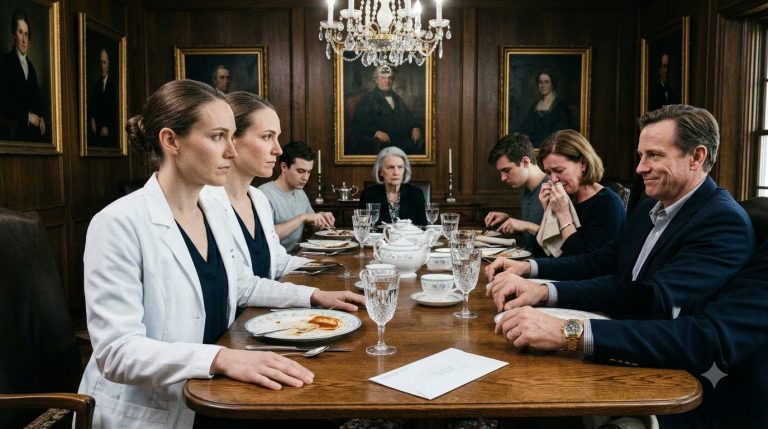
The chatter in the living room died down instantly. My father, Harold, stood near the head of the long table. His hair was silver, perfectly groomed, his navy blazer unbuttoned just enough to look relaxed. Beside him, my mother beamed, her arm looped through his like a debutante at a ball.
“Forty years,” my father began, his voice dropping into the rich, rhythmic cadence he used for branch management speeches before he retired. “Forty years of building a life, a home, and a family in this town. Patricia and I look around this room tonight, and we see the proof of that work.”
A polite wave of applause rippled through the guests. Megan squeezed Derek’s arm, resting her chin on his shoulder.
I stood near the kitchen doorframe, holding a tray of dirty dessert plates. My dress was plain black, functional, selected specifically so I would blend into the wallpaper while the caterers worked.
“And to mark this milestone,” my father continued, pausing to let the suspense build, “Patricia and I have a surprise for our family.”
My mother’s smile widened, bright and tight under the chandelier light.
“Next Thursday, we are taking the whole family to Maui,” my father announced. “One week at the Four Seasons. A second honeymoon, surrounded by the people who matter most.”
The room erupted. Cheers, laughter, the sharp clatter of hands clapping. Megan let out a high-pitched squeal that echoed off the high ceiling.
“Dad! Oh my god, Maui?” Megan threw her arms around his neck. “The kids are going to lose their minds!”
A sudden, strange light lifted inside my chest. One week. Seven days where I wouldn’t have to answer six phone calls a day to run errands or file tax forms for Derek’s partners for free. A real breath of air.
I stepped forward from the threshold, letting the heavy tray rest against my hip.
“That’s incredible, Dad,” I said, my voice cutting through a brief lull in the noise. “What time is our flight on Thursday? I need to let my clients know when I’ll be out of reach.”
The laughter in the room didn’t fade—it evaporated.
My father’s hand, still holding the champagne glass, stayed suspended in mid-air. He looked at me over the rim of his reading glasses, his mouth setting into a hard, flat line.
My mother’s chin snapped upward. Her tight smile didn’t drop; it turned to stone.
“Wendy,” my father said, his voice dropping an octave into a low, controlled rumble. “You don’t need to worry about flight times.”
I stopped two feet from the table. “What do you mean?”
My mother took a small step forward, smoothing the front of her skirt with both hands. “Someone has to stay behind and take care of the house, Wendy. And the children.”
The silence in the room became absolute. Thirty pairs of eyes—neighbors, bank directors, church board members—shifted from my mother’s face to mine.
“The children?” I repeated. The word tasted dry, like dust.
“Megan and Derek need a real break,” my father said, his tone casual, as if he were explaining a parking rule to a stranger. “Derek’s had a grueling quarter at the firm. They can’t enjoy a vacation with a five-year-old and a toddler dragging them down.”
“I have work, Dad,” I said. My voice was quiet, but it didn’t shake. “I have clients.”
“Your little home accounting?” my mother interjected, letting out a small, light laugh meant for the room to hear. “Wendy, honestly. Don’t be dramatic in front of our guests. You work from your laptop. It’s not as if you have an office to go to.”
Derek took a sip of his wine, looking down at his polished leather shoes. “The kids love you, Wendy. It’s just a week.”
A woman in a cream sweater near the sofa leaned toward her husband, her voice carrying in the dead quiet: “Poor thing. She’s always the one stuck running the house.”
My father tapped his glass again, turning his back to me to face the crowd. “Now, who wants another glass of Dom Pérignon?”
The room surged back to life. Talk resumed. Laughter restarted, loud and fast, burying the moment under a mountain of polite suburban noise.
I stood there in my plain black dress, holding thirty dirtied dessert plates.
My thumb pressed down on the lens cap in my pocket until the sharp plastic edge cut deep into the meat of my skin. I didn’t drop the tray. I didn’t raise my voice. I turned around, stepped back through the doorframe, and walked into the dark, quiet space of the kitchen.
CHAPTER 2: THE KEY ON THE COUNTER
I turned off the faucet. The kitchen was dead quiet now, save for the rhythmic hum of the double-door refrigerator. In the living room, the last clinking glass had cleared out twenty minutes ago, leaving behind the stale smell of spilled wine and wilted white peonies.
“Wendy.”
My mother stood in the doorway, her silk blouse slightly rumpled at the waist, her eyes tracking me with a sharp, predatory tightness. She didn’t look tired. She looked annoyed that the stage was clear and I was still standing on it.
“Leave the rest of the glassware,” she said, tapping her gold watch. “Your sister needs you at her place by seven tomorrow morning. Derek has an early tee time with a founding partner, and she needs someone to handle Oliver’s breakfast.”
I reached into my pocket, my thumb resting on the cold, ridged edge of the Canon lens cap. I didn’t pull it out. I just felt its weight.
“I won’t be there at seven, Mom,” I said. My voice was flat, devoid of the familiar apologetic tilt she usually relied on.
Her eyebrows pulled together, a single deep crease cutting between them. “What does that mean? I just told you Derek has a meeting. Don’t start being difficult because of that silly Hawaii comment. Your father was making a practical decision.”
“I’m not watching the kids tomorrow,” I said, stepping past her to grab my black coat off the wooden peg near the garage door. “Or next week.”
“Wendy Dixon, you drop this attitude right now,” she snapped, her hand shooting out to grab my forearm. Her nails, manicured into soft pink ovals, pinched through the fabric of my sleeve. “We have given you every concession. We let you park your beat-up car on the street so guests wouldn’t see it, we let you use the guest kitchen for your little project—”
“I paid for my own food, Mom. I paid for my own gas. And I did Derek’s firm taxes for three years without charging a single dime.” I pulled my arm back. Not violently. Just far enough that her grip slipped off my coat. “I’m leaving.”
“Leaving?” She let out a short, bark-like laugh. “To go where? Back to your depressingly small apartment to stare at four walls? You need this family, Wendy. Without us, you don’t even have a social life.”
I didn’t answer her. I didn’t give her the satisfaction of an argument she could reframe as a daughterly tantrum. I pushed open the heavy wooden door, stepped into the cold midnight air, and pulled it shut behind me until the latch clicked home.
Forty minutes later, the beige carpet of my small apartment felt different under my boots. It didn’t feel cheap anymore. It felt like a launching pad.
I pulled three black canvas suitcases out from the back of the bedroom closet. I didn’t pack clothes for a weekend; I packed everything that mattered. My laptop, my hard drives, my three favorite sweaters, and the cashmere scarf wrapped around my secondhand DSLR.
My phone on the kitchen counter vibrated continuously, sliding an inch across the formica with every missed call.
Patricia Dixon – 6 Missed Calls.
Megan Hartley – 4 Missed Calls.
Then came the text from Megan, the screen lighting up the dark counter:
Mom says you’re ruining the trip on purpose. Derek is furious. You’re going to end up alone just like Aunt Ruth if you keep acting like this.
I stared at the glowing letters. Just like Aunt Ruth.
Aunt Ruth had a studio two blocks from the ocean, her own name on the tax deed, and a peace of mind that didn’t require permission from Harold Dixon. It wasn’t a threat. It was an blueprint.
I took the brass spare key to my apartment, walked down the carpeted hallway, and slid it beneath the landlord’s door inside a white envelope marked Lease Terminated – Rent Paid Through Month End. No loose threads. No reasons for anyone to track me down.
By five in the morning, the trunk of my ten-year-old Honda Civic was weighed down with my entire life. The engine turned over with a rough, familiar rattle, the exhaust puffing white steam into the freezing Boston dawn.
I didn’t look at the rear-view mirror as I pulled away from the curb. I shifted into drive, stepped on the gas, and headed west toward the open highway, leaving the Dixon family to realize what happens when the foundation decides to stop holding up the house.
CHAPTER 3: THE FRAME IN THE LIGHT
My hands tightened on the worn vinyl steering wheel. Three thousand miles of highway noise, cheap diner coffee, and silent motel rooms were behind me.
Ahead, Ocean Avenue dipped toward the Pacific, flanked by whitewashed cottages and iron shop signs swinging gently in the coastal breeze.
The Civic rattled as I pulled into the gravel alley behind Aunt Ruth’s cafe, The Ceramic Cup. The sign out front was hand-lettered in cobalt blue.
Before I could kill the engine, the screen-door flipped open. Aunt Ruth stepped out on the wooden porch wearing a navy canvas apron smudged with clay dust. She didn’t offer a dramatic speech or ask for a play-by-play of the damage I’d left in Boston.
“Trunk’s stuck again, isn’t it?” she called out, her voice rough from forty years of sea air and studio kilns.
“Only if you pull the lever too hard,” I said, swinging my legs out of the car.
She walked down the steps, wrapped her arms around my shoulders, and squeezed once, hard and steady. “Your room upstairs has fresh linen. The morning shift starts at six. And Marcus Coleman is expecting you at two.”
She turned back toward the cafe, pausing at the threshold. “And Wendy? Turn your phone off. The world keeps spinning even if Harold Dixon isn’t watching it.”
By 1:45 PM, I was walking down the immaculate hardwood floor of Coastal Light Gallery.
The space was dead quiet except for the low, precise hum of a track lighting system. High white walls held massive, matted black-and-white prints. Natural light poured through thirty-foot skylights, reflecting off polished concrete floors.
A tall man with silver hair and a linen shirt rolled up to his elbows stepped out from an back office. Marcus Coleman didn’t carry himself like a slick art dealer. He moved with the slow, deliberate care of a craftsman.
“Wendy,” he said, extending a hand that was dry and firm. “Ruth promised me you’d arrive before two.”
He turned to a long oak desk, picking up a heavy manila folder. He opened it, laying a three-page contract flat between us.
“Fifteen prints,” Marcus said, laying a silver Parker pen beside the paper. “Solo exhibition in six weeks. Invisible Women: Portraits of the Overlooked. Gallery covers framing, lighting, press outreach, and the opening reception. Sixty percent of every sale goes directly into your bank account.”
I looked down at the top page. The legal font printed at the top read: Artist Representation Agreement — Wendy Dixon.
My thumb found the metal lens cap in my pocket, tracing its cold, ridged perimeter. For ten years in Boston, my name had only appeared on tax returns as a zero-dollar preparer, or at the bottom of a holiday chore list.
“You’re sure about the dates?” I asked, my voice steady.
“I don’t gamble on dates,” Marcus replied smoothly. “I saw the portrait you took of that elderly woman at the bus stop. The one Ruth forwarded. Most people shoot portraits to show off their camera. You shot that to show a human being who was tired of being ignored.”
He leaned against the desk, tapping the edge of the paper. “Sign it, Wendy. Let the work belong to you.”
I picked up the pen. The blue ink flowed smooth and heavy across the signature line.
As Marcus countersigned the bottom page, his assistant stepped over with an official notary seal, pressing the heavy metal jaw down onto the paper with a sharp, metallic clack.
Across the country, five thousand miles away in Maui, my mother was probably screaming at a resort concierge because her turn-down service was ten minutes late, while Megan tried to figure out why Oliver wouldn’t stop crying without his specific bedtime routine.
They thought they had left me behind to keep house.
Instead, I had just locked my name into a legally binding contract that proved I existed on my own terms.
As Marcus handed me my executed copy, I noticed a second folder lying open on his desk. Tucked beneath a gallery schedule was a banking slip from a regional bank in Boston—the exact branch my father had managed for twenty-five years. A line item stamped in red ink caught my eye: Escrow Deficit Clearance — Account #8841.
I looked up at Marcus. His expression remained entirely neutral, but he gently closed the folder cover with one finger.
“Six weeks, Wendy,” Marcus said softly. “Get your final proofs ready.”
CHAPTER 4: THE UNINVITED GUESTS
The string quartet playing near the back wall faltered for a fraction of a second.
Megan stepped across the polished concrete threshold, her bright floral sundress utterly out of place against the gallery’s muted slate walls. Right behind her, Derek adjusted the collar of his tailored jacket, his phone firmly gripped in his right hand as his eyes scanned the room like a process server delivering a subpoena.
Fifty guests in evening wear turned slightly, their low conversation dimming.
“Wendy!” Megan called out, her voice loud enough to clip through the ambient cello music. She marched forward, arms reaching out as if we were staging a dramatic family reunion for an audience. “Oh my god, we’ve been so worried about you!”
I didn’t step back. I didn’t drop my glass. I stood my ground right beside the matted black frame of my main piece.
“Megan,” I said, keeping my tone perfectly level. “This is unexpected.”
“We flew in yesterday,” she rushed out, her hands fluttering near her chest. “Mom found your Instagram account after Hawaii. She’s been calling everyone trying to track you down!”
Derek stepped up beside her, nodding at the white walls with an air of mild condescension. “Nice place, Wendy. Little far out, but nice.”
“It’s an art gallery, Derek,” I said. “My exhibition opening, actually.”
Megan blinked, her eyes darting from the red sale dots on the wall placards to the waiters carrying champagne trays. A faint flicker of confusion crossed her face—the look she always got when something in the real world refused to align with her expectations.
“You… you did all this?” she asked, dropping her voice slightly. “Since when do you do art?”
“Since three years ago,” I said. “You never asked.”
Aunt Ruth materialized at my elbow, standing silent and solid as a concrete pier. Across the room, Marcus Coleman paused mid-sentence with a museum curator, his sharp grey eyes locking onto Derek’s rigid posture.
Megan leaned in closer, dropping her voice to a dramatic, confidential whisper. “Wendy, look, I have news. I’m pregnant again. Number three.”
She paused, waiting for the gasp, the hug, the immediate surrender. When I just looked at her, she pressed on, the familiar edge of panic bleeding into her tone.
“Derek’s firm hours are completely insane right now,” she urged, reaching out to grab my wrist. “Mom is totally useless with toddlers. I really need you to come home.”
There it was. Not an apology for thirty guests watching me get dismissed at an anniversary dinner. Not a word of congratulations on fifteen framed prints hanging in a major gallery.
Just need. The insatiable, bottomless need of a sister who viewed my entire existence as a backup utility service.
“I’m in the middle of my opening night, Megan,” I said, pulling my arm back until her fingers slipped off my skin.
“I know, I know, and this is lovely!” She waved a hand dismissively toward six months of my life’s work as if it were a high school science fair project. “It’s a great little hobby, Wendy. Truly. But we can talk about that later. I need to know when you’re flying back to Boston.”
“She isn’t,” Aunt Ruth said. Her voice wasn’t loud, but it possessed the heavy, grating weight of two grinding millstones. “She lives here.”
Derek took half a step forward, his jaw tightening into his courtroom demeanor. “With all due respect, Ruth, this is a private family matter.”
“Family matter?” Ruth let out a dry, rasping laugh. “You mean the family that told her she didn’t qualify for a seat at the table?”
“That’s not—we didn’t mean it like that!” Megan stammered, her cheeks flushing dark red under the track lights.
“How exactly did you mean it?”
The interruption didn’t come from me. It came from Mrs. Peyton—the woman in cultured pearls who had spent the last ten minutes staring at my bus stop print. She turned around completely, her champagne glass poised near her lip, her cold eyes fixing directly on Derek.
Derek’s lawyer instincts kicked in instantly, his shoulders squaring. “I’m sorry, who are you?”
“Someone who just handed Marcus Coleman a check for three thousand dollars for that young woman’s art,” Mrs. Peyton said, her voice carrying easily into the silent gallery. “And someone who is exceptionally curious why a corporate attorney thinks his wife’s babysitting schedule overrides a professional exhibition.”
The room temperature dropped ten degrees. Two journalists from Carmel Magazine stopped taking notes and quietly adjusted their posture, listening with rapt attention.
Megan looked at me, genuine desperation finally breaking through her carefully curated demeanor. “Wendy, please. We can’t talk about this here. Step outside with us.”
I looked at my sister. I looked at Derek’s twitching jaw. And for the first time in thirty-two years, I didn’t yield an inch of ground.
“No,” I said quietly. “We’re going to talk right here.”
CHAPTER 5: THE COLLAPSE OF AUTHORITY
My mother marched across the slate floor in her navy trench coat, her heels clicking like sharp, precise gunfire against the stone.
“Wendy,” she said, her voice dropping into the icy tone she used whenever a maid left dust on a baseboard. “You have caused an absolute spectacle. We had to take a red-eye flight from Maui because your sister was hysterical.”
My father followed two steps behind, his silver hair immaculate, though a dark shadow of exhaustion sagged beneath his eyes. He looked around the white walls, his mouth twisting with subtle distaste.
“We are going outside right now,” my mother said, reaching out to grasp my wrist. “Your father and I did not raise you to throw public tantrums when you don’t get your way.”
I didn’t move. I let my arm hang motionless, a solid weight she couldn’t drag without making herself look ridiculous.
“I didn’t throw a tantrum, Mom,” I said, my voice quiet, cutting easily through the low hushed whisper of fifty art patrons watching from five feet away. “I just didn’t show up to be your unpaid nanny.”
“Unpaid?” My father stepped in, clearing his throat, his posture rigid. “We give you a family to belong to, Wendy. You sit at our dinner table. We helped you out when that boy Kevin dumped you—”
“You let me wash your dishes after dinner, Dad,” I corrected him plainly. “And while Derek was claiming partnership at Whitmore and Associates, I was doing his personal and corporate tax schedules for three years straight without billing a single dollar.”
Derek’s face drained of color. He shot a frantic glance toward Mrs. Peyton and the two journalists standing near the champagne table.
“Wendy, that’s private tax information,” Derek muttered under his breath, stepping closer. “Keep your mouth shut about my firm.”
“Why, Derek?” I asked, looking him square in the eyes. “Because if your senior partners find out you couldn’t balance your own client ledgers without an uncompensated relative, they’ll check Account #8841?”
The gallery went dead silent.
My father’s chin twitched. A fine bead of sweat broke out along his hairline, despite the cool sea breeze coming through the open door.
I didn’t need digital screenshots. I didn’t need printed emails. I knew the physical accounting because I had done the legwork by hand on my mother’s kitchen table for thirty-six months.
“You took out a personal guarantor loan through Dad’s retired branch account to buy your equity stake at the law firm,” I said, every word hitting the room with cold, clinical precision. “And when the interest payments hit six thousand a month, Dad pulled funds from the family trust ledger—the blue cloth ledger in Mom’s desk drawer.”
My mother’s mouth opened, then snapped shut. Her hands tightened on the strap of her leather handbag until her knuckles turned chalk white.
“That’s why I had to stay behind,” I continued, holding my father’s wide, staring eyes. “It wasn’t about watching the kids so Megan could rest. It was because if I wasn’t in Boston to run the quarterly reconciliation before the bank audit on Friday, the escrow deficit would trigger a manual review.”
“You… you don’t know what you’re talking about,” Megan stammered, her voice cracking as she looked between her husband and her father. “Derek? What is she talking about?”
Derek didn’t answer. He couldn’t. His mouth was set in a tight, terrified line.
Mrs. Peyton raised her eyebrows, taking a slow sip of her mineral water before looking directly at my mother. “Well, Patricia. It appears your daughter isn’t just an extraordinary artist. She’s an exceptional accountant.”
A quiet ripple of hushed, severe judgment swept through the gallery. The two journalists were writing furiously in their small notebooks, their pens scratching against paper in the silence.
My mother looked around the room, realizing in one terrible, crushing instant that her decades of accumulated suburban authority had vanished. The polished, perfect Dixon family image had shattered into dust under the cold track lights of Coastal Light Gallery.
“Wendy,” my father whispered, his voice stripped of all its charm, reduced to a hollow rasp. “Please.”
“I hope your third child is healthy, Megan,” I said, looking at my sister one last time. “And I hope you find a good nanny. But my rates start at eighty dollars an hour, and my calendar is full.”
I turned my back on all four of them, stepping toward Marcus Coleman as he handed me a fresh pen to sign Mrs. Peyton’s red sale tag. Behind me, the heavy brass door clicked shut, sealing out the noise of my past for good.
CHAPTER 6: THE QUIET HORIZON
The morning mist was still lifting off Ocean Avenue, leaving a clean, damp sheen on the cobblestones outside the window.
In my hands, the glossy cover of Carmel Magazine caught the warm morning light. Below the matted black-and-white print of my bus stop portrait, bold black letters read: The Artist Who Learned to See Herself — By Wendy Dixon.
“That’s three more copies sold before nine in the morning,” Aunt Ruth said, setting a plate of warm cranberry scones on the table. Her apron was dusted with white flour, her knuckles greyed from glaze clay. “Marcus called from the gallery while you were setting up the window display. Mrs. Peyton wants to commission a Big Sur coastline series.”
“I know,” I said, setting the magazine flat on the pine table beside my secondhand DSLR. “She called my studio line yesterday.”
I picked up the camera, running my fingers over the scratched grip and the metal edge of the lens cap. It was battered, worn down by thousands of miles of travel, but it worked with perfect, unflinching clarity.
My phone sat on the wooden table, completely dark.
There were no six missed calls from Patricia Dixon demanding I run her dry cleaning. There were no urgent text lists from Megan about Oliver’s ear drops or Derek’s ironed shirts.
The silence wasn’t empty; it was pristine.
My sister had sent one text three weeks ago—a simple photograph of a newborn girl named Charlotte, along with a quiet note saying they had hired a full-time certified nanny. I had sent back a polite gift card for a children’s clothing shop in Boston, wished them health, and left the door closed.
My father had sent a single email to my professional studio inbox. Three plain lines acknowledging the magazine feature, signed simply with his first name. No demands for reconciliation. No rehearsed speech about family duty. Just the quiet admission that the house he built on leverage was finally forced to stand on its own feet.
I took a slow sip of coffee, feeling the heat anchor me to the present moment.
Outside, the first morning tourists were strolling down the sidewalk, pausing to admire the ceramic window boxes and the cobalt sign above the door.
I turned the page of my sketchbook, opened my fountain pen, and began drafting the framing dimensions for my spring show. No explanations required. No permission needed. Just the quiet work of an independent life, captured cleanly on my own terms.