The Price of Obedience: A Carrier Strike Group’s Quiet Stand Against Irresponsible Power
CHAPTER 1: THE COLD COORDINATES
The neon-blue glow of the CIC tactical table cast a harsh light across the grease pencil marks on Petty Officer Martinez’s console. Commander Sarah Chen leaned her knuckles against the steel frame of the display, the cold metal biting into her palms through her flight gloves. Overhead, the rhythmic thump-thump of an F/A-18 catching the 3-wire vibrated clear down into the deck plates of the USS Constellation.
“Run those numbers again, Martinez,” Sarah said. Her voice didn’t rise above the ambient hum of the cooling fans, but the petty officer’s fingers moved across the keypad without a second’s hesitation.
“Grid square 34.2581 North, 118.4441 East,” Martinez read off, pointing a blunt thumb at the high-resolution satellite thermal feed. “Sensors pick up structural mass, high heat signature near the south wall, and regular vehicular traffic every morning at 0600.”
Sarah reached into her flight suit pocket, pulled out a worn brass pocket watch with a hairline crack running across its glass lens, and let the mechanical latch snap open. Click. The quiet metallic sound barely registered against the electronic chatter of the room, but it anchored her hands. She stared at the thermal imagery. The perimeter walls weren’t reinforced concrete for weapons storage; they were low, hollow-block enclosures built for shade. And right in the center court sat a distinct, T-shaped frame with suspended chains.
Playground swings.
“That’s not a munitions depot,” Sarah said flatly. She snapped the watch cover shut. Click. “That’s the regional trauma center near the border. My sister Lisa has been sending logistical requests from that exact grid for three months.”
“Ma’am, the target packet came down signed from Fleet Command,” Martinez muttered, keeping his eyes glued to his monitors. “Operation Thunder Strike goes live in less than an hour.”
Sarah turned without another word and headed up the ladder-well to the flag briefing room. Her boots made no sound on the non-skid deck strips, but her chest felt tightly bound, every breath forced and deliberate.
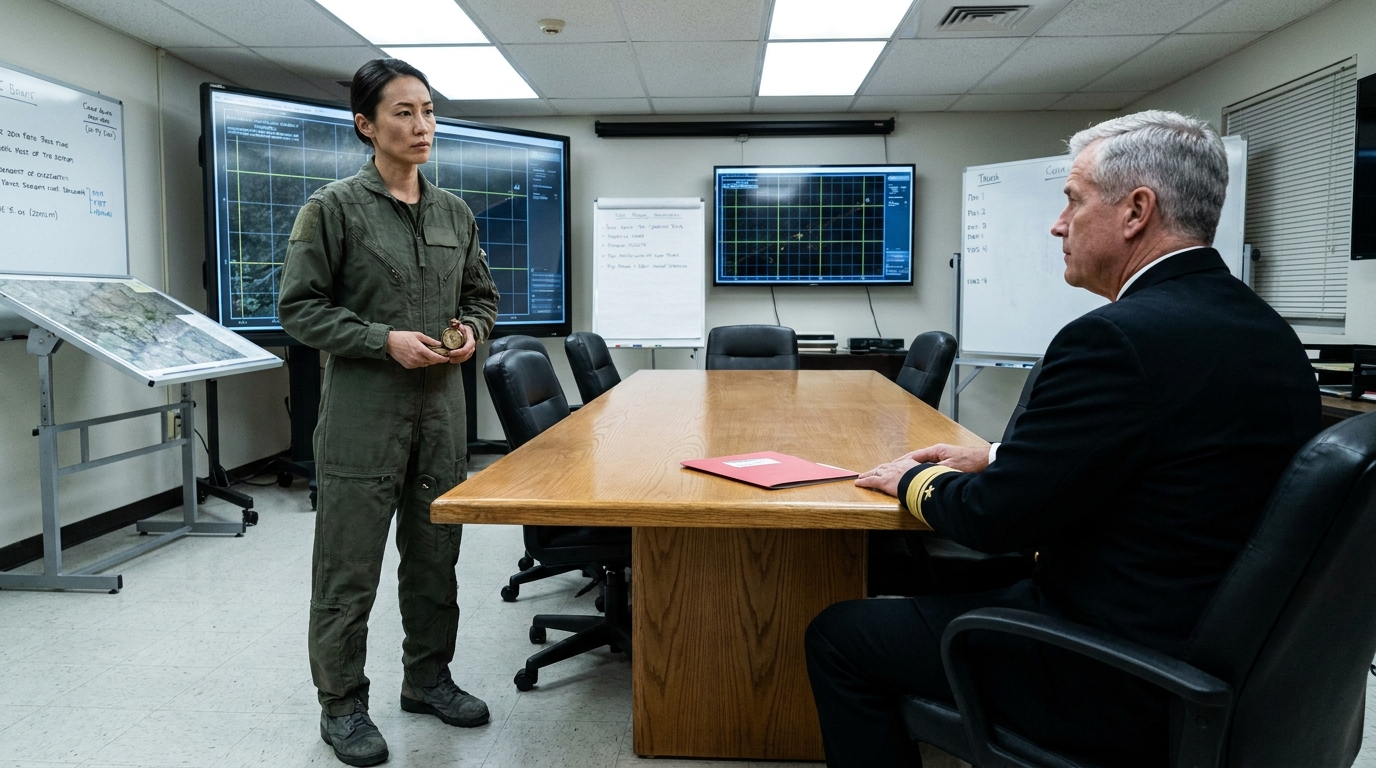
Inside the briefing room, Admiral Morrison stood at the head of the long oak table, his silver hair immaculate under the overhead fluorescents. A red-stamped paper folder sat near his right hand—completely devoid of the standard Joint Staff security barcodes along its margin. He didn’t look up when the heavy hatch swung open.
“Commander Chen,” Morrison said, marking a map display with a red dry-erase pen. “You should be in your aircraft executing pre-flight checks with Williams.”
“Admiral, the target coordinates for the primary package are wrong,” Sarah stated clearly, stopping two paces from the table. She didn’t offer an apology for interrupting. “Grid 34.2581 by 118.4441 is an active pediatric and trauma site registered under international humanitarian protocols.”
Morrison laid the marker down on the wood with a quiet, deliberate tap. His gray eyes met hers, utterly unbothered by her presence.
“The intelligence for Thunder Strike was vetted through proper staff channels, Commander. What you’re looking at is a hardened insurgent command post using civilian camouflage.”
“With respect, sir, enemy supply depots don’t haul five-ton shipments of clean water and IV saline every Tuesday morning,” Sarah countered, stepping closer to the table until her thigh brushed the edge. She flicked the pocket watch latch open inside her pocket. Click. “I’m asking for thirty minutes to run an independent verification through regional maritime traffic control.”
Morrison leaned forward, resting his palms flat on the table, his posture blocking the light behind him.
“You don’t get thirty minutes, Commander. And you don’t cross-reference Fleet orders with civilian traffic control. You have an assigned launch window on Catapult Two. You will fly the mission, or you will hand your sidearm to the Master-at-Arms right now.”
Sarah looked at the Admiral’s unyielding face, then down at the unbarcoded red folder sitting inches from his thumb. The ship shuddered slightly as another jet launched into the dark Pacific night above them.
“Then you’d better call the Master-at-Arms, sir,” Sarah said softly.
CHAPTER 2: SOUND OF THE LATCH
Sarah didn’t move from the center of the narrow deck space until the footfalls of the Master-at-Arms faded down the passageway. Her flight suit felt heavy, soaked through with the stale sweat of the flight deck, but her hands were entirely steady as she pulled her brass pocket watch from her pocket.
She turned the casing over in her fingers. The hairline crack across the glass lens reflected the harsh, white overhead LED.
Morrison thought stripping her flight status and locking her in transit quarters would freeze the threat. He assumed a Commander without a cockpit was a toothless gear in a machine that only moved forward. He was relying on the cold, unyielding weight of rank to keep everyone else in line.
Click. She opened the latch, then snapped it shut.
She walked over to the small steel desk bolted to the bulkhead. The ship’s internal sound powered phone—the old, hardwired copper line that bypassed the modern digital CIC comms entirely—hung in its cradle near the bunk. It was a redundant system meant for damage control teams during a hull breach, completely unmonitored by the automated comm logs.
She lifted the heavy receiver to her ear and dialed three short turns on the hand crank.
The line crackled with dead static before a tired voice answered on the third click. “Engineering, Petty Officer Miller.”
“Miller, it’s Chen,” Sarah said, keeping her tone conversational, stripped of any urgency. “I need you to run a routine pressure test on the primary steam catapult lines for Cat Two.”
There was a long pause on the line. Miller wasn’t an idiot. He’d been maintaining the steam valves on the Constellation for twelve years, and he knew as well as Sarah that a pressure test during active launch ops meant locking down the forward deck for at least twenty minutes.
“Ma’am,” Miller said slowly, his voice dropping an octave. “The Admiral’s flag lieutenant just walked through the bay five minutes ago. They’re rushing the ordnance load on the Super Hornets.”
“I know,” Sarah said. She reached out and touched the edge of the unbarcoded red folder’s image in her mind—the missing Joint Staff verification stamps, the rushed timeline. “The pressure readings on Cat Two were spiking before I walked off the deck. If those valves bind during launch, you’ll lose the shuttle and the pilot.”
“A valve lock…” Miller murmured. She could hear the quiet metal-on-metal scrape of a wrench shifting in his hand. “That’d take a full diagnostic. We’d have to hold the launch sequence until the pressure bleeds.”
“Exactly,” Sarah said. “Make sure the watch officer sees the pressure drop on his board. Don’t let them force the steam until you see the physical gauge align.”
“Understood, Commander,” Miller replied, the hesitation gone from his voice. “We’ll run a very thorough diagnostic.”
She hung up the heavy receiver, the copper cradle settling back into the bulkhead with a firm click.
She stepped toward the small porthole looking out over the dark Pacific. Down below, riding the black swells two hundred yards off the carrier’s starboard side, the dark, elongated shadow of a Virginia-class submarine cut through the water. The USS Leviathan.
She knew Captain Rodriguez was on that bridge. They’d served together on the Joint Staff three years ago, back when Morrison was still climbing the promotion ladder by shaving time off safety margins. Rodriguez didn’t operate on unverified red folders either.
Sarah pulled her watch out once more, her thumb rubbing over the cold, cracked glass. The carrier’s engines hummed deep beneath her boots, a low, relentless vibration that demanded action. She wasn’t going to get a call from Washington. No higher authority was coming to blow the whistle and relieve Morrison from above.
If this train was going to stop, she had to pull the air brake herself, piece by piece, from the inside out.
A sudden, sharp knock rattled the steel door of her stateroom.
“Commander Chen,” a voice called from the passageway. It was Lieutenant Commander Brooks, Morrison’s slick junior aide. “Pack your gear. The Admiral ordered your immediate transfer off the ship. You’re being placed on the supply transport bound for San Diego in ten minutes.”
Sarah didn’t flinch. She let the watch latch click open one more time. Click.
“Tell the Admiral I’m ready,” she said toward the locked hatch.
CHAPTER 3: STANDING AGAINST THE BOW
Sarah hauled her duffel bag over the slick steel threshold of the transfer hatch, her boots gripping the wet rubber grating.
The hatch hissed shut behind her, sealing out the roaring jet wash from the flight deck above. She didn’t drop her gear until she stood in the tight, green-lit passageway of the USS Leviathan.
Captain Rodriguez stepped through the control room bulkhead, his khaki uniform rumpled, a half-empty mug of black coffee held firmly in his right hand. He didn’t offer a crisp military salute. He just looked at her, his eyes taking in her flight suit and the brass watch tucked into her left hand.
“You’re supposed to be on a transport plane back to the States, Sarah,” Rodriguez said, his voice grating like gravel.
“And Morrison is supposed to verify target packets before he dumps twenty tons of high explosives on a hospital grid,” Sarah replied, dropping her duffel against the bulkhead.
Rodriguez took a slow sip from his mug, the ceramic clinking faintly against his ring. “The Admiral radioed down ten minutes ago. He ordered me to hold you in the brig for immediate transfer at dawn.”
“He’s operating on an unbarcoded red folder, Javier,” Sarah said softly, pulling her watch out and letting the cover rest between her fingers. “No Joint Staff verification stamps. No satellite sub-patch codes. He pushed Thunder Strike forward three days early because the intelligence packet didn’t come from Central Command—it came from a private defense contractor’s pipeline.”
Rodriguez froze. The subtle twitch in his jaw told her he knew exactly what that meant. A skipped verification code meant someone was rushing a strike to validate a contract line item before the quarterly audit.
“You’re sure?” Rodriguez asked.
“Look at the grid numbers yourself,” Sarah said, pointing toward the tactical display in the center of the control room. “34.2581 North, 118.4441 East. My sister is standing in the courtyard of that site right now with seventy civilian casualties. If Morrison launches his Super Hornets, he’s not hitting a weapons bunker.”
Rodriguez stared at the glowing green map on his main console. The tactical marker for the Constellation sat dead center, flanked by its escort destroyers.
“If I breach depth and block his launch fan, it’s mutiny, Sarah,” Rodriguez said quietly. “They’ll strip my command before the sun comes up.”
“It’s not mutiny if you’re executing a mandatory safety hold under Fleet directives,” Sarah countered, stepping right up to the navigation table. “Morrison doesn’t have a cleared firing corridor if a warship is positioned within his immediate catapult emergency buffer. You surface two hundred yards off his starboard bow, and his air boss legally cannot give the green light to launch.”
Rodriguez set his coffee mug down on the edge of the chart table with a heavy, deliberate thud.
“Chief of the Watch,” Rodriguez called out, his voice turning cold and sharp as iron. “Blow main ballast tanks. Bring us to surface trim, two hundred yards off the carrier’s starboard bow.”
“Surfacing, aye, Cap’n,” the Chief responded from the ballast control panel.
The deck beneath Sarah’s feet tilted sharply upward as compressed air roared into the ballast tanks. Sarah gripped the edge of the steel navigation table, her thumb resting against the cold brass latch of her watch.
Through the periscope monitor, the black ocean broke apart in a mountain of white foam. Right across the churning water, the massive grey wall of the USS Constellation loomed large, its catapult lights flashing amber as the flight deck crew prepared to force the launch.
“We’re in his launch line, ma’am,” the watch officer reported, his voice tight. “The carrier is signaling emergency radio silence break.”
Sarah looked directly at the tactical screen. She didn’t need a call from Washington, and she didn’t need a general to step in. The heavy hull of the Leviathan sat like a black iron mountain right in front of Morrison’s path.
CHAPTER 4: THE SILENT PARALYZING
“Leviathan, this is Admiral Morrison,” the flagship’s radio broadcast crackled, heavy with static and barely suppressed rage. “You are sitting in an active launch corridor. Submerge your vessel immediately or face summary court-martial.”
Captain Rodriguez didn’t touch the microphone. He leaned back against the helm console, crossing his arms as he watched the tactical display.
“Chief,” Rodriguez said calmly, his eyes reflecting the amber sweep of the radar screen. “Send a plain-language flash to the escort fleet. Advise them we are experiencing an unresolvable navigation clearance hold due to unidentified surface obstructions in the launch zone.”
“Sending now, sir,” the Chief of the Watch replied, his fingers flying across the comm terminal.
Sarah watched the tactical map as the ripple effect began. On the display, the guided-missile destroyer USS Defiance, trailing two miles off the carrier’s port quarter, suddenly dropped its speed vector from twenty-two knots down to four.
The comm speaker sputtered again. “Defiance, flagship! Report your status! Why are you dropping out of formation?”
A new voice—exhausted, dry, and strictly professional—came back over the task force fleet frequency. “Constellation, this is Defiance. We have a sudden loss of radar lock calibration on the primary targeting grid. Regulations require us to hold position until we run a manual system purge.”
Sarah pulled her brass watch from her flight suit, letting her thumb rest on the cold, worn casing. Click.
She knew the tactical officer on the Defiance. He was an old Mustang who’d spent twenty years in surface warfare. He knew a rigged intelligence packet when he saw one, and he knew how to use a standard maintenance checklist to halt an illegal launch without uttering a single word of defiance.
“Intrepid is slowing down too, ma’am,” the sonar operator reported, adjusting his headset with a quiet grunt. “They’re dumping steam from their main boilers. Reporting an ‘unexplained temperature spike’ in boiler room two.”
Morrison’s voice roared through the open radio channel again, stripped of all polished command composure. “All units, this is Morrison! Override your local diagnostics! Execute launch sequence Thunder Strike now on my direct order!”
Silence stretched across the fleet frequency. Five seconds. Ten seconds. Not a single ship sped up. Not a single radar dish re-aligned toward the target coordinates.
“He’s losing them,” Rodriguez murmured, a cold, grim smile touching the corner of his mouth. “He built a thirty-year career on fear and paper authority, but you can’t court-martial an entire task force for following the safety manual.”
“He’s not going to back down, Javier,” Sarah said softly, snapping the watch shut. Click. “Men like Morrison don’t admit mistakes when they’re backed into a corner. They double down.”
On the periscope monitor, the Constellation’s deck lights shifted frantically from amber to red. The carrier was turning into the wind on its own, its massive engines churning up a mountain of white wake as it tried to clear a launch angle around the Leviathan’s stern.
“He’s going to try a manual override from the flight deck,” Sarah said, picking up her duffel bag. “He thinks if he gets one jet in the air, the rest of the fleet will be forced to follow.”
“Where are you going?” Rodriguez asked, turning his head.
“Back up to his bridge,” Sarah said, setting her jaw. “It’s time to put that unbarcoded folder on the chart table in front of his entire staff.”
CHAPTER 5: THE TRAP AT THE DECK EDGE
Sarah pushed through the heavy armored hatch onto the flag bridge, her boots ringing against the deck plates.
Admiral Morrison stood towering over the central navigation console, his face dark with fury as he slammed his fist onto the edge of the display frame. His junior aide, Lieutenant Commander Brooks, hovered at his elbow, nervously shuffling a stack of operational printouts.
“Commander Chen,” Morrison barked, turning his head sharply, a muscle twitching beneath his tight jaw. “You are trespassing on an active command bridge during combat operations. Master-at-Arms!”
“The Master-at-Arms is currently assisting Engineering down on the cat deck, Admiral,” Sarah said evenly. She walked straight to the long briefing table and set her brass watch down on the wood with a quiet, solid click.
She reached into her flight suit jacket and pulled out the physical intelligence packet—the red-stamped folder with its telltale blank margins—and dropped it flat beside the watch.
“You skipped the Joint Staff verification protocols,” Sarah said. Her voice didn’t carry drama; it carried the cold, unyielding weight of plain facts. “You took an expedited targeting feed straight from Apex Defense Systems and signed off on it forty-eight hours before their quarterly contract review.”
Brooks flinched, his hand dropping the papers he was holding onto the console deck.
“That’s classified targeting data!” Morrison shouted, stepping toward her until his chest nearly brushed the edge of the table. “You have no authority to review or question Fleet Command distribution channels! You’re facing a court-martial for insubordination!”
“I’m not questioning Fleet Command, Admiral,” Sarah said, pointing a finger at the blank red margin where the barcode verification seal belonged. “I’m questioning why an Admiral with thirty years in uniform is taking unverified strike orders from a private contractor’s regional rep.”
Morrison’s neck flushed red above his starch-stiffened collar. His eyes darted to the bridge watch standers, who had all turned away from their radar scopes, staring at the folder on the table.
“That facility is a confirmed insurgent hub,” Morrison sneered, leaning over the table, his knuckles turning white against the polished oak. “Your personal connections to civilian personnel on the ground do not alter military reality, Commander. You’re trying to save face for a failed career by sabotaging a national security operation.”
“Then call the target verification desk at Central Command right now on the open bridge squawk box,” Sarah replied quietly. “Put it on speaker. Let the entire bridge staff hear them confirm the Joint Staff barcode on that red folder.”
Morrison froze. His breath came in shallow, tight hitches, his arm rigid where he leaned against the table.
He didn’t reach for the squawk box handset. He couldn’t.
“You don’t get to issue orders on my bridge,” Morrison growled, his voice dropping into a raspy, desperate hiss. “This strike goes forward. If the escort fleet won’t fire, I will authorize a manual launch from Catapult One myself!”
“You can’t manual launch, sir,” Brooks whispered nervously from behind him, his voice trembling. “Cat One steam pressure just dropped ten percent. Engineering says the main valve is locked.”
Morrison turned on his aide, his face contorted in disbelief. “Then clear it! Override the lock!”
Sarah picked up her watch from the table and snapped the latch shut. Click.
“Nobody is overriding anything, Admiral,” Sarah said softly. “The fleet isn’t moving. The jets aren’t launching. You’re out of leverage.”
CHAPTER 6: CLEAR WATER
“You think this makes you a hero, Chen?” Morrison spat, his voice dropping into a desperate, rasping venom as he grabbed the red folder, his thumb smudging the fresh ink. “You derailed a strike force command. You sabotaged operational readiness. I’ll make sure you never step foot on a flight deck again—you’ll be sitting in a brig in Miramar by end of week!”
Sarah didn’t raise her hand. She didn’t raise her voice. She reached down to the chart table, picked up her brass pocket watch, and held it flat in her open palm.
“You skipped Joint Staff authorization because Apex Defense was paying for the target data streams,” Sarah said, looking him dead in the eye while the bridge officers listened in total stillness. “The red folder has no barcode because it never passed through a military analyst. It was a private contractor’s invoice disguised as an order.”
Morrison’s jaw twitched. He opened his mouth to shout, to cite rank, to invoke every thread of institutional authority he had left, but the silence on his own bridge swallowed him whole. Lieutenant Commander Brooks quietly stepped back two paces, clearing space between himself and the Admiral.
The ship’s internal squawk box crackled to life. It was Petty Officer Miller down in Engineering.
“Bridge, Engineering,” Miller’s voice rang out clearly over the speaker. “Steam pressure on Cat One and Cat Two is completely depressurized for safety inspection. Flight deck is officially cold.”
Morrison let go of the folder. The paper slid across the smooth varnish, hitting the brass lip of the chart table and stopping flat. His hands shook as he straightened his tunic, but nobody stepped forward to take his orders. His authority hadn’t been stripped by a phone call from a four-star general; it had simply evaporated under the weight of his own absurd choices.
Sarah picked up the folder, tucked it into her flight jacket alongside her watch, and turned toward the hatch.
“Where are you going, Commander?” Brooks asked quietly.
“To the flight deck,” Sarah said. “To turn the lights off.”
Out on the flight deck, the damp sea wind cut across the wide steel deck. The roaring jet engines had all gone quiet. Technicians and ordnance crews stood by the idle Super Hornets, talking in low, steady voices while the ocean swells slapped against the carrier’s hull.
Two hundred yards off the starboard bow, the dark, slick back of the USS Leviathan sat riding the water, its running lights gleaming against the black Pacific.
Sarah walked over to the catwalk railing and leaned her forearms against the cold steel pipe. She pulled her pocket watch from her pocket, flipped the latch open, and watched the second hand tick in quiet, steady rhythm.
Down at grid square 34.2581 North, 118.4441 East, three thousand miles away, the sun was just beginning to rise over the low whitewashed walls of the regional trauma center. The swings in the courtyard sat still in the morning air. No bombs were falling. No sirens were sounding.
She snapped the watch latch shut with a firm, final click.
Her naval career as a pilot was over, and the paperwork would be long and messy. But as she stood on the quiet, stationary deck, listening to the calm splash of the Pacific swells against the steel hull, Sarah knew the boundary had held.