The Rusted Steel of Nui Dat: A Gritty Reckoning in the Jungle Canopy Where Iron Meets Silence
CHAPTER 1: THE DUST AND THE ODOR
The chopper skids rattled against the stamped metal deck before the pilot even cut the fuel. Major Vance adjusted the strap of his crisp, freshly laundered field cap, stepping down into the red dust of Nui Dat with a sharp, practiced stride. His boots were polished to a dull military shine, his uniform starched despite the stifling humidity, and his standard-issue hygiene kit swung heavy and reassuring in his canvas pack. He had spent eighteen months in this God-forsaken country, and he knew what a functioning military encampment looked like.
Forty meters away, that understanding violently unraveled.
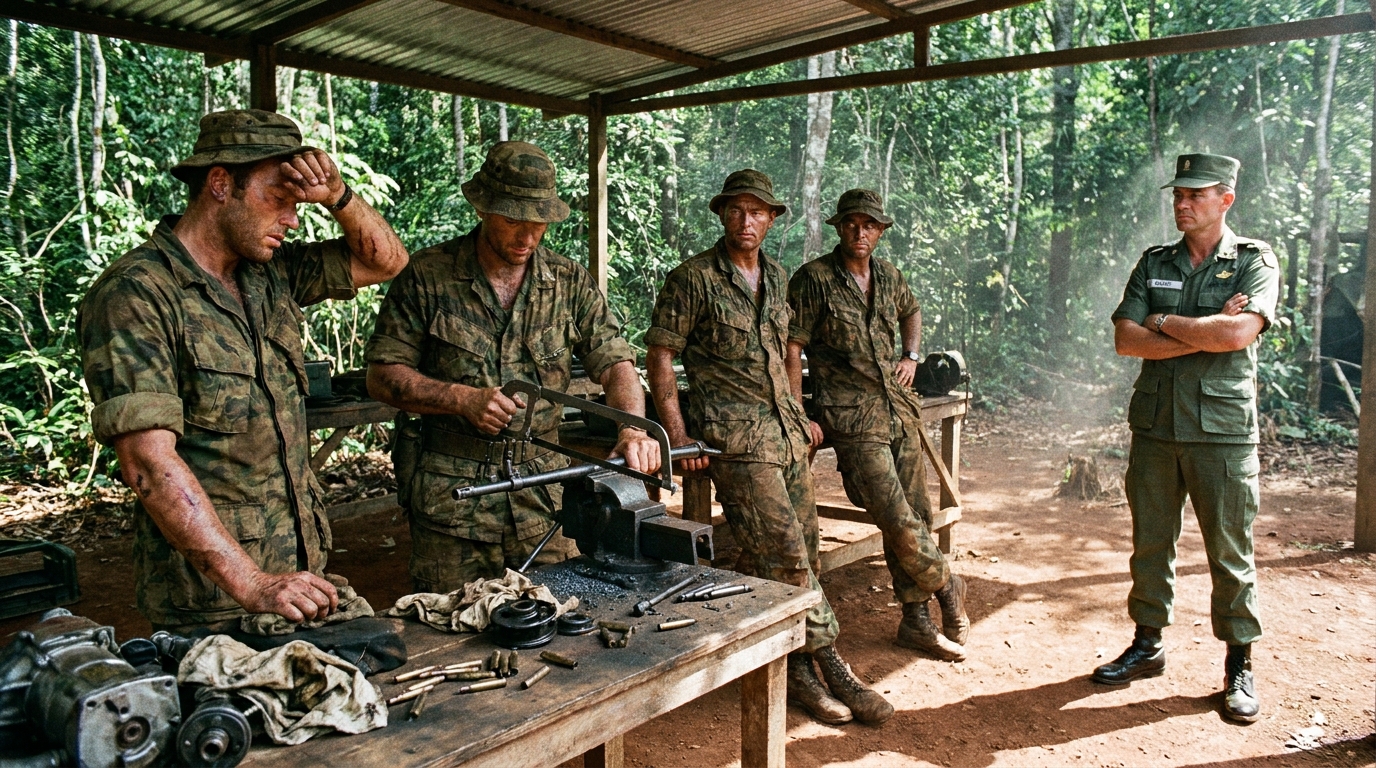
A cluster of Australian SAS troopers sat outside a corrugated tin garage, paying the incoming helicopter precisely zero attention. Vance covered his nose with a gloved hand, his stomach turning at the aggressive, multi-layered stench of decomposition, wet earth, and unwashed skin. It was an absolute affront to field discipline. He marched straight toward them, his boots grinding loudly against the gravel, fully intending to read the senior man the riot act on basic military sanitation.
The nearest trooper didn’t look up. He was clamping the barrel of a heavy self-loading rifle into a vice, a greasy tool gripped tightly in his calloused hand. Next to him lay a crude, heavily notched hacksaw blade covered in dark iron filings. A pile of discarded metal shavings sat on the dirt like iron dandruff.
“You men clear on the regulations regarding camp hygiene and equipment modification?” Vance barked, his voice cutting through the humid air with sharp authority.
The Australian sergeant slowly lifted his head, wiping a bead of oily sweat from his forehead with the back of a scarred forearm. He didn’t blink. He didn’t stand to salute. He simply looked past Vance’s immaculate insignia as if the major were a minor atmospheric annoyance.
“We’re clearing brush, Major,” the sergeant said, his voice a low, raspy gravel that carried no hint of deference. “And your cologne is carrying a mile down the trail.”
CHAPTER 2: THE HUNDRED METER HOUR
The metallic rasp of the blade stopped abruptly. The Australian sergeant didn’t wipe the sweat from his eyes; he simply blew a thin line of iron dust off the freshly shortened muzzle.
Major Vance shifted his weight in the red mud, crossing his arms with a rigid, defensive snap. “You are deliberately destroying government-issued hardware,” he said, his voice dropping into a tight, controlled register. “Command back in Saigon wants precision at four hundred meters, not a collection of rusty carbines that look like scrap metal.”
The sergeant didn’t look up from his work, his calloused thumb running slowly over the jagged, newly cut edge of the barrel. “At four hundred meters in this canopy, Major, you are shooting at ghosts you cannot see,” he said quietly, his tone devoid of anger. “A long barrel catches every vine between here and the tree line. Every snag makes a snap. Every snap makes a grave.”
Vance exhaled a sharp breath, his starched collar chafing against his skin in the suffocating heat. He reached down instinctively to adjust his pristine field cap, but stopped his hand halfway. The silence in the base was unnatural; there were no marching drills, no loud orders echoing across the gravel, only the rhythmic, methodical clicking of weapons being stripped and re-assembled with absolute, terrifying economy.
“We move at three kilometers a day minimum,” Vance pressed, relying on the doctrine he had memorized like scripture. “Speed dictates initiative. If you crawl through the brush like insects, you surrender the territory.”
The sergeant finally raised his gaze, his eyes flat and heavy with a exhaustion that transcended physical tiredness. “Try moving three kilometers a day when the trees are watching you,” he muttered, standing up from the workbench with a low groan. “Come outside. Let me show you what speed actually buys you in this province.”
They walked out past the perimeter wire toward the ragged edge of the jungle wall where the emerald shadows swallowed the sunlight whole. Four troopers stood waiting in the oppressive humidity, their uniforms caked in dried mud, their skin darkened by weeks under a sun they could barely see. They carried no heavy packs, no gleaming canteens, no sweet-smelling insect repellent. They smelled entirely of the damp earth beneath their boots.
The point man took a single step forward, his boot descending with absolute, mathematical silence onto a rotting root that should have snapped under twenty pounds of pressure. Then he froze.
The entire patrol stopped dead. Not a shoulder twitched. Not a head turned. For four agonizing minutes, the four men simply melted into the surrounding foliage, blending seamlessly into the green decay. Vance watched closely, his hand instinctively reaching for his sidearm holster out of sheer nervous tension.
A bird called out in the canopy overhead, undisturbed by their presence.
After what felt like an hour, the point man took another single, silent step, disappearing twenty inches deeper into the green shadows without a single rustle of a leaf. The sergeant stood beside Vance, his voice barely a breath above the hum of the cicadas. “That is a hundred meters an hour, Major,” he whispered. “You cannot ambush what has already stopped existing.”
CHAPTER 3: THE IGNORED WARNING
The oil lamp on the desk flickered, casting long, wavering shadows across the canvas walls of the command tent. Major Vance stared down at his own handwriting, the ink still smelling faintly of fresh petroleum. Every word in the report outlined the terrifying efficiency of the Australian methods—the scent elimination, the short-barreled rifles, the absolute mastery of slow, silent movement. He had spent three grueling days documenting every detail, convinced that upper command would demand an immediate doctrinal overhaul once they saw the casualty data from Phuoc Tuy province.
A heavy pair of polished boots crunched on the gravel outside, stopping abruptly at the tent flap. Colonel Harrison ducked inside, his uniform bearing the pristine creases of a desk officer who rarely ventured beyond the perimeter wire. He didn’t offer a greeting; he simply dropped a thick red stamp onto the corner of the desk with a dry, flat thud.
“What is this garrison gossip, Vance?” Harrison muttered, tapping a gloved finger against the cover of the report. “You’re suggesting the 173rd Airborne is running patrols wrong because some colonials in ragged sandals told you so?”
Vance stood up slowly, the wood of his chair scraping against the bare floorboards. “Sir, the numbers don’t lie. Their kill-to-loss ratio is fifty to one while our sectors average twelve to one. The Viet Cong cannot track them because they leave no signature.”
Harrison let out a short, dismissive laugh, shaking his head as he reached for a cigarette. “We didn’t win two world wars by creeping around the undergrowth like frightened children, Major. We rely on firepower, logistics, and standard operational pacing. That’s what discipline looks like.”
“Discipline that smells like sweet tobacco and industrial soap from a kilometer away,” Vance shot back, his voice dropping into a harsh, controlled whisper. “The enemy is waiting for us because our doctrine announces our arrival before our boots even touch the clearing.”
Harrison’s face hardened, the cigarette pausing halfway to his lips. He picked up the clipboard, flipped the top page without reading a single line, and dropped it into the metal burn bin beside the desk.
“File closed, Major,” Harrison said coldly, turning toward the flap. “Focus your energy on standard company deployment schedules in Phuoc Tuy. Let the Australians play in the mud; we have a war to run.”
The metal lid of the burn bin slid shut with a definitive, hollow echo, leaving Vance staring at a cold, gray plume of smoke that never had a chance to rise.
CHAPTER 4: THE LSHAPED SILENCE
The air in the Phuoc Tuy clearing felt instantly heavy, choked with the unmistakable metallic tang of burnt propellant. Captain Miller dropped flat against the damp earth, his fingers clawing into the decaying roots as heavy automatic rounds chewed through the bamboo stalks three feet above his head. His company had marched straight down the marked trail like a parade float, moving at standard military speed with starched uniforms smelling faintly of sweet Virginia tobacco.
The ambush closed around them with geometric precision, forming an unbreakable L-shaped wall of fire.
“Return fire! Locate those muzzle flashes!” Miller shouted into his handset, his voice cracking against the continuous roar of enemy rocket-propelled grenades.
Around him, twenty-three paratroopers were already pinned behind rotting logs that offered zero ballistic protection against heavy rounds. There was no tactical breathing room, no slow movement, no environmental awareness—just a desperate, chaotic scramble to feed magazines into weapons that were fouling instantly in the fine, abrasive red mud. Miller reached blindly for his radio handset to demand immediate artillery support, his thumb pressing the transmission key with frantic urgency.
The handset squawked back a wall of static.
The heavy command relay stationed back at the base was out of range, blocked by miles of dense, unbroken jungle ridges that standard deployment maps had completely failed to account for. Without high-altitude radio repeaters or pre-cleared coordinates, his entire heavy support network had vanished into thin air.
A fresh wave of automatic fire stitched across the clearing, forcing Miller’s face deeper into the dirt as another soldier crumpled three feet to his left. The enemy wasn’t guessing where they were; the enemy had been waiting for them for thirty minutes, tracking their scent and their speed with absolute, chilling ease.
Miller realized with a cold shock of pure terror that his firepower was completely useless against targets he couldn’t see, and his radios were dead weight in a killing zone designed specifically for American doctrine.
CHAPTER 5: THE NINETYTHREE MINUTES
The relentless roar of automatic weapons filled the clearing, shaking loose fragments of bark and rotting leaves that rained down on the wounded paratroopers. Miller wiped a streak of greasy mud across his forehead, his breathing coming in ragged, shallow gasps as another soldier fell back against a rotting stump. They had held out for over an hour, expending thousands of rounds against shadows and empty ridges while the enemy’s prepared positions remained utterly untouched by their blind suppressive fire.
The perimeter was shrinking by the minute, compressed by an invisible force that demanded absolute submission.
Miller’s hand trembled as he gripped the handset once more, his pride burning away in the suffocating heat of the killing zone. There was no tactical alternative left, no flanking maneuver to execute, and no high command coming to save them from a doctrine built on arrogance. He had to look past the protocol he had sworn to uphold and reach out to the very men he and his peers had mocked just days before in the dust of Nui Dat.
He keyed the tactical frequency, his voice tight, raw, and stripped of all military vanity.
“Australian patrol—this is Captain Miller,” he transmitted, the words catching in his dry throat as a rocket-propelled grenade detonated thirty yards away. “We are compromised in the western sector of Phuoc Tuy. Casualties are heavy and we cannot break the perimeter.”
The radio hissed with static for three agonizing seconds before a slow, raspy voice broke through the noise. It wasn’t an expression of surprise or pity; it was the cold, flat tone of a professional assessing an amateur’s mess.
“We hear you, Captain,” the Australian sergeant replied smoothly over the crackle. “We’re two kilometers out. But we move at a hundred meters an hour, and we won’t run into a trap just because you’re in a hurry.”
Miller slammed his fist against the root in pure, impotent fury, his face flushing dark red in the humid air. “My men are dying right now!” he shouted into the mic, his composure entirely fracturing. “You need to move twice as fast—double-time it across the ridge!”
“If we run, we get spotted, and then there are four more bodies for you to count,” the sergeant’s voice came back, steady and unyielding. “Sit tight, keep your heads in the dirt, and let us work the perimeter the right way.”
The transmission cut dead, leaving Miller alone with the deafening chatter of enemy fire and ninety-three agonizing minutes of waiting for ghosts who refused to rush.
CHAPTER 6: THE GHOST PERIMETER
Four figures materialized out of the dense green undergrowth without a single snap of a branch or a rustle of damp foliage. They carried short-barreled rifles, wore sandals carved from automobile tires, and smelled entirely of earth and wet vegetation. The Australian sergeant raised a single scarred hand, signaling his team to freeze directly inside the outer ring of the Viet Cong battalion perimeter.
Two hundred enemy fighters stood focused entirely on the American killing zone fifty yards to the west, completely unaware that death had just walked past their sentries.
The sergeant pulled a greasy field pencil from his pocket, his gaze fixed on the enemy command bunker thirty-five meters ahead. He didn’t waste time on radio protocol or bureaucratic clearance; he simply read the terrain, calculated the exact range, and relayed the first coordinate correction directly to the pinned American frequency.
A single heavy mortar round dropped from the sky with zero preliminary whistle, impacting squarely on the enemy command post in a devastating flash of orange and gray.
The command bunker collapsed inward in a heartbeat, neutralizing the officers directing the ambush before a single order could be reissued.
“Shift left—target the heavy machine gun nest by the fallen bamboo,” the sergeant muttered into his handset, his voice as calm as if he were ordering tea.
The second correction landed with surgical, punishing accuracy, permanently silencing the weapon that had been chewing through Captain Miller’s company. Within eighteen minutes, the entire enemy position unraveled from the inside out under a barrage of precise coordinates delivered by men who shouldn’t even have been there. The surviving enemy fighters scattered into the smoke, abandoning their positions and leaving the jungle entirely to the silence that followed.
Back at Nui Dat days later, Colonel Harrison slammed a fresh stack of sanitized after-action reports onto his desk, his face tight with controlled rage as he tried to bury the incident before Saigon caught wind of it.
Major Vance didn’t blink or step back. He reached across the polished wood, picked up the official report detailing the fifty-to-one kill ratios, and dropped it squarely onto the colonel’s ink blotter.
“You can stamp ‘classified’ on the file all you want, Colonel,” Vance said quietly, his voice carrying the immovable weight of a hard-earned truth. “The dead men aren’t reading your regulations anymore, and the jungle doesn’t care about your doctrine.”
Harrison opened his mouth to bark a reprimand, but the words died in his throat as he looked at the cold, steady glare of an officer who had finally learned what survival actually cost.
The burn bin beside the desk remained empty, its metal lid cold and open to the damp air.