The Weight of a Coffee Cup: How an Unexpected Alliance and Quiet Resolve Restored a Veteran’s Home
CHAPTER 1: The Diner Confrontation
The spoon shook against the ceramic rim, a sharp, rhythmic clink that betrayed the exhaustion in Walter’s hands. He kept his gaze locked on the worn grain of the wooden table, his fingers curled tight around a manila envelope.
Across the room, the low thunder of heavy engines died away, replaced by the heavy boots of men walking with unhurried authority. Walter didn’t look up as the leather vests settled into the corner booth, but his shoulders squared with a sudden, rigid discipline.
“Sir,” Walter said, his voice dropping into the quiet space between tables as he stood up. “I know this is strange.”
Cole looked up from his black coffee, his gray eyes measuring the old soldier without a flicker of judgment. The silence in the diner stretched thin, every regular holding their breath as Walter laid out his desperate plea under the heavy weight of impending manipulation.
Lena moved instantly from behind the counter, sliding between the booths to drop a warning murmur about the predatory papers waiting at the door. Cole stood, his leather jacket creaking, and tossed an arm over Walter’s frail shoulders with an easy, protective weight.
“Sit down, Dad,” Cole said, loud enough to anchor the room. “We were just waiting for you.”
CHAPTER 2: The Cedar Lane Convoy
The old Chevrolet crawled down Cedar Lane at a deliberate pace, flanked on either side by chrome and polished steel. Walter kept his eyes fixed on the rearview mirror, watching the massive rear tire of Cole’s machine roll in time with his own axle.
Front curtains fluttered across the street as Mrs. Gable peeked through her lace, her gaze snapping instantly from the pristine lawns to the low-slung leather vests escorting her neighbor home. Walter didn’t wave; his knuckles stayed welded to the rubber wheel, sore from months of white-knuckled stress.
The convoy rolled into the gravel driveway with a crunch of loose stone that felt less like a visit and more like a garrison taking the hill. Cole cut his engine first, the sudden mechanical silence ringing loudly in the humid afternoon air.
Walter killed his ignition, the old motor shuddering once before dying. He reached for the door handle, but the latch clicked open before his fingers even curled around it.
A broad-shouldered rider named Miller stood outside, already testing the loose gate hinge with a heavy wrench pulled from a saddlebag. “Latch was chewing up the wood,” Miller muttered, not looking up as he tightened the screw with two sharp twists. “Wind would’ve taken it off by winter.”
Walter stepped out onto the worn concrete path, his boots sinking slightly into the damp grass near the porch steps. “I meant to fix that,” he said, his voice dry.
“Doesn’t matter now,” Cole said, walking up the steps with his helmet tucked under his arm. He didn’t wait for an invitation; he checked the heavy brass deadbolt on the front door with a firm press of his thumb.
The door gave a half-inch before catching solid. “Needs a longer strike plate,” Cole noted, his eyes scanning the shadowed corners of the porch where a delivery box sat half-hidden behind a potted fern.
Walter stepped past him into the dim hallway, the familiar smell of old paper and peppermint hitting him like a physical weight. He reached into his coat pocket for his keys, but stopped short as a folded piece of crisp, unfamiliar stationery fluttered out from the mail slot onto the floorboards.
It wasn’t a bill. It was a thick sheet of heavy bond paper bearing the embossed header of a medical evaluation clinic three counties over—a place Walter had never visited in his life.
Cole knelt down, his leather vest creaking against his ribs, and picked up the paper without unfolding it. “Evan didn’t drop this,” Cole said quietly, his thumb rubbing the sharp edge of the letterhead. “Someone else was already here checking the locks.”
CHAPTER 3: The Broken Pipe
Walter dropped his keys onto the small wooden entryway table with a hollow clatter.
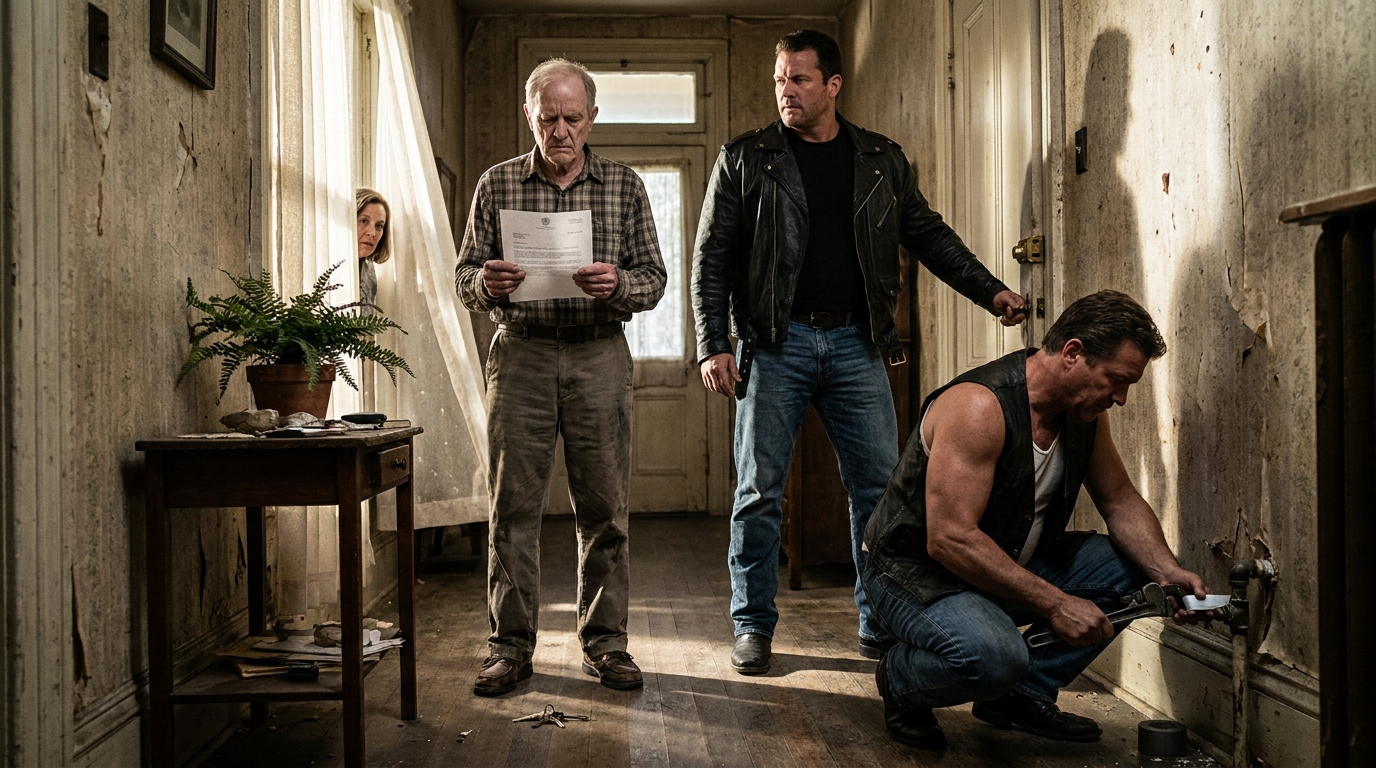
The low rumble of water spraying against the wooden cabinet beneath the sink cut short any thought of unpacking. Walter stared down the narrow hallway, his arthritis aching with the sudden realization that his ancient plumbing had chosen the absolute worst afternoon to fail.
Miller tossed his heavy wrench back into his leather saddlebag by the front door, the metal tools clinking with flat utility. “Copper line’s split at the elbow,” Miller called out, striding past Cole without waiting for an invitation. “Old solder finally gave up under the pressure.”
Walter knelt by the kitchen baseboard, watching a widening pool of gray water inch across the linoleum floor. He reached blindly for a rusted bucket under the basin, his fingers stiff and trembling against the damp plastic handle.
Cole didn’t offer empty words or pity. He dropped to one knee beside Walter, his heavy frame blocking the draft from the back door while his bare hands wrenched the under-sink shutoff valve clockwise until the metal shrieked in protest.
The spraying water choked down to a steady, useless drip. “Valve’s calcified,” Cole muttered, wiping a smudge of greasy rust across his forearm. “You’ve been nursing this house alone too long, old man.”
Walter let out a dry, rattling breath, the tension in his shoulders sagging an inch as he looked at the wet floorboards. “I didn’t want to bother anyone,” Walter said, his voice tightening with defensive pride.
“Bothering people is what family does when things break,” Miller countered, already wrapping heavy rubber tape around the ruptured pipe with brutal, practiced efficiency.
Walter reached into his shirt pocket, his fingers brushing against the cold plastic of the prepaid emergency phone Cole had left him days ago. He hadn’t needed to press it for a broken pipe, because they were already here—fixing the damage before the water could ruin the subfloor.
The repair took less twenty minutes, silent and methodical, stripped of any hollow praise or dramatic speeches. But as Miller packed his tools away, the crisp out-of-town medical letterhead still lay flat and accusing on the entryway table.
CHAPTER 4: The Hidden Forgery
Walter picked up the heavy bond paper, his thumb catching on the embossed seal of a medical facility three counties away.
He hadn’t signed anything from that clinic, nor had he ever traveled there for an evaluation. The ink was fresh, printed with a digital sharpness that stood out against his own faded utility bills.
Cole stepped up behind him, the smell of machine oil and cool evening air following him from the porch. “Look at the signature line,” Cole said, pointing a thick finger at the bottom corner of the document. “That’s not your hand.”
Walter squinted at the sprawling script scrawled across the dotted line. It was a crude imitation of his old, blocky infantry signature, dashed off in a hurry by someone who didn’t know how deep his hand tremors actually ran.
“Evan didn’t just want power of attorney,” Walter muttered, a cold realization settling into his chest. “He needed a clean bill of health on paper to clear the title on the property before the bank called.”
The pieces clicked into place with the heavy weight of absolute common sense. Evan wasn’t trying to look after an aging relative; he was drowning in personal debt and running out of time to liquidate an asset that didn’t belong to him.
Miller leaned against the doorframe, crossing his arms over his leather vest with a low grunt. “We take this to the local registrar tomorrow morning,” Miller said. “Before he tries to file it downtown.”
Walter shook his head slowly, sliding the forged letter back onto the scarred wood. “They won’t look at it without a formal challenge, and I can’t afford a lawyer to walk it through.”
Cole rolled a scarred coin between his knuckles, the metallic click breaking the heavy silence of the hallway. “Who said anything about lawyers?” Cole asked quietly. “We’ll deliver it ourselves.”
CHAPTER 5: The Clubhouse Dinner
The heavy scent of slow-cooked chili and woodsmoke hung thick in the rafters of the converted machine shop.
Walter sat at the long wooden trestle table, his fingers wrapped around a heavy ceramic mug of black coffee that had long since cooled.
Around him, the low rumble of gravel-rough voices rose and fell, discussing engine blocks, winter weather, and local township politics with unhurried ease. No one asked him about the papers in his pocket or the legal threats hanging over his fence line.
Miller set a heavy iron Dutch oven down in the center of the table with a dull thud, steam billowing up toward the exposed rafters. “Eat up, old man,” Miller said, dropping a ladle beside the pot. “You’ve been burning daylight worrying over things that don’t belong to you.”
Walter scooped a generous portion into his bowl, his hands steady for the first time in months. He looked down the table at Cole, who sat carving a piece of cornbread with a pocketknife, his gray eyes catching the amber glow of the overhead lamps.
“I never had a crew like this,” Walter said quietly, his voice cutting through the clatter of silverware. “Back in the infantry, you had your squad, but when the discharge papers cleared, you were on your own island.”
Cole paused his knife, laying it flat against the wood before looking up. “The service teaches you how to stand watch,” Cole said, his voice dropping into that immovable register. “It forgets to teach you how to put the rifle down when you get home.”
Walter swallowed hard, feeling the tight knot in his chest loosen against the steady hum of brotherhood surrounding him. “I didn’t think anyone would notice if I vanished,” Walter admitted, staring into his ceramic bowl.
“We noticed,” Cole replied, picking his knife back up. “And tomorrow morning, we finish what we started.”
CHAPTER 6: The Golden Porch
The afternoon sun burned low and amber across the front lawn of Cedar Lane, casting long shadows over the freshly tightened gate hinge.
Walter sat rocking gently in his wooden porch chair, watching the distant asphalt ribbon where the highway met the horizon.
The heavy binder containing Evan’s forged documents sat buried deep at the bottom of the municipal burn barrel behind the garage, reduced to grey ash weeks ago when the title office quietly rejected the fraudulent filing. Evan had packed up his belongings under the cover of a Tuesday morning rainstorm, his financial ruin complete and his leverage entirely dissolved under the weight of his own overreach.
Cole stepped up onto the wooden planks, his heavy boots muted by the weathered boards, carrying two steaming mugs of black coffee. He handed one down without a word, settling into the adjacent chair with a slow, bone-deep sigh.
“Trees are turning early this year,” Cole noted, blowing a thin trail of steam across the rim of his cup.
Walter took a slow sip, tasting the familiar bitterness that grounded him squarely in the present moment. “Always do when the frost comes in sharp,” Walter replied, his voice steady and clear.
Down the street, the familiar deep rumble of heavy exhaust echoed against the maple trees as the evening convoy rolled into view, pulling up neatly along the curb in front of the house.
Walter didn’t tense, and he didn’t look for an escape hatch; he simply watched his friends cut their engines, stepping out into the fading twilight to share an ordinary evening with a man who was no longer alone.