The Old Janitor’s Crude Arm Tattoo Held a Secret That Shattered a Navy Commander’s Career
CHAPTER 1: THE BUFFER STOP
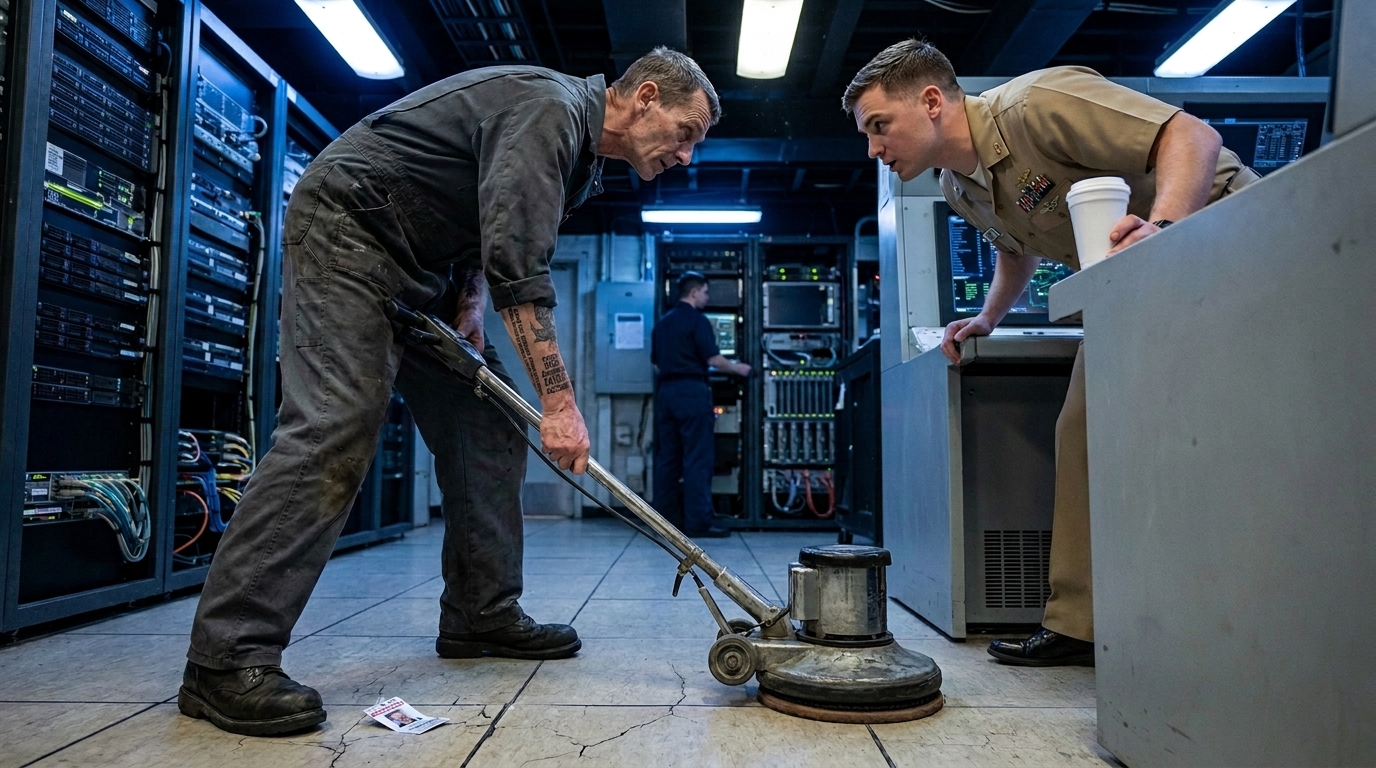
The heavy industrial buffer vibrated in steady, rhythmic pulses through Harold Beck’s worn palms. The blue LED arrays of the naval server banks cast a cold, clinical glare across the fresh linoleum, reflecting the slow, deliberate arc of his machine. At eighty-two, Harold knew how to let the weight of the floor buffer do the labor. He kept his feet shoulder-width apart, his spine locked against the ache that had lived in his lower back since the central highlands in ’68.
“Is that supposed to be a snake? Or did a toddler get hold of a Sharpie while you were passing out drunk?”
The voice cracked over the hum of the cooling fans. Harold didn’t raise his head. He kept his grip firm on the rubber handles, thumb resting near the brass vibration-control knob. Silence was free, and in fifty years, Harold had never seen a man buy anything useful by talking over an engine.
A pair of pristine dress oxfords stepped directly into his path, stopping two inches short of the spinning pad.
Lt. Commander Vance stood there holding a styrofoam cup, his uniform pressed so sharp the creases looked like weaponized paper. He pointed a manicured finger toward Harold’s rolled coverall sleeve, where the faded, grey-black ink of a diamond, a jagged bolt, and three crooked dots sat embedded in the crepe paper skin of his inner forearm.
“Hey. I’m talking to you, Pops,” Vance said, his tone dropping into the clipped, flat cadence of an officer accustomed to room-wide compliance. “I asked about the ink. That scratch pad garbage looks like gang tagging, and this deck has a standard.”
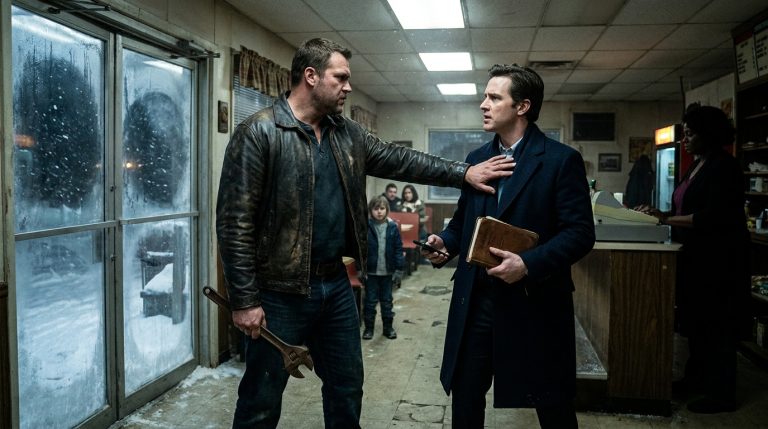
Harold clicked the safety switch. The buffer’s motor whined down to a dead stop, leaving only the sterile whisper of the server racks. He straightened slowly, the vertebrae in his back popping in a muted, familiar sequence. He didn’t shrink back. He didn’t reach down to pull his sleeve over the mark.
“It’s just a mark, sir,” Harold said softly, his voice rough as unpaved gravel. “Just a reminder.”
“A reminder of what? Bad choices in a state pen?” Vance scoffed, glancing over his shoulder toward two junior ensigns standing by the main tactical display. Ensign Miller shifted her weight awkwardly, her eyes dropping to her console, but Vance was already leaning closer. “The contract maintenance code calls for professional presentation on the command deck. Roll your sleeves down. I don’t want to look at prison tats while coordinating fleet logistics.”
“Safety protocol four-ten for heavy deck equipment requires exposed forearms,” Harold replied, his tone entirely devoid of heat. “Prevents loose fabric from catching the drive belt. The base civilian maintenance contract follows standard OSHA compliance.”
Vance’s face hardened instantly. The subtle smirk vanished, replaced by the tight, white-hot irritation of a middle-management authority figure whose authority had just been measured against a handbook. He set his coffee cup on top of a nearby server housing with a sharp clack.
“Are you quoting civilian maintenance codes to the watch officer of this deck?” Vance stepped into Harold’s personal space, the smell of expensive aftershave cutting through the floor wax. “Your job is to clean the linoleum, old man. Not to debate uniform standards with me. In fact, I’m questioning your clearance right now. If you’ve got gang affiliations, you’re a security risk.”
“I’ve worked this floor fifteen years,” Harold said. His boots remained anchored to the white tile, his hands resting on the rubber grips of his machine. “Clearance is checked every October.”
“Miller,” Vance barked without turning around. “Run his badge ID. I want to know if admin fell asleep or if this guy is trespassing in an inner sanctum.”
Ensign Miller hesitated, her fingers hovering above her touchscreen. “Sir, Mr. Beck clears the deck every Tuesday—”
“Check the badge, Ensign. That’s an order.”
Harold stood motionless as the young woman stepped forward, her face flushed with quiet embarrassment as she scanned the laminated badge clipped to his breast pocket. He didn’t look at her. He kept his eyes fixed on a hairline crack in the concrete beneath the linoleum, right where the server rack met the floor frame. The phantom ache in his forearm throbbed—not from anger, but from the memory of cold mud, shaking hands, and the smell of burnt powder.
“Badge comes back valid, sir,” Miller reported quietly. “Level four maintenance access. Authorized by base infrastructure command.”
Vance snatched the tablet from her hand, squinted at the green verification light, and let out a dry, dismissive breath. “A clerical error. Probably mopped the right hallway twenty years ago.” He grabbed Harold’s clipped badge, tore it off the red coveralls with a sharp jerk, and tossed it to the floor.
The plastic card bounced twice against the white tile, stopping at the edge of Harold’s work boot.
“Pick it up,” Vance commanded, his eyes cold. “Then pack your buffer and get off my deck. I’m revoking your deck access pending a full security review. I don’t like your tone, and I don’t like the trash on your arm.”
Harold didn’t move. He looked down at the badge, then looked up, meeting Vance’s eyes with the calm, immovable stillness of a granite wall.
“I have a job to finish, sir,” Harold said evenly. “And the floor isn’t done.”
CHAPTER 2: PAPERWORK COLD REGS
The silence in the command center stretched until the hum of the cooling racks sounded like a distant furnace. Vance stood over the dropped plastic card, his jaw working as if trying to chew through a bad taste.
“You’re making a mistake, old man,” Vance said, his voice dropping into a flat, deadly whisper. “Pick it up and walk out, or I call the master-at-arms and have you dragged off base in cuffs.”
“I don’t need to be dragged,” Harold said softly. He didn’t bend down. He didn’t reach for the badge. Instead, he reached over to the brass vibration-control knob on the buffer’s handle and gave it a quarter-turn, locking the mechanical brake in place. “And you don’t need the MPs to clear a janitor, Commander. You just need to file a Form 409-C with Base Infrastructure.”
Vance’s left eye twitched—a tiny, involuntary spasm that cracked his pristine mask. “What are you talking about?”
“Level four maintenance access isn’t a civilian badge,” Harold said, keeping his eyes locked on Vance’s face. “It’s a structural oversight clearance. Signed by the Base Facilities Engineering Command. You pull a level four operator off this deck mid-shift without an immediate structural hazard report, and the automated system flags the entire command grid for an emergency audit.”
In the corner, Ensign Miller’s fingers flew across her terminal screen. Her eyes widened as the monitor flashed a bright yellow status warning.
“Sir…” Miller began, her voice tight with hesitation.
“Shut up, Miller,” Vance snapped without looking at her. He took a half-step closer to Harold, his polished shoes nearly touching the dropped badge. “He’s bluffing. He’s a guy with a mop who found a loop-hole in an old manual.”
“Check the terminal, Commander,” Miller insisted, her voice rising above her usual muted tone. “He’s not bluffing. The moment you flagged his badge ID for revocation without entering a code three hazard clearance, the main system locked the deck’s environmental safety logging. It’s an automated protocol.”
Vance turned slowly, his face flushing dark red. “Override it.”
“I can’t, sir. The system considers an unverified clearance revocation on a level four structural operator as an active infrastructure compromise. It’s freezing all non-essential administrative traffic on the server deck until Facilities verifies the floor load.”
Harold didn’t move an inch. He simply adjusted his grip on the buffer handle, feeling the faint, microscopic shudder of the building beneath his boots. The hairline crack in the concrete—running from the edge of the server rack right under the linoleum—seemed to sit right beneath the center of his weight.
“You think you’re clever, don’t you?” Vance turned back to Harold, his voice venomous. He pointed a trembling finger at the old man’s chest. “You think some fifty-year-old administrative loophole is going to save your job? I run this deck.”
“I don’t care about the job, son,” Harold said, his gravelly voice dropping an octave into absolute stone. “I care about the floor. And right now, you’re standing on something you don’t understand.”
Vance sneered, stepping directly onto the dropped plastic badge, the hard leather of his shoe grinding the laminated card into the floor tile. “I don’t give a damn about your floor, Harold. Get your gear off my deck.”
He reached out, grabbing the steel shaft of the heavy industrial buffer, intending to shove it toward the double doors.
“Don’t touch the frame,” Harold warned quietly.
Vance ignored him, yanking the handle with all his weight.
The heavy steel base of the buffer shifted two inches to the left. The rubber pad ground against the linoleum, right over the hairline fracture in the foundation. A low, dull thud reverberated through the concrete floor—not from the machine, but from deep within the concrete slab beneath them.
A sudden, sharp red warning light began to pulse silently on the primary server rack.
CHAPTER 3: THE FRACTURED FOUNDATION
“Release the handle, Commander,” Harold said. His voice didn’t rise, but the quiet weight behind it made Ensign Miller freeze behind her desk. “You’re dragging four hundred pounds of steel against a stress seam.”
“Don’t tell me what to touch!” Vance’s face contorted, a bead of sweat breaking through his hairline and running down his cheek. He yanked hard on the buffer frame again, attempting to violently wheel the machine away from his personal space.
The heavy iron pad scraped across the linoleum with a screech that tore through the server room. Beneath the tile, a muffled, metallic clack echoed up from the foundation—the sharp, unmistakable sound of a structural shear pin snapping under unaligned pressure.
Instantly, the quiet hum of the cooling racks shifted into a rising, high-pitched mechanical whine.
The pulsing red light on the primary rack locked into a solid, glaring beam. Across the entire deck, three secondary consoles flashed dark amber.
“What did you do?” Vance dropped his hand from the buffer as if the steel had turned red-hot. He stumbled back a step, his heel grinding into the shattered plastic of Harold’s badge. “What is that sound?”
“The floor under server rack four dropped three-eighths of an inch,” Harold said cleanly. He didn’t check the monitors. He didn’t look at the warning lights. He kept his eyes locked on the floor where the hairline crack emerged from beneath the linoleum. “That machine weighs four hundred pounds. You dragged it across an unreinforced utility trench.”
“Sir!” Ensign Miller’s chair rolled backward as she scrambled to her feet, her hands hovering frantically above her terminal. “The automated structural monitoring system just triggered a Level Two Deck Freeze. It’s registering a foundation displacement directly beneath the main communications array.”
“Clear the warning!” Vance shouted, his voice cracking into a shrill, desperate pitch. “It’s a glitch! The old man rammed the rack with his cleaning gear!”
“I haven’t moved this buffer in three minutes,” Harold said. He stepped forward, his heavy work boots planting firmly on either side of the fracture. “And the facility logs will show the vibration signatures. You pulled the machine off-balance while the motor axle was locked.”
“You set this up,” Vance hissed, stepping into Harold’s chest, his hands clenching into tight, trembling fists at his sides. “You brought this unsafe piece of junk onto my deck to sabotage my watch!”
“I brought standard issue maintenance equipment,” Harold replied, looking down at Vance’s chest. “You’re the one who refused to read the weight-load clearance tags stamped right on the chassis.”
“Miller, call security!” Vance roared, turning toward the console deck. “Tell them a civilian contractor deliberately compromised the server array foundation! I want him in restraints right now!”
“Security won’t clear the door, sir,” Miller said, her voice shaking as she pointed a cold, pale finger at the master terminal. “The moment the foundation sensor registered a shift over zero-point-two inches, the system initiated an automatic base-wide infrastructure lockout. Facilities Command and the Officer of the Day have already been pinged. They’re on the access elevator right now.”
Vance went completely rigid. The flush in his cheeks drained, leaving his face a mottled, grey mess. “They’re… what?”
“You wanted a security review for my tattoo, Commander,” Harold said softly, reaching out to give the brass control knob on his buffer one final, deliberate click to lock the safety pin. “Looks like you’re getting one for the floor.”
Vance whirled back toward Harold, his teeth bared in an envenomed sneer. “You think you won something, old man? I am an officer. You are a janitor with dirt under your nails. When the base commander steps through those doors, who do you think he’s going to believe?”
“He doesn’t have to believe either of us,” Harold said, leaning his hands back onto the rubber handles of his machine. “He just has to read the concrete.”
CHAPTER 4: THE FINAL INSPECTION
The double doors slid open with a heavy pneumatic hiss. Two civil engineering inspectors wearing high-visibility vests stepped onto the server deck, led by the base duty captain. Their eyes scanned the flashing amber terminals before landing directly on the red alert glowing above server rack four.
“What is the status of this deck?” the duty captain demanded, his voice echoing across the blue-lit room. “Facilities received an automated structural shear warning.”
Vance instantly stepped forward, gesturing aggressively at Harold. “Captain! I ordered this civilian contractor off the floor for a security infraction. He refused to comply, operated heavy machinery outside approved parameters, and rammed the buffer into the primary rack housing!”
Harold didn’t speak. He stood beside the buffer, his right sleeve still rolled up, revealing the faded ink of the diamond, the lightning bolt, and the three crooked dots.
“Ensign Miller,” the duty captain said, turning toward the console. “Read the system log.”
Miller swallowed hard, her eyes darting between Vance and the touchscreen. “Sir… vibration sensors indicate zero kinetic impact against the rack frame. The shear alarm was triggered by a four-hundred-pound lateral drag across the unreinforced foundation seam.”
“A lateral drag?” The lead inspector knelt by the base of the machine, pulling a high-powered inspection light from his belt. He shined the beam along the linoleum, tracing the dark rubber scuff mark that led directly from Vance’s dress shoes to the hairline fracture in the concrete. “Someone yanked an unpowered industrial buffer across the structural expansion joint while the wheel locks were engaged.”
The inspector looked up, his beam highlighting the crushed plastic of Harold’s badge pinned beneath Vance’s right heel.
“Commander Vance,” the inspector said quietly. “Did you attempt to manually move a four-hundred-pound locked unit across a flagged foundation grid?”
“The old man was insubordinate!” Vance shouted, his composure shattering as he pointed a trembling finger at Harold’s arm. “He’s wearing non-compliant markings! He cited civilian codes to an officer! I was removing an unauthorized distraction from my command deck!”
“That ‘distraction,'” the lead inspector said, standing up and opening a thick leather binder, “is the specific structural layout grid for the 1968 sub-floor ordnance survey. This base was built on an unexploded ammunition dump from the old artillery range.”
The room went dead silent. The cooling fans hummed softly in the background.
“The mark on Mr. Beck’s arm isn’t gang tagging, Commander,” the inspector continued, his voice cold and deliberate. “It’s the original surveyor’s map for the subterranean concrete cap beneath this exact server bay. The diamond marks the reinforced slab. The lightning bolt marks the live drainage channel. The three dots mark the original inspection anchor points.”
Vance’s mouth opened, but no sound came out. His face drained of all color, leaving him staring at the faded ink on Harold’s forearm as if seeing it for the first time.
“Mr. Beck holds a Level Four Master Structural Clearance because he is one of two people on this entire installation who knows how to operate heavy equipment over this foundation without triggering a structural collapse,” the duty captain said, stepping into Vance’s personal space. “You nearly compromised a fifty-million-dollar server array because you didn’t like the look of a veteran’s forearm.”
“Captain, I—I was enforcing uniform standards—” Vance stammered, stepping back, his boot sliding off the crushed badge.
“You are relieved of deck duty, Lieutenant Commander,” the captain cut in sharply. “Report to administrative headquarters immediately. Pending a full inquiry into gross negligence and destruction of base property.”
Vance stood frozen for two seconds, looking at the ensigns, the inspectors, and finally at Harold. No one moved. No one spoke. Lowering his head, Vance turned and walked toward the exit, his pristine shoes clicking softly against the polished linoleum until the double doors sealed behind him.
The lead inspector turned to Harold, offering a brief, respectful nod. “Appreciate you keeping the machine still, Mr. Beck. Could have been a mess.”
“Just doing the job,” Harold said softly.
He reached down, picked up his crushed badge from the floor, and wiped the dust off the plastic with his thumb. Re-clipping it to his red coveralls, he turned the brass vibration-control knob on the buffer, releasing the wheel lock.
The motor hummed to life, a low, steady rhythm returning to the quiet server room. Harold guided the machine in a slow, precise arc over the linoleum, smoothing over the rubber scuff marks until the floor reflected the blue lights like clear, still water.