The Old Man in Seat 14B and the Cockpit Built for Two Dead Pilots
CHAPTER 1: THE BREACH AT 34000 FEET
The Boeing 777 dropped four hundred feet in a single breath, the airframe groaning like a cold iron bridge under a freight train.
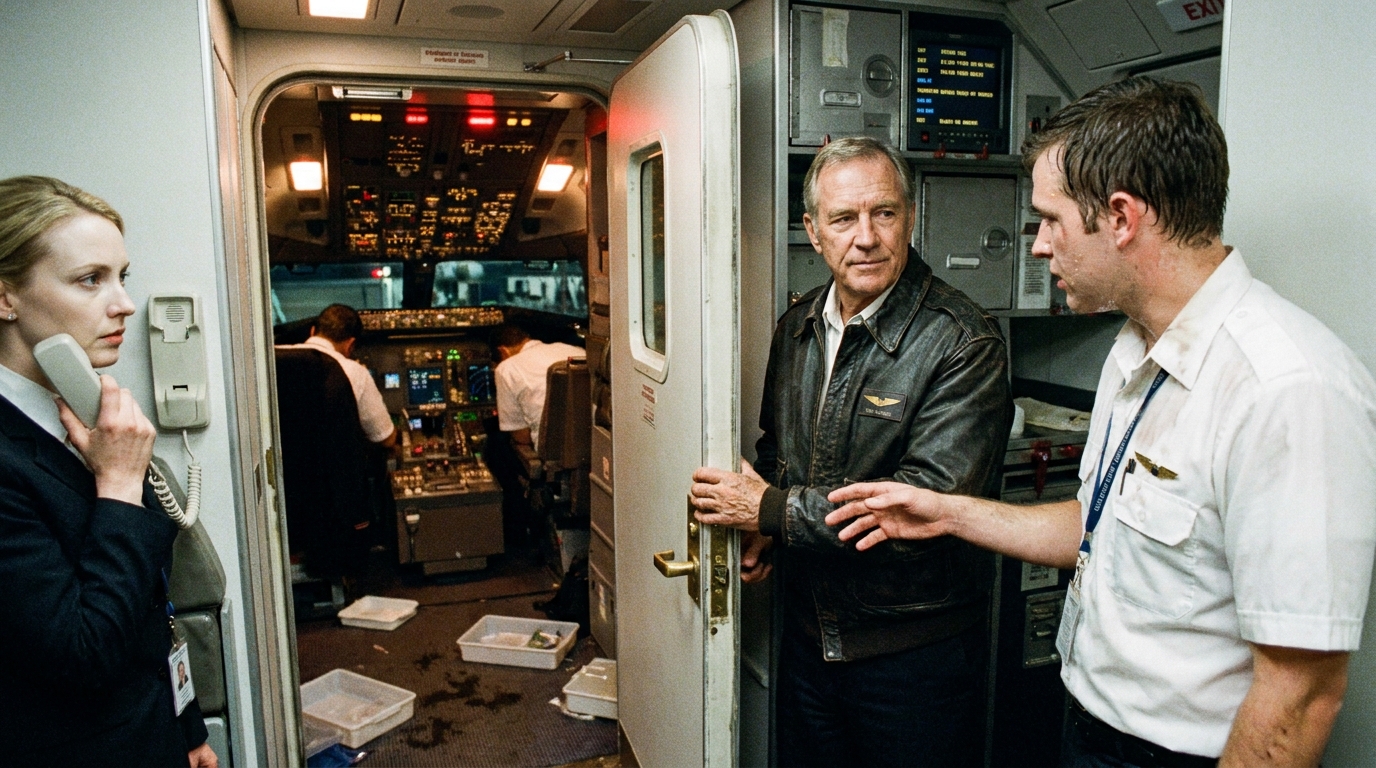
In the narrow galley forward of seat 14B, plastic service trays exploded against the ceiling. Norman Randall did not grab the overhead bins. He adjusted his weight, planting his worn work boots wide on the carpet, his calloused thumb resting against the brass zip-toggle of his leather jacket.
“Sir, you need to return to your seat right now,” Kyle said, his voice high and thin, pinched with the sharp edge of panic. The kid’s name tag—Lead Flight Attendant—was pinned slightly crooked across a stiff white collar that had gone soaked with sweat. “This is a restricted area.”
Norman didn’t look at the kid’s face. He looked past his shoulder, through the open cockpit door.
Inside, the center console was a Christmas tree of yellow warning boxes. The co-pilot was slumping sideways against the throttle quadrant, his chin resting uselessly against his collarbone. Beyond him, the captain’s head was pinned back against the cold glass of the port window, unmoving.
“Your altitude is unwinding,” Norman said. His voice was a flat, low rasp, rasped dry by sixty years of inhaled kerosene and cold air. “And your autopilot is hunting.”
“I am the authority on this aircraft!” Kyle stepped into the narrow frame of the doorway, puffing his chest, his hands trembling as he reached out to shove Norman’s chest. “We have procedures! We have radioed for ground protocol! You are an unauthorized passenger—”
Norman caught the kid’s wrist before the palm made contact. He didn’t twist it. He just held it, his fingers like rusted iron clamps, letting the kid feel the dead weight of sixty years of manual labor.
“You’re at thirty-four thousand feet, son,” Norman said, his eyes staying level on the flashing flight display inside the cabin. “And your procedures are about three minutes away from digging a hole in the dirt.”
The nose pitched down sharply. A collective, shrill scream ripped forward from the economy cabin, followed immediately by the harsh, mechanical wail of the master caution horn.
CLACK. CLACK. CLACK.
Behind the main instrument panel, a tiny, rhythmic metallic click stuttered through the floorboards—four seconds apart, precise and wrong.
Norman let go of the kid’s wrist, stepped over the co-pilot’s trailing foot, and dropped his old frame into the left-hand seat.
“Get out of the doorway,” Norman grunted, his fingers wrapping around the cold rubber grip of the control yoke. “And close that damn door behind you.”
CHAPTER 2: COLD METAL AND DEAD INSTRUMENTS
Behind me, the cockpit door slammed shut, but the brass latch didn’t drop.
Kyle’s face appeared in the narrow reinforced glass window of the door, flushed red, his mouth twisting as he pounded a fist against the double-paned acrylic. He was yelling something through the soundproof seal, pointing frantically at his chest, then at the keypad beside the frame.
I didn’t waste oxygen looking back at him. My left thumb flicked the master autopilot disconnect toggle on the yoke.
The piercing dual-tone alarm cut off instantly, replaced by the deep, hollow roar of thirty thousand pounds of air tearing across cold aluminum. The cockpit got quiet—the kind of dangerous quiet that comes right before the structural rivets start to shear.
The primary flight display was a mess of amber text. FMS-1 OFFLINE. ALT HOLD FAIL. SPEED BRAKE AUTO-DEPLOY.
“You’re not flying it,” I muttered to the empty cabin, pulling back on the yoke with steady, even pressure. “You’re fighting it.”
The controls were heavy. Far too heavy. A three-hundred-thousand-pound jet on a clean glide path shouldn’t feel like hauling a dead mule out of a frozen ditch. My biceps burned, the strain radiating up into the old scar tissue on my shoulder.
CLACK. CLACK. CLACK.
There it was again. Every four seconds, precise as a pulse. Beneath the center pedestal, near the mechanical trim wheels, something was slipping.
The digital artificial horizon leveled off for two seconds, then began a slow, stubborn creep back toward the blue sky below us. The automated flight computer was sending signals to pitch the nose down, overriding the manual cable tension.
The keypad on the door outside beeped three times. Red light to green. Kyle had remembered the emergency access code.
I reached out with my left foot without turning around and kicked the co-pilot’s heavy leather flight bag off the pedestal, wedging it firmly into the gap beneath the door’s lower lever. The handle clicked down half an inch, hit the heavy ballistic nylon of the bag, and jammed tight.
Outside, Kyle threw his full weight against the frame. The door rattled, but the frame held.
“Stay out there, kid,” I said, my knuckles turning chalk-white as I pulled the control yoke back another two inches against the rising mechanical resistance. “You’re safer behind the lock.”
The starboard engine surged again, a high-pitched metallic whine vibrating through the floorboards as the digital telemetry tried to correct a speed error that didn’t exist. The plane was throwing a fit, locked in a digital loop, convinced it was five thousand feet higher than the cold fog outside suggested.
I reached down and grabbed the manual pitch-trim wheel beside my right knee, wrapping my fingers around the hard rubber grip.
It didn’t budge. It was locked solid, frozen in place like an iron stake driven into the floorboard.
CHAPTER 3: THE MECHANICAL LIE
It wasn’t a software glitch. Software doesn’t grind iron filings into the carpet.
I leaned my shoulder into the center pedestal, putting all one hundred and ninety pounds of my frame behind my right arm, trying to force the manual pitch-trim wheel backwards against its housing. The metal housing was hot to the touch, radiating the stink of scorched grease and overworked electric coils.
Through the glass panel behind me, Kyle stopped shoving the door and started hitting the emergency access keypad again, his face slick with sweat, his jaw working as he shouted at Sarah in the forward galley.
“The flight computer is trying to pitch down,” I said, my voice low as I held the yoke wedged against my ribcage with my left hand. “Because the servo motor down in the belly is jammed on a broken tooth.”
The plane bucked hard, dropping another two hundred feet into a wall of freezing sleet. Ice rattled against the windshield like thrown gravel, the whiteout outside swallowing the wings completely.
CLACK. CLACK. CLACK.
The rhythmic clicking behind the center console was faster now—three seconds apart. Every time the jammed gear slipped, the horizontal stabilizer on the tail pulled us two degrees deeper toward the clouds.
“Sarah!” I yelled over the roar of the wind shearing past the cockpit seals. “Handset!”
The young flight attendant pushed past Kyle’s shoulder outside the glass, her face pale as bedsheets, but her hands were steady enough to slide the cabin interphone handset through the small document pass-through slot near the floor.
I grabbed the cord, hooking the receiver between my ear and shoulder while my hands stayed locked on the yoke and the frozen trim wheel.
“Air traffic,” I grunted into the mic, ignoring the crackle of static. “This is Transatlantic 721. I’m manual-flying left seat. We have an uncommanded nose-down pitch trim lock.”
A voice came back through the overhead speaker—fast, clipped, and sharp with radio noise. “Transatlantic 721, radio check. We have your transponder. Say again, who is on the controls?”
“An old man with a sore back,” I said, pulling the yoke another inch toward my chest as the airframe shivered. “Clear the sky underneath us down to ten thousand. We aren’t holding thirty-four.”
Behind me, Kyle’s voice cut through the pass-through slot, sharp and shrill with absolute arrogance. “Don’t listen to him! He’s an unauthorized passenger! He’s breaking the protocol! He’s going to stall the aircraft!”
I didn’t turn around. I reached down with my right hand, grabbed the brass zip-toggle on my leather jacket, and pulled it up to my throat, feeling the cold metal anchor my focus.
“He’s right about one thing, ATC,” I muttered into the handset, looking at the primary flight display as the altitude numbers rolled past twenty-eight thousand. “The box isn’t flying this plane anymore. And neither is the company.”
CHAPTER 4: GRINDING THE GEARS
A sharp, metallic pop echoed from beneath the center console, followed by the immediate stench of ozone and freshly sheared steel.
The wheel spun free three full turns in my grip. On the tail, sixty feet behind us, the horizontal stabilizer finally released its deadly downward bite. The pitch indicator on the primary screen shuddered, stalled at eighteen thousand feet, and then stabilized into a level horizon.
The sudden redistribution of G-force slammed my lower back hard into the seat cushion, making my spine pop like dry kindling.
Behind the glass, Kyle stopped hammering his fist against the frame. His jaw hung slack as he watched the digital altitude tape lock solid onto eighteen thousand, the yellow warning boxes flickering out one by one as the airframe leveled.
“He… he broke the override,” Sarah’s voice wavered over the interphone handset still pinned against my neck. “ATC, Transatlantic 721 has leveled at eighteen thousand. Altitude holding manual.”
“Copy 721,” the controller’s voice cut through the static, thick with sudden, disbelief-laden relief. “We have you clean on radar. Divert vector available for regional deck, but storm cells are heavy at three thousand. Can you handle a visual glide-slope?”
“We’ll take the deck,” I grunted, reaching up with my right hand to slap the pitch-trim circuit breaker outward, killing power to the corrupted servo drive permanently. “Tell ’em to leave the runway lights burning bright. I’m not using the digital approach.”
Kyle shoved Sarah aside, pressing his face flush against the glass panel, his fingers clawing at the rubber seal. “You ruined the flight recorder loop!” he screamed through the document slot, his voice cracking into an ugly, desperate pitch. “You bypassed company maintenance locks! That’s a federal violation! You’re a passenger—you have zero authority to touch those breakers!”
I slowly turned my head, meeting his wide, bloodshot eyes through the glass.
I didn’t yell. I didn’t smile. I just rolled the brass zip-toggle of my jacket between my thumb and forefinger, letting the quiet rattle of the metal ring carry over the hum of the twin turbines.
“The authority is on the stick, son,” I said, my voice dropping into a dry, bone-hard rasp. “And right now, this stick says everybody on this bird walks away to complain about their luggage.”
I reached out and flipped the manual fuel-crossfeed switch, balancing the thrust between the two roaring engines by ear, feeling the steady rumble travel right up through the soles of my work boots.
CHAPTER 5: THE HARD DECK LANDING
The crosswind hit us at four hundred feet, broadsiding the airframe like a swinging steel girder. The wings tilted twelve degrees left, the nose slewing sideways into the dark storm.
Behind the glass, Kyle had his phone pressed flat against the partition window, video recording my hands on the yoke. “I’m documenting this!” he yelled through the slot, his neck tendons bulging under his damp collar. “Every illegal input! You have no rating for this airframe! The company’s legal department will have you in handcuffs before you hit the terminal gate!”
I didn’t blink. I kicked the right rudder pedal hard, feeling the cable tension strain against the heel of my boot as I crabbed the fuselage straight into the runway centerline.
“Sarah,” I grunted, my eyes locked on the two rows of white approach strobes cutting through the fog. “Tell your lead attendant to put his seatbelt on. The flare’s going to be heavy.”
“He won’t sit down,” Sarah said, her hands braced white-knuckled on the jump-seat frame behind the pedestal. “He says he’s taking full charge of the post-incident report.”
“Then he’s going to learn what twelve Gs of rubber hitting wet concrete feels like while standing up,” I said.
The ground rushed up fast—black asphalt gleaming under the landing lights, water spraying fifty feet high from the main gear bays. I pulled the yoke back against my chest, holding the nose wheel off the deck, letting the rear tires touch first.
THUD-THUD.
The 777 slammed onto the runway threshold with a bone-jarring rattle that shook loose a shower of dust from the ceiling panels. Kyle lost his footing instantly, his phone flying from his grip and shattering against the lower pedestal as he crashed hard onto his knees against the galley bulkhead.
I slammed the thrust reversers back, the twin turbines roaring like dragons as six hundred feet of wet runway blurred past the windshield, the speed tape unwinding through sixty knots… forty… twenty.
The plane slowed to a smooth, heavy crawl, swinging smoothly onto the high-speed taxiway exit.
Outside the window, red and blue emergency lights flashed across the rain-soaked tarmac—not military escorts, not brass bands, just local airport fire trucks and two county sheriff cruisers waiting quietly at the edge of the ramp.
“Transatlantic 721, ground cleared to stand four,” the controller’s voice came through, steady and calm. “Nice flying, pilot.”
I reached over and pulled the engine fuel cutoffs one by one, watching the digital screens fade to black.
CHAPTER 6: THE QUIET RECKONING
Two county deputies stood in the galley doorway, rain dripping from the brim of their wide hats onto the carpet.
Kyle scrambled off the floor, shoving his way past Sarah, pointing a trembling, ink-stained finger at my chest. “Arrest him!” his voice cracked, desperate and shrill. “He forced his way in! He tampered with the breaker panel! He hijacked this aircraft!”
The lead deputy didn’t draw a weapon. He looked at Kyle’s disheveled uniform, looked at Sarah, and then looked past them into the quiet cockpit where both pilots were already being tended to by paramedics.
“Son,” the deputy said, his voice a flat Midwestern drawl. “Federal aviation investigators are already on the tarmac. You might want to stop talking until they look at the flight data box.”
“The box is corrupted!” Kyle shouted, his face turning an ugly shade of plum as he backed into the galley counter. “He broke the trim gear! I saw him force the wheel! He’s a civilian—he’s nothing! He doesn’t have the right credentials to touch a multi-engine jet!”
I reached into my leather jacket, pulled out my creased wallet, and slid a small, laminated card onto the pedestal table.
“Private multi-engine,” I said, my voice low and steady. “Certified 1984. Expired commercial rating, 1998. But a cable-driven control surface works the same on a Piper Seneca as it does on a three-hundred-ton Boeing, kid. Metal doesn’t care about your uniform.”
The investigator from the NTSB stepped past the deputies, carrying a heavy flashlight and a mechanical inspection tool. He didn’t say a word to Kyle. He knelt by the lower pedestal, shined his light beneath the trim housing, and reached in with a pair of long-nose pliers.
He pulled out a three-inch piece of sheared brass—a stripped gear tooth from an uncalibrated maintenance installation, wedged tight into the primary servo drive.
“Servo jammed,” the investigator said, turning the mangled piece of metal over in his palm. “If the autopilot had kept pulling against this for another ninety seconds, the tail cable would have snapped. The plane would have gone straight down.”
Kyle froze. His mouth opened, but no sound came out. The arrogant entitlement that had carried him through thirty thousand feet of falling sky collapsed all at once, leaving him looking hollow, small, and terribly young.
“Your company’s maintenance team has some questions to answer,” the investigator added, looking up at Kyle. “And so do you, for trying to block a pilot from clearing a mechanical jam.”
Kyle didn’t answer. He turned slowly, his eyes fixed on the wet floorboards, and walked out the cabin door between the two silent deputies.
I grabbed my worn leather wallet off the pedestal, slipped it back into my pocket, and adjusted the brass zip-toggle on my jacket.
Outside, the rain had settled into a soft, steady drizzle over the quiet tarmac. The engines were dead, the warning lights were dark, and the air was cold and still.
I stepped out onto the mobile stairs, feeling the cold air hit my face, and began the slow walk down to the wet pavement.