Paper Trail of Shadow and Ice: A Weary Investigator’s Fight for Lost Justice
CHAPTER 1: THE BRASS KEY AND THE FROST
The air in the rear office of the Lakeside Public Library smelled of damp wool and old paper.
Dorothy Henderson’s hand trembled as she pushed the small square of notebook paper across the mahogany desk. Beside it lay a single brass key, stamped with the number 447, its edges worn smooth from grease and handling.
I picked up the note, turning the sharp folds back with the tip of my thumb. The handwriting was meticulous, tiny, and rigidly straight, written by someone who had spent months keeping their panic under tight control.
“My name is Elena Rose Bennett. I’m 17,” I read aloud, my voice flat against the quiet room. “My guardian, Thomas Richards, has stolen $187,000 from my parents’ trust fund while I sleep on subway grates.”
Michelle stood near the window, her coat still buttoned against the Michigan draft coming off the front doors. “She was here every morning at nine on the dot, Wolf. Same gray coat. Same broken backpack. Dorothy found that note tucked inside a returned copy of Where the Crawdads Sing three hours ago.”
“The key was taped under the sink?” I asked, looking up at Dorothy.
“Third stall in the women’s room,” Dorothy said, her fingers tightening around a plastic pen until the plastic groaned. “Clear packing tape. She built a vault inside a public bathroom because she had nowhere else on earth to put it.”
My phone vibrated against my hip. I pulled it out, checking the text from the desk clerk out front: The Bennett girl just passed out by the computer terminals. Paramedics are on the floor now.
I didn’t pause to process the gut-punch. “Michelle, get to Mercy General. Tell the ED attending I’m on the case and to hold any guardian notification until State Police step in.”
I palmed the brass key, feeling the cold brass bite into my lifeline, and turned toward the back exit. “I’m meeting Greg at Community Trust.”
The vault in the basement of Community Trust Bank was dead silent except for the heavy, rhythmic hum of the air circulation units. Greg Simmons, the weekend manager, slid his master key into the dual-lock mechanism of Box 447, turned it ninety degrees, and stepped back.
I inserted the brass key into the top slot. The tumblers fell with a heavy, metallic click.
When I pulled the metal tray out and set it on the examination table, the manila folder inside was thick enough to split its binding. I opened it carefully, taking photos of every page before my fingers touched the grain of the paper.
Bank statements. Seventeen consecutive months of $11,000 cash withdrawals from an account bearing the names of David and Caroline Bennett. Direct transfer receipts to an offshore sports betting platform under the name of Thomas Richards.
And tucked under a stack of fake private-tutoring invoices was a single, official-looking document bearing a faint red institutional stamp. I leaned down, squinting under the bright fluorescent light. The notary seal at the bottom of a $8,500 educational expense report was faint, the outer rim smudged, but the registration number ended in digits that had expired two years prior.
Greg leaned over my shoulder, his breath catching. “That’s… that’s our institutional clearance stamp. But that number hasn’t been valid since the county audit.”
“He didn’t just drain the money,” I said, setting my phone down with a sharp tap on the steel table. “He had someone inside signing off on the exemptions.”
My phone buzzed again in the quiet room. It was Detective Gonzalez: Warrant is signed. Meets us at Woodland Avenue in twenty minutes.
I turned the brass key over in my hand, rolling the cold metal across my knuckles, and closed the manila folder.
CHAPTER 2: COLD RECORDS AND RED INK
The receiver clattered against the cradle as Greg finished giving the station our location.
I didn’t lift my hand from the steel tray. The manila folder sat open between us, its edges curled from months of sitting under high-volume climate control.
“Look at the dates on these cash vouchers,” I said, pointing a calloused finger at the top three slips. “Every withdrawal hits on the second of the month. $11,000 even. No variance for groceries, no clothing allowances, no medical co-pays.”
Greg pulled a pair of reading glasses from his breast pocket and leaned over the steel examination table. “A minor’s living expenses are dynamic. They fluctuate. This looks like a payroll run.”
“It is a payroll run,” I said. “He was paying off his personal credit lines. Look at the transfer confirmations attached to the back of the December statement.”
The vault door heavy-hinged into the frame as Detective Maria Gonzalez walked in, her damp trench coat smelling of exhaust and cold rain. She didn’t offer a greeting. She pulled a fresh pair of nitrile gloves from her pocket, snapped them onto her hands, and stepped directly to the table.
“Mercy General confirmed the girl’s condition,” Gonzalez said, her voice dropping into a low, metallic register. “Stage-two frostbite on three fingers of her left hand. Severe dehydration. Early-stage lobar pneumonia. She’s stable, but the attending physician said another forty-eight hours in those temperatures would have finished it.”
She picked up the ledger sheets, her eyes scanning the columns with the speed of someone who spent forty hours a week untangling white-collar fraud.
“The legal guardian filed a runaway report with the third precinct nine months ago,” Gonzalez said, holding a sheet up to the overhead fluorescent bulb. “Whenever social services flagged her name, his filing popped up first. It bought him total immunity. Every time an officer saw her in a shelter line, the system told them she was a troubled youth rejecting placement.”
“He built a cage out of paper,” I said.
“And he kept the lock greased,” Gonzalez replied. She flipped to the fake tutoring invoices, her gloved thumb brushing over the bottom margin of an $8,500 receipt from a non-existent academy in Lansing. “This red ink stamp. The notary seal.”
“It’s expired,” I said. “Number ends in 882. That registration was revoked by the Secretary of State’s office two years ago during the county clerk cleanup.”
Gonzalez looked up, her dark eyes locking onto mine across the stainless steel surface. “An expired seal doesn’t pass a court clerk unless someone at the county trust administration office deliberately bypasses the verification flag.”
“Which means Richards didn’t just lie to the system,” I said, feeling the dry heat of the vault itch against the back of my neck. “He had a hand holding the backdoor open.”
She pulled an official evidence bag from her binder and began sliding the original bank vouchers inside, sealing the top with tamper-evident tape. “The arrest warrant for Richards is active as of ten minutes ago. He thinks he’s sitting in a warm house waiting for the March first payout.”
I picked up my keys from the table, the brass safe-deposit key clinking sharply against my pocketknife. “I’ll drive. I want to be on his porch when he realizes the paper trail ran out.”
CHAPTER 3: THE TRAP AT WOODLAND AVENUE
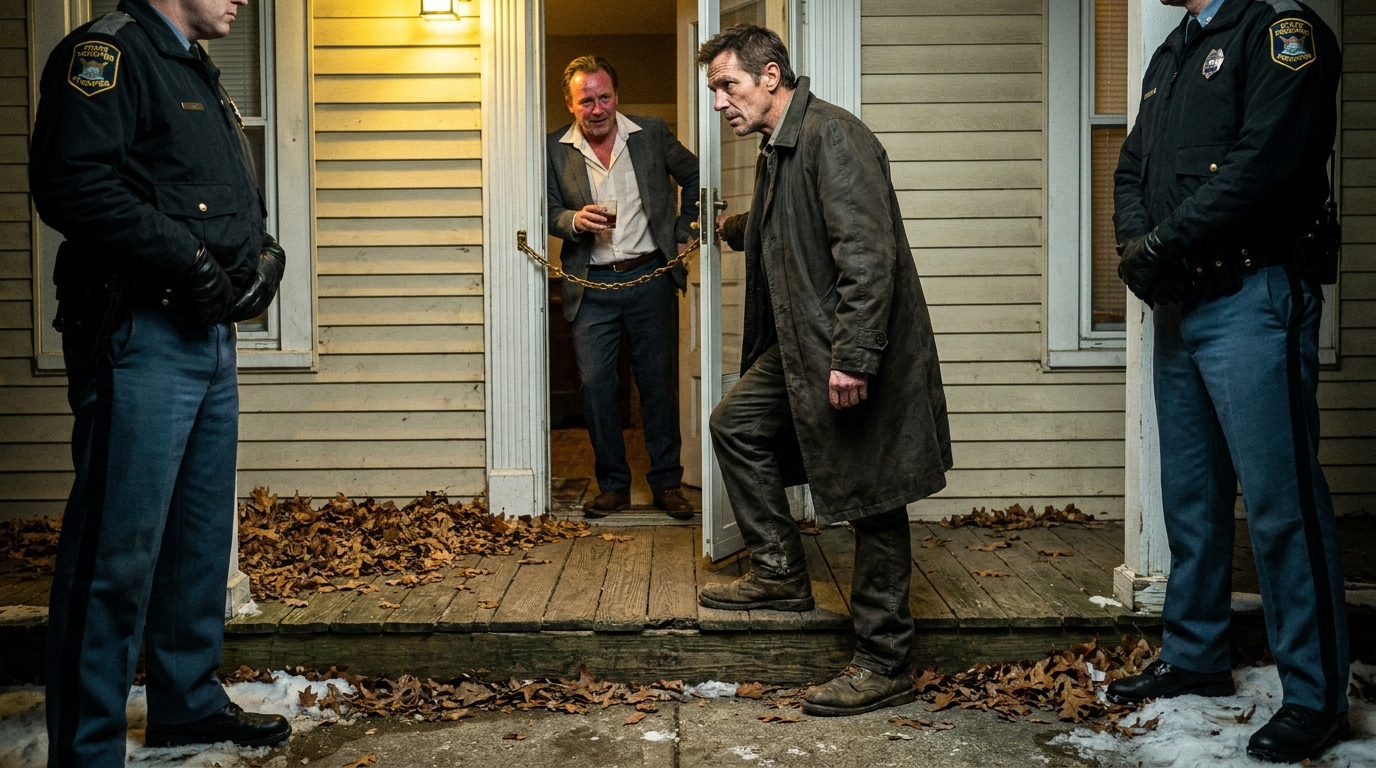
Gonzalez adjusted the leather holster under her arm before stepping toward the front porch. Two uniformed state troopers moved up the flank, their boots leaving heavy impressions in the dirty snow accumulated along the sidewalk.
The porch light flickered, casting a dull yellow beam over a porch swing covered in dry leaf debris. Inside, the muffled thump of a television commentator echoed through the glass.
Gonzalez knocked—three hard, rhythmic impacts with the flat of her palm against the wooden doorframe.
The door swung inward three inches, held fast by a brass security chain. Thomas Richards looked through the gap, a glass filled with ice and dark liquor resting loosely in his right hand. His face was flushed, his collar unbuttoned, carrying the casual unconcern of a man who believed his legal paperwork made him invisible.
“Can I help you, officers?” Richards asked, his tone dripping with the smooth, practiced exasperation of an important man being inconvenienced. “If this is about the noise complaint from next door, my TV is barely on.”
“Thomas Wesley Richards?” Gonzalez asked, pulling her badge wallet from her coat pocket.
“You know who I am,” Richards said, taking a slow sip from his glass. “What’s the issue?”
“I have a warrant for your arrest,” Gonzalez said. “Aggravated financial exploitation of a vulnerable person, grand larceny, and felony embezzlement.”
Richards didn’t flinch. He didn’t drop his glass. Instead, his mouth twisted into a thin, condescending smile as he leaned his shoulder against the doorframe. “You’ve got the wrong house, Detective. I’m Elena Bennett’s legal guardian. The girl is a chronic runaway with severe psychiatric issues. I filed missing persons reports with the precinct months ago.”
“We checked the vault at Community Trust, Thomas,” I said, stepping up onto the top wooden plank of the porch. “Box 447.”
Richards’ eyes shifted to me for the first time, his grip tightening around the tumbler until the ice cubes clinked sharply against the glass. The condescending posture faltered, replaced by a cold, calculating twitch at the corner of his jaw.
“You’re trespassing,” Richards snapped, his voice dropping two octaves into a low threat. “Whatever garbage that unhinged teenager gave you is worthless. I have full power of attorney over the estate. Every dollar withdrawn was cleared for her care and boarding.”
“The girl was admitted to Mercy General two hours ago with frostbite and hypothermia,” Gonzalez said, resting her hand on the brass chain. “She collapsed on a public library floor while you spent twenty-six thousand dollars of her trust fund on offshore sports bets.”
“She chose to sleep outside!” Richards shouted, his voice rising into the sharp, entitled screech of a man watching his perimeter collapse. “I offered her a home! She ran away! You can’t charge me for a teenager’s bad decisions!”
“Unhook the chain, Thomas,” Gonzalez said softly. “Or we take the frame down.”
Richards glared at us through the three-inch gap, his knuckles white against the rim of his glass, before slamming the door shut to unhook the latch.
CHAPTER 4: THE SYSTEMIC SHIELD UNRAVELS
Richards didn’t stop yelling as they marched him down the porch steps, his shoes skidding through the slush on the walkway.
“You think this holds up?” Richards spat over his shoulder, his breath fogging heavy in the cold air. “I signed those forms under full legal authority! Every transaction had county approval!”
Gonzalez didn’t answer him. She pulled the front door shut, turned the lock, and handed me the evidence bag containing his cell phone and laptop.
“County approval,” I said, looking down at the screen of his unlocked phone where a web browser was still open to an offshore sports betting dashboard. “That’s what’s kept him safe for seventeen months.”
“Social services doesn’t clear eleven thousand dollars a month without an internal sign-off,” Gonzalez said, pulling her gloves tight over her knuckles. “The system is built to flag anything over two grand. Someone was manually overriding the administrative holds.”
We walked back to the cruiser, the gravel crunching under our boots. I sat in the passenger seat, unzipping the evidence binder and pulling up the digitized records we’d pulled from the bank vault.
I traced the approval chain on the digital ledger sheets. On every single invoice—the fake tutoring, the fabricated medical co-pays, the non-existent educational materials—the administrative override code was identical: CLERK-882-EX.
“That’s not a general pool code,” I said, turning the tablet screen toward Gonzalez. “That’s a specific station ID in the County Trust Administration building.”
Gonzalez shifted the cruiser into drive, the tires biting into the wet asphalt. “Station 882 belongs to the senior auditor’s desk. Vance Miller.”
“The expired notary stamp,” I said, the realization settling into my ribs like cold stone. “The registration number on those fake tutoring receipts matched Miller’s old revoked seal.”
“He wasn’t just overlooking bad paperwork,” Gonzalez said, her eyes fixed on the dark stretch of road leading toward downtown. “He was cutting the overrides himself and taking a cut of the liquidations.”
“Which is why Elena’s calls to the county hotline kept getting redirected back to Richards,” I said, resting my knuckles against the cold glass of the passenger window. “Every time she tried to raise an alarm, Miller caught the ticket in the queue, flagged her as a flight risk, and closed the file.”
Gonzalez hit the turn signal, pulling the car toward the county administration complex. “We don’t have a warrant for Miller’s office yet.”
“We don’t need one to ask him why his revoked notary seal is stamped on eighty-seven thousand dollars worth of fake invoices,” I said.
CHAPTER 5: CONFRONTATION IN ROOM 4B
I pushed the door open without knocking.
Vance Miller sat behind a wide oak desk covered in stacked manila folders, a half-eaten sandwich sitting on a paper towel near his computer keyboard. He was a thin man in his late fifties, wearing wire-rimmed glasses and a tie pulled two inches loose from his collar.
He looked up, his eyebrows drawing together as his hand moved toward the desk phone. “This floor is closed to the public after five. You need to leave.”
Gonzalez stepped around me, pulling her badge case from her pocket and laying it flat on the green blotter in front of him. “Sit back down, Vance.”
Miller’s hand froze two inches above the telephone receiver. A tiny, involuntary muscle twitched under his right eye as he looked from the badge to the evidence binder tucked under my arm. “What is this? I’m in the middle of a quarterly closing.”
“We just came from Woodland Avenue,” I said, pulling a chair out and sitting down across from him. I didn’t open the binder. I laid the brass bank key on the blotter, letting it clink against the edge of his paperweight. “Thomas Richards is sitting in the back of a state police cruiser.”
Miller’s posture went stiff. He didn’t touch the key, but his gaze remained locked on the stamped numbers for three full seconds before he forced his shoulders to relax. “I don’t know a Thomas Richards. I handle hundreds of trust oversight files for this district.”
“You know station ID CLERK-882-EX,” Gonzalez said, resting both hands on his desk and leaning forward. “That code bypassed seventeen consecutive monthly holds on the Bennett estate account. Over one hundred and eighty-seven thousand dollars drained while a minor froze on subway grates.”
Miller’s jaw tightened. He reached for his glasses, taking them off to wipe the lenses with his tie, a deliberate delay tactic to buy time. “If an administrative hold was overridden, it was based on documentation submitted by the legal guardian. We rely on sworn affidavits. If Richards lied, that’s a law enforcement issue, not an administrative error.”
“And the notary seal?” I asked, tapping the folder. “Every fake tutoring invoice had your expired registration stamp on it. Number ending in 882. Revoked two years ago by the Secretary of State.”
Miller’s hand trembled slightly as he put his glasses back on. The calm bureaucrat facade cracked, exposing a sharp, defensive snarl. “That seal was stolen from my desk during the office renovation in ’24! I filed a loss report with facility security!”
“You didn’t file a report,” Gonzalez said, her voice dropping into a hard, flat line. “We pulled the department logs before we walked up those stairs. You used that same station code forty minutes ago to clear a final five-thousand-dollar administrative fee transfer to Richards’ personal account.”
Miller slammed his palm against the desk, his face flushing red. “You have no standing here! I operate under county civil service protections! You want my files? Get a subpoena from a circuit judge! Until then, get out of my office!”
“The prosecutor is signing the subpoena right now, Vance,” I said, standing up and leaning over the desk until I was six inches from his face. “And when he reads the kickback transfers from Richards’ betting accounts to your offshore shell company, civil service won’t cover a single day of your sentence.”
Miller stared at me, his breath coming in shallow, ragged hitches, his fingers gripping the edge of his oak desk so hard the knuckles turned gray.
CHAPTER 6: THE ARRAIGNMENT GAVEL
Richards moved with a stiff, unnatural posture, the wrist chains clinking against his belt line as he shuffled toward the defense table.
His public defender, a tired man with ink-stained cuffs, didn’t look up from his legal pad as Richards sat down. Across the aisle, Prosecutor Chen smoothed a stack of certified bank ledgers, setting Vance Miller’s sworn deposition right on top of the pile.
Richards twisted in his chair, his eyes sweeping the gallery until they landed on Elena, who sat beside Michelle and Detective Gonzalez in the row behind me.
“Your Honor,” Richards’ attorney began, clearing his throat and standing up. “My client maintains that all account distributions were executed within his discretion as court-appointed guardian. The runaway status of the minor created exceptional administrative expenses—”
“Save it, Counsel,” Judge Morrison said, her glasses resting halfway down her nose as she flipped through the grand jury indictment. “I’ve reviewed the bank records, the medical intake reports from Mercy General, and Mr. Vance Miller’s signed statement from county administration.”
Richards’ hands jerked against the oak table, his knuckles pressing white against the dark wood. “Miller lied! He took those fees himself! I was trying to preserve her estate from her own destructive behavior—”
“Silence,” Judge Morrison said, her voice dropping into a register that made the court reporter pause. “The paper trail is absolute, Mr. Richards. You filed false runaway reports to systematically isolate a minor while gambling away one hundred and eighty-seven thousand dollars of her inheritance.”
She adjusted the papers on her bench, bringing her gavel down once with a heavy, wooden report that echoed off the high plaster ceiling.
“Bail is set at five hundred thousand dollars cash, no surety,” she announced. “The court orders an immediate freeze on all real property, vehicles, and liquid accounts associated with the defendant, to be remitted directly to the victim’s trust under independent estate management.”
Richards opened his mouth, his face turning dark red as two bailiffs stepped up behind his chair. “You can’t do this! I have rights as her designated representative!”
“Take him down,” Judge Morrison said flatly.
The bailiffs gripped his elbows, steering him through the heavy steel door beside the jury box. The latch clicked shut behind him, cutting off his voice instantly.
Outside the courthouse, the afternoon sun hit the concrete steps, cold and clear.
Elena stood near the brass handrail, her winter coat zipped to her chin, her hands tucked deep into her pockets. She wasn’t shaking anymore.
“The bank manager finalized the account transfer this morning,” I said, stepping up beside her and pulling my collar up against the breeze. “Three hundred and twenty-two thousand dollars, once the house and vehicle liquidations clear. It’s set up in a structured educational trust. Nobody touches it without a court signature.”
She pulled her left hand from her pocket, looking at the faint silver scars across her fingertips where the frostbite had healed. “It was never just about the money, Wolf.”
“I know,” I said, handing her a small manila envelope containing the original brass key from Box 447. “It’s about making sure the record stays clean.”
She took the envelope, sliding the heavy key inside her coat pocket.
Down on the street, the traffic moved steadily past the courthouse steps—ordinary cars, city buses, people hurrying through the cold on their way home. There were no sirens, no grand spectacles, just the quiet, methodical work of common sense finally catching up to a lie.