The Frozen Ledger of West 29th Street and the Heavy Iron of Erie
CHAPTER 1: THE COLD COUNTER AT 2 AM
The coffee in the thick ceramic mug had gone cold twenty minutes ago, but Calvin “Grizzly” Mercer didn’t flag down the waitress. He sat in the end booth of the Lakefront Travel Plaza, his thumbs hooked through the belt loops of his work jeans, watching the wind drive lake-effect snow sideways across the asphalt outside. The thermometer mounted by the double glass doors read eighteen degrees, and the storm was just getting its teeth in.
A sharp, wet squeak cut through the low drone of the overhead exhaust fan.
Grizzly didn’t move his head, only his eyes. A child was shuffling past the magazine rack. He couldn’t have been more than seven, though he was sized like a five-year-old—a bundle of oversized, mismatched rags held together at the waist by a length of rough jute twine. His canvas sneakers were soaked through, turning dark gray against the salt-crusted tile.
At booth four, a middle-aged couple in matching winter coats looked up. The woman glanced at the boy’s blue-tinted lips, grabbed her purse off the vinyl seat, and angled her body toward the wall. Her husband shifted his plate of french fries away from the edge of the table, his eyes fixed firmly on his phone screen.
The boy kept moving. Squeak. Squeak.
He stopped two feet from the counter. The night cashier, a woman named Brenda with dark circles carved deep into her face, didn’t look up from her stack of register receipts.
“No loitering, kid,” Brenda said, her fingers tapping rhythmically on her calculator. “Buy a coffee or hit the door. I’m not keeping the heat on for free.”
The boy didn’t answer. His hands, raw and cracked across the knuckles, dug into the pockets of his tan parka. He turned slowly, his eyes darting across the fourteen people scattered throughout the diner. Nobody made eye contact. An off-duty security guard by the vending machines shifted his belt, cleared his throat loudly, and took a deliberate step toward the boy’s shoulder.
Grizzly reached down and picked up a rusted 9/16ths combination wrench resting on the table next to his paper napkin. He turned it over once in his palm, the cold steel heavy against his scarred skin, then set it down on the formica top with a dull, heavy clack.
The security guard stopped his stride. He looked over at the end booth, caught the flat, unblinking set of Grizzly’s jaw, and slowly pulled a mint from his pocket instead.
The boy turned toward the sound of the metal hitting the table. He took three short, shivering steps until he reached the edge of Grizzly’s booth. His breathing sounded like a dry reed scraping against glass—shallow, whistling, and rapid.
“Please,” the boy whispered. His teeth clicked together, the sound fast and uncontrollable. “He’s coming to take me back.”
Grizzly didn’t ask who. He didn’t ask where the boy’s coat zipper was or why his wrists were marked with ringed, yellowing bruises. He simply slid his heavy frame three inches to the left, cleared the bench, and tapped the cracked vinyl beside him.
“Sit down, kid,” Grizzly said. His voice was a low, gravelly rasp that barely carried past the table. “Drink the water. Leave the ice.”
The boy pulled himself onto the seat, his small knees knocking against the underside of the table. He reached for the water glass with both hands, his fingers trembling so hard the liquid sloshed over the rim, dripping onto a folded, crumpled piece of paper he had pressed tightly against his ribs.
CHAPTER 2: THE PAPERWORK OF ABUSE
The paper beneath Grizzly’s palm was damp, softened by melted lake snow and the salt from the kid’s chin. He didn’t lift his hand. He kept his weight planted over the table, his broad shoulders blocking the line of sight from the front register where Brenda was still punching numbers into her machine.
“Eli,” Grizzly said. His voice dropped an octave, deep enough that the vibration hummed through the formica. “Look at me, son.”
The boy raised his head. His eyes were wide, hazel rings flecked with raw yellow light from the overhead fluorescents. His teeth had stopped clicking, but his breath still came in small, panicked hitches—shivering lungs trying to process hot, greasy diner air after three miles in sub-zero wind.
Grizzly reached out with his left hand, leaving his right anchored on the table. He picked up his cold coffee mug, shifted it two inches to the side, and picked up the rusted 9/16ths wrench. He didn’t swing it. He just turned the tool in his grip, feeling the raised forge-marks on the spine.
“Your guardian,” Grizzly said, his gaze locked on the kid’s face. “What’s his name?”
“Trent,” Eli whispered. He pulled his arms tight against his stomach, the thin knit beanie slipping lower over his ears. “Trent Holloway. He… he takes care of the house on West 29th.”
“He doesn’t take care of a damn thing,” Grizzly muttered, the words thick with greasy shop floor reality. He carefully peeled back the damp cuff of the boy’s oversized parka.
The wrist was narrow—thin enough that Grizzly could have wrapped his thumb and forefinger entirely around the joint with room to spare. Circling the pale skin were twin rings of inflamed, yellowish scar tissue. The marks weren’t fresh cut; they were old, layered over with fresh pink friction burns where hard plastic had bitten deep into flesh more than once.
“Zip ties,” Grizzly said. It wasn’t a question.
Eli flinched, trying to pull his arm back into the sleeve, but Grizzly didn’t squeeze. He simply opened his palm, letting the boy’s hand rest on his open fingers like a cold stone.
“He locks the door when the snow comes,” Eli said, his voice dropping so low the hum of the diner’s refrigerator almost swallowed it. “He puts the big metal slider on the outside. He said if I make noise, the deacon council comes and takes my shoes.”
Grizzly felt a cold, dry knot tighten right behind his ribs. A deacon. A pillar of West 29th Street. A man who wore pressed trousers on Sunday mornings and signed emergency custody waivers while shutting off the heat in a basement utility closet.
“No cops,” Grizzly thought, the memory of his own past grinding against his molars. The local precinct in Erie didn’t care about a kid with bad clothes and a well-dressed guardian who donated to the summer youth drive. Calling the station would just get a cruiser dispatched to hand the boy right back to the front porch on 29th before the storm cleared.
The diner door chimed.
A gust of freezing air swept across the floorboards, carrying a spray of fine, dry snow that hissed as it hit the baseboard heater. Grizzly didn’t turn around, but he felt the shift in the room’s pressure.
Doc stepped out of the weather, pulling off a pair of heavy leather work gloves. At sixty-seven, the former field medic moved with an unhurried, heavy-footed precision. He didn’t look like a savior; he looked like a retired pipefitter who had seen too many crushed limbs to be impressed by anything short of a collapse.
Beside him came Switchback, his dark canvas jacket zipped to the chin, his sharp gray eyes instantly sweeping the room—cataloging Brenda at the counter, the guard by the vending machine, and the empty booths along the wall.
“Grizzly,” Doc said, stepping up to the booth. He didn’t ask questions. He reached into his coat pocket, pulled out a rolled pair of dry wool socks, and dropped them onto the laminate. “The kid’s core is dropping. He’s sweating cold.”
“He’s running from Holloway,” Grizzly said, pointing down at the crayon drawing beneath his palm. “The deacon.”
Switchback leaned over the back of the vinyl booth, his gaze dropping to the paper. His jaw tightened slightly, a single muscle twitching beneath his gray beard. “Holloway. He’s got three foster properties registered through the county board. All tax-exempt.”
“He said a number, Doc,” Eli broke in, his small voice cutting clean through the low rumble of the men’s voices. He was staring down at Grizzly’s heavy wrench. “Trent was talking to the phone man. He said $296,700. He said the winter does the work.”
Doc froze, his hand hovering over the dry socks. Switchback slowly raised his head, his eyes meeting Grizzly’s across the narrow table.
“That’s not a budget,” Switchback said softly, his tone flat as an anvil. “That’s a payout.”
Grizzly slid the paper toward Switchback, his calloused thumb tracing the shaky crayon line of the winged rider. “We aren’t calling the county. We aren’t calling the station. Switch… pull the board filing on 29th Street before the sun comes up.”
“I don’t need the station,” Switchback said, pulling a worn ledger from his inner pocket. “I just need twenty minutes on the county clerk’s public terminal down at the plaza office. If there’s a rider on this boy’s name, it’s filed under the property deed.”
Outside, a pair of bright halogen headlights cut through the swirling snow, flashing white across the diner’s front windows as a heavy dark SUV pulled slowly into the travel plaza lot.
CHAPTER 3: THE TRAP AT THE WINDOW
The glass doors slid open with a sharp, pneumatic hiss. Snow rattled against the rubber mat, followed by the measured, heavy crunch of leather-soled dress boots.
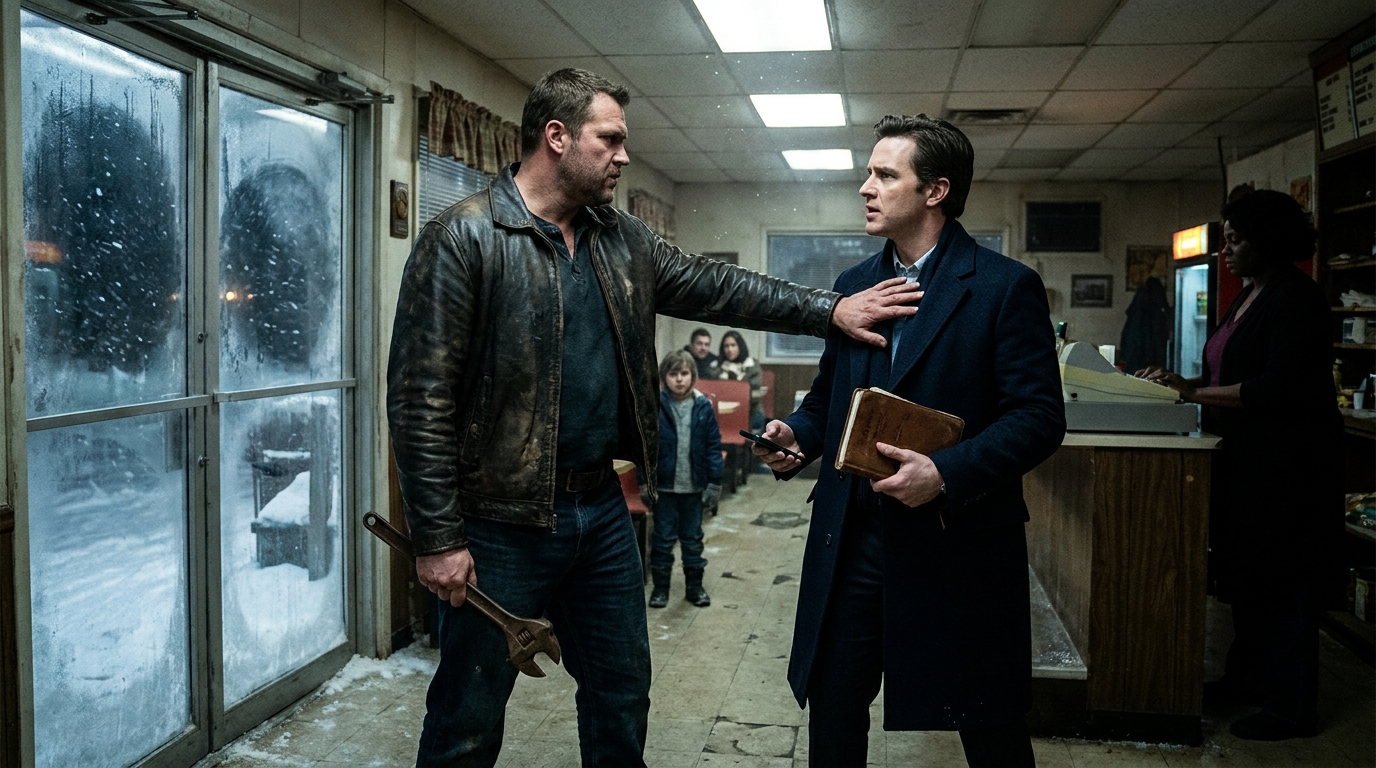
Trent Holloway stepped into the travel plaza. He was a man in his late forties with neatly trimmed graying sideburns, wearing a tailored navy wool overcoat that looked entirely out of place against the grease-stained linoleum. He didn’t look like a man searching for a lost child in a blizzard. He looked like an inspector checking on a late shipment.
“Eli,” Holloway called out, his voice smooth, carrying the practiced warmth of a man who spoke into a pulpit microphone every Sunday morning. “There you are. Do you have any idea how frantic you’ve made everyone?”
In the booth, Eli shrank until his chin hit his collarbone, his fingers digging so hard into Grizzly’s dry wool socks that the fabric stretched thin.
Holloway didn’t look at Doc or Switchback. His eyes swept over Brenda at the counter and the off-duty guard, offering them a tight, apologetic smile that radiated weary parental tolerance.
“I’m so sorry for the commotion,” Holloway said, taking two long strides toward the booth, his leather gloves held open in a gesture of harmless concern. “He slips out when he gets confused. It’s a medical condition—his mind wanders when the pressure drops. Come along, Eli. The car is running.”
Grizzly took one step sideways, filling the three-foot aisle between the pie display and the edge of the booth. His six-foot-three frame completely cut off the line of sight to the kid.
“Car’s running,” Grizzly repeated, his voice low, flat, and dry as ash. “It’s eighteen below out there, Holloway. The boy’s feet are wet to the ankles.”
Holloway stopped two feet short of Grizzly’s chest. The polite smile on his face didn’t slip, but his jaw tightened just enough for a muscle below his ear to twitch.
“I don’t believe I addressed you, friend,” Holloway said, his tone dropping the Sunday cadence, turning crisp and bureaucratic. “I am his court-appointed legal guardian. You are currently standing between a minor and his lawful custodian. That carries a very specific legal definition in this county.”
“Is that right?” Grizzly shifted his weight, his heavy boots making a dull thud against the tile. He brought his right hand up from his side, holding the 9/16ths wrench loosely by the head. He didn’t raise it. He just let the iron stem rest against his thigh. “Tell me about the slider latch on the utility room door on West 29th.”
Holloway’s eyes flicked down to the wrench, then back up to Grizzly’s face. The polite warmth vanished completely, replaced by a cold, sharp stillness.
“You’re making a catastrophic mistake,” Holloway said, leaning in half an inch, keeping his voice below the roar of the exhaust fan. “You think because you wear a leather jacket you can interfere with county business? I have five board members on speed dial. By five o’clock tomorrow morning, you’ll be answering to a magistrate for unlawful restraint.”
“We aren’t waiting for five o’clock,” Switchback said from behind Grizzly. He held up his worn leather ledger, flipping it open with his thumb to expose a handwritten list of property tax IDs. “And we aren’t calling the county board either, deacon. The clerk’s public office keeps physical archives on tax-exempt foster stipends. Page forty-two of your 2021 filing has a very interesting entry.”
Holloway’s throat moved in a single, hard swallow, though his face remained rigid. “My filings are public record. I have nothing to hide from a group of vagrants in a truck stop.”
“Kayla Benton,” Doc said quietly from inside the booth, his hand resting gently on Eli’s shaking back. “Sixteen years old. Feburary 2021. The county coroner signed off on accidental exposure in an unheated annex. Payout cleared seventy-two hours later.”
Holloway didn’t yell. He didn’t reach for a weapon. Instead, he stepped back, pulled a high-end smartphone from his breast pocket, and tapped the screen twice.
“You have two minutes,” Holloway said, his voice dropping all pretense of warmth, cold as the sleet outside. “I am filing an emergency custody violation directly with the state magistrate. When the state troopers get here, they won’t ask about 2021. They will see a child being held by three men with prior records. Move out of my way.”
He didn’t try to push past Grizzly. He stood his ground in the center of the aisle, using the weight of the law and his tailored coat like a shield, waiting for the everyman’s fear of the system to force Grizzly to back down.
Grizzly didn’t move an inch. He turned the wrench once in his palm, the iron cold against his knuckles.
“Doc,” Grizzly said without taking his eyes off Holloway. “Take the boy out through the kitchen exit. Get him into the service truck with the heater running.”
“You can’t do that!” Holloway snapped, taking an aggressive step forward, his voice finally cracking into an sharp, indignant bark. “That’s kidnapping!”
Grizzly planted his broad hand flat against Holloway’s chest—not a punch, not a strike, just two hundred and forty pounds of immovable physical mass holding the man in place while Doc lifted the shivering child and moved swiftly toward the back doors.
CHAPTER 4: THE MECHANICAL AUDIT
The wind whipped down the narrow alleyway between the two beige houses, carrying a fine spray of ice that crusted over Grizzly’s collar. He reached out with his thick leather work glove, resting his palm flat against the frost-covered cedar siding.
The galvanized steel bar of the slide latch was thick—an industrial gate bolt fitted with a heavy brass padlock hanging open from the iron eyelet. The lock wasn’t locked yet. It was hanging ready.
“He didn’t padlock it during the day,” Switchback muttered, his flash-light beam cutting through the swirling gray snow to illuminate the metal. “He just slid the bar home when the temperature dropped at night. Keeps the kid from pushing the door open from the inside.”
Grizzly didn’t answer. He hooked two fingers under the latch bar and slid it back.
The heavy bolt screeched against the mounting plate, a dry, metallic rasp that echoed off the neighboring foundation.
Grizzly pushed the door inward. The air that rushed out from the room wasn’t warm. It was colder than the gale outside—a dead, stale chill that smelled of damp concrete, old laundry soap, and the sharp, chemical tang of unburned kerosene.
“No heat register,” Doc said, stepping over the threshold. He shone his small penlight across the floorboards. The beam passed over a thin synthetic blanket bunched on the concrete, a plastic bucket in the corner, and a square aluminum vent near the floor.
Grizzly reached down and touched the vent cover. Heavy gray duct tape had been pressed across the metal slats in four overlapping layers, completely sealing the home’s central furnace airflow out of the room.
“He starved the room of house heat,” Grizzly said. He bent down, his knee joints popping in the quiet space, and brought his light up to the wooden shelf mounted against the wall studs.
Resting on the pine board was an unbranded, heavy-duty industrial space heater—a metal cylinder with a wide heating cone, thick with dust across the top mesh. Right beside it lay a crisp, clean booklet with white pages untouched by grease or soot.
Grizzly picked up the booklet with two gloved fingers. The title on the front read: Model 400 Kerosene Radiant Heater — Operation & Safety Manual.
He flipped the cover. Page fourteen was folded down at the corner. A red ballpoint pen had circled a single warning block in the middle of the text: DO NOT OPERATE IN UNVENTED OR ENCLOSED SPACES. HIGH RISK OF CARBON MONOXIDE ACCUMULATION.
“He didn’t even hide the instructions,” Switchback said, his voice dropping into a harsh rasp. “He kept it on the shelf like a repair guide.”
“It’s not a repair guide,” Grizzly said, his voice terrifyingly quiet as he set the manual down next to his 9/16ths wrench on the shelf. “It’s his blueprint.”
A sharp crunch of boots on frozen gravel sounded from the driveway out front.
Grizzly turned his head toward the door. Through the swirling snow, the headlights of Holloway’s dark SUV cut through the storm, throwing long, jagged shadows against the utility room wall as the engine cut out.
CHAPTER 5: THE COLLAPSE OF THE DEACON
Holloway stopped at the edge of the back porch steps. Snow crunched beneath his polished loafers, his hands jammed deep into his wool coat pockets. He looked past Grizzly, taking in Switchback and Doc standing inside the concrete alcove.
“Breaking and entering,” Holloway said, his voice clipped and precise. He didn’t raise his tone, but the vein along his temple throbbed against his pale skin. “You men are trespassing on private property. Every second you stay here adds another felony to the list.”
Grizzly stepped down off the concrete threshold, his boots sinking two inches into the drift. He held up the white manual in his left hand, the red pen markings visible under the porch light.
“You left the booklet on the shelf, deacon,” Grizzly said. “Page fourteen. The part where it says running this unit in a closed room starves the oxygen in forty minutes.”
Holloway’s chest hitched once. He smoothed the front of his coat with a slow, deliberate sweep of his gloves, stepping up onto the bottom stair.
“That is a standard backup heating unit,” Holloway said, his jaw locked tight. “The house heating system experienced an emergency outage two days ago. I am a licensed guardian providing temporary shelter under county supervision. You have no legal standing, no authority, and no proof of anything.”
“I have the county tax records,” Switchback said, stepping out from behind Grizzly. He held up his leather-bound ledger, tapping the page with a thumb. “Kayla Benton in 2021. Same unheated room. Same life policy payout cleared to your personal account seventy-two hours before the county audit. And now Eli.”
Holloway turned his head slowly, his eyes narrowing into dark slits. “Kayla was a tragedy. An unfortunate domestic accident that was fully investigated and closed by the county coroner. You are making wild, slanderous accusations because you cannot accept that some children are simply beyond help.”
“Eli isn’t beyond help,” Doc said, stepping down beside Grizzly. He held up his phone, screen glowing with a high-resolution photograph of the duct tape sealed over the floor vent and the exterior slide latch. “And this wasn’t an accident. You locked that boy in a freezing cell and waited for the weather to clear your ledger.”
Holloway took a sharp breath, his composure finally cracking around the edges. He reached into his coat, pulled out a heavy set of brass keys, and pointed them directly at Grizzly’s chest.
“I am a deacon of the First Congregational Church,” Holloway snapped, his voice rising into a harsh, trembling pitch that rang out down the quiet residential street. “I sit on the municipal oversight board! Do you think anyone in this city will take the word of three greasy grease-monkeys over mine? Give me that manual and get off my property before I have you ruined!”
“No,” Grizzly said. He turned the rusted 9/16ths wrench in his right palm, feeling the cold weight of the tool. He didn’t raise his voice, and he didn’t move an inch off the steps. “You’re done, Holloway. We aren’t asking the city. We aren’t asking the county. The evidence stays right here on this porch until the neighborhood sees what you are.”
Holloway stood frozen on the snow-covered step, his keys clutching tight in his fist, his breath coming in fast, ragged white puffs as he stared into Grizzly’s unblinking eyes.
CHAPTER 6: THE QUIET NORMAL
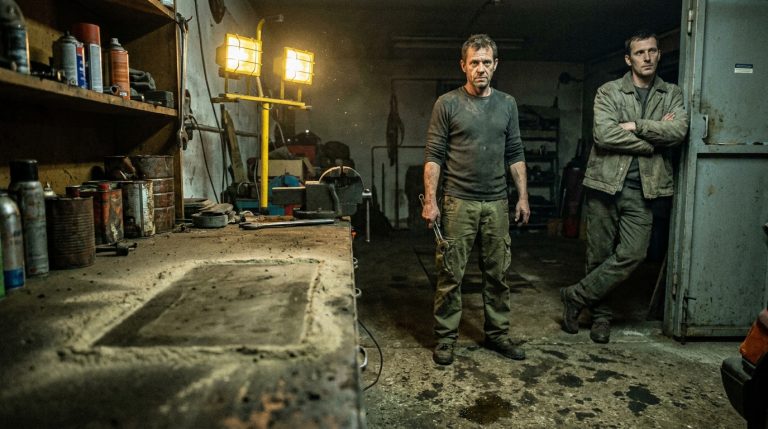
The afternoon sun poured through the cracked glass panes of the garage door, warming the dusty air and turning the oil stains on the floor a dark, shimmering bronze. Outside, the summer humidity of Lake Erie clung to the siding, but inside the shade of the workshop, the breeze carried only the dry scent of cut grass and gear oil.
Eli drove the yellow tractor across a pine board, making a low, rumbling noise in the back of his throat. He had gained six pounds since February. The sharp, starved angles of his collarbones had softened under three meals a day, and the raw, pink rings on his wrists were long gone, replaced by smooth pale skin.
Grizzly folded the shop rag into a neat square and set it beside his toolbox.
On the corner of the bench lay the rusted 9/16ths wrench, its iron handle clean of salt and grease. Beside it rested a stamped county document, signed and sealed three weeks ago by a regional magistrate who had reviewed Switchback’s physical evidence file and the audit records from West 29th Street.
Trent Holloway was currently sitting in a state holding facility awaiting trial on two counts of corporate-sponsored endangerment and financial fraud, his municipal connections completely severed by the overwhelming paper trail of his own bank transfers. There had been no big courtroom speeches or cinematic showdowns—just a quiet, relentless pile of paper, photographs, and medical records that collapsed his leverage before he ever reached a jury.
The door from the back kitchen opened with a soft click.
Switchback stepped into the garage holding two cold aluminum cans of lemonade. He didn’t say a word as he handed one to Grizzly and set the second on the edge of the bench. He leaned his hips back against the fender of an old pickup truck, watching Eli park the tractor against a stack of spare tires.
“The county clerk finalized the trust release this morning,” Switchback said softly, wiping a bead of condensation off his thumb. “Every dime from that policy is locked in an escrow account until he turns eighteen. Holloway couldn’t touch a cent.”
Grizzly took a slow sip of the lemonade, the cold metal can heavy against his palm.
“Good,” Grizzly said. His voice was a low, steady rumble, stripped of the dry, exhausting tension that had carried them through the blizzard five months ago. “He doesn’t need to hear that name again.”
“Doc stopped by the shop earlier,” Switchback added, nodding toward the driveway. “Said he’s bringing over a pair of work boots for the kid tomorrow. Sized six.”
Eli looked up from his tractor, hearing his name. He didn’t flinch, and he didn’t look toward the door with fear. He simply reached into his pocket, pulled out a small, worn piece of paper, and laid it flat on the concrete.
It was the crayon drawing from the diner—creased, faded at the edges, but carefully unfolded and smoothed flat under his palm.
Grizzly slid off the wooden bench, his boots making a quiet thud on the concrete. He walked over, bent his heavy frame down, and picked up the paper by the corner. He reached into his chest pocket, pulled out a strip of masking tape, and stuck the drawing directly to the front of his steel tool chest, right at eye level.
“Looks good right there,” Grizzly said, tapping the corner of the tape with his thumb.
Eli smiled, a quick, clean flash of teeth, and went right back to pushing his tractor across the pine board. Grizzly walked back to his bench, picked up a clean shop rag, and picked up his next wrench, completely at peace in the warm, quiet afternoon.