The Iron Lever’s Weight: How an Old Veteran Taught a Young Sergeant Real Mastery
CHAPTER 1: THE BROKEN TRACK
The computer screen flashed green, but sixty tons of dead steel said otherwise.
Sergeant Miller slammed his palm against the side of the digital diagnostic tablet, sending a smudge of black grease across the glass.
Behind him, the M1 Abrams sat lopsided on the concrete floor, its heavy steel track thrown completely off the rear sprocket and piled up like an iron carcass.
“The hydraulic tensioner is reading max pressure, Sarge,” Corporal Davis called out, wiping sweat from his eyes with a dirty forearm. “Manual says it should align automatically once the sensor clears.”
“The manual wasn’t written for three tons of jammed metal,” Miller grunted, his voice raw from three hours of inhaling exhaust fumes and heated iron.
He kicked the dead track with the heel of his boot, the impact vibrating straight up his leg without moving the steel link a fraction of an inch.
In the shadowed corner of the bay, the steady, rhythmic scrape of a push broom never stopped.
Bill swept a pile of metal shavings into a neat line, his faded gray jumpsuit smelling faintly of diesel fuel and old tobacco.
He didn’t look up from his work, but his old, gnarled hands adjusted their grip on the wooden handle as the hydraulic pump on the rig screamed in protest.
“Run the diagnostic cycle again,” Miller ordered, turning back to the control harness. “If this line bursts, we’re all scrubbing concrete for a month.”
“It’s not the fluid line, son,” a low, raspy voice cut through the whine of the motor.
Miller froze, turning his head slowly toward the corner.
Bill stood leaning against the broom handle, his bad knee stiff, pointing his chin toward the rear of the tank’s hull.
“You’re pumping pressure against a twisted link,” Bill said softly, his pale blue eyes fixed on the gap between the road wheels. “The idler arm is locked up because the weight is resting on an incline.”
Miller shifted his weight, his patience thin after hours of heat and failing gear. “Bill, stick to the floor. We’ve got forty thousand dollars of diagnostic hardware plugged into this hull.”
“Hardware don’t feel the bind,” Bill said, letting the broom rest against the workbench as he picked up a chipped six-foot iron crowbar resting against the wall.
CHAPTER 2: THE DIGITAL LIE UNCOVERED
Miller’s thumb hovered over the diagnostic screen, his neck flushed red under the grease.
“Stand down, Bill,” the sergeant said, though his voice lacked the sharp bite it had ten minutes ago. “The tablet reads zero pressure differential on the primary manifold. The sensor says the line is clear.”
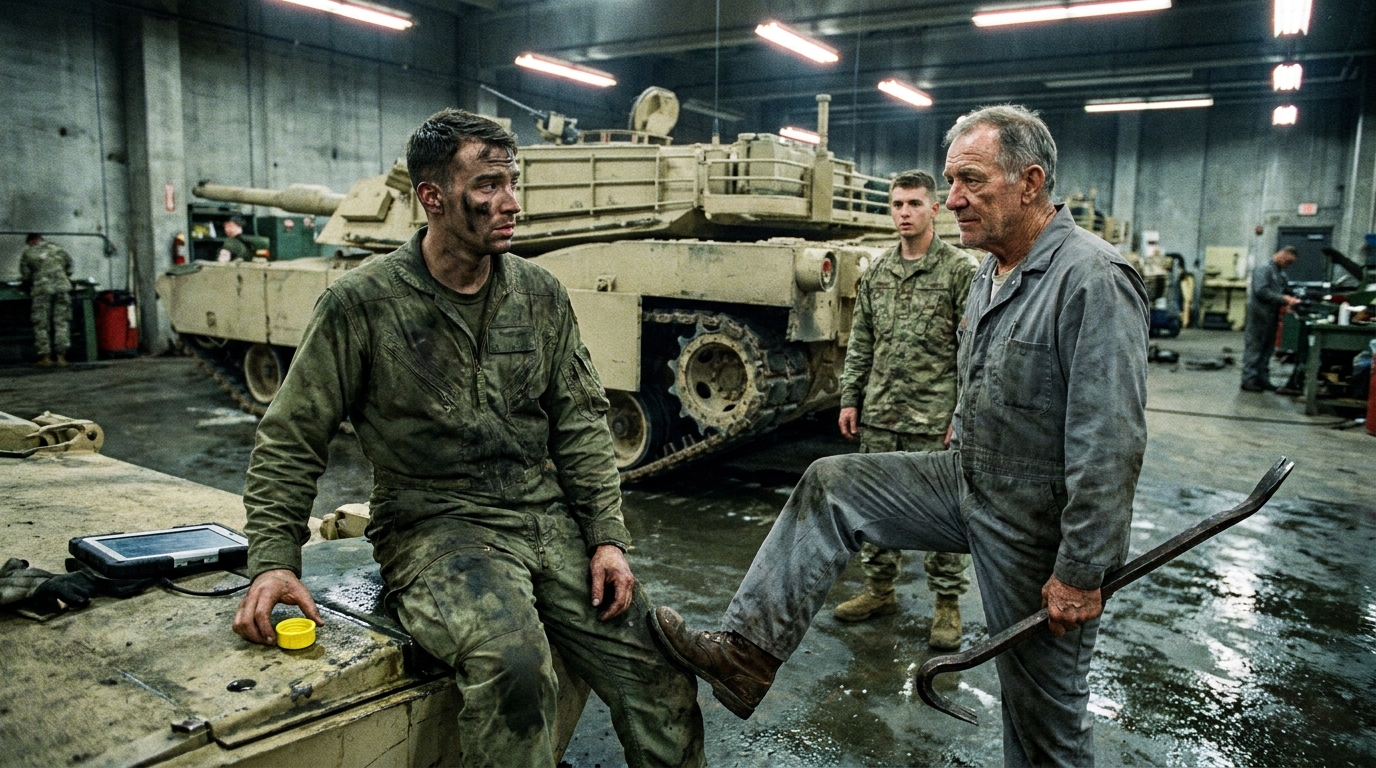
Bill didn’t lower the crowbar. He let the chipped, six-foot length of iron drop until its flat edge rested against the concrete, the heavy iron ringing softly against the bay floor.
He didn’t yell. He didn’t point to his gray hair or talk about thirty years in armor. He simply pointed the tip of his scarred boot toward the base of the tank’s suspension arm.
“Your tablet is reading what the computer wants to see, Sergeant,” Bill said, his gravelly voice dropping below the hum of the overhead exhaust fans. “Look at the bypass housing.”
Miller stepped closer, squinting through the heat haze rising off the engine deck.
Corporal Davis leaned over the track fender, wiping sweat off his chin, his eyes darting between the sergeant and the old man in coveralls. “Sarge, pressure gauge on the pump is spiking into the yellow. If we push another cycle, that hose is going to whip.”
“It’s not going to whip,” Miller muttered, though he stopped short of touching the diagnostic cable. “The ECU governs the feed.”
“Look at the seal cap,” Bill repeated quietly.
He tapped the crowbar against the heavy steel housing near the idler pivot. Among the scraped, oil-caked gray paint of the thirty-year-old assembly, a small screw-cap shone with bright, unweathered yellow paint. It was clean. It didn’t have a speck of grime on it.
Miller froze. His fingers twitched away from the tablet screen.
“That’s a secondary override cap,” Miller said, his eyebrows knotting together as he knelt in the dirt, ignoring the black grease staining his trousers. “That shouldn’t be open. That’s factory-sealed.”
“Someone cleared the error code manually,” Bill said. He didn’t offer a dramatic explanation. He just stated the mechanical truth. “The computer thinks the cylinder is retracted because the bypass was forced shut. It’s pushing sixty tons of hydraulic force into a locked pin. You keep pressing that green button, and you’re going to shear the housing clean off the hull.”
Davis took an immediate step back, his boots slipping slightly on the slick concrete. “Sarge… if the housing shears, that track drops flat. We won’t move this bird with three cranes.”
Miller looked up at Bill. The old man wasn’t gloating. His face was a map of dry wrinkles and quiet, patient endurance, his hands anchored securely around the center balance of the heavy iron bar.
“The manual doesn’t list a bypass override for this model,” Miller said, his voice cracking slightly as the reality of the situation began to set in.
“The manual assumes the man who touched it last had a conscience,” Bill replied plain and simple. “You want to clear that track before the captain comes down here, or do you want to keep reading a green screen that’s lying to you?”
Miller swallowed hard, his eyes locked on the clean yellow cap.
CHAPTER 3: THE LEVER AND THE MINDSET SHIFT
Miller pulled his hand back from the yellow cap like the hot metal had scorched his skin.
“Step clear,” Bill grunted, moving his stiff right leg forward until his work boot wedged against the edge of the track link.
He didn’t wait for Miller to give an order. He slid the chisel tip of the six-foot iron crowbar past the edge of the steel connector, searching in the dark gap for a hard surface. The metal scraped, screaming against the housing until the bar locked solid against the main frame.
“Davis,” Bill barked, his voice carrying the flat, unmistakable authority of someone who had commanded men before the young corporal was born. “Get in the hatch. Idle the turbine. Left steering clutch only—on my mark.”
Davis looked at Miller, his boots glued to the oil-slicked floor. “Sarge?”
Miller swallowed hard, his posture slumping as he stared at the simple length of iron in the janitor’s hands. He looked at his tablet, then clicked the display off and set it down on the tank’s fender. “Do what he says, Davis. Single bump.”
The turbine engine roared to life, a high-pitched whine echoing through the steel girders of the maintenance bay. Smoke puffed from the rear grates, filling the air with the sharp, bitter tang of burning JP-8 fuel.
Bill didn’t flinch. He leaned his entire body weight over the long end of the iron bar, his worn coveralls stretching tight across his back. His knuckles turned stark white against the dark, rusted surface of the tool.
“Now!” Bill yelled over the turbine’s scream.
Davis bumped the left control stick. The drive sprocket turned a fraction of an inch, biting into the slack track.
Bill drove his hip into the iron bar, utilizing simple physics where forty thousand dollars of high-tech hydraulics had failed. He didn’t fight the machinery; he guided the misaligned steel pin right into the groove.
A sound like a sledgehammer hitting an anvil cracked through the bay.
The three-ton track jumped upward, guided by the leverage of the iron, and snapped squarely over the teeth of the sprocket wheel with a heavy, final thud.
The whole tank shuddered once on its suspension, then settled level.
“Kill it!” Bill shouted, his breath coming in heavy, raspy hitches as he eased his pressure off the bar.
The turbine died down to a whistle, leaving a heavy silence in the bay, broken only by the ticking of the cooling exhaust manifold.
The track sat perfectly straight, seated deep in the guides, ready to roll.
Miller stared at the aligned links, his mouth slightly open. He reached down and touched the iron crowbar still resting in Bill’s calloused hands, feeling the heat generated by the sheer friction of the movement.
“The computer said it was impossible without a teardown,” Miller muttered softly.
“The computer doesn’t know what it feels like when steel gives up,” Bill said, wiping his grease-stained palm on his trousers. He turned toward the yellow cap on the bypass valve. “Now you’d better figure out why somebody rigged that line to lie to you.”
CHAPTER 4: THE UNSEEN FRAUD IN THE HYDRAULICS
Miller remained crouched on the concrete, his fingers trembling slightly as they pressed against the cold iron of the crowbar.
He stared at the clean yellow cap on the bypass valve.
Without saying a word, Miller dragged his thumbnail across the bright yellow paint. It didn’t peel like grease-baked factory enamel. It flaked off in soft, fresh strips, revealing a manually carved notch on the metal screw underneath.
“Someone locked the internal fluid loop on purpose,” Miller whispered, his face going completely pale under the grease stains.
Bill leaned his crowbar against the fender and pulled a small steel flashlight from his coverall pocket. He clicked it on, casting a tight white beam directly into the valve gap.
“Look at the copper threading inside,” Bill said, his gravelly voice tight. “That’s not wear and tear. Somebody backed that screw out until the sensor registered a closed circuit, then capped it so the diagnostic software wouldn’t flag the pressure bleed.”
Corporal Davis wiped a bead of cold sweat from his forehead. “Sarge… the logbook says Captain Vance ran the pre-inspection maintenance scan himself last night. He signed off on the hydraulic assembly as zero-defect.”
Miller slowly stood up, his knee cracking loudly in the quiet bay.
The pieces fell together with brutal clarity. The captain hadn’t fixed the fluid leak; he had simply tricked the diagnostic tablet into reading a perfect signal so the unit wouldn’t fail its readiness review. If they had run that tank hard in the field, the bypass would have blown out under operational strain, throwing the track at full speed.
“He covered it up,” Miller said, his breathing shallow. “He risked a total mechanical blowout just to clear the readiness report.”
“He trusted a computer to hide a physical lie,” Bill said softly, setting his hand on the tank’s iron fender. “Machines don’t care about rank or paperwork, Sergeant. You feed ’em a lie, and eventually, the steel demands payment.”
Footsteps echoed from the heavy bay doors behind them—sharp, hurried strides on the concrete floor.
Miller turned around. Captain Vance was walking toward the maintenance bay, holding a clip board with a smug, impatient scowl on his face.
CHAPTER 5: THE CORNERED SERGEANTS CHOICE
Miller stood tall beside the tank, his grease-stained hand clamped tightly around the iron crowbar as Captain Vance closed the distance between them.
“What is taking so long, Miller?” Vance demanded, slapping his clipboard against his thigh, his polished brass pin glinting in the harsh bay lights. “Why isn’t this unit in line? The readiness inspection starts in fifteen minutes.”
Miller didn’t offer a smooth excuse. He pointed the tip of the crowbar straight down toward the yellow cap on the suspension housing.
“The track is seated, Captain,” Miller said, his voice flat and hard like concrete. “No thanks to the diagnostic log you signed off on last night.”
Vance’s eyes narrowed instantly, a sharp twitch pulling at the corner of his jaw. He didn’t look at Bill, who stood silently by the workbench holding his broom. He kept his eyes locked on Miller.
“Watch your tone, Sergeant,” Vance snapped, stepping directly into Miller’s personal space. “The system readout was clear. You have your orders—crank the engine and move it out to the line.”
“The internal loop was manually jammed,” Miller spat back, tapping the iron bar against the yellow cap until the soft paint flaked off completely, exposing the altered screw underneath. “You backed out the pressure relief screw and sealed it with fresh paint so the tablet wouldn’t flag the leak. If I ran this rig hard, that assembly would have shattered and thrown forty tons of force right into the drive wheel.”
“You’re out of line, Sergeant!” Vance yelled, his forehead flushing a deep red as his entitlement flared. “You are not a mechanical engineer. You read the computer, you execute the maintenance checklist, and you obey my directives! That valve is within operational tolerance!”
“It’s a structural lie, Captain,” Miller said, refusing to back down a single inch. “And I’m not signing my name to a dead machine just to save your readiness metrics.”
“Then I’ll relieve you of command right here,” Vance hissed, grabbing his radio from his belt. “I’ll have you cited for insubordination before the hour is out. Davis! Get in that seat and drive this tank out!”
Corporal Davis stood frozen by the fender, looking between the captain’s wild eyes and Miller’s iron grip on the crowbar.
“He’s not driving it, Vance,” Bill’s voice broke the silence—not loud, but dropping into the bay with the weight of an iron anchor.
Vance spun around, pointing a finger at Bill’s faded gray jumpsuit. “Shut your mouth! You’re a civilian custodian sweeping trash. You don’t speak in my bay!”
Bill didn’t raise his voice or reach for an credential. He just stood there, resting his gnarled hand on the wooden broom handle, his cold blue eyes locking onto the captain with absolute, immovable authority.
“I’ve seen men like you burn out turbine engines in ninety-one,” Bill said quietly. “You think paper shields you from steel. But when that track breaks on the field, it won’t be your clipboard taking the hit.”
Vance snatched the clipboard higher, his chest heaving as he prepared to bark an order to security.
CHAPTER 6: THE QUIET LEGACY ON THE WORKSHOP WALL
Vance’s hand hovered over his radio, his jaw locked tight as he glared down the janitor.
“You’re a civilian sweeper, old man,” Vance sneered, stepping closer until his boots nearly touched Bill’s work shoes. “You don’t talk to officers. You don’t question diagnostic reports. And you certainly don’t tell me how to manage my motor pool.”
Bill didn’t move an inch. He simply turned the wooden broom handle slightly in his calloused palms, his eyes resting on the fresh yellow paint flaking off the bypass valve.
“I don’t question the report, Captain,” Bill said, his raspy voice cutting cleanly through the hum of the bay. “The paint does. You want to call security? Call ’em. But when they get here, Sergeant Miller and Corporal Davis are going to hand them the physical valve cap with your yellow touch-up paint still wet on the threads.”
Vance’s thumb twitched on the radio clip. He looked at Miller, whose hand remained anchored around the six-foot iron crowbar. He looked at Davis, who pulled a mechanical inspection tag from his pocket and wrote HYDRAULIC TAMPERING — UNIT HALTED across the front in red grease pencil.
“You’re committing career suicide, Miller,” Vance growled, his voice dropping into a sharp, desperate whisper. “You sign that tag, and I’ll make sure you never see another promotion.”
“I’d rather lose a stripe than lose a crew to a blown housing,” Miller said plainly. He didn’t raise his voice. He took the tag from Davis and wired it directly onto the track frame, right next to the yellow cap. “The rig stays grounded until the main depot pulls the valve assembly and inspects the logbook.”
Vance’s face went dead white. He snatched his hand off the radio, gripped his clipboard so hard the plastic bowed, and turned on his heel without another word, marching out of the maintenance bay into the hot afternoon sun.
The heavy bay doors hummed as the heat haze shimmered over the empty concrete drive.
Davis let out a long breath, resting his hands on his knees. “He’s going to try to throw us under the bus, Sarge.”
“Let him try,” Miller said, looking down at the heavy iron crowbar in his hand. “The metal doesn’t lie. The inspector will see the cut threads the second they unbolt the housing.”
Bill stepped back toward his corner, grabbing his dustpan. He didn’t ask for credit. He didn’t ask for a report or a thank-you. He simply began sweeping the small pile of metal shavings and dry dirt he had started an hour ago.
Miller walked over to the workbench. He pulled a bracket from the scrap bin, picked up a heavy hammer, and drove two solid mounting hooks directly into the brick wall right above the main tool board.
He lifted the chipped, rusty six-foot crowbar and laid it across the hooks.
“What are you doing, Sarge?” Davis asked, wiping his brow.
“Mounting the primary diagnostic tool,” Miller said, setting the hammer down with a quiet thud.
Miller grabbed a broom from the rack nearby and pushed the bristles against the concrete floor, matching the steady, rhythmic scrape from the corner of the bay.
Bill paused his sweeping for a single second, catching Miller’s eye across the wide floor. The old man gave a quiet, barely perceptible nod, then went right back to pushing the dirt.