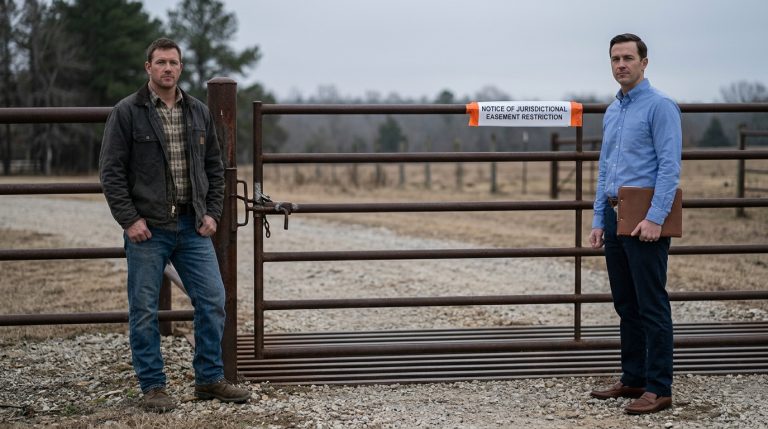
The Concrete Tomb of Oak Hollow: A Blueprint for Federal Retribution
CHAPTER 1: THE MOUNTAIN AT ALPHA
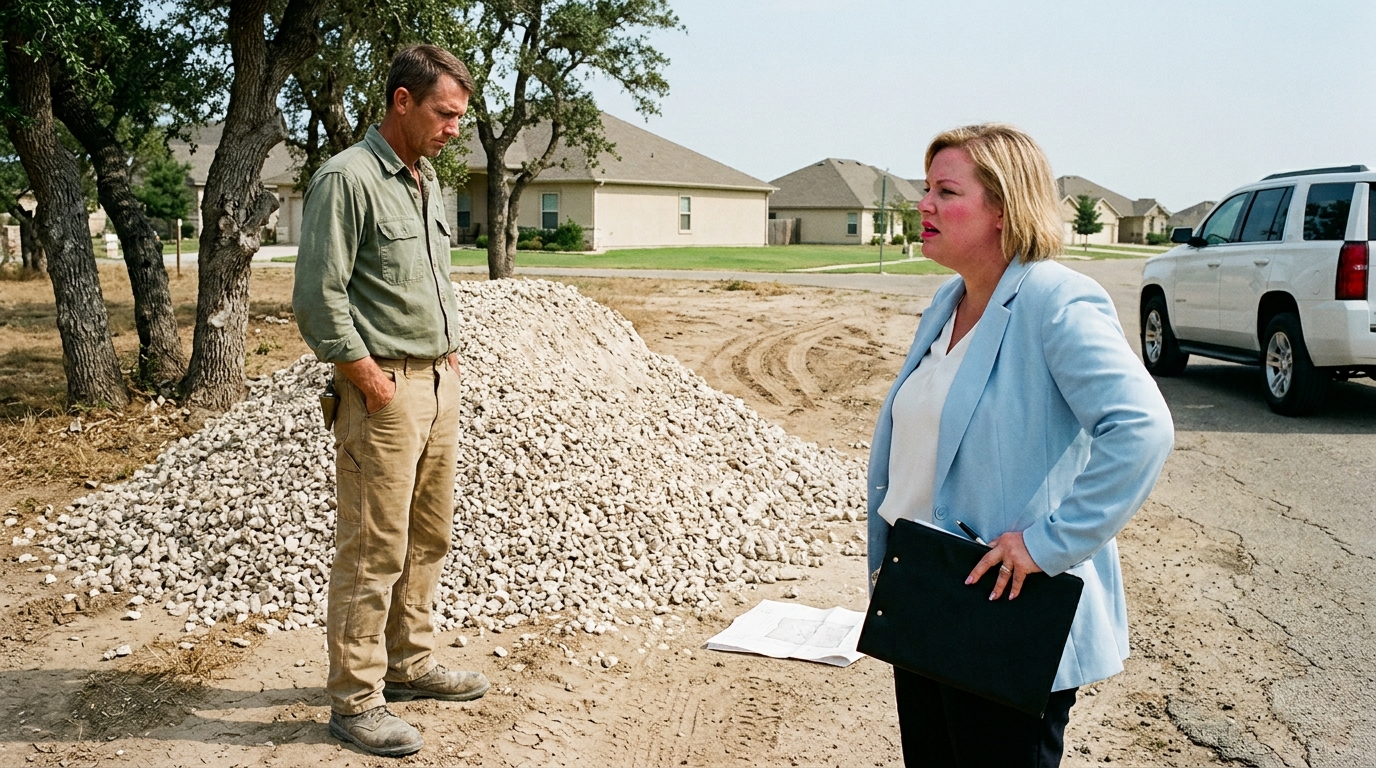
The heat coming off twenty tons of crushed limestone felt like a open furnace door.
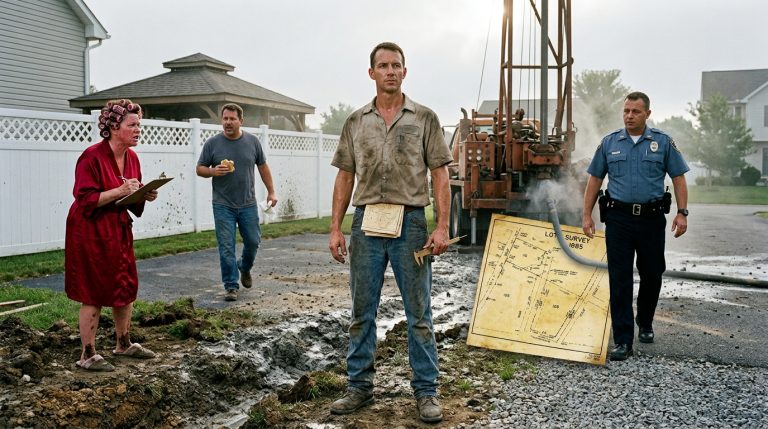
I didn’t move. I stood on the dusty shoulder of County Road 485, thumb resting against the cold, notched edge of the surveyor’s plumb bob in my right pocket. The heavy brass weight grounded the heat in my blood. I stared at the gray mound blocking the fifty-foot gap between two oak trees. Access Point Alpha. My deeded throat to thirty acres of post oak and prairie. Gone. Submerged under six feet of jagged stone.
“This is an official HOA-sanctioned beautification project, Mr. Warren.”
The voice hit my ear like coarse sandpaper dragged across dry pine.
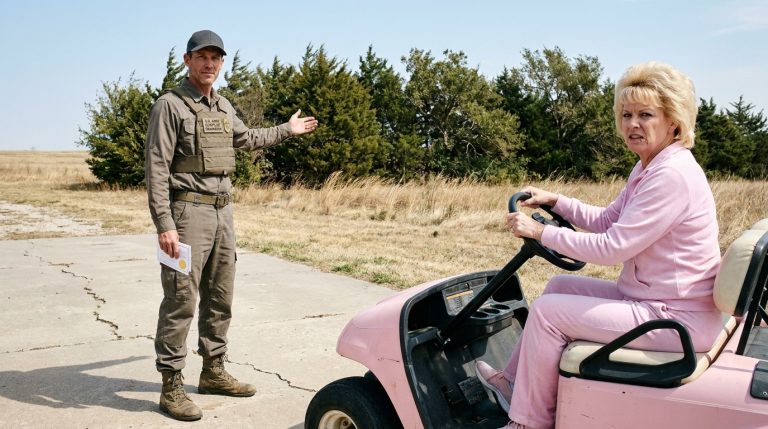
Karen stood four feet away on the asphalt, hands planted on hips that flared out the cut of a cheap polyester blazer. Her pink lipstick was a violent, smeared streak against pale skin. In her right hand, she held a black leatherette clipboard like a commander’s baton. Behind her, three identical beige houses stretched down the cul-de-sac, their manicured lawns burning under the August sun.
“You should be thanking us,” she added, her chest heaving slightly under the heat. “Improving the aesthetic of your approach protects everyone’s equity.”
“You dumped twenty tons of roadbase on a recorded deed easement, Karen.” My voice stayed flat. Low. I didn’t raise it. You don’t scream at a structural failure; you locate the stress fracture.
“It’s a common boundary zone,” she snapped, tapping a acrylic nail against her clipboard. The sound was a sharp clack-clack. “Per Article Four, Section Two of the Oak Hollow covenants. All access points adjacent to our subdivision must meet community standards. You haven’t brush-hogged the sumac in two months. It’s a fire hazard and an eyesore.”
I took a slow breath, letting the hot air fill my lungs. I didn’t look at her face. I looked at the tire tracks. Deep, heavy dual-wheel impressions cut directly into the dirt at the base of the gravel pile, turning sharply back toward the paved loop of Oak Hollow. A commercial dump truck. Unloaded within the last two hours while I was in town buying diesel.
“My land isn’t in your subdivision,” I said.
“All property bordering Oak Hollow falls under our environmental covenants,” she countered instantly. She didn’t hesitate. She believed it. The arrogance wasn’t an act; it was a physical structure she lived inside. “You have until Friday to submit an application to the Architectural Review Committee for an alternate driveway design. Until then, the material stays.”
“You have until five o’clock today to remove it,” I said. “If it’s here at five-zero-one, it’s criminal obstruction.”
She laughed. A quick, barking noise that rattled in her throat. “Threats don’t work here, Mr. Warren. This board has legal counsel on retainer. I suggest you read your rulebook.”
She turned on her heel, her wedge heels crunching hard against the pavement as she headed toward her white SUV parked by the curb.
I didn’t call after her. I didn’t yell.
The moment her driver’s door slammed shut, I pulled my phone from my belt. I tapped the video icon and brought the camera up to eye level, stepping toward the perimeter of the gravel mountain.
“August fourteenth. Two-fifteen p.m.,” I spoke into the mic, my voice steady. “Location: Access Point Alpha, County Road 485. Total obstruction of deeded right-of-way by estimated twenty tons of commercial aggregate. Documenting wheel tracks originating from Oak Hollow main loop.”
I walked the perimeter, taking slow, panning shots of the blockage, the property line markers, and the white SUV vanishing around the bend of the cul-de-sac. Every angle. Every detail. Cold, physical facts.
Thirty minutes later, Deputy Miller’s cruiser kicked up dust as it pulled off the county road. He got out slowly, adjusting his utility belt, his eyes squinting against the glare off the gravel pile. He looked at the mound, then at the laminated survey map I handed him.
He kicked a loose piece of limestone with his boot. “Well, Jack… she sure didn’t leave you much room to turn a truck around.”
“It’s a complete blockage, Miller. Emergency access is zero.”
Miller winced, rubbing the back of his neck. “Look, I get it. It’s a mess. But she’s claiming it’s an HOA improvement on disputed boundary soil. The sheriff’s office can’t tow twenty tons of gravel on a property dispute. It’s a civil issue.”
“Blocking a recorded deed isn’t a civil issue,” I said softly.
“Without a court order showing criminal intent to deny ingress? It is to my captain,” Miller said, handing back the map. “I’ll file an informational report. I’ll talk to her. But my hands are tied until a judge signs an injunction.”
“Write the report,” I said. “Make sure you include the words total fire-truck obstruction.”
He nodded, stepped back into his cruiser, and drove off.
I walked back to the tailgate of my F-250, flipped open my laptop, and tethered the signal to my phone. The metal of the truck bed burned through my denim, but I didn’t move. I pulled up my legal folder, opened a blank document, and began typing a formal cease-and-desist.
No emotion. No adjectives. Just chapter and verse of Texas Property Code Chapter 209, the exact book and page number of the 1950 deed recorded in county records, and Deputy Miller’s incident number.
My thumb rolled the brass surveyor’s weight inside my pocket. Karen thought she was playing a game of chicken over a pile of rocks. She didn’t realize I wasn’t trying to clear the road.
I was building a paper trail that would crush her.
CHAPTER 2: PAPER SHIELD
The ping from my laptop speaker cut through the rhythmic hum of the cicadas like a razor blade.
I didn’t lift my fingers from the warm plastic keys of my laptop. On the tailgate of the F-250, surrounded by the smell of hot diesel and baked dust, I watched the notification banner drop across the top of my screen.
Sender: Oak Hollow HOA Board of Directors.
Subject: Re: Notice of Unlawful Encroachment & Right-of-Way Obstruction.
I opened the message. No legal representative copied. No formal heading. Just three lines from Karen Peterson, typed with the blunt, hurried arrogance of someone who believed the written word belonged exclusively to her.
Mr. Warren,
The Board has reviewed your notice. Be advised that the access zone in question was officially re-designated as HOA Common Area under Architectural Review Committee File ARC-2024-B during the executive session on August 7th. The aggregate installation is a permanent environmental stabilization measure to control soil erosion. Your demand is denied. Further attempts to disturb the installation will be treated as criminal destruction of private community property.
Attached was a single PDF scan.
I downloaded it. The document was an ARC approval form, printed on generic blue-bordered letterhead. At the bottom, three signatures were scribbled in blue ballpoint ink: Karen Peterson (President), along with two illegible scrawls for Treasurer and Secretary. Dated eight days ago.
I zoomed in to four hundred percent.
The resolution was grainy, but the physical discrepancy was glaring. The timestamp at the top of the scanned page—generated by a standard desktop scanner—read Today, 3:12 PM. Exactly twenty-two minutes ago.
She hadn’t just denied the claim. She had fabricated a retroactive committee authorization on her kitchen printer, retrofitting a legal shield after the dump truck had already tipped its load.
A fraud. A paper shield built out of desperation and absolute ignorance of property boundaries.
I saved the email, the PDF, and its underlying metadata into three separate backup drives. My thumb rubbed the smooth, heavy brass of the plumb bob in my pocket, the cold metal drawing out the heat of my skin. Layer One was built. She was claiming common area jurisdiction over land she didn’t own, using a forged vote to justify a physical blockade.
I shut the laptop lid, slid it into my canvas pack, and started walking down the asphalt loop of Oak Hollow.
The neighborhood was dead quiet, baking under the 3:00 p.m. glare. Identical two-story facades of beige stucco and pale brick stared back at me like blank faces. Every lawn was cut to the exact same two-and-a-half-inch height; every mailbox was painted the same dull bronze. But beneath the pristine surface, the friction was visible if you knew where to look.
Three houses down from the cul-de-sac, a middle-aged man in a sweat-stained gray shirt was standing on a stepladder, holding a small tin of off-white paint and a sash brush. His hands were trembling slightly as he touched up the frame of his front door.
George Maxwell.
According to the public HOA meeting minutes I’d pulled the night before, Maxwell had been fined twenty-five hundred dollars two years ago for painting his door a shade of red that wasn’t on the board’s approved palette.
I stopped at the edge of his driveway, my boots resting on the clean concrete curb. “Afternoon, Mr. Maxwell.”
He flinched, almost dropping the brush. He turned, squinting against the sun, his eyes darting past me toward the street before settling on my face. “Can I… can I help you?”
“Jack Warren. I own the acreage at the end of the deed road.”
Maxwell’s face drained of color. He lowered the brush, his knuckles white against the wooden handle. “Look, Mr. Warren… I don’t want any trouble. I saw the gravel pile at the entrance. Everyone saw it.”
“She blocked my only way in,” I said. My voice was a calm, low hum. “She told me the board voted to turn my easement into an ARC environmental stabilization zone. Claimed it was in the minutes from two years ago, right around the time you got fined for the door.”
Maxwell’s mouth twitched. He stepped down from the ladder, his eyes doing another quick sweep of the empty street. “She’s lying,” he whispered, his voice raspy. “There was no vote on your easement. There wasn’t even a meeting on August seventh. She hasn’t held a quorum in six months. She just writes the notices herself and drops them in mailboxes.”
“She put a lean on your house back then, didn’t she?” I asked softly.
Maxwell swallowed hard, his throat working. He looked down at the tin of paint in his hand. “Twenty-five hundred dollars. Then administrative fees. Then late penalties. She threatened to foreclose on the house over a door color called ‘Crimson Brick.’ My wife… my wife couldn’t sleep for a month. We couldn’t afford a lawyer to fight their retainer. So I repainted it ‘Vanilla Mist’ and paid the fine.”
He looked up at me, a bitter, exhausted fire flickering in his eyes. “She doesn’t run an association, Mr. Warren. She runs an extortion racket. If you cross her, she finds something. A weed in the pavement. A oil drip on the apron. A satellite dish angled two degrees off parallel. She grinds you down until you pay.”
“She tried to use a fake ARC form on me today,” I said, leaning in slightly. “A document she scanned twenty minutes ago.”
Maxwell let out a dry, hollow laugh. “She does it all the time. She thinks because it’s on letterhead, nobody can check it.”
“I can check it,” I said. “And I am going to tear it out by the roots. But I need to see what else she’s filed.”
Maxwell hesitated, his eyes locked on my face, searching for the crack in my composure. Finding none, he reached into his back pocket, pulled out a small set of keys, and gestured toward his open garage.
“Come inside,” he muttered, his voice barely audible over the cicadas. “I keep a box under my workbench. Five years of her letters. Five years of receipts.”
He stepped into the shade of the garage, and I followed him, leaving the blinding glare of the street behind.
As he pulled a dusty plastic crate from beneath a pile of lawn care tools, a printed notice taped to the garage wall caught my eye. It was an old municipal notice from the county planning department, faded and yellowed at the edges.
Near the bottom, in small, dense block text, a reference code stood out against the legal jargon: Pursuant to Provisions of the Rural Electrification Act & Section 85-767.
I stared at the numbers. My thumb pressed hard against the surveyor’s weight in my pocket.
Karen thought she was playing with local subdivision rules and forged committee forms. She had no idea she was standing on top of a half-century-old federal grid line.
CHAPTER 3: THE FEDERAL LEVER
The yellowed paper flapped softly against the garage wall as a hot gust of wind blew under the roll-up door.
My eyes didn’t leave the block letters: Section 85-767.
George dragged the plastic crate across the concrete floor, the sound scraping against my eardrums like nails on a blackboard. He straightened up, wiping his grease-stained hands on a rag. “That notice is from ten years ago when the county upgraded the transformer bank down by the creek. Karen tried to sue the utility company for parking a boom truck on the easement. They sent her a copy of the original grant and told her to go kick sand.”
“She had the grant document ten years ago?” I asked, my thumb pressing into the knurled brass of the surveyor’s weight in my pocket.
“She had it,” George said, kicking the crate with his work boot. “Didn’t care then. Doesn’t care now. In her mind, if it’s within sight of these houses, it belongs to her board.”
I pulled my phone from my pocket and took a clean, high-resolution photo of the faded municipal sheet, focusing on the statute code and the county filing reference at the bottom. “George, I’m taking three files from this box: the original threat letter regarding your door, the invoice with the bogus administrative surcharge, and the notice where she claims authority over the easement drainage.”
George hesitated, his fingers twitching against the rag. “If she finds out I gave you those…”
“She won’t know where they came from until the trap is already sprung,” I said. I pulled two folded hundred-dollar bills from my wallet and set them on his workbench next to a jar of rusted bolts. “For your time and the paper.”
“I don’t want your money, Jack.”
“It’s not payment, George. It’s retainer. You’re my primary witness when the state environmental board asks about her history of unpermitted drainage modifications.”
George looked at the money, then at the box, and finally at me. A slow, quiet breath left his chest, deflating the tension in his shoulders. “Take whatever you need. Just make sure when you hit her, she doesn’t get back up.”
“She won’t.”
I picked up the three documents, slid them into my canvas pack, and walked out into the blinding August heat.
I didn’t head back to my truck right away. Instead, I walked fifty yards down the drainage ditch that ran parallel to the easement. The ditch was dry, filled with scorched weeds, cracked mud, and the sharp, angular stones of Karen’s gravel pile spilling over the lip.
The mound of limestone wasn’t just blocking my truck. It was sitting directly in the natural run-off channel. If a late-summer thunderstorm rolled through—the kind that drops two inches of rain in twenty minutes—that gravel would act as a dam, backing water up into the cul-de-sac before washing tons of loose silt straight into Willow Creek a half-mile downstream.
Unpermitted aggregate placement. Disruption of a primary drainage easement. Potential siltation hazard.
I snapped six photos of the gravel spilling into the ditch line, capturing the precise angle where the crushed rock choked the culvert entrance.
Ten minutes later, I was back in the cab of my F-250, the air conditioning blasting lukewarm air against my face. I opened my laptop on the console, connected my phone’s hotspot, and dialed a direct line to Dallas.
The phone rang twice before a booming voice cut through the speaker.
“Jack Warren. Tell me you’re calling to tell me you bought a boat and gave up on farming dirt.”
“Dave,” I said, leaning back against the cracked vinyl seat. “I’m calling because a suburban warlord dumped twenty tons of roadbase across Access Point Alpha and handed me a forged ARC approval form to justify it.”
A brief pause on the line, followed by the heavy clatter of a mechanical keyboard. Dave standard-issued his legal advice at two hundred dollars an hour, but for guys from the 412th Engineer Command, he worked on trade.
“Did she block the throat entirely?” Dave asked, his voice shifting instantly from casual to analytical.
“Completely. Deputy Miller called it a civil matter. Karen Peterson called it an environmental stabilization project.”
“She’s an idiot,” Dave said flatly. “A deed easement recorded in Texas prior to 1960 is virtually unassailable by a residential HOA unless they hold superior title, which they don’t. But a civil suit for tortious interference will take six to eight months to get on a docket. You don’t have six months to park your truck on the shoulder.”
“I don’t need a civil suit to move the gravel,” I said. “I just found a municipal notice on a neighbor’s wall. Section 85-767.”
The typing on Dave’s end stopped dead.
“Repeat that section number,” Dave said slowly.
“Section 85-767. It’s referenced on a ten-year-old county utility notice for the transformer bank at the north property boundary. The easement was created under the 1950s Rural Electrification Act.”
I heard a chair squeak as Dave leaned back. “Jack… if that easement was created under federal rural electrification provisions, it’s not a private driveway. It’s a federally protected access corridor designed to guarantee infrastructure reach to interior agricultural parcels.”
“Which means?”
“Which means blocking it isn’t just picking a fight with you,” Dave said, a quiet, dangerous satisfaction creeping into his voice. “It’s an unpermitted obstruction of a federal access right-of-way under the Department of Transportation’s regional oversight. And if that gravel is sitting in a drainage channel…”
“It’s spilling into the storm ditch that feeds Willow Creek,” I finished. “No containment fencing. No Siltation Waiver on file with the county.”
“Holy hell,” Dave laughed, the sound loud and harsh through the truck speakers. “She didn’t just step in a trap, Jack. She built a concrete block, tied it to her own ankles, and jumped off the pier.”
“How fast can we mobilize the administrative side?” I asked, my thumb rolling the surveyor’s weight over my knuckles.
“Local fire marshal first,” Dave instructed, his keyboard clacking rapidly again. “Emergency vehicle access blockage. That gets a municipal violation on the board within twenty-four hours. Second, I draft a formal notice of unpermitted watershed discharge to the Texas Commission on Environmental Quality. Third, we file a federal access grievance with the DOT regional office, attaching the original 1950 land grant deed.”
“What about her fake ARC form?”
“Save it,” Dave said grimly. “When she hands that forged document to a federal agent or a state investigator to prove she had the right to dump that rock, she crosses the line from petty arrogance straight into falsifying documents to a regulatory authority. Let her hold her paper shield up high, Jack. It’ll just make the target bigger.”
I looked out the windshield at the glare reflecting off the peak of the gravel mountain blocking my road.
“Draft the filings, Dave,” I said softly. “I’ll handle the fire marshal.”
CHAPTER 4: THE COALITION IN THE DARK
The line went dead with a soft click.
I set my phone on the dashboard next to the hot air vent, my thumb tapping the knurled edge of the brass plumb bob in my pocket. Through the bug-splattered glass of the F-250, the gray peak of the gravel mountain stood motionless under the dying orange glare of the Texas sky.
I shifted into drive, idling down County Road 485 to a gravel turn-out two hundred yards past the Oak Hollow boundary. I killed the engine, slid my canvas pack over my shoulder, and stepped out into the humid dusk.
The suburban streets were quiet, the air thick with the smell of freshly cut Saint Augustine grass and pool chlorine. Streetlights flickered to life in a long, orderly grid of amber dots. I kept my head down, walking along the unpaved shoulder until I reached the back gate of George Maxwell’s property.
I lifted the iron latch without a sound and slipped through the side entrance into his living room.
The curtains were drawn tight. A single floor lamp cast a dim, yellow circle over six people sitting in a tight circle on folding chairs and a worn fabric sofa.
George stood by the hallway, his hands buried deep in his jeans pockets. Next to him sat a young woman in her early thirties, her knuckles white as she squeezed the strap of a leather purse. Across from her was a thin man in a faded polo shirt, meticulously aligning three yellowed index cards on the coffee table.
Nobody was drinking their iced tea. The condensation on the glasses pooled on the oak table, leaving dark, overlapping rings.
“Jack,” George said, his voice barely above a whisper. “Everyone’s here. This is Sarah and Mark from lot forty-two. Frank over there is a CPA from the south loop. And Mrs. Higgins.” He gestured toward an elderly woman sitting straight-backed on the edge of a chair, a thick manila folder resting on her lap.
“Thank you for coming,” I said. I didn’t sit. I placed my canvas pack flat on the table, unbuckled the straps, and pulled out the three folders from my truck, along with the printed municipal notice.
Frank, the CPA, looked up, his brow furrowed behind rimless glasses. “George said you have a plan to force the board’s hand. Mr. Warren, I’ve lived here six years. Every time someone tries to challenge Karen at an annual meeting, she invokes parliamentary procedure, shuts down the floor, and mails a two-hundred-dollar fine for disruptive conduct the next morning.”
“She doesn’t run a parliament, Frank,” I said, laying the photos of the gravel blockage side-by-side on the wood. “She runs an unauthorized barrier across a public utility corridor.”
Sarah leaned forward, her eyes scanning the high-resolution prints. “She told the street group on Tuesday that you were trespassing on HOA property and that the board was installing a retaining berm to protect our property values.”
“She lied,” I said flatly. “And to cover that lie, she generated a fake Architectural Review Committee form twenty minutes after I served her with a legal demand.”
I pulled out the zoomed-in printout of the ARC form, pointing to the digital timestamp along the margin.
Frank leaned over, his eyes narrowing. He pulled a pen from his pocket, using the cap to trace the numbers. “Three-twelve PM today. The executive meeting she cited was supposed to have happened eight days ago.” He let out a low, breathy whistle. “That’s not just a procedural error. That’s a falsified record.”
“It gets worse,” I said. I laid down the copy of the county utility notice I’d photographed in George’s garage. “The access road she blocked isn’t subdivision land. It’s an access corridor established under the Rural Electrification Act and Section 85-767. It belongs to a federal grid easement created in 1950.”
The room went dead silent. The low, steady hum of the refrigerator in the kitchen sounded unnaturally loud.
Mrs. Higgins cleared her throat, her wrinkled hands opening her manila folder. She pulled out a stack of paper an inch thick, all stamped with red VIOLATION headers. “She fined me four hundred dollars last winter because my late husband’s handicap ramp didn’t have a matching stain to the front porch pillars. When I told her I couldn’t afford the contractor, she threatened to put a lien on the house.”
“She can’t enforce a lien based on a fraudulent authority,” I said, looking at each of them in turn. “Right now, the local fire marshal is reviewing an emergency access obstruction report. By Tuesday, the Texas Commission on Environmental Quality will have an investigator on-site checking that uncontained aggregate for a missing Siltation Waiver.”
Frank stood up, his fingers tapping rapidly against his thigh. The nervous tic contradicted his rigid posture. “A TCEQ citation carries mandatory statutory fines against the entity holding title. If the HOA gets hit with an unpermitted watershed discharge penalty, the board doesn’t pay that out of their pocket. They issue a special assessment to every homeowner in Oak Hollow.”
“Exactly,” I said. “Every door on this loop will get a bill for four figures to pay for Karen’s pile of rocks.”
Sarah gasped, her hand flying to her mouth. “We can’t pay that. We’re saving for a down payment on a minivan.”
“You won’t have to,” I said. “But when the state and federal investigators show up at that curb on Tuesday, Karen is going to tell them that the entire neighborhood supported this project to protect community standards. She’s going to use your silence as her mandate.”
George stepped forward out of the shadows by the hallway. His voice wasn’t shaking anymore. “So what do we do?”
“We build an audit,” I said. “Every bogus fine, every backdated notice, every threat of a lien. Frank, I need you to reconcile these violation numbers against the official HOA bank statements published in the annual report. I want to know where those fine payments went if there were no committee quorums to record them.”
Frank’s face hardened, the timid caution melting away into the sharp, cold focus of an accountant looking at a crooked ledger. “Give me forty-eight hours. If she didn’t record those ARC approvals in the official minutes, those funds can’t legally be categorized as operating revenue.”
“And the rest of you,” I continued, looking at Sarah, Mark, and Mrs. Higgins. “Gather your paperwork. Don’t confront her. Don’t send emails. Just have your records ready when the county district attorney’s office asks for evidence of a systemic pattern.”
Mrs. Higgins pulled a small pair of reading glasses from her sweater pocket, set them on her nose, and neatly stacked her red-stamped notices into a clean pile. “Mr. Warren, my husband spent thirty years in the postal service. He taught me that when a paper trail is rotten, you don’t burn it. You file it.”
“We file it,” I agreed.
I repacked my canvas bag, snapped the brass buckles shut, and looked at George. “Keep your porch light off tonight.”
“Jack,” George said as he unlocked the back door to let me out into the dark. “What happens if she tries to move the gravel before Tuesday?”
“She won’t,” I said, stepping into the cool night air. “Arrogance doesn’t retreat. It decorates.”
CHAPTER 5: THE TRAP AT PETERSON PARK
Forty-eight hours of silence felt like a drawn bowstring.
Tuesday morning hit ninety-four degrees by nine o’clock. I stood on the dusty shoulder of County Road 485, leaning against the warm front fender of my F-250. My boots were planted on county soil, two feet short of the easement line. My thumb moved slowly, turning the heavy, cold brass of the surveyor’s plumb bob inside my right pocket.
Across the fifty-foot gap, Karen Peterson was hosting a party on a crime scene.
A folding card table covered in a red-and-white checkered vinyl cloth sat three feet from the base of the gravel mountain. A large metal coffee urn glinted in the sun next to a half-empty box of powdered donuts. Beside the table, mounted on a wooden artist’s easel, was a painted sign in pristine gold lettering: Peterson Park — A Community Green Space, Oak Hollow HOA.
Karen stood beside the easel in a floral-print pantsuit, a powdered donut balanced in her left hand and her black leatherette clipboard tucked under her arm. Two board members stood behind her like reluctant guards, holding paper cups of lukewarm coffee while six nervous residents milled around the edge of the cul-de-sac, trying not to look at my truck.
Karen took a bite of her donut, her eyes locking onto mine across the gravel. She smiled—a slow, triumphant curve of wet pink lipstick—and tapped her clipboard against her thigh.
She thought the silence meant submission. She thought the green space sign was the final seal on her territory.
At 9:58 AM, the quiet hum of the neighborhood was broken by the crunch of tires on hot asphalt.
A white state sedan bearing the emblem of the Texas Commission on Environmental Quality turned the corner, pulling up to the curb. A young woman in a high-visibility vest got out holding a digital clipboard and a water sampling kit. She walked straight past the donut table to the drainage ditch, stepping right up to where the gray limestone was choking the culvert.
Karen’s smile vanished. She set her donut on the table and marched over, her wedge heels clicking sharply on the pavement. “Excuse me! This is a private community dedication. What do you think you’re doing?”
The investigator didn’t look up from her screen. “TCEQ Water Quality Division. Inspecting an uncontained aggregate placement reported for potential watershed siltation without an approved Siltation Waiver.”
“A what?” Karen demanded, her voice cracking slightly. “This is an authorized environmental stabilization project!”
Before the investigator could answer, a dark red county SUV pulled up behind the sedan. The driver’s door swung open, and Fire Marshal Billips stepped out, his broad chest filling his navy uniform shirt. He didn’t check the donut table either. He walked up to the edge of the gravel pile, took one look at the six-foot mound blocking the fifty-foot gap, and pulled a yellow citation pad from his belt.
“Peterson,” Billips barked, his voice carrying straight across the cul-de-sac. “Your forty-eight-hour compliance window closed Sunday at noon. You’re sitting at four thousand dollars in county emergency access obstruction penalties, and it ticks up another thousand at midnight.”
Karen’s face flushed a deep, blotchy crimson. She held her clipboard up like a shield. “This is a designated park! We passed an Architectural Review Committee resolution!”
“Your committee doesn’t override county fire lanes, ma’am,” Billips snapped, ripping a carbon-copy sheet from his pad.
Then the heavy iron arrived.
A blue government sedan bearing US Department of Transportation plates pulled alongside my F-250, followed immediately by an unmarked gray utility vehicle.
Agent Harris stepped out of the lead car. She wore a tailored charcoal suit that didn’t show a single drop of sweat despite the heat. Her gray hair was pulled back tightly, and her face was carved out of cold granite. Beside her, a middle-aged man in a navy polo shirt with an EPA badge on his belt stepped out of the gray truck, holding a hard-shelled camera case.
Agent Harris walked with a slow, measured cadence directly to the center of the asphalt loop, stopping three feet from Karen’s wooden easel.
“Karen Peterson?” Harris asked. Her voice was flat, low, and completely devoid of inflection.
“Yes,” Karen said, her chin jutting out as she tried to regain her posture. “I am the president of this association, and if this is about Mr. Warren’s wild accusations—”
“I am Agent Harris with the Federal Highway Administration, Office of Program Administration,” the woman interrupted smoothly. She didn’t raise her voice, but the entire street went dead silent. Behind the lace curtains of lot forty-two, I saw George Maxwell’s outline standing motionless.
Agent Harris unbuttoned her jacket, pulled a thick manila file from her leather briefcase, and opened it.
“We have opened an official administrative review regarding the total obstruction of an established federal right-of-way,” Harris stated. “Specifically, an access corridor dedicated under the Rural Electrification Act and recorded under Section 85-767.”
Karen blinked. Her jaw worked silently for two full seconds. “That’s… that’s a private easement. We re-designated it as common area under ARC File 2024-B.”
“You cannot re-designate a federal infrastructure grant with a residential committee form, Miss Peterson,” Harris said coldly. “And submitting a retroactively backdated document to a state investigator to claim jurisdiction over federal utility access constitutes a direct violation of federal disclosure statutes.”
The EPA agent stepped past her, opening his camera case with two sharp metal snaps. “We are also conducting a joint runoff assessment under the Clean Water Act. Unpermitted aggregate placement threatening a primary tributary without containment fencing carries strict civil liability.”
Karen looked from Agent Harris, to the EPA inspector, to Fire Marshal Billips, and finally to the young TCEQ officer taking water samples from the mud in the ditch.
The floral pantsuit seemed to deflate around her shoulders. Her fingers loosened, and the black leatherette clipboard slipped from her hand, striking the hot asphalt with a sharp, hollow crack.
The paper shield was gone.
Agent Harris closed her file with a soft snap. “Your association has twenty-four hours to initiate complete site remediation using an approved commercial contractor at HOA expense. Furthermore, the district attorney’s office has been notified regarding the fraudulent lien placed against Mr. Warren’s title.”
The two board members behind the card table quietly set their paper cups down, turned around, and walked rapidly away toward their houses, leaving Karen standing alone beside her powdered donuts and her wooden sign.
I stood by my truck, my hand resting on the cool steel of the bed rail. My thumb stopped rolling the surveyor’s weight.
The trap was sprung.
CHAPTER 6: CHECKMATE AND CONCRETE
The black leatherette clipboard lay motionless on the hot street, its metal clip reflecting a harsh point of sunlight.
Karen didn’t pick it up. Her hands hung limp at her sides as Fire Marshal Billips flagged down a yellow commercial skid-steer idling at the mouth of the cul-de-sac. Within ten minutes, the air filled with the heavy, mechanical roar of diesel engines. The excavation crew hired by the county went to work, their steel buckets scraping twenty tons of illegal limestone off the dirt throat of Access Point Alpha.
Karen didn’t speak as the EPA agent documented the lack of a Siltation Waiver. She didn’t move when Agent Harris handed her a formal federal summons detailing the violations under the Rural Electrification Act and Section 85-767. When a county deputy arrived to serve the paperwork regarding the fraudulent lien she’d filed against my property title, she simply turned and walked back toward her house, her wedge heels dragging along the pavement.
By six o’clock that evening, the gravel mountain was gone. The dirt easement stretched fifty feet wide, clear and unimpeded, connecting my thirty acres directly to County Road 485.
Three weeks later, the final dominoes fell in rapid succession.
The Oak Hollow HOA held an emergency special assembly in the elementary school cafeteria down the road. Frank, the CPA, took the floor with a thick spiral notebook. Using the records George Maxwell and Mrs. Higgins had preserved, he laid out four years of unrecorded fines, unauthorized committee actions, and the staggering financial liability Karen had brought upon the community—over eighty thousand dollars in combined municipal penalties, remediation fees, and legal costs.
The vote to remove Karen Peterson and dissolve her board passed ninety-eight to two.
The county district attorney accepted a negotiated plea on the fraudulent lien charge, resulting in five years of strict probation, full restitution of my legal expenses, and a permanent prohibition against her serving on any corporate or residential board in the state. Her house went up for sale less than a month later.
On a warm Saturday afternoon in late September, I stood at the northern edge of my property. The air was cool, carrying the sharp, clean scent of crushed cedar and dry prairie grass.
An F-250 cement mixer was backing slowly down my cleared easement road, its heavy tires rolling over the smooth, graded dirt without a single obstruction.
George Maxwell walked up the side of the driveway, carrying a thermos of dark coffee and two thick ceramic mugs. He looked different—his shoulders were set back, his chin up, the nervous, hunted posture completely gone. Down the street, the front door of his house gleamed in the afternoon light, painted a vibrant, unapologetic shade of cobalt blue.
He poured two cups, handing one to me as the cement truck brought its chute into position over my new shop foundation.
“They elected Frank as the new board treasurer on Thursday,” George said, taking a slow sip. “First thing he did was burn the old violation register. We voted to cap all architectural fines at twenty-five dollars, subject to a full neighborhood vote.”
I took the mug, watching the gray, wet concrete spill smoothly into the wooden forms I’d staked out along the perimeter. “And Karen?”
“Sign came down yesterday,” George said quietly. “Moving van comes Tuesday. She’s relocating to a condo complex in Dallas.”
I pulled my hand from my pocket, setting my brass surveyor’s plumb bob on the flat wooden staging table beside my blueprints. The heavy metal weight sat solid and level against the oak board, catching the golden glare of the setting Texas sun.
“Access looks good, Jack,” George added, looking down the long, clear stretch of the 1950s grant road. “Ironclad.”
“It always was, George,” I said, taking a drink of the hot coffee. “She just had to learn how to read the deed.”