The Iron Strain: A Legacy Sealed in Dirt and Cold Steel
CHAPTER 1: THE PAPER NAIL
The steel latch on the west gate didn’t drop clean.
It hung up two millimeters high, scraping raw iron against the receiver post. Somebody had leveraged a pry bar against the fitting within the last six hours, leaving fresh silver scratches through the rust.
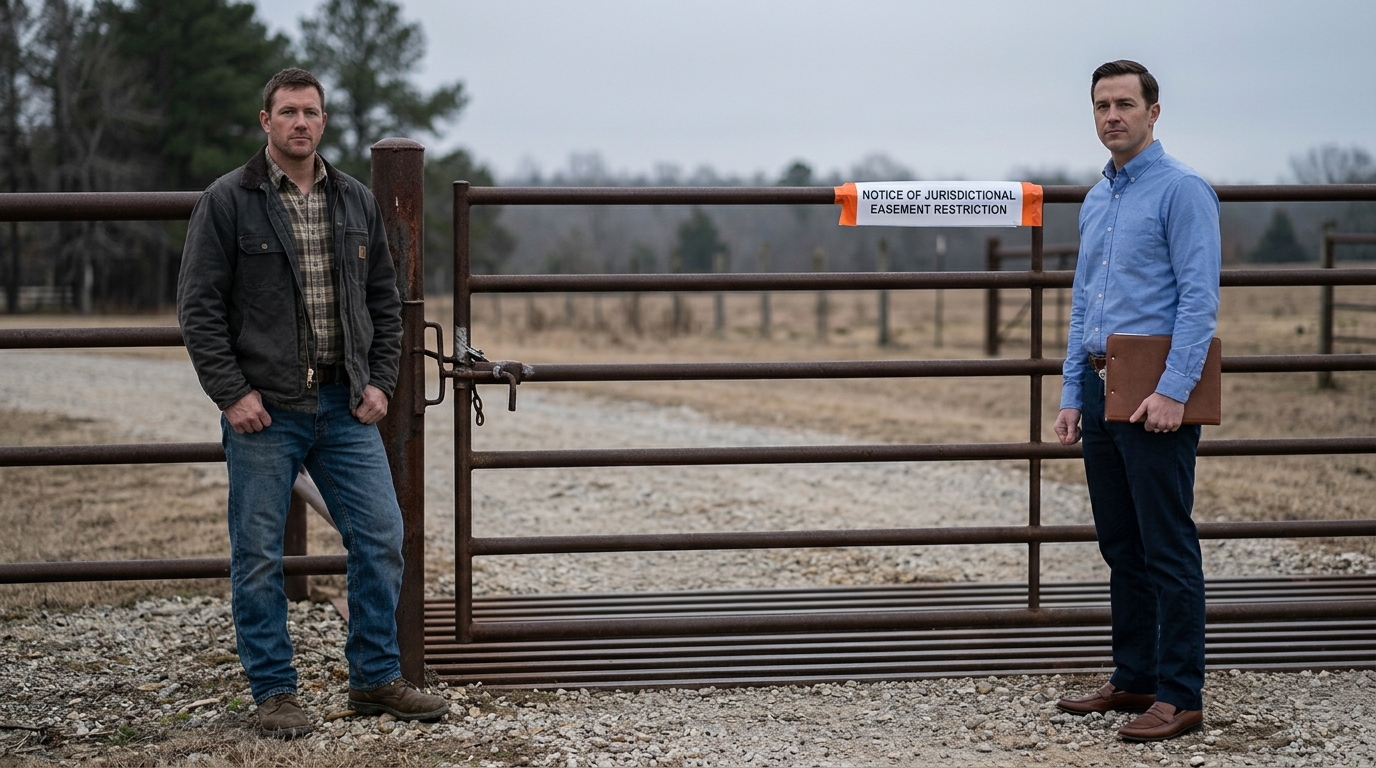
Jake Callaway didn’t touch the paper at first. He sat in the cab of the F-250, engine idling at seven hundred RPM, watching the white corner flutter in the exhaust draft. A single strip of heavy-duty orange contractor tape bound the laminate to the top rail of the Callaway family grid.
He reached down, picked up the brass tire-depth gauge off the console, and ran his thumb over the knurled steel slider. Click. Click. Click. The metal was ice-cold.
“Harland,” Jake muttered.
He stepped out of the truck. His boots hit the dry gravel with a flat, heavy crunch. Morning light hadn’t cleared the ridge line yet, leaving the valley washed in a dull, leaden gray.
The sign wasn’t paper; it was heavy industrial laminate, stamped with an official county seal that looked off-center by three degrees.
NOTICE OF JURISDICTIONAL EASEMENT RESTRICTION
Property boundary designation: PARCEL-407 / ACCESS ROUTE BRAVO.
Unpaid Association Dues (2019–2026): $48,210.00.
Failure to comply will result in immediate non-resident vehicle restriction.
Jake didn’t tear it down. He took out his phone, snapped four images from two paces back, ensuring the fresh gouges on the latch frame were centered in every frame.
A silver Ford Explorer pulled off the county road two minutes later. It didn’t turn in. It stopped dead across the mouth of the gravel, blocking the egress angle.
Richard Harland stepped out. Pressed blue Oxford shirt. Leather loafers that hadn’t seen grease or manure in a lifetime. He held a leather-bound clipboard clamped under his left forearm.
“Jake,” Harland said. He didn’t offer a hand this time. He stopped three feet short of the cattle grid, eyeing the dust on Jake’s work coat. “I see you got the notice.”
Jake slid the brass gauge into his breast pocket. “You broke the frame on my latch.”
Harland’s left eyelid twitched—a micro-fraction of a second before the smooth, curated smile slid back into place. “Administrative access. The surveying crew needed entry to verify the roadway shoulder. It’s HOA property now, Jake. Has been since the board ratified the district overlay.”
“My granddad set the foundation stone for this culvert in 1954,” Jake said. His voice stayed level, low, stripped of heat. “My dad graded the crown every spring after the thaw. There’s no overlay on my deed.”
Harland lifted the top sheet on his clipboard. “Section 4, Line B of the modified easement code. Your access route links directly to the master residential arterial. Under current county guidelines, that grants the association oversight.” He tapped a gold-nibbed pen against the paper. Tap. Tap. “Seven years of back maintenance, Jake. Plus interest. We’re willing to discuss a structured payment plan—if you sign the access agreement today.”
“You’re standing on private dirt, Richard.”
“The dirt is subject to Parcel-407 administrative code,” Harland said. His tone was smooth, perfectly sterile, the voice of a man who believed a stamped folder outweighed sixty years of fence lines. “You have thirty days to settle the ledger, or we lock the grid.”
Jake took one step forward. He didn’t raise his hands. He didn’t close his fists. He simply shifted his body weight over his lead boot, lowering his shoulder center by an inch.
Harland didn’t step back, but his right hand tightened around the edge of his clipboard until the knuckles turned waxy white.
“You’ve got five seconds to back that Explorer out of my driveway,” Jake said softly. “Before I drag it onto the county shoulder with the tow chain.”
Harland held the stare for two beats. The smile was gone now, replaced by a cold, bureaucratic disdain. “The law moves faster than a tractor, Callaway. You can’t farm if you can’t haul.”
“Try me.”
Harland turned, climbed into the Explorer, and reversed onto the asphalt with a sharp squeal of rubber.
Jake stood alone at the gate. He reached into his pocket, pulled out the brass gauge, and clicked the slider once. The sound cut sharp through the morning quiet.
He didn’t tear down the notice. He drove back to the house, walked past the cold coffee pot, and cleared the kitchen table with one sweep of his arm.
It was time to dig up the bones.
CHAPTER 2: COLD GEOMETRY
The brass slider clicked against the metal stop, marking a precise six-millimeter gap on the parchment.
Beneath my thumb, the ink from the 1978 land survey was dry, faded to a dull brown, but the paper held the physical impression of the draftsman’s steel pen. It was heavy bond, rag-content stock, smelling faintly of damp cellar and ancient cedar dust. I ran the tip of the gauge along the eastern boundary line of Parcel-407.
The line was straight as a rifle barrel. It cleared the natural rock shelf at the creek cut, ran precisely ninety rods south-southwest, and bypassed the family access road by a full twenty feet.
On the laminated print Harland had shoved in my face at the gate, that same line had a sudden, unnatural belly in it. A three-degree bow that swept east just long enough to swallow the dirt under my tires before snapping back to the county highway.
“He didn’t get this from the county vault,” I said to the empty kitchen.
The kitchen clock ticked—a heavy, mechanical thud every sixty seconds. Outside, the wind rattled the loose pane in the storm door, carrying the scent of dry pine dust and exhaust from the county highway two miles out.
I opened the blue metal file box my father had kept in the bottom drawer of his roll-top desk. Inside were forty years of canceled checks, hand-written receipts for crushed limestone, and fuel logs from the old Allis-Chalmers grader. Every spring, after the frost heaved the soil, Dad had spent three days dragging the crown smooth.
I pulled out a yellowed receipt from 1994. Hutchkins Gravel & Soil. 40 tons crushed granite. Delivered to Callaway Private Drive.
My phone buzzed on the oak table. The vibration made the brass gauge rattle against the edge of a land plat.
I picked it up. “Yeah.”
“Jake. It’s Thomas.”
Thomas Greavves didn’t do pleasantries. He’d handled my father’s probate twelve years ago, spent thirty years watching county clerks come and go, and knew exactly which drawers in the land office held the real records and which ones held the trash.
“I took a look at the county clerk’s digital portal,” Thomas said. His voice was dry, raspy from forty years of cheap cigars and courtroom air. “The easement modification Harland’s tossing around was uploaded eighteen months ago. It lists your road under a secondary designation—Access Route Bravo.”
“There is no Access Route Bravo,” I said. “It’s the Callaway road. My granddad laid the culverts.”
“On the original deed, yes,” Thomas cut in. “But somebody filed an administrative amendment under an entity called Apex-Vanguard Holdings, acting as an agent for the HOA board. They tied the filing to Parcel-407. They’re claiming the easement was dedicated to public utility in 2005 during the initial subdivision build.”
“Apex-Vanguard?”
“A shell company out of Wilmington,” Thomas said. “They buy up debt notes and infrastructure claims. But here’s the kicker, Jake—the amendment isn’t signed by a judge. It’s got a board signature from Harland, a treasurer sign-off from Vincent Puit, and a notary seal.”
I set the brass gauge down on the 1978 map. “Whose seal?”
“Carol Ames,” Thomas said. “She’s been the independent notary down at the hardware store for thirty years. I called her five minutes ago. She doesn’t remember stamping any easement transfer for Harland. But her logbook is public record. I’m going down to the courthouse at eight tomorrow morning to pull the physical paper.”
“I’m coming with you.”
“Stay on the ranch, Jake,” Thomas said, his tone dropping an octave, heavy and deliberate. “Harland wants you hot. He wants you blocking a truck or swinging a fist so he can call the sheriff and get an injunction. A civil trespass charge gives him leverage. A clean paper trail gives us a hammer.”
“He put a sign on my gate, Thomas.”
“Let the sign rot,” Thomas replied. “Bring me every paper your dad left in that desk. Every invoice, every tax map, every hand-drawn sketch. We build the wall out of dirt and ink. Nothing else.”
The line went dead.
I sat there until the sun dropped below the ridge, turning the kitchen windows into dark grey mirrors. The cold crept through the floorboards. I didn’t turn on the overhead light. I just sat with the smell of the old paper and the quiet weight of the house around me.
At nine o’clock, the sweep of headlights cut across the kitchen wall.
A vehicle had turned off the county road. It was moving slow, the tires crunching over the loose stone of my drive. No high beams—just parking lights cutting through the dust.
I stood up, slid the brass gauge into my pocket, and walked to the front door without turning on the porch lamp. I didn’t grab a rifle. In a fight over dirt, a gun just makes you look desperate.
I stepped out onto the porch. The air was forty degrees, sharp enough to burn the back of my throat.
A black heavy-duty pickup idling at the edge of the yard didn’t have HOA markings. It had tinted windows and a commercial rack in the bed. The driver’s side window rolled down four inches.
A man I’d never seen before looked out. He had a square jaw, thick neck, and a canvas work jacket with no grease on the cuffs.
“Jake Callaway?” he asked. Voice flat, industrial.
“You’re past the private property marker,” I said, staying on the top porch step. “About two hundred yards past it.”
“Just delivering a courtesy notice,” the man said. He reached out the window and dropped a white plastic marker—a surveyor’s pin with a strip of neon pink flagging tape attached—straight into the dirt of my driveway. “Survey crew starts marking the shoulder widening at six a.m. Harland said to let you know so you don’t park your tractor in the way of the equipment.”
“Tell Harland if his equipment touches that grid, the operator better have a bill of sale for the machine,” I said. “Because it won’t be driving back out.”
The man didn’t laugh. He didn’t get mad. He just stared at me for three seconds, his eyes cold and analytical, taking in my posture, the angle of the porch, the dark windows of the house behind me.
“It’s just dirt, Callaway,” he said softly. “Nobody owns it forever.”
He rolled the window up, threw the truck into reverse, and backed down the drive with smooth, practiced precision, never hitting the gravel shoulders once.
I walked down the steps, knelt in the dust, and picked up the surveyor’s pin. The steel was fresh, cold, factory-milled. Stamped along the side in microscopic block lettering was a serial code: AVH-AQ9-407.
I ran my thumb over the raised letters, feeling the sharp metal edges cut into my skin.
Apex-Vanguard.
They weren’t just trying to collect back dues. They were marking a line.
CHAPTER 3: THE FORGED INK
The steel edge bit into my skin until a single drop of dark blood welled against the stamped letters.
I didn’t wipe it off. I stood up, slid the pin into my coat pocket next to the brass tire gauge, and walked back up the porch steps. The truck’s taillights were long gone, swallowed by the thick valley mist hanging over the county road, but the smell of burnt diesel still clung to the damp cedar posts.
I didn’t sleep. By six in the morning, the F-250 was idling at the county courthouse line, heater blowing lukewarm air against the frost-rimmed windshield.
Thomas Greavves was waiting on the broad granite steps, his coat collar turned up against the wind. In his right hand, he carried a battered leather briefcase with a brass latch held together by a loop of copper wire. He looked at the surveyor’s pin I handed him without a word, turning it over in his liver-spotted fingers before slipping it into his pocket.
“The clerk opened at seven-thirty,” Thomas said. His voice was raspy, dry as chaff. “We don’t go through the public portal. We go to the basement vault.”
The records room smelled of old damp cardboard, floor wax, and sixty years of institutional dust. Fluorescent tubes hummed overhead, flickering with a dull, sickening blue light. Behind the tall oak counter sat Carol Ames. She wore a heavy knit cardigan, her silver hair pulled back in a tight bun, spectacles hanging from a woven cord around her neck.
She looked up as Thomas set his briefcase on the wood. “Thomas,” she said softly. “You look like you slept in a ditch.”
“Feels like it, Carol,” Thomas said. He pulled a folded sheet of paper from his pocket—the certified printout of the easement amendment Harland had submitted. “I need your physical ledger. November of two years ago.”
Carol adjusted her glasses, peering through the bifocals at the official red seal on the printout. Her thumb brushed the dark violet ink mark at the bottom of the page.
“That’s my stamp,” she said.
“Is it?” Thomas asked.
Carol didn’t answer right away. She turned, unlocked a heavy steel cabinet behind her desk, and pulled out a thick, leather-bound register with marbled edges. The pages were ledger-ruled, filled with dense, disciplined handwriting—date, document type, signer’s printed name, fee collected, signature.
She flipped back eighteen months, her finger running down the column line by line.
“November 14,” Carol read aloud. “Deed transfer for Miller. Land contract for Jennings. Vehicle title. November 15… power of attorney for the Vance family.” She paused. She brought her face within four inches of the paper. “There’s no entry for the HOA. No entry for Richard Harland. No entry for Apex-Vanguard.”
“Look at the serial code under the stamp on the filing, Carol,” Thomas said softly.
She looked back at the printout. “Code 884-B. My stamp number.” She reached into her top desk drawer, pulled out a small wooden-handled rubber stamp, and pressed it onto a blank index card.
The ink mark hit the white card with a clean, razor-sharp border.
She laid the index card directly beside the certified copy of the easement amendment.
The difference was tiny—a fraction of a millimeter. The upper loop of the letter C in County on the official filing had a microscopic break in the serif. On Carol’s actual stamp, the loop was completely closed.
“It’s a duplicate,” Carol whispered. Her hands didn’t shake, but her jaw set into a hard, rigid line. “Somebody took a high-resolution scan of my seal off an old mortgage filing, manufactured a rubber plate, and stamped this page.”
“And filed it directly into the land book during the digital transition,” Thomas added. He leaned over the counter, his eyes locked on hers. “Who submitted the paper packet for indexing?”
Carol turned the page of her ledger, looking at the clerk’s intake stamp on the back of the archival jacket. “Vincent Puit. He brought a stack of twenty-five easement updates in a manila folder right before the Thanksgiving weekend two years ago. Said the board was consolidating district records.”
“Layer One,” I muttered.
Thomas looked at me, his face grim. “They didn’t just bend the line on a map, Jake. They committed a felony in broad daylight, betting nobody would ever pull the physical ledger from a dark basement.”
Carol stood up, her knuckles resting flat on the open ledger. “I’ve lived in this valley for seventy-two years, Thomas. I notary-stamped your bar admission paper thirty years ago. I stamped Jake’s father’s land purchase.” She looked straight at me, her eyes clear and fiercely sharp. “Nobody uses my name to steal a man’s road. I’ll sign an affidavit right now.”
“Hold the affidavit, Carol,” Thomas said quietly. “If we file it today, Harland’s lawyers will claim an administrative error and pull the document before we get a judge on the bench. We let Harland hang his whole case on this paper.”
“He’s putting up barricades at the gate this afternoon,” I said, my voice dropping low. “I saw the crew.”
“Let him put them up,” Thomas said, turning toward the basement stairs. “The higher he builds the fence, the harder he falls when the post snaps.”
He didn’t wait for me. He walked out, his leather briefcase slapping against his knee with a dull, rhythmic thud.
I stood in the cold basement for a second longer, looking at the index card Carol had stamped. The dark ink was still wet, shining under the harsh tube light. Beside it, the stamped serial number on the surveyor’s pin in my coat pocket seemed to burn right through the canvas.
They had built a house out of forged paper and fake authority. And tomorrow, we were going to pull the foundation pin.
CHAPTER 4: THE PRESSURE TRAP
The air outside the courthouse hit my lungs like ground glass.
Shadows stretched across the dashboard, and forty minutes of silence broke when the F-250’s tires finally crunched on the gravel of my drive.
Harland hadn’t waited for noon. Two heavy orange water-filled plastic barricades blocked the neck of the culvert, zip-tied together with steel cable. A high-visibility laminated sign hung off the crossbar, bold black letters reflecting my headlights in the graying light: ACCESS RESTRICTED — UNSANCTIONED VEHICLE ENTRY SUBJECT TO IMMEDIATE IMPOUND.
Behind the plastic wall stood a yellow Bobcat skid-steer, idling with a low, hydraulic whine.
I didn’t hit the brakes until my front bumper was three inches from the plastic orange wall. I stepped out, my work boots sinking into the wet mud at the shoulder. The diesel smoke from the skid-steer smelled sour, heavy with unburnt fuel.
The operator inside the cab didn’t look at me. He kept his eyes locked on his phone, thumbs moving fast across the glass.
“Clear the lane,” I said.
The cab door didn’t open. The side window slid down two inches. “Harland’s orders, chief. Site prep for the drainage expansion under Parcel-407. Non-residents got to use the southern detour.”
“There is no southern detour,” I said. “That’s three miles of sinkhole wash.”
I reached into my canvas coat, pulled out the steel surveyor’s pin stamped AVH-AQ9-407, and slammed it flat onto the plastic barricade right in front of the operator’s glass. The metallic snap echoed off the steel cab frame.
“Call Harland,” I told him, my voice flat, carrying no heat at all. “Tell him I brought his pin back. Tell him the county basement has three pages of ledger that don’t match his filing.”
The operator looked down at the steel pin, then at my face. His thumb stopped moving on his phone screen. He pulled his hand back, tapped the radio on his dash, and spoke two words into the mic.
He didn’t move the machine. But he didn’t lower the bucket either.
By seven that night, the pressure moved from the dirt to the town.
The regional community center on 4th Street smelled of pine floor cleaner and damp wool coats. Forty folding chairs were set up in five neat rows facing a folding table where Harland sat flanked by two men in dark suits. Neither man belonged to the valley; their hands were smooth, uncalloused, their notebooks leather-bound and unmarked.
On the projector screen behind them hung a high-resolution digital slide: PARCEL-407 DISTRICT CONSOLIDATION & WATER MANAGEMENT INITIATIVE.
“It’s about regional equity,” Harland was saying as I walked through the double doors at the back of the hall. His voice was warm, projected with easy, practiced cadence. “When one property owner refuses to contribute to the shared infrastructure, the burden falls on every family in the subdivision. We’re simply asking Mr. Callaway to honor the same standard as his neighbors.”
A few heads turned. Earl Hutchkins sat in the third row, his faded john-deere cap clamped between his knees. Next to him, Margaret O’Neal turned her head, her face pale, her lips pressed into a thin line.
I didn’t take a seat. I stood against the back wall, my coat unbuttoned, my right thumb resting inside my pocket against the cold knurled steel of the tire-depth gauge. Click.
“Mr. Callaway,” Harland said smoothly, spotting me in the light. He didn’t flinch. “I’m glad you could join us. We were just explaining the maintenance deficit to the board.”
“Explain the notary,” I said.
The room went dead quiet. The hum of the projector fan filled the silence like a swarm of flies.
Harland’s smile didn’t fade, but his shoulders squared by a fraction of an inch. “Administrative filings are handled through third-party counsel, Jake. If there was a clerical discrepancy—”
“It wasn’t a discrepancy, Richard,” I said, stepping forward. The heels of my boots struck the linoleum floor with hard, distinct beats. I pulled a folded paper from my inner pocket and held it out, not to Harland, but toward Earl and Margaret. “Carol Ames logged four thousand entries in thirty years. Not one of them was for your easement. Somebody cloned her stamp to put a fake lien on my deed.”
One of the suited men beside Harland leaned over, whispered three words into Harland’s ear, and laid a hand flat on a thick blue folder marked Apex-Vanguard Legal Counsel.
Harland didn’t look at the folder. He looked straight at me, his eyes narrowing into cold, razor-sharp focus.
“A technical challenge to a recording stamp doesn’t extinguish a public utility easement, Mr. Callaway,” Harland said, his voice dropping the warmth, taking on the hard, unyielding edge of an anvil. “Parcel-407 is part of a broader watershed district. The county water board authorized survey rights under Aquifer-Nine two weeks ago. If you block the road, you’re not fighting an HOA. You’re blocking a regional water infrastructure project.”
The word hung in the air like smoke. Aquifer-Nine.
Earl Hutchkins turned clear around in his chair, his eyes wide. “The deep well line? That’s under the Callaway bottomland.”
“The bottomland holds the static head for the whole basin,” Harland said flatly, standing up from his chair. He didn’t look like a suburban board president anymore. He looked like an executor reading a liquidation order. “The road isn’t just gravel, Jake. It’s the pipeline right-of-way. You sign the easement agreement by Friday, or the county enforcement marshal clears the culvert.”
He didn’t wait for a vote. He snapped his leather binder shut, turned his back on the room, and walked out the side door with his two attorneys trailing behind him like shadows.
I stayed standing in the aisle. Earl stood up, walked over, and set a heavy, scarred hand on my shoulder.
“They’re going after the water, Jake,” Earl muttered, his voice shaking slightly. “If they tap the static head under your lower forty, every shallow well in this valley goes dry by August.”
I felt the brass gauge in my pocket. My thumb pressed the slider all the way to the stop, locking the steel pin against the casing until it couldn’t move another millimeter.
“They aren’t tapping anything,” I said. “They built their case on a fake stamp. Now we make them swear to it under oath.”
CHAPTER 5: THE FRACTURED PAPER
The brass slider on my depth gauge clicked once inside my pocket, the cold steel pin pressing hard against my hip bone as Earl took his hand off my coat.
Three days vanished into four hours of quiet road glare, and when the heavy oak doors of Hearing Room 3 clicked shut behind us, the silence inside felt pressurized, like a storm cellar before the hatch drops.
Judge Patricia Voss sat behind the raised mahogany bench, her dark hair pulled into a severe knot, a thick ring-binder lying open under her right hand. Below her, the court reporter’s fingers hovered over the machine key-tray.
Harland sat at the defense table in a charcoal three-piece suit, his hands folded neatly over a pristine manila folder labeled PARCEL-407 INFRASTRUCTURE AGREEMENT. Beside him, the lead corporate attorney from Wilmington—a tall, hawk-nosed man named Vance—unfurls a blue-line master plan across the wood.
“We are here on the petition of the District HOA Board regarding easement access and unpaid maintenance assessments on Parcel-407,” Judge Voss said. Her voice was flat, dry, stripped of patience. “Mr. Greavves, you requested an evidentiary hearing before any summary order on the road access.”
Thomas Greavves didn’t stand up immediately. He reached down, unbuckled his battered briefcase, and pulled out two items: a leather-bound ledger with marbled edges and a single yellow index card.
“We do not object to the court reviewing infrastructure filings, Your Honor,” Thomas said, his voice raspy as dry gravel dragging across slate. “We object to the court reviewing forged documents.”
Vance stood up smoothly. “Your Honor, opposing counsel is hurling wild allegations to delay a critical regional utility transition tied to the Aquifer-Nine development project.”
“Sit down, Mr. Vance,” Judge Voss said without looking up from her binder. “Mr. Greavves, put your witness on the stand.”
Carol Ames walked to the wooden box with short, measured steps. She didn’t look at Harland. She smoothed the front of her cardigan, laid her hands flat on the railing, and waited for the oath.
“Mrs. Ames,” Thomas said, stepping around our table. “You have served as a commissioned notary in this county for thirty-two years?”
“Thirty-two years and four months,” she replied clear and sharp.
Thomas held up the certified copy of the easement amendment. “Look at the stamp on Exhibit B. Is that your seal?”
Carol pulled her spectacles from her sweater, set them on her nose, and examined the paper for four seconds. “It bears my name and commission number. It is not my stamp.”
Vance clicked his pen. Snap. “Objection—foundation.”
“Overruled,” Voss snapped. “Explain, Mrs. Ames.”
Carol opened the marbled ledger Thomas set before her. “Every notary act in this county requires a contemporaneous entry in a bound register. On November 14 of two years ago, when this document purports to have been notarized in my office by Mr. Harland, my log shows three entries: a deed transfer, a land contract, and a title transfer. None involved the HOA. None involved Parcel-407.”
She pulled the index card from her sweater pocket and set it beside the exhibit. “Furthermore, the rubber plate used on Exhibit B contains a microscopic defect—an open serif on the letter C—that does not exist on my state-issued die. The stamp on that document is an unauthorized duplicate.”
A quiet rustle ran through the public gallery behind us. Earl Hutchkins leaned forward, his boots creaking against the floorboards.
Harland didn’t move a muscle, but his jaw muscle tightened until the skin turned gray under his cheekbone.
“Mr. Harland,” Judge Voss said, her gaze shifting slowly toward the defense table like a gun turret. “You signed this filing as board president. Who presented this instrument for notarization?”
Harland stood up. His suit jacket fell clean, his expression settled into an easy, practiced look of mild administrative regret. “Your Honor, the board utilizes third-party administrative contractors provided through Apex-Vanguard. If an outside paralegal improperly executed a notary stamp during the mass digital conversion of regional records, that is a clerical irregularity. It does not alter the fact that the road over Parcel-407 sits atop a critical public utility corridor.”
“It wasn’t a paralegal, Richard,” I said from my seat.
My voice wasn’t loud, but it cut through the room like cold iron through frozen turf.
Vance slammed his hand on the table. “Your Honor, control your client!”
“Let him speak,” Voss said, leaning forward.
I reached into my pocket, pulled out the steel surveyor’s pin stamped AVH-AQ9-407, and set it on the counsel table with a dull, heavy clink.
“Apex-Vanguard didn’t want a road,” I said, looking straight into Harland’s eyes. “The road was just the lever to put a fifty-thousand-dollar debt lien on my family’s deed. When I couldn’t pay, you foreclosed on Parcel-407, acquired the static water head under my lower pasture, and routed the commercial draw for Aquifer-Nine directly to the Wilmington resort group.”
Harland’s eyes twitched—the same sharp flicker I’d seen at my gate six days ago. “That is speculative nonsense—”
“The serial code on that pin matches the corporate filing for Apex-Vanguard’s water extraction lease filed in Wilmington six months ago,” Thomas said, dropping a second stack of papers onto the judge’s bench. “Signed by Vincent Puit as managing director. The same Vincent Puit who resigned from the HOA board forty-eight hours ago.”
The air went dead cold in the courtroom.
Judge Voss read the top page of Thomas’s filing. Then she read it again. Her face didn’t change, but when she lowered the paper, her eyes were like two pieces of slate.
“Mr. Harland,” she said, her voice dropping an octave, terrifyingly calm. “Did you or any agent of Apex-Vanguard arrange for the creation of a fraudulent notary stamp to cloud the title of the Callaway property?”
Harland opened his mouth. For the first time since this began, the smooth, effortless answers weren’t there. He looked at Vance, but Vance was already closing his leather notebook, his eyes fixed on the blank wall above the judge’s head. The corporate lawyer wasn’t defending him anymore; he was building a firewall between Apex-Vanguard and a felony indictment.
“I… I relied on administrative filings prepared by counsel,” Harland stammered, his fingers tightening around the edge of his manila folder until the paper creaked.
Judge Voss picked up her gavel. She didn’t strike the block hard, just a single, sharp strike that sounded like a dry branch snapping in winter.
“The court finds that the amended easement map filed against Parcel-407 is tainted by clear evidence of criminal fraud and unauthenticated execution,” Voss declared. “The filing is hereby ordered stricken from the county land registry, effective immediately.”
She looked straight at Harland. “Every fee, assessment, and lien claimed against the Callaway property is voided with prejudice. Furthermore, I am referring this record, along with the physical evidence of the forged seal, directly to the State Attorney General and the County Prosecutor for immediate criminal investigation regarding land fraud and forgery.”
She struck the block a second time. “We are adjourned.”
The room erupted into a low murmur, but Harland just stood there at his table, staring down at his pristine manila folder like he was looking into a deep, dark well.
He didn’t look at me when I walked past him down the center aisle. He looked smaller, his expensive wool suit hanging loose over his shoulders, his hands stiff at his sides.
I pushed open the heavy oak doors and stepped out onto the courthouse steps.
The valley air was clear, cold, and quiet. The sun had finally broken through the grey clouds over the ridge, striking the wet gravel of the street below until it shone like polished brass.
CHAPTER 6: DIRT AND RECORD
The gravel at the base of the courthouse steps was wet, holding the imprint of heavy work boots long after the crowd dispersed.
Shadows stretched across the windshield as I drove west, and forty-five minutes of quiet engine hum dissolved when the F-250’s tires left the pavement and took to the rough crown of the Callaway drive.
The orange water-filled barricades were gone.
Someone had dragged them off the road shoulder and tipped them into the ditch, where they lay drained, hollow, and graying in the low afternoon light. The yellow Bobcat skid-steer had vanished too, leaving only two deep, torn tracks in the mud where the tracks had loaded onto a lowboy trailer.
I pulled up to the west gate, shifted into park, and let the engine idle at seven hundred RPM.
The steel latch on the gate still hung high, but the fresh gouges where Harland’s crew had jammed a bar were already beginning to rust, turning the bright silver metal into a dull, dark orange.
I stepped out of the truck. The mountain air was clean, forty degrees, carrying no smell of diesel smoke or warm hydraulic fluid—just dry pine needle dust and the cold dampness rising off the creek cut.
I reached into my canvas coat pocket, pulled out a small adjustable wrench, three grease rags, and the brass tire-depth gauge. I walked up to the post, loosened the two half-inch carriage bolts holding the receiver bracket, and tapped the frame down two millimeters with the heel of my hand.
I swung the heavy iron gate wide. When it swung back, the latch dropped straight into the slot—a clean, heavy clack of iron meeting iron. No drag. No bind.
Footsteps crunched over the drive behind me.
Earl Hutchkins walked up from his farm truck parked on the shoulder, carrying a thermite-welded fence tool and a roll of heavy galvanized wire. Behind him, Margaret O’Neal pulled her station wagon onto the grass, her grand-kids sitting quiet in the back seat.
“County marshal’s office drove through twenty minutes ago,” Earl said, resting his arm on the fence post. “Served the formal injunction papers on the HOA office down at the subdivision entry. Harland wasn’t there. Puit’s house has a ‘For Sale’ sign stuck in the lawn.”
“He won’t be back,” I said.
Earl nodded slowly, looking past me down the long gravel ribbon cutting through the bottomland. “Apex-Vanguard pulled their permit applications for the Aquifer-Nine test wells before noon. Once Judge Voss put the forgery referral on the public docket, their corporate attorneys cut the line. Parcel-407 stays on the county plat as Callaway dirt.”
“Always was,” I said.
Margaret walked over, holding a small manila folder. She didn’t hand it to me right away; she set it on the flat wood of the gate post. Inside was a certified copy of the court order, signed by Judge Voss and stamped with the raised seal of the County Clerk—the real seal, impressed deep into the paper fibre without a single broken serif.
“Carol wanted you to have the official transcript for your file box,” Margaret said softly. “The one your dad kept in the desk.”
“Tell her I owe her a cup of coffee,” I said.
“She said to tell you the ledger is closed, Jake. Signed and stamped.”
We stood at the gate for ten minutes without speaking. Out in the lower forty, three black Angus cows grazed near the willow line where the creek ran over the gravel bed. The static head under the dirt—the deep, cold water that had drawn men in wool suits three hundred miles from Wilmington—lay quiet forty feet down, untouched, uncapped, running slow through the limestone bedrock.
Earl fixed a loose strand of barb on the corner post, twisted the wire tight with his pliers until it hummed, and tossed the scrap into his truck bed. He didn’t offer a speech. He just tapped his knuckles against the top rail and walked back to his rig.
When their trucks drove off down the county road, the quiet settled over the valley like a heavy wool blanket.
I walked back to the F-250, picked up the yellowed 1978 land survey map off the seat, and smoothed it flat across the hood.
I pulled the brass depth gauge from my pocket. I set the steel slider to zero, pressed the casing shut, and slipped it into the bottom drawer of the metal file box sitting on the passenger floorboards—right next to my granddad’s 1954 receipts for the culvert stone and my father’s hand-written fuel logs.
Men like Harland come and go. They come with laminated maps, crisp folders, and smooth words built to make a man feel like thirty years of sweat can be erased by a signature on a fake form. They count on you getting tired. They count on you believing that paper holds more weight than the ground beneath your boots.
But paper burns, and fake ink fades.
I shut the truck door, locked the blue metal box, and threw the F-250 into gear. The tires caught the gravel, crunching smooth and steady as I drove down the road my grandfather built, winding west through the afternoon shadow, exactly where it had always belonged.