The Architecture of Resistance: How One Engineer Weaponized Bureaucracy Against Suburban Tyranny
CHAPTER 1: THE HUNDREDDOLLAR PER INCH WAR
The laminated clipboards of suburban despots always smelled faintly of lemon-scented sanitizer and unearned authority.
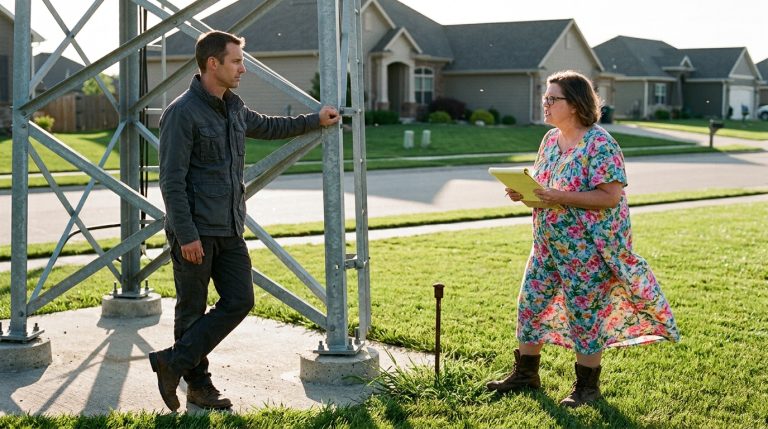
From my position on the concrete apron of the driveway, the view was absolute. Five years of steady growth stood behind me—a dense, multi-row staggered barrier of eastern red cedar, bur oak, and hackberry designed according to strict USDA agronomist blueprints. They had transformed our patch of the former soybean flats from a wind-scoured wasteland into a sanctuary. But Karen did not see biology or physics. She saw an infraction against her personal theology of beige siding and uniform sightlines.
Her pastel pink tracksuit strained against the contours of her golf cart seat like a compressed spring ready to snap. The stiff, sprayed helmet of blonde hair remained completely motionless despite the afternoon thermal rising off the drive.
“Thirty days, Mr. Turner,” she repeated, her voice dripping with the practiced cadence of someone who had never once faced a real consequence in her life. “Ten thousand dollars in accumulated compliance penalties. And every single one of those unauthorized timber obstructions removed down to the root line. Otherwise, our attorney initiates the foreclosure filing.”
I did not blink. My heart rate, conditioned by two decades of analyzing topographical vulnerabilities for the Army Corps of Engineers, dropped into a rhythmic, steady baseline. Every crisis was merely a system with inputs, constraints, and structural failure points. Karen was relying on a single, predictable input: the panic response. She expected the blood to rush to my ears, expected the stammered defense, the half-formed plea for an extension, the total psychological collapse that kept her petty fiefdom intact.
Instead, I offered her an empty room.
I let the silence stretch out, long enough for the electric whine of her golf cart battery to hum against the background prairie wind. I let a bead of sweat trace its slow path down the bridge of her nose, breaking through her carefully applied makeup.
“Foreclosure, Karen?” I kept my voice lowered, pitched into that tight, dangerous frequency that forces people to lean in even when they want to run away. “That is a very specific legal remedy. You start attaching liens to real property, you better make sure your paper trail survives discovery. Are you entirely certain your architectural committee minutes reflect a unanimous vote, or did you just tell Stan and Brenda what to sign over a box of donuts?”
A micro-twitch crossed the left corner of her mouth—a fractional loss of control that she instantly tried to paper over by revving the cart’s throttle.
“The board operates with total autonomy,” she snapped, her voice pitching an octave higher than intended. “The aesthetic violation is self-evident. Your trees block the uniform sightline of the cul-de-sac.”
She jammed the accelerator forward, spitting a spray of white limestone gravel across my lawn before peeling away toward the next house on her ledger.
I looked down at the paper she had left behind. It was crisply printed, featuring a gold-embossed seal that the local print shop probably charged thirty dollars an hour to produce. I folded it once, twice, pressing the creases down with my thumb until the edges were razor-sharp, and slid it into my back pocket.
Inside the house, the air conditioning hummed a steady, cool counterpoint to the heat outside. Sarah was standing by the kitchen island, wiping down the granite counter with a damp cloth, her eyes darting instantly to my expression as the screen door latched shut behind me. She knew the cadence of these visits. She knew the particular flavor of suburban malice that arrived in pastel pink.
“What did she want this time, Mark?” Sarah asked, her hands halting mid-wipe.
I pulled the folded document from my pocket, laid it flat against the cool stone, and slid it across the counter without a word.
Sarah’s eyes scanned the top paragraph. The color drained from her cheeks in real-time, replaced by a sudden, sharp flush of pure, unadulterated fury as her gaze locked onto the word foreclosure.
“Ten thousand dollars?” Her voice dropped to a tight, vibrating whisper. “Over the trees? The exact trees that keep our patio furniture from ending up in the next county every time a spring front rolls through?”
“She’s escalating,” I said quietly, walking over to the corner desk where the thick three-ring binder labeled HOUSE sat wedged between manuals and tax returns. I unlatched the heavy brass rings, flipping past utility easements and appliance warranties straight to the tab marked HOA. “She thinks we’re an easy target because the developer vanished three years ago and left the bylaws full of deliberate ambiguities.”
I pulled out the original architectural review application I had submitted half a decade ago—a clean, stamped, rubber-approved document signed by the original developer’s proxy when the neighborhood was just stakes in the mud.
“She thinks she’s running a court of law,” I muttered, opening my laptop and creating a new folder on the desktop with a clean, unblinking title: Operation Defoliation. “She’s about to discover the difference between an arbitrary rule and a structural flaw.”
I sat down, pulled the scanner feed toward me, and placed Karen’s notice glass-down on the flatbed. The light flashed a brilliant, sterile blue against the dark room.
As the scan progress bar crept slowly across the screen, my phone buzzed against the wooden desk surface. It was an unknown local number, but the area code belonged to the county seat downtown. I let it ring once, twice, listening to the digital chime echo in the quiet kitchen, before sliding my thumb across the glass to answer.
CHAPTER 2: THE AUDIT OF THE LIVING ARCHIVE
The phone stopped ringing on the third chime, leaving only the low, rhythmic hum of the computer tower and the steady glare of the flatbed scanner light pulsing against the kitchen walls.
I did not pick up. An unknown number from the county seat on the exact afternoon an unprovoked legal threat was dropped on a doorstep was not a coincidence; it was noise. In engineering, you filter out noise until you have isolated the raw signal. Right now, the signal was sitting face-down on the glass bed of my scanner, glowing a harsh, sterile blue as it converted Karen’s manufactured decree into unalterable digital data.
The scan progress bar ticked to one hundred percent. A sharp, digital beep signaled the file’s completion.
I reached out, lifted the scanner lid, and dragged the digital image into a newly created folder on the desktop. Operation Defoliation. The subfolders were already mapped out in my mind: Correspondence, Photographs, Financials, Precedents. I named the file Violation_Notice_Original.pdf, hitting save with a deliberate, measured click of the mouse.
Sarah stood motionless by the kitchen island, her hands still resting on the cool granite surface. The initial surge of heat in her face had settled into a hard, cold resolve. She knew this house as well as I did—every board driven, every box unpacked when we moved in five years ago after my discharge from the Corps.
“She used an embossing stamp on the header,” Sarah said quietly, her eyes fixed on the scanner light. “I saw it when you slid it over. It looked official.”
“It’s designed to look official,” I said, leaning back in the chair and stretching my fingers over the edge of the desk. “Printers down on Main Street sell those seals to anyone with forty dollars and a business license. A real legal notice from a retained counsel comes via certified mail with a verifiable bar association number attached to the signature block. This was hand-delivered in an unfranked envelope by someone who couldn’t be bothered to pay for postage because she wanted the psychological impact of standing on the porch.”
I opened a blank spreadsheet document, locking the top row with permanent parameters: Date, Time, Source, Description, Legal Reference.
“If she wants to play a game of municipal paperwork, we’ll give her an institutional-grade audit,” I continued, my fingers moving steadily across the keyboard. “Most people take a letter like that and panic. They look at the ten-thousand-dollar figure, they calculate their savings account, and they start looking for a chainsaw. That’s what she’s banking on. Fear is her primary operational expense.”
“And if she forces the issue with the bank?” Sarah asked, her voice dropping into a register that revealed the underlying weight of the threat. A mortgage was a fragile contract; an unauthorized lien filed by an aggressive HOA could trigger an automatic default clause before a judge ever saw the paperwork.
“She can’t file a legitimate lien without a recorded quorum vote and a verified notice of default,” I replied without hesitation. “And according to Article Five of the original covenants—the ones filed back when the developer still owned the paper on this land—any compliance fine over five hundred dollars requires a formal arbitration hearing with thirty days’ written notice. I’ve read every line of that document twice. Karen skipped the entire dispute resolution phase. She bypassed the board’s mediation step and jumped straight to extortion.”
I turned my chair back toward the monitor, pulling up the high-resolution photo of the eastern red cedars, bur oaks, and hackberries outside. Through the kitchen window, the western wind was tearing across the open prairie, bending the upper branches of the windbreak into a fierce, undulating wave. But down on the patio, the air was entirely still. The physical science of the multi-row staggered planting was doing exactly what the USDA agronomist manuals said it would do: lifting the destructive kinetic energy of the prairie draft up and over the roofline, protecting the structure, the yard, and the soil.
“We need a complete inventory,” I said, standing up from the desk. “Every receipt for the saplings, every check stub from five years ago when I hauled the topsoil in myself, every photo of the yard before and after. If she wants to claim these trees are an aesthetic violation, we’ll establish their physical and functional necessity as a permanent capital improvement.”
“Where do we start?” Sarah asked, stepping away from the counter.
“The three-ring binder in the pantry,” I said. “Every receipt, every warranty, every amendment the developer filed before they folded their tents and left town. I want every single page digitized by tonight.”
For the next four hours, the kitchen transformed into a command post. We worked in a synchronized, silent rhythm that mirrored our deployments back during my engineering days. Sarah pulled documents from the thick blue binder, sorting them chronologically while I fed them through the flatbed scanner, indexing each one with rigorous precision. There were receipts from the state soil conservation district, planting diagrams annotated with soil pH requirements, and the original architectural review board approval stamp from five years ago—signed by a developer proxy who hadn’t stepped foot in the subdivision since the final lot sold.
As the digital stack grew, the true shape of the neighborhood’s governance began to emerge through the data. It wasn’t an organization; it was an unchecked vacuum. When the original developer walked away, they left behind a generic set of boilerplate bylaws designed for a suburban development in a completely different climate zone. Karen had inherited a legal vacuum and turned it into a personal tax collection agency.
By midnight, the primary archive was complete. The desktop folder contained over forty distinct files, cross-referenced and timestamped.
I leaned back, rubbing the back of my neck as the house settled into the quiet hours of the night. The digital glow of the monitor cast long, sharp shadows across the room. The first phase of the counter-strategy was locked in place. We had mapped her baseline, secured our documentation, and established the baseline parameters of the defense.
But defense was only the first step. To break a monopoly on local tyranny, you don’t just hold the line; you find out who else she has been starving in the dark.
I looked over at Sarah, who was organizing the final stack of receipts into a neat, squared pile on the edge of the granite counter.
“Tomorrow,” I said quietly, “we go for a walk down Ash Street.”
CHAPTER 3: RECONNAISSANCE ON ASH STREET
The morning air carried the sharp, dry metallic tang of early autumn, cutting through the humidity of the previous day like a cold blade.
I pushed open the front screen door, letting it latch behind me with a clean, metallic click that seemed entirely too loud against the quiet stillness of the cul-de-sac. Sarah stayed behind to manage the digital database, leaving me to execute the second phase of the operational blueprint. Reconnaissance. In any structured engagement, you do not launch a counter-offensive based on isolated data points; you map the perimeter, identify the friendly positions, and measure the extent of the collateral damage.
Ash Street lay three blocks east, a carbon copy of our own thoroughfare except for one critical variable: it was closer to the perimeter drainage ditch, making it far more vulnerable to the relentless prairie winds that funneled across the open acreage.
As I walked down the sidewalk, the physical architecture of Karen’s campaign of intimidation became starkly visible. Every property was a exercise in forced conformity. Lawns were cut to an identical, sterile height; mailboxes stood at precise geometric angles; and the vibrant variety of regional flora had been systematically replaced by monotonous patches of imported sod or decorative gravel. It was a landscape stripped of personality, governed by invisible tripwires.
Midway down the block, I spotted the target. Number 412.
George Henderson’s house looked like a small, weathered outpost surrounded by standardized beige fortresses. The siding was slightly faded, the front porch a patchwork of honest wear and tear, and standing half-hidden behind the frame of the open garage door was a small cluster of ceramic figures wearing pointed red hats.
I altered my trajectory, walking up the cracked concrete path with deliberate, measured strides. Before I could reach the top step, the side door clicked open, and George stepped out, holding a blue ceramic watering can. He froze, his eyes widening in a sudden flash of defensive panic, as if expecting a pastel pink golf cart to round the corner at any second.
“Mark,” he breathed, his shoulders slumping slightly as he recognized me. He lowered the watering can, casting a nervous glance toward the street. “Morning. You’re up early. Everything… everything alright on your end?”
“Morning, George,” I said, stopping at the base of the porch steps. The morning sun caught the sharp angles of the weathered aluminum siding, throwing harsh silver reflections across the yard. “We need to talk about the gnomes.”
George flinched, instinctively stepping back to block the interior view of the garage. “Look, I got another notice yesterday,” he muttered, his voice dropping to a gravelly whisper. “Fifty dollars a day. Karen claims they violate the subdivision’s visual harmony clause. She says they look like a ‘whimsical infestation.’ My daughter gave those to me after my wife passed away. But… I don’t want any trouble. I was thinking of just packing them into a box in the attic.”
“That’s exactly what she wants you to do, George,” I said quietly, keeping my voice level, stripped of any theatrical urgency. “She wants compliance through exhaustion. She wants you to feel like you’re the only one standing outside the lines, so you’ll surrender without a fight.”
“What choice do I have?” George asked, his hands tightening around the handle of the watering can until his knuckles turned white. “She’s got the board. She’s got the letters. If I don’t pay or get rid of them, she says she’ll start the legal process. You know what that means for a fixed-income pension.”
I stepped up onto the porch, closing the distance between us, and planted my boots firmly on the worn wooden planks. My internal telemetry calculated the risk: fear was a contagious asset, but so was resolve.
“She doesn’t have the legal process, George. She has a bluff,” I said, letting the words carry the weight of an engineering stress test. “I spent the last twenty-four hours auditing the HOA’s foundational bylaws and tracking their administrative record. Do you know what happens when an HOA levies fines without a formal arbitration hearing or a recorded quorum vote? They commit civil extortion under state statute.”
George stared at me, blinking behind his thick-rimmed glasses. “Extortion? That’s a pretty heavy word, Mark.”
“It’s a precise word,” I replied, pulling a single printed sheet from my jacket pocket—a clean, unassailable copy of the covenant clause regarding member record access. “She didn’t pass that fine through a legal board vote. She executed an administrative fiat because she knows Stan and Brenda are too intimidated to object. But a fiat isn’t a lien, and a threat isn’t a judgment.”
A slow, tentative spark flickered behind George’s tired eyes—the first genuine sign of tactical resistance I had seen since this entire ordeal began.
“You’re really fighting her on this, aren’t you?” he asked, his voice losing its tremor.
“I’m not just fighting her,” I said, holding his gaze with absolute steadiness. “I’m dismantling the mechanism. But I can’t do it as an isolated data point. I need to know who else on this street received those letters. How many other families are currently hiding their personal belongings in their garages because a woman in a pink tracksuit decided they didn’t match her aesthetic template?”
George looked down at the ceramic watering can in his hands, then turned his head slowly toward the shadowy interior of the garage, where half a dozen small red hats peeked out from behind a lawnmower. He took a deep, steadying breath, the kind of breath a man takes before making a decision he can’t walk back from.
“Son,” George said, raising his head, a dry, humorless smile finally touching the corners of his mouth. “I’ll do you one better than a list of names. I’ve kept every single piece of paper she’s slid under my door for the last twenty-four months. Every warning, every arbitrary fine calculation, every threat of legal action. I kept them in a manila folder in my desk drawer because I figured a man has a right to know who’s trying to evict him from his own front porch.”
He set the watering can down with a sharp clank on the wooden deck.
“Come on inside,” George said, stepping back to hold the screen door open. “My wife just finished brewing a pot of coffee. Let’s see what else your audit turns up.”
I crossed the threshold into the quiet, sunlit interior of the house, feeling the physical shift in momentum. The perimeter was no longer undefended. The first alliance had been forged, and the structural integrity of Karen’s system had just taken its first calculated fracture.
CHAPTER 4: EXCAVATING THE RECORDS VAULT
The transition from George Henderson’s sunlit porch to the municipal basement of the county courthouse was marked by a sudden drop in temperature and the heavy, stagnant smell of floor wax and decaying wood pulp.
I did not pause to catch my breath after stepping out of the car. The physical momentum generated on Ash Street had to be maintained. Every hour Karen operated unchecked was another hour she could consolidate her administrative trap.
The county records room was a cavernous, windowless space lined with floor-to-ceiling metal shelving units packed with leather-bound ledgers, plat maps, and microfiche trays. At the center of the room sat a high wooden counter scarred by decades of elbows and clipboards. Behind it stood Gloria, her name tag glinting under the harsh fluorescent tubes as she peered over the top of her reading glasses at my approach.
“Back again, Mr. Turner,” Gloria said, her lips curling into a dry, knowing smirk. “Most folks only visit the archives when they’re buying a plot or burying an uncle. You look like a man hunting for ordnance.”
“I am, Gloria,” I said, resting my hands flat against the worn wood of the counter. “I need the complete historical tract index for Whispering Winds Estates, specifically the corporate filings and deed transfers from the initial developer to the current homeowners association over the last seven years.”
Gloria let out a low whistle, leaning back into her ergonomic chair with a soft squeak of springs. “That’s a deep dig. That subdivision was thrown together during the tail end of the real estate boom. The developer vanished faster than a summer storm on the prairie. Left behind a shell corporation and a stack of boilerplate covenants that nobody bothered to read.”
“That’s exactly what I’m counting on,” I replied. “Pull the corporate registry files for the HOA’s founding entity. I want to see every amendment filed after the developer pulled out.”
Gloria turned to her terminal, her fingers clacking rhythmically against the plastic keys. The sound was sharp, brittle, and clinical—matching the cold steel of the filing cabinets behind her. After a minute of quiet data retrieval, she reached out and pulled a heavy blue binder from the lower shelf, sliding it across the counter with a dull thud.
“Here’s the initial filing from eight years ago,” she said, tapping the corner of the cover with a manicured nail. “And here are the subsequent amendments filed two years ago—right around the time your current president took office.”
I opened the binder, flipping past standard property descriptions and utility easements straight to the administrative amendments section. My eyes scanned the lines of legalese with the practiced focus of a military engineer reading a structural stress report.
Most of the amendments were standard procedural adjustments, but on page fourteen, a small, handwritten marginal note caught my attention. It was an initialed correction stamped by a junior clerk, referencing a secondary corporate entity registered under an address three counties away—a dormant LLC named Prairie View Compliance Group.
I leaned closer, tracing the line with my finger. The LLC hadn’t been dissolved when the original developer went under. Instead, its registry status had been quietly updated two years ago, right as Karen took control of the board. The annual filing fees weren’t being paid out of the HOA’s public operating account; they were being funneled through a separate clearinghouse account tied directly to the compliance revenue stream—the very same stream generated by the daily fines levied against homeowners like George and me.
It wasn’t just a petty tyranny. It was a proprietary corporate tollbooth disguised as a neighborhood association.
“Gloria,” I said, keeping my voice entirely even, though my pulse ticked upward. “Who signed the corporate status update for Prairie View Compliance Group two years ago?”
Gloria leaned over the counter, squinting at the microfiche printout I pointed to. She adjusted her glasses, tracing the signature block at the bottom of the page. “Says here… an agent operating under power of attorney for the board president. Karen Vance.”
The pieces clicked into place with the cold, undeniable precision of a mechanical lock engaging. The fines weren’t being held in escrow for neighborhood beautification or landscaping reserves. They were flowing directly into a private corporate pipeline managed by Karen herself.
I pulled out my phone, framing the document within the camera lens, and tapped the screen to capture a high-resolution image. The digital shutter click sounded unnaturally loud in the quiet vault.
“That’s the leverage,” I muttered under my target breath.
Gloria looked up, her expression tightening with professional caution. “You didn’t hear this from me, Mr. Turner. But if someone were auditing that LLC, they’d find out it shares a tax ID with a collection agency three towns over. That crosses the line from a civil covenant dispute straight into fraudulent financial enterprise.”
“Thank you, Gloria,” I said, closing the binder and sliding it back across the counter. “You’ve just saved me a week of guesswork.”
“Just doing my job,” she said with a dry nod, pulling another ledger toward her. “Go ruin her day.”
I turned on my heel and walked out of the archives, the heavy steel door swinging shut behind me with a solid, echoing thud. The digital image on my phone represented the structural failure point of Karen’s entire empire. She had built her castle on the assumption that nobody would ever look past the first layer of paper.
Now, I had the blueprint of her foundation. And the next step required a state-level agricultural certification to make sure her defenses had nowhere left to hide.
CHAPTER 5: THE STATE AGRONOMISTS VERDICT
The heavy steel door of the county records vault closed behind me with a final, echoing metallic thud, sealing away Gloria and the damning corporate paper trail of Prairie View Compliance Group.
I walked out into the harsh afternoon glare of the municipal parking lot, the digital image of the state ID cross-reference burning a hole in my phone’s local memory. The metadata was clear. Karen wasn’t just acting as a zealous neighborhood volunteer; she was operating an unauthorized corporate extraction pipeline through the administrative machinery of the HOA. But corporate shell entities and secret ledger notes were only half the equation. To legally neutralize her compliance penalties, I needed physical certification. I needed the state.
My truck sat three rows down, its dark hood absorbing the relentless prairie heat. I unlocked the door, slid into the driver’s seat, and turned the ignition, letting the air conditioning roar to life against the stifling cabin temperature.
The drive back to Whispering Winds Estates took exactly twenty-four minutes. I didn’t speed, and I didn’t take shortcuts. Every meter of asphalt was measured, every turn executed with mechanical precision. When I pulled up to the curb in front of my house, a modest, slate-grey sedan bearing state agricultural plates was already idling by the edge of my driveway.
A man in a lightweight utility vest and a canvas cap was stepping out of the driver’s side, holding a black instrument case and a digital tablet. David Chen.
I killed the engine, stepped out onto the sun-baked concrete, and walked across the grass to meet him. The wind was kicking up from the west, carrying a dry, whistling edge that whipped the lower branches of the hackberry trees into motion.
“Mr. Turner,” David said, extending a hand with a firm, professional grip. “Good to make it out here. The office flagged your request when they pulled up the initial GIS mapping of your plot. A multi-row perimeter windbreak on an exurban residential parcel is… unusual, to say the least.”
“Unusual, but structurally necessary,” I replied, gesturing toward the dense wall of eastern red cedars and bur oaks standing tall against the horizon. “The developer clear-cut this acreage down to the clay before they poured the foundations. The first two winters here were a localized disaster zone. Patio furniture ended up three blocks away, and the topsoil blew off the newly seeded lawns before the grass could take root.”
David unlatched his instrument case, pulling out a handheld anemometer and a long measuring tape. “Let’s see what the data says,” he said, walking toward the outer edge of the tree line.
For the next two hours, the inspection proceeded with clinical intensity. David was meticulous. He measured the exact spacing between the rows, checked the soil density around the root collars of the bur oaks, and recorded wind velocity readings on both the windward and leeward sides of the living barrier.
“Look at this,” David muttered, tapping the screen of his tablet as the digital anemometer registered a sustained gust. “Wind velocity on the open side is pushing forty-two miles per hour. Behind this third row of cedars? Twelve miles per hour. That’s nearly a seventy percent reduction in kinetic force. This isn’t just landscaping, Mr. Turner. This is a functional, highly efficient windbreak operating exactly to USDA conservation standards.”
He pulled a camera from his utility vest and began snapping high-resolution images of the canopy structure, the soil mulch retention, and the perimeter boundaries.
Across the street, a sharp, metallic squeak broke the low roar of the wind. I didn’t have to turn my head to know what it was. The pastel pink hull of Karen’s golf cart had rolled to a halt near the edge of her driveway. She sat behind the steering wheel, her sprayed blonde helmet stiff against the skyline, her clipboard resting on her lap like an inspection shield. She was watching us with narrowed, calculating eyes, trying to decode the presence of state-issued agricultural equipment on her carefully curated canvas.
Let her watch.
David noticed her too, casting a brief, neutral glance across the asphalt before turning back to me with a slight, knowing smile.
“Well, the numbers don’t lie,” David said, stowing his instruments back into the case and snapping the latches shut. “You’ve followed the state and federal conservation guidelines down to the letter. From a technical standpoint, this barrier prevents topsoil erosion and manages microclimate wind stress.”
He pulled a formal, pre-printed certificate jacket from his leather folio, sliding a multi-page document onto a flat clipboard.
“What does that mean for the HOA’s compliance demands?” I asked, keeping my voice low.
“It means,” David said, handing me the document with a sharp stroke of his pen on the final signature block, “that under state statute four-point-seventeen dash B, this vegetative barrier is officially designated as a protected agricultural and conservation feature. Any municipal or neighborhood entity attempting to force its removal without a formal state environmental permit is violating state law. And I can assure you right now—my office will never issue that permit.”
He shook my hand once more, turned toward his sedan, and slid behind the wheel. The state vehicle pulled away from the curb, kicking up a light spray of dust as it headed out of the cul-de-sac.
Across the street, Karen’s golf cart remained stationary, the silence between us charged with an unspoken, escalating friction. The first phase of the tactical counter-offensive was complete. We had the evidence, we had the science, and now we had the state behind us.
I turned and walked back toward the front door, the heavy paper of the state certificate gripped firmly in my hand.
CHAPTER 6: THE SECRET ASSEMBLY AT THE LIBRARY
The heavy parchment of the state agricultural certificate folded cleanly against my palm as I stepped back across the threshold into the quiet, temperature-controlled interior of the house.
Sarah was waiting by the dining room table, where the laptop screen still displayed the digital blueprint of the corporate filings we had uncovered at the county archives. She looked up, her eyes locking onto the document in my hand.
“Chen signed off?” she asked, her voice dropping into a focused, low register.
“Official seal, state statute citation, and full protection status,” I said, laying the certificate flat on the wood grain next to the corporate records. “The tree line is legally reclassified as an agricultural conservation barrier. Any attempt by Karen or her proxy board to force removal is a class C misdemeanor.”
“Then the defensive perimeter is locked,” Sarah said. “What about the rest of the neighborhood?”
“That’s the next vector,” I replied, glancing at my watch. “George Henderson and the others are already gathering at the downtown public library branch. We agreed on a back-room booking under an alias to keep Karen’s informants from flagging the attendance.”
I didn’t linger. I grabbed the manila file containing the master evidence portfolio—the scanned notices, the corporate shell printouts, and the state certification—and headed back out to the truck.
The drive to the municipal library took twelve minutes. The building itself was a low-slung brick structure situated on the edge of the commercial district, flanked by rows of skeletal elm trees dropping dry leaves onto the asphalt. I parked near the rear service entrance, slipped out of the cab, and walked down the concrete ramp leading to the basement multi-purpose rooms.
The door to Room B was pulled half shut, casting a thin vertical sliver of yellow light across the linoleum hallway. From inside came the low, anxious murmur of muted conversations—voices that usually carried the defeated cadence of people accustomed to absorbing arbitrary fines in silence.
I pushed the door open and stepped inside.
The room was packed tighter than any local governance meeting Whispering Winds had ever seen. Seventeen residents filled the folding chairs, their coats draped over their knees, their expressions a tense mixture of apprehension and grim resolve. George Henderson sat near the front, holding a small, familiar ceramic object in his lap—Norman the gnome, his pointed red hat gleaming under the overhead fluorescents like a tiny mascot of rebellion.
When the door clicked shut behind me, the murmurs died instantly. Seventeen sets of eyes turned toward the front of the room.
“Mark,” George said, clearing his throat as he stood up from his folding chair. “We were starting to wonder if you got intercepted.”
“Traffic on the bypass,” I said, walking to the front of the room and placing the manila file squarely on the center table. “And I had to wait for the state agronomist to finalize the physical inspection of the property.”
I opened the folder, letting the stark white pages of the state certificate and the corporate shell registry printouts catch the light.
“For the last two years,” I began, my voice carrying steady and clear across the small room, “every single one of us in Whispering Winds has operated under the assumption that we were dealing with an overzealous neighborhood association president enforcing arbitrary rules about lawn height, paint colors, and yard ornaments. We thought Karen was just a bad neighbor with a clipboard.”
I tapped the corporate registry printout with my forefinger.
“We were wrong. Karen isn’t running a homeowners association. She is operating a proprietary extraction pipeline under a dormant corporate shell named Prairie View Compliance Group. The fines you’ve been paying—the fifty dollars a day for garden gnomes, the hundred dollars a day for unapproved landscaping—aren’t going into a neighborhood beautification fund. They are being funneled through a private clearinghouse account designed to generate personal revenue and force vulnerable families into foreclosure.”
A sharp intake of breath rippled through the room. Mrs. Gable, sitting near the second row, clutched her handbag tighter against her chest, her frail shoulders stiffening. Across the aisle, the Diazes—the young couple forced to repaint their daughter’s swing set—exchanged a grim, knowing look.
“Foreclosure?” Mr. Diaz asked, his voice tight. “Is that what happened to the millers down on Willow Creek last year?”
“That’s exactly what happened to them,” I replied, sliding the county foreclosure filings onto the table. “They weren’t default risks. They were targets. Karen waited until they were vulnerable, weaponized the HOA’s legal counsel, and initiated seizure proceedings before they could organize a defense.”
The silence that followed was heavy, suffocating, and absolute. The illusion of safety that gated communities rely on had just been systematically dismantled. But beneath the shock, a harder, colder emotion began to take root across the room—the collective friction of people who realized they had been played for fools and were finally done running.
George Henderson looked down at the ceramic gnome in his lap, gently tracing the brim of its red hat with his thumb. He raised his head, his eyes locked onto mine with a steady, unyielding clarity.
“Alright, Mark,” George said, his voice dropping its previous tremor, replaced by the quiet authority of a man who had survived a long career in logistics. “You’ve mapped out the enemy’s position. You’ve got the paper trail. What’s the tactical deployment?”
“The annual membership meeting is in three weeks,” I said, leaning forward against the edge of the table. “Karen has already added my property to the old business agenda as a public shaming exercise. She plans to use my windbreak as the final execution to remind everyone else who holds the lease on your homes.”
I pulled a stack of pre-printed petition sheets from the back of the file and set them down next to the evidence.
“We don’t argue with her on her terms,” I said. “We don’t write letters, and we don’t call her office. We let her walk right into the trap she built for herself. We pack that auditorium with forty percent of the neighborhood, armed with sworn affidavits, state certification, and a formal petition for an immediate vote of no confidence to dissolve the board.”
George reached out, picked up the top petition sheet, and pulled a pen from his breast pocket without a moment’s hesitation.
“Where do I sign?” he asked.
One by one, the folding chairs scraped against the linoleum as the room stood up. The resistance was no longer an isolated engineering problem; it was a mobilized front. And the final confrontation was ticking closer by the hour.
CHAPTER 7: THE TRAP CLOSES ON THE NOTICE OF LIEN
The heavy metal door of the library basement closed behind us with a sharp click, but the collective momentum generated inside did not dissipate. It traveled with us, hardening into a quiet, calculated resolve over the next three weeks.
During that time, the neighborhood maintained an eerie, deceptive surface calm. On the exterior, the lawns were mowed, the mailboxes stood at precise angles, and Karen continued her daily rounds in her pastel pink golf cart, offering tight, triumphant smiles to anyone she passed. She believed she had executed a flawless containment strategy. She assumed my silence following her certified letter meant submission.
She did not know about the forty percent threshold on the petition. She did not know about the state agricultural seal registered in county records. And she certainly did not know about the corporate registry tracking Prairie View Compliance Group.
The night of the annual membership meeting arrived with a heavy, overcast sky threatening rain. I stepped out of my truck in the community center parking lot, carrying a single manila file folder tucked beneath my arm. Sarah walked beside me, her expression steady and cold. Across the asphalt, seventeen other families from our coalition were arriving in staggered intervals, blending seamlessly into the steady stream of residents filing through the double glass doors.
We didn’t coordinate a dramatic entrance. We simply filled the room.
The multi-purpose hall was packed far beyond its usual capacity. Folding chairs scraped against the polished linoleum floor, and standing room along the back walls was entirely claimed by residents who normally stayed home. At the front of the hall sat Karen, flanked by Stan and Brenda at the long folding table. She wore a bright, sequined jacket that caught the harsh glare of the overhead fluorescent tubes, her expression radiating the smug satisfaction of a monarch preparing a public display of royal discipline.
She struck her small brass gavel against the table edge.
“Welcome, everyone, to the annual meeting of the Whispering Winds Homeowners Association,” Karen began, her voice projecting smoothly through the podium microphone.
The first hour was a masterclass in bureaucratic deflection. She droned through standardized reports on mailbox finish standardization, holiday lighting limitations, and decorative mulch compliance. She presented a slideshow of sanitized before-and-after photographs, glorifying the removal of non-compliant flora and the acquisition of non-dues compliance revenue.
“As you can see,” Karen said, tapping her laser pointer against the screen’s financial ledger line, “our rigorous enforcement of neighborhood standards has generated a healthy surplus in our compliance adjudication fund, allowing us to maintain our property values without raising quarterly dues.”
A low, collective murmur rippled through the front rows. The tension in the room was tightening like a winch.
Finally, Karen clicked to the final slide of her presentation. The image on the projection screen shifted to a high-resolution aerial photograph of my property, with the multi-row perimeter windbreak circled in heavy red marker.
“And now,” Karen continued, her voice dropping into a theatrical register of sorrowful duty, “we come to a difficult matter under old business. The ongoing, willful non-compliance of the property at twelve-twenty Willow Creek Lane.”
Every head in the room turned toward the back row where I sat. Karen stared directly at me, her eyes flashing with triumphant malice.
“Despite months of warnings and administrative notices, the homeowner has refused to remove these unauthorized timber obstructions,” she announced, consulting her notes. “The accumulated penalties have now reached twenty-two thousand, five hundred dollars. The board has voted unanimously to place a formal lien on the property and initiate foreclosure proceedings to protect our community standards. Does the homeowner have anything to say before we entertain a final motion?”
The silence that followed was absolute. The air in the room felt thin, charged with static electricity.
I stood up slowly from my folding chair. I did not rush. I walked down the central aisle toward the front microphone, the manila file secure beneath my arm. Karen watched me approach, her smirk hardening slightly, expecting the stammered defense of a cornered man.
I reached the podium, adjusted the microphone stalk to my height, and looked past Karen straight out at the sea of familiar faces in the room—George, the Diazes, Mrs. Gable, and dozens of others who had suffered under the same administrative yoke.
“Madam President,” I said, my voice steady, carrying cleanly into every corner of the hall. “You’ve presented a very compelling story. But a story requires facts to survive discovery. And yours just hit a structural failure point.”
I reached into the manila folder, pulled out the state agricultural certificate, and laid it flat across the podium surface under the harsh light.
CHAPTER 8: THE PUBLIC EXECUTION OF THE BOARD
The state agricultural certificate lay crisp and flat against the dark wood of the podium, its official seal catching the harsh glare of the overhead fluorescent tubes.
Karen’s triumphant smile did not vanish instantly; it froze, fracturing along the edges as her eyes scanned the bold lettering of the state statute citation. Beside her, Stan shifted uneasily in his folding chair, his fingers gripping the edge of the table, while Brenda stared down at her lap as if willing the linoleum floor to open up and swallow her whole.
“This is out of order!” Karen’s voice cracked slightly, pitching an octave higher than intended as she reached for her small brass gavel. “The architectural review committee’s decisions are final. That document doesn’t supersede neighborhood covenants!”
“According to state statute four-point-seventeen dash B, it does,” I said, my voice cutting cleanly through her protest without raising a single decibel. I turned the page of the manila file, revealing the second document—the corporate registry printout detailing Prairie View Compliance Group. “And furthermore, Madam President, the compliance fines you’ve been levying aren’t governed by neighborhood interest. They’re being channeled through an unauthorized corporate shell entity registered three counties away—an entity you control under power of attorney.”
A sharp wave of murmurs surged through the auditorium. The residents in the front rows leaned forward, the pieces of the puzzle snapping violently into place. It wasn’t about the height of the trees, the color of the swing sets, or the placement of garden gnomes. It was a private revenue extraction pipeline built on intimidation and manufactured fear.
Karen stood up abruptly, her face mottled with a sudden, furious flush. “That’s a lie! Fabricated documents! This meeting is adjourned—effective immediately!”
She slammed her gavel down, but the sharp crack was instantly swallowed by a booming voice from the back of the room.
“No, it’s not!”
George Henderson stepped out from the rear aisle, holding a thick clipboard containing the signed petitions. He walked steadily down the center path toward the front table, his expression locked in unyielding resolve.
“According to Article Three, Section Four of the association bylaws, a special vote of no confidence can be called by a petition of twenty-five percent of the property owners,” George declared, his voice echoing off the concrete walls. “I have here the signatures of forty percent of the homeowners in Whispering Winds calling for the immediate dissolution of the current Board of Directors for gross negligence, breach of fiduciary duty, and systematic financial fraud.”
He slammed the clipboard down directly on top of Karen’s stack of notes.
Karen stared down at the signatures—the names of the very neighbors she had bullied, isolated, and taxed for two years. Her mouth opened, but no words came out. The absolute foundation of her power had evaporated, reduced to ink on paper.
From the third row, Jessica Riley stood up, adjusting her jacket with calm professional precision. “And for the record, Karen,” she said, her voice like ice, “the civil filings for wrongful lien, extortion, and personal liability against you, Stan, and Brenda were filed with the county clerk fifteen minutes before this meeting began. You are no longer representing an association. You are defending yourselves.”
The silence in the hall was profound. Karen looked left and right, seeking support from Stan and Brenda, but Stan had already pushed his chair back and was staring at the floor, while Brenda was quietly weeping into her hands. The queen’s court had vanished.
George turned to face the assembly, raising his hand to call the vote. “All those in favor of dissolving the board and removing Karen, Stan, and Brenda from office effective immediately, please raise your hand.”
A dense forest of hands shot up across the room—mine, Sarah’s, the Diazes, Mrs. Gable’s, Dr. Evans’s, and dozens more. It was nearly unanimous.
“Opposed?” George asked.
Three hands remained down. Karen stared blankly at her lap, refusing to acknowledge the defeat, while her former cronies simply surrendered to the inevitable.
“The motion carries,” George announced, his voice steady and resonant. “The board is dissolved.”
A long, slow wave of applause swept through the room—not a thunderous roar of hollow celebration, but a deep, collective exhale of a community that had finally broken free from a long, suffocating winter.
The months that followed moved with the steady, unhurried rhythm of a system healing itself.
The new interim board, led by George Henderson and Maria Diaz, systematically dismantled the infrastructure of Karen’s regime. The oppressive rulebooks were rewritten into a handful of sensible, common-sense guidelines. The compliance revenue pipeline was audited, and the settlement from the civil lawsuit was funneled directly back into a restitution fund, cutting checks to every family that had been illegally fined.
Karen put her house on the market within two weeks of the meeting. It sold quietly within a month, the pastel pink golf cart disappearing from the cul-de-sac forever.
One evening, exactly a year after the confrontation in the driveway, I stood out on the back patio with Sarah. The western prairie wind was howling across the open acreage, a fierce, tearing gale that used to send patio furniture tumbling across the grass. But here, behind the multi-row perimeter of eastern red cedars, bur oaks, and hackberries, the air was entirely still. The sound of the wind was reduced to a distant, muffled roar—a neutralized monster held at bay by living architecture.
Sarah handed me a glass of iced tea, her shoulder resting lightly against mine as we looked out across the dark green line of trees.
“It’s more than a windbreak now,” she said softly.
“No,” I replied, taking a slow sip of the cold tea and looking down at the small ceramic figure of Norman the gnome sitting near the edge of the patio as our permanent guest of honor. “It’s a monument to what happens when you stop running from the storm and start building something that can weather it.”
The principles had taken root, deep and permanent, and the sanctuary we had fought for stood strong against the sky.