The Asphalt Line: A Retired Engineer’s Calculated War Against Suburban Tyranny
CHAPTER 1: THE ASHALT LINE
The fluorescent orange paint still smelled of chemical decay, a sharp, cloying reek cutting through the damp morning air.
John McTavish kept his hand resting lightly on the cold, brushed aluminum of his truck door, his fingers curling into a rigid, calculated fist. The knuckles went chalk-white. Thirty years in the Army Corps of Engineers had taught him one fundamental law of physics and tactical deployment: never react to the initial shock of an ambush. You absorb the impact, let the dust settle just enough to map the contours of the threat, and then you calculate the counter-move.
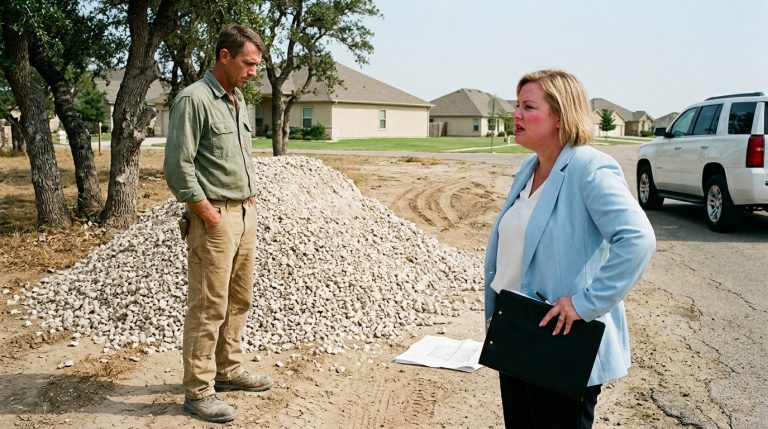
Karen stood five feet away, her floral muumuu stretched tight over a frame built entirely on unearned authority. She lowered the aerosol can with a self-satisfied jerk of her chin, her gaze locking onto the high-gloss lift of his brand-new F250.
“That’s a five hundred dollar fine for an unapproved surface alteration, Major,” she said, her voice dripping with the heavy, practiced complacency of a petty tyrant who had never once faced a return fire. “And another five hundred for every day it remains non-compliant. I suggest you get it rectified.”
The word hung there, a deliberate provocation meant to elicit a raw, explosive reaction. She wanted a shouting match. She wanted him to lose his temper, to step across the boundary of his own property line, so her laminated binder of bylaws could validate her position as the injured party.
Instead, Mac felt his pulse drop, settling into the steady, methodical rhythm of a man reading a blueprint under mortar fire. His eyes flicked upward, past the brim of her visor, toward the discreet white dome of the security camera tucked neatly beneath the aluminum soffit of the garage eave. The lens was blinking its faint, rhythmic red light, capturing every microscopic twitch of her expression, the exact coordinate of the spray can, and the jagged, obscene streak of orange bleeding into the fresh blacktop seal.
Every single word she was uttering right now was being committed to a digital hard drive inside his office.
“Rectified,” Mac repeated, his voice dropping into a flat, level register completely devoid of warmth. It was a textureless surface, hard enough to crack a blade. “That you come onto my private property, vandalize my asphalt, and you’re instructing me to fix it?”
Karen puffed out her chest, her small eyes narrowing behind wire-rimmed glasses. “This is an official enforcement action under Article Four. The glossy finish constitutes a visual nuisance. The committee has spoken.”
Mac didn’t reach for the paperwork sitting in his glove compartment. He didn’t point out the signed architectural review form bearing her own signature from three months prior. To argue details with a predator who made up the rules as she walked was a tactical error.
He slowly pulled his smartphone from his pocket, his movements deliberate and unhurried.
“You are trespassing,” Mac stated, locking his dark gaze onto hers. “You have committed criminal property damage. I am ordering you off this property immediately.”
Her smug smirk flickered, replaced by a sudden, micro-second jolt of uncertainty. She was accustomed to cowed neighbors who mumbled apologies and paid the tribute.
“This is official HOA business,” she blustered, taking half a step backward as Mac thumbed the screen awake. “I am within my legal rights—”
“You are not,” Mac said, stepping forward just an inch—enough to shift the tactical balance of the space. “And as of this exact second, every second you remain here is recorded evidence. The sheriff’s department is going to find the footage of your little morning art project fascinating.”
CHAPTER 2: THE COMMAND CENTER
The hum of the domestic refrigerator in the kitchen was a low, steady drone that did little to soothe the metallic taste of adrenaline lingering at the back of John McTavish’s throat.
He didn’t drop his gaze. He held his phone steady, the screen illuminating the tight, furious lines around Karen’s mouth as her eyes darted upward once more toward the little plastic dome beneath the aluminum soffit. The red LED didn’t blink faster; it just maintained its rhythmic, indifferent pulse. It was a mechanical heartbeat recording the exact micro-second her absolute immunity began to fracture.
“You’re making a mistake, Major,” she hissed, her voice dropping an octave, losing its public-address resonance and thinning into something sharp and brittle. “The board doesn’t look kindly on residents who try to intimidate the administration.”
“An enforcement action requires jurisdiction, Karen,” Mac replied, his voice maintaining its flat, unyielding surface. “Property damage requires a lack of ownership. You’re standing on my concrete, looking at my camera, holding a can of industrial paint you had no business purchasing with community funds. Walk away. Now.”
The silence that stretched between them was heavy with the weight of unspent violence—not physical violence, which was crude and left paper trails of a different sort, but the cold, structural violence of accountability. Karen’s chest heaved once beneath the floral expanse of her muumuu. For a second, her fingers tightened around the can of orange paint as if she might hurl it against the pristine brick of the garage wall.
Then the digital reality of the red lens caught her eye again. The calculation shifted behind her gaze. She wasn’t stupid; she was merely unaccustomed to resistance that didn’t fold under administrative noise.
Without another word, she turned on her heel, the fabric of her dress whispering sharply against her shins as she marched back toward her electric golf cart. The vehicle whined to life with a high-pitched, inductive shudder, and she spun it around on the asphalt, her tires crunching over the grit of the fresh seal before she sped down the cul-de-sac, leaving behind only the stinging scent of aerosol and scorched battery acid.
Mac didn’t watch her turn the corner. He turned on his heel and stepped into the cool shadow of the garage, pulling the heavy wooden service door shut behind him with a dull, satisfying thud.
The interior of his home was a sanctuary of straight lines and muted earth tones, but today the domestic quiet felt like the staging area before a predawn breach. He walked through the utility room and down the short hallway into his home office—a room dominated by a heavy oak desk, two high-resolution monitors, and the faint, ozone smell of running electronics.
Sarah was sitting by the kitchen pass-through, her hands wrapped around a ceramic mug of coffee, her eyes tracking him as he crossed the threshold. The degenerative joint condition in her hips made her movements slow and deliberate, a daily reminder of why they had chosen this flat-layout ranch in the first place, and why this intrusion felt so personal.
“She leave?” Sarah asked quietly, her voice carrying the low, cautious timber of someone who had spent three decades living near military bases where the deployment orders could drop at midnight.
“She left,” Mac said, dropping his keys onto the small wooden valet tray by the door. “For now.”
“John, what is this going to cost us? The neighbors… people don’t fight her. You know what Arthur said about the last family on Elm Street who tried to contest the fence height.”
“They got ground down by paperwork until they sold at a loss,” Mac said, walking over to his desk and waking the dual monitors with a sharp tap of the spacebar. The screens flickered to life, bathing his face in a pale, sterile blue light. “They played her game on her terms. They tried to argue aesthetics. You don’t argue aesthetics with an amateur bureaucrat.”
He sat down in the ergonomic mesh chair, the casters squeaking softly against the hardwood floor. With a few practiced keystrokes, he brought up the file directory labeled Willow Creek. Inside sat the raw video export from the garage camera, time-stamped, uncompressed, and crystal clear.
The framing of the camera caught the entire driveway in wide-angle 4K. He could zoom in enough to read the warning labels on the side of the orange spray can Karen had brandished like a scepter.
“We aren’t arguing aesthetics, Sarah,” Mac murmured, his fingers flying across the mechanical keyboard as he backed up the raw footage to an encrypted external drive locked in a drawer. “We’re building a dossier.”
The tactical reality of their situation was simple: Karen’s power was centralized in the architectural review committee and the rubber-stamp board of directors. She controlled the flow of violation notices, the collection of fines, and the maintenance contracts. But a centralized power structure has a single, fatal vulnerability—it relies entirely on the illusion of absolute legitimacy. Once that illusion is punctured by verifiable, unvarnished documentation, the entire hierarchy becomes top-heavy.
Mac pulled up the state’s public business registry portal in a browser window. He didn’t close the video player; instead, he dragged it to the secondary monitor, letting Karen’s frozen, defiant face sit there in pause mode like a specimen pinned to a board.
His first operational objective wasn’t to fight the five-hundred-dollar fine. It was to find out who supplied the paint, who serviced the golf carts, and who exactly had been cashing the checks for the last three years of neighborhood beautification projects.
He opened a blank spreadsheet, naming the first tab Ledger_Inquiries.
The room was dead silent save for the whir of the computer’s cooling fans. Mac leaned back, resting his wrists on the edge of the desk, his eyes fixed on the blue glow of the screens. The first phase of the engagement was complete. The enemy had advanced, committed resources within range of defensive fire, and left behind hard evidence.
Now came the long, meticulous work of drawing the lines of supply and command.
CHAPTER 3: THE RECONNAISSANCE WALK
The sunlight hitting the aluminum siding of Arthur Pendleton’s porch was blinding, reflecting off the white paint with a clean, sharp glare that made John McTavish squint as he stepped onto the concrete flagstones.
He didn’t knock. Arthur was already sitting in his usual low-slung Adirondack chair, a thick, dog-eared volume of civil history resting face-down on his knee like a closed brick, a glass of amber iced tea sweating in his weathered hand. The ice cubes shifted with a faint, crystalline clink as Arthur raised his head, his pale blue eyes twinkling sharply over the top of wire-rimmed reading glasses.
“Mac,” Arthur greeted, his voice raspy and dry as old parchment. “I see the orange stripe on your driveway survived the night. Word travels fast in a cul-de-sac when the electric golf cart is the fastest thing on four wheels.”
Mac walked over and settled into the empty chair beside him, the wood creaking under the weight of his frame. He kept his posture straight, his shoulders squared against the backrest, carrying the quiet, ingrained stillness of a man accustomed to observing tree lines before crossing open ground.
“She came by,” Mac said, his tone flat. “Tried to enforce a five-hundred-dollar penalty for a glossy finish on a standard seal. She’s tightening the perimeter.”
“Of course she is,” Arthur sighed, setting his glass down on a small, weathered side table. He leaned back, crossing his ankles. “Queen Karen doesn’t know any other gear. You have to understand, Mac—ten years ago, when she first moved into Willow Creek, she was just another divorcee with a modest alimony check and too much time on her hands. She didn’t have a kingdom, so she built one out of bylaws and intimidation.”
Mac felt a sudden, intrusive mental echo pull at the edges of his concentration—the memory of an old bridge-building project in the Euphrates valley where local contractors had skimmed concrete reinforcement materials, substituting weak aggregate to pocket the margin. The structural failure hadn’t happened on day one; it had shown up six months later under the weight of heavy supply trucks, cracking right down the middle like dried mud.
He blinked the memory away, keeping his focus locked on the physical present: the grain of Arthur’s porch railing, the dry rustle of oak leaves in the front yard, the precise geometry of the neighborhood streets.
“A kingdom built on paper requires a supply line,” Mac said quietly. “A budget. Maintenance contracts.”
Arthur’s eyes sharpened. A slow, knowing smile creaked across the corners of his mouth. “Ah. You’re looking past the gatehouse. Good. Most people stare right at the badge and lose their footing.”
“Who handles the physical work around here?” Mac asked, shifting slightly in his chair to face the old professor. “The landscaping, the asphalt repairs, the common-area lighting.”
“A firm called Prestige Property Management,” Arthur said, the name dropping like a lead weight onto the wooden table. “They’ve had an exclusive lock on every municipal-grade contract in this subdivision for roughly five years. Ever since Karen pushed out the old independent bidders under the guise of ‘streamlining community standards.’ Funny thing is, nobody had ever heard of Prestige before she brought them in. And their billing rates? Twenty percent higher than any standard commercial outfit in the county.”
Mac kept his face neutral, but the pieces were locking into place with the precision of a breechblock sliding home. A closed loop. The HOA board approves the inflated budgets; the favored contractor executes the work; the excess funds cycle through a closed corporate pipeline.
“Do you have a name on the incorporation papers?” Mac asked.
“I’m an old history professor, Mac, not a forensic accountant,” Arthur chuckled dryly, picking up his tea glass again. “Though I do know how to listen to the whispers around the mailboxes. Rumor has it the fellow whose name is on the state filing—a chap named Daniel Petrov—happens to share a rather close familial alignment with our dear Madam President. A brother-in-law, or something very much to that effect.”
Mac nodded slowly. The structural integrity of Karen’s regime wasn’t maintained by community spirit or adherence to neighborhood aesthetics; it was sustained by a financial kickback loop hidden behind a wall of dense administrative red tape.
He stood up, resting his hand momentarily on the smooth, painted wood of the porch pillar. The air smelled of dry dust and sun-baked asphalt, the classic scent of a terrain ripe for mapping.
“Thanks, Arthur,” Mac said, his voice low and steady.
“Be careful, Major,” Arthur murmured, looking up with a glance that carried genuine weight. “She doesn’t just want you to pay a fine. She wants to break the precedent of anyone ever looking under her hood.”
“Let her try,” Mac replied, turning down the steps and walking back toward the quiet, amber-lit sanctuary of his home office. The intelligence was gathered. The target was isolated. It was time to pull the rest of the platoon into the briefing room.
CHAPTER 4: THE WAR COUNCIL
The digital glow of the office monitors cast pale blue streaks across the hallway floor, but inside the living room, the lighting was soft, muted by the drawn linen curtains.
John McTavish turned away from the hallway entrance, stepping onto the carpet where a small circle of folding chairs had been arranged in a tight perimeter. Sarah stood near the kitchen pass-through, a fresh tray of ceramic mugs resting on a folded cloth napkin, her gaze quiet and steady. She didn’t say a word, but her presence anchored the room, a silent witness to a deployment that had crossed from personal defense into neighborhood mobilization.
Four people sat in the circle. Arthur Pendleton occupied the corner armchair, leaning forward with his elbows on his knees. Across from him sat Mr. Garcia, his knuckles locked tight together over his knees, and beside him his wife, her expression tense with the lingering memory of fines levied over a child’s basketball hoop. Further along, Lisa, the single mother who worked sixty hours a week, stared down at the floor, her shoulders hunched under the invisible weight of a dozen petty violation notices.
They weren’t soldiers, but they shared the distinct, hollow fatigue of people who had been cornered by a system designed to wear them down.
“Thank you for coming,” Mac said, his voice dropping into its standard briefing register—calm, even, and stripped of unnecessary preamble. He didn’t sit down; he remained standing near the coffee table where he had laid out a single manila folder. “I know taking a weeknight to sit in a living room and talk about an HOA dispute feels risky. Karen has spent years making sure dissent carries a heavy administrative price tag.”
Mr. Garcia looked up, his jaw tight. “She fined us three times last month because the portable hoop sat out past sunset. My boy is ten years old, Major. He just wants to bounce a ball in his own driveway. She treats the cul-de-sac like an occupied zone.”
“Because it is one,” Arthur said dryly, shifting his weight. “She rules by micro-enforcement. If you keep people busy defending their trash can placement, they never look up to see who’s holding the keys to the treasury.”
Mac opened the manila folder. He didn’t offer speeches or dramatic flourishes. He slid a printed sheet across the coffee table toward Lisa.
“This is a state business filing pulled from the public registry,” Mac said, his finger tapping the corner of the paper. “For five years, nearly every major maintenance contract in Willow Creek—landscaping, asphalt repair, common-area lighting—has been awarded to a single entity called Prestige Property Management. No competitive bidding. No open ledger.”
Lisa picked up the paper, her eyes scanning the lines of text. “I remember when they replaced the common area benches,” she murmured, frowning. “They billed the association fifty thousand dollars. The wood started rotting within six months.”
“They billed fifty thousand,” Mac continued, his voice steady as he placed a second document beside the first, “and the sole registered owner of Prestige Property Management is a man named Daniel Petrov. Operating out of a post office box in the neighboring district.”
A heavy silence dropped over the room. The hum of the refrigerator in the kitchen sounded louder, a persistent mechanical drone ticking against the background.
“Petrov,” Arthur repeated, a thin, grim smile touching his lips. “The exact same surname as our esteemed Madam President. How remarkably convenient for family gatherings.”
“It’s a kickback loop,” Mac stated plainly. “She uses the architectural committee to bleed residents through arbitrary fines, and she uses the board’s voting majority to funnel community fees into a family shell corporation. It isn’t just a tyranny of petty rules. It’s a financial operation.”
Lisa looked up, her eyes wide, the exhaustion momentarily replaced by a sharp, clear spark of realization. “And the board just lets her do it? Carol? Bob?”
“Carol and Bob are rubber stamps,” Mac said. “They sign whatever she puts in front of them because they’re too afraid of becoming targets themselves. A centralized power structure looks solid from the outside, but it’s brittle at the core. It depends entirely on isolation. As long as every resident fights her alone, she wins. But isolated targets become a collective front the moment you pool the data.”
Mr. Garcia shifted forward, his hands unlatching. “What do you propose we do, Major? We can’t just ignore the liens. She’s threatening to attach them to our deeds.”
“We don’t ignore them,” Mac said, pulling a stack of pre-drafted letters from the folder and distributing them one by one. “We answer them with procedure. Every single one of us is going to file a formal, written dispute of our respective fines tomorrow morning. We will use identical statutory language citing state housing codes and the association’s own bylaws regarding due process.”
He paused, letting the weight of the tactical directive settle over the room.
“Furthermore,” Mac added, his gaze sweeping across their faces, “we are going to invoke Article Eleven, Section Three. A formal demand for a public hearing before the full Board of Directors, scheduled within fourteen days. She wants to handle our disputes behind closed doors in her clubhouse office where she controls the minutes? We strip her of that controlled environment. We force her into the open, in front of the entire neighborhood, with cameras and documentation.”
Arthur picked up his copy of the letter, adjusting his glasses as he read through the dense legal phrasing. A low, appreciative chuckle escaped his throat. “My word, Mac. You aren’t just planning a defense. You’re laying siege.”
“A siege requires logistics,” Mac said, walking over to the computer desk and tapping the keyboard. The secondary monitor flickered, casting the room in a brief, cool blue glow before settling on the interface of a secure digital Dropbox. “I’ve set up a shared repository. Every violation notice, every threatening letter, every photograph of arbitrary enforcement from any resident in this subdivision goes into this folder. We build a comprehensive dossier.”
He turned back to face them, his expression unwavering. “When she sits down at that board table, she won’t be facing a lone homeowner she can intimidate into silence. She’ll be facing a coordinated record of administrative malfeasance and financial corruption. Are you ready to hold the line?”
Lisa looked down at the paper in her hand, her fingers tracing the edge of the text. Then she raised her chin, her voice steady and clear for the first time all evening. “Yes.”
Mr. Garcia nodded firmly, turning to look at his wife, who offered a resolute agreement. Arthur simply tapped his letter against the table like a gavel coming down.
“Count me in, Major,” Arthur said. “Let’s see how well her laminated bylaws hold up against the sunlight.”
CHAPTER 5: THE LEGAL COUNTERSTRIKE
The fluorescent lights of the postal annex hummed with a harsh, flickering frequency, casting a pale, chemical glare over the polished oak counter.
John McTavish pressed the flat of his thumb against the edge of a heavy manila envelope, feeling the dense bulk of the documents contained inside. Beside him, Arthur Pendleton adjusted the collar of his windbreaker, clutching a nearly identical packet with fingers that showed faint, papery age spots but maintained a steady grip. Behind them, Mr. Garcia and Lisa stood shoulder to shoulder, their forms silhouetted against the sliding glass doors by the grey, overcast light of mid-morning.
They weren’t merely mailing letters; they were serving notice.
Mac slid his packet across the scratched laminate counter toward the postal clerk, a young man wearing a headset who looked half asleep.
“Certified mail, return receipt requested,” Mac said, his voice level and devoid of any conversational padding. “Six separate parcels. Same destination, same return tracking architecture.”
The clerk blinked, pulled his headset down around his neck, and reached for the first envelope, glancing briefly at the printed address label: Willow Creek Estates Architectural Control Committee, Attention: Board of Directors.
“That’s six certified slips,” the clerk muttered, his fingers tapping rhythmically against the plastic keyboard. “You want these tracked to the primary mailing or the registered agent?”
“Primary mailing,” Mac replied, his eyes fixed on the neat row of green slips lined up beside the scale. “And make sure the electronic delivery confirmation is flagged for signature verification upon receipt.”
Each envelope contained a masterpiece of legal engineering crafted with the tactical guidance of David Chen, the old military lawyer who now operated a civilian real estate practice in the city. The check enclosed within Mac’s packet was for the full, extortionate sum of seventy-five hundred dollars in accumulated fines—every penny demanded by Karen’s regime. But written across the memo line in precise, heavy block letters were the words: Paid under duress and protest.
Tucked behind the check was the formal dispute brief citing three distinct state housing statutes regarding arbitrary enforcement, paired with the critical administrative trap: a formal demand for a public hearing before the full Board of Directors pursuant to Article Eleven, Section Three, mandated to occur within fourteen calendar days.
As the clerk handed over the stack of sticky green tracking receipts, a sudden, sharp electronic chime echoed near the entrance of the annex. A gust of wind rattled the exterior metal door, carrying a swirl of dry grit across the concrete floor—a minor environmental shift, but one that broke the sterile quiet of the room.
“Done,” Arthur murmured, stepping forward to collect his own receipt with a thin, satisfied smile. “The packets are in the stream. Now comes the waiting.”
“Not waiting,” Mac corrected, turning away from the counter and walking toward the glass doors where Lisa and Mr. Garcia waited. “Reconnaissance. Karen signed for the first warning shots yesterday. By tomorrow afternoon, she’ll have six identical demands sitting on her desk. She can ignore a lone resident complaining about a fence, but she cannot ignore a coordinated legal block invoking mandatory due process without triggering immediate statutory default.”
“And if she refuses the hearing?” Mr. Garcia asked, stepping out into the brisk morning air, pulling his jacket tighter against the wind.
“Then she violates her own bylaws and state housing statutes simultaneously,” Mac said, opening the door of his truck and letting the heavy steel thud shut behind him. “Which gives David the immediate opening to file an injunction freezing the association’s bank accounts and forcing a court-ordered forensic audit of the entire financial ledger.”
The operational pieces were moving exactly as calculated. But strategy in a closed suburban environment rarely went unchallenged without triggering a counter-maneuver.
When Mac returned to his cul-de-sac forty minutes later, slowing his truck as he turned down the quiet street, he noticed the small, pale yellow slip of paper fluttering beneath the windshield wiper of his neighbor’s car across the street. A second later, he spotted his own mailbox lid standing half-open, a stark, unauthorized white envelope protruding from the slot like a raised flag.
He didn’t pull into the garage immediately. He parked parallel to the curb, cut the engine, and stepped out onto the asphalt.
The air smelled faintly of damp earth and exhaust fumes. He walked slowly up his driveway, stepping directly over the faded orange line that Karen had painted days prior. He reached into the metal box and pulled out the envelope.
It wasn’t a standard certified notice. It was a heavy cardstock missive bearing the embossed crest of Willow Creek Estates, stamped with an emergency priority marker in red ink across the top corner.
Mac tore the flap open with a single, practiced motion of his thumb. Inside, a brief, hastily typed notice informed him that his demand for a public hearing had been acknowledged, but the date had been unilaterally set by the president for the following night at 7:00 p.m. in the cramped, windowless administrative back room of the clubhouse—an intentional attempt to restrict attendance, bypass transparency, and bottle up the dispute away from the rest of the community.
A faint, cold smile touched the corners of Mac’s mouth. She was taking the bait, but she was trying to funnel the engagement back into her own killing ground.
He pulled out his phone, dialed a pre-programmed number, and waited exactly two rings before David Chen’s sharp, clear voice answered on the other end.
“Mac,” David said without preamble. “Did she bite?”
“She bit,” Mac replied, his eyes scanning the quiet, manicured lawns of the cul-de-sac where unsuspecting residents lived behind closed doors. “She scheduled the hearing for tomorrow night. But she’s holding it in the back office. She’s trying to keep the doors closed.”
A low, delighted chuckle came through the speaker. “Trying to keep her star chamber private, is she? Perfect. Let her lock the inner door, Mac. Because we aren’t just bringing documents tomorrow night. We’re bringing cameras.”
CHAPTER 6: THE MEDIA DROP
The blue glow of the dual monitors washed over John McTavish’s face, casting sharp, angular shadows beneath his cheekbones as he finalized the export queue.
He didn’t look away from the screen when the heavy rubber tires of a vehicle crunched over the gravel near the curb outside. The low, muffled thrum of a high-output diesel engine died down, followed by the metallic click of heavy doors opening and closing in unison. Through the vertical slats of the blinds, the unmistakable side-panel graphics of a local news van caught the streetlamp’s amber glare—Channel 8 Investigative News, the mobile broadcast unit for Riley’s Raiders.
Beside him, the encrypted digital folder containing the master compilation video hummed quietly in the system tray. It wasn’t just raw footage anymore; it was a tight, five-minute sequence designed with absolute structural economy. It opened with the wide-angle 4K security clip of Karen stepping onto his property with the orange spray can, cut cleanly to the close-up of the $500 fine and the manipulated bylaw text, and then transitioned into brief, powerful interviews captured earlier that evening with Arthur, Mr. Garcia, and Lisa.
There was no emotional grandstanding in the edit. The pacing relied entirely on the weight of undeniable physical evidence.
A sharp, distinct rap sounded against the front door. Three firm knocks.
Mac stood up from the ergonomic chair, his joints making a faint, dry pop as he straightened. He walked down the dimly lit hallway past the quiet kitchen where Sarah sat at the small wooden table, her hands resting flat against the surface. She didn’t speak as he passed; she simply offered a steady, grounding nod—a silent acknowledgment of the threshold they were about to cross.
Mac unlocked the deadbolt and pulled the heavy wood door open.
Standing on the porch was Jessica Riley, her dark coat collar turned up against the damp night wind, holding a compact professional microphone. Behind her, a camera operator adjusted a shoulder-mounted rig, the red tally light blinking a steady, hypnotic pulse in the dark.
“Major McTavish,” Jessica said, her voice sharp, measured, and entirely devoid of small talk. “Your email indicated you had more than just a local dispute.”
“Step inside,” Mac said, pulling the door wide enough to clear the threshold. “The equipment is set up in the office.”
They didn’t waste time on pleasantries. Jessica and her producer moved into the house with the precise, practiced efficiency of military intelligence specialists entering a briefing room. Within minutes, the laptop was plugged into the feed, and the 5-minute compilation began to roll across the portable monitor.
Mac watched Jessica’s face as the images played out in silence. He saw the exact second her professional detachment shifted into investigative focus—when the footage cut from the orange line on his driveway to the corporate registration documents of Prestige Property Management, laying bare the no-bid contracts and the familial paper trail linking Daniel Petrov to the HOA president.
When the screen finally went dark, the office was dead silent save for the hum of the computer’s cooling fans.
“She’s been running her own private treasury,” Jessica murmured, her gaze fixed on the blank monitor before she looked up directly at Mac. “No competitive bidding over five years, inflated municipal contracts, and direct familial routing. This isn’t just an overzealous neighborhood bully. This is corporate malfeasance wrapped in a plastic flower box.”
“She scheduled a closed administrative hearing for tomorrow night in the back office of the clubhouse,” Mac said, his voice flat and hard. “She’s trying to bottle up the disputes before they hit the open record.”
A sharp, confident smile cut across Jessica’s face. Her eyes brightened with the predatory instincts of an experienced investigative reporter. “Then we won’t crash the door, Major. We’ll let her open it herself on live television. My crew will be parked right outside that clubhouse tomorrow at seven sharp. Let’s see how well her bylaws protect her when the cameras are rolling.”
Mac gave a single, slow nod. The chess pieces were locked in position. The media drop was secured, the legal notices were in transit, and the community alliance was marshaled.
He walked the news crew back to the front door, watching as their van dissolved into the damp night fog of the cul-de-sac. The terrain was mapped, the enemy was isolated, and the final theater of operations was set for the following evening.
CHAPTER 7: THE PUBLIC TRIBUNAL
The fluorescent tubes of the Willow Creek clubhouse back room hummed with a thin, irritating frequency, casting a harsh, glare-heavy wash over the long laminate table at the front.
John McTavish stepped across the threshold, his boots clicking with a sharp, measured cadence against the industrial tile floor. Beside him, David Chen carried a slim, dark leather briefcase with the quiet composure of a prosecutor walking into a predetermined verdict. Behind them, Arthur Pendleton, Mr. Garcia, and Lisa filed in, filling the narrow space until the walls felt like they were pressing inward.
There were no extra chairs. The room had been deliberately configured to feel cramped and airless, an administrative bottleneck designed to discourage attendance. But the hallway outside was already packed shoulder-to-shoulder with dozens of residents who had caught wind of the proceedings.
At the center of the front table sat Karen. Her face was tight, the skin drawn pale across her cheekbones, her fingers white-knuckled as she clutched a heavy wooden gavel. Two empty seats sat on either side of her—silent testaments to the resignations of Carol and Bob earlier in the week. To her far right, Henderson, the sole remaining board member, sat hunched over a stack of papers, refusing to look up as the room filled.
Karen slammed the gavel down once. The sharp crack bounced off the low ceiling.
“This special executive session is called to order,” Karen announced, her voice pitched slightly higher than usual, lacking its old broadcast resonance. “We are here to review administrative appeals regarding property violations. Major McTavish, you have the floor. Keep it brief.”
Mac didn’t sit down. He walked forward and placed a single, organized binder of documents onto the table directly in front of her, the edges sliding across the laminate with a soft hiss.
“We aren’t here for a closed administrative review, Madam President,” Mac said, his voice flat, low, and perfectly level. “Pursuant to Article Eleven of the association bylaws and state housing statutes, this is a public proceeding. And given the nature of the filings submitted this week, the scope has expanded.”
Karen’s jaw tightened. “The agenda is set by the board. Your individual fine is the only item under consideration—”
“Let’s look at the records instead,” David Chen interrupted smoothly, stepping forward to open his briefcase. He pulled out a large, crisp architectural print and laid it flat over her notes. “Let’s review Exhibit A: the signed and approved application for standard driveway resealing, bearing your own signature from three months prior.”
Karen stared down at the paper as if it might burn her fingers. “The application was for a standard coat. What was applied constituted an unapproved, high-gloss visual nuisance.”
“A semantic evasion,” David countered, his voice like cold steel. “Now let’s examine Exhibit B.” He placed an 8×10 glossy print from Mac’s security camera onto the table, capturing the exact moment Karen stood over the asphalt holding the industrial spray can. “Is this you on August fourteenth, trespassing on private property and willfully applying unauthorized paint to a resident’s driveway?”
A collective murmur rippled through the doorway behind them. Karen’s face flushed a deep, mottled crimson.
“I was executing an official enforcement action,” she snapped, her voice cracking slightly as she yanked her hands back from the photograph. “The committee authorized measures to maintain community aesthetic standards.”
“That brings us to the core aesthetic standard,” David said, his tone never rising, maintaining a lethal, surgical precision. He slid a fresh set of corporate financial printouts across the table. “Let’s discuss Prestige Property Management. State business filings list Daniel Petrov as the sole registered owner—a gentleman sharing your direct familial lineage. Over the last three years, this association has funneled upwards of one hundred thousand dollars in no-bid contracts through his firm at twenty percent above market rates.”
Karen slammed her hand flat against the table. “That is a malicious lie! The board approved every contract in accordance with our budgetary guidelines!”
“Did Henderson approve them?” David asked, turning his gaze toward the sweating board member on her right. Henderson shrank back into his chair, sliding his hands beneath the table and shaking his head in silent, immediate denial.
“And while we are on the subject of community standards,” Mac added quietly, stepping closer to the edge of the table, his dark eyes locked onto hers, “let’s examine your own property.”
Mac dropped a final set of satellite mapping photos onto the laminate. They were crisp, overhead shots of Karen’s backyard, highlighting an unapproved deck extension built without an architectural review, a non-standard satellite dish mounted in direct violation of Section Eight, and a massive plastic storage shed explicitly forbidden by municipal bylaws.
“The woman who has spent three years fining families for the color of their basketball nets and the placement of their garden hoses,” Mac stated, the weight of every syllable dropping like lead, “has been in flagrant violation of the association’s core bylaws since the day she took office.”
The silence in the room became absolute. The clubhouse hummed, the fluorescent lights flickered once, and Karen sat frozen, the last vestiges of her administrative armor stripping away to reveal pure, unadulterated panic.
She opened her mouth to speak, but no sound came out. The gavel slipped from her trembling fingers, clattering uselessly against the edge of the table.
CHAPTER 8: THE CLEAN PAVEMENT
The dull, heavy wooden gavel had stopped echoing seconds ago, but the silence in the clubhouse back room remained frozen, thick and suffocating.
Karen sat motionless in her chair, her hands resting limply beside the scattered architectural diagrams and the photographic evidence of her own unapproved structures. The absolute hypocrisy of her regime—built upon years of arbitrary fines, manufactured infractions, and secret kickback loops through her brother-in-law’s corporate front—lay fully exposed under the white glare of the overhead fluorescents and the unblinking lens of the news camera positioned by the doorway.
Henderson, the sole remaining board member, slowly pushed his chair back from the laminate table. The metal legs scraped against the industrial tile with a harsh, grating screech.
“I move for an immediate vote of no confidence,” Henderson whispered, his voice trembling as he refused to meet Karen’s vacant stare. “And a unanimous second for her removal as president.”
Arthur Pendleton raised his hand from the front row, his voice steady and carrying the quiet weight of authority. “Seconded.”
The recall vote was a formality that required no debate. Within minutes, the community members packing the hallway had flooded into the room, their voices rising in a unified wave of rejection that stripped Karen of every vestige of authority she had spent a decade accumulating. She didn’t shout, and she didn’t mount a final defense. She simply gathered her personal notepad, pushed herself up from the chair with trembling fingers, and walked out through the crowd, her head bowed as the murmurs of the neighborhood parted before her like cold water.
The state investigators moved swiftly in the days that followed. The forensic audit ordered by the interim board uncovered over two hundred thousand dollars funneled through Prestige Property Management, leading directly to criminal charges for fraud, embezzlement, and tax evasion. The bank foreclosed on her home to satisfy the cascading civil liens, and her reign over Willow Creek Estates ended not with a compromise, but with absolute institutional dismantling.
Three weeks later, the morning sun broke over the cul-de-sac with a crisp, clean clarity.
John McTavish stood at the edge of his property, his boots resting on the cool, uniform surface of a brand-new layer of asphalt. The professional paving crew sent by the newly elected board—led by Arthur, Mr. Garcia, and Lisa—had ground away the old sealant along with every last trace of the jagged, fluorescent orange line Karen had left behind. The scar was completely gone.
Sarah stepped out onto the front porch, a ceramic mug of coffee in her hand, her movements easy as she walked down the gentle slope of the newly installed walkway. She stopped beside him, her shoulder brushing his arm as she looked out over the pristine, unbroken blacktop.
“It’s quiet,” Sarah said softly, a genuine smile touching her lips.
“It’s compliant,” Mac replied, a faint, rare smile breaking across his weathered features.
Down the street, the cheerful sound of a basketball bouncing against a concrete driveway echoed through the morning air, followed by the sound of a child’s laughter. Two doors down, Arthur Pendleton sat on his porch reading a book, raising his mug in a silent, respectful salute across the grass.
Mac raised his hand in a slow, measured response. The operation was complete. The perimeter was secure, the system was restored, and the community had reclaimed its foundation, brick by painstaking brick.