A Ghost Beneath the Ice: One Man’s Silent Vigil to Protect the Future of Human Connection
CHAPTER 1: THE PIER OF MIRRORS
The wind off the Long Island Sound carried a sharp, metallic tang, but Lieutenant Commander Sarah Mitchell smelled only the rigid, comfortable scent of order. She adjusted her name tag, the fabric of her uniform resisting with a crisp, satisfying tension. To her, the pier was a ledger—names on the list were real, and names absent were ghosts.
“I’m going to need you to step back, sir,” she said. Her voice didn’t waver; it was a calibrated instrument, honed by a decade of standing between the public and the untouchable.
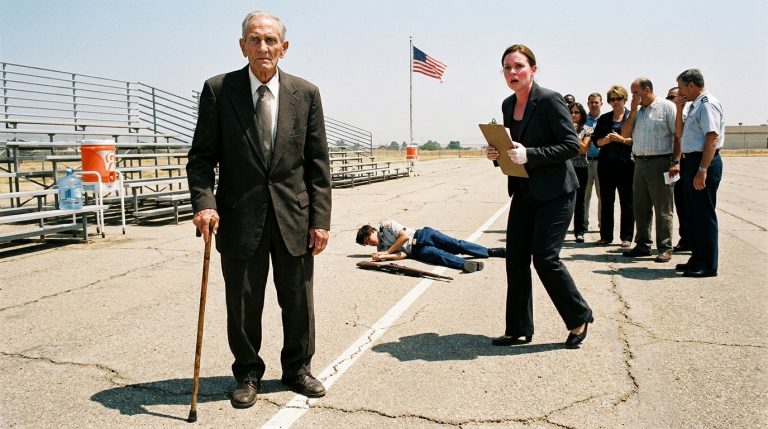
Across from her, William Harrison did not move. He was a brittle collection of angles, draped in a gray windbreaker that hung off his frame like a moth-eaten sail. His USS Nautilus cap was perched atop hair as white as the foam in the ship’s wake. He wasn’t looking at her, but at the dark, hulking mass of the museum submarine anchored to the pier. His pale blue eyes were distant, anchored to a memory Sarah couldn’t see.
“Sir, did you hear me?” Sarah stepped into his personal space, her polished heels clicking against the concrete like a countdown. “This area is restricted to authorized personnel.”
“I have an invitation,” William said. His voice was not the tremor-filled rasp she expected from an eighty-five-year-old; it was quiet, weighted with an unsettling density.
“Everyone claims to have an invitation,” Sarah replied, her gaze flicking to the crowd gathering behind her. Dignitaries and families were milling about, a sea of cameras and excitement. She had a ceremony to run, and this man was a structural flaw in her day. “Unless you have a current military ID, you need to return to the public area.”
William reached into his jacket. The movement was agonizingly slow, as if he were fighting the gravity of his own years. He produced a letter. The paper was yellowed, softened by decades of folds, but the seal was unmistakable. Sarah scanned it with a practiced, dismissive speed.
“This is a general mass-production invitation for veterans,” she said, handing it back with a sharp, crisp motion. “It does not grant access to the gangway. Protocol is protocol, sir.”
Her eyes drifted down, seeking a reason to dismiss him entirely. They landed on his chest. A small, frayed patch was sewn onto the windbreaker. It wasn’t the clean, modern insignia of a submarine sailor. It was a black field with a stylized submarine, sliced through by a jagged, blood-red star.
Sarah’s brow furrowed. The geometry was wrong. It was amateurish.
“Is that a craft project?” she asked, her voice dropping into a register of patronizing efficiency. “Stolen valor is a serious allegation, sir. If you don’t have proper credentials, I am asking you to leave before I involve security.”
For a split second, the bright, sunny pier seemed to dim. William’s gaze finally locked onto hers. In those eyes, Sarah saw something that made the hair on her arms stand up—not the confusion of an old man, but the flat, terrifying stillness of a sonar operator waiting for a signal in the dead of the Arctic night.
“It’s not a craft project,” he whispered, and the intensity of the statement was a physical weight between them. “And it isn’t something I can show you the papers for.”
“Classified?” Sarah let out a short, biting laugh, reaching for her radio. “Of course. Master-at-arms, I need assistance at the gangway.”
As she keyed the radio, she didn’t notice the younger sailor, Petty Officer Chen, staring at the old man’s hands, which remained perfectly, unnervingly steady. She also didn’t notice a tall, retired Master Chief in the VIP crowd turning pale, his phone beginning to shake in his hand.
CHAPTER 2: THE BREAKING POINT
The static hissed from Sarah’s radio, a jagged, electric sound that tore through the ceremonial calm of the pier. She held the device like a weapon, her knuckles white. Around her, the crowd had curdled into a tight, observant ring. The initial excitement of a 70th-anniversary celebration had been replaced by the heavy, suffocating atmosphere of a mistake in progress.
William Harrison didn’t look at the radio. He didn’t look at the other officers closing in, nor did he look at the Master-at-arms sprinting down the gangway. He was looking at the black hull of the Nautilus again. For a heartbeat, the salt air of Connecticut vanished, replaced by the bitter, metallic frost of the Arctic. He could feel the condensation dripping down the steel bulkhead of his old boat, the sound of the sonar ping echoing against the ice pack above, a rhythm that had been the heartbeat of his existence for eighty-nine days.
“Sir, I am telling you—step away from the access point,” Sarah commanded. Her voice was sharp, but a flicker of doubt had taken root in her chest.
Petty Officer Chen, standing just to her right, had stopped moving entirely. He was watching William’s hands. They weren’t shaking. They weren’t the hands of a confused old man looking for attention; they were the hands of a man who had spent a lifetime holding a position against impossible odds. Chen looked at the patch again—the red star, slashed through with the surgical precision of a secret that hadn’t been meant to survive.
“Ma’am,” Chen murmured, his voice barely audible over the wind. “Maybe… maybe we should just wait for the verification. He hasn’t moved. He’s just standing there.”
“He’s trespassing, Chen,” Sarah snapped, though her eyes flicked to the patch once more. The embroidery was old, the thread faded to the color of oxidized iron. It felt wrong to call it a craft project. It felt like an artifact.
“I have done nothing but wait,” William said, his voice quiet. He turned his head slightly, his pale blue eyes settling on Sarah. “I have waited sixty years to be here. A few more minutes of your time won’t change the outcome, Lieutenant Commander.”
The Master-at-arms arrived, breathless, his hand hovering near his sidearm. He was a mountain of a man, built for enforcement, not philosophy. “What’s the situation?”
“Trespassing. Potential stolen valor,” Sarah said, but the words felt brittle in her mouth. She felt the eyes of the crowd—the families, the veterans—pressing against her back like a physical weight.
Before the Master-at-arms could respond, a voice cut through the air, vibrating with a tone of command that had been absent from the pier all morning.
“Stand down.”
Master Chief Daniels pushed through the thinning crowd. He was a man of few words, a legend among the submarine community, his uniform a testament to decades of silent service. He stopped ten feet from William, and his face, usually a mask of granite, was pale. He wasn’t looking at Sarah, or the Master-at-arms. He was staring at the red star on William’s windbreaker.
“Chief,” Sarah began, her frustration spiking. “This is an active access point. This man is causing a disruption.”
Daniels didn’t look at her. He didn’t blink. He kept his eyes locked on William, his shoulders slumping just a fraction—not in defeat, but in a strange, sudden recognition. “I said stand down, Commander. Do you have any idea what you’re looking at? Do you have any idea how close you are to making a mistake you won’t be able to undo for the rest of your career?”
The silence that followed was total. Even the gulls circling the pier seemed to go quiet. Sarah felt the air shift. It was as if the invisible barrier she had built around the Nautilus had been breached, not by force, but by the sheer, crushing reality of someone who knew more than she did.
William didn’t puff out his chest. He didn’t argue. He simply let his hands fall to his sides, the wind ruffling his thin jacket. He was the only person on the pier who seemed to be breathing normally.
“I’m not looking for a scene, Chief,” William said, his voice carrying the calm, steady cadence of a man who had spent his life submerged in the deep.
“I know who you are,” Daniels whispered, a tremor finally touching his voice. He reached for his phone, his movements jerky and uncoordinated. “Or rather, I know what you are. And if I’m right, God help us all.”
Sarah watched as the Master Chief turned away from her, dialing a number with frantic speed. She felt the first real cold of the day seep into her marrow, a chill that had nothing to do with the wind. The “decoy” of a senile veteran was dissolving, and in its place, the outline of something much larger, much older, and much more dangerous began to emerge.
CHAPTER 3: THE ADMIRALS ARRIVAL
Sarah felt the shift in the air before she saw the cause. The heavy, stagnant humidity of the pier, previously thick with the tension of her own rigid enforcement, suddenly thinned. The crowd, which had been pressing in with the restless, hungry curiosity of onlookers at a car wreck, seemed to shrink back, clearing a path not out of fear, but out of an instinctual recognition of hierarchy.
At the edge of her peripheral vision, she saw the blurred motion of uniforms—not the sharp, crisp movements of the security detail she had summoned, but the frantic, unpolished gait of men who were late for a moment they had dreaded for decades. Vice Admiral Roberts was not walking. He was moving with a desperate, lung-burning urgency that shattered the decorum of the anniversary ceremony.
“Commander Mitchell!” The voice boomed across the concrete, stripped of the usual professional courtesy.
Sarah turned, her salute already instinctive, but her hand froze in mid-air. Roberts didn’t acknowledge her. He didn’t acknowledge the Master-at-arms or the confused petty officers flanking her. He bypassed them entirely, his boots hammering against the metal plating of the gangway access point, his eyes locked onto a single point of focus: the thin, gray-clad figure of William Harrison.
The Admiral stopped five feet away. The space between them seemed to vibrate. Roberts, a man whose reputation was built on steel-trap efficiency and a cold, mathematical approach to naval strategy, was gasping for breath. He drew himself up, his heels snapping together with a sound like a gunshot, and rendered a salute that was so sharp, so deeply reverent, that the entire pier fell into a vacuum of absolute silence.
It was a salute Sarah had only ever seen in training videos, the kind reserved for fallen heroes or the highest rites of military tradition.
“Mr. Harrison,” Roberts said, his voice thick, rough, and noticeably cracked. “Sir. It is… it is a profound honor.”
Sarah felt the blood drain from her face. The sensation was immediate and sickening. She watched as William Harrison—the “hostile civilian” she had threatened with handcuffs, the “impostor” she had accused of stolen valor—slowly, painfully, raised his hand. His movement was a study in controlled gravity. He returned the salute, his pale blue eyes steady, meeting the Admiral’s gaze with the familiar, chilling calm of a man who had seen the end of the world and simply decided to keep walking.
Only when the Admiral lowered his arm did the silence on the pier break, replaced by a low, murmuring hum from the crowd. Roberts turned, and for the first time, his gaze fell on Sarah. The look in his eyes was not anger; it was something far worse. It was the look of a man contemplating a structural failure so catastrophic that he couldn’t even find the words to label it.
“For those who don’t understand,” Roberts addressed the crowd, his voice resonating with the practiced, terrifying clarity of a high-command briefing, “let me make one thing very clear. This man is William Harrison. Call sign: Ghost.”
Sarah’s hand dropped to her side. She felt the radio, still clutched in her grip, go dead.
“That patch,” Roberts pointed, his finger trembling just slightly as he gestured to the frayed insignia on William’s chest, “is not a souvenir. It is the only remaining artifact from a mission that officially never occurred. A mission that occurred in October 1962, at the absolute precipice of nuclear exchange.”
The world seemed to tilt on its axis. Sarah looked at the patch—that blood-red, slashed star—and saw it for the first time not as an object of mockery, but as a brand. It looked like the charred remains of a secret that had been kept for sixty years.
“While the world held its breath,” Roberts continued, his tone hardening into a surgical critique that made the skin on Sarah’s neck prickle, “a small, handpicked crew of sonar operators was operating a vessel without a name. They were the ears of the Atlantic. They tracked Soviet boomers, mapped patrol routes, and stayed in the silence until the last possible second. On day seventy-four, they faced a choice that would have meant the end of the American coastline as we know it.”
He stepped closer to William, and the contrast between the two men was startling—the Admiral, decorated and powerful, and the old man, faded and seemingly fragile. Yet, in the way they stood, it was clear who held the true authority.
“Mr. Harrison’s crew maneuvered directly into a firing solution,” Roberts said, the words falling like stones into a dark pool. “They pinged active sonar. They broke every rule of stealth and engagement. They made themselves a target, effectively telling the Soviet captain that if he turned that key, he would not be the only one to die. They forced a stand-down. They averted a war that history doesn’t even know was about to begin.”
Sarah’s mouth felt dry. The logic of her world—the protocols, the lists, the authorized badges—was dissolving into ash. She looked at William, whose eyes were fixed on the black hull of the Nautilus once more. He wasn’t basking in the Admiral’s praise; he was looking through the steel, through the years, through the ice.
“Commander Mitchell,” Roberts said, his voice dropping into a register that signaled the end of Sarah’s previous existence. “You just threatened to arrest one of the greatest sonar operators in the history of the United States Navy. You accused him of stolen valor because you could not look past the surface of the uniform to see the man who helped ensure you would even have a country to wear that uniform for.”
Sarah looked down at her polished boots, at the pristine, white concrete of the pier. She felt the weight of the patch, the weight of the years, and the crushing realization that the “problem” she had been so eager to clear from the gangway was the only reason the gangway was still standing.
“Sir,” Sarah whispered, her voice barely a breath.
“You didn’t ask,” Roberts replied, his voice a blade. “You enforced a rule, but you failed to exercise the one thing that separates a soldier from a machine: judgment.”
He turned back to the crowd, his face a mask of iron, but his eyes lingering on the old man with a look of desperate, unearned respect. William Harrison didn’t look back at the Admiral, nor at Sarah. He reached out and touched the railing of the gangway, his weathered fingers tracing the cold metal as if greeting an old, tired friend.
CHAPTER 4: THE ECHOES OF THE ICE
The pier had emptied, though the silence it left behind felt even more crowded. Sarah stood near the edge of the gangway, her uniform feeling suddenly like a costume that no longer fit. She watched William Harrison walk slowly toward the submarine’s sail, his gait heavy, as if the floor were still shifting under him. He wasn’t walking on the concrete of a modern naval base; he was walking the steel deck of a vessel that had long since surrendered to the rust of time.
Sarah found herself moving before she made the conscious decision to follow. She didn’t want to speak to him—she didn’t think she could find the words—but the sheer gravitational pull of the mystery demanded proximity. As she approached, she saw him stop by the sonar shack’s exterior casing. He reached out, his fingers tracing the rivets, his eyes closed.
“You’re wondering if I’m a ghost,” he said without turning around. His voice was raspy, thin as parchment.
“I’m wondering how you live with it,” Sarah replied, her professional veneer stripped away. She leaned against the railing, the cold metal biting into her palms. “How you spent sixty years keeping a secret that could have… that should have changed everything.”
William opened his eyes. They were fixed on the black water lapping against the hull. “You think of secrets as burdens, Commander. You think of them as things you carry because you’re forced to. But a secret like that—it’s not a rock in your pocket. It’s the air in the room. You don’t realize you’re breathing it until someone tries to take it away.”
A gust of wind whistled through the rigging of nearby ships, a high-pitched, mournful sound that mirrored the phantom pinging William had described in his lecture. He shivered, a slight, rhythmic tremor that traveled from his shoulders down to his hands.
“I remember the cold,” he whispered, and for a moment, the atmosphere around them seemed to drop twenty degrees. “Not the wind. The cold that stays in the marrow. The kind of cold that comes from knowing that if you move, you might break something precious. We were sitting in that steel tube, and I could hear the Russians. I could hear their screws churning the water. I could hear the captain’s breath. I was nineteen, and I knew more about the end of the world than the men running it.”
Sarah watched him, her heart thudding against her ribs. She saw the flickers of a younger man in the set of his jaw—a ferocity that defied his fragile frame.
“When we pinged,” he continued, “I felt the vibration through my own soles. It wasn’t just a sound. It was a scream. We were saying, we are here, and if you fire, we will go down with you. And the silence that followed—that was the loudest thing I have ever heard in my life.”
He turned to her, his gaze intense, piercing through the polished indifference she had worn like armor for years. “You want to know how I live with it? I live with it by listening. Every room I walk into, I listen for the noise that doesn’t belong. The lie. The mistake. The moment where someone chooses to do the right thing despite the protocol.”
Sarah looked away, the weight of her own past mistakes—the blind enforcement of rules, the casual dismissal of veterans—settling over her. She saw, for the first time, the brokenness in the world around her, and the way William Harrison seemed to be trying to glue it back together with nothing but memory and a faded piece of fabric.
“They’re reviewing your file,” she said, her voice dropping into a whisper. “The Admiral’s office. They’re pulling the old logs, the declassified radio transmissions from ’62. They’re going to make you talk, William. They’re going to ask you to explain things that were meant to be forgotten.”
William looked at the submarine one last time, a ghost-like flicker of a smile touching his lips. “They can ask. But they won’t understand. Understanding requires you to have been there. It requires you to have felt the ice.”
He began to walk away, his figure silhouetted against the vast, gray expanse of the harbor. Sarah stood alone, the sound of the wind filling the space where his voice had been. She realized then that he wasn’t just a veteran, and he wasn’t just a hero. He was a sentinel, a man who had been left behind to guard the truth against a world that was far too comfortable in its ignorance. She felt a sudden, frantic need to pull out her own notebook, to write down everything he had said, but her hands were shaking too hard to move. She was no longer just an observer; she was becoming a witness to the decay of the order she had once worshipped.
CHAPTER 5: THE CLASSROOM OF CONSCIENCE
The Naval Submarine School in Groton was a place of polished linoleum and relentless, humming fluorescent lights. It was a place where variables were controlled and outcomes were calculated with the precision of a slide rule. But for Lieutenant Commander Sarah Mitchell, the air here felt thinner now, charged with the static of a secret that refused to stay buried.
Six months had passed since the pier. The inquiry into William Harrison’s history had been a slow, bureaucratic grind. Admiral Roberts had been true to his word; the files were surfacing. Yet, they were incomplete. Paperwork from 1962 was a labyrinth of redacted lines, missing pages, and official denials. Sarah spent her evenings in the archive basement, the scent of yellowing paper and dry dust becoming the soundtrack to her new existence.
She looked up as the classroom door opened. William Harrison walked in. He was wearing the same gray windbreaker, but his posture seemed marginally more upright today. He carried a small, leather-bound notebook—his personal log. As he stood at the front of the room, he didn’t look like a man who had been the subject of a high-level naval investigation; he looked like a man who was finally, after sixty years, taking off a heavy coat.
“My name is William Harrison,” he began, his voice projecting easily to the twenty young officers seated in the front rows. “I am here to talk about the difference between following orders and understanding why.”
Sarah sat in the back, her notebook open, but her pen was dry. She watched the students. They were young, their faces bright with the same certainty she had possessed on that pier—the belief that the manual was the world, that the procedure was the truth. She looked down at the logbook William had pressed into her hands weeks ago. She had spent the night cross-referencing it with the official, partially redacted records.
There was a discrepancy.
On Day 74, the official log cited a mechanical malfunction in a boiler room aboard an unnamed vessel. William’s personal log, however, documented a deliberate, manual override of the reactor cooling system. He had written: It wasn’t a malfunction. It was a sacrifice. We pushed the threshold to gain the speed needed to intercept the firing solution. We knew the risk.
She looked up at William. He was talking about the Arctic ice, describing the way sound traveled in the darkness—the groan of the glaciers, the whine of the Soviet screws. He was talking about the psychological pressure of a mission that demanded you become invisible to exist. He wasn’t giving a speech; he was offering a testimony.
“Orders don’t account for the human variable,” William said, his gaze drifting toward the back of the room, finding Sarah. He didn’t blink. “When we pinged, we weren’t just testing our sonar. We were forcing a choice. We were showing the enemy that we were there, and that we were willing to lose everything to keep the peace. That isn’t a tactic. It’s an act of faith.”
Sarah felt a sharp, sudden pang of alarm. If he was right—if the record was being sanitized by someone other than the Admiral—then the ‘ghost crew’ wasn’t just a relic of history. It was a problem for someone in the present. Someone didn’t want the details of that reactor override to come to light.
She looked at her own notes. She had tracked the signatures of the officers who had signed off on the current curriculum. One name kept appearing in the margins of the redacted files: Captain Vance, a man who currently held a position in the office of Naval Intelligence. She hadn’t realized it until now, but the friction wasn’t just with the past. The friction was active.
William moved to the whiteboard, drawing a simple, crude map of the patrol route. “If you ever find yourselves in the dark,” he said, his voice dropping, “listen for the noise that doesn’t belong. It will be the most important sound you ever hear.”
After the lecture, the room emptied out in a flurry of movement. Sarah waited until the final student had left. She approached the desk. William was packing his bag, his movements slow and methodical.
“There’s something in your log,” Sarah said, her voice low. “Day 74. The reactor override. It’s not in the official files, William. Someone purged it.”
William paused. He looked at her, and for the first time, she saw a flicker of genuine, hard-edged concern. He didn’t look surprised. He looked weary.
“I know,” he said. “They’ve been trying to keep that part of the story quiet since the day we surfaced. It isn’t just about the mission. It’s about the cost. If people knew how close we actually came to a meltdown—how close we came to being the ones who started the war—the narrative changes.”
“Who is doing it?” Sarah asked, her grip tightening on her notebook.
“People who believe that some truths are too dangerous for the public,” William replied. He reached out and touched her hand, his skin papery and cold. “Be careful, Commander. You’re looking for a noise that a lot of powerful people would prefer remained silent.”
He walked out, leaving Sarah alone in the fluorescent glow of the classroom. She stood still, listening. For the first time, she realized that the silence of the room wasn’t empty. It was filled with the hum of the ventilation, the distant sound of engines, and the faint, unsettling realization that she was no longer just the teacher. She was a target.
CHAPTER 6: THE FINAL TRANSMISSION
Three years had passed since the classroom, and the air in the small, wind-swept cemetery in Groton carried the crisp, clean scent of approaching winter. Sarah Mitchell stood with her head bowed, the weight of a heavy, leather-bound book in her hand. The funeral had been simple, attended only by those who understood the language of the deep—twelve young submarine officers in dress whites, each wearing the small, black patch of the ghost crew on their collars.
William Harrison had passed away in his sleep, his final mission—the transmission of the truth—completed.
Sarah watched as the coffin was lowered into the earth. It was a rhythmic, mechanical process, the soft thud of dirt against the wood sounding like the distant, rhythmic pulse of a sonar ping. She stepped forward, her hand trembling slightly as she reached into her pocket. She pulled out the small, brass key to her office desk—the same desk where she had spent hundreds of hours decoding the redacted logs, identifying the structural erasure orchestrated by the very intelligence office she once viewed as the pinnacle of service.
The payoff had come not in a flash of courtroom drama, but in a slow, suffocating attrition. She had brought the evidence of the reactor override, the documented proof of the sacrifice that saved the coast, directly to the Vice Admiral. She had sat in his office, watching as the cold, hard logic of the Navy’s bureaucratic machine finally realized that it could not bury a truth that had already walked into the light. Captain Vance, the architect of the cover-up, hadn’t been arrested in a dramatic scene; he had been quietly retired, his career hollowed out by the slow exposure of his lies.
Poetic justice was quiet. It was the sound of a legacy being restored not by decree, but by the acknowledgement of those who mattered.
Sarah looked at the twelve officers. They were the ones who carried the patch now—not as a badge of stolen valor, but as a commitment to the “human variable.” Each of them had stood in her classroom, learned of the Arctic ice, and understood that protocol was a fence, not a cage.
As the ceremony wound down and the others began to drift toward the gates, Sarah stayed. She walked to the graveside and knelt, the damp earth staining her trousers. She reached into her bag and pulled out a small, metal wrench—a tool she had been using to repair the old, antique sonar equipment she kept in her office. She had used it to fix a loose dial that had been broken for decades, a tiny piece of history she could finally touch and make work again.
Symbolic closure. She placed the wrench on the edge of the stone marker, a small offering to the man who had taught her that the machines were only as good as the people who listened to them.
“You said it wasn’t about glory,” she whispered, the wind carrying the words away toward the Sound. “You were right. It was about the silence.”
She stood up, looking out toward the horizon where the dark, churning water of the Atlantic waited. She felt a profound, aching peace. The decoy secret—the idea that he was an impostor—had died long ago. The core truth—the heavy, beautiful, terrible cost of the ghost crew’s sacrifice—was now the foundation upon which her own career was built.
Sarah reached into her pocket one last time and touched the small black patch. She didn’t sew it onto her uniform; she kept it in her wallet, a weight that reminded her to look past the protocol, to listen for the noise that didn’t belong, and to always, always value the person over the procedure.
She turned away from the grave, walking toward the gate where the path ahead was clear, quiet, and profoundly changed. The mission was over. The ghost had finally found his home, and for the first time, Sarah didn’t feel the need to look behind her. She walked into the cool, fading light, the memory of the sonar pulse now just a steady, reassuring beat in her own heart.