The Weight of Salt and Iron: Uncovering the Forgotten Ledger of Task Unit Neptune
CHAPTER 1: THE TIDE MARKS
The Pacific didn’t care about rank. That was the first lesson of the coastal approach course, and watching Arthur Donovan now, Chief Mason Hail realized the old man hadn’t just learned that lesson—he had been carved by it.
The wind whipped through the training beach, smelling of brine and wet iron. Donovan stood perfectly still, his faded navy jacket whipping around his thin frame, while the modern trainees scurried behind him like nervous crabs. Hail stood five paces back, his boots digging into the loose, abrasive grit of the dune. He kept his hands in his pockets, his fingers hovering over the cold steel of his utility knife, a subconscious urge for a familiar, solid weight.
“You’re looking for the current,” Donovan said, his voice barely rising above the rhythmic slap of the waves. He didn’t turn around. “You’re looking for the path of least resistance.”
Hail stepped forward, the friction of the sand grinding against his soles. “That’s how we’re trained, Commander. Find the channel, save the energy.”
Donovan shifted, and the movement was stiff—not with age, but with the specific, jarring stiffness of old scar tissue. He pointed to a jagged outcropping of black rock, half-submerged a hundred yards out. “When we started, there were no channels. We were the first ones out there, pushing through the dark. We didn’t look for the path of least resistance. We looked for where the enemy thought the water was too treacherous to navigate.”
He paused, and Hail noticed the way the man’s hand twitched toward his own belt—a ghost limb reaching for a pistol he hadn’t carried in forty years. “If you can navigate the impossible,” Donovan continued, his gaze narrowing on a whitecap breaking over the rocks, “then you don’t need a strategy. You just need to survive.”
Hail felt a prickle of unease at the base of his neck. This wasn’t the heroic history he’d expected. This sounded like desperation. He glanced at the small burn mark on the back of Donovan’s right hand—a puckered, white scar that looked remarkably like a chemical or friction burn. It looked painful, yet Donovan didn’t even acknowledge the cold spray of the Atlantic against his exposed skin.
“Is that why the Neptune unit was disbanded?” Hail asked, keeping his tone carefully neutral. “Because it was too treacherous?”
Donovan finally turned. His eyes were pale, washed out by decades of looking at things he probably shouldn’t have seen. He looked at Hail, not as a superior officer, but as a man assessing a threat. The silence stretched between them, filled only by the grinding of the tide against the shore.
“The unit wasn’t disbanded because it was treacherous, Chief,” Donovan said, his voice dropping into a register that felt like grinding metal. “It was disbanded because we stopped being the ones navigating the water. We became the water itself.”
He took a step toward the surf, his boots crunching on a fragment of rusted metal partially buried in the sand—a relic of an old, discarded buoy, or something else entirely. Hail looked down, his heart hammering against his ribs, as Donovan stepped past the debris without a second glance.
Then, Donovan stopped. He tilted his head, listening to the wind, his expression shifting from calm to something profoundly, chillingly vacant. “Did you hear that?” he whispered.
Hail strained his ears, hearing only the crash of the waves and the distant hum of a patrol boat’s engine. “Hear what, sir?”
Donovan looked back at the mess hall, his face pale. “The sound of the mistake.”
He turned and walked toward the water, leaving Hail alone in the grit, staring at the patch of rusted metal that had been exposed by the retreating tide—a piece of charred, unrecognizable equipment that had been buried in the sand for a very long time.
CHAPTER 2: THE PAPER SHADOWS
The piece of charred metal sat in the palm of Hail’s hand, feeling heavier than it looked. It was a fragment of a communication array, the type used in experimental, short-range sub-surface transmission—tech that had been decommissioned before Hail was even born. He wiped the gritty sand from the blackened surface, the metal cold and biting against his skin, smelling faintly of sulfur and stale oil.
He didn’t look at Donovan. He couldn’t. The old man was still staring at the water, his posture as still as a lighthouse foundation. Hail shoved the fragment deep into his pocket, his hand clenching around it until the sharp, irregular edges pressed painful indents into his palm. It wasn’t just trash; it was a physical discrepancy, an out-of-place detail in a world that ran on perfect, redundant systems.
“We should get back,” Hail said, his voice coming out flatter than he intended.
Donovan didn’t move. “The tide will cover that soon,” he replied, pointing not at the water, but at the ground where the fragment had been buried. “Some things are meant to be submerged. The Navy spent a great deal of money and a great deal of effort making sure that piece stayed under the silt.”
Hail’s pulse quickened. He turned back toward the base, his boots leaving deep, heavy indentations in the damp sand. The friction of his movement was irritating, a physical grind that mirrored the growing static in his head. He remembered a lecture from his advanced qualification days, taught by a senior instructor who had been notoriously tight-lipped about the ‘Neptune’ archives. He had dismissed it then as old-school superstition, a ghost story told to keep recruits focused on their compasses. Now, the memory surfaced with the force of a physical phantom: Neptune was never lost. It was discarded.
“Is that why you’re here, Commander?” Hail asked, falling into step with the admiral who had remained silent nearby. “To see if the tide is still keeping your secrets?”
Vice Admiral Walker walked with a measured, steady gait, his eyes fixed on the path ahead. He didn’t look at Hail, but the corner of his jaw tightened—a subtle, involuntary twitch of muscle. “Commander Donovan is here to witness the progress of the current coastal program, Chief. Nothing more.”
The dismissal was as smooth as polished brass, but Hail didn’t buy it. He felt the cold weight of the fragment in his pocket, a burning reminder that the official narrative was failing to account for the reality under their feet.
They reached the edge of the training compound, the perimeter fence rusted at the joints, the metal flaking away in orange scales. Hail stopped. “If you’ll excuse me, Admiral, I have a duty shift to report to.”
“Of course, Chief,” Walker said, his voice clipped.
As Hail walked away, he didn’t head for the mess hall or the barracks. He headed for the administrative wing. His boots hammered against the concrete walkways, his mind racing through the protocols for file access. He needed to verify the Neptune decommissioning orders. He needed to know why a piece of equipment that shouldn’t exist was rotting on a training beach.
The administrative building was quiet, the air conditioning humming a low, steady drone that set his nerves on edge. He entered the restricted terminal room, the light from the monitors casting a harsh, blue glare over the stacks of paper and empty desks. He sat down, the chair squeaking under his weight.
His fingers hovered over the keyboard. Accessing these archives required a specific clearance—one that usually triggered an automatic audit. He hesitated, his thumb rubbing against the sharp edge of the fragment he’d pulled from his pocket. The bureaucratic weight of his career suddenly felt fragile. If he opened these files, there was no going back to the comfortable, routine life of a Chief. He would be digging into the foundation of his own command, looking for the cracks.
He took a slow, steadying breath, the scent of dust and ozone thick in the room. He logged in.
The screen blinked, the interface cold and clinical. PROJECT NEPTUNE: AUTHORIZED ACCESS ONLY.
He typed the override. He didn’t search for a hero. He searched for a failure. The cursor blinked, a rhythmic, taunting pulse, and for a second, the image of Donovan standing on the beach—looking at the water with that hollow, haunted expression—flashed behind his eyes. Hail realized then that the old man hadn’t come to boast. He had come to ensure someone else finally saw the wreckage.
The first file opened. It wasn’t a report. It was a list of names, all with the same red ‘DECOMMISSIONED’ stamp slashed across them, and beneath it, a footnote that made the air in the room feel instantly thin: Reason for closure: Catastrophic loss of command integrity.
Hail felt the blood drain from his face. He leaned closer, the pixels blurring, as he realized the names on the list didn’t match the standard records for a decommissioned unit. He recognized one of the names—a legendary instructor who had disappeared from service records three decades ago.
The door behind him creaked, the sound of metal hinges straining against silence. Hail’s hand slammed down, covering the screen, his heart hammering against his ribs like a bird trapped in a cage.
CHAPTER 3: THE GHOST IN THE CIRCUIT
The silence of the terminal room wasn’t empty; it was pressurized. Hail stood paralyzed, his palm still pressed flat against the monitor, obscuring the red-stamped names. He waited for the shrill, mechanical shriek of a security override, for the heavy tread of base police in the hallway, or the sharp crackle of an intercom demanding his identity.
But the room remained dead quiet. The cooling fans of the server banks hummed in their rhythmic, mechanical cadence, and the blue light of the screen continued to bathe his trembling fingers in an eerie, synthetic glow. That was worse than an alarm. An alarm would have meant a protocol-driven response, a mistake that could be explained away by a glitch or an authorized investigation. This silence meant someone knew he was there, and they weren’t in a hurry to stop him—they were waiting to see what he would do with the information.
Hail pulled his hand away, the skin of his palm damp and cold. The list on the screen was a graveyard. He scanned the names again: commanders, senior chiefs, and technical specialists, all wiped from the public record in the span of six months during the mid-eighties. He looked for Donovan’s name, his heart hammering against his ribs, but it wasn’t there. Donovan was the one who had survived, the one who had walked out into the light while the others were erased.
He needed to move. Staying in the terminal room felt like sitting in the center of a target. He reached down and yanked the secure drive from the port, his movements jerky, the plastic housing of the device clicking harshly against the metal terminal. He shoved it into his pocket next to the charred fragment of metal he’d salvaged from the beach.
The weight of the two items felt like lead. He backed away from the desk, his boots feeling too loud on the linoleum floor. Every shadow cast by the server racks looked like a man standing still, waiting for him. He reached the door, pushing it open just enough to peer into the hallway. It was empty, the polished floor reflecting the harsh fluorescent overheads in long, distorted ribbons of white.
He moved quickly, his training overriding the rising panic. He didn’t take the main corridor. He slipped into the maintenance stairwell, the air here smelling of damp concrete, iron, and the stale, subterranean scent of the base’s older pipes. He descended, his hand sliding along the cold, rusted railing. The friction of the metal against his calloused skin was grounding, a physical reality in a situation that felt increasingly like a fever dream.
He had to get to Donovan. If anyone knew what was in these files—if anyone knew why a whole unit had been buried in the archives—it was the old man.
He emerged into the cool, salt-heavy air of the outdoor utility corridor, the base’s night-light cycle just beginning to kick in. The Pacific was a dark, churning void in the distance, audible only as a low, continuous rumble. He made his way toward the isolated maintenance shack at the edge of the training compound, a structure that had been used for equipment storage back when the Neptune team was still a theory on a drawing board.
As he approached, he saw a sliver of light beneath the shack’s door. Someone was inside.
Hail slowed his pace, stepping into the shadows of a nearby supply shed. He watched the light. It flickered—not the steady burn of an electric bulb, but the erratic, warm dance of a kerosene lamp or a candle. It was an anachronism, a defiant refusal of the base’s grid.
He waited, his hand resting instinctively on the utility knife in his pocket, though he knew it was a pathetic defense against whatever weight this secret carried. A shadow moved across the threshold, thin and angular. It was Donovan. The old man wasn’t pacing. He was sitting at a workbench, his back to the door, his hands moving with agonizing slowness.
Hail stepped forward, the grit of the path crunching loudly under his boot. He froze, cursing his own clumsiness, but Donovan didn’t turn. The old man just continued his work, his voice drifting out through the gap in the door, calm and chillingly precise.
“I wondered how long it would take you, Chief,” Donovan said, his voice stripped of the mess hall’s casual veneer. “The files are like a siren. Everyone thinks they’re the one who can navigate the wreckage without sinking.”
Hail stepped into the light of the shack. The interior was packed with rusted tools, coils of weathered rope, and boxes of faded paperwork that smelled of salt and rot. Donovan sat at the bench, hunched over a small, intricate brass device—the inner workings of a navigation array—cleaning the gears with a rag that was stained black with oil.
“I saw the names,” Hail said, his voice tight. “I saw what happened to them. Why didn’t they take you, too?”
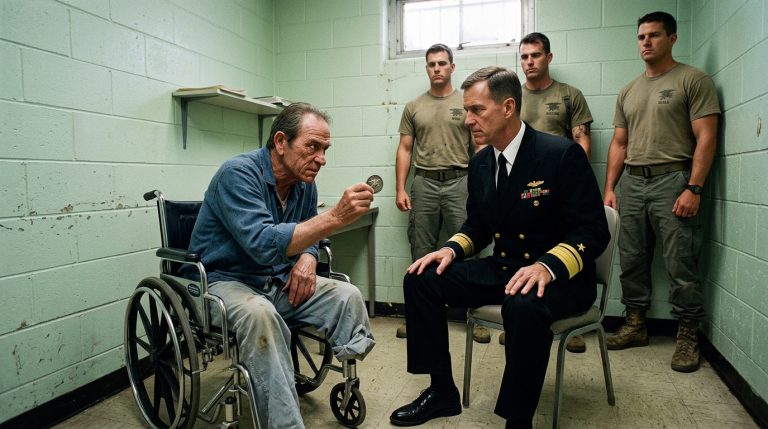
Donovan finally turned. In the low, flickering light, his eyes looked like two cold, grey stones. He set the rag down, his hands steady despite the years. “Because I was the one who signed the orders, Hail. You don’t bury the man who holds the shovel until the grave is full.”
He held up the brass device, his fingers trembling, just a fraction. “They didn’t erase us to protect the Navy,” he said, the shadow of his own face stretching long and jagged across the workbench. “They erased us to protect the experiment. And now, you’ve just walked right into the middle of the trial run.”
CHAPTER 4: THE DECOY LEDGER
The silence that followed Donovan’s confession was heavy, smelling of damp earth and the sharp, metallic tang of the brass gears on the workbench. Hail didn’t move. He stood in the center of the shack, the floorboards groaning slightly beneath his weight. Outside, the wind rattled the corrugated tin roof, a hollow, rhythmic sound that reminded him of a firing range under a storm.
“You signed the orders?” Hail asked, his voice barely a whisper. He looked at the old man, expecting to see some shadow of a monster, some flick of cold, bureaucratic detachment. Instead, he saw only the worn-out hands of a man who had spent forty years cleaning the same set of gears.
Donovan picked up a small jeweler’s screwdriver and began to work on the housing of the navigation array. The friction of the metal on metal was a sharp, grating sound in the confined space. “I signed them to stop the bleed, Chief. But the people who ordered the mission—the people who funded that ‘experimental’ infiltration—didn’t stop because I signed a piece of paper. They just changed the file name.”
He gestured toward the workbench with his chin. Hail took a step closer, noticing for the first time a blank space in the row of labeled boxes stacked against the wall. A specific label—1984, Neptune Alpha—had been ripped away, leaving a jagged strip of raw, unweathered wood underneath. The vacuum of information was visceral. It was a tactical erasure, done with professional care.
“If they changed the file name, where is it now?” Hail asked.
Donovan looked up, his pale eyes searching Hail’s face. “The file isn’t in an archive, Chief. That’s the decoy. The people who are watching you right now—the ones who let you into that terminal room—they keep the real ledger in a place that moves. It’s not on a server. It’s in the institutional memory of the command.”
Hail’s breath caught in his throat. He thought back to the terminal room, the way the screens hadn’t flashed an alarm, the way the quiet had felt like an invitation rather than a blockade. They had let him see the graveyard of names because it was the easy truth—a tragedy of the past that the modern command could easily distance themselves from. It was a masterpiece of misdirection.
“They used me,” Hail said, the realization hitting him with the cold weight of a physical blow. “They wanted me to find those names so I’d stop digging.”
“And you will,” Donovan said, his voice quiet. “If you’re smart, you’ll stop digging. You’ll take the promotion they’re going to offer you in the morning, you’ll forget you ever saw that charred piece of metal on the beach, and you’ll go back to running drills for boys who think they’re invincible.”
Donovan stood up, his joints popping, and stepped around the workbench. He walked to a crate in the corner, his movements slow and deliberate. He pulled out a worn, canvas-bound notebook—the kind used by field operators for decades. The edges were frayed, the leather cracked, and it was held shut by a piece of heavy-duty black electrical tape.
“But if you want to know what actually happened to Task Unit Neptune,” Donovan said, thrusting the notebook toward Hail, “you have to accept that you won’t be coming back to the life you had this morning.”
Hail hesitated. He reached out, his fingers brushing the rough canvas. The texture was gritty, infused with the dust of places that didn’t appear on any map. As his hand closed around the spine, he felt a strange, jarring resonance—the same feeling he’d had when he touched the fragment on the beach.
“Why give it to me?” Hail asked.
Donovan’s face tightened, a flicker of pain crossing his features like a shadow under a spotlight. “Because I’m tired of holding the shovel, Chief. And because you’re the first person in forty years who asked the right question before someone told you what the answer was.”
The shack door suddenly shuddered. Not from the wind, but from a deliberate, hard knock—the kind of rap that signaled an arrival, not a request for entry. Hail’s hand snapped to the notebook, his heart hammering as he looked toward the gap in the door. A silhouette stood outside, tall and rigid against the night light of the base.
It was Senior Chief Daniel Reyes.
“Donovan,” Reyes called out, his voice muffled by the wood. “The Admiral is finished with his review. He’s expecting a final report.”
Hail held his breath, his back to the door, the notebook hidden behind his leg. Donovan looked at him, his expression unreadable, a ghost of a warning in his eyes. He slowly reached out and turned the kerosene lamp down, plunging the shack into a deep, rust-colored gloom, before walking toward the door with the steady, heavy tread of a man who had already decided how the night would end.
CHAPTER 5: THE PRICE OF THE LEDGER
The knock on the shack door wasn’t just a sound; it was a physical weight that seemed to tilt the entire room. Hail stood frozen, the canvas-bound notebook pressed firmly against his thigh, shielded by the darkness of the room. He felt the cold, rough fabric of the cover through his trousers, a reminder that the truth he held was no longer just an idea—it was contraband.
“Come in, Reyes,” Donovan’s voice was as steady as a compass needle, showing no tremor despite the sudden arrival.
The door creaked open, admitting a slice of the base’s artificial night-light. Senior Chief Daniel Reyes stood in the doorway, his silhouette imposing and stark against the damp, misty backdrop of the coastal evening. He didn’t move to enter; he held his position with the rigid, calculated patience of an operator who had spent his life checking for traps. His eyes tracked across the interior, lingering on the workbench, the scattered tools, and finally resting on the darkened corner where Hail stood.
Reyes didn’t blink. He simply acknowledged Hail’s presence with a sharp, imperceptible nod before turning his focus to Donovan. “The Admiral is heading to the comms center to brief the command board. He asked for the unit’s final appraisal, Commander. He said you knew where to find it.”
“I know where to find it,” Donovan replied, stepping forward. He moved with a subtle, fluid shift of his body that placed him directly between Reyes and the corner where Hail was hidden. “But an appraisal isn’t just a document, Senior Chief. It’s a confession of failure.”
Reyes tightened his grip on the doorframe, his knuckles white. “Sir, you know the protocols. The board isn’t interested in appraisals. They’re interested in confirmation that the Neptune infrastructure is fully integrated into the current program. If there’s anything else in the ledger, it needs to be handed over now.”
Hail felt the hair on his arms stand up. The ledger. They weren’t looking for a document; they were hunting for the very notebook he had hidden against his leg. The realization sent a spike of adrenaline through his system, making his fingers twitch. He saw Reyes’ gaze flicker toward his corner again—a predatory shift, brief but deliberate. Reyes wasn’t here to escort the Commander; he was here to finish a sweep that had started the moment Hail touched the terminal.
“I’m afraid the only ledger I have,” Donovan said, his tone turning razor-sharp, “is one you haven’t been cleared to read.”
“Commander, don’t make this a tactical situation,” Reyes warned, his voice dropping into the low, dangerous register of a man who was about to draw a weapon. “There’s an order in place to secure all Neptune assets. If that means a site lockdown, the base police will be here in five minutes.”
Hail knew he couldn’t stay in the shack. The space was a trap. He looked at the rear wall, where a small, rusted ventilation grate rattled in the wind. It was narrow, choked with salt and grime, but it led to the back of the maintenance yard, away from the main path.
He didn’t wait for Donovan to finish his rebuttal. He shifted his weight, his boot sliding silently on the grit-covered floorboards, and eased toward the back wall. He kept his eyes on Reyes, watching for the slightest sign that the Senior Chief had noticed the movement. Reyes was focused entirely on Donovan, his eyes locked, his breathing controlled—but he was moving closer to the workbench, his hand drifting toward his tactical belt.
The moment Donovan stepped sideways, gesturing toward the row of toolboxes, Hail lunged for the grate. He jammed his shoulder against the rusted metal, the cold iron biting into his skin. With a grunt of effort, he shoved the grate free. It hit the wet sand outside with a dull, heavy thud that sounded like a gunshot in the quiet night.
Reyes spun around, his hand moving to his side, his face contorting into a mask of pure, calculated aggression. “Hail! Stop!”
Hail didn’t look back. He squeezed through the opening, the metal edges tearing at his uniform, and tumbled out into the mud and rain. The night air hit him like a physical blow, cold and sharp. He scrambled to his feet, his heart hammering against his ribs as he sprinted toward the cover of the equipment containers, the notebook still tucked securely in his pocket. Behind him, he heard the shack door bang open and the heavy, rhythmic thud of Reyes’ boots hitting the mud, chasing him into the dark.
CHAPTER 6: THE FRICTION OF TRUTH
The mud was a living weight, grasping at Hail’s boots with every stride. He didn’t look back; he didn’t need to. The heavy, syncopated rhythm of boots hitting the wet ground behind him told him everything he needed to know. Reyes was closing the distance, his pace disciplined and lethal. Hail rounded the corner of a row of shipping containers, the sharp steel edges slick with condensation, and skidded into the darkness of the maintenance yard.
His lungs burned with the cold, damp air, and the notebook in his pocket felt like a brand against his thigh. He needed cover, but the yard was a labyrinth of open space, rusted racks, and shadows that offered no true sanctuary. He ducked behind a stack of weathered, palletized crates, his back pressing against the rough wood. The rain intensified, turning the ground into a slurry of oil and grit that soaked through his uniform instantly.
Focus, he told himself. The path of least resistance.
He listened. The footsteps stopped. The silence that followed was more unnerving than the chase; it was the tactical pause of a predator verifying the target’s position. Hail’s heart hammered against his ribs, a frantic, irregular drumbeat. He pulled the notebook from his pocket, his hands shaking—not from fear, but from the raw, freezing fatigue that was beginning to leach the strength from his limbs.
In the brief flashes of lightning that lit up the horizon, he saw the edge of the notebook. It wasn’t just a journal; it was a ledger. He flipped it open to the center, the pages thick and yellowed, covered in tight, desperate handwriting that looked nothing like Donovan’s calm, deliberate script. It was a list of coordinates, mapped alongside tactical notes that described a catastrophic breakdown of communication—a failure, not of hardware, but of human agency.
We didn’t lose them, the ink seemed to scream from the page. We sacrificed them.
A shadow detached itself from the row of crates across the aisle. Reyes moved with terrifying efficiency, his weapon lowered but ready, his silhouette cutting a jagged line through the driving rain. He wasn’t running anymore; he was stalking, his eyes sweeping the area with the precision of a technician.
Hail felt the world tilt. The sound of the rain against the metal containers began to morph in his ears, sharpening into the high-pitched, discordant whine of a radio array breaking down—the exact noise Donovan had described. It was a phantom sound, a trick of his own exhausted nerves, yet it felt so real that he flinched, his heel catching on a discarded length of iron pipe.
The pipe clattered against the concrete with a loud, ringing sound that echoed like a bell through the yard.
Reyes didn’t hesitate. He was across the yard in a blur of movement, his boots slamming into the mud as he vaulted toward Hail’s position. Hail scrambled to his feet, his muscles screaming in protest, and pushed off the crate, sliding through the oily muck to avoid the sweep of Reyes’ flashlight. The light cut through the rain, illuminating the spot where Hail had been standing a second before.
“It’s over, Chief!” Reyes shouted, his voice hard, amplified by the confined space of the yard. “You’re carrying a liability that doesn’t exist. Put the book down and let’s talk about your career.”
“Is that what they called them, Reyes?” Hail yelled back, his voice ragged. “Liabilities? Is that how you labeled the men who died in the Neptune tests?”
Reyes stopped. He stood ten feet away, the rain streaming down his face, his expression hardened into a mask of professional apathy. “They weren’t men. They were the first iteration of a doctrine that keeps this country breathing. You think you’re uncovering a hero’s shame? You’re just looking at a scrap of paper that’s been obsolete for forty years.”
Hail reached into his other pocket and pulled out the charred fragment of metal he’d found on the beach. He held it up, the jagged, blackened edge glinting in the pale light. “Then why are you hunting me for it?”
Reyes’ posture shifted. He didn’t advance, but his hand tightened around the grip of his light. The standoff was a stalemate of iron and grit, the weight of the past pressing down on the two men with the force of the ocean tide. Hail knew he couldn’t outrun Reyes; he had to break the cycle. He had to stop being the one who ran and become the one who forced the confrontation. He shifted his grip on the notebook, the rough, wet canvas grounding him, as he calculated the distance to the next row of containers—a final gamble on his own survival.
CHAPTER 7: THE HOUSE OF CARDS
Hail’s lungs felt like they were filled with crushed glass. He slammed against the corrugated side of a storage unit, the rusted metal vibrating from the impact. Behind him, the rhythmic, relentless stomp of Reyes’ boots grew louder, closer. The storm had turned the maintenance yard into a slick, shadowed graveyard of industrial debris, the rain blurring the lines between the shadows and the steel.
He wasn’t going to outrun him. The realization wasn’t a defeat; it was a tactical pivot. Hail ducked behind the container, his hand gripping the edge of the notebook. The canvas cover was soaked through, the pages inside warping from the moisture, but the ink—the damning, handwritten record of the Neptune failure—remained clear. He heard Reyes stop. The boots ceased their clatter, replaced by the soft, rhythmic clicking of a safety being disengaged.
“You’re making a mistake, Hail,” Reyes’ voice carried through the rain, calm, professional, and devoid of heat. “You’re trying to defend a ghost. That notebook isn’t a weapon. It’s a suicide note.”
Hail didn’t answer. He was watching the reflection in a puddle of oil and rainwater near his boot. He saw Reyes’ legs, the stance wide and controlled, moving toward his position. Hail gripped the iron pipe he’d picked up earlier, the cold surface slick with mud.
He’s looking for the book, not the man.
Hail waited until the shadow of Reyes’ rifle barrel entered the puddle’s reflection. Then, with a scream of effort, he didn’t run; he turned. He threw the notebook—not at Reyes, but toward the far side of the yard, into the tangle of rusted chains and derelict machinery.
Reyes reacted instantly, his head snapping toward the sound of the thud. He lunged in the direction of the notebook, his focus shattered by the decoy. Hail didn’t hesitate. He launched himself from the shadows, not with speed, but with the full, desperate momentum of his body. He slammed into Reyes, the two of them hitting the slick concrete with a sickening thud.
The struggle was a tangle of limbs and grit. Reyes was stronger, his training ingrained into his every movement, but Hail was fighting with the feral desperation of a man who had already lost his future. They rolled through the mud, the taste of rust and iron filling Hail’s mouth. Reyes’ hand caught Hail’s throat, squeezing hard, cutting off his air. Hail gasped, his vision swimming with sparks of black and white, but his hand found the heavy iron pipe.
He didn’t swing at Reyes; he swung at the radio on Reyes’ shoulder. The metal pipe connected with a jarring, bone-shaking force, shattering the plastic housing and sending a spray of sparks into the dark. The comms unit went dead, emitting a final, high-pitched whine that cut through the storm.
Reyes recoiled, his hand flying to his shoulder, a look of genuine shock crossing his face as he realized his link to the command board was severed.
Hail scrambled backward, gasping for air, clutching the mud-caked notebook he had retrieved from his other pocket while Reyes was lunging for the decoy. He stood up, shaking, his uniform torn and blackened with grease. Reyes rose, his hand hovering over his sidearm, but he stopped. He looked at the shattered radio, then back at Hail, and the professional mask finally cracked.
“You have no idea what you’ve done,” Reyes breathed, his voice barely audible over the rain. “The Board isn’t just going to erase the Neptune files now. They’re going to erase this entire facility. If you show that book to the Admiral, you aren’t just ending careers—you’re collapsing the entire chain of command.”
“Then let it collapse,” Hail said, his voice raw but steady.
He turned and bolted toward the administration wing, his legs burning, the notebook pressed against his heart like a shield. He didn’t look back to see if Reyes was following. He moved through the shadows of the base, his eyes fixed on the distant, steady glow of the command deck. The house of cards was leaning, the foundations were exposed, and for the first time in his life, Hail knew exactly where the next strike had to land.
CHAPTER 8: THE TIDE RETURNS
The administration hallway was a tunnel of sterile, white light—the inverse of the dark, rain-slicked hell he had just escaped. Hail pushed open the heavy double doors, his boots leaving a trail of wet, blackened mud on the polished linoleum. Every muscle in his body felt like it was pulled to the point of snapping, but he didn’t stop. He walked past the startled duty officers, his eyes locked on the corner office where Vice Admiral Walker sat, the door slightly ajar.
He pushed into the room. Walker was standing by the window, looking out toward the dark horizon of the Pacific. He turned slowly, his face etched with a weary, profound resignation. He didn’t look like a man surprised; he looked like a man who had been expecting this arrival since the moment Arthur Donovan stepped into the mess hall.
“You’re late, Chief,” Walker said, his voice quiet.
Hail didn’t answer. He walked to the center of the room and placed the mud-caked notebook on the Admiral’s desk. The sound of the damp canvas hitting the mahogany surface was a dull, final thud. “I saw the list,” Hail said, his voice rasping from the exertion. “I saw the Neptune failures. And I saw why the unit had to be buried.”
Walker looked down at the notebook. He didn’t open it. “Arthur didn’t give that to you to incite a mutiny, Hail. He gave it to you to see if you would still care when you realized the truth.”
“The truth is that you murdered an entire unit to save a program,” Hail said, his chest heaving. “That’s not a doctrine. That’s a crime.”
“It was a calculation,” Walker corrected, stepping forward. The light from the desk lamp glinted off the stars on his shoulders, casting a long, rigid shadow across the carpet. “The Neptune unit was testing coastal infiltration tech that was too volatile for standard deployment. When they went dark in ’84, the intelligence was compromised. We didn’t bury them to hide a failure—we buried them to prevent the enemy from knowing we had already reached the technology’s limit.”
Walker’s hands were clasped behind his back, his posture as immovable as a monument. “Arthur Donovan was the one who pulled the fail-safe. He destroyed the communications array—the fragment you found on the beach—to ensure the data couldn’t be extracted. He saved the Navy, Hail. But he sacrificed his team to do it.”
The truth landed with the weight of cold iron. Donovan hadn’t just been a witness to the failure; he had been the executioner. All these years, the man had been walking through the base, saluting the ghosts he had created, living in the quiet, dusty grey of a penance that no one else understood.
Hail felt the anger drain out of him, replaced by a hollow, chilling numbness. He looked at the notebook, then out the window at the Pacific, the same ocean that had been a silent witness to the sacrifice decades ago.
“The Board is currently purging the Neptune logs,” Walker said, his voice turning firm. “By morning, there will be no evidence that Task Unit Neptune ever existed, save for the men who still carry the secret. You have a choice, Chief. You can take this book to the press and tear down the command—destroying the legacy of the men who died for that silence—or you can let it rest. You can accept the promotion you’ve earned, and you can live with the quiet.”
Hail looked at his hands—stained with grease, shaking, and marked by the scars of the night. He thought of Donovan, sitting in that shack, cleaning the gears of a navigation array that no longer had a ship. He realized then that the truth wasn’t about justice; it was about the burden of the living.
He reached out and picked up the notebook. Without a word, he turned toward the Admiral’s hearth, where a small fire was crackling in the grate. He tossed the canvas-bound book into the flames.
The paper curled, the ink turning to ash as the heat consumed the records of the men who had been forgotten. The smell of burning paper—acrid, dry, and ancient—filled the office. Walker watched in silence, his expression unreadable, as the last of the Neptune ledger turned to soot.
An hour later, Hail stepped out of the administration building and into the cool, pre-dawn air. The rain had stopped. The Pacific was a calm, mirror-like expanse, the horizon beginning to lighten with the first, faint bruise of purple morning. He walked toward the shoreline, his steps heavy and slow.
He found Donovan sitting on a piece of weathered driftwood, his silhouette sharp against the rising light. The old man didn’t turn as Hail approached. He simply stared at the water, his hands resting in his lap, the silver ring on his finger glinting in the pale, watery sun.
Hail sat down beside him. He didn’t speak. He just looked out at the tide, the rhythmic pull of the water against the sand acting as a steady, grounding pulse.
“Is it gone?” Donovan asked, his voice soft.
“Yes,” Hail replied.
Donovan nodded, a small, weary movement that settled the tension of a lifetime. He leaned back, the wind brushing through his thin hair. “The tide always takes what we give it,” he said.
Hail picked up a stone from the sand—a smooth, grey piece of shale—and skipped it out into the surf. It skipped three times before disappearing into the dark blue, a small, inconsequential act of closure. He looked at Donovan, seeing not a myth, not a hero, and not a villain, but an old man who was finally, for the first time in forty years, sitting in the sun without the weight of the shovel in his hands.
The base behind them was beginning to wake up—the sounds of engines, the distant bark of orders, the rhythm of a new day. But for a moment, the two of them sat in the silence of the coast, watching the light spread across the water, the past buried beneath the sand, and the future, for the first time, theirs to claim.