The Echo of the Flame: A Journey Through the Weight of Memory and Quiet Valor
CHAPTER 1: THE ASHES OF DISCIPLINE
Staff Sergeant Miller’s hand hit the table with the force of a gavel, a sound that sliced through the sterile, humid air of the mess hall like a razor. The plastic tray jumped, a small tidal wave of cold pea soup sloshing over the lip and soaking into the frayed cuff of Harlon’s red plaid flannel shirt.
Harlon didn’t flinch. He didn’t look up. He simply watched the liquid—pale green and stagnant—seep into the cotton, his pulse slowing to the steady, rhythmic beat of a man who had long ago traded anxiety for a kind of hollowed-out calm. Around him, the mess hall was a cacophony of youth, the clatter of 200 trays creating a white noise that Miller’s voice, sharp and demanding, tried to dominate.
“I asked you a question, old man,” Miller barked, his face a map of fresh, angry crimson. He loomed, a pristine, midnight-blue silhouette that blocked the harsh overhead fluorescent lights, casting a long, dark shadow over Harlon’s small, grease-stained hands. “Who authorized a civilian contractor to sit at a level one protocol station? You’re a stain on this hall.”
Harlon felt the weight of the Zippo in his pocket. It felt heavier than it should, the battered brass warm against his thigh, a dormant weight that seemed to pulse in time with the throbbing in his shoulder—a phantom ache from a wound that had healed decades ago. He reached into his pocket, his fingers tracing the faint, scratched engraving on the side.
“I’m just eating my lunch, Sergeant,” Harlon said, his voice raspy, a dry sound like dead leaves skittering across pavement. He kept his head down, focused on the way the light caught the microscopic dust motes dancing above the tray. He knew Miller was waiting for an explosion, a fight, a defiance that would justify the Sergeant’s rigid, hollow world.
“You’re a mess, Vance. A soup sandwich of a man,” Miller sneered, his hand reaching out to snatch the Zippo from the table where Harlon had set it down.
As Miller’s fingers closed around the brass, Harlon’s world tilted. The air, heavy with the artificial scent of industrial bleach and floor wax, suddenly fractured. For a fraction of a second, the smell shifted, turning thick and coppery, wet with the rot of jungle vegetation and the metallic tang of distant, impending rain.
Miller held the lighter up, his eyes narrowing as he read the engraving. “Rooster?” he laughed, the sound hollow and devoid of any real joy. “What kind of name is that? Did you hide in a chicken coop to miss the draft?”
The mess hall didn’t erupt in laughter. Instead, it did something far more terrifying. The clatter of the forks stopped. The shouting ceased. The air in the room grew heavy, dense with a sudden, suffocating silence that felt like the moment before a mountain collapses. Miller stood there, holding the Zippo, his smirk faltering as he realized he was being watched by three hundred pairs of eyes—eyes that weren’t laughing, but were waiting for him to drop it.
Harlon looked up, his watery, faded blue eyes meeting Miller’s. And for the first time in his life, Miller felt small, his uniform suddenly feeling like nothing more than a thin, paper-thin disguise for the trembling kid beneath it.
CHAPTER 2: THE ECHO IN THE MARROW
The silence was a physical weight, pressing against Harlon’s eardrums until they hummed with the phantom vibration of a distant explosion. He felt the cold, worn brass of the Zippo lighter against his thumb, a small, grounding anchor in a world that had suddenly grown too sharp. Beside him, the hum of the mess hall’s industrial machinery felt wrong—too steady, too clean, lacking the ragged, chaotic rhythm of the monsoons that had defined his youth.
Miller’s hand, still clutching the lighter, seemed to tremble, though the man tried to hide it by squeezing the brass until his knuckles turned the color of bone. He was looking at Harlon, but his eyes were wide, darting, as if he expected a ghost to manifest out of the stale air.
Harlon didn’t reach for the lighter. He didn’t have to. He felt the phantom heat of the A Shau Valley creeping into his limbs, a slow, creeping fire that turned his arthritic knuckles into the white-knuckled grip of a twenty-four-year-old soldier. He saw the way the light played across Miller’s face—a flicker of blue neon against the dull, washed-out reality of the mess hall—and in his mind, that same light was the flare of a phosphorus grenade illuminating a dark, mud-slicked tunnel.
“Give it back, Sergeant,” Harlon whispered. The words were quiet, but they carried an edge of authority that made the air between them ripple.
Miller flinched. The bravado he had worn like armor for his entire career was fraying at the seams. He looked down at the lighter, his own reflection distorted in the tarnished brass. “I…” Miller started, then stopped. The logic of his world—the protocol, the rank, the rules he lived by—was clashing with the raw, terrifying recognition he saw in the eyes of the other marines in the room.
He didn’t hand it over; he dropped it. The Zippo hit the metal tray with a sharp, hollow clink that echoed like a rifle shot through the vast, quiet space.
Harlon reached out, his hand steady for the first time in years. He didn’t look at the lighter as he picked it up; he looked at Miller. He saw the boy’s fear, the way he was desperately searching for a rule, a manual, a regulation that could explain why an old man in a frayed flannel shirt could make the entire room hold its breath.
Harlon tucked the lighter into his pocket. The action felt final, yet the memory of the explosion continued to play out in his peripheral vision. He could smell the ozone. He could hear the whistle of a mortar round—the high-pitched, mocking keening that always preceded the red clay and the screaming. He squeezed his eyes shut for a heartbeat, forcing himself to breathe in the smell of synthetic floor wax and lukewarm peas.
Not here, he told himself. Not now.
“Is there anything else, Sergeant?” Harlon asked, his voice returning to the raspy, broken cadence of the base janitor.
Miller stepped back, his boots scuffing against the polished linoleum. He looked around, suddenly realizing that three hundred men were staring at him—not with the standard deference, but with a strange, searching curiosity. The authority he had banked on was gone, replaced by an uncomfortable, prickling awareness.
“I… no,” Miller muttered, his face shifting from crimson to a sickly, pale gray. He turned abruptly, his movements stiff and uncoordinated, and walked toward the exit. He didn’t look back, but Harlon felt the sting of his gaze from the distance, a residue of confusion that lingered in the air like smoke.
Harlon didn’t get up. He picked up his plastic fork and pushed the peas around the tray again. He was tired—not the kind of exhaustion that sleep could fix, but a deep, structural fatigue that permeated his very marrow. He felt the eyes of the other marines on him, a heavy, inquisitive weight. They were trying to piece together the silhouette of the man who had turned the sergeant’s world inside out.
He wasn’t ready for them to see. He wasn’t ready to be anything other than the man who mopped the floors and stayed in the shadows. He pushed the tray away, the plastic sliding with a screech against the metal table.
As he stood, his knees popped with the sharp, honest pain of age, a reminder that the jungle was decades behind him, no matter how loudly his memory tried to call it back. He began the slow walk toward the scullery, his steps careful, deliberate. He knew the room was still watching, but he didn’t care. He was navigating by the internal map of his own survival, one slow, measured movement at a time.
He passed a group of young privates at the next table. They froze as he approached, their forks hovering mid-air. One of them, a kid with wide, dark eyes and a uniform that looked barely broken in, shifted to clear his path. Harlon gave a curt, almost imperceptible nod. He didn’t want their respect; he wanted the quiet, the fading scent of the bleach, and the sanctuary of the janitor’s closet where he could sit in the dark and wait for the echoes to die down.
He reached the end of the aisle, the heavy steel door of the scullery looming ahead. Just as his hand touched the cool, painted metal, he heard a sound—not a shout, not a bark of command, but a single, rhythmic tapping on a metal table somewhere behind him. It was a slow, deliberate sound.
Clink. Clink.
He stopped, his hand resting against the door. He didn’t turn around. He didn’t need to. He knew that sound. It was the rhythm of a lighter hitting a table, a quiet, coded acknowledgment that drifted through the stillness of the room, binding him to the very history he had tried so hard to bury.
He took a breath, pushed the door open, and stepped out of the mess hall, leaving the silence to settle behind him like dust.
CHAPTER 3: THE LONG WALK THROUGH SHADOWS
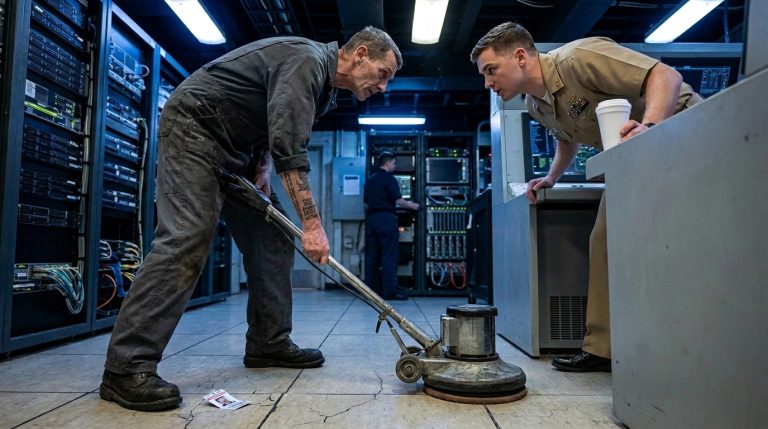
The scullery was a sanctuary of mechanical indifference. Industrial-sized dishwasher racks clattered against metal, and the roar of the high-pressure spray drowned out the lingering echoes of the mess hall. Harlon moved through the steam, his boots wet with the soapy runoff of a hundred trays. He kept his head down, his posture hunched, the weight of the janitor’s mop bucket swinging rhythmically against his leg—a grounded, mundane anchor.
He needed to get to the supply closet. He needed to disappear into the mundane task of scrubbing linoleum, to let the rhythmic motion of the mop neutralize the tremor in his hands. But as he exited the rear of the scullery into the narrow maintenance hallway, he found his path blocked.
Two MPs stood near the intersection of the main barracks corridor. They weren’t looking at him initially, their gazes fixed on a clipboard, but the vibration of his approach caused them to look up in unison. Harlon stopped, his heart stuttering. The overhead lights in the hallway were older here, buzzing with a yellow, sickly intensity that flickered in a pattern he found agonizingly familiar—a staccato rhythm that mirrored the strobe of a distant artillery strike.
“Janitor,” one of the MPs said, not unkindly, but with a clinical detachment. “You’re Harlon Vance, right?”
Harlon felt the Zippo in his pocket, its sharp corners digging into his thigh. He nodded, his throat feeling as though it were lined with the grit and silt of a dry riverbed. “Just heading to the supply room, Officer.”
“The Commandant’s staff is looking for you,” the second MP added, stepping slightly to the side to block the path toward the barracks. “They didn’t give us a specific order to detain you, but they mentioned the General would like a word once his meeting concludes.”
Harlon’s pulse quickened. The “word” with the General was something he had spent decades avoiding. He had built his life on the premise that the past was a private grave, something to be visited only in the quiet of his own mind, not something to be exhumed and paraded before three hundred marines and four-star generals.
“I’m just on the clock,” Harlon said, trying to infuse his voice with the invisibility he usually cultivated. “I have floors to finish before 1300.”
The MPs shared a look—a subtle, communicative glance that Harlon interpreted as a mix of curiosity and reluctant respect. They had heard the rumor, clearly. The mess hall news traveled faster than any official dispatch. “We’ll let you go, but you might want to stay in the wing for a while,” the first MP advised. “It’s a bit of a circus out there right now.”
Harlon nodded, squeezed past them, and kept walking. His breath came in shallow, controlled bursts. The walls of the maintenance hallway felt like they were constricting. He passed a utility closet, the metal door dented and scratched, and he saw a reflection of himself in a nearby window. He looked like a ghost haunting his own life—gray-haired, stooped, wearing a shirt that had faded to the color of dried blood.
He turned the corner, his mind playing tricks on him. For a moment, the linoleum turned to red clay. The hum of the ventilation system transformed into the distant, buzzing whine of a turbine engine circling high above the clouds. He shook his head, a violent, jerky motion that made his neck ache. Focus on the floor. Focus on the bucket.
He reached the supply closet and fumbled with his keys. His hands were shaking again, a fine, high-frequency tremor that made the key dance against the lock. As he finally pushed the door open, he heard the heavy, rhythmic thud of boots behind him. He didn’t turn. He stepped inside, the dark, cramped space smelling of industrial soap and damp mops, and pulled the door shut just enough to create a sliver of shadow.
He peered through the gap. Down the corridor, the entourage was moving—not the General himself, but the Colonel and the Sergeant Major he had seen earlier. They were moving with a focused, predatory urgency. They weren’t checking trash bins; they were checking every room, their faces etched with the same look of searching, hungry awe that Harlon had seen in the mess hall.
They were hunting for the “Rooster.”
Harlon realized then that he couldn’t hide in the closet. The mess hall had been an accident, a singular moment of friction, but the heat of it had created a wake that was now sweeping through the entire base. He was no longer the invisible janitor. He was an object of historical gravity, and the people around him—the ones who sought meaning in a world of protocol—were not going to let him retreat into the quiet.
He looked at his mop. He looked at the bucket. He looked at the small, narrow ventilation grate high up on the wall, one he had cleaned a dozen times, never thinking it would become an exit.
He didn’t want to run. Running was for people who still believed they had a future to escape to. But he also knew that if he stayed, the truth he had guarded for fifty years—the truth that was currently locked behind the calm of his own silence—would be pried open by the hands of well-meaning men who had no idea what they were asking him to remember.
He knelt by his bucket and began to wring out the mop, the water splashing into the dark metal basin. Each drop sounded like the ticking of a clock. The Colonel’s voice drifted closer, loud and booming, echoing against the floor tiles.
“He couldn’t have gone far. The janitor doesn’t just vanish.”
Harlon stopped wringing the mop. He reached into his pocket and pulled out the Zippo. He didn’t light it. He simply held it, the cold brass against his skin acting as a final barrier between the man he was and the myth they were trying to build. He had to make a choice: remain the man who cleaned the floors, or acknowledge that the flame he carried was meant to be seen.
He stood up, his joints protesting the movement, and walked toward the back of the closet, toward the shadows and the narrow, dust-choked vent.
CHAPTER 4: THE THRESHOLD OF RETROSPECTION
The ventilation duct was a cramped, metallic throat of dust and forgotten debris. Harlon crawled through it, his movements sluggish, his arthritic joints protesting every inch of the progress. The metal sheets groaned beneath his weight, a sound that seemed deafeningly loud in the confined space. Ahead, a faint square of light filtered through the grate, showing the way toward the exterior courtyard.
He was a creature of the dark, yet the prospect of the sun-drenched concrete outside offered little comfort. He knew that the base, usually a place of quiet, methodical routines, had become an active grid of searching eyes. The sound of heavy boot heels—not the casual stride of a base patrol, but the disciplined, aggressive march of a security detail—vibrated through the metal floor of the duct.
They are hunting, he thought, the realization settling into his chest with the cold, immovable weight of a stone.
Suddenly, the silence was shattered by a high-pitched, electronic trill. A maintenance drone, its sensors humming with a blue, predatory glow, buzzed into the narrow space just ahead of him. It stopped, its camera lens focusing with a mechanical click that seemed to pierce Harlon’s very soul.
An alarm began to wail, a shrill, pulsing sound that reverberated within the duct. Harlon slammed himself flat against the cold metal, his breath hitching. The drone’s spotlight swept over the interior, illuminating the layers of gray dust and Harlon’s own grime-streaked face.
He didn’t freeze in terror; he froze in a familiar, tactical paralysis. His mind didn’t see the drone; it saw a flickering surveillance camera in a dark corner of a command post, a piece of technology that could betray his position as surely as a flare in the night sky. He reached out, his hand moving with the reflexive speed of a man who had survived by neutralizing threats, and swiped at the drone. His calloused palm connected with the unit, sending it spinning into the side of the duct with a shower of sparks.
The light died. The alarm cut out abruptly, leaving a ringing silence in its wake. But he knew it was too late. The central security system would have logged the disruption.
Harlon forced himself to continue, his hands scraping against the rough rivets as he pushed the grate forward. He kicked it loose and tumbled out, landing in a heap on the hard, dry earth of the barracks courtyard. He gasped for air, the sunlight blinding after the gloom of the duct.
He wasn’t in the clear. The courtyard was a desolate, expansive square, flanked by the high, windowless walls of the logistics wing and the barracks. He stood, his flannel shirt torn at the shoulder, and brushed the dirt from his trousers. He felt exposed, a single, fraying thread in the meticulously ordered fabric of the base.
A voice, calm and unmistakably authoritative, drifted across the yard.
“I wondered if you’d take the ventilation route, Gunny.”
Harlon turned. General Sterling stood by the entrance to the logistics wing. He was alone, his service alphas crisp and unwrinkled, his hands clasped behind his back. He didn’t look like a Commandant; he looked like the man who had crouched in the mud beside Harlon decades ago. He was looking at Harlon with a profound, unblinking intensity, as if he were trying to read the lines of a book he had been searching for his entire life.
“General,” Harlon rasped, his voice barely audible over the wind.
“You never did like the front door, Harlon,” Sterling said, taking a slow step forward. “Not in the A Shau, not here.”
Harlon felt the Zippo in his pocket. It felt like a coal, glowing with the heat of the memories that threatened to overwhelm him. “I’m just a janitor, sir. I don’t know why you’re out here.”
“Because you’re not just a janitor,” Sterling replied, his voice dropping, lose of all rank and formality. “You’re the man who gave me a future. And I’ve spent twenty years watching you trade that future for a mop and a bucket, burying the man I knew beneath the dust of these barracks.”
Harlon felt the sting of tears, hot and stinging against the grit of his skin. He hadn’t wanted this. He had wanted the silence, the slow fading away of the ghosts, the simple, honest erasure of his own existence.
“I didn’t ask for a future, Tommy,” Harlon said, the name sounding foreign on his tongue after so many years of enforced separation. “I just wanted to be done with the fire.”
“The fire is still there, Gunny,” Sterling said, gesturing toward the Zippo in Harlon’s pocket. “I see it every time you touch that lighter. You aren’t done. You’re just waiting for the final word.”
The courtyard seemed to expand, the world around them dropping away until it was just the two of them—the broken-down old man in the flannel shirt and the most powerful officer in the Corps. Harlon looked at the ground, at the dry, cracked earth of the courtyard, and he realized that the truth was no longer something he could keep hidden. The net had tightened, the security teams were likely already rounding the corner, and the secret he had protected was bleeding out, visible to anyone who knew where to look.
He looked at Sterling. He didn’t see the four stars. He saw the face of the kid he had pulled from the mud.
“If I tell you,” Harlon said, his voice finally firm, “it stops here. All of it.”
Sterling nodded, his own expression one of quiet, terrifying resolve. “It stops here.”
The sound of approaching boots—too many, too fast—echoed from the barracks tunnel. Harlon didn’t move. He reached into his pocket, his fingers hovering over the Zippo, and prepared to reveal the final weight he had carried across the threshold of time.
CHAPTER 5: THE WEIGHT OF THE FLAME
The boots were heavy, rhythmic, and closing in. Harlon could see the flashlight beams swinging across the far barracks wall—long, jagged arcs of artificial light that cut through the dusk. Beside him, General Sterling didn’t move. He stood as rigid as a sentry, his eyes fixed on the battered Zippo in Harlon’s hand.
“They’re coming,” Harlon said, his voice a low, gravelly rasp. “If you want to keep your clean record, General, you should walk away now.”
“My record hasn’t been clean since the day I pulled myself out of that crater,” Sterling replied. His voice was devoid of the command tone he used for the troops; it was the voice of a man speaking to his only equal in a room full of ghosts. “I didn’t come here for rank, Harlon. I came here for the rest of the story.”
Harlon looked down at the lighter. The brass was cold, pitted with the marks of half a century of friction. He thought of the fire—not the fire in the A Shau Valley, but the fire he had kept burning inside himself, the quiet, corrosive heat of surviving when others had not.
“They think I’m a hero,” Harlon said, nodding toward the approaching shadows. “They look at you, they see four stars, and they think the world is built on things like that. They think it’s all about who holds the line.”
“It is about who holds the line,” Sterling countered.
“No,” Harlon shook his head, a slow, weary motion. “It’s about who’s left to write the history after the screaming stops.”
A sudden, sharp burst of static erupted from a radio held by a security guard rounding the corner of the barracks. The sound—a harsh, electronic shriek—tore through the courtyard, making them both flinch. The security team froze, their lights converging on the figures in the center of the yard.
“Sir?” The lead guard’s voice was tense, strained by the realization of who stood before him. “We were looking for… the janitor. We didn’t expect to find you with him.”
Sterling didn’t turn. He kept his gaze locked on Harlon. “As you were, Sergeant. This is a private matter.”
The guards hesitated, their lights flickering over the scene—the General, the janitor in the shredded flannel, and the palpable, suffocating tension that hung between them. They knew better than to push, yet they didn’t leave. They stood at the perimeter, a wall of uniforms that acted as a silent audience to the final act of a play they couldn’t possibly understand.
Harlon felt the Zippo. He realized that the decoy secret—the idea that he was just a man hiding from his past—wasn’t enough anymore. The “Rooster” wasn’t just a call sign. It was a sentence.
“You asked about the name,” Harlon whispered, the sound barely audible over the hum of the distant power generators. “You think I crowed to bring in the air support. You think I was a marker.”
“You were,” Sterling said, his eyes darkening.
“I was a cage,” Harlon corrected.
He flipped the Zippo open. The snap of the hinge was incredibly loud in the silence of the courtyard. He didn’t strike the flint. He just held the mechanism open, letting the smell of lighter fluid—sharp, chemical, and clean—waft into the cool evening air.
“When I stood on that ridge,” Harlon continued, his voice taking on a strange, distant clarity, “I wasn’t calling for the jets. I was calling for the end of the world. I didn’t care if I was a target. I wanted the fire to hit the ground so hard that nothing would be left of the valley—or of us.”
He looked at Sterling, and for a moment, he saw the General’s face reflect a new kind of horror—the realization that his own life had been purchased by a man who had intentionally tried to burn them all to ash.
“I didn’t save you, Tommy,” Harlon whispered, his hand trembling. “I just wanted to be the last thing burning before it all went dark. The ‘Rooster’ was just the sound I made while I was waiting for the light to take me.”
The silence that followed was absolute. Even the distant march of the base patrols seemed to vanish, leaving only the sound of Harlon’s ragged breathing. Sterling stood motionless, the weight of the confession settling over him like a burial shroud. He had spent his life building a temple to a man he thought was a savior, only to find out that the foundation was built on a man’s desire to destroy everything he touched.
Harlon watched the General’s expression shift—the confusion, the denial, and finally, the slow, painful acceptance. It was the Kintsugi of a soul; the cracks were now visible, the gold filling them in.
“You’re still here, Harlon,” Sterling said softly. It was the only thing he could think to say.
“I know,” Harlon said. He closed the Zippo with a soft, final click. “And now, you are too.”
He stepped toward the General, the shadows of the barracks swallowing the space between them. He felt a strange, terrifying lightness, as if he had finally unburdened himself of the last coal in the furnace. The courtyard was cold, but for the first time in fifty years, Harlon didn’t feel the chill. He felt the weight of the air, the reality of the ground beneath his feet, and the long, slow process of finally becoming a man who could walk away from his own shadow.
CHAPTER 6: THE SILENT VIGIL
The guards shifted, their boots grating on the gravel, but the space between Harlon and Sterling remained untouched. The confession was a physical presence now, a heavy, jagged piece of reality that had finally been laid bare. Sterling’s face, usually an unreadable mask of command, was visibly fracturing. The four-star insignia on his collar seemed to dull, losing its luster against the stark, fading light of the courtyard.
“You should have left me to burn, Harlon,” Sterling said, his voice barely a breath. “If you hadn’t crowed… if you hadn’t fought to survive… we would have died as soldiers. Instead, I’ve spent my life becoming something that never would have existed if you’d just let the fire do its work.”
“I didn’t have a choice,” Harlon replied. He felt a profound, exhausting detachment. “That’s the curse of the survivor, Tommy. You don’t get to choose who you keep alive. You just keep breathing until the air runs out.”
Sterling reached out. For the first time in their encounter, he broke his rigid posture, his hand hovering near Harlon’s shoulder before resting there with a heavy, paternal grip. It was a gesture of profound reconciliation, the closing of a circle that had started in a mud-filled crater in 1969. “Then let the breathing be enough,” Sterling said. “The fire is out. There’s nothing left to save, and nothing left to burn.”
The security guards, witnessing a moment of intimacy that transcended the hierarchy of the Corps, began to slowly back away. They were no longer hunters; they were spectators to a grief that belonged to a different era. As they withdrew, the courtyard felt suddenly smaller, the towering walls of the logistics wing closing in like a cocoon.
Harlon realized that his duty—the self-imposed, grinding, janitorial penance—was complete. He had scrubbed the stains of the valley from his floors, but he had finally scrubbed the stain from his own conscience. The Zippo, heavy and warm in his pocket, felt like a relic, an object that had lost its purpose.
The denouement came in the days that followed, not as a storm, but as a quiet, settling tide. Harlon did not return to the mess hall. He did not return to his closet or his mop. The transition to retirement was swift, organized by the very infrastructure he had once feared. Within a week, the flannel shirts were packed, the grease-stained hands were clean, and the base was a memory fading into the distance.
His final years were spent in a house in rural Virginia, a structure of wood and stone that smelled of earth and pine rather than bleach and steel. It was a life of profound, intentional stillness. He repaired a broken porch swing, his arthritic hands finding a rhythm in the simple, tactile labor of sanding the wood, the rhythmic back-and-forth movement replacing the frantic pace of his past. The swing, once splintered and gray, slowly regained its strength, its surface smooth and welcoming. It was his symbolic closure—a piece of his world he had chosen to mend, rather than burn.
General Sterling visited on the weekends. He arrived in a nondescript vehicle, without a driver or an entourage. He would sit on the porch, a bourbon glass in his hand, watching the shadows stretch across the fields. They rarely spoke of the war. They spoke of the changing seasons, the repair of the swing, and the quiet, unending stretch of time.
The silence between them was no longer a pressurized chamber; it was a companion.
One evening, as the sun dipped below the tree line, painting the sky in colors that reminded Harlon of the smoke of a fading fire, he pulled the Zippo from his pocket. He held it for a long time, watching the way the light glinted off the tarnished brass. He didn’t strike the flint. He didn’t need to hear the sound of the ignition, nor did he need the light.
He placed the Zippo on the porch railing, leaving it there—a small, static monument in the fading light.
“I’m going to take it out to the field tomorrow,” Harlon said, his voice steady. “Bury it.”
Sterling looked at him, a sad, knowing smile touching his lips. “It’s been a long time, Gunny.”
“It has,” Harlon agreed.
He watched the General, the man who had been a boy in the mud, and he felt a quiet, deep sense of growth. He had survived the fire, he had survived the years of hiding, and he had survived the weight of the truth. He looked out at the fields, the wind stirring the tall grass, and for the first time, he didn’t see a battlefield. He saw a home.
The Rooster had stopped crowing. The sun had finally risen, and in the golden, waning light of the afternoon, Harlon Vance was, at last, just a man sitting on a porch, waiting for the evening to arrive. The internal war was finally, utterly, silent.