A Shattered Frame: The Silent Weight of Sacrifice and the Slow, Fragile Repair of a Boy’s Soul
CHAPTER 1: THE FRICTION OF SILENCE
The sound of the aluminum can hitting the ground was a vulgar, hollow clatter, a tinny dissonance against the sacred hush of the Arlington grounds. It skidded, a lazy arc of amber-colored liquid splattering across the pristine toe of a boot that had been polished to a mirror shine hours before sunrise.
Tyler Grayson felt the vibration of the throw travel up his arm, a lingering phantom sensation of the discarded soda. He grinned, his thumb hovering over the screen of his phone, waiting for the flicker of a flinch, the inevitable crack in the stoic armor that occupied this patch of Virginia earth. But the guard did not move. He was a pillar of navy wool and disciplined stillness, a statue that had somehow learned to breathe, yet refused to acknowledge the sticky, sweet mess pooling near his heel.
The heat was a physical presence, a thick, humid blanket that smelled of baked dust and mown grass. Around them, the crowd had become a collective lung, holding its breath. Tyler glanced at his phone—the recording bar was counting up, a steady heartbeat of digital vanity.
“Yo, check the statue,” Tyler murmured, loud enough to be heard by the tourists shivering in the heat. “He’s literally leaking, and he won’t even look down.”
He expected a glare. He expected the guard to break his stride, to demand an apology, to offer him the satisfaction of a reaction. Instead, the man—Ethan, the name plate on his uniform was a sharp, silver sliver—simply completed his twenty-one steps with a rhythmic, mechanical precision. Every click of his heels against the pavement wasn’t just a sound; it was an anchor, dragging through the soil of the cemetery.
Tyler stepped closer to the thin, braided rope that demarcated the sacred from the profane. He felt the itch of boredom under his skin, a restless energy that demanded the world yield to his perspective. He zoomed in on the mess, the amber liquid glistening in the harsh sun like slow-moving lava. He didn’t notice the way the air around the guard seemed to shimmer, nor the subtle, rhythmic tightening of the muscles in the man’s jaw.
Then, he saw it. As the guard turned to face the tomb, a small, faded blue ribbon slipped slightly from the interior brim of his kepi hat. It wasn’t standard issue. It was frayed, the edges worn to a soft, fibrous fuzz, the color of a twilight that no longer existed. It was a detail so small it felt like a discrepancy in the geometry of the ceremony.
Tyler’s focus narrowed. He tilted his phone to get a better shot of the ribbon, his thumb pressing closer to the screen. The guard’s gaze, shielded behind dark lenses, shifted. It wasn’t a glance at the crowd. It was a direct, absolute locking of senses onto Tyler.
The heat suddenly felt cooler, sharper. The silence of the tomb felt less like reverence and more like a held breath before a scream. Tyler blinked, his thumb hovering over the ‘stop’ button, a sudden, cold prickle of intuition telling him that he had looked at something he wasn’t supposed to see.
CHAPTER 2: THE STERILE WEIGHT OF TRUTH
The transition from the sweltering heat of the cemetery to the air-conditioned tomb of the security office was not a relief; it was a sensory plummet. Tyler’s skin, still prickling with the residual electricity of the standoff, felt suddenly clammy. The room was small, a box defined by gray linoleum and the low-frequency hum of a flickering fluorescent light that cast long, rhythmic shadows across the walls.
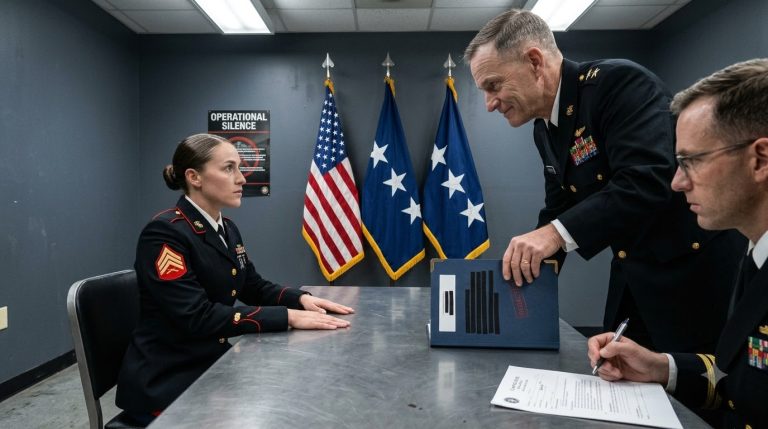
He sat on a folding chair, the plastic covering biting into his thighs. Across from him, the room felt crowded with authorities—Inspector Laura Bennett, her face a mask of weary professionalism, and the presence of Colonel Margaret Hayes, who seemed to bring the very atmosphere of the Tomb inside with her.
Tyler gripped the edges of the seat. The shattered phone in his pocket—or what was left of it—felt like a dead weight. For the first time in his thirteen years, the digital shield that had mediated his experience of the world was gone, replaced by the unblinking, judgmental reality of the room. He felt a sudden, sharp pang of memory: a Tuesday afternoon in his home office, watching his father, Jonathan, sign contracts while barely glancing at his son’s report card. His father’s love had always been a transaction, a credit to be earned through performance or status. Now, in the face of this sterile, unforgiving silence, Tyler realized how much of his own behavior was a frantic, mimicked attempt to command that same transactional respect. He had tried to buy the world’s attention because he hadn’t known how to earn its presence.
“Mr. Grayson,” Laura’s voice cut through the hum, cold and surgical. She wasn’t asking for his side of the story; she was cataloging his failures. “You are not in a classroom. You are not at home. You are on federal property, and you have, through your own deliberate action, violated the sanctity of a site that is guarded by the United States Army.”
Tyler opened his mouth to offer one of his usual deflections, but the words withered. He looked at Colonel Hayes, who stood by the window, her silhouette framed by the stark, unrelenting light of the cemetery outside. She wasn’t angry. That was worse. Anger would have been a reaction—a form of engagement. This was assessment. She was looking at him as if he were a mechanical error to be diagnosed and corrected.
“I just wanted a video,” Tyler whispered. The words sounded pathetic even to his own ears, stripped of the bravado he had cultivated for his followers. “Everyone does it. It’s just… it’s just what people do.”
“That is exactly the problem,” Margaret said, her voice devoid of heat but dense with intent. She walked toward the center of the room. “You have spent your life viewing the world as a background for your own existence. You’ve mistaken visibility for substance. But that tomb out there? It doesn’t care about your followers. It doesn’t care about your sneakers. It stands for the reality that existence itself is a debt paid in blood.”
She paused, her gaze dropping to Tyler’s hands, which were still trembling slightly. “You think you’ve ruined your vacation. You think you’ve lost a piece of hardware. But you haven’t begun to understand what you’ve actually broken.”
Tyler looked up, his eyes meeting hers. He expected to see a reflection of his own arrogance. Instead, he saw a profound, weary sadness—the kind of look reserved for something already lost. He felt a strange, cold vertigo. The “decoy” of his life—the image, the wealth, the noise—seemed to be peeling away, revealing a hollow core he hadn’t realized he was carrying.
The door opened, and a woman stepped in. She didn’t look like a guard or an administrator. She wore a soft-colored blazer, her expression neutral but observant. This was Dr. Emily Carter. She didn’t carry a clipboard; she carried a presence. She moved to a seat and sat down, crossing her legs, her eyes tracking Tyler’s every movement, as if noting the micro-flickers of his panic.
“Tyler,” she said, her voice not as sharp as the others, but somehow more penetrating. “We aren’t going to talk about your phone. We aren’t going to talk about your parents. I want to talk about what you felt when you stepped over that rope.”
Tyler stared at the floor. The linoleum had a pattern—a repeating, soulless series of gray swirls. He thought of the soda splashing the boots. He thought of the way the crowd had gasped, and how, for a fleeting, horrifying second, he had felt completely and utterly alone in a room full of people.
“I felt… I felt like I was winning,” he managed to say, his voice cracking. “But then… then he looked at me. And I didn’t feel like I was winning anymore.”
Emily nodded, her gaze intensifying. “The guard. What did you see in him, Tyler? Beyond the uniform. Beyond the ‘statue’.”
Tyler closed his eyes. The image of the fraying blue ribbon in the hat brim flashed in his mind. He didn’t know why, but he felt an urge to mention it, then pulled back, shielding that detail. He realized he was instinctively hiding the only thing that felt real.
“I saw someone who was tired,” Tyler whispered. “And I think… I think I hated him for it. Because he was so sure of who he was. And I didn’t even know who I was supposed to be.”
The silence returned, heavier than before. Outside, a lone, rhythmic clack-click of heels hitting the pavement drifted through the window—the guard, still pacing, still honoring, still existing in a world where actions held weight. Tyler felt the walls of the office closing in, a box where the truth of his own smallness was finally catching up to him.
CHAPTER 3: THE GRIT OF THE GROUND
The morning after the office confrontation was a study in physical erosion. Tyler had been dropped off at the service entrance of the cemetery well before the sun had fully burned the dew from the grass. His designer sneakers, now stained with the literal dirt of the place he had disrespected, felt heavy and wrong on his feet. He had been handed a stiff, abrasive work shirt and a pair of gloves that smelled of motor oil and old sweat.
He didn’t know where to look. He didn’t know who to speak to. He was simply a smudge on the landscape of pristine, white headstones.
“Pick it up, kid. We don’t have all morning.” The voice belonged to a man named Silas, a retired Army sergeant with skin the color of tanned leather and eyes that seemed to look through Tyler rather than at him. Silas handed him a heavy-duty rake. “The rain is coming. If we don’t clear the perimeter path before the deluge, the sediment washes over the walkways. And we don’t let the walkways get dirty.”
Tyler took the rake. The handle was rough, unvarnished wood that bit into his palms. “Where do I start?”
“You follow the line,” Silas said, gesturing toward the long, winding path that bordered the outer section of the graves. “And you keep your eyes on the ground. Don’t worry about the tourists, don’t worry about your phone—which, by the way, I’m guessing is still a pile of scrap in your pocket. Just move the earth.”
For the first three hours, there was no conversation. Tyler moved with a mechanical, angry rhythm. Every time he dragged the rake, he felt the friction of the soil, the resistance of roots and stones. His back ached in a way he had never experienced. His life until yesterday had been built on air—on likes, on comments, on the soft, cushioned velocity of a tech-CEO childhood. This was the opposite. This was the world of mass and gravity.
Around noon, the sky shifted. The bright, blinding blue of the Virginia morning was swallowed by a bruised, heavy purple. The air pressure dropped, making Tyler’s ears pop. He looked up, wiping sweat from his forehead with a mud-streaked arm.
“Storm’s breaking,” Silas noted, leaning on his own shovel.
Before Tyler could respond, the heavens opened. It wasn’t a gentle rain; it was a sudden, violent deluge that turned the dry dirt into slippery, dark sludge. The crew scrambled, but there was nowhere to go that wasn’t exposed. They huddled under the deep eaves of a nearby tool shed, a cramped space that smelled of wet wool, ozone, and old iron.
Tyler found himself pressed against the corrugated metal wall, shivering. He was drenched, his clothes clinging to his skin like a second, heavier layer. Next to him, a younger veteran named Marcus, who had spent the last two hours showing Tyler how to edge a curb, was wringing out his hat.
“First time out here in the real wet?” Marcus asked, not with mockery, but with a strange, tired curiosity.
“First time doing anything like this,” Tyler admitted, his teeth chattering. He looked at his hands. They were raw, the skin red and inflamed. “I don’t get it. Why stay? Why not just… why put in the work?”
Marcus looked out at the rain, his eyes tracking the way the water ran in sheets down the side of a marble monument a few yards away. “You think we do it for the money? Or the glory?” He laughed, a short, sharp sound. “We do it because someone has to remember that the dirt is not just dirt. It’s an anchor. When you lose everyone, or when you lose your way, you come back to the thing that stays put. The stones stay. The duty stays.”
Tyler felt a knot tighten in his chest. He thought about the ribbon he had seen in Ethan’s cap. “Is that what it’s about? Just… staying?”
“It’s about being responsible for something that can’t talk back to you,” Silas added from the back of the shed, his voice rumbling over the roar of the rain on the metal roof. “You spent your whole life talking, Tyler. Broadcasting. Thinking your voice was the only one that mattered. Out here, you learn the value of silence. You learn that the only voice that counts is the one that follows the rules, even when it’s pouring rain and nobody is watching.”
Tyler looked down at his muddy boots. He remembered the feeling of the soda can in his hand, the intoxicating surge of power he’d felt when he thought he could provoke a reaction. Now, in the damp, claustrophobic chill of the shed, that power felt like a fever dream—a distorted, ugly thing.
“I broke his phone,” Tyler muttered, almost to himself. “And he broke mine. I thought that made us even.”
“You’re not even,” Marcus said quietly. “You’re just starting.”
The rain hammered against the roof, a deafening, rhythmic percussion that drowned out any chance for further conversation. Tyler watched the water pool in the ruts of the path he had spent the morning clearing. He realized, with a sinking, visceral clarity, that he couldn’t just walk away from this. He had tried to treat the cemetery as a set, a background for his own viral moment, but the cemetery was a living, breathing entity of labor and memory. It didn’t care about his apology. It cared about the mud on his boots and the work he had left to do.
He leaned his head back against the cold, vibrating metal of the shed, listening to the rain. He felt a deep, profound exhaustion, not just in his muscles, but in his spirit. He had been trying to build a personality out of glass, and now, he was being forced to rebuild it out of stone. It was heavy, it was wet, and it was the most real thing he had ever felt.
CHAPTER 4: THE FRAGILE ECHO
The work shed smelled of wet earth and slow, steady rot. As the rain tapered off to a dull, rhythmic dripping from the corrugated roof, Tyler pushed himself away from the cold metal wall. His limbs felt heavy, weighted by the unaccustomed labor of the last few days. He turned to help Silas pack away the shovels, his gaze drifting to the corner where the stones of the shed foundation met the rising slope of the hill.
Something caught the light—a sliver of pale, off-white material wedged deep into a crevice. Tyler hesitated. He knew he should be focused on the equipment, on getting back to the groundskeeper’s station before the shift ended, but his curiosity had been sharpened by the raw, physical reality of the last four weeks. He knelt, his fingers scraping against the grit of the foundation.
He pulled a small, tightly folded bundle from the dark crevice. It was a handful of letters, the paper yellowed and brittle, smelling faintly of ozone and old dust. As he unfolded the top page, his heart skipped a beat. The ink was faded, the handwriting jagged and hurried. It wasn’t a formal document; it was a desperate, personal plea to someone named ‘Michael.’
Tyler stared at the name. Michael. The name Ethan had spoken during their first meeting—the brother he lost.
His breath hitched. He wasn’t supposed to be here. He wasn’t supposed to touch this. But as his eyes scanned the lines, the words blurred the line between the guard he had mocked and the human being he was becoming. The letters spoke of fear, of a life lived in the shadow of a war that felt distant to everyone but the person writing them. They weren’t records; they were pieces of a soul that had been left behind.
“Tyler! Let’s move!” Silas’s voice boomed from the shed entrance, sharp and impatient.
Tyler quickly tucked the letters into his work shirt, the paper cold against his damp skin. His heart was hammering a frantic, uneven rhythm against his ribs. He stood up, his legs shaking slightly, and emerged into the gray, dripping world outside. The cemetery was vast and silent, the white headstones gleaming like teeth in the fading afternoon light.
He walked back toward the crew, his mind racing. He had been looking for a way to prove his change, to show everyone he was more than the viral kid in designer sneakers, but this discovery felt like a transgression—or perhaps a key. He thought of Ethan, the man who guarded the silence. Was this the weight he carried? A hidden history, a secret mourning that made the march not just a duty, but a lifeline?
The walk back to the service building felt miles long. Every step was a negotiation between his old self, who would have broadcasted this discovery to the world for the sake of ‘content,’ and the new self, who felt the strange, heavy sanctity of the paper pressed against his chest.
When they arrived, the grounds crew dispersed, their movements weary and efficient. Tyler lagged behind, his hands shoved deep into his pockets, clutching the bundle. He looked toward the Tomb. In the distance, he could see the faint, dark silhouette of a sentinel. Was it Ethan? The distance was too great to tell, but the presence of the guard seemed to anchor the entire landscape.
He retreated to the small, sterile locker room provided for the workers. He waited until the corridor was empty before pulling the letters back out. He had intended to just look at the signature again, to be certain, but as he smoothed the paper, he saw a date—a date that preceded the war in Afghanistan by years.
It wasn’t just Michael’s story. It was something older. A deeper, more complex layer of sacrifice that didn’t fit into the simple narrative of “hero” or “soldier.”
A shadow fell across the doorway. Tyler whipped his hand behind his back, his breath stalling.
It was Inspector Laura Bennett. She was holding a clipboard, her eyes scanning the room with that same surgical, unblinking intensity he had seen in the security office. Her gaze lingered on him, taking in his muddy boots, his sweat-streaked face, and the stiff, guarded posture he had unconsciously adopted.
“You’re lingering, Tyler,” she said, her voice dropping into the quiet of the room. “The crew is done for the day. You should be heading to your family’s quarters.”
“I… I was just cleaning up,” Tyler said, his voice sounding hollow to his own ears. He felt a sudden, frantic need to get out of the room, to protect the secret he held. “I’ll be out in a second.”
Laura stepped into the room, the sound of her heels sharp on the concrete. She didn’t approach him, but she didn’t leave, either. “You’ve changed, Tyler. A lot of people have noticed. Silas says you’ve stopped complaining about the work.”
“I guess I’m tired of complaining,” Tyler replied, his fingers trembling behind his back.
“Good,” she said, though her eyes remained suspicious. “But remember why you’re here. This place is not a place for discovery. It is a place for quiet.”
She turned and left, her footsteps fading down the hallway. Tyler exhaled, a ragged, shaky sound. He looked at the letters again, then at the gray, unforgiving walls of the locker room. The realization hit him with the force of a physical blow: he was no longer just a participant in his own life. He was a keeper of someone else’s ghosts. And if he was going to survive the transformation he had started, he had to be careful—because the secrets of this place were guarded by people who knew how to silence anything that disrupted their sacred, static world.
CHAPTER 5: THE WATCHER AT THE GATE
The transition from the locker room to the outside world was a plunge into a different kind of intensity. The sun had dipped below the horizon, bleeding the sky into a bruised, deep indigo. Tyler moved through the winding paths of the cemetery, the bundle of letters burning a hole in his chest. He felt as though he were walking through a gauntlet. Every white headstone, once just a marker of history, now looked like an eye, watching his nervous, jagged pace.
The rhythmic clack-click of a sentinel’s boots sounded from the direction of the Tomb, echoing with a haunting, metallic resonance. It wasn’t just a sound; it was a heartbeat. Tyler slowed his pace, trying to force his breathing to stay even. His paranoia was a rising tide. He had spent his life reading the reactions of his followers, but now, he found himself misreading the environment. A shifting shadow near a mausoleum seemed to him like a guard intercepting his path; the beam of a distant flashlight flickered, and he was certain they were hunting him.
He wasn’t hunted, not yet. But he was cornered by the gravity of his own discovery.
He reached the perimeter where the shadows were deepest, beneath the thick, sprawling limbs of a weeping willow. He didn’t want to go back to the quarters where his parents were—where the gilded, hollow conversation of his “rehab” waited to consume him. He needed to be near the source. He needed to understand if Ethan was just a guard, or if he was the final piece of the mystery trapped behind the letters.
As he moved, he saw a figure standing near the edge of the restricted area. It was a tall, rigid shape, motionless. Tyler crouched behind the thick trunk of the tree, his heart thumping against his ribs like a trapped bird. The figure turned. It was Ethan.
The guard wasn’t marching now. He was standing perfectly still, facing the Tomb, his shoulders slumped ever so slightly—a posture of exhaustion that Tyler had never seen in the disciplined, machine-like man during the ceremony. Ethan reached up and removed his sunglasses, rubbing the bridge of his nose. In the dim, ambient light, his face looked older, ravaged by a fatigue that went beyond simple physical exertion.
Tyler’s grip on the letters tightened. The parchment felt fragile, like a piece of his own burgeoning conscience. He realized then that Ethan’s rage, his precision, and his stone-faced indifference were all components of a structure designed to keep him from falling apart. The guard wasn’t guarding the unknown; he was guarding his own internal ruins.
A sudden, sharp sound—the crack of a dry branch beneath Tyler’s boot—pierced the quiet.
Ethan’s head snapped toward the tree. It was a movement of terrifying, animalistic speed. The guard’s hand moved to his belt, his posture shifting instantly from exhaustion to a lethal, tactical readiness.
“Who’s there?” Ethan’s voice was low, a rasp of gravel and steel.
Tyler froze. The paranoia he had felt moments ago vanished, replaced by a cold, absolute realization: he could not hide. If he ran, he confirmed the guilt. If he stayed, he faced the man he had once mocked, now armed with the secret of his brother’s hidden life.
Tyler stepped out from behind the tree, his hands held up, showing nothing but empty palms. The moonlight caught the white edges of the letters still clenched in his left hand.
Ethan’s gaze dropped instantly to the paper. His eyes widened, a flicker of pure, unadulterated vulnerability breaking through his military mask. He moved toward Tyler, not with the grace of a sentinel, but with the desperate, jagged movement of a man who had finally been touched by the thing he had spent years trying to bury.
“Where did you get that?” Ethan asked. His voice wasn’t an order; it was a plea.
“I found them,” Tyler said, his voice barely audible. “In the foundation of the shed. Behind the stones.”
Ethan stopped a few feet away. The distance between them felt charged, a bridge spanning the gap between two people who were both, in their own ways, broken by the weight of expectations. Ethan looked at the letters, then back at Tyler. The guard’s eyes were glassy, reflecting the cold, indifferent light of the stars.
“You don’t know what you’re holding,” Ethan whispered. “You think you’ve found a story. You’ve found a life that ended before it could even begin. And if you show those to anyone… if you let the world turn these into ‘content,’ you won’t just be disrespecting the dead. You’ll be killing the only thing that’s left of him.”
Tyler looked at the letters. He saw the way the ink caught the moonlight. For the first time, he realized that there was no “winning” this scenario. There was no viral clip, no apology, no clean resolution. There was only the decision: to keep the secret, or to let the world consume it.
The ground felt like it was shifting beneath him. The cold air of the evening bit into his skin, and the distant, rhythmic ticking of the guard’s boots started up again, faster, more insistent, as if time itself were running out.
CHAPTER 6: THE SILENT REPAIR
The space under the weeping willow was a sanctuary of shadows. For a long, grueling minute, there was no sound but the labored breathing of the two of them. Ethan’s hand, calloused and trembling, rested on the hilt of his belt, but the lethal edge had left his posture. He looked, for the first time, like a man who had simply run out of places to hide.
“My brother,” Ethan began, his voice barely a whisper against the rustling leaves. “He wasn’t a hero in the way the stories tell. He was just a boy who wanted to be something more than the dust he came from. He wrote those letters because he was terrified. He wasn’t afraid of dying; he was afraid of being forgotten before he’d ever truly lived.”
Ethan reached out, and with a delicate, unpracticed motion, took the bundle of letters from Tyler’s hand. He didn’t open them. He held them against his chest, as if they were a talisman. “I’ve spent every day at this tomb trying to be the monument he couldn’t have. I thought if I were perfect enough, if I were still enough, I could hold the world together for him. But you… you saw the crack, didn’t you?”
Tyler nodded, the lump in his throat making it impossible to speak. He looked at Ethan, truly looking at him, and saw the reflection of his own fear—the fear that his life was a sequence of performances without a center.
“I didn’t just find these,” Tyler finally said, his voice raw. “I realized I was holding them because I didn’t want to be the person who threw the soda can anymore. I didn’t want to be the kid who made everything about the camera.”
Ethan looked at the Tomb, then back to the boy. The guard’s gaze softened, the harsh, defensive edges of his expression dissolving into a quiet, exhausted grace. “The world is going to want the story, Tyler. They’re going to want the headline. Are you ready for what that costs?”
Tyler looked down at his own hands. They were still stained with the mud of the cemetery—the honest, gritty dirt of labor. “I don’t want the story. I just want… to do the work.”
The sunrise began to bleed over the horizon, casting a long, golden ribbon of light across the path. In that light, the world felt stripped of its illusions. There was no viral clip to be made here. No likes to be gained. There was only the duty, the morning shift, and the heavy, beautiful truth of being human in a place built for the dead.
Over the next few weeks, the public fervor died down, replaced by the mundane, rhythmic persistence of life. Tyler finished his service, not with a flourish, but with a quiet, steady dedication. He didn’t change the world, and he didn’t become a saint. He just became someone who showed up. He repaired the path, he cleaned the stones, and he learned that dignity wasn’t something you claimed; it was something you earned in the increments of your own actions.
On his final day, Tyler walked back to the shed. He carried a small, leather-bound book—not for recording content, but for his own thoughts, a quiet place to keep his own life. He passed by the Tomb. Ethan was there, marching with his usual, breathtaking precision, but as Tyler walked by, the guard offered a single, almost imperceptible nod.
It wasn’t a forgiveness—it was an acknowledgment. A recognition that both of them were still standing, still breathing, still carrying the weight of their own histories.
Tyler reached the maintenance area and sat on the bench where he had first learned to rake the earth. He reached into his pocket and pulled out the shattered shell of his phone, the one that had been broken in that first, arrogant moment. He didn’t throw it away. He sat there and worked to clean the glass shards from the frame, a slow, methodical process that required patience and focus.
He didn’t fix the phone; it was beyond saving. But he fixed the frame. He made it clean, removing the jagged bits that could cut.
He looked out over the cemetery. The white headstones were bathed in the soft, morning light, stretching out like a sea of white caps toward the horizon. He realized then that the “unknown” wasn’t a mystery to be solved or a secret to be exposed. It was a silence to be respected.
He stood up, his body feeling both tired and remarkably light. He had no more tricks. He had no more performances. He had only the quiet, steady rhythm of the present moment, and for the first time in his life, it was enough. He walked away from the path, leaving the cemetery behind, his steps falling in time with the distant, steady cadence of the guard, moving toward a future he no longer needed to broadcast to the world. He was, finally, his own person—quiet, grounded, and profoundly, irrevocably awake.