The Weight of Honor: A Soldier’s Silent Battle Against the Calculated Indifference of the Skies
CHAPTER 1: THE CLICK OF DISCIPLINE
The airport was a cathedral of motion, a frantic, swirling dance of humanity that meant nothing to Colonel David Carter. To him, the terminal was merely a corridor—an obstacle between the weight of his duty and the finality of his mission. His polished dress shoes struck the linoleum floor with the sharp, rhythmic precision of a metronome. Click. Step. Click.
Private first class Jason Reynolds was waiting in the shadows of the tarmac, wrapped in the heavy, somber dignity of the flag. Carter felt the casket’s presence like a physical gravity pulling at his own chest, a weight far more significant than the medals pinned to his uniform. He stopped at the gate desk. The woman behind the computer didn’t look up, her fingers drumming a frenetic, synthetic beat against the keyboard.
“Flight 237,” Carter said. His voice was a low, resonant calm that cut through the surrounding chaos. “Escorting military remains.”
The woman’s typing faltered. She glanced at the screen, her brow furrowing, then looked up. Her eyes met his for a fraction of a second before darting away toward the rows of passengers behind him. She tapped a command, a sharp, quick motion, then frowned deeper.
“Sir,” she said, her voice tight, lacking the rehearsed lilt of customer service. “There seems to be an issue.”
Carter leaned forward. He didn’t blink. He watched the way her pulse jumped at the base of her throat, a rhythmic, frantic flutter that had nothing to do with standard airline operations. “My orders are valid. My ID is current. Explain the issue.”
She swallowed hard, her eyes flicking toward the supervisor huddled near the frosted glass of the back office. “It’s… it’s a security protocol, sir. We cannot override the system’s block.”
“Protocol,” Carter repeated, the word tasting like copper. He had navigated combat zones where the rules were written in smoke and fire; he knew the shape of a lie when it was presented as procedure. “I have flown this route a dozen times. There is no protocol that prevents a soldier from honoring a fallen brother.”
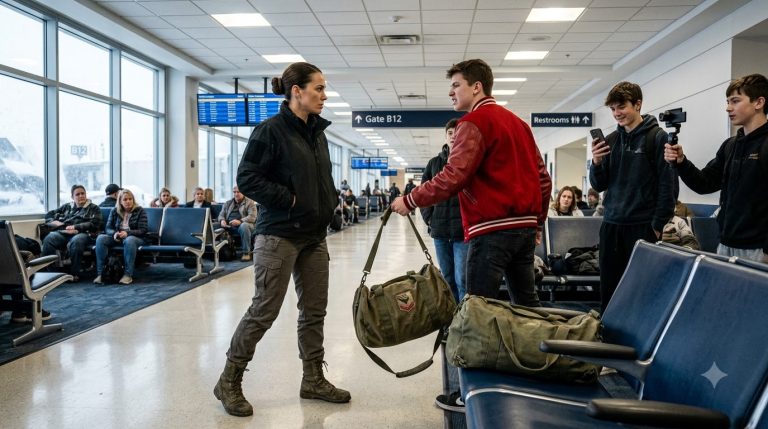
The terminal air grew dense, pressurized by the sudden stillness of the people nearby. A young man in a hoodie, clutching his phone, slowed his pace, his eyes shifting from the agent’s trembling hands to the Colonel’s stony, unyielding profile. Carter didn’t need to turn around to feel the focus of the room tightening like a noose.
“I need a name,” Carter said, his voice dropping an octave, cold and razor-sharp. “And I need a supervisor. Now.”
The agent’s fingers hovered, frozen over the keys, and the screen flashed a warning that wasn’t about a flight, but about something far deeper—a systemic, rigid code that prioritized its own efficiency over the dignity of a human soul. The supervisor stepped out, his face a mask of practiced, professional exhaustion, but his eyes betrayed a flicker of genuine fear as he saw the Colonel standing his ground.
“Colonel,” the supervisor began, his voice a calculated slide of false sympathy. “We have a bit of a situation here.”
Carter didn’t shift his weight. He didn’t retreat. He stood as an immovable object in a world built for speed, waiting for the truth to crack the polished facade. He knew the airport was watching, and he knew that for the first time that day, someone was going to be held accountable for the shadows.
CHAPTER 2: THE FRICTION OF PROTOCOL
The supervisor, a man whose name tag read ‘Miller’, shifted his stance. It was a subtle movement, a slight weight-transfer to his left boot, but to Carter, it was a data point. The man was bracing, not for an argument, but for a retreat.
“Colonel,” Miller said, his voice dropping into that specific, oily register designed to de-escalate without conceding an inch. “I understand your frustration. Truly, I do. But this is a corporate environment. The logistics software flagged the manifest discrepancy—the nature of the cargo, the specialized handling requirements—and the system automatically locked the boarding pass. I have no authorization to manually override a Level-4 manifest security block.”
Carter didn’t blink. He felt the cold hum of the terminal’s fluorescent lights against his skin, a sharp, artificial buzzing that echoed the tightening in his own chest. He wasn’t seeing Miller. He was seeing the ridge line at Khost, the way the rain had turned the earth into a slick, grey porridge, and the way the Sergeant had looked when he’d been told there was no room on the transport. The memory was a ghost, cold and biting, rising in the silence of the airport lobby.
“Logistics software doesn’t have a soul, Mr. Miller,” Carter replied, his voice devoid of heat, which only made it more dangerous. “People do. You are the one standing behind the counter. You are the one with the authority to pick up the phone, call the regional hub, and tell them that a soldier is going home today.”
“I can’t do that,” Miller said, and for the first time, a flicker of genuine panic broke through the professional veneer. He looked at the passengers behind Carter. The line had stopped moving. People had turned, their bodies angled toward the confrontation like metal filings pulled toward a magnet. A woman in a dark coat stood only three feet away, her phone poised.
Carter took a single step forward, the steel heel of his dress shoe meeting the tile with a sound like a pistol shot. He didn’t raise his voice, but the space between them seemed to contract. “You’re worried about your metrics. You’re worried about the quarterly performance report for a department that doesn’t know the name of the man in that casket. I am worried about a promise.”
“Colonel, please,” Miller whispered, stepping back until his heels hit the frosted glass door of the office. “You’re creating a scene.”
“No,” Carter said, glancing at the line of people who were now holding their breath, their devices held high like offerings. “I’m creating accountability. It’s a very different thing.”
Carter reached out and placed his ID and military orders directly onto the counter, right in the center of the terminal’s harsh, white glare. He kept his hand flat, fingers splayed. He wasn’t leaving. The friction of the situation was absolute; there was no room for the supervisor to slide away, no path for the bureaucracy to hide behind its own jargon.
Miller looked down at the documents, then back up at the Colonel. His eyes flickered toward the back office again. The agent who had first refused Carter was nowhere to be seen, likely cowering behind the equipment or whispering to a superior in the back. The silence in the terminal was no longer a void; it was a physical weight, pressing against the windows, the ceilings, and the very floor they stood on.
“I’m going to give you ten seconds to pick up that phone,” Carter said, his eyes locking onto Miller’s. “And if you tell me there’s no one available to talk to, I will start naming every airline regulation that requires the accommodation of military remains. And I will do it loud enough for every camera in this room to pick it up.”
Miller’s throat moved as he swallowed. He knew, in that split second, that he was the lightning rod for a storm he hadn’t created but was now entirely responsible for containing. The air felt thin, like the air in a cabin at thirty thousand feet, and the sharp edges of the airport furniture—the chrome railings, the glass barriers—seemed to lean in, waiting for the break.
“Ten,” Carter counted, the word dropping into the silence like a stone into a dark well.
Miller reached for the telephone. His hand trembled, just enough for Carter to notice. The trap was set; the supervisor was about to make a call, and whether he was calling for help or calling to bury the truth, the friction had finally caught fire.
CHAPTER 3: THE DIGITAL UPRISING
Miller’s fingers were slick with sweat as he punched in the sequence. He didn’t look at Carter. He looked at the floor, at the scuffed grey tile that had seen thousands of travelers pass by in mindless, orderly lines. Now, the line was gone. The passengers were a jagged, unmoving wall of human presence, their phones held up like votive candles, capturing every vibration of the air.
Carter watched the supervisor’s jaw work. He watched the way the man’s eyes flicked to the ceiling cameras, then back to the desk. This wasn’t just a flight issue anymore. The air in the terminal had shifted—it had become electric, ionized by the collective focus of a hundred strangers. He could feel the shift in the way the crowd breathed. They weren’t just watching; they were beginning to murmur, a low, discordant sound that hummed beneath the sterile announcement chimes.
“Speak to him,” Carter prompted, his voice steady.
Miller pressed the phone to his ear. “This is Miller at Gate 42. I… I need authorization on the override for the military escort manifest.” He paused, listening. His expression didn’t change, but his shoulders slumped, a surrender to the voice on the other end. “I understand. I understand the mandate. But sir, the optics—there’s a crowd, and they’re recording everything.”
Carter felt a cold satisfaction. He didn’t need to hear the other end of the line to know exactly what was being said. The “mandate” was the key. He stepped closer, leaning his forearm on the counter, invading Miller’s personal space. The supervisor flinched, instinctively pulling the phone slightly away from his ear.
“Ask them about the cargo priority,” Carter said, his voice a low, hard edge. “Ask them why a soldier’s remains are being treated as a logistics bottleneck.”
Miller’s eyes widened. He looked at Carter with something akin to terror. “I can’t say that.”
“Then I will,” Carter said. He moved to reach for the phone, but Miller jerked it away, his eyes wild.
“Sir, wait! Please.” Miller turned his back to the crowd, shielding the conversation with his body, but it was too late. The woman in the denim jacket from earlier had moved closer, her phone held just inches from the back of Miller’s head.
“Is he refusing again?” the woman asked, her voice sharp, cutting through the thin, desperate air of the terminal.
“No,” Miller snapped, turning back, his face a mask of sweating, desperate calm. “I am simply following the standard operational procedure. We have safety requirements for all cargo—”
“Cargo?” the Marine’s voice roared from a few paces back, deeper and more resonant than the rest. The crowd shifted, parting to let the older man step forward. His USMC hat was pulled low, but his eyes were blazing. “He’s a soldier. He’s a hero. You call him cargo again, and you’re going to have more than just a crowd on your hands.”
The murmurs swelled into a roar. A younger man in a hoodie began to chant, the rhythm simple and relentless. “Let him fly. Let him fly.”
It wasn’t a riot; it was something more controlled, more devastating. It was a complete breakdown of the illusion of order. Carter stood perfectly still in the center of it, his posture rigid, his gaze locked on the gate screens. He felt the phantom pressure of the past—the weight of duty, the cold, wet air of the war zone—merging with the present. He was starting to wonder if the situation was sliding away from him, if the anger he had stoked was becoming a beast that he could no longer lead. The phones were recording him too, documenting his every expression, and for a moment, he felt a flicker of paranoia. Was he the hero here, or was he just the catalyst for a different kind of chaos?
Miller looked at the screens, then at the mob. The airline representative he had called seemed to be screaming into his ear, but Miller couldn’t hear it over the rhythmic chanting of the crowd. He lowered the phone, his hand shaking violently. The screen of the phone glowed with a ‘Connection Lost’ icon.
“I can’t reach them,” Miller said, his voice barely a whisper. “They’ve locked the entire manifest server.”
Carter didn’t move. He knew the truth was deeper than a server. It was built into the logic of the entire machine—a cold, calculated, and entirely inhumane system. He looked at the supervisor, seeing not a villain, but a ghost in the system, someone who had been told to hold the line and was now realizing there was no line left to hold.
“Then you have a choice to make, Mr. Miller,” Carter said, his voice cutting through the noise like a blade through silk. “You can continue to be a component of this failure, or you can step aside and let the truth be told.”
The terminal fell into a sudden, expectant silence. The phones were still pointed, the crowd was still waiting, and the weight of the moment sat on Miller’s chest like a casket.
CHAPTER 4: THE CORPORATE PULSE
The terminal didn’t just go quiet; it seemed to hold its breath. The hum of the climate control system suddenly spiked, a low, mechanical growl that vibrated through the floorboards and into the soles of Carter’s shoes. Above them, the flight status boards flickered once, twice, and then went dark, only to pulse back to life with a garbled, strobing glitch. It was as if the airport’s central nervous system was reacting to the tension, straining under the weight of the scrutiny.
Miller didn’t move. He stood with the phone dangling from his right hand, the plastic cord twisted and taught against his wrist. He was staring at the blank space where his authority used to be. The back-office door, the one that had promised sanctuary, remained shut, a cold, unyielding barrier of frosted glass.
“You’re not going to get a signal back there, Miller,” Carter said, his voice low and devoid of threat, which somehow made it more lethal. “The system is already reacting to the noise. You’ve let the error propagate.”
Miller blinked, his eyes unfocused. “I didn’t… I just followed the code. The manifest flagged the weight, the handling, the transit time. It’s all automated, Colonel. It wasn’t me.”
“It’s always someone,” Carter replied, stepping around the counter. The movement was fluid, controlled, the kind of motion that came from a lifetime of occupying hostile space. He stopped within arm’s reach of the supervisor. “You chose to interpret a flaw in the code as an excuse to stop a soldier from going home. That is a human decision, not a technical one.”
A ripple of motion moved through the crowd. The woman in the denim jacket had stepped even closer, her phone camera fixed on Miller’s face. She didn’t look angry anymore; she looked horrified. “He’s telling the truth,” she muttered to her husband, her voice carrying in the heavy, pressurized silence of the terminal. “Look at his hands. He’s shaking because he knows he just followed a bad order.”
The sound of the gate-system reset echoed again, a sharp, metallic clack-thrum that shuddered through the terminal’s infrastructure. It sounded like a cage door locking. A few passengers near the windows looked back toward the security checkpoint, where the line had begun to snake toward the other gates. People were beginning to move, to mill about, but no one was leaving. They were trapped in the orbit of the conflict, drawn to the truth that was currently unfolding at Gate 42.
Carter looked past Miller, through the glass barrier, and into the dim, clinical lighting of the office. He caught a glimpse of a movement—a shadow shifting, a hand pulling a curtain closed. He didn’t react. He simply cataloged the information. The airline wasn’t just stalling; they were conducting triage. They were trying to isolate the contagion, to keep the “error” from spreading to the rest of the fleet.
“Where is the regional manager?” Carter asked, keeping his eyes on the office door.
Miller didn’t answer. He was staring at his own computer screen, watching the lines of code scroll by in a frantic, cascading waterfall of data. “They’re locking us out. Both of us. They’re isolating the node.”
“Let them,” Carter said. He reached down and picked up his military orders from the counter. The paper felt heavy, substantial, a document that carried the weight of the nation. He didn’t look at it. He looked at the crowd. “They think they can solve this by turning off the lights. They don’t understand that the story is already out of this terminal.”
The young man in the hoodie, still standing at the perimeter of the crowd, tapped his screen. “It’s not just trending, Colonel,” he called out, his voice cracking with intensity. “There’s a live thread. People are calling the airline’s corporate headquarters. Thousands of them. They’re crashing the switchboards.”
Carter felt a small, hard knot of tension in his chest soften. It wasn’t relief—he hadn’t earned that yet—but it was confirmation. The “Butterfly Detour”—the system glitch, the panic, the isolation—was just proof that the machine was failing. The corporate pulse was erratic, panicked, and, for the first time, visible to everyone.
He didn’t need to shout to be heard. “Mr. Miller,” Carter said, his voice carrying the calm, absolute authority of a man who had seen worse and survived. “Your company is trying to sacrifice you to save their reputation. They’ve already decided you’re the ‘error’ in their system.”
Miller went pale, his skin turning the color of the sterile tile beneath their feet. He looked at the closed office door, then back at Carter. The realization was blooming in his eyes, slow and agonizing. He was the scapegoat, and he was realizing it in real-time, in front of a hundred witnesses.
Carter held Miller’s gaze. He wasn’t acting with malice. He was acting with the cold, hard logic of a survivor. “You can keep guarding the door,” Carter said, “or you can help me finish this mission. The truth is the only thing that’s going to clear your name.”
The supervisor looked at the telephone in his hand, then at the camera lenses leveled at him, and for a second, the only sound was the distant, muffled thrum of the airport’s cooling fans. The standoff was over. The game had shifted from a binary ‘yes or no’ to something far more dangerous.
CHAPTER 5: THE DIGITAL DISCREPANCY
Miller’s hands were no longer shaking. They had transitioned into a state of mechanical, hollow focus. He didn’t look at Carter. He didn’t look at the crowd. His eyes were fixed on the screen, his pupils reflecting the rapid, oscillating movement of code that he was now navigating with the desperation of a man falling through ice.
“Look at this,” Miller said, his voice stripped of all emotion, sounding as synthetic as the terminal’s automated announcements. He pointed to a line of crimson text on the monitor—a timestamp entry that stood out against the pale blue background of the manifest logs.
Carter leaned in, his shoulder brushing against the edge of the gate desk. The terminal was a blur of motion behind them—passengers pressing forward, phones held aloft like obsidian mirrors, the Marine standing guard like a sentry—but Carter’s world narrowed down to that single line of data.
“08:42:15,” Miller whispered. “That’s the override. It wasn’t a system glitch. It was an input. A command line triggered from an internal terminal, routed through the cargo load-optimization server.”
“Who entered it?” Carter asked.
Miller tapped a key, and the sub-menu expanded. His jaw tightened. “It doesn’t have an employee ID. It’s an automated task scheduler. The board… they have a program that reallocates storage capacity based on ‘real-time revenue variance.’ If a flight is over capacity, the system identifies the least ‘valuable’ cargo and shifts it to the next available transport to maximize fuel efficiency and boarding speed.”
Carter felt the cold, hard weight of the reality settle into his gut. It wasn’t a mistake. It wasn’t an act of malice by a specific individual. It was an algorithm. A cold, unfeeling equation that had calculated the ‘value’ of the remains of a soldier and found them to be an inefficiency.
“They turned his return home into a fuel-saving exercise,” Carter said. His voice was terrifyingly soft, a low vibration that seemed to ripple through the air around the desk.
“It’s a mandate,” Miller said, finally meeting Carter’s eyes. The supervisor’s face was pale, his eyes wide and vacant. “I’ve been here for twelve years. I’ve seen shifts, delays, weather grounding, but I never knew… I never knew they did this to the military manifests. It’s hidden in the logistics sub-layers. If you don’t look for it, you’ll never see it.”
The crowd behind them had gone deathly silent. The younger man in the hoodie had tilted his phone screen so that the group of people behind him could see the screen. A collective gasp, low and sharp, rippled through the terminal. The realization that they were standing in the heart of a calculated, corporate betrayal was not just a news story anymore; it was a physical threat to the status quo.
Carter looked at the gate screen, then back to the office door. The shadow behind the frosted glass was moving again, more frantically. Someone was inside there, watching, knowing that their invisible hand had been pulled into the light.
“They’re going to try to wipe the server,” Miller said, his voice gaining a sudden, desperate edge. “They’re running a clean-up script. If they clear the cache, the override command disappears, and it just looks like a standard system error. I’m the only one with the hard-wired override key, and if I don’t execute a lockdown, they’ll purge the log.”
“Then lock it,” Carter commanded.
Miller’s fingers hovered. “If I lock this server, I’m fired. I’m done. They’ll blacklist me, file a lawsuit, destroy everything.”
“Look around you, Miller,” Carter said, gesturing to the terminal. The crowd was a sea of eyes, reflecting the blue light of the screens. Every single one of them was a witness. “You’re not just an employee anymore. You’re a witness. And if you stand with the truth, you won’t be standing alone.”
The supervisor stared at the ‘Lockdown’ prompt, his finger hovering just millimeters from the Enter key. Outside, the airport’s automated voice began a new announcement, but it was drowned out by the roar of the crowd, which had started to press against the gate barriers. The tension had peaked. The escalation was no longer about a flight; it was about the exposure of a system that had traded dignity for data, and now, it was about to break.
CHAPTER 6: THE ARRIVAL OF AUTHORITY
The sound of the siren was a jagged blade cutting through the terminal’s suffocating atmosphere. It was the harsh, mournful wail of a military transport on the tarmac, an unmistakable tone that sent a shiver of recognition down Carter’s spine. For a heartbeat, the airport lobby dissolved. He wasn’t standing at a gate; he was back on the flight line in a forward operating base, the scent of jet fuel and burning rubber biting at his senses, the ground vibrating under the heavy boots of a rapid-response team.
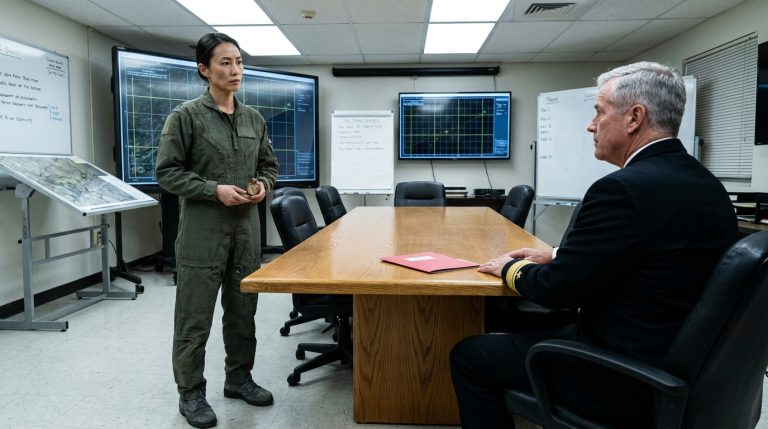
He blinked, and the image snapped back to the stark reality of polished tile and flickering fluorescent lights. Major Thomas Beckett was there, cutting through the dense, restless crowd like a ship’s prow through heavy water. He didn’t look like an airport security guard; he moved with the effortless, contained power of a man who commanded the very ground he walked on.
“Colonel,” Beckett said, his voice clipped and resonant, reaching Carter just as the supervisor, Miller, was hitting the final key to engage the server lockdown.
“Major,” Carter replied, his posture shifting, his body language signaling that the tactical advantage had finally pivoted.
The supervisor, Miller, recoiled, his hand frozen over the keyboard. He looked at Beckett, then back at the door to the back office. The shadow behind the frosted glass suddenly vanished, retreating further into the darkened confines of the administrative hub. The power shift was palpable; the corporate hierarchy, which had felt like an insurmountable monolith just moments before, was now looking fractured and small.
Beckett didn’t waste time on pleasantries. He took in the scene with a quick, predatory scan: the phones still held aloft, the silent, watching crowd, and the terminal’s internal systems still flickering in a state of controlled chaos. “The Department of the Army is aware of the situation, Colonel. We have the transport redirected. We’re not here for the airline’s ‘regrettable misunderstanding.’ We’re here to secure the manifest.”
The Major’s eyes flicked to Miller, who was now visibly trembling. “Mr. Miller, I believe you have something that doesn’t belong to your employer.”
Miller reached for the terminal, his fingers dancing over the keys to finalize the encryption of the log. “It’s… it’s locked, sir. The override is active. All the data, the automated task scheduler logs, the cargo priority mandates—it’s all isolated in this drive.” He pulled a sleek, ruggedized flash drive from the terminal port and held it out, his hand shaking.
Before Beckett could take it, the back office door swung open with a sharp, aggressive thwack. A man in a tailored, charcoal-grey suit stepped out, his face a portrait of controlled, expensive fury. This was the regional director, a man whose presence usually signaled a swift, decisive end to any airport conflict. But he wasn’t looking at Carter. He was looking at the flash drive in Miller’s hand.
“That drive is company property,” the director said, his voice smooth, professional, and entirely hollow. “Mr. Miller, you are in direct violation of your employment contract. You are instructed to relinquish that device immediately, or you will be held personally and criminally liable for the theft of proprietary software.”
The terminal fell into a silence so absolute it felt heavy. The crowd, the phones, the Marine, the Major—all of it froze. The director was playing the only card he had left: the threat of absolute, crushing corporate authority.
Beckett didn’t move toward the man. He stood his ground, his eyes narrowing. “Proprietary software, Director?” he said, his voice dripping with a dangerous, quiet iron. “You seem to be under the impression that you have the right to curate the passage of fallen American soldiers. I suggest you reconsider the implications of that claim before we involve federal oversight.”
The director laughed, a cold, dry sound that lacked any real humor. “Federal oversight? This is a private logistics network, Major. We operate under commercial regulations. The Colonel and his ‘cargo’ are subject to our service guidelines, which you have just interfered with.”
Carter stepped forward, the sound of his shoes echoing like gunfire. He didn’t look at the director. He looked at the Marine, then at the young woman with the camera. He felt the weight of the moment—the friction, the heat, the absolute refusal to be diminished by a man in a suit who viewed the world through an Excel spreadsheet.
“The director is right about one thing,” Carter said, his voice rising, clear and steady, reaching every corner of the lobby. “This is a private company. But there is nothing private about the truth. And everyone in this room has just seen exactly how much this company values the men and women who provide them with the very freedom they use to operate.”
He turned to the director, his eyes locking onto the man’s carefully groomed, arrogant face. “The override is done. The logs are secured. And the world isn’t watching a commercial dispute. They’re watching a reckoning.”
The director’s mask slipped. A flicker of genuine panic passed over his features—the realization that his leverage was not just failing, but actively working against him. The terminal erupted into a renewed, higher-pitched roar of voices, and for the first time, Carter could see the cracks in the entire structure. The escalation was peaking; the failure of the corporate logic was total, and the truth was now just a few keystrokes away from being laid bare.
CHAPTER 7: THE SYSTEMIC COLLAPSE
The regional director’s hands were shaking—a rhythmic, involuntary tremors that betrayed the absolute collapse of his authority. The room was not merely quiet; it was expectant, suspended in a state of high-voltage anticipation. Every phone in the terminal was pointed like a weapon, the screens glowing with the reflected light of the broken gate displays.
“You don’t understand the liability,” the director stammered, his eyes darting toward the Major. “If that drive leaves this facility, if that data hits a public server, the entire logistical foundation of this airline… the automated efficiency protocols… they will be audited. Every decision, every delay, every cost-saving override—it will be laid bare.”
“That is precisely the point,” Major Beckett said. His voice didn’t rise; it sharpened. He took one measured step toward the director, his boots clicking with the same tactical finality as Carter’s. “You have treated human service as a margin-error for too long. Your ‘efficiency protocols’ have become an institutional failure. This is no longer a civil dispute. This is a federal inquiry.”
Carter watched the director’s face. The man’s eyes were frantic, searching for an exit, for a lie, for any piece of leverage that still held weight. But the leverage was gone. The crowd was a wall, the technology had been locked down, and the military authority had moved from being a bystander to being the adjudicator.
“I have done my job,” the director hissed, though the conviction had bled out of his tone, leaving only a hollow, pathetic defensiveness. “I have followed the corporate directive.”
“And that is exactly what will be your undoing,” Carter said. He moved closer, towering over the director, his shadow casting a long, dark line across the polished floor. “You call it a directive. The rest of the world calls it a moral atrocity. And the difference between those two things is the reason you are standing there, exposed.”
A sudden, jarring electronic pulse shrieked through the terminal—a feedback loop triggered by the sheer volume of data being streamed from the crowd’s devices. The gate screens flickered, turning a blinding, stark white, then displaying a scrolling list of internal corporate memos. It was a digital suicide note. Miller had triggered the override, and now, the contents of the cargo-priority mandate were broadcasting to every screen in the airport.
The director looked up, his face drained of all color as he saw his own company’s internal logic being displayed for thousands to read. Priority 4: Strategic Logistics Override – Minimize handling costs for non-revenue, low-tier cargo, including remains transport, to ensure operational throughput.
The words were cold, sterile, and damning.
“Look at that,” the Marine’s voice carried over the murmurs, harsh and unforgiving. “Non-revenue. That’s what they call our brothers. That’s what they call our heroes.”
The terminal erupted. It wasn’t a riot, but a surge of visceral, righteous indignation. People were stepping forward, their voices combining into a single, overwhelming sound of condemnation. The director scrambled back, hitting the gate desk, his composure entirely disintegrated. He reached for his phone, but his fingers were so numb he couldn’t even unlock the screen.
Carter looked past the director, through the transparent glass of the gate area, and toward the tarmac. He could see the flash of lights from the military transport that had arrived—a sleek, quiet, and powerful vessel that stood in stark contrast to the chaotic, commercial mess of the terminal. His duty was shifting. He was no longer just a soldier in a lobby; he was the shepherd for a fallen comrade, and the path ahead was finally clear.
“Major,” Carter said, his gaze never leaving the director’s terrified, hollow eyes. “Secure the data. Secure the transport.”
“It’s done, Colonel,” Beckett replied, his voice firm. He signaled to the team of security personnel moving in from the terminal’s main entrance—not airport security, but military police.
As the MPs moved in to cordon off the gate area, Carter took a deep breath, the air tasting of static and cold metal. He had forced the machine to look at itself, and in doing so, he had stripped away the lies that kept the system running. He looked at the reflection of himself in the darkened office glass—a man who had been pushed to the edge, a man who had stood his ground, and a man who had finally, unequivocally, completed his mission.
The director was being led away, his suit disheveled, his face a mask of defeat. But the victory felt sharp, cutting, and heavy. He turned toward the exit, ready to leave the terminal, ready to finish the job he had started at the tarmac. The truth had been revealed, the cost had been paid, and the long journey home was finally, mercifully, beginning.
CHAPTER 8: THE FINAL CATHARSIS
The tarmac was cold, a stark, flat expanse of asphalt that stretched into the night. The silence here was different from the terminal—it was heavy, grounded, and thick with the weight of the mission. Colonel Carter walked with the slow, deliberate gait of a man who had carried a mountain and was finally, carefully, setting it down. Major Beckett walked beside him, his presence a steady, muted support.
“The Director was detained by federal agents as he reached his vehicle,” Beckett said, his voice low. “The board of directors is already scrambling. They’re claiming the ‘automated mandate’ was a software error, but with the data Miller provided, the investigation will be long and thorough. They’ve lost control of the narrative, Colonel. They’ve lost the board’s support.”
Carter didn’t respond immediately. He watched the ground crew working near the transport—a group of men and women who moved with a quiet, synchronized efficiency that was the polar opposite of the chaotic, automated indifference he had just left behind. They weren’t optimizing for revenue; they were preparing for a transfer of honor.
“It wasn’t a software error,” Carter said, his voice steady, carrying into the cool night air. “It was a choice. A choice made at every level of that corporation to value their bottom line over the dignity of those who served. The system didn’t fail. It worked exactly as they programmed it to.”
They reached the side of the transport. The loading ramp was down, the interior glowing with a soft, warm light that stood in sharp relief against the dark runway. Two honor guards stood at the base of the ramp, their posture stiff, their faces unreadable.
Carter stopped and looked up at the flag-draped casket being carefully moved into the hold. The sight of it—the simple, stark reality of the flag—brought a wave of quiet, profound relief to his chest. He reached into his pocket and pulled out a small, metallic rank pin—the one he had been fiddling with in his palm throughout the long hours at the gate. It was a simple object, damaged in the transit, its surface scratched and dulled.
He didn’t just tuck it away. He stood for a moment, his fingers tracing the edge of the pin, a small, symbolic repair of his own internal composure. He had held onto this physical tension, this symbol of the conflict, and now, he was ready to let it go. He placed the pin securely in his pocket, a silent acknowledgment of the struggle, and turned his focus entirely to the task at hand.
The loading process was slow, rhythmic, and perfectly, humanly respectful. There was no ‘efficiency’ here, only the measured pace of duty.
“Private First Class Jason Reynolds,” Carter said, his voice barely a whisper, yet firm, directed toward the soldiers as they finished securing the load. “Welcome home.”
He spent the next thirty minutes on the flight deck, overseeing the final logistics, not as a commander, but as a witness to the completion of his pledge. The transition was total. He watched as the cargo bay doors hissed shut—a sound of finality that felt like a closing chapter.
Back on the tarmac, the Major signaled that the ground staff was ready. Carter stepped back, his duty effectively transitioning from the struggle of the terminal to the quiet dignity of the return.
“You did the right thing,” Beckett said, standing beside him as the transport’s engines began to whine, a low, pulsing vibration that grew until it seemed to inhabit the very air. “You didn’t just get him home, David. You changed the way they’re going to have to treat every soldier from here on out.”
Carter shook his head slowly. He watched the aircraft begin to taxi, the lights along the runway flashing in a steady, rhythmic pulse that guided it into the dark. “I didn’t do this for the system. I did it for the promise. Every soldier who didn’t come home—every one of them deserves to be treated with this same respect. That’s the only thing that matters.”
He felt a deep, settled peace. The terminal’s fury was gone, the corporate board’s panic was a world away, and the memory of the cold ridge line in Khost no longer felt like a ghost, but like a shared history. He walked back toward the military vehicle waiting at the edge of the tarmac, his movements fluid, his mind quiet.
The night air was crisp, and as the transport lifted off, its lights becoming a tiny, determined star against the horizon, Carter felt the weight in his chest finally disperse. He had stood his ground. He had forced the truth into the light. And now, he was finally ready to go home.