The Echo of the Phantom: A Quiet Redemption Found Within the Warmth of a Broken World
CHAPTER 1: THE AMBER GLOW
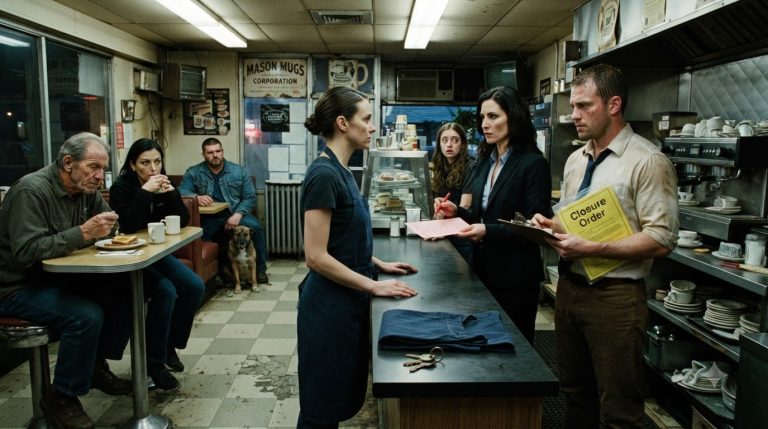
The fluorescent beer signs cast an amber glow across the corner of Sullivan’s bar, a sickly, artificial light that made the dust motes dance like dying stars around the rim of Marcus’s coffee mug. His fingers, calloused and mapped with the fine white lines of a thousand scars, remained locked around the ceramic. The liquid inside had long ago surrendered its steam, turning into a bitter, dark pool that mirrored his own stagnation.
Around him, the Friday night crowd was a blur of motion and sound—the sharp clatter of glasses, the aggressive joy of the young and unburdened, the heavy bass thrumming through the floorboards. Marcus was a seam in the fabric of the room, a place where the edges didn’t quite meet. His hair, a gray-streaked curtain, hung low, shielding him from the world, while his beard held the remnants of a life spent avoiding mirrors.
Then, the rhythm of the room shifted. A heavy, rhythmic thud-thud-thud of combat boots approached.
“Hey, old man.”
The voice was thin, reeking of the kind of desperation that only comes from someone trying too hard to be seen. Marcus didn’t turn. He focused on the reflection of the jukebox in his coffee, watching the shifting lights of the machine—red, green, neon blue. He knew the type. Blake. The kid with the Marine Corps tattoo and the ego that looked like it would snap under the slightest pressure.
“You planning on ordering something, or you just here to stink up the place?”
Marcus felt the heat of Blake’s proximity, a sharp contrast to the chill that lived permanently in his own marrow. He breathed in, slow and steady—a rhythm that had kept him alive in places where air was a luxury. One, two, three. Hold. He wouldn’t bite. He wouldn’t break. Responding only gave the bully the oxygen he craved.
“I’m talking to you, homeless guy. You deaf or just stupid?”
A movement at the bar caught Marcus’s peripheral vision. Tom Sullivan, the owner, was moving—his gait uneven, a reminder of the Gulf War he still carried in his leg. Tom was the only one who didn’t look at Marcus with pity. He looked at him with recognition.
“Blake, leave him alone,” Tom said, his voice a low gravel. “He’s not bothering anyone. I gave him that coffee.”
Blake spun around, his jaw working with performative indignation. The room had gone quiet now. The chatter of the young SEALs at the back table faded, their curiosity piqued by the sudden tension.
“Yeah, and that’s the problem, Tom,” Blake crowed, arms wide, playing to the room. “Look at him. Wearing a surplus jacket he probably fished out of a dumpster. Sitting in a military bar like he belongs here. It’s disrespectful to actual veterans.”
Marcus felt the ghost of a shiver crawl down his spine—not from fear, but from the raw, abrasive friction of the word veteran used as a weapon. He looked down at his hands. Beneath the table, his fingers curled into a fist, the knuckles white. He was back in the dust. The smell of burning rubber and ozone filled his senses.
He didn’t need to look up to know the exact moment the door opened. The November wind gusted in, cold and sharp, bringing the scent of rain and diesel. A new presence entered the room, the air pressure changing as the man moved with a precision that silenced the bar completely.
Then, the air in front of his booth turned frigid. Marcus looked up, the scar across his temple catching the amber light. He looked directly into the eyes of a man who was seeing not a beggar, but a ghost.
“Phantom?” the stranger whispered, his voice cracking like dry wood.
The sound of his old call sign hit Marcus like a physical blow. He froze. Every defensive wall he had built over nine years—the silence, the dirt, the invisibility—cracked down the middle. For the first time in nearly a decade, the world didn’t look like a series of threats. It looked like a trap.
And for the first time, he realized the trap wasn’t the bar. It was the memory he had been running from.
CHAPTER 2: THE GHOSTS THRESHOLD
The silence in the bar was thick, pressurized, the kind of stillness that usually preceded a mortar strike. Marcus felt the air vibrate against his skin, the fine hairs on his arms rising. Patterson was still leaning over the table, his face illuminated by the amber beer signs, the mask of the professional commander slipping away to reveal the raw, unpolished grief beneath.
“Phantom,” Patterson said again. It wasn’t a question anymore. It was an anchor.
Marcus blinked. The name felt like a heavy, rusted shackle, something he had buried deep in the mud of a thousand different nights, only for it to be dredged up and placed back onto his wrists. He looked at Patterson, really looked at him, and saw the lines etched into the corners of the man’s eyes—a record of nineteen years of service, of missions that burned the soul, of the same ghosts that haunted Marcus’s own dreams.
“Patterson,” Marcus replied. His voice felt alien, a grating, unlubricated sound after hours of silence. He didn’t use the call sign. To use it felt like an admission of a life he had already buried.
“Hawk,” Patterson corrected, his voice tight. “You taught me how to read a topographic map in the dark, Marcus. You taught me that you never, ever leave a man in the grid. And here I am, looking at you, wondering how the hell I let you vanish.”
Marcus looked away. His gaze drifted to the jukebox, where the neon flickered, casting rhythmic, pulsing shadows across the floorboards. V-2: The memory hit him with the force of a physical impact—the high-pitched whine of the tactical radio in Ramadi. He could smell the ozone and the burning plastic of the radio casing, the sound of his team’s laughter cut short by the sudden, sickening pop of small-arms fire. He wasn’t in the bar anymore; he was huddled in the dark, clutching that broken plastic brick, listening to the silence expand as one by one, the voices on the other end went dark.
“I didn’t vanish,” Marcus said, his voice barely audible over the hum of the cooling units behind the bar. “I was left behind.”
“By who?” Patterson stepped closer, his shadow falling over the table. “We searched. We scoured every building, every alleyway. The command said the building was structural collapse, that there was nothing left to retrieve. They told us you were gone.”
“They told you what they wanted to keep their files clean,” Marcus muttered. He finally met Patterson’s gaze. There was no defiance in it, only the profound, bone-deep exhaustion of a man who had stopped trying to justify his own existence. “I didn’t want to be retrieved. I wanted the noise to stop.”
Tom Sullivan moved in then, a silent, stabilizing presence. He didn’t speak; he just set a fresh coaster down on the scarred wood of the table. He knew the geography of a man’s silence better than anyone. He knew that for Marcus, this wasn’t a reunion—it was an intrusion.
“He’s been here for three months, Hawk,” Tom said softly, his eyes flicking toward the corner where Blake had been standing just moments before. “He didn’t ask for a hero’s welcome. He didn’t ask for anything. He’s been existing in the margins.”
Patterson stood up, his movements stiff. He looked around the bar at the young SEALs, at the tension still lingering in the rafters, at the way the room had become a tomb for the secrets he thought were long buried. He wasn’t going to let this go. The structure of the room, the scent of stale beer and old wood, the presence of the man he once considered his mentor—it was all shifting.
“You’re not staying here,” Patterson said, his tone shifting into the authoritative, non-negotiable cadence of a command. “The VA has a program, and I have the clearance to pull strings that haven’t been touched in a decade. We are not doing this here, in the middle of a Friday night crowd.”
Marcus felt the panic rising, a cold, sharp blade pressing against his ribs. He looked at his hands, those calloused, trembling tools of a life he didn’t know how to live anymore. He wanted to run. He wanted to find a bridge, a dark alley, a place where no one knew his name, his rank, or the sound of the silence he carried.
But then, he looked at Tom. He saw the genuine, quiet concern in the older veteran’s face. He looked at the young seals, their eyes wide with a mixture of reverence and confusion. They were waiting. They were waiting for him to confirm the legend, or to shatter it.
“I need to breathe,” Marcus said, standing up. His joints ached with a deep, systemic fatigue. He didn’t ask for permission. He didn’t offer an explanation. He just moved.
He walked past Patterson, past the bar, his boots feeling heavy against the worn wooden floor. He reached the door, the cold November air biting at his exposed skin, and stepped out into the night. He didn’t stop. He walked into the darkness, the neon lights of the street painting the puddles on the sidewalk with long, distorted streaks of amber and blue. He felt the weight of the past following him, a shadow that had finally caught up. He realized, with a sense of dread that tasted like ash, that he could no longer outrun the truth of his own name. He had to go back in, or he had to finally let go of the ghost he had been feeding for nine years.
CHAPTER 3: THE WEIGHT OF THE BADGE
The rain began as a thin, silver mist, clinging to the neon signs of the city like a second skin. It felt familiar, a sharp, cleansing bite that lacked the dust of Iraq, yet the sensation triggered the same neural pathways. Marcus stood under the awning of a closed deli, the yellow light of the storefront buzzing rhythmically, mirroring the erratic heartbeat he had fought to control for nearly a decade.
Behind him, the door to Sullivan’s bar opened, casting a trapezoid of warm, amber light onto the slick pavement. Patterson stepped out, his silhouette framed by the haze of smoke and the muffled roar of the crowd inside. He didn’t rush. He moved with the measured, deliberate gait of a man who knew exactly how to track prey, or in this case, a man who refused to be lost.
“You’re not going anywhere, Marcus,” Patterson said, his voice stripped of the command-grade steel it held inside. He reached the awning and leaned against the brick, his own shoulders slumping just an inch. “I’m not here to drag you back into the service. I’m here because you left a piece of yourself under the Roosevelt Bridge, and I think you’re tired of carrying the rest of it alone.”
Marcus stared at the street. V-4: A group of people walked by, their laughter echoing against the brickwork, and for a fleeting, sickening second, Marcus saw the silhouettes of his team—not as they were in the photo, but as they were in the final, desperate moments of the ambush. The rain turned into the red haze of tracer fire. He gripped the edge of the brickwork, his nails biting into the mortar, until the vision dissolved back into the dull, mundane reality of the street.
“You don’t know what I carry,” Marcus said, his voice rough. He looked at his hands, open and empty in the dim light. “The badge, the patch, the rank—they’re just metal and cloth. They don’t weigh anything compared to the silence of that radio.”
“The radio,” Patterson echoed. He reached into his leather jacket and pulled out a pack of cigarettes, offering one to Marcus. Marcus declined with a slow shake of his head. Patterson lit his own, the cherry glow illuminating his tired, weather-beaten face. “You think you’re the only one who listened to that static? Every night for eighteen years, I’ve heard it, too. We all did. The ones who weren’t there, the ones who were in the operations center, the ones who had to sign the redacted reports. You weren’t the only one left in that building, Phantom. You were just the only one who didn’t come out.”
The words landed with the weight of cold iron. Marcus felt the air catch in his throat. He had spent nine years believing that his survival was a solitary crime—a singular act of cowardice that he had to punish by erasing himself from the map of the living. To hear that the guilt was shared, that the static had been vibrating in other rooms, in other lives, felt like a structural fracture in his reality.
“I need to see it,” Marcus said suddenly, the words surfacing from a place he hadn’t visited since he walked away from his life.
“See what?”
“The records. Not the sanitized ones. Not the ones the families got. I want to see the original logs from the Red Shadow operation. If I’m going to stay in this room, if I’m going to accept your help, I need to know why I’m still here.”
Patterson went still. The smoke from his cigarette curled into the damp air, a thin, gray wisp of uncertainty. “That’s a hard door to open, Marcus. Those files aren’t just classified; they’re effectively nonexistent in the standard archive. You’re asking to stir up the kind of dust that settles on careers, even mine.”
“I’m already living in the dust,” Marcus replied, turning to look at him. His eyes, pale and piercing, seemed to cut through the rain. “If you want me to be real again, Hawk, you have to show me the truth of how I stopped being one.”
Patterson held his gaze for a long moment. The street was quiet now, the city holding its breath in the cold November night. The dynamic between them had shifted—the mentor and the student had traded places, and the weight of the request hung between them like a physical wall.
“Monday,” Patterson said finally, crushing his cigarette under his boot. “I can’t get it all, but I can get the tactical logs. There’s a man at the archives who still remembers what we did in Fallujah. He’ll talk, if I’m the one asking.”
“And the team?” Marcus asked, his voice low, his heart hammering against his ribs. “Is there anything left of them? Anything at all?”
Patterson looked away, out toward the dark, swirling water of the bay. “The Navy kept the personal effects. They’ve been sitting in a storage facility in North Island for years. Waiting for next of kin who never claimed them because the families were told the bodies were never recovered.”
Marcus felt a coldness bloom in his chest, one that had nothing to do with the wind. The realization was a slow-motion impact: nine years of hiding, nine years of living under a bridge, and all that time, the evidence of his team’s existence—their watches, their letters, the small, tangible artifacts of their lives—had been sitting in a sterile metal box, waiting for a ghost to claim them.
“I’ll go,” Marcus said.
He didn’t wait for Patterson’s response. He stepped out from under the awning and into the rain, his movements fluid, the hesitation of the last nine years falling away with every step he took. The road ahead wasn’t clear—it was, in fact, terrifying—but for the first time, he wasn’t walking away from the noise. He was walking toward the center of it, ready to find out if the scale could ever truly be balanced.
CHAPTER 4: THE UNMASKING
The interior of the storage facility smelled of ozone and long-stagnant air, a dry, sterile scent that stood in stark contrast to the damp, rain-slicked city Marcus had left behind. James Patterson moved with a familiarity that suggested he had been here before, though his posture remained rigid. He carried a heavy key ring that jingled with a sharp, dissonant sound against the concrete floor.
“Row thirty-four, locker nine,” Patterson murmured, his voice bouncing off the high, metallic ceiling.
Marcus followed him, his boots clicking in a cadence that felt almost like a heartbeat. He didn’t speak. Every step felt like he was walking further into a trap he had constructed for himself. He watched the back of Patterson’s neck, the slight tension in the corded muscles there, and wondered if the commander knew that he was about to provide the fuel for a fire that would either forge Marcus anew or consume him completely.
They stopped. Patterson fitted a heavy, iron key into the padlock of a reinforced unit. With a twist, the lock clicked open—a sound that felt like the final hammer blow in a long, drawn-out trial. The door creaked upward, releasing a puff of dust that caught the harsh overhead fluorescent light.
“It’s all here,” Patterson said, stepping aside.
Marcus peered into the locker. It was filled with standard-issue plastic bins, each marked with a fading label. The one at the top bore a name he hadn’t seen since the morning he walked away from his life. He reached out, his hand shaking, and pulled the bin toward him. It was lighter than he expected.
He didn’t open the lid immediately. He looked at the tactical radio sitting in the corner of the bin—the very radio he had clung to for nine years, the one he had tried to fix until his fingers bled. He picked it up. It felt different here, away from the grime of the street. It felt small. Dead.
“Open the log, Marcus,” Patterson urged softly.
Marcus set the radio down and lifted the lid of the second bin. Inside sat a heavy, binder-clipped file—the original mission records from Operation Red Shadow. As he flipped through the pages, the first thing he noticed was the discrepancy. V-1: The discrepancy struck him like a blow to the solar plexus. The operational logs listed the extraction timeline as twelve hours earlier than he remembered. He stared at the handwritten notes in the margins—notes in a script he didn’t recognize, detailing a shift in the perimeter that shouldn’t have been possible given the radio silence he had endured.
“This isn’t right,” Marcus whispered. He traced a line of text with his finger, his pulse quickening. “These logs show an extraction window that was closed by the time I was even at the rally point. And these signatures… these aren’t the command logs I saw.”
“What are you saying?” Patterson moved closer, his brow furrowing as he looked at the documents.
“I’m saying the ambush wasn’t just a failure,” Marcus said, his voice rising, the cool, detached exterior beginning to crack. “It was a diversion. Someone was drawing fire away from the primary objective, and they used my team to do it.”
The silence that followed was absolute. Patterson went deathly pale. He reached for the file, his fingers hovering over the signature of the officer who had authorized the mission. “This is impossible,” Patterson breathed. “This level of redaction, this kind of operational override… it requires a level of clearance that wasn’t even active in our sector.”
Marcus looked at the radio again, then back at the file. The guilt that had been his constant companion—the crushing, singular weight of his own failure—began to shift. It didn’t disappear, but it transformed into something sharper, more dangerous: fury. He hadn’t just been the last man standing in a tragedy; he had been the pawn in a calculation.
“You said you had a contact,” Marcus said, his voice a low, dangerous growl. “You said someone here still remembers what happened in Fallujah.”
Patterson nodded, his jaw set. “Old Man Miller. He was the archive sergeant during the shadow operations. If these signatures are forged or improperly authorized, he’ll know.”
“Then let’s find him,” Marcus said. He stuffed the file into his jacket, his movements becoming precise, calculated—the movements of a man who no longer had the luxury of being a ghost. “If they erased my team, they’re going to have to answer to me.”
He stepped out of the storage locker, his eyes fixed on the long, dark corridor ahead. The vulnerability he had felt in the bar was gone, replaced by the cold, tactical clarity of the Phantom. He wasn’t just looking for peace anymore; he was looking for the truth, and he was no longer afraid of the cost.
CHAPTER 5: THE WALL OF NAMES
The transit to the archives felt like stepping backward into a different era. The facility was subterranean, a labyrinth of concrete tunnels and hum-filled server rooms that felt disconnected from the rain-lashed world above. Marcus walked with a measured, predatory silence, his hand instinctively checking the inside lining of his jacket where the file from the locker was tucked. Every shadow seemed to hold the potential for resistance, a remnant of the instinctual vigilance he had practiced for nearly a decade.
“Miller is in the back,” Patterson whispered, his voice sounding thin in the pressurized silence. He led Marcus toward a reinforced door tucked away at the end of a corridor labeled ‘DECOMMISSIONED RECORDS.’ “He’s a ghost, just like you, Marcus. He hasn’t left this level in five years. If he tells you the authorization signatures were forged, it means the breach goes all the way to the top.”
Marcus stopped before the door. V-3: As Patterson reached to knock, a sudden, sharp sound—the rhythmic, wet thud of an emergency buzzer—echoed down the hall. A medical cart careened around the corner, pushed by two frantic techs. Miller had collapsed. The door to the archive was propped open, and for a split second, Marcus saw the state of the room: it wasn’t a library; it was a sanctuary of shredded documents, a place where history had been intentionally ground into pulp.
“Miller!” Patterson surged forward, abandoning his caution.
Marcus stepped into the room, his eyes scanning the chaos. He didn’t rush to help the fallen man; he moved to the desk where the last open logbook sat. His hands, scarred and steady, sifted through the papers. He found it. A signature—not forged, but authentic. And beneath it, a footnote in Miller’s own shaky, urgent handwriting: Operation Red Shadow was not a combat loss. It was a planned liquidation to balance the books.
The world tilted. The air in the room felt suddenly thin, drained of all oxygen. The guilt—the nine-year-old, marrow-deep shame—wasn’t just misplaced; it was a manufactured product of a betrayal that had nothing to do with Marcus’s skill as an operator. He had been a scapegoat, designed to carry the weight of a policy failure so profound it required the total erasure of his entire unit.
“Marcus, leave it,” Patterson’s voice drifted in from the hallway, strained and distant.
But Marcus couldn’t leave it. He saw the evidence—not just of his team’s death, but of their honor. They hadn’t died in a tactical error; they had stood their ground against an impossible, premeditated removal. He stood up, the file in his hand, his eyes locking onto the blank, concrete wall opposite the desk. He felt the cold iron of the truth settling into his gut, not as a burden, but as a weapon.
He turned toward the door just as Patterson returned, his face ashen. “He’s alive, but he’s not talking to anyone today. Marcus, what did you find?”
Marcus held out the logbook. He didn’t speak. He didn’t need to. The raw shock on Patterson’s face as he read the footnote confirmed everything. The commander slumped against the doorframe, the weight of the revelation visibly crushing his posture.
“They killed them to hide the budget,” Patterson whispered, his voice trembling. “They erased six of the best men I ever knew to save a political seat.”
Marcus looked at the exit, then back at the desk. The archive was a graveyard of broken lives, but among the wreckage, he had found the key to the final gate. He wasn’t the broken man who had sat in the corner of Sullivan’s bar three months ago. He was the Phantom, and he had finally located the specters that had haunted him for nine years.
“We aren’t done, Hawk,” Marcus said, his voice flat, devoid of the hesitation that had defined his existence since the bridge. “There’s a memorial ceremony in three days. The wall is there. The names are there. And now, I know what really happened.”
He pushed past Patterson and walked back toward the tunnel. The path ahead was jagged, demanding, and utterly clear. He was going to stand in front of that wall, not as a ghost, but as the man who held the secret of their final act.
CHAPTER 6: THE FINAL POUR
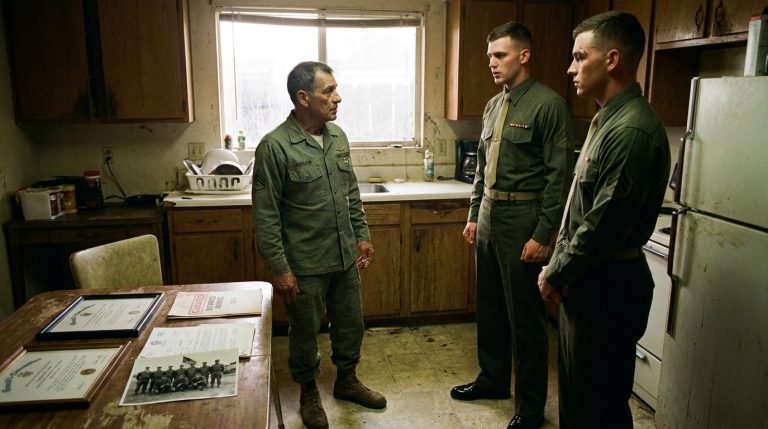
The morning of the memorial ceremony arrived with the quiet, muted grace of a city still waking from a long rain. The air at the Naval Base was cool, holding the faint, metallic scent of the ocean. Marcus walked onto the grounds with Patterson by his side, his steps rhythmic and deliberate. In his jacket pocket, the logbook felt less like a dangerous document and more like a testament—a record of a debt that was finally being settled.
They approached the granite wall, a cold, dark expanse etched with thousands of names. It was a place where silence was the only appropriate language. Marcus stopped three paces away, his gaze tracking the rows of letters until it landed on the specific cluster he had memorized in the dark of his own mind for nearly a decade.
“They’re not just names,” Patterson said, his voice hushed, the reverence in his tone reflecting the heavy atmosphere of the base. “They were brothers. And now, they’re finally going to be remembered for who they were, not just as collateral in a redacted report.”
Marcus reached out. His fingers hovered over the granite, cool and polished under his touch. He didn’t feel the phantom heat of the ambush anymore. Instead, he felt the resonance of the men who had stood beside him, who had chosen to hold the line even when the command had already signed their death warrants to save their own records. It wasn’t a tragedy of his making; it was a sacrifice of their choosing.
He pulled the logbook from his pocket and laid it against the base of the wall.
“You were there,” Marcus whispered, the words drifting into the quiet. “And you didn’t die for a budget. You died because you held the line.”
He didn’t look for applause, or for the brass who had authorized the betrayal, or for the justification that would never come. He only needed the wall to know. He stood there for a long time, the weight of the last nine years dissolving into the cool morning air. He thought of the forty-seven marines he had guided to safety—they were his legacy, not the ashes of Ramadi. He thought of Rosa, of Kenny, of the young veterans who had found their way into Sullivan’s bar looking for a sign that survival was possible.
Patterson stepped forward and placed a hand on Marcus’s shoulder. It wasn’t the grip of a commander, but the touch of a peer. “The board is convening in an hour. We have the logs. We have Miller’s testimony. They won’t be able to bury this again.”
“I don’t care about the board,” Marcus said, turning away from the wall. He felt a sudden, profound lightness, as if he had finally unspooled the last of the tight, protective wire he had wrapped around his own heart. “I care that they know.”
They walked back toward the gate in silence. The facility looked different in the daylight—not as a trap, but as a place where the truth had been stored, waiting for someone to be brave enough to look at it.
The following Friday, the lights at Sullivan’s bar were dimmed, the amber glow warm and inviting. The crowd was thinner than usual, a collection of regulars who knew the rhythm of the place. Marcus stood behind the bar, his hands busy with a glass, his movements fluid and at peace. He wasn’t the ghost of the bridge anymore. He was Marcus.
He reached down to the counter and picked up a small, chipped ceramic mug—the same one he had clutched on that first night—and placed it gently on the shelf behind the bar. It was a relic, a tool he no longer required. Beside it, he placed the small, weathered photograph of his team, the one he had carried in his pack through every cold night and desperate, lonely year.
Tom Sullivan approached, a soft smile touching his face. He didn’t say a word, just set a fresh, steaming cup of coffee on the wood in front of Marcus.
“You’re a good man, Marcus,” Tom said, his eyes conveying the weight of the journey they had all witnessed. “The bar’s better for having you.”
Marcus nodded, the simple, honest gesture of a man who had finally earned his place in the world. He took the coffee, the heat radiating through his palms, and turned to watch the door. A young, shell-shocked veteran stumbled in, his eyes darting, his posture hunched—the same posture Marcus had carried for so long.
Marcus stepped around the counter, his gait steady. He didn’t rush. He walked with the quiet, unhurried grace of someone who knew exactly how to reach out, and how to pull someone back from the edge. He arrived at the young man’s side, and as he spoke, his voice was the calm, anchoring presence the room had been waiting for all along.
The cycle of survival had ended, and the work of living had finally, quietly, begun.