A Veteran’s Silent War: The Meticulous Unraveling of a Son’s Calculated Greed and Moral Betrayal
CHAPTER 1: THE TARMAC DIVIDE
The Fayetteville heat shimmered off the runway, distorting the world into a series of wavy, unstable lines, much like the promise Harry had made three years ago. I stood by the curb, a seventy-four-year-old ghost with a duffel bag and fifty dollars in my pocket. My son, Harry, and his wife, Lisa, were already back inside the air-conditioned cabin of their BMW. The engine hummed with a smooth, expensive rhythm that felt like a mockery of my own shaking pulse.
They hadn’t even looked back. The last thing I heard was Lisa’s high-pitched, melodic laugh—a sound that usually accompanied their plans to renovate my house with my own money. They thought they were dumping garbage. They didn’t know they were abandoning an asset that had been recording their every mistake for thirty-six months.
I adjusted the strap of my bag, feeling the weight of the digital recorder in my inner pocket. It was a small, cold comfort. The air was thick, heavy with the moisture of North Carolina, but I felt only the chill of the mission. My PTSD medication, the sertraline and prazosin, sat in their designated slots in the blue plastic organizer in my bag. I didn’t need them today. Today, the adrenaline was a cleaner fuel.
Harry thought he’d won. He had the power of attorney, the forged property papers, and a collection of staged videos of my bad days. He’d played the devoted son so well he almost believed it himself. But a Marine doesn’t just fold when the terrain gets difficult; a Marine assesses the kill zone and waits for the enemy to expose their flank.
I watched their car merge onto the highway, a black smear against the horizon. They were heading to my house—the one I’d bought with the blood-money of three Purple Hearts—to begin the final phase of their takeover. They believed my age was my weakness, that the tremors in my hands were the beginning of a total mental collapse.
They were wrong. Every time Harry had rolled his eyes, every time Lisa had “accidentally” deleted an important email, I had been documenting the causality. I turned away from the terminal. The asphalt felt hard and unforgiving under my boots. I didn’t look like a man who was fighting a war, but then, they never suspected the man sitting in the corner with a notebook until it was far too late to retreat.
A familiar face emerged from the crowd—a former unit brother who didn’t recognize me at first. I didn’t reach out. Not yet. I kept my eyes fixed on the path ahead. The battle hadn’t just begun; it had been unfolding for three years, and today was simply the moment the tactical situation shifted from defense to the final, inevitable push.
CHAPTER 2: THE KITCHEN INSPECTION
The house stood at the end of the cul-de-sac like a monument to a life I was no longer supposed to own. It was a solid, three-bedroom structure, built in 1987 with a pension that had tasted like sweat and damp, mildewed earth. Now, it smelled of stale air and the aggressive, synthetic lemon scent that Lisa used to mask the fact that she hadn’t cleaned the baseboards in months.
I pushed the front door open. The lock turned with a smooth, expensive click. They hadn’t changed the tumblers yet. They were too confident, too sure that I would be sitting in that airport terminal, waiting for a ride that wasn’t coming, or perhaps stumbling through the terminal in a fog of supposed senility.
I walked into the kitchen. The kitchen table, Era’s table, was the epicenter of their campaign. I pulled out the chair—the one that still squeaked on the left side—and sat. It was cold. I looked at the kitchen cabinet where the pill organizer lived. It was still there, but Harry had moved it to the center of the counter, a calculated placement. He wanted me to see it, to realize he had been cataloging my medication usage, looking for the gaps, the missed doses, the “proof” that I was losing my grip on the basics of survival.
My eyes drifted to the shadows stretching across the linoleum. They were sharp, cutting across the floor like blades. I didn’t reach for the pills. I reached for the silence. In the quiet of the house, I could hear the subtle hum of the refrigerator, a machine older than my son, still working perfectly.
The sound of a key in the front door snapped the atmosphere like a dry twig.
I didn’t move. I kept my posture rigid, shoulders squared, hands flat on the scarred wood of the table. Harry walked in first, his pace brisk, filled with the arrogant energy of a man who believes he has just finished a difficult task. Lisa followed, her iPhone already raised, the lens catching the light like a predator’s eye.
“Dad?” Harry’s voice was pitched high, dripping with a rehearsed, saccharine concern. He stopped dead in the hallway, his face twisting into a mask of feigned shock. “What are you doing here? We… we thought you were going to wait at the terminal for the shuttle.”
I looked at him. I didn’t let my gaze waver. I watched the way his throat moved as he swallowed, the slight tremor in his own fingers as he realized his plan—the abandonment, the isolation—hadn’t produced the broken, sobbing mess he’d paid for.
“I decided I preferred my own house,” I said. My voice was steady, stripped of the trembling cadence he expected.
Lisa stepped forward, the phone humming in her hand. “Sam, you’re confused. You remember we talked about this. About the transition to the new facility. It’s for your own safety.”
She was fishing for a reaction. She wanted a flinch, an outburst, a moment of disorientation that would justify the recording. I let a flash of memory hit me—a V-2 variance—the way Era used to pour tea in this exact light, the way the steam would rise in a soft, curling pillar. It was an intrusive, sharp contrast to the sterile, calculated hostility of the room. I let that warmth settle in my chest, a secret anchor, and kept my face a mask of iron.
“I’m not confused, Lisa,” I replied, my tone neutral, transactional. “I’m very clear on who owns this house.”
Harry’s eyes darted to the cabinet, then back to me. The mask of the ‘devoted son’ slipped for a fraction of a second, revealing the jagged edge of his desperation. He needed me declared incompetent by the end of the week. The bank was pressuring him about the BMW lease, and his credit cards were hovering near the limit. He didn’t have time for a slow decline; he needed a crash.
“Dad, look at yourself,” Harry said, stepping into the kitchen, his voice taking on a sharper, more aggressive edge. “You’re talking about property rights when you can’t even remember to take your medication on schedule. We have records, Dad. We have the logs.”
“Logs,” I repeated. The word tasted like rust.
“Yes, logs,” Lisa chimed in, circling to the side of the table. The phone followed my every move, a digital tether trying to record my collapse. “We’re just trying to protect you from yourself. Don’t you see that? You’re struggling, and you’re lashing out because you’re scared.”
I looked at the blue pill organizer. I knew exactly what was in it—the sertraline, the prazosin. I had been taking them for years to keep the nightmares of the rice paddies at bay, not because my mind was failing, but because I had seen things that would turn most men into hollow shells. They were weaponizing my healing.
“I’m not scared, Harry,” I said, standing up. My movement was fluid, deliberate. I saw Harry flinch—a small, involuntary recoil. He wasn’t used to me standing with this kind of presence. He was used to me hunched over, apologizing for existing. “But I think we need to talk about the mortgage applications you’ve been drafting on your laptop.”
The room went completely silent. The hum of the refrigerator seemed to swell, a low-frequency drone that filled the space between us. Harry’s face lost its practiced concern, replaced by a pale, hard mask of realization. He hadn’t expected me to know. He hadn’t expected me to be looking.
“What are you talking about?” Harry’s voice was a flat, dangerous line.
“The paperwork,” I said, my gaze locked onto his. “The ones you think are going to solve your financial situation. I think you’re going to find that the house isn’t as ‘transferable’ as you hoped.”
I turned away from them, walking toward the stairs that led to the basement. I didn’t look back to see the look on their faces—the panic, the calculation, the sudden awareness that the ‘broken’ old man was no longer playing the part. I didn’t need to see it. I could hear it in the way Harry’s breathing had become shallow and uneven.
I had planted the seed. I had let them know that the foundation of their trap was built on a lie, and that I had the leverage to bring it all down. Now, I just had to wait for them to make the next mistake. And given their greed, it wouldn’t take long.
CHAPTER 3: THE BARBECUE PERFORMANCE
The basement was a cool, concrete sanctuary, far removed from the performative humidity of Harry’s kitchen. I didn’t turn on the light. I didn’t need it. I knew every inch of this space by touch—the smooth, metal rim of the fireproof box tucked beneath the mattress, the specific texture of the concrete floor where the dampness always gathered in the corner. I sat on the edge of the cot, my breathing regulated, deep, and rhythmic.
Above me, muffled by the floorboards, I could hear the sharp, clipped sounds of their conversation. They were arguing. It was a jagged, discordant noise, the sound of a plan beginning to fray at the seams. Harry was the one pacing; I recognized the heavy, uneven thud of his heels against the kitchen tile. He was stressed. He had expected the “confused old man” to retreat into a corner, to apologize, to maybe even cry. He hadn’t expected the wall I had just erected.
I reached beneath the mattress and felt the cool, reassuring steel of the lockbox. My fingers traced the combination dial—a familiar, tactile ritual. They thought this was about the house. They thought this was about me being an obstacle to their ‘future.’ They had no concept of the logistics of war, and they certainly didn’t understand the depth of the file I was building. I didn’t open the box, though. Not yet. I just needed the reminder that it was there, a weight of evidence that rendered their entire performance a house of cards.
My phone, tucked into my shirt pocket, vibrated—a soft, pulsing buzz against my ribs. I pulled it out. A text from an unknown number: a reminder about the Johnsons’ barbecue the following afternoon. It was a trap, a social stage they had built to showcase my “decline” to the neighborhood.
I stood up. My knees were stiff, a reminder of the decades behind me, but my resolve was as sharp as the shadows in the room. I walked to the stairs and began the ascent. I had to play the part. If they wanted a “confused old man” for their audience, I would give them exactly what they were looking for, but I would play it with the cold, detached precision of a scout assessing the enemy’s strength.
The next afternoon, the neighborhood was a hive of forced congeniality. The Johnsons’ backyard was a sprawling patch of manicured grass, crowded with families and the smell of charcoal smoke—a scent that, for a split second, brought the ghost of a humid, burning jungle to the back of my throat. I suppressed the reaction. I fixed my gaze on a spot just above the horizon, keeping my face slack, my expression drifting in and out of focus.
Harry was working the crowd. He was a natural performer, his laughter bright and effortless. He leaned in close to Mrs. Johnson, his hand resting on her arm, his voice a low, melodic hum of manufactured tragedy. “It’s hard, honestly,” I heard him say, his voice perfectly modulated to be overheard. “He just… he drifts. One minute he’s fine, the next he’s gone. It’s the trauma, I think. It’s finally catching up to him.”
Lisa was at his side, her iPhone 15 Pro poised like a weapon. She was filming, capturing every moment I stood silently, staring at a cluster of hydrangeas. To anyone watching, I was a man lost in the fog of a broken mind. To me, I was a camera, recording the way they leaned in, the way they traded conspiratorial glances, the way they were effectively building a public record of my ‘incompetence.’
Tony Rodriguez, a man I knew from the local veteran network, drifted toward the edge of the circle. He was a younger man, sharp-eyed, a man who understood the difference between a shell-shocked veteran and a man waiting for a command. He looked at me, then at Harry. I saw the recognition in Tony’s eyes—the quiet, internal question. He saw the way I wasn’t flinching, the way my breathing remained steady despite the noise of the barbecue.
“Sam?” Tony said, stepping into my field of vision. “You doing okay?”
I shifted my focus, letting my eyes appear slightly glassy. “The light,” I muttered, my voice thin, tentative. “It’s… a bit much today, isn’t it, Tony?”
Harry’s head snapped toward us. His grin widened, a predatory thing. He rushed over, his arm sliding around my shoulders, possessive and firm. “Oh, sorry, Tony! I should have kept an eye on him. He gets these bouts of vertigo when the sun hits the glare. Don’t you, Pop?”
He squeezed my shoulder, a physical assertion of ownership. “Let’s get him back to the shade, Lisa. Maybe get him some water. He hasn’t been taking his medicine consistently, I’m afraid.”
Lisa clicked the recording button off, her fingers tapping a quick rhythm against the screen. “It’s okay, Harry. We’re doing our best. That’s all we can do, right?”
“Right,” Harry said, his voice dripping with false empathy. He looked at me, a flicker of irritation crossing his eyes—a fleeting shadow of the man he was beneath the suit. He thought he had me cornered, trapped in the narrative he’d spun. He didn’t see the way I was watching his hands, the way he was constantly checking the time, the way he was already calculating the money he’d save once the house was officially under his control.
I looked at the crowd. I saw the pity on their faces. I saw the way they turned away, uncomfortable with the sight of a veteran whose life had supposedly dissolved into confusion and violence. Every sympathetic nod they gave Harry was another piece of evidence. Every lie he told was another nail in his coffin.
I leaned back into the shade of a large oak tree. The bark was rough against my back—a grounding, tactile sensation. I watched the world through a thin, analytical lens, carefully noting who was watching, who was nodding, and who was actually paying attention to the cracks in the Johnsons’ backyard performance.
Harry and Lisa had laid the trap, and they were so busy admiring the bait that they hadn’t realized I was the one who had cleared the mechanism. Tomorrow, I would meet with Jimmy. Tomorrow, the social performance would end, and the strategic phase would begin in earnest. I adjusted my posture, keeping my eyes fixed on the house across the street, waiting for the sun to dip low enough to hide my thoughts in the deepening evening shadows.
CHAPTER 4: THE VFW BRIEFING
The transition from the neighbor’s backyard to the interior of the VFW Post was not merely a physical movement; it was a shift in reality. The air in the Post was thick with the scent of floor wax and old paper, a stark, metallic contrast to the cloying, fake-sweet smell of the Johnsons’ barbecue. I walked through the double doors, my gait steady, no longer mimicking the fragile, hesitant shuffle I used for Harry’s benefit.
The lobby was empty. I made my way down the hall toward the commander’s office. The floorboards groaned beneath my boots, a familiar, rhythmic sound that reminded me of years spent on bases, on ships, and in tactical command posts where every noise had a meaning. I was no longer the ‘confused old man.’ I was a Marine returning to his command, carrying a weight of evidence that would break Harry’s plan into dust.
Jimmy Miller’s door was slightly ajar. He was sitting at his desk, the desk lamp casting long, sharp shadows over a stack of legal documents. He looked up as I entered, his eyes immediately assessing my posture, the set of my jaw, the stillness in my hands. He didn’t ask how I was. He didn’t offer a platitude. He simply pushed the chair across from him out with his foot.
“I expected you an hour ago,” Jimmy said. His voice was gravelly, professional.
“I had to finish the performance,” I replied, sitting down. I reached into my inner jacket pocket and withdrew the lockbox key, placing it on the desk. The metal made a sharp, definitive sound as it hit the wood—a strike of finality.
Jimmy looked at the key, then back at me. He waited. He knew better than to prompt me. We had been in tight spots before, and he knew that when a Marine brings the evidence, he does so on his own terms.
I began to lay out the documentation. First, the VA medical records from Dr. Patricia Hayes. I fanned them out—quarterly reports, every single one signed, stamped, and verified, all detailing the same clinical reality: manageable anxiety, no cognitive decline. I watched Jimmy’s eyes skim the pages. He was a veteran of the law, a man who understood the power of a clean, clinical record.
“Harry’s using the ‘competency’ card,” I said, my voice cutting through the silence of the room. “He’s been documenting every moment I was supposedly losing my memory, trying to build a narrative of dementia. He’s got hours of footage, Jimmy. He’s going to use it in court.”
Jimmy didn’t look up. He was already pulling a yellow legal pad toward him, scribbling notes with a fountain pen. The scratch of the nib was the only sound in the room. “He’s an amateur,” Jimmy muttered, his eyes narrowing. “He thinks the camera is the reality. He doesn’t understand that the camera is just the frame, and frames can be broken.”
I reached into my pocket and produced the small, silver digital recorder. I placed it next to the medical files. “This is the rest of it. Every conversation, every threat, every mention of the inheritance, every piece of evidence of the financial abuse. Forty-seven minutes of them planning the theft of my life.”
Jimmy picked up the recorder. He didn’t press play. He handled it with the care of someone holding a detonator. “This is the nail in the coffin, Sam. If we present this to the District Attorney, the ‘competency’ narrative won’t just fall apart. It will turn into a criminal investigation against them.”
“That’s the objective,” I said.
I then pulled out the draft of the forged deed Harry had left on his laptop. Jimmy took it, his expression hardening as he scrutinized the notary stamp. He held the paper up to the desk lamp, the light revealing the slight misalignment of the imprint.
“This is bad,” Jimmy said, his voice dropping to a low, cold register. “He’s trying to use a professional seal he doesn’t have the license to use. This isn’t just civil fraud, Sam. This is a felony. He’s not just trying to take your house; he’s trying to steal your identity.”
I felt a surge of cold clarity. For three years, I had watched them, observed their movements, allowed them to think I was the prey. I had let them build their cage, only to realize that they had been building it around themselves.
“I want to go public, Jimmy,” I said. My voice was steady, void of any tremor. “I don’t want a quiet settlement in a back room. I want this addressed where everyone can see it. I want the community to know what they did.”
Jimmy stopped writing. He looked at me, a long, searching gaze that lasted for several heartbeats. He saw the shift in me—the change from a victim to an architect of his own resolution. He finally nodded, a slow, deliberate movement.
“The Memorial Day parade,” he said. “It’s next Monday. The committee is still looking for a grand marshal. It’s a public forum. It’s exactly where we can hold this, but there’s no turning back once we start this, Sam. Once you go public, you become the face of this battle.”
“I’ve been the face of this battle for fifty years,” I replied, standing up. My shadow stretched long and thin across the linoleum, a dark, unwavering silhouette against the light. “It’s time the rest of them saw it, too.”
I walked toward the door, leaving the box of evidence in Jimmy’s care. The tension in my chest, which had been a constant, tight-wound coil for three years, began to slacken. I hadn’t resolved the conflict—not yet—but the strategy was in place. The trap was set. Now, I only had to wait for the parade.
I stepped out into the hallway, the air feeling different—thinner, colder, more real. The next few days would be a period of preparation, of ensuring every detail was accounted for, every document in place. Harry was still at home, likely rehearsing his next move, confident in his deception. He had no idea that the ground beneath his feet had already been pulled away. He was walking toward the end of his game, and he didn’t even know it.
CHAPTER 5: THE PARADE RECKONING
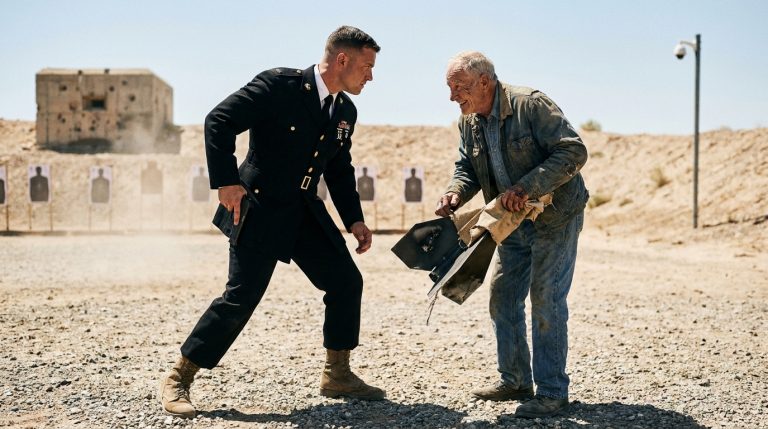
The morning of Memorial Day was unnaturally still, the kind of quiet that precedes a major pressure drop. I stood before the hall mirror, my reflection a study in disciplined geometry. The dress blues were stiff, the wool heavy against my skin, but they fit with the precision of a second skin. Every medal was in its regulation place. The three Purple Hearts, the Bronze Star, the Combat Infantry Badge—they didn’t just shine; they seemed to demand a certain gravity from the room. I wasn’t just Cadell Anderson, a father betrayed; I was a Marine, and today, I was reclaiming the narrative.
Harry knocked on the bedroom door at 07:00, his voice eager, almost vibrating with the anticipated glory of being the ‘devoted son’ of the local hero. “Dad? The car’s detailed. You ready for the big day?”
I opened the door. He was wearing his best suit, a shark-skin grey that caught the morning light in a way that made him look like he was auditioning for a role he didn’t understand. His smile was wide, fixed, and entirely hollow. He looked at me, not as a father, but as a political asset. He stepped forward, reaching out to straighten a ribbon on my chest, his fingers lingering a second too long on the metal.
“You look great, Pop,” he said, his eyes darting to the hallway where Lisa was already poised with her phone. “This is going to be perfect. Everyone’s going to see exactly how well we’ve taken care of you.”
I didn’t answer. I stepped past him, my stride measured and rhythmic. The house felt different today. It felt temporary, a staging area rather than a home. We walked out to the BMW, the sunlight glinting off the polished black paint. Lisa trailed behind us, her thumbs dancing across her screen as she updated her social media, setting the stage for the public performance of our ‘family unity.’
The drive to City Hall was filled with Harry’s chatter—a nervous, rapid-fire monologue about the route, the crowd size, and the importance of waving at the right people. I stared out the window, watching the town pass by, the architecture of my life blurring into a series of static images. I felt the digital recorder in my pocket, the cold, hard reality of it pressing against my thigh. It was my insurance, my leverage, and my final witness.
When we arrived, the staging area was already a cacophony of sound. The high school band was warming up with a dissonant, screeching brass tune, and the smell of ozone and hot pavement was pervasive. Jimmy Miller was waiting near the lead convertible—a cherry-red Mustang with the top down. He caught my eye, his face unreadable behind his aviator glasses, and gave me a single, sharp nod. The signal.
Harry moved to take my arm, his grip firm, proprietary. “Come on, Dad. Let’s get you to the reviewing stand so everyone can get a good look.”
“I think I’ll stay here for a moment, Harry,” I said, my voice quiet but carrying a weight that forced him to pause. “I need to coordinate with the commander.”
Harry’s brow furrowed, a flicker of irritation crossing his face. “We don’t have time, Dad. The schedule is tight.”
“It’ll take a second,” I said, and I walked toward the Mustang, leaving him standing there, confused and slightly exposed.
I leaned into the car, where Jimmy was leaning against the door frame. “Everything is set?” I asked.
“The PA system is locked,” Jimmy whispered. “The witnesses are positioned. When you take the mic, don’t rush it. Let the silence do the work. The crowd is ready.”
I looked back at Harry. He was watching us, his hands clasped, his face a mask of practiced patience. He thought I was asking about the schedule, about the logistics of the parade. He had no idea he was standing at the epicenter of his own demolition.
The parade began with a jolt of movement. The motorcade started to roll, the Mustang cutting through the thick morning air like a blade. We moved at a walking pace, the crowd thickening as we reached the downtown section. I kept my hand on the side of the car, feeling the vibration of the engine through my palm. I saw the faces—hundreds of them—staring up, seeking the image of the veteran, the symbol of the day.
When we reached the reviewing stand, the convertible pulled to a stop directly in front of the platform. Harry and Lisa were there, standing in the front row, bathed in the warmth of the community’s collective admiration. Harry was waving, his expression one of humble, reflected pride.
Jimmy Miller climbed onto the platform, his uniform immaculate. He grabbed the microphone, and the feedback hummed, a low-frequency pulse that silenced the crowd.
“Ladies and gentlemen,” Jimmy’s voice boomed, clear and authoritative. “Our grand marshal, Marine veteran Cadell Anderson.”
The applause was genuine, a rising swell of respect. I stood up, the weight of the medals pulling at my jacket, and stepped out of the car. I walked toward the podium, my movements steady and deliberate. The silence in the crowd shifted, moving from respectful to expectant. They sensed that this was not a standard speech.
I looked at the microphone, then turned to look directly at Harry. His smile was still fixed, but his eyes were beginning to track the sudden, sharp tension in the air.
“Thank you,” I said. My voice was amplified, booming against the storefronts, stripping the street of its festive veneer. “For three years, I have been told I am broken. I have been told I am confused. I have been told that the man who survived three tours in a jungle couldn’t survive the quiet of his own home.”
The silence on the street became absolute. Even the band had stopped. Harry took a step forward, his hand rising in an involuntary, defensive gesture.
“But today,” I continued, my eyes scanning the crowd, locking onto the eyes of the people who had watched me at the barbecue, “I want to share the reality of that ‘confusion.'”
I reached into my pocket and pulled out the Manila envelope. The movement was slow, deliberate—a gesture of total, calculated transparency.
“What you see before you is not a broken man. It is a man who was targeted by his own family. A man whose own son sought to steal his legacy, his house, and his dignity by documenting his own crimes and calling them my failures.”
The reaction was instantaneous. A ripple of gasps went through the crowd, a collective intake of air that sounded like the tide pulling away from the shore. Harry lunged for the platform, his face a mask of frantic, sweating desperation. “Dad! Dad, stop it! You’re—you’re confused, you don’t know what you’re doing!”
“I know exactly what I am doing,” I said, my voice cold, sharp, and final.
I held up the recorder. “And so does the evidence.”
I pressed play.
CHAPTER 6: THE FINAL ACCOUNTING
The silence after the recording was a physical weight, pressing down on the crowd, on the politicians, and, most importantly, on Harry. He stood on the platform, his face a mottled, uneven gray, the mask of the devoted son finally liquefying into something terrified and small. He looked around for an exit, for a sympathetic eye, for anything that would offer him a reprieve from the collective judgment of the town, but he found only the rigid, accusing stares of the veterans and the stone-faced silence of the neighbors who had been his props for three years.
Lisa had stopped filming. The iPhone hung from her hand, its screen dark, its digital witness effectively muted. She looked at Harry, not with solidarity, but with a sudden, sharp betrayal, as if she were already calculating how to distance herself from the wreckage.
Jimmy Miller stepped into the space beside me, his uniform crisp and unwavering. He held out the leather folder containing the legal documents—the restraining orders, the notices of investigation, the proof of the forged deed. He handed them to Harry, who took them with trembling hands, the papers rattling like dead leaves.
“You’re served, Harry,” Jimmy said, his voice carrying clearly to the front row. “The authorities are already at the house. Your access to the bank accounts has been terminated as of ten minutes ago. You are officially under investigation for elder abuse, forgery, and financial fraud.”
Harry tried to speak, but the words caught in his throat—a wet, strangled sound. He looked at me, pleading, his eyes wide and vacant. “Dad… we can work this out. This… this is just a misunderstanding. It’s family, we can just sit down and—”
“You lost the right to call me family the moment you turned my medical history into a screenplay for your own profit,” I said, my voice steady, stripped of the artificial tremor I had played for him for months. I stepped forward, closing the distance between us until I was looking directly into his eyes. There was no rage there, only a cold, clinical indifference. The predator had become the prey, and the transition had been so surgical that he hadn’t even felt the blade until it was finished.
The crowd began to murmur, then to chant. It wasn’t a riot, but it was a surge—the collective, righteous anger of a community that had been played for fools. Tony Rodriguez and the other Marines moved to the edge of the platform, a physical wall that kept Harry and Lisa trapped in the center of the town’s focus.
Harry turned, desperate, and tried to push his way off the back of the platform, but he found himself met by the cold, unyielding stare of the town’s Sheriff, who was already waiting with a pair of handcuffs. The transition from ‘devoted son’ to ‘suspect’ was finalized in the sharp, metallic click of the restraints.
I turned my back on them. I didn’t watch the police escort them to the cruiser. I didn’t watch the neighbors turn their heads, their faces twisted in disgust. I walked toward the red Mustang, the weight of the medals on my chest feeling lighter now, as if the past had finally been balanced against the present.
The denouement was quiet. The parade ended, not with fanfare, but with a slow, grinding dissolution of the crowd. Jimmy drove me back to the house in silence. When we arrived, the police cruiser was still parked in the driveway, the officers finishing their report. I stepped out of the car, the air cool and clean, smelling of cut grass and impending rain.
I walked into my home. It was exactly as it had been, yet entirely different. The house belonged to me again, not just in title, but in spirit. I went into the kitchen and found the blue plastic pill organizer still sitting on the counter, exactly where Harry had placed it. I picked it up, feeling the cheap, molded plastic beneath my fingers. I didn’t empty it. I walked to the trash, held it over the bin, and let it go. It hit the bottom with a hollow, plastic clatter—the last remnant of their manufactured cage.
I went to the living room and sat in Era’s chair. The house was quiet, the only sound the steady, rhythmic ticking of the wall clock. I looked at the framed medals on the wall. For the first time in three years, I felt the space around me as a sanctuary. I thought of the veterans’ fund Jimmy had proposed, the people we would help, the lives we would steady. I thought of the garden I would plant, the doors I would leave unlocked, the life I would reclaim from the wreckage of the past.
The repair of my world had begun, not with a grand explosion, but with the quiet, deliberate process of replacing the broken with the whole. My hand reached out to the edge of the table, tracing the wood grain I had known since 1987. It was scarred, worn, and imperfect—a map of a life that had survived more than enough to know that peace is the only victory worth having. I closed my eyes, the adrenaline finally leaving my system, and for the first time in a long time, I felt the deep, resonant stillness of a life that was finally, unequivocally, mine.