The Weight of Silence: A General’s Redemption and the Quiet Power of a Single Soldier’s Resolve
CHAPTER 1: The Arrival
The rain didn’t fall on the Valder base; it punished it. Through the narrow window of his office, General Delmas watched the gray veil swallow the perimeter fence. It had been fifteen years, and the cadence of the barracks had long since bled into a rhythmic, soul-numbing drone. The drip from the radiator matched the pulse in his temple—a steady, unwanted reminder of the passing time he couldn’t reclaim.
When the knock came, it was precise. Not the hesitant rap of a subordinate looking for a way out, but the sharp, rhythmic strike of someone who expected to be heard.
“Enter.”
The door pushed open, and the atmosphere in the room shifted. Aïcha stood on the threshold, a silhouette of rain and damp wool. She carried the air of the outside world with her—the sharp, untamed smell of wet earth and impending motion. She stood at attention, her boots anchoring her to the ground with a finality that made Delmas’s own stillness feel like a deficiency.
“Recrue Aïcha Mbaye, au rapport, mon général.”
Delmas didn’t answer immediately. He stared at her, tracing the line of her posture. She was small, but she took up space in a way that made the office feel suddenly cramped. He looked down at the dark, jagged line of mud her boots had carved across his immaculate carpet. It was a physical intrusion, a stain on his controlled environment.
“You know where you are, soldier?” he asked, his voice rasping from disuse.
“Yes, mon général. Infantry Base Valder, Company C.”
“You know you’re the first woman here?”
“Yes, mon général.”
“And that most of my men think your presence is a bureaucratic error?”
She didn’t blink. The light from the window caught the hard, flat planes of her face, stripping away any softness. There was no apology in her eyes, only a quiet, unnerving readiness.
“They might think differently after they see me work.”
Delmas felt a strange, cold pull in his chest—a ghost of the man who once understood the language of challenge. He shifted in his chair, the leather protesting under his weight, a sound that felt like a dying breath. He had spent years pruning his life to fit into the geometry of a desk and a chair, and this young woman had walked in and dismantled the room with three sentences.
He saw the way she looked at him—not with pity, but with a clinical, piercing observation. It was as if she were inspecting a weapon to see if it was still capable of firing, or if it was merely rusted through.
“Effort isn’t always enough, recruit,” he said, watching her carefully.
“I know,” she replied, her voice steady enough to bridge the silence. “But I have nothing else.”
She held his gaze, and for a moment, the heavy, stale air of the office seemed to vanish. He realized then that she hadn’t come to take orders; she had come to witness the silence he had lived in for a decade. Before he could respond, a sudden, sharp crack of thunder shook the building, and the office plunged into shadow as the power grid stuttered and failed. In the sudden dark, he could still feel her presence—an anchor in the middle of a storm he had long ago given up fighting.
CHAPTER 2: The Echo of Authority
The darkness was not merely an absence of light; it was a weight. It pressed against the walls of the office, turning the familiar topography of Delmas’s sanctuary into something alien. The only sound was the stuttering rain against the glass and the shallow, rhythmic intake of Aïcha’s breath somewhere in the void near the door.
Delmas sat in his chair, his hands gripping the armrests with a force that made his knuckles ache. He felt exposed. For fifteen years, he had operated within the safety of light, structure, and the absolute predictability of his own immobility. In the dark, the geography of his paralysis felt different—more like a cage. He was acutely aware of his legs, cold and unresponsive, and the sensation of being watched by someone who didn’t respect the rules of his self-imposed exile.
“The power will return shortly,” Aïcha’s voice came, steady and devoid of the deference he was accustomed to. “The backup grid in Sector C usually resets within three minutes of a surge.”
Her voice was too calm. It was a measured cadence, a tactical observation that had no business being spoken to a General by a raw recruit. Delmas felt a prickle of irritation, a heat that began in his chest and radiated outward. It was the first time in a decade he had felt anything other than the dull, flat ache of resignation.
“You speak as if you’ve spent your entire career watching this base fail, soldier,” Delmas said, his voice sounding brittle in the confined space.
“I’ve spent my life watching systems, sir. Everything has a cycle. Even stagnation.”
She moved then. He didn’t see her, but he heard the faint, precise rustle of fabric as she stepped toward the desk. He imagined the way she must look—uniform still damp, hair pulled back, face set in that mask of infuriating, quiet competence. He felt a sudden, sharp, and entirely irrational suspicion: was she here to evaluate him? Was this ‘assignment’ a reconnaissance mission from Command, designed to see just how deep the rot in his office had truly gone? The idea shifted in his mind, feeling less like a theory and more like a certainty. She was a tool, a sharp, polished implement meant to gauge the weight of his irrelevance.
“You’re checking my pulse,” he muttered, the words slipping out before he could filter them through his usual caution.
There was a pause. In the darkness, the silence grew thick, charged with the static electricity of the storm outside.
“I’m waiting for the lights, mon général,” she replied.
“Don’t lie to me. I know an assessment when I see one. You’re not here for infantry training. You’re here to see if the General is still a man, or if he’s just another piece of furniture gathering dust in the archives.”
The air in the room felt thinner. He could hear the rain tapping on the window—a frantic, irregular rhythm that mocked his forced stillness. His brain, conditioned to analyze, began to misinterpret the shadows. The coat rack looked like a looming figure; the stacks of paper on his desk resembled tombstones. He knew it was his own paranoia, a flicker of the old field-tension, yet he couldn’t stop his mind from racing. He was the commander, yet he was pinned to a chair while a stranger stood in the dark, measuring him.
A click sounded—a sharp, metallic snap of a flashlight being activated. A narrow beam of white light cut through the gloom, momentarily blinding him. It didn’t illuminate his face; instead, it swung downward, resting briefly on his lap, on the heavy fabric of his trousers where his legs lay dormant. It was a deliberate, clinical look.
Aïcha adjusted the beam, casting the light toward the wall, turning the room into a canvas of long, distorted shadows. She didn’t offer an excuse, nor did she look away.
“I don’t care about the furniture,” she said, her tone dropping into a lower, more dangerous register. “I care about the fact that this company is drifting, sir. We’re losing the ability to react. We’re running on habit, not instinct. My presence here isn’t a test of your personal history. It’s a test of whether you still intend to lead.”
“And if I don’t?”
“Then you’re not a General, sir. You’re just a ghost in a uniform. And ghosts don’t give orders that matter.”
The harsh, unfiltered truth of the statement hit him with more force than a physical blow. He gripped the edge of his desk, his fingers tracing the familiar gouges in the wood—scars from years of suppressed frustration. He wanted to dismiss her, to order her out of his sight, to return to the comfortable, gray void of his existence. But he couldn’t. Her voice, the unwavering steadiness of it, was the first thing in fifteen years that had made him feel genuinely alive.
“You are arrogant, Mbaye,” he breathed.
“I am observant, mon général.”
Suddenly, the overhead fluorescent lights flickered once, twice, and then hummed to life, bathing the office in a harsh, clinical yellow glow. The transition was violent, stripping away the privacy of the dark. Delmas blinked, his eyes stinging. Aïcha was standing by the bookshelf, hand on her flashlight, her uniform stained with the mud of the barracks. She looked unbothered, as if she had just finished a routine drill.
She didn’t move to leave. She looked at the stacks of paper on his desk—the backlogged reports, the circulars, the meaningless, empty paperwork that had occupied his life. She glanced at the wall behind him, at the medals he had long since stopped dusting. Then, she looked back at him, her eyes searching.
“The exercise starts at 0600,” she said, her voice neutral again, stripping away the fire of the previous moments. “I expect I’ll see you at the perimeter, sir. If you’re still leading, that is.”
She saluted—a sharp, perfect movement—and turned on her heel. The door opened and closed with a click, leaving Delmas alone in the bright, unforgiving light. He sat there for a long time, staring at the muddy boot prints she had left on the floor. They were drying, turning from wet, dark earth to a pale, dusty film. He felt the phantom ache in his legs, a dull throb that felt like a warning, or perhaps, a beginning.
He leaned forward, his hands trembling slightly as he reached for a pen. He hadn’t touched the duty roster in weeks, but as he pulled it toward him, he realized with a jolt of alarm that he was no longer thinking about how to hide his inactivity. He was thinking about how to get to the perimeter by dawn.
CHAPTER 3: The Parade Ground Gauntlet
The first light of dawn didn’t bring warmth; it brought a brittle, grey clarity to the base. Delmas sat on the edge of his bed, his hands white-knuckled as he gripped the frame. He had spent the remaining hours of the night in a state of suspended animation, listening to the drip of the rain subside and the distant, rhythmic creaking of the metal barracks as the temperature dropped.
He moved with agonizing deliberation, every muscle in his thighs protesting the sudden demand for utility. It was a humiliating, granular process—sliding his legs toward the floor, finding the purchase of the wood, and locking his knees. For fifteen years, he had treated his body like a broken piece of gear that had been decommissioned and left to rust in the corner. Now, he was trying to bring it back into service.
He didn’t use the wheelchair. He reached for his cane, the handle worn smooth by years of static contact, and dragged himself upright. The room tilted. For a heart-stopping second, he felt the familiar, crushing gravity of his failure, the internal voice that had whispered not today for five thousand mornings.
But then, he remembered the mud on the office floor. He remembered the unblinking, obsidian stare of the recruit who had not offered him pity, but a challenge.
Delmas dressed, his movements stiff and practiced. He had forgotten the specific weight of his uniform—the way the shoulder boards dragged against his collar, the pull of the medals. He walked out of his quarters and into the barracks corridor. The air here was different; it smelled of stale sweat, diesel, and the underlying, metallic tang of repressed friction. He moved down the hallway, the rhythmic thump-tap of his boots and cane against the linoleum echoing like a countdown.
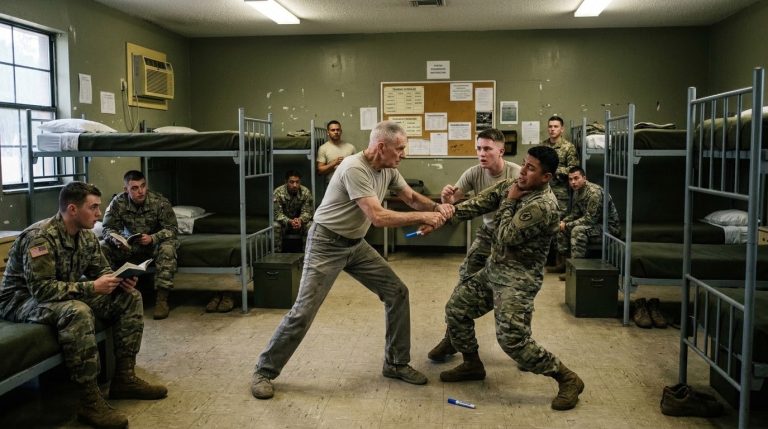
When he emerged into the yard, the company was already forming up. The sight hit him like a physical impact: fifty men, their faces etched with the exhaustion of the mundane, their bodies aligned in rigid, lifeless rows.
Captain Morel stood at the front, his back to the formation, hands clasped behind him. He looked solid, reliable, and utterly uninspired. As Delmas stepped off the porch and onto the gravel of the parade ground, the sound of the men’s chatter didn’t just die—it evaporated.
The silence was absolute. It was the silence of a mechanism that had been forced to stop mid-cycle.
Delmas didn’t rush. He walked. Each step was a battle against the neural feedback loop of fifteen years of disuse, but he kept his gaze locked on the horizon. He walked past the rows, feeling the heat of their stares. He saw the shift in their shoulders, the way they tried to hide their confusion behind the mask of regulation. They were looking for the broken man, the relic they had been told to respect but had learned to pity.
He stopped directly behind Morel. The Captain turned, his face tightening in a mask of professional shock.
“Mon général,” Morel said, his voice dropping to a low, tight frequency. “I didn’t expect you to join the morning formation. We can—”
“You can proceed, Captain,” Delmas cut him off. His voice was raspy, but it held a jagged edge of authority that made Morel flinch. “I am here to observe the drill.”
Morel hesitated, his eyes darting toward the lines of men, then back to the General. There was a flicker of something in the Captain’s expression—not just surprise, but a deep-seated, simmering resentment. For Morel, the General’s recovery was an intrusion. It threatened the stability of the department he had spent years managing in the shadows of that wheelchair.
“Section C, prepare for warm-ups,” Morel ordered, his voice sharper than usual. “And try to maintain some semblance of unit cohesion today.”
Delmas moved to the side, leaning against a rusted equipment crate. He scanned the ranks. He found her immediately. Aïcha stood in the third row, her uniform as crisp as if she had just stepped off the parade ground in Saint-Mexan. She didn’t look at him, but her posture had shifted. She was braced, her center of gravity low, her eyes scanning the field with the same clinical detachment he had seen in his office.
The drill began. It was a series of rhythmic, brutal repetitions—sprints through the mud, structural lifts of heavy timber, and tactical maneuvers that were designed to break the spirit through sheer, mindless repetition.
Delmas watched, and as the morning light grew brighter, his mind began to fray at the edges. The sound of the men’s boots hitting the earth transformed into the dull, percussive thud of heavy artillery fire from a time he had tried to bury. The smell of the damp ground shifted into the acrid smoke of a burning convoy. He wasn’t on the parade ground; he was in a valley in the Hindu Kush, feeling the heat of the sun on his back and the terrifying, electric clarity of a mission gone wrong.
He saw a soldier trip. A young recruit, Le Fèvre, went down face-first into the grit. Morel roared a reprimand, his voice cutting through the General’s hallucination.
“Get up, soldier! Do you think the enemy waits for you to fix your shoelaces?”
Le Fèvre scrambled, his face smeared with black mud, his eyes wide and vacant. Aïcha, moving without a word of command, reached out and caught his arm, hauling him back into the line. It was a fluid, efficient movement—a piece of tactical empathy that Morel missed entirely.
Delmas stared at her. She had noticed the soldier’s instability long before the Captain had. She was the only one on the field who wasn’t just performing the drill; she was monitoring the men.
The General felt a sudden, sharp pain in his back, a reminder of the metal that still whispered of his past, but he didn’t lean heavier on his cane. He watched Aïcha lead the next maneuver, her movements precise, her eyes scanning the perimeter as if she were waiting for an ambush that only she knew was coming.
He realized then that he had been looking for a soldier, but he was watching a variable. She was the disruption he needed, the friction that would either set the company on fire or forge it into something new.
When the drill finally halted for a brief water break, Morel marched toward the General. He looked winded, his brow slick with sweat.
“The men are tired, mon général,” Morel said, though the words were a thinly veiled protest. “This intensity… it’s going to cause injuries.”
“Injuries are part of the process, Captain,” Delmas replied, his eyes fixed on Aïcha, who was walking toward the water trough with a canteen in her hand. “The question is whether we are breaking them, or if we are finally waking them up.”
Morel stiffened. “And what do you think we are doing?”
Delmas didn’t answer. He watched Aïcha reach the trough, pause, and glance back toward the crate where he stood. Their eyes met for a fraction of a second—a transfer of silent, heavy recognition. She wasn’t just here to serve. She was here to hold the line, and she was waiting for him to decide which side of it he was on.
CHAPTER 4: The Mechanics of Dissent
General Delmas did not head back to the sanctuary of his office. The weight of his cane felt different today—less like a crutch, and more like a probe, testing the integrity of the ground beneath him. He made his way toward the motor pool, his movements stiff and deliberate. The base was waking up, but it was a sluggish, heavy-eyed awakening.
He found her beneath the chassis of a heavy-duty transport vehicle, her boots protruding from the darkness of the undercarriage. She was working in a rhythm of absolute silence. No grunts of exertion, no clatter of misplaced tools. Just the methodical turn of a wrench and the occasional, sharp scrape of metal on concrete.
Delmas stopped, leaning his weight against a structural pillar. He watched the way her hands moved—clean, despite the environment. She pulled herself out, sliding on a piece of cardboard, and looked up. She didn’t seem surprised to see him. She merely wiped her palms on a rag, the movement unhurried.
“The hydraulic system on this unit is scavenged, sir,” she said, her voice dropping into the steady, mechanical frequency of the shop floor. “It’s been patched with parts from a model that was retired in the early nineties.”
Delmas stepped forward, the sound of his boots echoing against the concrete walls of the hangar. He looked at the open belly of the vehicle. “It’s functional enough for basic drills, surely?”
“Functional for drills, maybe. But the maintenance logs claim this unit received a full overhaul three months ago.” She gestured toward a clip-board hanging on a nearby wall. “The signature on the report belongs to a procurement officer who hasn’t been assigned to this base in two years. Someone is skimming the budget, mon général, and they’re using the lack of real mission activity as a cover to strip the fleet.”
Delmas felt a cold, sharp clarity pierce through his fatigue. He moved closer, squinting at the ink on the log. He knew the signature. It was a phantom, a ghost of an administration that had prioritized optics over reality.
“You’re digging for things that aren’t meant to be found, recruit,” he said, though his tone wasn’t a reprimand. It was a warning.
“I’m just doing my job, sir,” she replied, her eyes meeting his. “Which is to ensure that when we move, we don’t end up stranded in the mud because of a faulty valve or a rusted gasket.”
Delmas looked around the motor pool. For fifteen years, he had allowed this place to become a graveyard of machinery. He had walked past these vehicles every day, pretending they were merely static exhibits in a museum of his own making. He had ignored the erosion, the decay, the subtle, creeping theft that occurred under the guise of bureaucratic management. He had wanted to believe the base was just “quiet,” but the reality was far more cynical: it was being cannibalized.
He leaned down, his joints groaning, and touched the cold, greasy metal of the engine block. It felt like touching his own skin—vulnerable, neglected, and slowly failing.
“Captain Morel oversees these logs,” Delmas said, the name tasting like ash in his mouth.
“Captain Morel oversees a lot of things, sir,” Aïcha replied, her voice dropping to a whisper that didn’t travel beyond the immediate radius of the chassis. “He treats this unit like a personal holding pen. He doesn’t want the machines to work well enough to justify a redeployment. If they’re broken, they stay here. If they stay here, he stays in command.”
The logic clicked into place with the precision of a tumbler in a safe. It wasn’t just laziness; it was a fortress of convenience. Morel wasn’t just managing a base; he was protecting a small, profitable domain of stagnation.
Delmas felt the familiar, dangerous spark of command ignite in his gut. It was a feeling he had forgotten—not the hollow sensation of signing off on reports, but the sharp, electric hunger for order. He looked at Aïcha. She wasn’t just a soldier anymore. She was a tactical asset, someone who saw the seams in the armor he had been too paralyzed to look at.
“If I were to initiate a full audit of the motor pool,” Delmas said, his voice hard, “what would we find?”
Aïcha stood up, her posture rigid, her face unreadable. “We would find that the company is effectively paralyzed by design, sir. And we would find that the ‘budgetary surplus’ that Captain Morel has been reporting doesn’t exist.”
The air in the hangar felt heavy, saturated with the scent of oil and the promise of a conflict that had been waiting for the General to notice it. A shadow moved near the hangar entrance—a figure passing by, perhaps a sentry or a junior officer, and for a moment, the atmosphere in the shop shifted from tactical to conspiratorial.
“This isn’t a drill, Mbaye,” Delmas said, though his hand, resting on the top of his cane, was rock-steady.
“I’m well aware of that, mon général,” she answered. “And for the record, I’m not interested in drills. I’m interested in whether this base is ever going to be a military unit again.”
Delmas turned away from the engine, his gaze tracking toward the distant, shimmering heat of the parade ground outside. He realized that the decoy secret—the idea that she was a “political token”—was completely dead. She was a mirror. She was reflecting the decay of the entire structure back at him, forcing him to decide if he was part of the rot or if he was still the man who once commanded the line.
He didn’t give an order. He didn’t promise to dismantle Morel’s empire. He simply stood there, feeling the cold, hard reality of the steel beneath his hand, and for the first time in fifteen years, he looked forward to the sunrise.
“Continue your work,” he said, his voice low. “And keep your observations to yourself. We move when the mechanics are ready.”
She offered a sharp, precise nod, already turning back to the shadows beneath the vehicle. Delmas walked toward the exit, the thump-tap of his stride hitting the concrete with a new, aggressive resonance. He wasn’t walking to his office. He was walking toward the center of the storm.
CHAPTER 5: The Friction of Authority
General Delmas did not have time to move away from the vehicle. The hangar’s heavy sliding door groaned open, admitting a slice of blinding morning light that cut through the dimness like a blade. Captain Morel stepped into the hangar, his uniform impeccable, his face a mask of controlled curiosity that didn’t quite reach his eyes. He stopped, his gaze sweeping from the open undercarriage of the transport to the General standing over it.
“Mon général,” Morel said, his voice echoing in the vast, hollow space of the motor pool. “I wasn’t informed you were conducting an inspection.”
Aïcha did not emerge from beneath the vehicle. The only sign of her presence was the cessation of her work; the wrench clinked once against the chassis and then went silent. Delmas felt the familiar rigidity return to his spine. He stood his ground, the weight of the cane in his hand feeling suddenly very heavy.
“I decided to take the air, Captain,” Delmas replied, keeping his voice steady, masking the irritation with the practiced calm of a man who had commanded battalions in the field. “I found myself curious about the state of the fleet. It seems there is quite a bit of rust to account for.”
Morel’s eyes flickered toward the vehicle, then back to the General. He walked forward, his stride measured, deliberate. “We operate on a skeleton budget, sir. I’ve sent in the reports. I believe you’ve seen them.”
“I have seen the reports, Morel,” Delmas said, turning slightly to face him. “What I haven’t seen is the maintenance they describe. Why is this unit using parts from a donor vehicle that was decommissioned a decade ago?”
Morel’s expression didn’t change, but his jaw tightened a fraction of an inch—a micro-tension that Delmas, now hyper-aware of the base’s internal rhythms, caught immediately.
“Supply chain issues, mon général. We make do with what we have. It’s a matter of pragmatism.”
“Pragmatism.” Delmas repeated the word, letting it hang in the air. “Is that what we call the falsification of maintenance logs these days?”
The silence that followed was heavy, filled with the distant, mocking sound of the wind rattling the hangar’s corrugated roof. Morel’s posture shifted, his shoulders broadening, his presence becoming more oppressive. He was not just a captain anymore; he was a man protecting a wall he had built, stone by stone, over the years.
“I think you’ve been spending too much time in the archives, sir,” Morel said, his voice dropping into a tone that was less a salute and more of a threat. “Perhaps the sedentary life has made you… overly imaginative. I’m concerned about your health. The stress of the last few days has clearly taken a toll.”
Delmas felt a flash of white-hot anger. He recognized the tactic: gaslighting, the weapon of choice for a man who needed to keep his commander in a state of self-doubt. Morel wasn’t just defending his budget; he was questioning the General’s mental stability to justify seizing full control of the base’s operations.
“Are you questioning my competence, Captain?” Delmas asked, taking a step forward. He stumbled slightly—the cane slipped on a patch of oil—but he caught himself, his grip on the handle turning white.
Morel’s eyes darted to the cane, then to the General’s legs. The smugness returned to his face, a thin, cruel smear of a smile. “I’m saying that you’ve been away from the line for a long time. Things are… different now. There are ways to handle these matters that don’t involve formal audits or public accusations. I’d hate to see you compromise your reputation for the sake of a recruit’s unverified suspicions.”
Aïcha’s boots finally appeared from beneath the transport. She stood up, brushing grease from her coveralls with a slow, agonizingly deliberate motion. She looked at Morel with a neutral, empty expression, the kind of look that communicated nothing and everything at once.
“Everything alright, Captain?” she asked.
Morel looked at her, his contempt for her presence undisguised. “This is an officer’s conversation, Mbaye. Get back to the barracks. That’s an order.”
Delmas felt his heartbeat accelerating—a frantic, rhythmic thumping that sounded like a warning. He knew he had to intervene, to assert his authority, but the physical effort of standing, of projecting the strength he was trying so desperately to regain, was pushing him to his absolute limit. He leaned into the cane, his joints burning.
“She stays, Morel,” Delmas said, his voice low, commanding. “And you will explain to me, right now, why the procurement signatures in this hangar don’t match the command registry.”
Morel stared at him for a long, silent moment. The hangar seemed to contract, the darkness of the corners pressing in. He didn’t answer. Instead, he pulled a radio from his belt, his thumb resting on the transmit button.
“We have a situation in the motor pool,” Morel said into the radio, his eyes never leaving the General’s. “Requesting a security escort for the General. He’s… having an episode.”
The betrayal was total. Delmas realized, with a sickening jolt, that he had underestimated the extent of Morel’s reach. The base wasn’t just his domain; it was his prison.
“You’re making a mistake, Morel,” Delmas said, but his voice was shaking.
“No, sir,” Morel replied, the radio emitting a sharp, confirming chirp from the distant guard shack. “I’m just maintaining the order you asked me to preserve. You told me to keep this unit running. I’m simply making sure it doesn’t break down.”
Delmas looked at Aïcha. For the first time, he saw a crack in her armor—a flicker of genuine, urgent fear. They had moved too quickly. They had broken the surface tension of the stagnation too abruptly, and now, the structure was pushing back with the weight of an entire system of corruption.
He stood his ground, legs trembling, while the sound of running boots began to echo in the distance, growing louder with every passing second. The hangar, once a place of quiet decay, had become the epicenter of a collapse.
CHAPTER 6: The Weight of the Chair
The boots on the concrete were not a march; they were a rhythmic, clinical closing of a trap. Two guards, young men whose eyes remained resolutely fixed on the horizon, reached the transport vehicle. They didn’t look at the General; they didn’t look at the mechanic. They moved with the terrifying, unthinking efficiency of a system that had finally decided to purge a foreign body.
“Mon général,” one of the guards said, his voice flat. “Captain Morel has requested that you return to your quarters. For your own safety.”
“My safety?” Delmas echoed, his voice steadying despite the frantic, erratic thumping of his heart. He felt the cane in his hand, the wood biting into his palm. He stood tall, projecting a final, brittle semblance of the authority he had spent fifteen years burying. “Since when does a Captain dictate the movements of his commanding officer?”
“Since the commanding officer became a liability to the unit’s stability, sir,” the guard replied. He took a step forward, his hand hovering near his belt.
Delmas shifted his weight. He could feel the metal in his spine, a cold, dull ache that usually heralded the onset of his paralysis. He refused to acknowledge it. He looked at Aïcha. She was standing perfectly still, her hands raised, palms open—a posture of surrender that he knew, with a sudden, sharp intuition, was a ruse. She was waiting for the exact moment the guards’ focus shifted.
“Step aside,” Delmas ordered. The command was pure, stripped of the weariness that had characterized his existence for a decade. It was the voice that had once led men across borders and through fire.
The guards hesitated. The weight of his rank, dormant and dusty, still possessed a residual gravity that stopped them for a heartbeat. Morel, standing near the hangar entrance, sneered.
“He’s confused, men. Get him out of here. Use whatever force is necessary to ensure he doesn’t hurt himself.”
Morel’s voice shattered the spell. The guards lunged.
The hangar erupted in a flurry of motion. Delmas swung the cane—not as a walking aid, but as a lever. He drove the tip into the concrete and pivoted, using his momentum to strike the guard’s knee. It was a crude, desperate maneuver, a reflex born of muscle memory rather than tactical planning. The guard grunted, stumbling as his leg buckled.
At the same instant, Aïcha moved. She didn’t strike the second guard; she dove for the heavy, iron wrench lying on the concrete. She swung it in a wide, whistling arc, not to strike, but to shatter the high-pressure hydraulic line of the transport vehicle sitting between them and the door.
A jet of high-pressure fluid sprayed outward—a thick, black, oily mist that transformed the floor into a skating rink. The second guard’s boots lost traction, his arms windmilling as he crashed into the oily slurry.
“Move, mon général!” Aïcha shouted.
Delmas ran. It wasn’t the fluid, graceful stride of his youth; it was a lopsided, agonizing trot, his legs burning with the sudden, violent exertion. He felt the metal in his back screaming, the psychosomatic wall he had built around his mobility shattering under the sheer, primitive necessity of flight.
They tore out of the hangar, the roar of the emergency sirens beginning to drown out the sounds of the struggle. Morel was shouting orders, his voice high and thin, the sound of a man watching his carefully ordered world dissolving into chaos.
They sprinted across the parade ground, the grey, oppressive morning sky feeling like it was closing in on them. Delmas’s breath came in ragged, burning gasps. He looked at his own legs, expecting them to collapse, expecting the familiar, dead weight to return. But they kept moving. They kept pounding against the gravel, propelled by the raw, unadulterated terror of being dragged back into the dark.
They reached the edge of the barracks, ducking into the narrow, shadow-filled gap between the supply shed and the fence. Delmas collapsed against the wall, his chest heaving, his eyes burning with sweat. Aïcha was right beside him, her face smeared with oil and dust, her eyes darting between the openings in the fence.
“They’ll seal the gates,” she said, her voice tight with focus. “They’ll tell the rest of the company that you’re suffering from a mental break. They’ll frame this as an attempt to protect you from yourself.”
Delmas wiped the sweat from his eyes. The realization hit him, cold and absolute: Morel wasn’t just hiding theft. He was hiding the fact that the entire command structure had been hollowed out. If the General was removed, the official report would be a simple case of medical discharge.
“We need a voice, Mbaye,” Delmas said, his voice a hoarse whisper. “We need to get to the comms tower. If I can send a broadcast to the regional command, the truth will come out.”
“The tower is the first place they’ll guard, sir,” she said, looking at the distant, needle-like spire rising into the morning clouds. “And you can’t run another kilometer on those legs.”
Delmas looked down at his feet. They were still, but they were trembling uncontrollably. The truth of his condition was catching up; the phantom paralysis was beginning to assert its reality once more. He had pushed past the wall, but he hadn’t destroyed it.
“I don’t need to run,” he said, the old, steely resolve flickering back to life. “I need to reach them. If I cannot walk to the tower, I will force them to bring the truth to me.”
He pulled his sidearm—a weapon he hadn’t carried in years—from its holster. The metal was cold, familiar. He looked at Aïcha. She was his mirror, the only person left on this base who wasn’t trapped in the cycle of convenience and cowardice.
“We don’t go to the tower,” Delmas said, his eyes hardening as he heard the crunch of heavy boots approaching the shed. “We hold the parade ground. We force them to confront us where everyone can see.”
It was a suicidal shift in tactics, but it was the only way. If they were to be labeled as lunatics, they would play the role of the most dangerous, most public lunatics the base had ever seen. He leaned against the wall, preparing himself for the final act of a career he had almost allowed to die in the shadows.
CHAPTER 7: The Final Stand
The wind whipped around the corner of the supply shed, carrying the grit of the parade ground into Delmas’s eyes. He stood with his back to the wall, his lungs burning with the sharp, cold intake of morning air. Beside him, Aïcha was already in motion, her gaze sweeping the yard with the detached focus of an operator assessing a kill zone.
“They’re flanking left,” she murmured, her voice stripped of everything but tactical necessity. “If we move now, we can hit the center of the field before they coordinate.”
“We aren’t retreating, Mbaye,” Delmas said, his voice firm, grounding himself against the tremors still rattling through his thighs. “We are occupying.”
They stepped out from the shelter of the shed. The parade ground lay before them—a wide, grey expanse of gravel and silence. Morel stood at the far end, framed by the administrative building, his arms crossed, a silhouette of calculated arrogance. Behind him, the two guards were joined by three more, their weapons held at the low-ready position.
Delmas walked. He didn’t jog. He didn’t crouch. He walked with the heavy, uneven gait of a man who had reclaimed the right to exist in his own space. Every step was an argument against the paralysis that had defined him. He felt the cold iron of his sidearm against his hip, a weight that served as the final, brutal punctuation of his authority.
Morel’s men stopped ten meters away, forming a loose, hesitant semicircle. They were young, their faces pale under the harsh light of the morning. They were looking at their General—the man whose legend had been the bedrock of this base for fifteen years—and they were seeing a man who refused to break.
“Drop the weapon, sir,” one of the guards called out. His voice lacked conviction. He was staring at the General not with the malice of an enemy, but with the confusion of a child watching his father fall.
“I am the commanding officer of this base,” Delmas shouted, his voice ringing out across the gravel, cutting through the wind. “Any man who aims a weapon at me is in open mutiny. Consider your next move, soldier. Are you serving the chain of command, or are you serving a thief?”
Morel stepped forward, his face contorted. “He’s lost his grip, men! Look at him! He’s barely standing! Do you want to be led by a ghost?”
Aïcha moved then. She didn’t look at the guards; she looked at the flagstaff at the center of the field. With a swift, fluid motion, she grabbed the halyard and yanked it hard. The flag, heavy with the damp of the morning, slid down the pole and hit the ground with a dull thud. The sound was like a drumbeat—a signal that the institution had been stripped of its ceremony.
“The hierarchy you’re protecting ended the moment you drew weapons on your General,” Aïcha’s voice carried, sharp and unforgiving. “This isn’t a base anymore. It’s a crime scene.”
The guards faltered. The visual weight of the fallen flag, combined with the sight of the General standing in the center of the yard, was a psychological wedge. Morel’s authority began to look less like a command and more like a desperate, isolated act of self-preservation.
Delmas saw the hesitation. He saw the guard on the left lower his rifle by a fraction of an inch. He saw the flicker of doubt in the eyes of the man behind Morel.
“I am giving you one chance,” Delmas said, his eyes locking onto Morel’s. “Lower your weapons. Clear the field. I will assume command, and we will conduct this investigation by the book. Fail, and you will answer for every cent, every part, and every lie you’ve built your empire on.”
Morel’s face turned a mottled, furious red. He reached for his own sidearm—a final, fatal escalation. “I’m ending this!” he spat.
He didn’t get the chance.
Before he could clear the holster, the first guard—the one who had hesitated—stepped forward, his rifle now pointed directly at the Captain. “Drop it, Captain,” he said, his voice no longer trembling. It was the voice of a soldier who had suddenly realized he had been on the wrong side of the history of his own life.
The other two guards followed suit. The formation collapsed. Morel stood alone, his hand frozen on his belt, his eyes wide as he realized that the infrastructure of his power had just evaporated in the face of a single, sustained act of defiance.
Delmas didn’t smile. He didn’t experience the cheap, cinematic rush of victory. He felt only a profound, hollow exhaustion. He reached Morel, the gravel crunching under his boots, and stopped inches away. The Captain looked smaller than he had in the hangar—hollow, brittle, a man who had mistaken silence for consent.
“You had the honor of this unit in your hands,” Delmas whispered, the sound barely audible over the wind. “And you traded it for scraps of metal.”
He took the sidearm from Morel’s holster with a slow, deliberate movement. The Captain didn’t resist. He was staring at the ground, his shoulders slumped, the weight of the inevitable investigation already crushing him.
Delmas turned away, his back to the man he had once trusted, and looked at Aïcha. She was standing by the pole, her expression one of quiet, resolved stillness. She wasn’t celebrating. She was watching, her eyes scanning the base—the motor pool, the administrative buildings, the quiet, waking barracks—as if she were checking for any other fractures.
“Secure him,” Delmas said to the guards. His legs were screaming now, the nerves firing in a cascade of agony that he could no longer suppress. He felt the familiar, cold numbness starting at the soles of his feet, creeping upward, a tide of paralysis that he knew was the price for the last few hours of movement.
He didn’t fight it. He leaned heavily on his cane, watching as they led Morel away. The parade ground was quiet again, the morning sun finally cresting the fence line and painting the gravel in long, golden strokes. The General stood in the center of the light, the weight of his uniform feeling, for the first time, like something he had truly earned.
CHAPTER 8: The Architecture of Peace
The silence that followed the departure of the security detail was not the hollow, stagnant silence of the previous years. It was a breathing, living quiet, punctuated by the distant sounds of a base finally waking up to a different rhythm. Delmas remained on the gravel, his legs locked in a state of defiance that felt less like biological function and more like an act of sustained will.
Aïcha walked toward him. She moved with a slow, measured gait, her expression unreadable. She stopped a few feet away, her hands resting at her sides. She didn’t offer a hand; she didn’t offer a platitude. She stood as a witness to the completion of the transition.
“They’ve taken him to the holding block, sir,” she said. Her voice was steady, lacking the tactical edge that had dominated their conversations for the past few days. It was just the voice of a soldier reporting a successful objective.
Delmas looked toward the administrative building, where the windows caught the morning sun and threw it back in dazzling, golden flashes. He thought of the fifteen years he had spent in that office, the static, grey geometry of his existence. He thought of the chair, that comfortable, upholstered prison that had promised him safety but had only delivered a slow, quiet death.
“The audit begins at noon,” Delmas said. He felt a sudden, sharp, and overwhelming fatigue—the kind that settles into the marrow of the bones when the adrenaline finally drains away. “I want every record, every ledger, and every maintenance log brought to the command center. We will account for every cent he stole.”
“Yes, mon général.”
He turned to look at her. “You could have walked away, Mbaye. You could have accepted the status quo, taken the easy path, and left this place to its decay. Why did you stay?”
Aïcha looked toward the parade ground, where the flag had been raised again, snapping in the morning breeze. “My father taught me that a soldier’s duty isn’t to the uniform, but to the reality the uniform is supposed to defend. You were part of that reality, sir. It felt like a waste to let you disappear.”
Delmas nodded slowly. He understood then that the “decoy” of her mission—the political assignment, the suspicion he had harbored—was merely the scaffolding of a much deeper, more fundamental truth. She had not come to save him. She had come to remind him of the price he had agreed to pay when he first earned his rank.
The days that followed were a blur of documentation and accountability. The regional command arrived in a flurry of activity, their suits and clean, crisp uniforms a stark contrast to the grit and oil of the base. Delmas watched from the porch of his office—not sitting, but standing, his hand resting on the railing. He saw Morel led away in cuffs, a small, diminished figure who looked less like an antagonist and more like a man who had simply lost the ability to see beyond his own reach.
The “Absolute Final Reality”—the truth Delmas had been hiding from even himself—was laid bare during the proceedings. The medical board, acting on the sudden influx of reports and the General’s return to active status, conducted a thorough re-evaluation. It was confirmed, in the clinical, detached language of the professionals, that there had been no physical obstruction to his mobility for years. His paralysis had been the final, desperate symptom of a man who had chosen to be broken rather than to be useless.
He didn’t retreat from the truth. He stood in the inquiry, flanked by the evidence of his own recovery and the accounts of the soldiers who had seen him walk. He admitted to the board that he had been lost, not in the field, but within his own convictions. He spoke of the decay, of the stagnation, and of the recruit who had forced him to look into the mirror he had been avoiding for a decade and a half.
The denouement came in the quiet of a late afternoon. The administrative office, once a tomb, was now a place of motion. Files were being processed, the air was thick with the scent of coffee and the sound of machines being serviced in the distance.
Delmas sat at his desk—not in the wheelchair, but in a standard, wooden chair. He was repairing the small, intricate desk clock that had stopped ticking on the day of his injury. He had spent hours on it, his hands steady, his focus narrowed to the tiny, delicate springs and gears.
Aïcha knocked and entered. She was wearing her formal uniform, her travel pack resting on the floor beside her. She was leaving for her next assignment; the base no longer required her specific brand of friction.
“The transport is ready, sir,” she said.
Delmas placed the final gear into the clock. He wound it. A soft, rhythmic tick-tick-tick began to fill the room, a heartbeat restored to the quiet heart of the office. He looked up, his face lined and weary, but his eyes were clear.
“I have something for you,” he said, reaching into his drawer. He pulled out the photograph he had kept for years—the one of his old battalion, the men who had shared the sand and the fear. He hadn’t touched it in years, but he slid it across the wood toward her. “You reminded me that we are not defined by our wounds, but by what we do once we realize we are still standing.”
Aïcha took the photo, her fingers grazing his. She looked at it for a moment, then back to him. There was a quiet, deep connection there—a shared understanding that transcended rank and time. They had both carried burdens, both stood in the rain, and both had come out on the other side.
“Keep the rhythm, mon général,” she said, a faint, rare smile touching her lips. “The base is going to need it.”
She saluted—a gesture that had lost its mechanical rigidity and gained a profound, human weight. Delmas returned the salute, his hand firm, his posture balanced. As she turned and walked out of the office, he didn’t watch her until she disappeared. He turned back to the clock, watching the second hand sweep across the dial.
The base was settling into a new, quiet peace. The corruption had been cleared, the machinery was being serviced, and the General, though he knew he would never truly be the man he was before the explosion, had finally stopped looking backward. He stood up, walked to the window, and opened it wide, letting the warm, golden light of the setting sun flood the room, washing away the last of the dust and the shadows of the chair.