The Rhythm of Iron: An Old Soldier’s Quiet Lesson in the Language of Respect
CHAPTER 1: THE STALLED PIG
The silence wasn’t empty; it was heavy, pressed down by the weight of three hundred expectant gazes. Miller’s fingers, usually steady enough to calibrate a laser sight, were trembling as he gripped the charging handle for the third time.
“It’s a museum piece,” Miller muttered, his voice cracking. He didn’t look at the crowd; he looked at the gun as if he could intimidate the steel into submission. “The tolerances are shot. The receiver’s warped. We should have pulled this garbage before the demonstration started.”
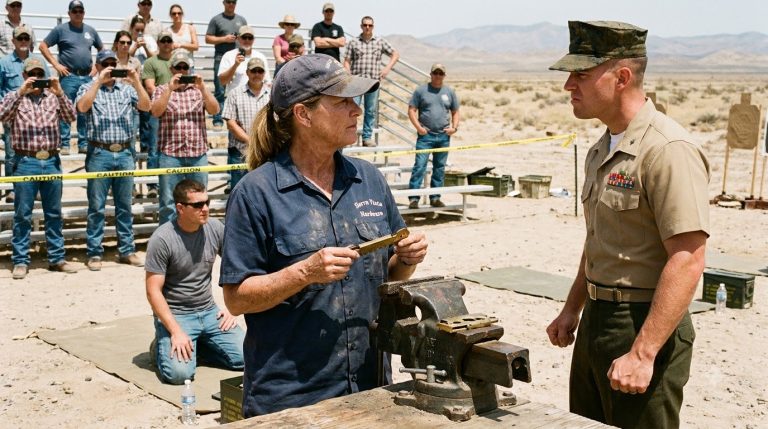
Twenty feet away, Sam Corbin stood in the periphery, his hands tucked into the pockets of his worn denim jeans. He didn’t need to see the internal mechanism to know what had happened. He could hear it. The clank of the extractor slipping the rim, the dull thud of the ejector fighting a live round. It was a familiar, rhythmic failure that felt like an old friend asking for a correction.
Sam took a half-step forward, his old boots crunching on the dry, sun-baked earth. He felt the heat radiating off the firing line, not just from the sun, but from the rising frustration of the crew. They were treating the M60 like an enemy. They were pulling, yanking, and cursing, their movements sharp and frantic—everything the machine wasn’t.
“You’re forcing it,” Sam said, his voice barely a rasp over the murmur of the crowd. He wasn’t trying to lecture; he was trying to stop them from making a mistake that would permanently damage the feed pawls.
Miller whipped his head around. His eyes were wide, the pupils dilated with the panic of a young man who had staked his entire identity on the perfection of the new. “I didn’t ask for a critique, sir,” Miller snapped, the word ‘sir’ dripping with a patronizing, sharp edge. “We’re certified armorers. We know how this works. It’s obsolete.”
Sam felt the familiar, dull ache of arthritis in his knuckles, but he didn’t pull his hands from his pockets. He just watched. The sun caught the dust motes dancing between him and the firing line. He saw the way Miller’s partner was sweating, the way the Colonel at the edge of the range was checking his watch with an expression that was hardening into something cold.
Miller reached for a screwdriver, his movements erratic, desperate to strip the weapon down before the Colonel walked over to intervene. He was going to pry the bolt carrier group out while the round was still partially chambered.
Sam knew that move. It was the quickest way to turn a simple jam into a shredded hand or a ruined receiver. He leaned into the heat, his intent clear, his posture shifting from a bystander to a man who had seen this exact mistake result in blood on the sand forty years ago. But before he could step onto the line, the sound of a heavy engine—the deep, distinctive purr of a government-issue sedan—cut through the range, silencing the murmurs of the crowd.
The car door opened, and a shadow stretched long and thin across the dirt, pointing directly toward the jammed machine gun. Sam blinked against the glare of the afternoon, feeling the familiar, stinging prickle of a memory he had spent decades trying to keep buried: the smell of cordite and the sound of his platoon’s laughter, long before the silences became permanent.
CHAPTER 2: THE WEIGHT OF THE SILENCE
The shadow stretching toward the firing line was not just a silhouette of a man; it was a physical weight. General Madson’s presence seemed to suck the oxygen out of the Georgia afternoon, turning the casual, sun-drenched range into a pressure cooker. Specialist Miller stood paralyzed, his hands still hooked around the M60’s receiver, his knuckles white against the dull, parkerized steel. He looked less like a soldier and more like a man caught in a lie he hadn’t yet realized he was telling.
Sam didn’t move. He stood at the edge of the crowd, his boots rooted in the dry, churned-up earth. He didn’t want this. He hadn’t come for the salute, or the recognition, or to be unearthed from the quiet life he had cultivated among his tomato plants and hand-carved birds. But as his gaze flickered from the General’s polished boots back to the jammed machine gun, the phantom sensation of 1968 flared in his mind.
He smelled the wet, metallic tang of the Asha Valley—not the dry, dusty air of Georgia. He felt the phantom vibration of a hot barrel against his own shoulder, the kick that didn’t hurt but rather settled his bones into place. Miller was currently fumbling with the feed tray, his breath coming in shallow, ragged bursts. The kid was terrified. It wasn’t just the presence of the General; it was the realization that the equipment was winning.
Sam felt a strange, cold detachment. The logic of the modern army, he realized, had shifted. They were trained to operate, not to understand. They were mechanics in a world that demanded surgeons. If he walked away now, he would remain “Sam,” the quiet widower who tended his bungalow. If he stepped forward, he would be Sergeant Major Corbin again, a title that felt like a heavy, rusted coat he hadn’t worn in decades.
“The extractor is catching the live round,” Sam whispered to himself, the words barely escaping his lips.
The sound of the crowd had died completely, replaced by the droning of a distant cicada. Miller looked up, his gaze meeting Sam’s. For a split second, the professional mask flickered, revealing the raw, unvarnished fear of a soldier who had been told he was invincible by a system that hadn’t prepared him for a simple, mechanical hiccup. It was a reflection of the same fear Sam had seen in the eyes of fresh-faced boys in the valley, boys who hadn’t yet learned that a machine was only as reliable as the heart of the one holding it.
General Madson had stopped now, his posture stiff, his eyes locked on the back of the M60. He wasn’t looking at the jam. He was looking at the way the sunlight hit the weapon, the way the history of the piece seemed to radiate outward.
“Sergeant Major,” the General said, the title cutting through the heat. It wasn’t a question; it was a recognition.
Sam’s breath hitched. He closed his eyes, and for a moment, he wasn’t in the present. He was back in the dirt, the smell of cordite thick in his lungs, listening to the voice of his platoon commander. The loss of those men was a hole in his chest that he had spent years filling with the mundane—the quiet of the morning, the careful carving of cedar, the slow growth of his garden. He had treated the M60 as a ghost because it was the only thing left that still spoke the language of those who were gone.
He felt the weight of his own age—the stiffness in his knees, the gnarled joints of his hands—and it felt like a betrayal. He wanted to be the man who could hold the line, but he was just the man who could remember how.
“It’s just a jam, General,” Sam said, finally finding his voice, though it felt rusty, like a gate that hadn’t been opened in years. He took a step forward. The crowd parted as if he were a current moving through water. “They’re just trying to force the gear. They don’t know the rhythm yet.”
Miller’s grip on the weapon slackened. He looked at Sam with a mixture of confusion and resentment, but the resentment was already bleeding out, replaced by the crushing weight of his own failure.
“The feed pawls aren’t engaging,” Sam continued, his eyes focused entirely on the M60. He didn’t look at the General, or the Colonel, or the stunned spectators. He looked at the machine. It was a piece of his soul, mounted on a tripod, and it was screaming for attention. “You’re fighting the extraction. If you keep pulling the charging handle while the brass is wedged, you’ll snap the rim. Then you’ve got a real problem.”
He reached the firing line. The sergeant who had previously tried to block him moved back, his hand falling from his holster as if he’d been burned. The air between Sam and the weapon felt thick, energized. He could feel the heat radiating from the barrel, a familiar warmth that promised to burn if he wasn’t careful.
He didn’t touch it yet. He just stood there, the stooped, flannel-clad figure standing in stark contrast to the sterile, tactical efficiency of the modern military. The silence was absolute. He could hear the faint, rhythmic thumping of his own heart, a slow, steady cadence that hadn’t changed since he was twenty-two.
“Let me,” Sam said quietly. He didn’t wait for permission. He reached out, his hand hovering over the receiver, feeling the grain of the metal, the familiar texture of a tool that had once been his only companion in the dark.
CHAPTER 3: THE INTERVENTION
The metal of the M60 was hot—searingly so—a familiar, biting heat that seemed to seep through the callouses of Sam’s skin and anchor him to the earth. He didn’t look at Miller. He didn’t look at the General. His entire universe had contracted to the three inches of steel between the feed tray and the bolt carrier.
“Step back, Specialist,” Sam said, his voice flat and devoid of judgment. It was a professional command, the kind that moved people without the need for volume.
Miller hesitated, his face a map of conflicting emotions—mortification, confusion, and a sudden, sharp spike of defensiveness. He stood his ground for a heartbeat too long, his hand still gripping the charging handle, before the weight of General Madson’s gaze, heavy as a slab of granite, forced him to release his hold. He stumbled backward, his boot catching on the uneven gravel, nearly losing his balance before he regained his posture, his eyes downcast.
Sam didn’t acknowledge the movement. He knelt. His knees cracked, a dry, popping sound that was swallowed by the oppressive quiet of the range. He began to work. He didn’t need to look at the internal components; he could visualize the mechanism in his mind—the way the springs coiled, the way the extractor claw hooked the brass, the way the ejector relied on the precise, rhythmic movement of the bolt.
It was a delicate, brutal process. He pushed the bolt carrier back just a fraction, a micro-adjustment that allowed him to see the spent casing that had jammed the cycle. It was there, wedged against the edge of the chamber like a stubborn splinter. He didn’t use a tool; he used his fingernail, a small, practiced motion that felt like a secret whisper between him and the machine. With a soft click, the brass popped free.
He caught it before it could hit the dirt, the brass still warm against his palm. He stood up, his movements fluid despite the ache in his joints. He didn’t rush. He placed the casing on the edge of the ammunition box, a silent statement of the failure he had just corrected.
“You were treating it like an enemy,” Sam said, looking up at Miller for the first time. The young man looked physically ill, his skin pale against the olive drab of his uniform. “You don’t fight the machine, son. You follow it.”
General Madson stepped forward, the heels of his boots crunching rhythmically on the gravel. He stopped just behind Sam, his presence casting a long, imposing shadow over the firing line. “He hasn’t been taught to listen, Sergeant Major,” the General said, his voice quiet, directed toward Sam but intended for the entire crew. “He’s been taught to output.”
Miller’s jaw tightened. “Sir, the technical manual says—”
“The technical manual was written by men who haven’t spent a night in the mud with that weapon,” the General cut him off, his voice sharpening into a blade. “Sergeant Major Corbin didn’t just carry that weapon. He was the reason the manual exists in the first place.”
The revelation rippled through the crowd. Sam felt a ripple of irritation. He hadn’t wanted this—the spotlight, the hero worship, the deconstruction of the young man’s confidence. He just wanted the gun to sing again. He turned back to the M60, his hands moving with an effortless grace to close the feed tray cover. It snapped shut with a definitive, metallic thud that resonated across the range.
He didn’t check the safety. He didn’t have to. He pulled the charging handle back, felt the reassuring resistance of the spring, and let it fly forward. The weapon was live, hungry, and waiting.
“The problem wasn’t the tolerances,” Sam said, his tone conversational, as if he were discussing the weather rather than the redemption of a machine. “It was the tension. You were trying to force a cycle that didn’t exist. You have to let it breathe.”
General Madson reached out and placed a hand on Sam’s shoulder. It was a gesture of profound respect, a bridge between two eras that had been separated by decades of administrative progress and the relentless pace of change.
“Show them, Sergeant Major,” the General commanded, his voice filled with a strange, melancholic hope. “Show them what a soldier sounds like.”
Sam settled behind the gun. As his shoulder pressed against the stock, the world began to blur at the edges. The modern uniforms, the pristine range, the distant, murmuring crowd—all of it faded, replaced by the memory of the Asha Valley in the damp, grey light of dawn. He felt the cold fear of that morning, the smell of damp earth, and the weight of the responsibility he had carried for the men who hadn’t walked out of that valley.
He wasn’t firing at a target. He was reaching out across the chasm of time, trying to touch the lives that had been snuffed out by the very reality he now stood in. Every round he was about to fire wasn’t just a projectile; it was a rhythmic reminder that he was still here, that they were still remembered, and that the language of the machine was the only one they had left in common.
He breathed in, his chest expanding with the air of a different time, and his finger curled around the butterfly trigger. The air around the firing line shimmered, the heat haze distorting the horizon, and for one, suspended moment, the entire base seemed to hold its breath.
CHAPTER 4: THE GHOST IN THE MACHINE
The air in front of the firing line wasn’t just displaced; it was shredded. Every burst of the M60 felt like a rhythmic, percussive heartbeat that rattled the very teeth of the onlookers. Sam didn’t lean into the recoil; he simply let it exist, his body becoming a rigid, compliant frame that absorbed the energy of the machine and channeled it back into the earth. It was a fluid, almost meditative action. His finger moved on the butterfly trigger with the lightness of a conductor’s baton, and the M60 responded with a clean, flawless stutter of steel on steel.
When he finally pulled his finger away, the sudden cessation of sound was deafening. A thin wisp of blue-grey cordite smoke curled lazily from the barrel, hanging in the stagnant Georgia air. Sam didn’t move immediately. He let the silence wash over him, listening to the ringing in his own ears—a sound he hadn’t heard in years, a sound that reminded him he was still breathing, still functioning, still capable of being the conduit for the memories he held.
He stood up, his knees complaining, and stepped away from the tripod. Specialist Miller was still standing a few feet back. The young man’s face had lost its earlier flush of anger; it was now a pale, mask-like expression of shock. He was staring at the machine gun as if it had just grown wings and taken flight.
“The feed tray,” Sam said, his voice quiet but sharp enough to cut through the lingering ringing in the air. “You were checking it for defects, weren’t you? Trying to find the fault that wasn’t there.”
Miller swallowed hard, his Adam’s apple bobbing in his throat. “I… I thought the feed pawls were sticking, sir. I’ve checked them three times today. The tolerance gauges were right on the edge of the service limit.”
Sam walked over to the ammunition box, his movements slow. He picked up a fresh belt of ammunition and held it out. “The machine doesn’t care about your gauges, Specialist. It cares about the tension. When you feed it, you have to guide it. You have to be part of the flow.” He tapped the side of the receiver with a gnarled, steady finger. “You treat it like a liability, it acts like one. You treat it like a partner, it does exactly what you ask.”
Miller took the belt, his hands shaking slightly. He looked at the ammunition, then at Sam, and for the first time, he didn’t look like a soldier with a job to do. He looked like a student who had just realized his textbook was missing the most important chapter.
“I don’t know why I couldn’t clear it,” Miller admitted, his voice barely audible. “I’ve run this drill a hundred times on the simulator. I’ve never seen it jam like that.”
Sam narrowed his eyes. He noticed something then—not in the gun, but in the way Miller was holding the belt. There was a specific, habitual tightness in the specialist’s grip, a tension that wasn’t born of the weapon, but of a deeper, systemic anxiety. It was the posture of someone who had been told that a mistake was a failure of character, rather than an inevitable part of the mechanical process.
“Why were you in such a hurry to strip it?” Sam asked, his gaze lingering on the specialist’s hands. “You knew the live round was partially chambered. That’s a textbook error.”
Miller’s shoulders slumped. “The Colonel was watching. If I couldn’t demonstrate the weapon, the command would have pulled the whole exhibit. They’re reviewing the budget for legacy equipment maintenance next week. If we couldn’t get it to run, they would have used it as proof that the older systems are just dead weight.”
The realization hit Sam with the force of a physical blow. The jam wasn’t just a mechanical failure; it was a symptom of a base command that was actively trying to kill the past. They weren’t just demonstrating the weapon; they were auditioning it for its own execution.
“It’s not dead weight,” Sam said, his voice dropping to a low, dangerous rumble. He gestured toward the M60. “It’s a witness. You strip it, you hide it, you ignore it—you lose the record of who you are.”
Miller looked at the General, then back at Sam. His fear had evolved. It was no longer the fear of an embarrassed soldier; it was the dawning, terrifying realization of a man who had been complicit in the erasure of his own history. The atmosphere on the range shifted from one of military precision to something far more intimate and fragile. The sunlight seemed to dim, casting long, sharp shadows across the firing line, and Sam could feel the weight of the past pressing in on them, demanding to be acknowledged.
He reached out and took the belt of ammunition from Miller’s hand. The metal felt cold, contrasting with the residual heat of the barrel. He began to feed the belt into the tray, his hands moving with a deliberate, rhythmic precision that felt like a secret ritual. He was doing more than preparing the gun; he was making a choice. He had come here to watch, to remember, and to leave. But looking at the hollow, frightened eyes of the young man before him, he realized he couldn’t walk away. Not yet. There was more to be done than just clearing a jam.
CHAPTER 5: THE ECHO OF CORDITE
Sam’s finger pulled back on the butterfly trigger, and the world dissolved. It was no longer a humid afternoon in Georgia; it was the suffocating, iron-heavy atmosphere of 1968. The rattle of the M60’s action was a deafening, mechanical roar that drowned out the modern world, transforming the firing line into a narrow, smoke-choked corridor of fire. He wasn’t firing at a dirt berm; he was holding a line that didn’t exist anymore, his body locked in a posture he hadn’t assumed in decades.
The brass casings ejected with a frantic, metallic chink, bouncing against the wooden bench and scattering into the dust like spent lives. Each shot was a heartbeat, a singular point of focus that anchored him to the men he had left behind. But as the belt fed through, a tremor began in his left hand—the hand that had rested on his knee, the hand that was supposed to stay still. It wasn’t the tremor of age; it was the sympathetic vibration of a ghost.
Beside him, Miller was watching, his eyes wide and unblinking. He wasn’t seeing a demonstration; he was witnessing an exorcism. The young specialist’s hand twitched, reaching out instinctively toward the gun as if to help, then pulling back. He saw the way Sam’s jaw was set—a line of granite—and the way his pale blue eyes weren’t looking at the target, but through it, toward something far away and infinitely more dangerous.
The weapon’s rhythm stumbled.
It was subtle—a fractional hesitation in the mechanical cycle. Sam felt it instantly. His muscle memory, sharp and unyielding, fought to correct the flow, but his body wouldn’t cooperate. The arthritis that had been a dull, background ache suddenly flared, a sharp, crystalline spike of pain that traveled from his knuckles up into his forearm. The M60 stuttered, the bolt carrier catching on a casing that didn’t fully eject.
Jam.
The silence that returned to the range was even more profound than before. It wasn’t the silence of anticipation; it was the silence of a stopped pulse. Sam let his hand fall from the trigger. His breathing was heavy, wet, and labored. The smell of the cordite was so intense he could taste the metallic tang of it on the back of his throat.
“I’ve got it,” Miller said, his voice strangely steady. It was the first time the specialist hadn’t used a condescending tone. He moved with a cautious, almost reverent fluidity, stepping into the space Sam had occupied.
Sam didn’t protest. He felt the cold sweat clinging to his flannel shirt. He backed away, his boots dragging slightly in the dust. He watched as Miller worked the action. The specialist didn’t yank, didn’t force, and didn’t use the screwdriver. He opened the feed tray with a thumb, inspected the chamber with a precise, clinical eye, and cleared the obstruction. It was the exact movement Sam had demonstrated—the same flow, the same respect for the mechanical limits.
The General walked forward, his boots sounding like hammer blows on the dry earth. He stopped beside Sam, who was leaning heavily on the wooden railing of the firing line.
“You’re tired, Sam,” the General said. It wasn’t an observation; it was a realization.
“I’m old, Eric,” Sam corrected, though his voice sounded thin, like paper tearing. He looked at the M60, then at the empty, smoking casings scattered at his feet. They looked like small, discarded parts of a life that had been lived entirely in the shadow of that machine. “The machine isn’t the problem. The problem is that I keep expecting it to be 1968, and it’s just… it’s just 2026.”
Miller turned back, his face a mask of quiet determination. “It ran fine, sir. It was just a stovepipe. The casing was bent—it’s been reloaded too many times.” He looked at Sam, his eyes reflecting a newfound, somber clarity. “I was looking at the wrong thing. I was looking for a failure in the design, not the age of the ammo.”
Sam nodded, a slow, weary motion. He reached out and touched the stock of the M60, the cool wood grounding him. The ghost of the valley hadn’t left; it was just becoming quiet, fading into the background of the humid Georgia day. But the look in Miller’s eyes told him that the transmission was complete. The young man finally understood that the history he was guarding wasn’t just a museum piece—it was a responsibility, and it required a language that couldn’t be found in a manual.
“Keep it clean,” Sam said, his voice a ghost of a whisper. “And stop using the cheap brass. She deserves better.”
He turned away from the line, his frame stooped once more. The walk back toward the edge of the crowd felt longer than it had before. Every step was a negotiation with gravity, with time, and with the sudden, overwhelming desire to be back in his bungalow, surrounded by the smell of cedar wood and tomato plants, where the only machines were the ones he chose to build himself.
CHAPTER 6: THE QUIET WALK HOME
The dust on the firing line settled slowly, caught in the golden, slanting light of the late afternoon. Sam moved with a rhythmic, measured cadence, his boots scraping against the gravel in a way that felt like a closing of a heavy door. He didn’t look back. He didn’t need to. He could feel the eyes of the crowd on his back, but for the first time in years, it didn’t feel like the weight of expectation. It felt like the weight of a duty fulfilled.
He reached the perimeter of the range, the transition from the manicured, tactical gravel to the overgrown grass of the roadside serving as a border between two worlds. The heat haze shimmered over the asphalt, distorting the horizon into a wavering, indistinct line. His shoulders, usually hunched against the pressure of the past, began to ease, the tension draining out of him with every step.
“Sergeant Major.”
The voice was hesitant, stripped of its former bravado. Sam stopped. He didn’t turn around immediately; he let the silence stretch, listening to the wind in the pines and the distant, rhythmic ping of cooling metal from the range behind him. Miller had followed him, his pace tentative.
Sam turned slowly. The young specialist looked different. The sharpness of his uniform, the calculated rigidity of his posture—it had all softened into something more authentic, more human. He held something in his hand: the brass casing Sam had cleared from the M60.
“You left this,” Miller said, extending it. His hand was steady.
Sam took the casing, the brass warm and slightly gritty against his fingertips. He looked at it, the small, circular remnant of the jam, and then back at the specialist. “Keep it,” Sam said, pushing Miller’s hand back gently. “A reminder. Not of the jam, but of the reason you were standing there.”
Miller’s gaze dropped to the brass, then back up to Sam’s eyes. “The General said you left your platoon in the valley. I looked it up, sir. After you… after you stepped off the line. I saw the record.”
The words hung in the air, heavy and unadorned. The ultimate truth—the reason Sam had held onto that M60 as if it were a pulse—was no longer a secret. He hadn’t just been holding back the enemy in 1968; he had been the only one left to remember the names, the voices, the way the light hit the trees in the valley before the world ended for his men. The M60 was the only thing he had ever successfully saved from that place.
“They’re not in the records, son,” Sam said, his voice quiet. “They’re in the rhythm. If you listen to the machine, you hear them. If you respect the work, they never really leave.”
Miller stood in the road, the silence between them no longer filled with professional tension but with the profound, shared burden of the heritage he was finally beginning to understand. The arrogance was gone, replaced by the weight of a history he had almost thrown away. He gave a sharp, clean salute—not to the rank, but to the man.
Sam returned the salute, his movement fluid, a sharp contrast to his stooped frame. It was the final motion of a long, quiet war.
As he continued his walk home, the sun dipped below the trees, bathing the landscape in a soft, amber glow that turned the rusted surfaces of the world into something beautiful. He reached his bungalow, the small, tidy structure framed by the vibrant, unruly growth of his garden. He didn’t head for the front door immediately. He walked to the back, to the small patch of turned earth where he grew his tomatoes.
He knelt, his joints protesting, and reached down to touch the soil. It was cool, damp, and alive—the opposite of the hard, dry gravel of the range. He picked up a wooden bird he had been carving, a small, fragile thing of cedar that still smelled of the forest. He sat there for a long time, listening to the evening birds begin their own, natural rhythm, a song that needed no instruction and feared no failure.
The past didn’t feel like a heavy coat anymore. It was just a part of the landscape, like the trees and the cooling air. He had cleared the jam, not just in the gun, but in the chain of command, and in the heart of the one who would hold the line after him. The legacy was safe.
He closed his eyes, the scent of fresh earth and cedar filling his senses, and for the first time in nearly sixty years, the silence was enough. He was no longer the ghost of the feed tray; he was just Sam, the gardener, the widower, the man who knew that when the work was done, the only thing that remained was the quiet, enduring peace of a day well spent. The wind rustled through the tomato vines, a soft, whispering sound that seemed to carry the names of his friends, not as a demand, but as a benediction. He stood up, dusted the earth from his knees, and finally went inside, closing the door on the fading light of a world that would never be quite the same again.