A Fragile Burden in the Dust: The Final Defense of a Forgotten Man’s Last Integrity
CHAPTER 1: THE WEIGHT OF IRON
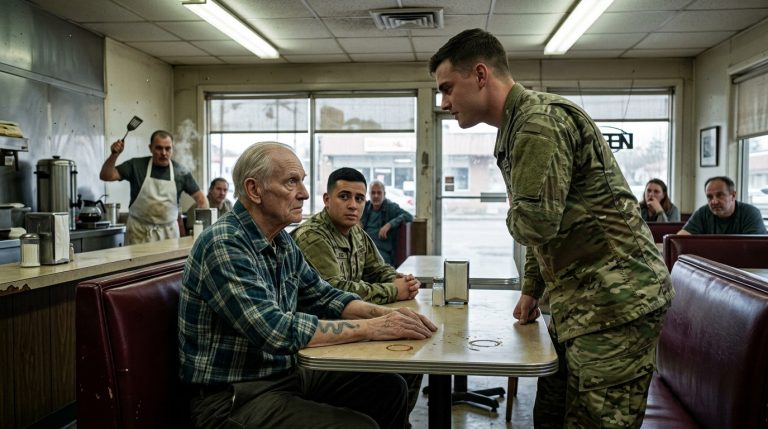
The silence in the diner was a physical weight, thick with the smell of scorched coffee and the dry, metallic tang of an approaching dust storm rattling the windowpanes. The biker’s laughter hung in the air like a taunt, but to Elias, it was just noise—a frequency he had learned to tune out decades ago.
He kept his gaze fixed on the counter. The wood beneath his calloused fingertips was scarred and peeling, a map of decades of neglect. He could feel the cold, sharp edges of the microfilm canister deep in his pocket, pressing against his thigh. It was a small, unassuming thing, a hollow metal tube that held the capacity to bring an entire county to its knees.
“I’m talking to you, old timer,” the man with the beard growled. The leather chair screeched against the floor as he stood up, his heavy boots echoing like drumbeats against the hollow floorboards.
Elias tightened his grip on the brass handle of his cane. The metal was cool and steady, a grounding anchor in a world that felt increasingly unmoored. He didn’t fear the men; he feared the expiration of time. If he didn’t reach the post office by noon, the envelope wouldn’t be postmarked, and the truth would stay buried in the dust of the valley floor for another generation.
“The ramp is for those who need it,” Elias said. His voice was a rasp of dry leaves, steady and devoid of tremors. He finally turned his head, his pale eyes tracking the biker’s movement. He noted the way the man shifted his weight to his right—a sign of a bad knee, an old injury that would make him slow to pivot.
The biker stepped into his space, the scent of stale tobacco and hot engine oil wafting off his vest. He loomed over Elias, a mountain of black leather and arrogance. “You got a death wish, pops? Or just lost your way?”
Elias allowed himself the ghost of a thin, humorless smile. He looked past the biker, toward the window where the sky was turning a sickly shade of ochre. The wind picked up, a high-pitched whistle that sounded like a warning.
“I know exactly where I am,” Elias replied, stepping sideways with a fluid, practiced motion that belied his age. As he moved, his hand brushed the pocket of his jacket, ensuring the canister hadn’t shifted.
He didn’t make for the door. Instead, he turned toward the kitchen service window, where he knew the heavy metal door led to the alleyway—and the shortcut to the town square.
“Hey!” the biker shouted, reaching out a hand, but his fingers caught only empty air.
Elias felt the vibration of a heavy boot hitting the floor behind him, but then the diner’s front door swung open, and a woman in a mud-splattered coat stepped inside, her face drained of color. She held a damp newspaper, and the headline was visible even from across the room: Local Factory Site Declared Safe.
Elias stopped dead. The woman wasn’t looking at the bikers. She was looking at him, her eyes wide with a specific, hollow terror that suggested she had just seen something in the dirt that she wasn’t supposed to see.
CHAPTER 2: THE PAPER SHADOW
Elias didn’t blink. He stood frozen, the kitchen service door mere inches to his left, the metal handle biting into his palm as he braced his weight. The headline in the woman’s hands—Local Factory Site Declared Safe—was a jagged shard of reality that didn’t just clash with his own knowledge; it threatened to burn it to ash.
The biker with the beard had stopped moving, his heavy frame blocking the light from the front window. He was watching the woman, not Elias, his brow furrowed in a flicker of genuine confusion that suggested he, too, hadn’t expected this particular development. The silence that followed was absolute, save for the rhythmic thrum of the overhead fluorescent light and the distant, low growl of the wind outside.
“Safe,” Elias whispered, the word feeling like a mouthful of grit.
He didn’t look at the bikers. He didn’t look at the door. His eyes stayed locked on the woman’s hands. She was trembling, the paper rattling against her wool coat. She looked up then, her eyes darting toward Elias, and in that split second, the air in the room shifted. She wasn’t just another customer; she was someone who knew exactly what the headline meant, and she was terrified.
The memory hit Elias with the force of a physical blow—[V-2] The sudden, invasive phantom of the factory’s rusted main gate, the way the iron would groan against the concrete when he’d locked it for the last time, years ago. He could smell the ozone and the rot, a scent that had no business in a diner serving coffee and cheap pie. He had kept that memory buried under layers of logistics and survival, but the word safe tore the seal right off.
“Ma’am,” Elias said, his voice dropping into the register he’d used as a foreman. It was a command, calm and serrated. “Put the paper down. It’s not worth the ink.”
The biker turned, his sneer returning as he caught the tension in Elias’s voice. “Leave the lady alone, pops. You’re already late for your exit.”
Elias ignored him. He moved, his movements precise and economical. He didn’t reach for the door; he moved toward the counter, closing the distance between himself and the woman. The bikers were peripheral, a noise to be managed, but the woman was the variable that could change the equation.
“They’re lying,” she whispered, her voice barely audible over the hum of the freezer unit. She didn’t drop the paper. She moved closer, leaning into his space. “I was there. At the site. I saw the testing rigs, Elias. They aren’t cleaning the soil. They’re burying it deeper.”
Elias stiffened. The mention of his name—not pops, not old man—sent a cold spike through his chest. He didn’t know her, or he thought he didn’t. But in this town, secrets had long memories and longer shadows.
“You’re mistaken,” Elias said, keeping his tone flat, even as his pulse began to hammer against the canister in his pocket. The deed, the maps, the logs—it was all there, a dead weight against his hip. If she was right, if the “cleaning” was a ruse, then his timeline had just collapsed. He didn’t have until noon. He had to move now.
“I’m not,” she insisted, her gaze locking onto his. “And they know you have it. The original deed. They’ve been tearing the floorboards up at the old office looking for it.”
The biker reached out, grabbing the edge of the counter, his knuckles white. “What’s that about a deed?”
Elias didn’t look at the man. He focused entirely on the shift in the woman’s posture—the way she tilted her head toward the kitchen door. She wasn’t just warning him; she was offering a path.
“The wind is picking up,” Elias said, his voice deceptively casual. He shifted his weight, his fingers finding the edge of a heavy ceramic sugar shaker on the counter. “Might be a bad time to be driving.”
He swept the shaker off the counter with a flick of his wrist. It hit the floor with a deafening crash, shattering into a thousand white, crystalline shards.
The sound was the trigger. The bikers jolted, eyes instinctively drawn to the mess, and in that second of distraction, Elias stepped backward, his cane finding the purchase of the kitchen threshold. He slammed his shoulder into the door, pushing it into the dark, narrow hallway that led toward the back alley.
“Don’t follow,” he muttered, though he knew they would.
He didn’t run. Running was for those who still believed in a finish line. He walked, his stride measured, his mind already calculating the distance to the town’s drainage ditch—a rusted, overgrown channel that cut through the center of the industrial park. If they followed, he would have to lead them into the one place where his age and knowledge of the terrain would outweigh their size and youth.
The hallway smelled of old grease and floor cleaner. He could hear the bikers scrambling in the diner, the heavy tread of boots on wood, the shouting. They weren’t just muscle anymore; they were hunters.
Elias reached the back door and pushed it open. The wind slammed into him, a wall of dust that stung his eyes, but he kept moving. He stepped out onto the cracked asphalt of the alleyway, the sky above a bruised purple. He turned left, toward the sound of the storm, his hand still tight on the canister. He had the truth, but he was no longer just protecting a memory. He was now the target of a lie that was moving fast, and he had nowhere left to go but through the dust.
CHAPTER 3: THE DRAINAGE DITCH GAMBIT
The asphalt of the alleyway was uneven, buckled by years of tree roots and neglect. Elias pushed himself, his breath coming in sharp, shallow stabs that tasted of copper and dust. The wind whipped his field jacket, the brass buttons clicking against the fabric like a frantic metronome. Behind him, the back door of the diner banged open, followed by the heavy, rhythmic thud of leather boots hitting the ground. They were closing the distance.
He kept his gaze low, scanning the ground for the manhole cover that led to the city’s old storm drainage network. He knew this alleyway better than he knew the lines on his own palms; he had helped survey it forty years ago, back when the town had grand ambitions of industrial expansion that died before the concrete even cured.
“There he is!” the bearded biker shouted, his voice thick with exertion and irritation.
Elias didn’t look back. He poured every ounce of his remaining strength into his stride, leaning on his cane to vault over a pile of discarded shipping crates. His hip protested, a dull, aching fire that traveled up his spine, but he ignored it. The physical pain was a distant concern; the survival of the canister was the only reality.
He reached the heavy iron grate near the far brick wall. His fingers flew to the latch, his heart hammering against his ribs. He yanked at the handle, expecting it to give way, but the mechanism jammed—[V-3] The latch had rusted into a singular, immovable piece of pitted iron.
“Damn it,” he hissed, his composure fracturing for a heartbeat.
He didn’t have time to fight the rust. He braced his boot against the brickwork, gripped the iron with both hands, and threw his weight backward. It was a foolish, desperate gamble, one that required the kind of kinetic leverage his body was no longer designed to handle. For a terrifying second, the iron held fast, and the sound of the bikers’ boots grew louder—a thunderous approach that promised a violent confrontation.
Then, with a screech of shearing metal that sounded like a scream, the latch gave. The grate swung open, revealing the dark, subterranean throat of the drainage tunnel. Elias didn’t hesitate. He swung his legs into the void, sliding down the slick, wet concrete of the incline just as a heavy hand slammed into the brick wall where his shoulder had been a second before.
He tumbled into the dark, the air changing instantly—the smell of ozone and surface heat replaced by the damp, earthy scent of stagnant water and cold, mossy stone. He landed hard on the embankment, the impact jarring his teeth, but he scrambled to his feet instantly.
He didn’t activate his flashlight. He knew the path by the sound of the water and the way the air currents pulled through the tunnel. He moved into the gloom, his hand instinctively patting his pocket to ensure the canister remained securely nested.
The sound of the bikers above was muffled now, reduced to angry shouting and the scraping of metal against metal. They were milling about, blinded by the sudden transition from the hazy, dust-choked afternoon to the deep shadows of the tunnel entrance.
Elias moved deeper. Every step was a tactical choice—he stayed against the wall, keeping his breathing rhythmic and shallow, minimizing the sound of his movement. He knew where the tunnel branched; the left pipe led toward the town square, while the right went toward the old archives building. He chose the right. It was longer, more treacherous, but it was the only route that offered a chance to slip into the library basement without being seen from the street.
He reached a section where the tunnel narrowed, the ceiling dripping with condensation that slicked the floor. He paused, pressing his back against the cold, sweating stone. He could hear his own heartbeat, a frantic rhythm that echoed in the confined space.
He pulled the canister from his pocket. It was small, cold, and heavy with the weight of decades of deceit. He thought of the woman in the diner, the way she had looked at him, the way she had whispered about the deed. She was a link to a past he had spent his entire life trying to bury, or perhaps, trying to find a way to burn.
Safe. The word echoed in the tunnel, mocked by the drip of water. If the site was safe, then he was holding a lie. If the site was poisoned, then he was holding the only thing that could force a reckoning.
He tucked the canister back into his pocket, his movements deliberate. He had been a foreman, a man who built things to last, and he knew that the strongest structures were the ones built on honest foundations. This town was built on a foundation of rust and rot, and he was the only one holding the blueprints to its collapse.
He rounded the corner, the tunnel opening up into a wider, arched chamber where the runoff from the old factory settled into a slow, black pool. He had to cross it. He knew the water was shallow, but the bottom was covered in slick silt and jagged rebar.
He tested the depth with his cane, the wood sinking into the black sludge. He took a step, then another, the cold water seeping through his boots. Every step was a negotiation with gravity, a test of his resolve against the encroaching darkness. He was a long way from the diner, a long way from the safety of his quiet, fading life, but as he felt the cold bite of the water, he realized he didn’t want to go back.
He was finally doing something that mattered. The fear was still there, a constant, low-frequency hum in his gut, but it was being eclipsed by a cold, hard sense of purpose. He reached the other side, his boots squelching on the concrete, and looked up toward the faint, rectangular glow of a storm drain grating high above. That was the archives building.
He began the climb, his fingers finding purchase in the weathered mortar. The air was getting thinner, sharper. He could hear the wind howling somewhere far above the surface, a sound that promised a long, difficult night ahead. He didn’t care. He was close now. Close enough to touch the truth.
CHAPTER 4: THE ARCHIVE OF LIES
Elias pulled himself through the storm grate and onto the concrete floor of the basement, his knees hitting the cold ground with a dull thud. The library archives were exactly as he remembered: rows of towering metal shelves laden with the dusty, yellowed bones of the town’s history, illuminated only by the faint, rhythmic strobe of a security light leaking from the upper floor. He stood up, his joints popping, and brushed the damp silt from his field jacket. The silence here was different—it wasn’t the natural quiet of the earth, but the heavy, pressurized stillness of a tomb.
He moved toward the center aisle, where the records from the old factory were housed. His hand instinctively found the microfilm canister in his pocket, the metal cool and reassuring against his skin. This was the place. If he could find the index, he could verify the property descriptions before attempting the next stage of his plan.
He didn’t turn on his own light. He knew the shelf layout by touch. He navigated the narrow gap between the rows, his boots making no sound on the worn linoleum. As he reached the section labeled Industrial Land Management, he paused. Something was off. He leaned in, his eyes adjusting to the low light. [V-1] Tucked behind a stack of weathered ledgers was a sleek, black housing unit—an infrared motion sensor, its tiny power light blinking a rhythmic, icy blue.
It was out of place, a piece of high-end, modern surveillance technology in a room that smelled of mildew and neglected paper. The town’s library couldn’t afford this. That realization hit him with a cold, sharpening clarity: they weren’t just looking for the deed; they were monitoring the archives specifically to intercept whoever might come looking for the proof.
Elias froze, his body rigid. He hadn’t been followed here—he was sure of that—but the trap was already set. He realized then that his assumption had been wrong. They didn’t just want the deed destroyed; they wanted the person who held it.
He stepped back, his heart hammering against his ribs. He couldn’t risk the microfilm reader in the back room; it would trigger an alarm or a notification. He had to go to ground, but he had to see the deed first. He reached out, his fingers tracing the spine of the ledger he needed. It felt fragile, the leather binding peeling away under his touch.
He pulled it down, keeping it in the shadows, and flipped it open. The pages were brittle, crinkling like dried leaves. He found the entry for the factory site, the ink faded but legible. He scanned the legal description, his brow furrowing. He compared it to the information he carried in his memory—the coordinates of the original survey.
The ledger was wrong.
Someone had altered the entries. The property lines for the factory had been shifted by a hundred yards on paper, effectively excluding the main runoff basin—the very area where the toxic waste had been pumped—from the deed’s jurisdiction. It was a masterstroke of bureaucratic theft, a way to make the poison legally disappear by moving it into a “neutral” zone that didn’t technically exist on the current town map.
Elias felt a wave of nausea wash over him. This was the decoy. The deed he carried was the correct one, the one that proved the toxic site and the deed were linked, but the records in the library had been scrubbed to reflect this new, forged reality. If he tried to present his deed, it would look like a forgery. He was trapped by a lie that had been systematically woven into the town’s history for years.
He closed the ledger, his hands trembling. He needed to get out, but he had to be smarter now. The surveillance meant that whoever was running this town—the developers, the politicians—was watching every move.
He heard a faint sound from the staircase: the metallic click of a door latch.
He dropped to his knees, sliding into the narrow crawlspace beneath the bottom shelf. He held his breath, his eyes fixed on the entrance to the archive room. A beam of white, LED light sliced through the darkness, sweeping across the rows of shelves. It was calm, methodical, and entirely professional.
“Nothing in the main racks,” a voice muttered—a man’s voice, crisp and devoid of the biker’s grit. It was the voice of someone who wore a suit, someone who operated in the daylight of offices and boardrooms.
Elias watched as the light passed over the shelf where he had just been standing. He gripped his cane, the handle pressed firmly into his palm. He had the truth, but he was currently just a ghost in his own history. He had to decide: stay hidden and hope they moved on, or move now and risk being seen.
The light stopped. It swung back, focusing on the gap where the ledger should have been.
“The management ledger is missing,” the voice said, the calm edge hardening into something predatory. “Find him. He’s already in the basement.”
Elias realized then that the archive wasn’t just a trap; it was a cage. He had to force his way out, but he couldn’t use the drainage tunnel again. He scanned the basement walls, looking for any other exit—a ventilation shaft, a coal chute, anything. His eyes settled on a small, high window near the ceiling, barely large enough for a man his size, but it led to the alley.
He waited until the flashlight moved to the opposite end of the room. He didn’t rush. He moved with the slow, calculated precision of an old soldier, using the sound of the intruder’s own footsteps to mask his approach to the wall. He was close to the window, the faint glimmer of streetlights visible through the dirty glass. He just had to climb.
He took a breath, the air tasting of iron and failure, and began to pull himself up the racking. He was going to get out, and when he did, he would stop playing by their rules. The deed wasn’t just his leverage anymore; it was his weapon.
CHAPTER 5: THE DEVELOPERS REACH
Elias hooked his fingers over the iron lip of the window frame, the metal biting into his skin like cold teeth. He hoisted himself up, his muscles screaming in protest, the heavy microfilm canister acting as a dead weight in his pocket. He swung his legs through the opening and dropped, landing hard in the grit of the alleyway. The impact sent a jolt of pain through his ankle, but he forced himself to stand, his eyes scanning the narrow corridor. The air here was thicker, swirling with the dust kicked up by the strengthening storm.
He hadn’t made it five yards before a black sedan blocked the mouth of the alley. Its headlights flickered on, two blinding white eyes that carved a path through the gloom. The engine didn’t roar; it hummed with the smooth, expensive silence of high-end machinery. Elias pressed himself into the shadow of a dumpster, the smell of damp refuse filling his lungs.
A door opened. A man stepped out, dressed in a charcoal-grey suit that looked entirely out of place against the peeling brick and rusted refuse of the industrial sector. He didn’t look like a thug; he looked like a man who spent his days signing balance sheets and his nights erasing liabilities. He held a small, handheld scanner that glowed with a faint, pulsing light—the same source that had powered the sensor in the archives.
“Mr. Thorne,” the man said, his voice smooth and utterly devoid of hostility. He stood in the center of the alley, hands clasped behind his back, looking exactly like a man who had all the time in the world. “You’ve been a very difficult man to find. The library is a bit of a trek for a man of your vintage.”
Elias stayed still, his hand hovering near the brass handle of his cane. He was cornered, but he wasn’t finished. He observed the man’s posture—shoulders relaxed, head tilted slightly, an air of complete, practiced arrogance. He wasn’t afraid. He knew exactly where Elias was, and he knew Elias had nowhere to run.
“I’m not interested in your company,” Elias said, his voice steady. He shifted his weight, preparing to dart toward the side-gate of the warehouse district.
“I’m sure you aren’t,” the man replied, taking a slow step forward. The scanner in his hand clicked. “But you have something that doesn’t belong to you. The property deed to the basin. It’s an administrative error, Elias. A relic of a time when the town had… different priorities. We’re simply cleaning up the paperwork.”
“Cleaning up,” Elias repeated, the words tasting like copper. “Is that what you call burying the truth under a hundred feet of concrete?”
The man paused, a thin, patronizing smile touching his lips. “I call it development. The town needs a future, Elias. You’re holding onto a past that is already dead. The contamination you think you’ve uncovered? It’s a closed chapter. The new site surveys have already been filed, notarized, and approved by the board. Your canister contains nothing but outdated, conflicting information that will only serve to confuse the progress we’ve made.”
Elias felt the weight of the canister, a sudden, blinding realization washing over him. The man didn’t want the deed because it proved the town was poisoned—he wanted it because it was the only document that could legally prevent the new construction. The decoy secret wasn’t just that the site was “safe”; it was that the developers had already legally rewritten the boundaries of the town to make the toxicity someone else’s problem. They were building over the evidence, and by the time anyone realized what was beneath their feet, the concrete would be cured, the permits filed, and the profit cleared.
“You’re not cleaning anything,” Elias said, his voice dropping into a dangerous, low rasp. “You’re just moving the dirt.”
“We’re moving the town forward,” the man corrected. He reached into his jacket, and for a split second, Elias feared a weapon, but the man merely pulled out a fountain pen. “Hand over the canister, Elias. Go home. You’ve spent forty years guarding a ghost. Let it go, and you can live out your remaining days in peace.”
Elias looked at the pen, then at the man’s eyes—cold, empty, and utterly devoid of doubt. The man didn’t see a person in front of him; he saw a line item to be resolved.
Elias stepped out from the shadows, the wind whipping his field jacket. He didn’t offer the canister. Instead, he gripped his cane and slammed the base of it into the soft, wet earth between them, a gesture of absolute defiance.
“I didn’t spend forty years guarding a ghost,” Elias said, his voice ringing with a sudden, sharp clarity. “I spent them waiting for someone arrogant enough to think I’d just hand it over.”
He reached into his pocket and pulled out the canister, but he didn’t hold it up for the man to take. He held it out over the open drain of the alleyway, his fingers loose, the cold metal balanced on the edge of the abyss.
The man’s smile faltered. For the first time, his posture shifted, his shoulders hunching slightly as he realized the tactical reality of the situation.
“Don’t,” the man warned, his voice losing its polished veneer.
“You want it?” Elias asked, his hand twitching over the dark, rushing water below. “Then come and get it. But know this—if this hits the water, it isn’t lost. It’s moved. And I have friends who know exactly where to look for it when it surfaces.”
It was a lie, a desperate, crumbling fabrication, but it was the only card he had left to play. He watched the man’s eyes flick toward the drain, then back to Elias’s face, searching for the crack in the facade.
Elias didn’t wait for a response. He didn’t let the man calculate the risk. He turned and threw the canister—not into the drain, but into the darkness of the warehouse district, a heavy metallic clatter echoing through the narrow gap. The man lunged toward the sound, his composure shattered, and in that split second of chaotic movement, Elias bolted in the opposite direction.
He didn’t look back. He ran with a desperate, lung-burning intensity, his legs pounding against the asphalt, his heart a frantic drum in his chest. He had bought himself time, but he had lost his leverage. He was now running on instinct, with nothing left but the truth he carried in his head. The game had changed. He wasn’t protecting a piece of paper anymore; he was now the only living witness to a crime that had already been erased.
CHAPTER 6: THE SHATTERED ARCHITECTURE
The warehouse district was a graveyard of ambition. Elias stumbled between the hulking, corrugated-steel husks of buildings that hadn’t seen a shipment in twenty years. His lungs felt like they were lined with sandpaper, and each inhalation brought the sharp, stinging taste of cold iron. He didn’t know if the man in the charcoal suit was still behind him, but he could feel the phantom pressure of surveillance—the sensation of invisible eyes tracking his erratic path through the maze of dead industry.
He ducked behind a stack of rotted wooden pallets, pressing his back against the corrugated metal wall. His hands were shaking, not just from the exertion, but from the unraveling of everything he had held onto for the last four decades. The deed he had been guarding, the secret he had been protecting—it was all a shell game, a distraction designed to keep him looking at the surface while they re-engineered the very geography of the valley.
[V-4] He looked down at his own hands, the skin mapped with age and grime, and for a fleeting, terrifying moment, they seemed like someone else’s hands—a stranger’s. The world blurred at the edges. Was he even here, in this alley, or was he still back in the foreman’s office, staring at the maps, waiting for the day the collapse would inevitably arrive? The distinction felt dangerous, a fraying thread in the tapestry of his own reality. He had to stay anchored. He had to be real.
He pushed off the wall and began to move again, favoring his left side, his cane clattering against the loose gravel. He needed to reach the old water tower. It was the highest point in the district, the only place where he could get a vantage point on the entire town. If they were indeed scrubbing the records and physically altering the town boundaries, he would see the evidence from above.
The wind had died down, replaced by a suffocating, unnatural stillness. He navigated the shadows with the practiced ease of a man who belonged to the night. When he reached the base of the water tower, he found the ladder. The metal was pitted, orange-brown with rust that stained his palms like dried blood. He began to climb, the rungs groaning under his weight, the wind picking up again as he ascended, whistling through the gaps in the tower’s girders.
He reached the maintenance catwalk, his breath hitching in his chest as he pulled himself up and stood on the grated platform. Below him, the town lay spread out like an architectural diagram.
He looked toward the factory site. At first, it looked normal—the flat, barren expanse he had known for years. Then, he looked closer. His vision seemed to sharpen, stripping away the twilight haze. He saw the subtle, geometric unnaturalness of the grading. The earth hadn’t just been moved; it had been sculpted. The drainage basin, the one he had spent his life watching, was gone. In its place was a freshly compacted rise, structured to divert the groundwater away from the new construction site and directly into the heart of the town’s water table.
They weren’t building on the site. They were turning the entire valley into a filtration system for the toxins they had buried.
“My god,” he whispered. The sound was swallowed instantly by the wind.
He wasn’t just protecting a deed; he was witnessing the murder of the town. The man in the suit hadn’t been lying when he said it was ‘development.’ It was a calculated, irreversible redistribution of poison.
He heard the sound of heavy engines idling below. Two, maybe three vehicles. They hadn’t followed him; they had anticipated him. They knew exactly where he would go once he realized the library archives were a dead end. He looked down and saw the flashlights again—a coordinated, grid-like sweep of the warehouse area.
He wasn’t going to make it down the ladder. He had nowhere left to go but up. He scrambled toward the maintenance hatch at the top of the tower, his fingers frantic against the frozen wheel of the lock. It moved an inch, then stuck. He threw his shoulder against it, a desperate, guttural grunt of effort escaping him.
The hatch shrieked, the metal grinding in protest, and then it gave way, swinging open into the dark, echoing interior of the water tank. He didn’t look down at the ground again. He climbed into the belly of the tower, the darkness closing around him like a shroud. He sat in the center of the cold, metallic space, his back against the curved wall, and listened.
Footsteps approached the base of the ladder—deliberate, heavy, and numerous. They were coming up. He realized then that he wouldn’t be leaving this tower, not in the way he had planned. He closed his eyes, his mind finally, painfully clear. He had spent his life trying to hold the past together, but the past was just a set of blueprints for a future they had already rewritten.
He didn’t need the deed to stop them. He just needed to be seen. He reached into his field jacket, pulled out the microfilm canister, and placed it inside the hollow of the metal railing near the hatch. It would be found, eventually. The truth would survive the fall. He settled himself, his grip firm on the brass handle of his cane, and waited for the hatch to open.
CHAPTER 7: THE ECHO OF THE FOREMAN
The hatch above clanged open, a harsh, discordant note that vibrated through the steel walls of the water tank. A shaft of twilight, cut by the erratic movement of flashlight beams, pierced the darkness of his hiding place. Elias pressed himself into the curve of the tank, his heart a frantic, uneven rhythm against his ribs. He felt the phantom chill of the metal against his spine, a cold that seemed to seep directly into his bones.
[V-2] In the silence between the footsteps, he heard it—a memory so vivid it felt like a hallucination. It was his own voice, forty years younger, echoing off the same steel walls during a routine inspection. “Make sure the seals hold, boys. Once we fill it, there’s no coming back.” The irony was a jagged blade in his throat. He had been the one to sign off on the structural integrity of this tank, never suspecting that the integrity of the ground beneath it was already compromised. He was the architect of his own cage.
“I know you’re in here, Elias,” the man in the charcoal suit called out, his voice modulated, calm, and maddeningly composed. “The tower isn’t exactly a labyrinth.”
Elias didn’t respond. He gripped his cane, his knuckles white, the wood biting into his palm. He watched the beam of a flashlight dance over the rusted interior, catching the flaking iron oxide that coated the walls. He wasn’t afraid of the man; he was afraid of the quiet that would follow. He had done his part. The microfilm was hidden, the truth was out of his hands, and now, he was just a loose end being trimmed away.
“You think you’ve done something heroic,” the man continued, his footsteps crunching on the metal floor of the tank. “But you’ve only managed to delay the inevitable. The demolition starts at dawn. By midday, the basin will be buried, and your little canister will be nothing but a curiosity for someone digging in the wreckage a century from now.”
Elias shifted, his boot scraping against the metal. The sound was amplified, a sharp, telegraphic signal.
“Is that right?” Elias asked, his voice rasping out into the dark, surprisingly steady. “Then why are you here? If it’s so meaningless, why not just let me sit here and wait for the sun to go down?”
The flashlight beam snapped onto him, blindingly bright, pinning him against the curve of the wall. He squinted against the glare, his silhouette cast in harsh relief. The man in the suit stopped a few feet away, his face obscured by the shadow of his own silhouette.
“Because I don’t like unfinished business,” the man said. “And because there’s a certain… poetry in having the man who built this place be the last one to see it go.”
The man reached into his coat. This time, there was no fountain pen. He pulled out a small, metallic object, something that shimmered with the dull, lethal light of a signaling device.
“I’m not going to hurt you, Elias. That would be messy, and we’ve worked too hard to keep this town clean. But I am going to see you off-site. We have a private transport waiting, and a very comfortable facility on the coast where you can spend your remaining years reconsidering your loyalty.”
Elias felt the walls of the tank closing in. A private facility. He knew what that meant—a soft, invisible prison where the truth would be buried alongside him. He stood up slowly, using the cane to leverage his weight. His legs were weak, trembling with fatigue, but he forced himself to stand straight, his gaze fixed on the man’s shadow.
“You forgot one thing,” Elias said, his voice gaining a sudden, dangerous edge.
“And what’s that?”
“I didn’t come here to be a witness,” Elias said. He took a single, halting step forward, his cane clicking against the metal floor. “I came here to finish the inspection.”
He reached into his pocket—not for a weapon, but for the heavy, iron-tipped key he had carried for forty years, the one that controlled the emergency drain valve at the base of the tower. He had pulled it from his locker before he left the diner, an instinct he hadn’t fully understood until this exact second.
He didn’t aim for the man. He aimed for the floor, for the pressure-release linkage he knew was beneath the grate they were standing on. He brought the cane down with every ounce of his remaining strength, the iron tip slamming into the rusted locking mechanism of the main release.
The metal shrieked—a sound of structural failure that dwarfed the clanging of the hatch. The floor beneath them groaned, the grate snapping upward with the force of the tension that had been held in place for decades. The man staggered, the light beam spinning wildly into the dark as he grabbed for the railing.
The ground beneath them didn’t just break; it gave way.
Elias didn’t jump. He didn’t have to. The tower, weakened by the decades of neglect and the heavy, shifting earth beneath it, surrendered to the sudden shift in balance. As the floor dropped, the entire structure lurched, the steel foundations screaming as they pulled from the soil. The world tilted—a sickening, grinding rotation that sent the man in the suit sliding toward the open hatch.
Elias held onto the central support beam, his body whipping through the air as the tower fell. The roar of the collapse was deafening, a symphony of twisted steel and rending iron. Everything went black, and then, a sudden, blinding flash of light as the tower slammed into the soft, muddy earth of the basin.
For a moment, there was only the sound of his own heavy, ragged breathing and the distant, fading echo of the industrial park. He was alive. He was pinned, his leg trapped beneath a girder, but he was alive. And looking up through the mangled remains of the tower’s side, he saw the dawn beginning to break, the first rays of light illuminating the valley in a way he had never seen before. The deception was failing. The land was exposed. He had done his part.
CHAPTER 8: THE WEIGHT OF THE TRUTH
The twisted steel groaned, a rhythmic, metallic screech as the wind pushed against the collapsed tower. Elias lay on his side, his breath hitching in his chest, the air tasting of pulverized concrete and old, stagnant water. His leg was trapped beneath a jagged strut, the pressure a dull, radiating heat that signaled he wasn’t going anywhere.
A few feet away, the man in the charcoal suit was crawling through the debris, his movements jagged and frantic. His coat was torn, and a deep laceration across his forehead bled a bright, stinging red that ruined the pristine symmetry of his suit. He reached for the microfilm canister—which had skidded across the mud during the collapse—but his fingers were slick with blood, making him clumsy.
Elias watched him. The man wasn’t a shark anymore; he was just a desperate, frightened animal caught in the ruin he had helped orchestrate.
“The canister,” the man wheezed, his eyes darting toward Elias. “Give it to me, Elias. I can call for a medivac. We can still fix this.”
Elias didn’t look at the canister. He looked at the sky. The dawn had broken fully, a pale, bruised light that revealed the extent of the damage. The basin was ripped open, the earth torn away to reveal the dark, oily soil of the former factory site—the truth exposed to the cold morning air.
“You can’t fix this,” Elias whispered, his voice thin but resonant against the silence of the valley. “You built this town on a grave, and the earth is finally spitting it back out.”
The man snarled, lurching forward, but he collapsed halfway, his strength failing. He was trapped in the wreckage as surely as Elias was. The power dynamic, the tactical advantage, the arrogance of the boardroom—it had all been crushed under the weight of the very structure he had come to secure.
Elias reached out, his hand trembling as he grasped a length of rusted piping near his head. With a final, agonizing push, he shifted his weight, using the pipe as a lever against the strut pinning his leg. The iron groaned, slipping, and then, with a sharp, sickening slide, the girder shifted just enough. Elias pulled his leg free, a cry of pure, white-hot pain escaping his throat.
He didn’t crawl toward the man. He crawled toward the canister. He grabbed it, his fingers closing over the cold metal.
The man watched, his face twisted in a mask of impotent rage. “You think that changes anything? They’ll just say you sabotaged the tower. They’ll erase the site, they’ll erase you, and by the end of the week, the concrete will be poured.”
Elias turned to face him, cradling the canister to his chest. He looked at the man—really looked at him—and saw the flicker of genuine terror beneath the fury. He wasn’t afraid of the police, or the law, or the townspeople. He was afraid of the fact that for the first time in his career, he had lost control of the narrative.
“They won’t be pouring anything,” Elias said. He reached into his pocket and pulled out his old, battered phone. It had survived the fall. He hit the one button he had kept on speed dial for forty years—the number for the local journalist, the one he had never had the courage to call.
He didn’t speak. He just held the phone out toward the debris, toward the exposed, black earth of the factory site, and pressed the speakerphone. He let the silence of the valley, the whistling of the wind through the wreckage, and the ragged, broken breathing of the man in the suit fill the line.
“They’re coming,” Elias said, his voice quiet. “And they aren’t here for the land.”
The man stopped moving. He slumped back against a piece of twisted grating, his eyes tracking the sound of distant, approaching sirens—not one, but many. The police, the news vans, the emergency crews; they were converging on the valley, drawn by the catastrophic failure of the tower that had served as the town’s silent, rusted anchor.
The Payoff was absolute. The man had come to bury the secret, and he had ended up orchestrating the very event that would expose it to the world. Poetic Justice, etched in steel and soil.
Elias closed his eyes, the strength finally leaving him. He leaned his head against the cold earth and let the sound of the sirens grow, a beautiful, discordant wail that signaled the end of the silence.
The Denouement began as the chaos reached them. Men in uniforms swarmed the wreckage, their lights flashing, their voices booming in the valley. They found the man first, dragging him away as he shrieked about liabilities and contracts, his suit ruined, his power dissolved into the mud.
Then, they found Elias.
A young paramedic knelt beside him, her face full of concern, her hands gentle as she checked for injuries. Elias didn’t fight her. He handed her the canister.
“Keep it safe,” he murmured. “It’s the foundation.”
They loaded him onto a stretcher, the movement fluid and soft. As they carried him toward the waiting ambulance, the town began to stir in the distance. He saw the buildings, the streets, the park—the place he had protected for so long. It looked different in the clear, sharp light of the morning. It wasn’t perfect, it wasn’t safe, but it was finally, brutally honest.
He felt a hand touch his arm—it was the woman from the diner. She wasn’t smiling, but she looked down at him with a quiet, profound respect. She took his hand, her palm warm and rough against his own, and for a moment, the pain in his leg faded into a distant hum.
He looked up at the sky, the clouds beginning to disperse, the sun finally touching the ground. He had spent his life fixing locks and guarding gates, but he had finally opened the one door that mattered. He felt a sense of peace settle into his chest, a quiet, resonant stillness.
He had saved nothing, and in doing so, he had saved everything. The weight was gone. The rust was being scoured away by the light, and for the first time in forty years, the foreman could finally close his eyes and rest.