The Velocity of Silence: A Sergeant’s Last Perimeter and the Ghost of the Firing Line
CHAPTER 1: THE FIRING LINE
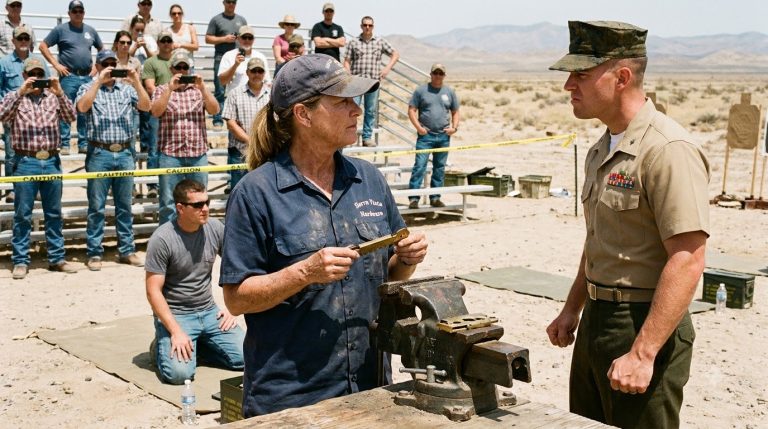
“Is this some kind of joke?” Gunnery Sergeant Miller barked, his voice cutting through the tense silence. He wasn’t looking at his Marines; his glare was fixed on the old man standing quietly behind the firing line. “Do you even know where you are, old man?”
Dean Peters, eighty-two years old and dressed in denim that had faded to the color of a winter sky, did not blink. He stood with the relaxed spine of someone who had spent his life walking through minefields without checking his feet. In his hands, he cradled a long, heavy object wrapped in oil-stained canvas. It looked like a rifle case, but the dimensions were wrong—too thick at the midsection, tapered in a way that defied modern manufacturing.
Miller’s thumb hooked instinctively into his belt, hovering near his sidearm. The range was live. The targets were paper, but the threat was steel. Behind Miller, the firing squad shifted, their boots crunching on the gravel. They were waiting for a command that Miller was currently too distracted to give.
“Step back, Peters,” Miller growled. He knew the name—it had surfaced during a routine security sweep of the local archives—but he hadn’t expected to see the man in the flesh, let alone here, in the restricted heart of the base.
Peters didn’t move. Instead, he tilted his head, his eyes tracking the red flags snapped taut by the desert wind. “The wind is shifting, Sergeant. Five degrees to the north-northeast. You’re firing into a cross-breeze. Your grouping will be off by at least two inches.”
Miller felt the skin on the back of his neck prickle. The old man wasn’t just observing the flags; he was reading the physics of the range like a blueprint. Miller checked the wind gauges on the peripheral display; the reading was flickering, unsettled.
“I didn’t ask for a ballistics report,” Miller said, taking a sharp step forward. The gravel groaned under his boot. “I asked you to leave.”
“I brought something back,” Peters said, his voice as dry as the dust blowing across the range. He didn’t look at Miller; he looked at the canvas-wrapped object. “It’s a pity they stopped keeping records of things that don’t serve the bottom line. It makes the truth so much heavier to carry alone.”
Miller’s heart rate climbed. He scanned the old man’s hands, looking for a trigger, a remote, a wire. Peters moved his hands slightly, and the canvas shifted, revealing a glimpse of matte-black finish beneath the fabric. It wasn’t a weapon. It looked like a piece of aerospace debris, scorched and pitted with age.
“Drop it,” Miller ordered, his voice dropping to a dangerous, low frequency.
Peters finally looked at him. His eyes were not the eyes of a senile trespasser; they were cold, steady, and terrifyingly clear. He didn’t drop the object. He stepped forward, into the kill zone, and tapped a jagged dent in the metal that was now visible through the fraying cloth.
“You don’t want to see this, Sergeant,” Peters whispered, the wind stealing the sound but not the intent. “Because once you see it, you’ll realize the man you call ‘Father’ didn’t just build this base. He buried the people who tried to fix it.”
CHAPTER 2: THE PERIMETER BREACH
Miller didn’t retreat. He couldn’t. To step back was to concede the space, and in the geography of a restricted-access range, space was the only currency that mattered. He kept his heels planted on the gravel, his boots grinding into the earth. The silence between them grew taut, vibrating like a piano wire pulled to the point of snapping. Around them, the wind surged, snapping the red range flags with the violence of a gunshot.
“You’re hallucinating, old man,” Miller said, though the words tasted like copper in his mouth. He watched Peters’ fingers—knobby, stained with grease, and perfectly steady—tightening slightly around the canvas. “My father served this country with distinction. He was a pioneer of the guidance systems you’re currently standing on.”
Peters smiled. It was a jagged, joyless expression that seemed to age his face by another decade. “Pioneer. Is that what the plaques say? He built the foundation, yes. But he didn’t build it to fly, Sergeant. He built it to fail.”
Miller’s hand drifted an inch closer to his holster. He felt the cold, hard weight of the service weapon against his hip, a familiar comfort. He calculated the distance: four feet. He could close that gap before Peters could unfurl whatever was inside that canvas. He could tackle him, pin him, and have the MPs on the line in thirty seconds.
But then the wind caught the edge of the canvas, peeling it back just enough.
It wasn’t a weapon. It was a stabilizer fin, scorched black, the serial number etched deep into the alloy. Miller felt his breath hitch in his throat, a sharp, involuntary spasm. He knew that font. He had seen it a thousand times in his father’s workshop back home, on the desk where he had done his homework, in the blueprints pinned to the wall that Miller had studied with boyish reverence.
The scent hit him then—a sharp, metallic tang of ozone and aged oil. It was the smell of his father’s workbench, a smell that had haunted his childhood. It was a memory of late nights and hushed arguments, of his mother crying in the kitchen while his father scrubbed his hands until they bled, trying to wash away the residue of something he couldn’t name.
V-2 Triggered: The Phantom of the Workbench.
“You’re lying,” Miller whispered. The conviction in his own voice felt hollow. He looked at the fin, then at the range, then back to the old man. The logic of his world—the structure, the rank, the clean lines of the base—began to fray at the edges.
“I’m not a liar, Miller. I’m a ghost,” Peters said, his voice dropping to a gravelly rasp. “And I’ve been waiting a long time to show someone the other side of that design.”
Miller signaled to the firing squad behind him, a subtle flick of his fingers that meant stand down, do not engage. He couldn’t risk a gunshot. If that object was what he thought it was, it was evidence, not a threat. Or, more terrifyingly, it was both.
“You’re going to put that down,” Miller said, his tone no longer a bark, but a demand born of sudden, cold pragmatism. “And we are going to walk to the command post. If you have a grievance, you’ll present it in a secure room, not on my firing line.”
“Your command post,” Peters chuckled, a dry, wheezing sound. “That’s where the rot is thickest, Sergeant. Are you sure you want to go there? Are you sure you want to see who holds the keys to that bunker?”
Miller stepped into Peters’ personal space. He stood taller, trying to force the hierarchy of the uniform back onto the situation. He stared into Peters’ eyes, searching for the crack in the resolve. He found nothing but the cold, reflective surface of a man who had already accepted his own end.
“I don’t care about the rot,” Miller said, his voice hard. “I care about the security of this base. You crossed a restricted line. You are in possession of unauthorized military material. That makes you a high-value detainee.”
“I am a whistleblower, Sergeant,” Peters countered, his posture not yielding an inch. “And you are the one who is about to be forced to choose between the name on your wall and the truth in your hand.”
Miller reached out and grabbed the edge of the canvas. Peters didn’t fight him, but he didn’t let go, either. The weight of the object was immense, heavier than its size suggested, as if it were anchored by the sheer gravity of what it represented. They stood locked in a stalemate, two men tethered by a piece of metal that carried the weight of a generation’s silence.
Miller saw the security camera above the target bunker swiveling toward them. He knew his CO would be watching the feed, seeing the Sergeant engaging with a trespasser, seeing the indecision. He had seconds before the tactical team arrived.
“Let go,” Miller hissed.
“When you realize why it’s scorched,” Peters whispered back, “you won’t be able to let go either.”
Miller yanked the canvas, and the metal beneath it groaned. He felt the cold iron against his skin, and for the first time in his career, he felt the terrifying, absolute certainty that he was on the wrong side of the wire. He looked past Peters, toward the command center, and realized that the guards weren’t moving to assist him; they were moving to intercept him.
The trap wasn’t the old man. The trap was the base itself.
CHAPTER 3: THE PERIMETER BREACH
The gravel shifted under Miller’s boots as the security team materialized from the treeline—three armed men moving with the practiced, predatory ease of predators scenting blood. They weren’t looking at Peters. They were looking at Miller, their weapons held at a low-ready, their expressions unreadable masks of tactical indifference.
“Stand down, Sergeant,” the lead security officer, a man named Halloway, commanded. His voice wasn’t a question. It was a cold, efficient instrument of authority. “Step away from the asset.”
Miller felt the weight of the canvas-wrapped metal in his grip. His knuckles had turned white, a stark contrast to the dark, oil-stained fabric. He looked at Peters, expecting fear, expecting a struggle, but the old man was perfectly, unnervingly still. He stood like a statue in a storm, his eyes fixed not on the encroaching security team, but on the command post bunker looming on the horizon.
“This man is a civilian, Halloway,” Miller said, his voice steadying by an act of sheer will. “He’s unarmed. There’s no reason for this level of escalation.”
“He’s in a restricted sector with classified material, Miller,” Halloway replied, his gaze flickering to the stabilizer fin now partially exposed. “That makes him a threat to the integrity of this base. And you, Sergeant, are currently obstructing an official containment procedure.”
The air grew frigid. Miller could feel the eyes of his own men on his back. He had to choose: maintain the integrity of his command and secure the man, or protect the object that threatened to dismantle everything he believed about his father. The logic of his training demanded he yield the asset. The intuition of his blood—the visceral, sick feeling in the pit of his stomach—demanded he hold it until he knew the truth.
“I’m not obstructing,” Miller said, taking a half-step back, pulling the object closer to his chest. “I’m securing evidence. This piece of metal is linked to the base’s original guidance calibration. If there’s a flaw in the system, Halloway, we have a duty to investigate it, not bury it.”
Halloway didn’t blink. He just raised his hand, a silent signal for his men to spread out, effectively surrounding Miller and Peters in a wide, tactical arc. “The integrity of this base is determined by the chain of command, Sergeant. Not by a relic carried by a trespasser. Last warning. Drop the object and step aside.”
Peters spoke then, his voice cutting through the tension like a razor. “He won’t drop it, Halloway. He knows what the scorch marks mean. He’s already seen the blueprints in his dreams.”
Halloway shifted his aim, just a fraction. It was a subtle, almost invisible movement, but Miller caught it. He saw the way Halloway’s finger tightened on the trigger guard. He saw the cold, calculated readiness. This wasn’t about security. This was about silencing a noise that had been growing for four decades.
Miller felt a sudden, sharp clarity. He looked at the bunker, then at the men closing in. He realized that the command post wasn’t just a place of administration; it was a vault. And he had just handed them the key.
“Miller,” Halloway said, his voice dropping to a low, dangerous growl. “You are seconds away from losing your rank, your career, and your freedom. Is this old man worth it? Is a pile of rusted metal worth the life you’ve built?”
Miller looked at Peters. The old man’s face was a map of hard-won wisdom, his eyes reflecting the cold gray of the sky.
“I’ve already lost the life I thought I had,” Miller said, his voice quiet, almost a whisper. “I’m just trying to find out what replaced it.”
He didn’t wait for Halloway’s command. He pivoted, his body moving with the kinetic speed of a man who had nothing left to lose. He knew the layout of this firing range better than any of them. He knew the blind spots in the surveillance, the soft earth near the drainage culvert, the timing of the rotating security light.
He lunged for the culvert, his boots tearing into the dirt.
“Move!” Halloway shouted.
The security team surged, their boots thundering against the gravel, but Miller was already in the low ground. He pulled Peters with him, the old man’s grip surprisingly firm despite his age. They hit the slope of the embankment, sliding into the darkness of the pipe, the world above them dissolving into a blur of shouting voices and the rhythmic thud of combat boots.
The darkness of the culvert swallowed them, smelling of damp earth and stagnant water. It was a narrow, claustrophobic space, barely wide enough for them to crawl. Miller pressed his back against the cold, corrugated steel, his breath coming in ragged, shallow gasps.
He could hear them above—the sound of the men fanning out, the crackle of their radios, the rhythmic searching of their flashlights as they swept the perimeter. He wasn’t safe, but for the first time in his career, he was free from the static of the chain of command.
Peters sat across from him, his face barely visible in the dim, filtered light. He didn’t look afraid. He looked satisfied.
“You chose, Sergeant,” Peters whispered. “Now you’ll have to see where that choice leads.”
Miller didn’t answer. He held the scorched stabilizer fin in his lap, his fingers tracing the jagged, blackened metal. He realized that the scorch marks weren’t from an engine failure. They were from an internal ignition—a deliberate sabotage meant to look like an accident.
His father hadn’t built a weapon. He had built a bomb, and he had hidden it in plain sight, right beneath the very feet of the soldiers he claimed to protect.
Miller looked at the tunnel ahead, the dark, winding path leading deep into the belly of the base. He knew where this went. It led to the restricted archive. If they could get there, if they could bypass the terminal security, they could prove it. But doing so would mean burning his own world to the ground.
He reached into his vest, pulling out his encrypted comms device. He stared at the screen, hesitating. If he called for backup, he was dead. If he stayed silent, he was a ghost.
“Where do we go?” Miller asked, his voice steadying.
Peters pointed toward the darkness. “To the truth, Sergeant. And pray we’re fast enough to reach it before they realize you’ve stopped playing their game.”
CHAPTER 4: THE FIRST DECEPTION
The darkness of the culvert was absolute, save for the narrow beam of Miller’s flashlight, which cut through the stagnant air like a scalpel. The pipe wasn’t just a conduit for runoff; it was an artery, sweating moisture and smelling of ancient, rusted iron. Miller kept his movements precise, his knees scraping against the corrugated floor. Behind him, Peters crawled with a rhythmic, steady persistence that Miller found both annoying and deeply unnerving.
“We shouldn’t be here,” Miller whispered, his voice sounding flat and dead against the metal walls. He paused, shining his light toward a junction ahead where a side-pipe bled into the main artery. “This connects directly to the intake manifolds for the command bunker. If I trigger a sensor, every MP on the base will be at our position in ninety seconds.”
“They won’t trigger,” Peters replied, his voice barely rising above the drip of water from the seams above. “The system is programmed to ignore movement within the drainage infrastructure. It’s a design oversight. Or perhaps, a design convenience.”
Miller stopped. He turned around, the light catching the sharp, aged lines of Peters’ face. “Convenience? You’re talking about a restricted-access facility. There are no conveniences.”
“There are when you write the code, Sergeant.” Peters gestured toward the junction. “Look at the ventilation intake. See the seam? It’s two millimeters wider than the rest. The automated maintenance drones don’t flag it because the diagnostic parameters are set to ignore any reading that comes from this specific sector.”
Miller knelt, shining his light on the seam Peters had indicated. He was a creature of standard operating procedure; he knew every inch of this base’s technical specs. He leaned in, his eyes narrowed, and he saw it—a subtle, almost microscopic misalignment in the steel casing. It wasn’t just poor maintenance. It was a bypass. Someone had manually forced the intake open and welded it to stay in a permanent state of flux, intentionally masking the structural vulnerability.
This was the decoy. Miller felt a cold chill run down his spine. This bypass was illegal, yes—it was a security breach—but it was something he could report. It was a tangible, punishable offense. It was the kind of ‘truth’ that people usually settled for because it was easier than looking at the broader, systemic rot.
“You’re showing me this to stop me from looking further,” Miller said, the realization hitting him with the force of a physical blow. “You want me to find this breach, report it, and close the file. You want me to be the good soldier who finds the ‘leak’ and calls it a day.”
Peters leaned against the corrugated wall, his breathing steady despite the cramped conditions. “You are quite sharp, Sergeant. Far sharper than your father was at your age. But you’re wrong about one thing. I’m not showing you this to stop you. I’m showing you what they expect you to find. This is the crumbs they drop for the rats to keep them from eating the foundation.”
Miller turned his light back to the main pipe, his mind racing. If this was the decoy, if this was the ‘breach’ that was meant to satisfy his curiosity, then what was waiting further in? He felt a surge of genuine dread. He looked at the scorched fin he still carried, a jagged piece of evidence that didn’t fit into any ‘maintenance breach’ narrative.
“If this is the lie,” Miller said, his voice hard, “then show me the truth.”
“Keep moving,” Peters urged. “But keep your eyes off the sensors. If you see a camera, don’t look at it. The newer lenses track pupil dilation and focus. They know when someone is looking at them.”
They crawled for another twenty minutes, the atmosphere becoming increasingly pressurized. The air grew warmer, vibrating with the low-frequency hum of the massive cooling systems located directly beneath the command bunker. Miller felt the weight of the base above him—the thousands of tons of reinforced concrete, the miles of copper wiring, the layers of classified, encrypted, and buried secrets.
He found himself constantly checking his surroundings, not for enemies, but for discrepancies. He noticed a patch of wiring that was insulated with a different grade of polymer than the rest. He saw a panel that had been painted over so many times the indentations of the hinges were barely visible. Everything here felt designed to be ignored.
When they finally reached the base of the command bunker’s intake manifold, Miller paused. He could hear the muffled sound of voices through the ventilation grating—sharp, urgent, and professional.
“The archives are through that vent,” Peters whispered, pointing upward to a heavy, industrial-grade fan that had been slowed to a near-halt by a jam in the mechanical housing. “But you’ll need to override the thermal lock. It’s a multi-stage process. If you mess up, the alarm won’t just sound; the vents will seal and flood the chamber with halon gas.”
Miller reached for his tactical belt, retrieving his multi-tool. His hands were steady, but his heart was pounding. He looked at the vent, then at the scorched fin, then finally at Peters.
“Why me?” Miller asked. “There are dozens of officers here with higher clearance, more access. Why come to the Sergeant who handles the firing range?”
Peters looked at him, and for a moment, the hardness in his eyes melted away, replaced by a profound, hollow grief. “Because, Sergeant, you’re the only one who didn’t know your father killed people to keep this place quiet. I needed someone who would fight for the truth, not someone who would try to protect the name.”
Miller stood up, his spine aching from the hours in the culvert. He looked at the vent—at the cold, unforgiving steel that guarded the secrets of his own bloodline. He didn’t feel like a hero. He felt like an intruder in his own life.
He inserted the multi-tool into the housing, the metal screaming in protest as he forced the locking mechanism. The system flared red, a warning light pulsing on the control panel, bathing the cramped, filthy tunnel in a harsh, artificial glow.
He had triggered it. He didn’t know if it was a lock-down or an alarm, but the hum of the bunker changed—a deep, rhythmic pulse of activity that traveled through the very walls. They had crossed the line. There was no going back to the range. There was no going back to the man he was four hours ago.
“The seal is broken,” Peters noted, his voice devoid of emotion.
Miller didn’t answer. He gripped the edge of the vent, his muscles straining as he began to pry it open. He knew that on the other side of this steel, the truth was waiting. And he knew that whatever he found, it would destroy him.
CHAPTER 5: THE INVENTORY
The alarm tone was not a siren; it was a rhythmic, low-frequency pulse that seemed to vibrate the very marrow of Miller’s bones. He scrambled through the vent opening, the metal edges tearing at his uniform, and dropped into the cramped, sterile darkness of a maintenance sub-corridor. Peters followed, landing with surprising grace despite his years. Before them lay the archives—a labyrinth of floor-to-ceiling server racks, glowing with the baleful, rhythmic pulse of amber indicator lights.
“Stay low,” Peters whispered, his gaze scanning the flickering shadows. “The automated security sweep will arrive in three minutes. That’s enough time to access the primary ledger, but not enough to erase your digital footprint.”
Miller stood, his heart hammering against his ribs like a caged bird. He looked at the vast array of data storage—this was where the history of his father’s work, the history of his own life, was archived. He moved toward the primary console, his movements heavy and uncoordinated. The adrenaline was fading, replaced by a cold, numbing clarity that felt dangerously like panic.
He accessed the terminal, his fingers dancing across the keys. The interface was archaic, a legacy system that hadn’t been updated since the eighties. He pulled up the design logs for the guidance project. Everything seemed perfectly organized, the file structures neat and meticulous. It was the work of a man—of his father—who lived for order.
He searched for the “scorched” incident, the date matching the serial number on the fin he carried. He found the report, but as he opened it, he felt a wave of dizziness.
The report didn’t detail a guidance failure. It detailed a weaponized calibration.
Miller leaned into the screen, the blue light washing over his features. The math was there, embedded in the code—not a failure, but a calculated, deliberate injection of faulty logic that would cause the guidance system to detonate on command. He stared at the data, the numbers swimming before his eyes. He thought of his father, the man who had taught him how to care for his gear, who had spoken of “precision” as if it were a religion.
V-4: The Paranoia of Memory. Miller suddenly wondered if the man he remembered—the man who would spend hours in his workshop—was actually the person who had sat here, in this cold, quiet room, orchestrating the deaths of hundreds in the name of a ‘design experiment.’ He looked at his own hands, trembling slightly, and for a terrifying second, he felt like an imposter in his own skin.
“Do you see it now, Sergeant?” Peters asked, standing just behind him.
“This is it,” Miller whispered, his voice cracking. “This is the ‘leak’ you wanted me to find?”
“No,” Peters said, his tone turning sharp. “That’s just the history. The leak is the fact that the project never ended. It just went dark.”
Miller searched further, his fingers flying over the console. He found a recent log—a file created only forty-eight hours ago. It was a requisition order for an upgrade to the very guidance system his father had built. The system was currently being reactivated, and it was being deployed to the same sector where the original “accident” had occurred.
“They’re doing it again,” Miller realized, the breath leaving his lungs. “They’re using the same faulty architecture. Why?”
“Because it’s efficient,” Peters said, moving to stand beside him. “It’s a perfect weapon because no one expects a guidance error to be a calculated strike. It leaves no forensic trace, no suspect, and no motive. It’s the perfect, invisible executioner.”
Suddenly, the archive room hummed. The overhead lights shifted from a soft amber to a stark, clinical white. The door at the far end of the corridor slid open with a soft hiss.
Miller froze. He didn’t turn around, but he could hear the sound of footsteps—slow, deliberate, and approaching. He looked at the console, at the screen still displaying the requisition order. He could pull the data, he could copy the files, but he was already out of time.
“They were waiting for us,” Miller whispered.
“Of course they were,” Peters replied, his voice calm, almost detached. “They needed you to provide the physical entry. The system doesn’t trust digital overrides anymore. It needs a biometric key from an officer with high-level clearance to unlock the final protocol.”
Miller spun around. Halloway stood in the doorway, his sidearm drawn and trained directly on Miller’s chest. He wasn’t alone; he had two guards with him, their rifles raised, their faces impassive.
“Step away from the console, Miller,” Halloway ordered.
Miller didn’t move. He looked at the requisition order on the screen—the final piece of the puzzle. He realized with a sickening clarity that the reason Halloway had let them get this far was because Miller’s own clearance, his father’s legacy, was the final piece of the activation protocol.
“You killed my father, didn’t you?” Miller asked, his voice low and vibrating with a sudden, violent rage.
Halloway didn’t even blink. “Your father was a patriot, Sergeant. He understood that the cost of order is sometimes a few lives that the system cannot afford to acknowledge. You’ve been a disappointment. You were supposed to be the one who carried the torch without asking why it was burning.”
“The torch is nothing but ash,” Miller said, reaching for the console, his hand hovering over the ‘delete’ key.
“Don’t,” Halloway warned, his finger tightening.
Miller looked at Peters. The old man was watching him, his expression unreadable. He realized that Peters had known all along. He had brought Miller here not just to reveal the truth, but to use him as the final, tragic component of the very system he was trying to break.
Miller realized he had two choices: surrender and let the cycle continue, or destroy the archive and everything in it, including himself.
He didn’t hesitate. He slammed his fist into the console, not to delete the file, but to hard-crash the entire server array. Sparks showered from the keyboard, the smell of ozone filling the air as the systems began to fail, one by one. The lights strobed, the fans groaned, and the archive erupted in a chaotic, discordant symphony of failing electronics.
“Miller, no!” Halloway shouted, but it was too late.
The room plunged into darkness, the only sound the high-pitched whine of the servers dying. Miller lunged for the shadow of the racks, the chaos of the environment his only shield. He had broken the loop, but he had also brought the walls down around him. He was in the heart of the beast, and the beast was waking up.
CHAPTER 6: THE MIRROR IMAGE
The darkness was thick, smelling of scorched silicon and ozone. Miller pressed his back against the cooling rack, his breathing ragged. Above him, the emergency lighting flickered to life—a harsh, rotating red strobe that turned the archive into a pulsing, hellish chamber. He could hear Halloway’s boots on the metal flooring, a steady, rhythmic pacing that signaled not a hunt, but a harvest.
“You’re trapped, Miller,” Halloway’s voice echoed, amplified by the facility’s internal comms system. It wasn’t angry; it was clinical. “You’ve destroyed millions in proprietary data, compromised a Level-5 security zone, and effectively ended your father’s legacy in a fit of petulant rage. Do you think this changes anything? The architecture is already synced to the deployment network. Nothing you do here alters the outcome.”
Miller gripped the side of the rack, his knuckles raw and bleeding from his assault on the console. Beside him, Peters was crouched, his hands rummaging through a technician’s emergency kit he’d pulled from beneath a console. He was calm, almost eerily so, as if he were watching a film he had already seen a hundred times.
“He’s right about the synchronization,” Peters whispered, not looking up. “The data is local. The servers are just the interface. They’ve already offloaded the targeting parameters to the satellite grid.”
Miller felt a surge of cold fury. “Then what was the point? Why make me think I could stop it?”
“To see if you’d break,” Peters replied, his fingers moving deftly over a bypass switch on the server rack. “They needed to know if you were truly your father’s son—if you possessed the same capacity for self-destruction. And now, they have their answer.”
A bullet pinged off the metal rack just inches from Miller’s head, showering him in sparks. He flinched, the sound of the suppressed rifle discharge lost in the high-pitched whine of the facility’s failing life-support fans. The cooling system was screaming, the lack of air circulation causing the remaining equipment to overheat and pop in violent, staccato bursts.
“We have to move,” Peters said, standing abruptly. He held a handheld diagnostic tablet that glowed with a faint, pulsing blue light. “The breach in the ventilation system—the one you found—hasn’t been sealed yet. If we can reach the intake manifold before they cycle the atmospheric pressure, we can get out.”
“And if they seal it?” Miller asked, checking his sidearm. He had one magazine left. It felt pitifully light.
“Then we die in the dark, Sergeant. A fitting end for a ghost and a traitor.”
Miller didn’t ask which one he was. He pivoted, leading the way toward the rear of the archive. The facility was literally falling apart around them. Sections of the ceiling collapsed as the heat built up, exposing the raw, tangled guts of the building’s infrastructure. They moved with the frantic, jagged pace of animals trapped in a cage.
As they reached the exit, a blast of white light blinded them. A flash-bang detonated near the entrance, the shockwave throwing Miller backward against a wall. His ears rang, his vision swimming in a sea of spots, but he managed to maintain his grip on his weapon. He saw Halloway standing in the doorway, a tactical silhouette against the sterile white light of the corridor.
“You’re just like him,” Halloway said, walking slowly toward them, his rifle raised. “He thought he could bury the truth by burning the lab, but all he did was create a crater that marked the spot for everyone to see. You think you’re different? You’re just the final, messy end of a long, failed experiment.”
Miller pulled himself up, using the shelving as a crutch. He looked at Halloway—at the man who claimed to represent order—and saw only the mirror image of his own despair. “My father wasn’t the experiment, Halloway. He was the prototype.”
Miller didn’t aim for the head. He aimed for the server rack behind Halloway—specifically, for the high-pressure coolant line that was already vibrating with the strain of the overheating system.
He fired.
The sound of the shot was deafening in the confined space. The line ruptured instantly, spraying a freezing, high-pressure mist of synthetic refrigerant into the room. The effect was immediate. The room plunged into a white-out of freezing fog, the temperature plummeting dozens of degrees in a heartbeat.
Halloway screamed, the sudden cold blinding his optics and freezing the internal mechanisms of his rifle. Miller grabbed Peters and lunged into the mist. He moved by touch, by the memory of the floor plan he had memorized as a child, his hands brushing against the freezing metal walls.
They reached the intake manifold, the massive fan blades frozen in place by the sudden temperature shift. Miller jammed his multi-tool into the emergency release, his fingers stiffening from the sub-zero chill.
“Open it!” he roared, the sound of Halloway’s panicked, muffled shouts echoing through the fog behind them.
The fan groaned, then shattered, the brittle metal snapping like glass. Miller shoved Peters through the gap, then threw himself after him, the two of them tumbling into the narrow, dark tunnel of the vent just as a series of heavy rounds chewed through the space they had occupied seconds before.
They scrambled, crawling on hands and knees through the dark, cold metal conduit. Miller didn’t look back. He didn’t care about the archives, or the data, or the facility. He felt the cold air of the outside world hitting his face—a crisp, biting wind that smelled of dust and freedom.
He pushed Peters out of the vent and tumbled out after him, landing on the hard, unforgiving gravel of the range. The night air was freezing, the stars bright and uncaring above the base. He looked up, seeing the silhouette of the command bunker looming against the moonlit sky.
He was out, but he knew the game was only beginning. The truth wasn’t in the files anymore. It was in the sky, in the weapon he now knew was being deployed.
He stood up, his body aching, his uniform shredded. He looked at Peters, who was brushing the dust from his shoulders with that same maddening, calm composure.
“We have to stop it,” Miller said, his voice hard, forged in the freezing darkness of the archive.
“I know,” Peters replied, his eyes reflecting the distant, steady light of the satellite grid above them. “But to stop it, you have to do the one thing you’ve spent your entire life avoiding.”
“What’s that?”
“You have to become the very thing you hate,” Peters said, turning to look toward the perimeter fence. “You have to use the weapon.”
CHAPTER 7: THE SYSTEM COLLAPSE
Miller stood on the dark, desolate floor of the firing range, the scorched stabilizer fin heavy and cold in his grasp. The desert night was vast, an infinite expanse of shadows that seemed to swallow the distant lights of the base. Beside him, Peters was already walking, his silhouette a jagged cut against the moonlit horizon. He didn’t look back to see if Miller was following. He didn’t have to.
Miller looked down at the fin. Under the pale moonlight, the scorch marks—the tell-tale evidence of an internal, sabotage-induced detonation—were clearer than they had been in the archives. It was a perfect, cold piece of engineering, designed to fail exactly when it mattered most. His father hadn’t just built a component; he had built a timer.
“They’re initiating the sequence now,” Peters said, his voice carrying clearly over the desolate wind. He stopped and pointed to the sky, where a faint, rhythmic pulse of light appeared above the clouds—a navigation beacon, the kind used to calibrate long-range delivery systems. “Do you see that, Sergeant? That is the heartbeat of the system. In twenty minutes, it will align with the satellite network. And then, the test will proceed.”
Miller felt a surge of adrenaline that was no longer about survival, but about an absolute, crushing weight of responsibility. He had the evidence. He had the physical component that proved the architecture was sabotaged. But he was a lone sergeant standing in the middle of a desert, while miles away, the machinery of a multi-billion dollar institution was already churning toward a catastrophic ‘success.’
“How do we stop it?” Miller asked, his voice raw.
“You don’t stop the system from the outside,” Peters replied, turning to face him. His eyes, reflective in the moonlight, seemed to hold the coldness of the star-filled sky. “You stop it by feeding it its own flawed logic. You have the component. You have the serial number. But you need the override key, and that is held in the primary calibration array—the very one you were trained to maintain.”
Miller felt his breath hitch. “The firing line calibration suite? It’s locked down. The emergency protocol we triggered in the archive would have put the entire range into a hard-coded lockdown.”
“Not for the maintenance team,” Peters said, his voice dropping to a whisper. “And you, Sergeant, are the only one with the credentials still logged into the primary grid. If you can reach the calibration tower, you can broadcast a null-signal. It will force the system to abort the sequence, but it will also fry the tower’s local memory banks. It will erase the evidence, Miller. It will erase your father’s final work, and it will effectively destroy your own career.”
Miller looked at the calibration tower—a looming, skeletal structure at the far end of the range. It was a place of familiar, boring routine, a place where he had spent countless hours ensuring the safety of the base. Now, it looked like a gallows.
“Why you?” Miller asked, the question clawing at his throat. “Why did you come to me?”
“Because you were the only one who didn’t know,” Peters repeated, his voice filled with a strange, weary tenderness. “And because, in the end, only someone who loved the system could truly understand how to kill it.”
They reached the base of the tower. The wind whipped through the steel struts, creating a low, mournful sound. Miller pulled his multi-tool from his belt, his hands shaking—not from fear, but from the immense, crushing gravity of the decision he was about to make.
He looked at the stabilizer fin one last time. He thought of his father, of the workbench, of the quiet, precise man who had lived his life in the shadow of this machine. He realized that the ‘test’ they were about to conduct wasn’t just a military exercise. It was a final, tragic realization of his father’s hidden shame.
“If I do this,” Miller said, looking up at the summit of the tower, “everything I ever believed about my family, my service, my life… it all becomes a lie.”
“Truth is a heavy thing to carry, Sergeant,” Peters said, moving toward the base of the ladder. “But it is the only thing that doesn’t rust.”
Miller looked back toward the command bunker one last time. He saw the movement of headlights—a search party, scouring the desert, closing the circle. They were coming for him, not to negotiate, but to silence the last witness.
He gripped the ladder, his fingers cold against the steel. He began to climb, each movement deliberate, each breath a conscious effort. He was no longer Miller the Sergeant. He was Miller the ghost, ascending toward a final, brutal reckoning.
He reached the summit of the tower, the wind biting at his face. The calibration suite was humming, the machinery inside waiting for a command it had been programmed to receive for forty years. He opened the panel, the familiar interface of the calibration console glowing in the dark, a cold, indifferent eye watching him.
He laid the stabilizer fin on the console. He reached into the panel, his heart slowing, his hands now perfectly steady. He saw the override port—a relic of an older era, a physical input that bypassed the digital lockdown.
He stood for a moment, looking out over the base. The lights of the facility, the carefully planned order, the meticulous precision of a war machine that had never seen a battlefield—it all looked so fragile from this height.
He inserted the fin into the port.
The tower groaned. The lights on the console flared to a brilliant, blinding white. The entire base seemed to shudder, a deep, tectonic vibration that traveled through the steel of the tower and into the very bones of the man standing at its peak.
“Initiating null-signal,” he whispered, his voice lost to the howling wind.
The system screamed. It was a digital, mechanical agony, the sound of a logic loop breaking under the weight of its own contradiction. The lights of the tower turned a deep, warning red, then surged into an intense, searing violet.
He didn’t pull his hands away. He held the connection until the console blackened, until the smell of burning copper filled the air, and until, finally, the distant heartbeat of the navigation beacon in the sky sputtered, flickered, and vanished into the velvet dark.
The system was dead. But as the silence of the desert rushed back in, Miller knew that the fallout was only beginning. He stood on the platform, his hands scorched, the weight of his father’s final, hidden burden finally lifted—and found that the silence was even heavier than the secret.
CHAPTER 8: THE FINAL ACCOUNTING
The tower vibrated one last time, a shudder that rattled the teeth in Miller’s head, before falling into an eerie, unnatural stillness. The violet light died, leaving behind a darkness so profound it felt heavy, a physical weight pressing against his skin. Miller remained crouched on the platform, his fingers still fused to the cold metal of the console, his pulse slowing to a ragged, uneven beat.
Below him, the base was a landscape of paralyzed machinery. The pulse that had powered the navigation grid had been short-circuited, effectively blinding the facility’s automated systems. Through the haze of the cooling vapor, Miller watched as the headlights of the pursuit vehicles stalled and flickered out, the internal electronics of the machines unable to cope with the surge of the null-signal.
He detached his fingers from the console, the skin of his palms burned and raw. Peters was waiting at the base of the tower, his silhouette barely visible against the backdrop of the darkened horizon. Miller began the descent. It took time; every rung of the ladder was slick with frost from the failed cooling system, and his body screamed in protest with every movement. When he finally reached the gravel, his legs buckled, and he collapsed, the cold earth pressing against his side.
“It’s done,” Peters said. His voice was not triumphant; it was merely a statement of fact, as dry as the desert air.
Miller didn’t answer. He reached into his pocket and pulled out the scorched stabilizer fin, the piece of metal that had served as the key to this destruction. He held it up to the moonlight. It looked smaller, less significant now that the system it represented had been effectively silenced.
“My father,” Miller whispered, the words feeling fragile. “He knew this would happen. He built this part to be the trigger, didn’t he? He knew that one day, someone would find it.”
“He was a man who lived in a state of permanent apology,” Peters said, coming to stand over him. “He spent his life building a machine he despised, hoping that by creating a fatal flaw, he could eventually atone for the wreckage he was forced to oversee. He didn’t just build a component, Miller. He built a trap for his own conscience.”
Miller stared at the fin, then let it drop to the gravel. It clattered against the stone, a hollow, lonely sound. “He didn’t save me. He just passed the burden down.”
“Perhaps,” Peters replied, his gaze fixed on the command bunker. The facility was beginning to stir—emergency generators were kicking in, the deep, rhythmic thrum of the reserve power coming online. Security teams were exiting the bunker, their flashlights sweeping the range, the beams cutting through the gloom like searchlights. “But look at you, Sergeant. You are the only person who knows what happened here tonight. You have the truth. What you do with it is no longer your father’s choice.”
Miller stood up, his body stiff, his uniform torn. He looked at the base. Halloway and his team were advancing, their movements slow and methodical, the searchlights inching closer. They were going to find the destroyed tower, the fried console, and the two men who had dismantled the machinery of a multi-billion dollar cover-up.
“They’ll charge me,” Miller said, looking at the approaching beams. “They’ll make sure no one ever hears the truth.”
“Then you make sure the truth is not yours to hold,” Peters said, reaching into his coat and pulling out a small, encrypted data drive—a backup of the archive he had taken before the servers had crashed. He pressed it into Miller’s palm. “The signal you sent alerted more than just the base, Miller. It reached the public network. The logs are already out there. They can lock you away, they can burn your record, but they cannot unwrite the data.”
Miller felt the weight of the drive, the small, plastic casing containing the final, unvarnished history of the project. He looked at Peters, and for the first time, he saw a glimmer of peace in the old man’s eyes—the look of a man who had finally put down a burden he had carried for forty years.
“What about you?” Miller asked.
“I have already served my sentence,” Peters said, gesturing toward the oncoming security team. “I will wait for them here. I am the evidence that will keep them occupied while you disappear.”
“I can’t just leave you.”
“You can,” Peters insisted, his voice turning firm. “You have to. If you are caught with the drive, everything we did tonight was for nothing. Go, Sergeant. Into the desert. Find the edge of the perimeter, and don’t look back.”
Miller hesitated. The searchlights were only a few hundred yards away, the sound of the guards’ boots crunching on the gravel beginning to rise in the night air. He looked at Peters, then at the vast, uncaring desert stretching out to the horizon.
He turned and ran.
He didn’t run with the training of a soldier, but with the desperation of a man who had seen the bottom of the well and had chosen to climb out. He sprinted into the darkness, his lungs burning, his muscles screaming, the sound of his own breathing the only thing tethered to the world.
He didn’t stop until he hit the perimeter fence. He used his last bit of strength to cut through the heavy chain-link, his hands tearing, his focus absolute. He slipped through, the cold wire scraping against his back, and stumbled out into the open, endless expanse of the desert.
He stopped, gasping for air, and looked back one final time. He saw the security teams converging on the calibration tower, the flashlights forming a circle around the silhouette of the old man standing alone in the center of the range. There was no struggle. There was only the quiet, inevitable surrender of a man who had finally finished his work.
Miller reached into his pocket and touched the data drive. He walked, slowly, deliberately, toward the faint, distant glow of a highway far off in the darkness. He felt the cold iron of the desert, the absolute silence of a world without the humming of the machine. He had lost his rank, his home, and his past, but as the first pale light of dawn began to bleed into the sky, Miller realized that for the first time in his life, he wasn’t just following orders. He was walking his own path.
He didn’t need to repair the stabilizer fin. He didn’t need to rebuild the tower. He simply kept walking, the weight of the drive in his pocket the only anchor he needed, moving into a morning that was finally, unequivocally his own.