The Silent Flight Line: How Captain Mara Cole Silenced the Echoes of Entitlement
CHAPTER 1: THE WEIGHT OF GRAVEL
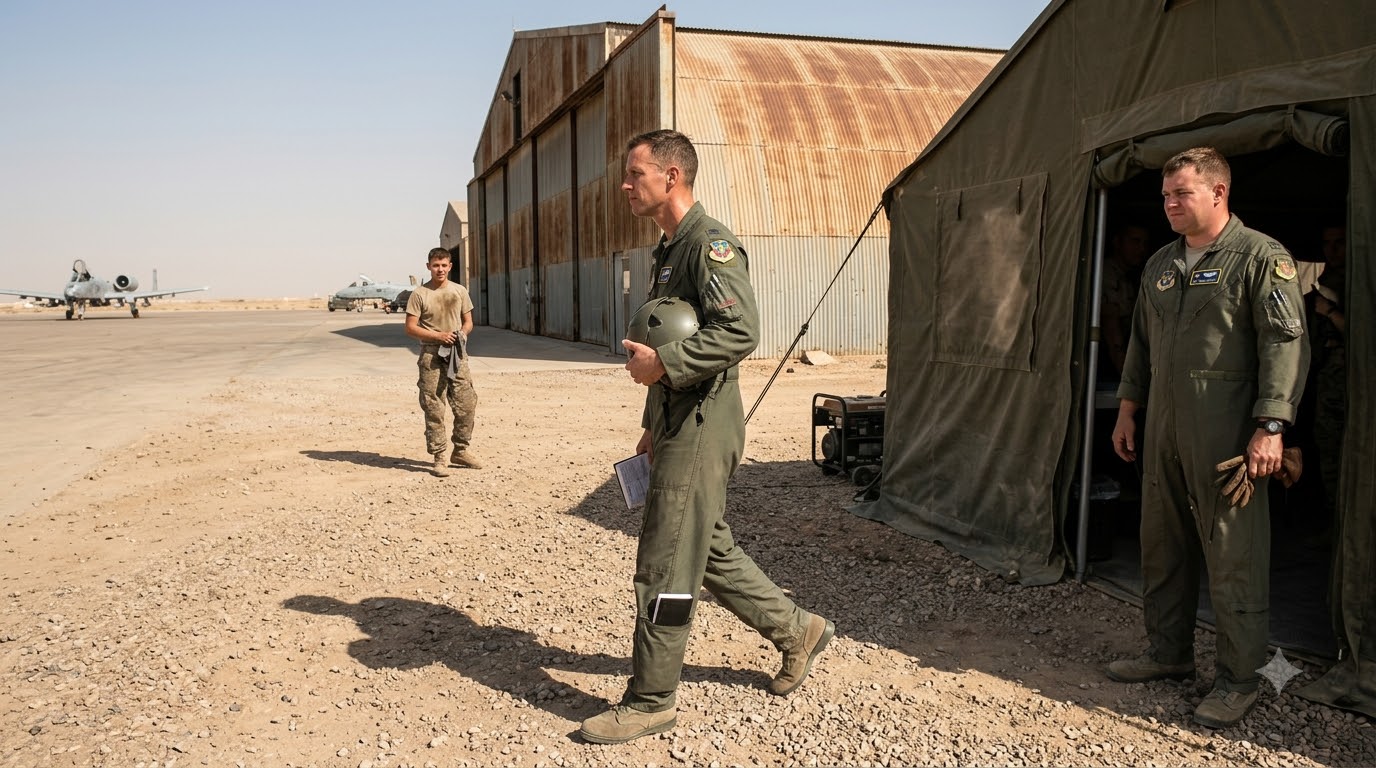
The desert sun hung low over the flight line, painting the rusted corrugated hangars in a dull, bruised orange. The air smelled of burnt JP-8 fuel, hot exhaust, and the dry, copper tang of kicked-up dust.
Inside the command tent, the air was thick with the stink of stale coffee and the hum of a straining generator. I stood two steps outside the flap, my helmet cradled against my ribs.
“Sound off with call signs,” a voice shouted from inside the canvas structure.
Names barked out in rapid succession, deep and booming, carrying the casual weight of men who owned every square foot of the tarmac. When my turn came, I stepped closer to the opening and gave my designator in two short, flat syllables.
A beat of silence followed, thick and heavy. Then came the snort from the back row.
“Say that again?” a captain named Ror called out, dragging the words through a grin you could hear in his tone. “Sounds like something a kid picked out from a video game.”
Laughter rippled through the tent, easy and contagious. I didn’t shift my weight on the crushed gravel. I didn’t reach up to adjust my collar or blink against the glare of the low sun.
“She sure that’s a real call sign or did she print it off a box of cereal?” another voice added, followed by the clatter of a folding chair shifting.
My fingers remained rested against the scarred plastic shell of my helmet. I didn’t answer them. I turned on my heel, the gravel grinding hard under the thick soles of my combat boots, and walked toward the flight line where my aircraft sat cooling in the heat.
The bird was a gray, low-slung chunk of metal, stripped of any decorative flair. No painted shark teeth on the nose, no lightning bolts along the vertical stabilizer, no personalized nicknames stitched near the canopy hinge. Just a faded serial number stenciled in matte black paint across the tail.
I unclipped my kneeboard and pulled the stubby pencil from its elastic loop. The wooden casing was dark from oil and sweat, worn smooth from years of pencil-striking coordinates onto thick paper. I laid the notebook flat against the metal ladder step and began my walk-around.
My thumb ran along the seam of the main gear door, feeling for loose rivets or stress hairline fractures in the aluminum skin. A young airman from the maintenance crew stepped out from beneath the fuselage, wiping grease from his knuckles with a rag that had seen better days.
He looked at me, then looked away, shuffling his feet in the dust. “She’s good to go, Captain,” he mumbled, his voice barely rising above the distant idle of a generator. “Checked the hydraulic lines twice.”
“Thank you,” I said, keeping my voice low and level. “I appreciate the extra pass.”
He nodded once, fast and awkward, before retreating toward the shadow of the tool cage. I didn’t call him back to chat, and I didn’t offer a joke to lighten the air. I simply opened the notebook, notched the time down in precise, squared-off numbers, and kept moving down the fuselage. Let them laugh in the tent. The sky didn’t care about jokes, and neither did the metal under my hands.
CHAPTER 2: THE UNHEARD NOTCH
The air inside the brief cell smelled like dry marker ink, sweat trapped in flight suit nylon, and stale coffee that had been boiling on the burner since 0400.
A portable projector hummed against a plastic folding table, casting a jittery topographic map across the hung bedsheet. Every few seconds, the diesel generator outside coughed, and the image flickered, sending green elevation contour lines dancing across the fabric.
“Primary ingress remains the southern corridor,” the mission planner said, his voice flat, monotonous, running on autopilot.
He tapped a red dot on the map—a narrow pass sandwiched between two jagged ridgelines.
“We keep the package low, use the terrain to mask the radar footprint, and punch through the notch at 1400 hours.”
Captain Ror sat two rows ahead of me, his broad shoulders blocking half the screen. He leaned back in his metal chair, arm draped over the empty seat beside him, tapping a silver Parker pen against his kneeboard.
I looked down at the handwritten wind data in my notebook. The raw thermal gradients from the morning meteorological sweep were mapped out in my precise, blocky print.
I raised my left hand, keeping my elbow resting on my knee. Not high. Just enough to break the line of sight.
“Yes, Captain Cole?” the planner asked, pausing his laser pointer on the notch.
“The valley wind channels straight through that notch between 1300 and 1500,” I said, my voice cutting through the hum of the projector. “The thermal buildup off the southern rock face creates a heavy downdraft right at the narrowest point.”
Ror didn’t turn around, but his tapping pen stopped.
“If we push through the notch on the inbound,” I continued, “the turbulence will force a hard lateral correction. You’ll lose speed, burn extra fuel, and toss the formation wide right into the line of sight from the eastern watchpost.”
A couple of pilots in the front row shifted in their seats. One turned his head slightly, squinting at my notebook, then looked back at the screen.
“Recommend setting the line two hundred feet higher over the western ridge,” I said. “Rode the uplift, then drop into the draw late.”
The planner looked at the map, then down at his printed kneeboard cards. He cleared his throat, a dry, rasping sound.
“Noted, Captain,” he said neutrally.
He didn’t adjust the red line on the sheet. His eyes swept right past me, searching the back of the room for someone else to speak.
“Moving on to the secondary bailout option—”
“Hold on,” Ror interrupted, his voice easily filling the small tent as he straightened up, slapping his palm down on his thigh.
He pointed his silver pen toward the bedsheet screen.
“Look at that notch again. If we run the flight straight through that bottleneck at 1400, the thermal pocket in the draw is going to toss us around like paper bags.”
The planner stopped mid-sentence, his pointer snapping back to the notch.
“We need to ride high over the western ridge,” Ror declared, glancing around the room with a wide, confident grin. “Catch the lift, then drop in late on the back side. Keeps the formation tight and saves us twenty gallons of jet fuel.”
The planner nodded rapidly, a light bulb practically turning on over his head. “That’s a sharp catch, Ror. Good tactical eye. Exactly the kind of dynamic adjustment we need for this run.”
A low murmur of agreement rippled through the folding chairs. Someone tapped their knuckles against a clip-board in approval.
I didn’t roll my eyes. I didn’t raise my hand a second time to claim the math.
I simply uncapped my pen, brought the tip down to the bottom of the page, and inked a quiet black checkmark next to the wind calculation. The numbers were right. That was the only part that would matter when the air started hitting the wings.
CHAPTER 3: THE SCAR AND THE NUMBERS
The heavy diesel engine of the tanker hummed beside me, vibrating through the thick soles of my boots. Dust swept off the runway in sheets, stinging the exposed skin of my neck.
Heavy footsteps crunched on the loose gravel behind me. Ror stopped two feet away, dropping his heavy leather flight gloves onto a wooden crate near my ladder.
“Still doing your own sumps, Cole?” he asked, throwing a shadow over my shoulder. “That’s what the airmen are for. You don’t see anyone else out here burning daylight on grease work.”
“It takes three minutes,” I said, unscrewing the jar to check the seal. “And it’s my tail on the line if there’s water in the cell.”
He scoffed, reaching down to grab his gloves. As he bent over, his eyes flicked down to the open flight suit pocket where my logbook sat propped against my black notebook.
The wind caught the thin paper, flipping the heavy leather cover wide open.
Ror froze mid-reach. His jaw went slightly slack, his eyes locking onto the column on the right side of the grid—the strict tally of operational night combat hours.
The entry numbers weren’t double digits. They spanned three long, dense columns, inked in dry, faded ballpoint.
It was more tactical time than Ror, the mission planner, and half the tent had combined.
His fingers hovered over his glove for a full second. He didn’t say a word. He didn’t make a joke. He just stared at the page, the smirk draining right out of his face until his mouth turned into a tight, pale line.
I reached down with my left hand and snapped the logbook shut, tucking it deep into my side pocket.
As my forearm extended, the worn cuff of my flight suit rode back an inch.
A crew chief standing three feet away by the nose wheel caught it—the pale, smooth track of a deep thermal burn scar running straight down my inner wrist, ending just short of the thumb joint. The kind of scar you only get when a cockpit canopy melts or a hot line ruptures in your face.
The crew chief’s eyes went wide. He looked up at my face, then back down at my wrist, swallowing hard.
I pulled my sleeve down, smoothing the green fabric over the skin until the mark was completely hidden again.
“Fuel’s clean,” I told the airman, handing him the jar.
Ror straightened up slowly, his leather gloves clutched tight in his right fist. He looked at me—really looked at me—for the first time since I’d arrived at the base.
The loud, easy confidence was gone, replaced by a cold, prickly silence that hung in the dust between us. He didn’t ask about the numbers. He didn’t ask about the wrist.
“We got a alert briefing at 1800,” Ror muttered, turning his eyes toward the ground. He stepped back without another word and walked toward the mess tent, his posture stiff and defensive.
The crew chief stayed by the wheel, holding the fuel jar like it was made of glass. He didn’t say anything either, but when I stepped up to the ladder, he held the frame steady for me without being asked.
CHAPTER 4: THE FLAW IN THE GRID
Overlapping voices bled through the main speaker, half-swallowed by squealing feedback and desert wind.
“Contact! Taking heavy fire—grid 7-6-5, 3-2-1, break 9-4-2!”
The JTAC operator pressed his headset tight against his left ear, his knuckles white against the dark plastic.
“Razer 1 is heading for grid 7-6-5,” Ror barked, stepping toward the board with a marker in hand. “They’re two minutes out. Let’s get the second bird moving.”
I looked down at my notebook. I looked up at the wall.
The grid numbers plotted on the projector sheet didn’t sit in a valley. They sat on a sheer, vertical cliff face three miles south of the patrol’s last known route.
“The northing and easting are transposed,” I said.
My voice didn’t rise. It didn’t waver. It simply sat in the middle of the room.
Ror turned around, his face flushed from the heat and sudden surge of tension.
“The grid is already verified by dispatch, Cole,” he snapped, waving his dry-erase marker at the board. “We don’t have time to re-check numbers while guys are taking rounds.”
“If you flip the last two digits,” I said, stepping up to the map edge and placing my pencil tip right on the dry riverbed east of the ridge, “it matches their reported movement along cover. The grid on your board puts a six-man patrol inside ninety feet of solid granite.”
The JTAC paused, his thumb hovering over his mic switch. He looked from his tablet screen to the map, his jaw tightening.
“We have two jets already burning fuel on the main vector,” Ror insisted, stepping into my personal space, his chest puffed out. “You’re asking us to divert close air support based on a hunch because you think you spotted a typo?”
“It isn’t a hunch,” I said, holding his gaze. “It’s simple math. Re-check the feed.”
Ror opened his mouth to shut it down, his face hardening into absolute refusal to lose ground in front of the room.
The JTAC didn’t wait for him. He slammed his palm onto the desk, keying his radio.
“Razer 2, divert to alternate grid. Check the riverbed east of the notch.”
Ror glared at me, his fingers digging into the plastic casing of his marker until it creaked.
CHAPTER 5: THE RIVERBED CHECKMATE
“Razer 2 is bingo fuel,” the voice static cut through my helmet headset. “They’re coming off station now.”
The dark sky outside the cockpit glass hummed with the distant rumble of the flight line. Wind whipped desert sand against the canopy, rattling the metal frame.
My fingers flipped the radio toggle on the throttle quadrant. “Control, this is Standby CAS. I am strapped and ready. Requesting clearance for immediate departure.”
In the operations tent, Ror’s voice hit the net, sharp and strained.
“Hold your position, Cole—”
“Razer 2 is off station and the ground unit is still under fire,” I interrupted, my voice dead level as I brought the engine spool up to idle. “If I don’t launch right now, nobody is over that riverbed for twenty minutes.”
Silence pressed over the radio frequency for two long seconds. Ror had the authority to hold me on the tarmac, to double down on his pride and keep the jet grounded just to avoid being proven wrong again.
“Launch standby,” the JTAC’s voice cut across Ror’s channel, override complete. “Grid seven-five-six, three-two-one. Pinned down in the draw.”
I released the brakes. The jet surged forward into the dark.
The climb through the cloud layer was rough, thermal pockets hammering the wings as I rode the western ridge line—the exact path I’d mapped out in my notebook two hours earlier. The air smoothed out the moment I cleared the crest.
“Contact visual,” I keyed the mic, dropping the nose toward the black shadow of the dry riverbed. “I see friendly strobe near the saddle. Suppressing enemy fire along the treeline now.”
I aligned the reticle, holding the stick steady as the g-forces pulled hard against my harness. Two quick, controlled bursts from the cannon shook the airframe, stitching a line of dust directly between the pinned patrol and the dark ridge.
“Good effects! Good effects!” the patrol leader’s voice broke through the static, ragged and breathless. “Enemy breaking contact! We’re moving!”
I orbited high overhead, banking wide to keep my eyes on the terrain until the last ground element cleared the draw and reached the extraction vehicle.
“All friendlies clear,” the JTAC reported over the net. “Standby CAS, key for home.”
I throttled back, leveling the wings against the dark horizon. No speech. No victory lap over the radio. Just a quiet click of the mic switch as I set the heading back to base.
CHAPTER 6: THE QUIET NORMAL
The turbine metal ticked softly as it shed heat into the cool night air. Across the tarmac, the lights inside the command tent cast long shadows across the gravel.
Footsteps approached from behind, heavy and unhurried. Ror stopped a few paces away, his flight helmet tucked awkwardly under his left arm. He didn’t have his silver Parker pen to tap, and he wasn’t smiling.
“Ground crew says the patrol made it to the extraction point,” Ror said, his voice stripped of all the booming theatrical weight it had carried during the briefing. “Every single one of them walked onto the transport.”
I didn’t turn around. I kept moving the rag over the glass, clearing a smudge near the forward seal.
“Good,” I said.
Ror shifted his weight, his boots crunching lightly against the stone. He looked down at the gravel, then up at the tail number stenciled on the fuselage.
“The mission planner is running a full audit on the map coordination files,” he continued, biting the inside of his cheek. “Turns out the digit swap wasn’t a radio mistake. It was logged wrong in the master database two weeks ago during the shift handoff. Nobody caught it.”
He paused, waiting for me to take the opening—to point out that I had caught it, or that his loud dismissal almost cost six lives in a dry riverbed.
I didn’t take the bait. I folded the rag in half, exposing a clean section of cotton.
“It’s fixed now,” I said plain and blunt. “That’s what matters.”
Ror stared at me for a long beat, his shoulder dropping slightly as his last ditch effort to spark a defensive argument dissolved into the quiet desert air. He didn’t apologize, and I didn’t demand one. He simply gave a short, stiff nod and turned back toward the mess tent, his shadow stretching thin across the dust.
The young airman from the maintenance crew stepped out from behind the gear door, carrying a grease bucket. He looked at Ror’s retreating back, then looked at me, a subtle shift in his eyes—no longer uncertain, no longer judging a cover by its lack of stitched patches.
“I’ll finish the canopy wipe down, Captain,” the airman said, reaching for the bottle of cleaner.
“It’s alright,” I replied, smoothing the fabric over the glass one last time. “I’m almost done.”
I uncapped the cleaner, set it securely inside the cockpit storage pouch, and pulled my worn black notebook from my side pocket. I brought the stubby pencil down to the bottom line, inked the final mission completion time in neat, blocky figures, and snapped the leather strap closed.
No speeches were made. No medals were handed out under the tarmac lights.
I picked up my plain gray helmet, stepped off the ladder, and walked toward the dark quarters, ready for tomorrow’s checklist.