The Mason Mug Stands Its Ground: A Quiet Woman’s Unyielding Battle Against Corporate Greed
CHAPTER 1: THE COLD LINE
Seven years of boiling dark roast teaches you exactly how much pressure a ceramic mug can take before it cracks in your palm.
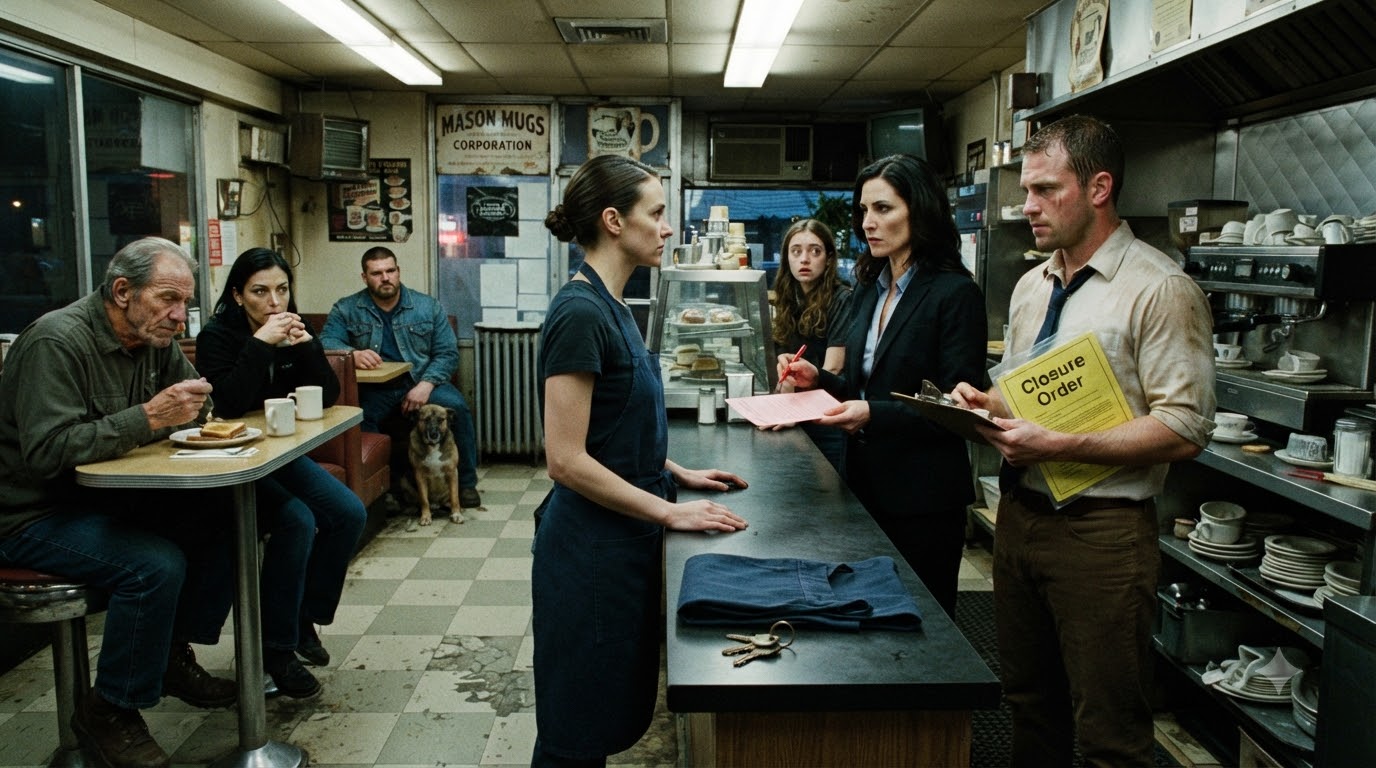
I kept my thumb pressed against the chipped handle of the heavy diner cup, feeling the familiar rough ceramic. Across the counter, Logan Prescott adjusted his navy blazer, his brass clip digging into a thick sheaf of white paper.
“The animal is an unauthorized biological hazard, Miss Donnelly,” Prescott said, his voice flat and thin like dry paper. “State code section 402 is explicit. No domesticated animals in active food-service zones.”
Over in the corner booth by the radiator, Shadow didn’t even growl. The lab-shepherd mix just rested his gray muzzle flatter against Ray’s worn leather work boots. Ray’s knuckles went chalk-white where his hands gripped his coffee cup, but the old Marine stayed locked in place.
“He’s a service animal,” I said, keeping my tone level enough to cut through the hum of the overhead fluorescent lights. “He stays with Ray.”
“He leaves, or I pull the sanitary permit before the morning rush finishes,” Prescott replied.
Before I could answer, the front door bell clattered. Deborah Lyall stepped through, sweeping her sharp eyes across the room like a hawk looking for dead grass. She didn’t look at the regulars sitting at the counter. She looked straight at the red service vest resting beside Ray’s table.
“You heard the inspector, Grace,” Deborah said, her voice dropping the artificial warmth she used on regional conference calls. “You’re out of compliance. Clear the animal out now, or you’re step-off line.”
“I won’t ask a veteran to walk out of this room,” I said softly, setting the ceramic mug down onto the stainless steel prep counter with a dull, heavy thump. “And I won’t turn his dog into the street.”
Deborah reached into her calfskin bag, pulled out a fresh red ballpoint pen, and unclipped a printed pink termination notice. “Then you’re done here, Grace. As of nine-fifteen this morning, your management contract with Mason Mugs Corporation is nullified. Untie the apron.”
The room went dead quiet. Ralph stopped chewing his toast. Louisa set her fork down without a sound.
I didn’t argue. I didn’t raise my voice. I reached behind my waist, undid the double knot in the dark blue canvas, and laid the folded apron flat on the counter.
“Lena,” I whispered, turning to the wide-eyed nineteen-year-old standing glued to the espresso machine. “Make sure Ray gets his second cup.”
I picked up my ring of brass keys, set them beside the apron, and walked straight out the side door into the cold Georgia air.
CHAPTER 2: THE SILENT EVICTION
My fingers rested on the cold brass door handle of my pickup, watching Deborah’s shadow move behind the frosted glass of the cafe window as she reached for the deadbolt.
She meant to turn the lock from the inside, shut the store down before the ten o’clock shift, and claim abandoned inventory. It was the standard corporate manual playbook for an immediate termination: clear the operator, lock the floor, seize the ledger.
I didn’t turn the ignition. I let go of the truck handle, turned on my heel, and walked straight back to the side entrance.
Inside, the air was thick with the smell of dark roast and the sharp, metallic tang of an electric grill cooling down. Deborah had her hand on the brass ring of my personal key ring, trying to pull it off the hook behind the register. Lena stood backed against the stainless steel ice bin, her hands wrapped tight in her white apron.
“Those keys belong to the franchisee of record, Deborah,” I said, my boots making a quiet, steady thud against the red tile floor. “The franchise lease is in my name, not the management company’s.”
Deborah didn’t flinch. She swung around, her high heels clicking sharp against the grout. “The management contract gives corporate power of attorney during a health code violation, Grace. You surrendered facility access the second you refused to clear that animal.”
Behind her, Logan Prescott was already sliding a printed yellow ‘Closure Order’ sign into a plastic sleeve. He didn’t look at me. His eyes were fixed on his clipboard, his thumb flicking the metal latch over and over with a dry, rhythmic click.
“The health code order isn’t signed by a magistrate,” Ray’s voice came from the back booth. It wasn’t loud, but it had the heavy, flat weight of a man used to reading military regulations off waterproof paper. He stood up slowly, his tall, lean frame blocking the light from the back window. “State law gives a facility forty-eight hours to remedy a non-critical sanitation note before you post a seal on the glass.”
“This is a corporate compliance override, sir,” Prescott said, his voice tightening a fraction. “You need to step outside. This is a private commercial action now.”
Ray didn’t step outside. He moved two paces to his left, positioning his broad shoulders right between Prescott and the main door. Behind him, Ralph got up from his stool, his old joints cracking soft in the quiet room. Then Louisa stood up, leaving three silver quarters sitting beside her half-empty ceramic cup.
They didn’t shout. They didn’t raise their hands or wave their arms. They just stepped into the narrow aisle between the tables, forming a solid, silent row of flannel shirts, faded work jackets, and calm eyes.
“You’re obstructing a state official,” Prescott stammered, his hand freezing on the yellow plastic sleeve. A small bead of sweat broke near his hairline, running down into the rim of his glasses. “This is a misdemeanor.”
“No one is touching you, son,” Ralph said, his voice raspy from fifty years of cheap tobacco and dust. “We’re just waiting for Grace to finish packing her personal property. That’s allowed under the lease, isn’t it, ma’am?”
Deborah looked at the four veterans standing in the aisle, then down at her leather tote bag resting on the counter. The side of the bag was pulled open just enough for me to see the corner of a crisp, white Manila folder. Printed along the tab in heavy red block letters was a stamp: Commercial Transfer – Urgent.
She pulled the tote bag higher up on her shoulder, covering the tab, but her fingers twitched where they held the leather strap.
“You have twenty minutes to take your personal belongings out of the back office, Grace,” Deborah said, her voice dropping down into a cold, clipped whisper. “After that, the locksmith arrives. If any corporate property leaves this building, I’m filing a police report before noon.”
“I don’t need twenty minutes,” I said. I walked past her, reached under the register counter, and grabbed my wooden recipe box and the heavy iron ring holding the back-door padlock keys. “And the locks on the front doors belong to the building owner. You change them without a court order, you’re breaking the lease.”
I looked Ray straight in the eye as I passed his table. “Keep your coffee warm, Ray. We aren’t finished here.”
CHAPTER 3: THE AUDIT TRAP
I stood on the damp gravel parking lot outside the cafe, holding the wooden recipe box under my arm, watching a black sedan with state government plates pull up beside Colonel Gaines’ staff car.
The sedan’s rear door opened, and two men in matching dark suits stepped out carrying aluminum clipboard cases. They didn’t glance at the autumn trees or the American flag snapping on the pole across the street. They marched straight toward the side entrance like a pair of repo men on a ticking clock.
Colonel Gaines stepped out from the shade of the building overhang, his polished boots crunching slow against the loose gravel. He held a thick, blue-backed document in his right hand.
“They’re filing an emergency structural audit, Grace,” Gaines said, his voice flat and low. “Deborah submitted a claim to the regional sanitation board twenty minutes ago. She’s claiming an unmitigated biological hazard ruined the kitchen subflooring.”
“The subfloors are solid pine,” I said, setting my recipe box on the hood of my pickup. “I replaced the seal three years ago myself after the grease trap leaked. She knows that.”
“She isn’t trying to win an argument,” Gaines replied, turning the blue-backed folder open. “She’s trying to build a paper trail before the city council meeting tomorrow morning. If the state marks the building condemned for commercial health risks, your lease option expires automatically.”
I reached into my pocket and pulled out my heavy diner mug—the one with the grease-pencil line on the handle—and tapped it gently against the truck hood. The dull, solid sound grounded my thoughts.
Inside the cafe, through the wide front window, I could see two junior corporate auditors pulling physical logbooks out of my filing cabinet. One was tossing old temperature sheets directly into a black plastic trash liner.
“They’re throwing away the health logs from last quarter,” I said, my jaw tightening as I took a step toward the glass.
“Let them,” Gaines said, catching my elbow with a firm, steady grip. “They think we’re going to fight them over health regulations. We’re not.”
He opened the folder and pointed to a small, handwritten marginal note near the bottom of page twelve. “Look at the landlord’s subordination clause. Deborah didn’t draft this. The parent company assigned the master lease to a third-party holding firm out of Atlanta six months ago.”
I leaned in, my eyes scanning the cramped legal print. Beneath the legal boilerplate was a corporate tax entity number that matched the stamp on the Manila folder I’d seen in Deborah’s tote bag.
“They aren’t trying to clean up the store,” I whispered, the realization clicking into place like a key turning in an rusty lock. “They’ve already sold the land.”
Gaines nodded once. “They’re staging a forced default so they can break the community zoning clause without paying the severance penalty to the town.”
Across the lot, the side door flew open. Deborah stood on the concrete landing, holding a clipboard in one hand and a freshly printed eviction notice in the other.
“Mr. Gaines,” she called out, her voice sharp enough to draw the attention of two passing pedestrians. “This lot is restricted to active corporate operations. If your vehicle isn’t cleared in five minutes, state transit will have it towed.”
I picked up my recipe box, held my chipped mug tight in my fist, and walked straight up the concrete steps toward her. “The lot is leased to the Mason Mug Operator’s Trust, Deborah. And as of right now, you’re standing on private property without a municipal warrant.”
CHAPTER 4: THE COUNTERSTRIKE
Deborah’s chin came up, her mascara smudged slightly at the outer corner from the damp wind. “A ninety-year-old survey map doesn’t override a state health directive, Grace.”
“It does when the survey defines the parcel boundary,” I said, unfolding the brittle paper against the flat surface of my recipe box. “My late husband’s grandfather didn’t just lease this corner to the franchise system in 1984. He deeded the concrete slab and five feet of perimeter drainage to the town as an agricultural easement.”
Prescott took a involuntary step back toward the door frame, his hand dropping from his clipboard. “The state holds primary jurisdiction over commercial food venues.”
“You have jurisdiction over the kitchen equipment inside,” Colonel Gaines said, stepping onto the bottom rung of the concrete stairs. He held up a sealed manila envelope stamped with the county clerk’s red wax seal. “You don’t have jurisdiction over the land under it. The town leased the easement rights directly to the Mason Veterans Association three weeks ago after your parent firm missed their Q2 property tax installment.”
Deborah’s fingers tightened on the strap of her leather tote until the leather creaked. “That tax payment was held in escrow pending corporate audit.”
“It wasn’t held in escrow,” I said, thumbing the faded grease-pencil line on my ceramic cup. “It was defaulted. You used the tax delinquency to trigger a rapid-sale clause with the commercial buyer out of Atlanta. That folder in your bag isn’t a health report. It’s a land transfer agreement.”
She pulled the tote bag flush against her coat, her lower lip setting into a hard, rigid line. “You’re out of your depth, Grace. The corporate legal team will have an injunction on this lot by four o’clock.”
“They can try,” Gaines said softly, pulling a thick black pen from his jacket pocket and handing it to me. “But county code dictates that any commercial transfer involving defaulted municipal easements requires unanimous approval from the local zoning board. And the board chairman happens to be sitting right inside.”
Through the glass door, Ralph set his empty coffee mug on the counter, stood up, and pulled a laminated county official badge out of his breast pocket, laying it flat against the window pane.
Deborah looked from the badge to the yellowed map, the color draining entirely from her face.
“Sign the easement transfer acknowledgement, Deborah,” I said, placing the county clerk’s document over my recipe box. “Or we file the tax fraud affidavit with the district attorney before the bank opens tomorrow.”
CHAPTER 5: THE CORPORATE CORNERING
Deborah’s corporate attorney smoothed the front of his tailored suit jacket, turning toward the bench with a thin, practiced smile.
“Your Honor, the municipality has no legal standing to freeze corporate assets during an active health compliance dispute,” he said, tapping a polished pen against his leather folder. “Miss Donnelly was a terminal contractor who breached basic sanitation protocols. Any claim regarding municipal easements is an administrative distraction.”
Judge Henderson adjusted his reading glasses, his eyes drifting over the top of his rim toward the defense table. “The court is looking at a certified copy of the 1984 municipal land grant, counselor. The easement runs directly under the foundation.”
Deborah stepped around her attorney, her cheeks flushed red beneath her heavy powder. “That easement was absorbed by the commercial franchise charter twenty years ago, Your Honor. Miss Donnelly is exploiting a filing error to block a legitimate land restructuring.”
I picked up the heavy brass paperweight sitting beside the podium, feeling its cold, solid weight in my palm before setting it down on top of my recipe box.
“It wasn’t a filing error, Deborah,” I said, my voice cutting through the quiet courtroom. “It was an intentional default. You held back the tax payments for eight months so your parent board could declare the location insolvent and sell the deed to an Atlanta investment group before the annual municipal audit.”
The attorney’s posture stiffened, his eyes darting toward Deborah’s tote bag sitting on the counsel table. “That is an unsubstantiated accusation against a national enterprise.”
“It’s substantiated by your own corporate transfer registry,” Colonel Gaines said, stepping forward from the gallery and laying a bound stack of financial disclosures on the clerk’s desk. “The Department of Defense verified the commercial lien filings two hours ago. The parent company carries forty million dollars in unhedged real estate debt. You aren’t closing bad stores—you’re liquidating active ones to satisfy short-term creditors.”
Deborah turned sharply on her heel, her eyes wide as she glared at the gallery. “This is an illegal interference with private commercial operations! You can’t use military influence to dictate municipal zoning!”
“We aren’t using military influence,” Ralph said from the second row, his voice rough and steady as he leaned on his wooden walking stick. “We’re using the county tax ledger. And as zoning chairman, I’m declaring the commercial transfer void for municipal fraud.”
Deborah grabbed her tote bag off the table, her hands shaking violently as the white Manila folder spilled onto the polished hardwood floor, revealing the red commercial transfer seal right in front of the judge’s bench.
“This hearing is adjourned,” Judge Henderson said, his wooden gavel striking the sound block with a sharp, echoing crack. “The clerk will issue an immediate injunction freezing the property title pending a full municipal audit.”
Deborah slammed her leather bag shut, glaring across the well at me with raw, unfiltered fury. “You haven’t won anything, Grace. You don’t have the capital to operate that building independently.”
“I don’t need corporate capital, Deborah,” I said, picking up my wooden recipe box. “I have the deed.”
CHAPTER 6: THE NEW GROUND
Standing behind the counter of the Mason Mug in the quiet morning light, holding an oily rag as I wipe down the brass edge of the espresso machine.
The brass shone under the warm tungsten overheads, stripped clean of the corporate logo that had hung above the register for six years. On the wall where the blue vinyl banner used to be, a plain wooden plaque now hung from a single brass nail. It held the original 1984 municipal land grant deed, stamped and certified in heavy black ink.
The front door glass rattled as Deborah Lyall stepped through the threshold, flanked by a court officer in a gray uniform. She didn’t carry her leather tote bag. Her hands held a single white envelope containing the formal corporate relinquishment order mandated by Judge Henderson’s ruling.
“The board signed the property release, Grace,” Deborah said, her voice dry and hollow, stripped of every ounce of its former authority. “The franchise contract is dissolved. You own the brick, the slab, and the equipment.”
She laid the envelope on the counter, her eyes briefly catching the chipped handle of my diner cup sitting beside the register.
“The corporate office is taking a nine-million-dollar write-down on the regional portfolio,” she added, her fingers hovering over the envelope for a second before she pulled them back into her coat pockets. “I hope this little victory was worth turning an entire district against you.”
“It wasn’t a victory, Deborah,” I said, picking up the envelope and sliding it into the wooden recipe box behind the counter. “It was just keeping what was already ours.”
She didn’t answer. She turned on her heel and walked out, the door bell giving a single, clear chime as the court officer pulled the door shut behind her.
Outside, the heavy rumble of diesel engines echoed off the brick storefronts down Main Street. Four olive-drab vehicles pulled up to the curb, parking in a quiet, orderly line along the sidewalk. Colonel Gaines stepped out of the lead vehicle, holding a fresh bag of dark roast beans from the base commissary, while Ray walked beside him with Shadow stepping calmly at his heel.
Lena walked out from the back kitchen carrying a tray of fresh ceramic mugs, setting them down on the counter with a clean, heavy clatter.
“First pot is ready, Grace,” Lena said, her voice steady and bright.
Ray pulled out his usual chair in the corner booth, the red service vest bright against his dark jacket. Shadow settled onto the floor beside his boots, resting his gray chin against the cool floor tiles with a long, contented sigh.
I reached for the coffee pot, filled the first cup to the brim, and set it down in front of Ray without saying a word.